 How to resolve AdBlock issue?
News

In science fiction, explorers can hop in futuristic spaceships and traverse half the galaxy in the blink of a plot hole.
However, this sidelines the navigational acrobatics required in order to guarantee real-life mission success.
In 2021, the feat of navigation that is the Lucy mission will launch.
To steer Lucy towards its targets doesn’t simply involve programming a map into a spacecraft and giving it gas money – it will fly by six asteroid targets, each in different orbits, over the course of 12 years.
Lucy’s destination is among Jupiter’s Trojan asteroids, clusters of rocky bodies almost as old as the Sun itself, and visiting these asteroids may help unlock the secrets of the early solar system.
Lucy will encounter a Main Belt asteroid in 2025, where it will conduct a practice run of its instruments before encountering the first four Trojan targets from 2027-2028.
In 2033, Lucy will end its mission with a study of a binary system of two Trojans orbiting each other.
Getting the spacecraft where it needs to go is a massive challenge. The solar system is in constant motion, and gravitational forces will pull on Lucy at all times, especially from the targets it aims to visit. Previous missions have flown by and even orbited multiple targets, but none so many as will Lucy.
Scientists and engineers involved with trajectory design have the responsibility of figuring out that route, under Flight Dynamics Team Leader Kevin Berry of NASA’s Goddard Space Flight Center in Greenbelt, Maryland.
One such engineer is Jacob Englander, the optimization technical lead for the Lucy mission. “There are two ways to navigate a mission like Lucy,” he said. “You can either burn an enormous amount of propellant and zig-zag your way around trying to find more targets, or you can look for an opportunity where they just all happen to line up perfectly.”
To visit these aligned targets, the majority of Lucy’s high-speed lane changes will come from gravity assists, with minimal use of fueled tweaks.
Though Lucy is programmed to throw itself out into a celestial alignment that will not occur for decades, it cannot be left to its own devices. Once the spacecraft begins to approach its asteroid targets, optical navigation is the next required step.
“OpNav,” as optical navigation technical lead Coralie Adam refers to it, is the usage of imagery from the on-board cameras to determine Lucy’s position relative to the target. This is a useful measurement used by the navigation team to tweak Lucy’s route and ensure it stays on the nominal flyby path. Adam works in Simi Valley, California, with KinetX, the company NASA selected to conduct Lucy’s deep space navigation.
By using the communications link from the spacecraft to Earth, Adam said, the Lucy team gets information about the spacecraft’s location, direction and velocity. The spacecraft takes pictures and sends them down to Earth, where Adam and other optical navigators use software to determine where the picture was taken based on the location of stars and the target.
The orbit determination team uses this data along with data from the communications link to solve for where the spacecraft is and where it is expected to be, relative to the Trojans. The team then designs a trajectory correction maneuver to get Lucy on track.
“The first maneuver is tiny,” said navigation technical lead Dale Stanbridge, who is also of KinetX. “But the second one is at 898 meters per second. That’s a characteristic of Lucy: very large delta V maneuvers.” Delta V refers to the change in speed during the maneuver.
Communicating all of these navigation commands with Lucy is a process all on its own.
“Lockheed Martin sends the commands to the spacecraft via the Deep Space Network,” Adam said. “What we do is we work with Lockheed and the Southwest Research Institute, where teams are sequencing the instruments and designing how the spacecraft is pointed, to make sure Lucy takes the pictures we want when we want them.”
“The maneuvers to correct Lucy’s trajectory are all going to be really critical because the spacecraft must encounter the Trojan at the intersection of the spacecraft and Trojan orbital planes,” Stanbridge said. “Changing the spacecraft orbital plane requires a lot of energy, so the maneuvers need to be executed at the optimal time to reach to next body while minimizing the fuel cost.”
While Lucy is conducting deep space maneuvers to correct its trajectory toward its targets, communications with the spacecraft are sometimes lost for brief periods. “Blackout periods can be up to 30 minutes for some of our bigger maneuvers,” Stanbridge said. “Other times you could lose communications would be when, for example, the Sun, comes between the Earth tracking station and the spacecraft, where the signal would be degraded by passing through the solar plasma.”
Losing contact isn’t disastrous, though. “We have high-fidelity predictions of the spacecraft trajectory which are easily good enough to resume tracking the spacecraft when the event causing a communication loss is over,” Stanbridge said.
What route will Lucy take once its mission is complete, nearly 15 years from now? “We’re just going to leave it out there,” Englander said. “We did an analysis to see if it passively hits anything, and looking far into the future, it doesn’t.”
The Lucy team has given the spacecraft a clear path for thousands of years, long after Lucy has rewritten the textbooks on our solar system’s history.
The Lucy mission is led by Principal Investigator Dr. Hal Levison from Southwest Research Institute in Boulder, Colorado. NASA Goddard in Greenbelt, Maryland, manages the mission. Lockheed Martin Space in Denver will build the spacecraft and conduct mission operations.
For more information about NASA's Lucy mission, visit www.nasa.gov/lucy.
Tamsyn Brann works for NASA’s Goddard Space Flight Center, Greenbelt, Md.
LAKEPORT, Calif. – The Board of Supervisors convened a brief special meeting on Friday morning in order to renew several proclamations for local emergencies.
The meeting, the board’s last of 2018, was attended by all but Supervisor Rob Brown and lasted about 10 minutes.
Interim County Health Officer Dr. Erin Gustafson went before the board to ask that the proclamation of a local health emergency by the Lake County health officer due to the Mendocino Complex fire be extended.
Gustafson said the special meeting to renew the proclamation was needed due to there being two holidays in a row – which meant the board wouldn’t normally have met within the time frame needed to approve extending the proclamation.
“The debris cleanup has not been quite completed and there is still soil testing that needs to be done,” she said, and therefore there may be exposure to hazardous substances that may lead to acute and chronic health risks.
“The local health emergency proclamation is necessary in order to protect the health and safety of the public,” Gustafson added.
The board approved renewing the proclamation 4-0.
Undersheriff Chris Macedo joined Gustafson to ask the board to continue the local emergency due to the Mendocino Complex because of the ongoing recovery efforts.
Gustafson reported that 177 sites that were burned during the complex have registered for debris removal and removal has been completed on 137 of those sites, with 69 sites completed and waiting for rebuilding. Another 20 sites registered for private cleanup, with seven of those sites ready for new structures.
She said the cleanup has been postponed due to hazardous road conditions. Once the weather improves the cleanup will restart.
The board unanimously approved continuing the local emergency before going on to also approve continuing emergencies for the June Pawnee fire, the October 2017 Sulphur fire, the August 2016 Clayton fire and the 2017 atmospheric river storm.
Email Elizabeth Larson atThis email address is being protected from spambots. You need JavaScript enabled to view it. . Follow her on Twitter, @ERLarson, or Lake County News, @LakeCoNews.
The meeting, the board’s last of 2018, was attended by all but Supervisor Rob Brown and lasted about 10 minutes.
Interim County Health Officer Dr. Erin Gustafson went before the board to ask that the proclamation of a local health emergency by the Lake County health officer due to the Mendocino Complex fire be extended.
Gustafson said the special meeting to renew the proclamation was needed due to there being two holidays in a row – which meant the board wouldn’t normally have met within the time frame needed to approve extending the proclamation.
“The debris cleanup has not been quite completed and there is still soil testing that needs to be done,” she said, and therefore there may be exposure to hazardous substances that may lead to acute and chronic health risks.
“The local health emergency proclamation is necessary in order to protect the health and safety of the public,” Gustafson added.
The board approved renewing the proclamation 4-0.
Undersheriff Chris Macedo joined Gustafson to ask the board to continue the local emergency due to the Mendocino Complex because of the ongoing recovery efforts.
Gustafson reported that 177 sites that were burned during the complex have registered for debris removal and removal has been completed on 137 of those sites, with 69 sites completed and waiting for rebuilding. Another 20 sites registered for private cleanup, with seven of those sites ready for new structures.
She said the cleanup has been postponed due to hazardous road conditions. Once the weather improves the cleanup will restart.
The board unanimously approved continuing the local emergency before going on to also approve continuing emergencies for the June Pawnee fire, the October 2017 Sulphur fire, the August 2016 Clayton fire and the 2017 atmospheric river storm.
Email Elizabeth Larson at

LAKE COUNTY, Calif. – “New Books for the New Year” will be on display through Jan. 5 at all branches of the Lake County Library.
The library invites the public to browse and check out more than 500 new books and DVDs that were purchased with $8,500 from the Friends of the Lake County Library.
The Friends of the Lake County Library raised the money through a capital campaign fundraiser earlier this year.
All branches of the Lake County Library will receive books and other items from this new collection. New items include children’s books, audio books, DVDs, large print fiction and non-fiction adults.
Jan Cook is a library technician at the Lakeport Library.
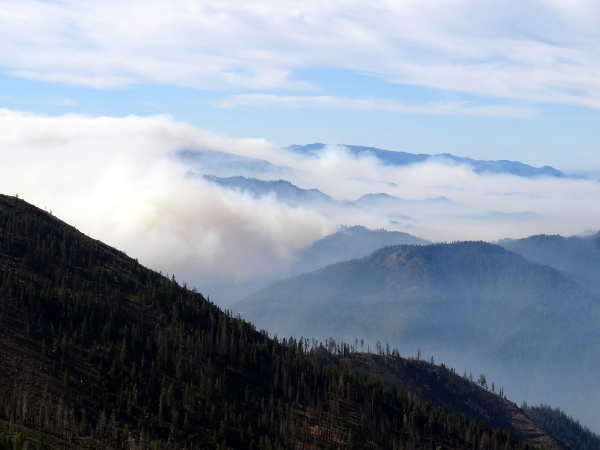
ALBANY, Calif. – Smoke generated by wildfires can cool river and stream water temperatures by reducing solar radiation and cooling air temperatures, according to a new study in California’s Klamath River Basin.
“Wildfire Smoke Cools Summer River and Stream Water Temperatures,” published recently online in the journal Water Resources Research, suggests that smoke-induced cooling has the potential to benefit aquatic species that require cool water to survive because high summer water temperatures are a major factor contributing to population declines, and wildfires are more likely to occur during the warmest and driest time of year.
Native American tribes and other entities measuring river water temperatures in the Klamath Basin had previously noticed drops in river temperatures during periods of heavy smoke, but this is the first study to demonstrate this phenomenon with rigorous statistical analysis of long-term datasets.
Co-author Frank Lake, a research ecologist with the U.S. Forest Service’s Pacific Southwest Research Station, says historical wildfire patterns are quite different than those of present day, yet likely share similarities in regards to this new concept.
“Prior to modern fire suppression, wildfires burned extensively throughout much of the Western United States, and smoke from these fires may have naturally cooled water temperatures during the summer when temperatures are hottest,” Lake said.
Bill Tripp, deputy director of the Karuk Tribe Department of Natural Resources, says this research provides a great example of how traditional ecological knowledge is used to focus a refined view under the western scientific framework and better understand the specific functions these processes provide.
“The ecological principles explored here are in no way new,” Tripp said. “In fact, there are cultural burning practices associated with Karuk World Renewal Ceremonies specifically for the purpose of ‘calling in the salmon’ that are directly connected to these factors.”
This study analyzed ground-based measurements of water, air and river hydrological data collected from stations throughout the lower Klamath River Basin in correlation with atmospheric smoke data derived from NASA satellite imagery.
In total, the data encompassed six years of extensive wildfire occurrence between 2006 and 2015.
LeRoy Cyr, a fish biologist with the Six Rivers National Forest, said this research is a result of a long-term collaborative effort.
“Over 20 years ago, we set out to answer some basic research questions when we began our collaborative stream temperature monitoring at numerous sites along the lower-mid Klamath River," Cyr said. "This pattern that emerged from the data is advancing our understanding of the cooling effects of smoke from wildland fires and the beneficial effects to salmonid survival during our critical summer period.”
Lake co-authored the study along with U.S. Fish and Wildlife Service biologist Aaron David and aquatic ecologist Eli Asarian of the consulting firm Riverbend Sciences. The project was funded in part by the Klamath Tribal Water Quality Consortium.
Read the full research article here.
Headquartered in Albany, California, the Pacific Southwest Research Station is part of the U.S. Forest Service’s Research and Development branch developing and communicating science needed to sustain forest ecosystems and other benefits to nature and society.
Pacific Southwest Research Station scientists are engaged in research across a network of 14 experimental watersheds, ranges and forests and eight research facilities in California, Hawaii and the U.S.–affiliated Pacific Islands.
Research is organized into five research units: conservation of biodiversity, ecosystem function and health, fire and fuels, urban ecosystems and social dynamics, as well as Pacific Islands forestry.
Estate planning requires an integrated approach to ensure that different parts work together.
The revocable living trust, will, power of attorney, and advance health care directive should be written in consideration of how they will function together in overlapping situations.
The living trust, the centerpiece of most estate planning, and the power of attorney have overlapping purposes: to provide for the settlor’s personal care (either at home or elsewhere); to assist the settlor to remain at home; to support the settlor’s dependents while the settlor is incapacitated; and, sometimes, to make lifetime gifts to qualify the settlor as eligible for needs based government benefits.
Whereas the trustee controls and uses the trust assets to further the trust’s purposes, the agent acts, within the scope of his or her delegated authority, to manage a person’s financial and legal affairs on a day to day basis.
The agent, for example, will sign personal care contracts and admission papers to admit a person into a skilled nursing facility. The trustee will then use assets to pay the expenses.
A power of attorney and an advance health care directive also overlap. The agent under the advance health care directive makes health care decisions that create expenses to be paid by the agent, who in turn may also seek financial support from the trustee.
The agent under the advance health care directive may also be the person who obtains a physician’s certificate of incapacity necessary to commence authority for another person to act, on behalf of the incapacitated person, either as the agent and/or as the trustee.
Often the same person acts in each of these various fiduciary capacities (i.e., as the legal representative). The same person avoids possible conflict when different individuals have separate legal authorities but are unable to cooperate together.
In second marriages, however, a married person may still want different individuals. They may nominate their spouse to be their agent under the power of attorney and advance health care directive – to manage the day to day operating financial, legal and health care decisions – but nominate an adult child as the trustee to control their trust assets where the bulk of their estate is contained.
When different persons are involved it is important to consider areas of possible disagreements amongst them and to address them.
Thus, the trust may require the trustee to pay for the settlor’s personal care and living expenses which the agent has approved.
Likewise, the trust may require that that the trustee transfer an incapacitated spouse’s ownership interests to their well spouse in order to qualify the incapacitated spouse to receive Medi-Cal for residential skilled nursing care.
A person’s will must take the person’s living trust into consideration. Often, but not always, the will leaves everything (or almost everything) to the trust for unified administration under the trust.
Moreover, married people through their wills often give their surviving spouse complete authority to change designated death beneficiaries to inherit the deceased spouse’s one-half community property interest in any life insurance on the surviving spouse’s life and retirement plans where the surviving spouse contributed marital earnings.
In addition, limitations on one’s estate planning options are to be found in various non-estate planning documents – such as premarital and post marital agreements, dissolution orders, and business succession agreements. These must also be considered when drafting the estate planning documents.
For example, a business succession plan that requires a buy-back of a deceased partner’s equity in a business will prevent a partner from gifting their share of the business in their estate plan.
Estate planning has many potential pitfalls, only some of which we have considered, for the unwary.
Hiring a qualified estate planning attorney to draft estate planning documents that integrate all relevant factors may avoid these pitfalls.
Dennis A. Fordham, attorney, is a State Bar-Certified Specialist in estate planning, probate and trust law. His office is at 870 S. Main St., Lakeport, Calif. He can be reached at

As the brilliant comet 46P/Wirtanen streaked across the sky, NASA telescopes caught it on camera from multiple angles.
NASA's Hubble Space Telescope photographed comet 46P/Wirtanen on Dec. 13, when the comet was 7.4 million miles (12 million kilometers) from Earth.
In the visible light image shown above, the comet's nucleus is hidden in the center of a fuzzy glow from the comet's coma.
The coma is a cloud of gas and dust that the comet has ejected during its pass through the inner solar system due to heating from the Sun.
To make this composite image, the color blue was applied to high-resolution grayscale exposures acquired from the spacecraft's WFC3 instrument.
The inner part of a comet's coma is normally not accessible from Earth. The close fly-by of comet 46P/Wirtanen allowed astronomers to study it in detail. They combined the unique capabilities of Hubble, NASA's Chandra X-ray Observatory, and the Neil Gehrels Swift Observatory to study how gases are released from the nucleus, what the comet's ices are composed of, and how gas in the coma is chemically altered by sunlight and solar radiation.
NASA's Stratospheric Observatory for Infrared Astronomy, SOFIA, took this image of the comet on Dec. 16 and 17 when the aircraft was flying at 40,000 feet.
Comets and asteroids may be the source of Earth's water. SOFIA is studying the chemical fingerprints of different types of hydrogen in the comet's water, which will help us learn about the origins and history of water in the solar system – including Earth's oceans.
The SOFIA image was taken with the telescope's visible light guide camera, using an orange filter to indicate the intensity of light relative to other objects. SOFIA's observations using infrared light to study the comet's water are now under analysis.
Comet 46P/Wirtanen made its closest approach to Earth on Dec. 16, when it passed just over 7 million miles (11 million kilometers) from our planet, about 30 times farther away than the moon.
Although its close approach is valuable for making science observations from Earth, and it is the brightest comet of 2018, 46P/Wirtanen is only barely visible to the unaided eye even where the sky is very dark. It is best viewed through binoculars or a telescope.
Backyard observers can currently find the comet near the constellation Taurus though with the challenge of added light from the Moon, but it will continue to be viewable in the weeks to come. Finder charts and other information are available at the Comet Wirtanen Observing Campaign Web site.
Comet 46P/Wirtanen orbits the Sun once every 5.4 years, much quicker than the 75-year orbit of the more famous Comet Halley. Most of its passes through the inner solar system are much farther from Earth, making this year's display particularly notable.
The Hubble Space Telescope is a project of international cooperation between NASA and ESA (European Space Agency). NASA's Goddard Space Flight Center in Greenbelt, Maryland, manages the telescope.
The Space Telescope Science Institute (STScI) in Baltimore, Maryland, conducts Hubble science operations. STScI is operated for NASA by the Association of Universities for Research in Astronomy, in Washington, D.C.
SOFIA is a Boeing 747SP jetliner modified to carry a 106-inch diameter telescope. It is a joint project of NASA and the German Aerospace Center, DLR. NASA's Ames Research Center in California's Silicon Valley manages the SOFIA program, science and mission operations in cooperation with the Universities Space Research Association headquartered in Columbia, Maryland, and the German SOFIA Institute (DSI) at the University of Stuttgart.
The aircraft is maintained and operated from NASA's Armstrong Flight Research Center Hangar 703, in Palmdale, California.