 How to resolve AdBlock issue?
News
The California Highway Patrol’s Clear Lake Area office reported that a victim of this phone scam came to the Kelseyville office on Wednesday, terrified that his girlfriend had been kidnapped for ransom.
A quick investigation by the CHP revealed that the man’s girlfriend was safe and not in danger.
He had been duped by the ongoing scam, which tries to scare unsuspecting people into believing harm will come to their loved ones if they don’t comply.
The CHP said the scam isn’t new, but it wants to raise awareness and educate community members so they will be less likely to be victimized.
The scam typically begins with a phone call saying your family member is being held captive. The caller may allege your daughter has been kidnapped and you hear a female screaming in the background.
Another variant of the fraud has a family member being held because he or she caused an auto accident, is injured and won't be allowed to go to the hospital until damages are paid.
Callers will typically provide the victim with specific instructions to ensure a safe return of the family member. You may be ordered to stay on the line until money is wired. The caller may claim not to have received the money and may demand more payment.
The Federal Bureau of Investigation says that to avoid becoming a victim of this extortion scheme, look for the following possible indicators:
– Incoming calls come from an outside area code, sometimes from Puerto Rico with area codes 787, 939 and 856.
– Calls do not come from the alleged kidnapped victim's phone.
– Callers go to great lengths to keep you on the phone.
– Callers prevent you from calling or locating the "kidnapped" victim.
– Ransom money is only accepted via wire transfer service. In today's incident, the caller requested cash.
If you receive a phone call from someone who demands payment of a ransom for a kidnapped victim, the following should be considered:
– Try to slow the situation down. Request to speak to the victim directly. Ask, "How do I know my loved one is OK?"
– If the callers don't let you speak to the victim, ask them to describe the victim or describe the vehicle the victim drives, if applicable.
– Listen carefully to the voice of the kidnapped victim if he/she speaks.
– Attempt to call, text, or contact the alleged victim via social media. Request that the victim call back from his or her cell phone.
– While staying on the line with the alleged kidnappers, try to call the alleged kidnap victim from another phone.
– To buy time, repeat the caller's request and tell them you are writing. down the demand, or tell the caller you need additional time to meet their demands.
– Don't directly challenge or argue with the caller. Keep your voice low and steady.
– Request the alleged kidnapper allow the victim to call you back from his/her cell phone.
– At the earliest opportunity, notify your local police department.
To help prevent this scam, check privacy settings on social media accounts and revisit the information you publicize on those accounts. The more information available to the public, the more information scammers can use to convince you into believing a scam is real.
This means planning not to drive impaired or distracted.
The CHP will observe the New Year with a maximum enforcement period from 6:01 p.m. on Friday, Dec. 28, to 11:59 p.m. on Tuesday, Jan. 1.
All available personnel will be on duty. The CHP will focus on impaired drivers, but officers will also watch for distracted driving, speeding, and seat belt violations, as well as motorists in need of assistance.
During last year’s New Year’s MEP, 40 people died in collisions on California roadways. Sadly, more than two-thirds of the vehicle occupants killed within CHP jurisdiction were not wearing a seat belt.
In addition, CHP officers made 936 arrests for driving under the influence during the New Year’s MEP, which was one day shorter than the upcoming holiday enforcement effort.
“Impairment of any kind while driving is illegal. Alcohol, cannabis, or legal or illegal drugs can all affect your driving,” CHP Commissioner Warren Stanley said. “Impaired driving is a serious crime that can lead to an arrest, serious injury or death.”
The AAA Foundation for Traffic Safety has found that an overwhelming majority of drivers – almost 95 percent – consider driving after drinking alcohol a serious threat to their personal safety.
However, 13.5 percent reported driving at least once in the past year when they thought their alcohol levels might have been close to or possibly over the legal limit.
More than 90 percent of drivers perceive people driving after using illegal drugs to be a serious threat to their personal safety.
Planning for a safe ride to and from festivities is easy and smart. Numerous alternatives to driving impaired are available, including ride-hailing services, public transportation, or calling a taxi or a sober friend or family member.
The Lake County Association of Realtors reported that the median sales prices for October and November pulled back from the September median sales price of $281,500.
The October median was $259,000 and the November median came in at $255,000.
On a year-to-year basis the 2018 October median was 3.6 percent greater than the October 2017 median, and the 2018 November median was up 2 percent over November of 2017.
In October 2018 there were 71 sales and in November the number of sales was 61. On a year-to-year comparison October sales were up 2.9 percent over the 2017 sales and November sales down by 21.8 percent.
“The trends that we are seeing in Lake County are similar to what economists are predicting for the 2019 California real estate market,” commented Mary Benson, LCAOR’s 2019 president. “If predictions hold true, we will see a slowing of price increases in 2019 along with a slight decrease in the number of sales.”
For the two months conventional loans accounted for 43 percent of the sales, with FHA loans being used in 20.5 percent of the transactions and VA loans being utilized in 3.1 percent of the deals. Cash was used to finance 23.9 percent of the sales.
On a statewide level the California Association of Realtors reported that existing, single-family home sales totaled 381,400 in November on a seasonally adjusted annualized rate, down 3.9 percent from October and down 13.4 percent from November 2017.
November’s median home price for the state was $554,760, down 3.0 percent from October but up 1.5 percent from November 2017.
The statewide Unsold Inventory Index was 3.7 months in November. In Lake County inventory levels were at 6.2 months.
Affordability continues to be a challenge in California with 26 percent of the state’s residents being able to purchase a median price home.
The California Association of Realtors reported 37 percent of Lake County residents could afford a median priced Lake County home and nationwide 53 percent of residents could afford the national median priced home.
The 30-year, fixed-mortgage interest rates averaged 4.87 percent in November, up from 3.92 percent in November 2017, according to Freddie Mac.
The five-year, adjustable mortgage interest rate edged higher in November to an average of 4.11 percent up from 3.24 percent in November 2017.
LAKE COUNTY NUMBERS AT A GLANCE
November 2018
Median price: $255,000
Units sold: 61
Median days to sell: 60
October 2018
Median price: $259,000
Units sold: 71
Median days to sell: 51
November 2017
Median price: $249,950
Units sold: 78
Median days to sell: 54
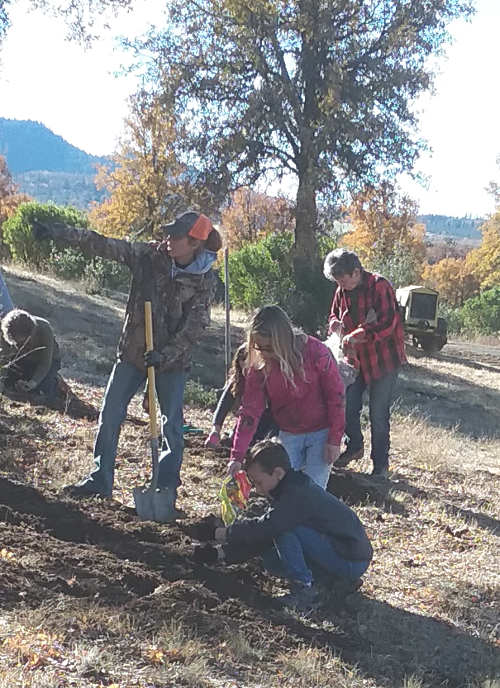
KELSEYVILLE, Calif. – On a beautiful Lake County November Sunday, two groups met at the Ely Stage Stop & Country Museum in Kelseyville to plant 1,840 daffodil bulbs on the hill between the farmhouse and the barn and around the vintage farm equipment.
Families of the Big Valley 4H Club and members of the Lake County Trowel and Trellis Club partnered together to plant the bulbs.
It was a wonderful project for all ages. It will be a spectacular scene of yellow on the property next spring.
With thanks to the many hands and men with rototillers, the project was completed in a record time of two hours.
This project was possible because of generous monetary donations and the energy of many people. The grateful Ely docents provided homemade cookies, hot cider and hot cocoa.
The Ely Stage Stop & Country Museum is located at 9921 Soda Bay Road between Kelseyville and Lower Lake.
The museum showcases a beautiful 1880s farmhouse with antiques, a handsome barn full of antique wagons, a San Francisco trolley car and a Blacksmith Shop that is being built. Throughout the property there are many beautiful antique tractors and wagons.
Admission is free; donations are gratefully accepted to fund the many ongoing projects.
The first Sunday of every month, there is a Fiddlers' Jam which keeps toes tapping.
The current visiting hours are Saturday and Sunday from 11 a.m. to 3 p.m.
Docents are available to tell the stories of old Lake County.
Marilyn Holdenried is a docent at the Ely Stage Stop & Country Museum.

Temporary License Plate Program (AB 516, Mullin)
This law requires licensed California dealers, of new and used vehicles to attach temporary paper license plates on a vehicle at the point of sale if that vehicle does not display license plates previously issued by the DMV. The temporary license plates contain a unique number and expiration date.
No vehicle can be driven off the dealership lot without the temporary license plate affixed to it unless it already has issued plates. The intent of this new law is to reduce the number of toll violators and improve safety for law enforcement.
Gender Identity Female, Male, or Nonbinary (SB 179, Atkins)
This law allows individuals applying for a California driver license or identification card to self-certify their chosen gender category of male, female or nonbinary in the application. Applicants who select nonbinary will receive a card with an “X” in the gender category.
Driving Under the Influence – Ignition Interlock Device (SB 1046, Hill)
From Jan. 1, 2019, to Jan. 1, 2026, this law mandates repeat offenders for driving under the influence (DUI) and first DUI offenders whose violations resulted in injury, to install an ignition interlock device (IID) for a period ranging from 12 to 48 months.
This law also allows those who receive a suspension under the Administrative Per Se law to obtain an IID-restricted driving privilege, and receive credit toward their required IID restriction period if they are later convicted of a DUI. These provisions apply to DUI violations that involve alcohol or the combined use of alcohol and drugs. They do not apply to drug-only violations.
Additionally, courts have the discretion to order a non-injury first DUI offender to install an IID for a period of up to 6 months. If the court does not order IID installation, a non-injury first offender may apply for a driver license for IID restrictions or restrictions that allow them to drive to, from, and during their employment and to and from a DUI treatment program for 12 months. Previously, an IID pilot program was only in effect in Alameda, Los Angeles, Sacramento and Tulare counties.
Smog Check Changes and New Abatement Fees (AB 1274, O’Donnell)
This law expands the existing smog check exemption to vehicles that are up to eight model years old, up from the current exemption of six model years.
During the additional two years of exemption, these vehicles will pay an annual $25 smog abatement fee. The current annual $20 smog abatement fee for the first six years of exemption remains unchanged.
Driving Privilege for Minors (AB 2685, Lackey)
This law repeals a juvenile court’s authority to suspend, restrict or delay the issuance of a driver license of a habitual truant or ward of the state for up to one year. The law clarifies that any suspensions or delays reported prior to January 1, 2019, remain in effect.
Motorized Scooters, (AB 2989, Flora)
Bicycle helmets are no longer required for riders of motorized scooters who are age 18 or older. It also amends existing law to prohibit a person from operating a motorized scooter on a highway with a speed limit greater than 25 miles per hour, unless it is within a Class IV bikeway as well as a Class II bikeway. However, it permits local authorities to authorize the operation of motorized scooters on roads with speed limits up to 35 miles per hour outside of a Class II or Class IV bikeway.
Unsafe, unsecured loads on vehicles (AB 1925, Choi)
This law requires the DMV to include at least one question addressing laws pertaining to driving with an unsafe, unsecured load in at least 20 percent of the knowledge tests administered to driver license applicants.
Unsecured loads, such as ladders, buckets and loose items in the back of pickup trucks, can be dangerous for motorists when they fall onto the road. Therefore, all vehicle loads must be covered or secured.
High-Occupancy Vehicle Lanes (AB 544, Bloom)
As previously announced, AB 544 created a new program to grant low-emission vehicles and transitional zero-emission vehicles access to high-occupancy vehicle (HOV) lanes for an approximate four-year period, regardless of the vehicle occupancy level. A green or white decal is valid until Jan. 1, 2019, and vehicles displaying these decals no longer have access to HOV lanes.
Vehicles that were issued a green or white decal between Jan. 1, 2017, and March 1, 2018, are eligible to apply for a red decal that grants them access to HOV lanes until Jan. 1, 2022. The DMV notified these customers of their eligibility by mail. The DMV will issue light purple decals in 2019 that will grant access to HOV lanes until Jan. 1, 2023.
Decals are available to applicants who have not applied for or received a consumer rebate pursuant to the Clean Vehicle Rebate Project, unless they meet annual income requirements. For more information or to apply, visit DMV’s Clean Air Vehicle Decals webpage. Visit the California Air Resources Board website for additional information on vehicle eligibility.
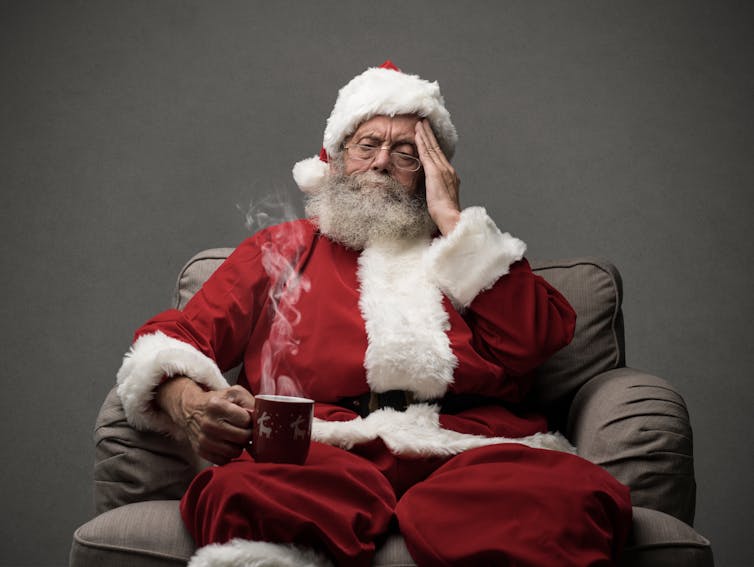 Even Santa can get worn out, which can lead to getting the blues. Stokkete
This time of the year brings a lot of changes to the usual day-to-day life of hundreds of millions of people: The weather is colder, trees are naked, snowy days become plentiful and friendly critters are less visible around the neighborhood. Especially in the Western Hemisphere, this time of the year is also linked to a lot of joyous celebrations and traditions. Most children and many adults have been excited for this time of the year to come for months, and they love the aura of celebrations, with their gatherings, gifts, cookies, emails and cards.
Alas, there are also millions who have to deal with darker emotions as the world literally darkens around them.
The holiday blues – that feeling of being in a lower or more anxious mood amid the significant change in our environment and the multitude of stressors that the holidays can bring – is a phenomenon that is yet to be researched thoroughly. However, as academic psychiatrists and neuroscience researchers, we have seen how several factors contribute to this experience.
Why feel blue in the red and green season?
There are many reasons to feel stressed or even downright overwhelmed during this time of year, in addition to the expectations set around us.
Memories of holidays past, either fond or sad, can create a sense of loss this time of year. We may find ourselves missing people who are no longer with us, and carrying on the same traditions without them can be a strong reminder of their absence.
The sense of burden or obligation, both socially or financially, can be significant. We can get caught up in the commercial aspects of gift giving, wanting to find that perfect item for family and friends. Many set their sights on special gifts, and we often can feel stretched thin trying to find a balance between making our loved ones happy and keeping our bank accounts from being in the black.

It’s also a time for gathering with those close to us, which can stir up many emotions, both good and bad. Some may find themselves away from or without close connections and end up isolated and withdrawn, further disconnected from others. On the other hand, many people find themselves feeling overwhelmed by the combination of potlucks and Secret Santas stacking up through multiple invitations, be it at school, work, or from friends and family – leaving us with the difficult position of not wanting to disappoint others, while not getting totally depleted by all the constant socializing.
Great expectations
People often feel disappointed when reality does not meet expectations. The larger the mismatch, the worse the negative feelings. One of us (Arash) often finds himself telling his patients: Childhood fairy tales can set an unrealistic bar in our minds about life. I wish we were told more real stories, taking the bad with the good, as we would get hurt less when faced with difficult realities of life, and learn how to especially appreciate our good fortunes.
These days viewers are showered with Christmas and New Year’s Eve movies, almost all of which sound and feel like fairy tales. People get married, get rich, fall in love or reconnect with their loved ones. Even unhappy events within “A Christmas Carol” conclude with a happy ending. These all, besides exposure to only happy moments and beautiful gifts (courtesy of Santa), dazzling Christmas decorations, and picturesque family scenes on social media, often set an unrealistic expectation for how this time of the year “should” feel.
Reality is different, though, and at its best is not always as colorful. There may be disagreements about hows, wheres, whats and whos of the celebration, and not all family members, friends and relatives get along well at parties. And as we feel lonelier, we may find ourselves spending more time immersed in TV and social media, leading to more exposure to unrealistic views of the holidays and feeling all the worse about our situation.
When is blue a red flag?
While many experience the more transient “holiday blues” this time of year, it is important not to miss more serious conditions like seasonal mood changes, which in its most severe case leads to clinical depression, including Seasonal Affective Disorder. SAD consists of episodes of depression or a worsening of existing depression during the late fall and early winter. The person may feel depressed and hopeless, or they may find it difficult to focus, sleep, or be motivated – they can even feel suicidal. As our emotions can color our thoughts and memories, a depressed person may remember more negative memories, have a more negative perception and interpretation of the events, and feel upset about the holidays.
In such cases, the sadness is “coincident” with the holidays and not caused solely by its circumstances. It is important to seek professional help with SAD, as we have effective treatments available, such as medications and light therapy.
What to do to minimize the blues?
-
Set realistic expectations: One readily available strategy is simply reframing the beliefs we have about what the holidays “should” be like. Not all parties will go perfectly. Some decorations may break, or kids may wake up grumpy or not be exhilarated by their gifts – but it doesn’t have to stop us from enjoying all the good moments.
-
Set firm boundaries: Too many invitations to social events? Too many financial demands? Set clear limits about what you are able and willing to do, whether that means declining some social events and setting your own limit on spending this year, focusing more on meaningful experiences over expense. This can be spending time with loved ones or getting creative with homemade gifts.
-
Feeling alone? There are many ways to steer clear of isolating this time of year. Reaching out to friends, volunteering at animal shelters, local charities or attending community meetups or religious events can be a great way to stay connected while also bringing happiness to ourselves and others.
-
Making new memories: Starting a new tradition, either solo or with loved ones, can help create fond new memories of the holidays, no longer overshadowed by the past.
-
Take care of yourself: It’s important to remember the value of self-care, including eating and drinking in moderation (as alcohol can worsen a depressed mood), exercising (even a short walk), and treating yourself this holiday season by doing something you enjoy.
While the holiday blues are most often temporary, it’s important to identify when things have crossed over into clinical depression, which is more severe and longer lasting. It also impairs daily functioning. For these symptoms it is often helpful and necessary to seek professional help. This can consist of counseling or use of medications, or both, to help treat symptoms.
Linda Saab, Assistant Professor of Psychiatry, Wayne State University and Arash Javanbakht, Assistant Professor of Psychiatry, Wayne State University
This article is republished from The Conversation under a Creative Commons license. Read the original article.