 How to resolve AdBlock issue?
News

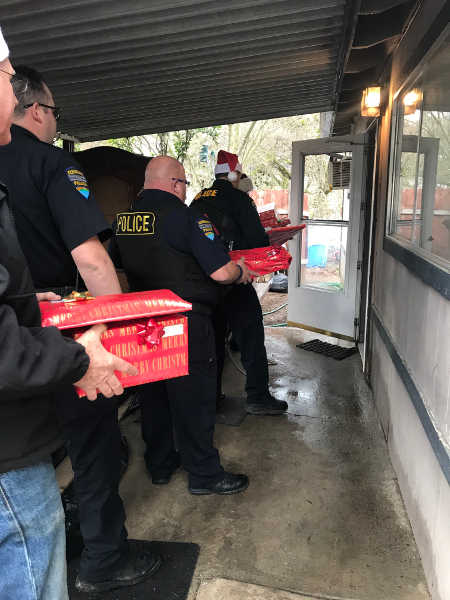
CLEARLAKE, Calif. – Clearlake Police officers helped spread Christmas cheer to local families this week.
On Christmas Eve members of the Clearlake Police Officers Association assisted Santa Claus in delivering toys to several families in the city of Clearlake.
This happy Christmas Day errand has been a tradition for the Clearlake Police Officers Association for more than 15 years, according to association President Ryan Peterson.
Throughout the year, members of the Police Officers Association meet a lot of families and children who are going through difficult times, Peterson said.
Through theses contacts, Peterson said families are chosen and contacted to see if they would like a visit from Santa Claus.

Police officers then collect handwritten letters from the children and deliver them to Santa Claus, Peterson said.
On Christmas Eve, Santa Claus was given a personal escort to deliver toys to the children, which this year resulted in 20 children receiving a visit from Santa Claus, according to Peterson.
“This program means a lot to the Clearlake Police Officers Association and has been successful because of community support,” he said.
Peterson added, “The Clearlake Police Officers Association would like to wish the community we serve a Merry Christmas and a safe holiday season.”
Gov. Edmund G. Brown Jr. announced on Monday that he has granted 143 pardons and 131 commutations.
The individuals who were granted clemency had been convicted of crimes ranging from drug possession to murder.
There were no Lake County cases included, but clemency was granted in cases from the neighboring counties of Glenn, Sonoma and Yolo.
Individuals who have been convicted of a crime in California may apply to the governor for a pardon.
Those granted pardons all completed their prison sentences years ago and the majority were convicted of drug-related or other nonviolent crimes.
Pardons are not granted unless they are earned.
A gubernatorial pardon may be granted to individuals who have demonstrated exemplary behavior and have lived productive and law-abiding lives following their conviction.
The process includes eligible individuals obtaining a Certificate of Rehabilitation, which is an order from a superior court declaring that a person convicted of a crime is now rehabilitated.
When a pardon is granted, the California Department of Justice and the Federal Bureau of Investigation are notified so that they may update their records on the applicant.
The pardon is filed with the Secretary of State’s Office and the Legislature, and it is a public record.
Individuals currently serving a sentence for a conviction by the California courts can petition to have their sentence reduced by applying for a commutation.
In the majority of these commutations, the individuals have been granted the opportunity to make their case before the Board of Parole Hearings, which will determine whether they are ready to be paroled.
Additionally, Gov. Brown on Monday issued an order regarding the pending application for executive clemency submitted by Kevin Cooper, which directs limited retesting of certain physical evidence in the case and appoints a retired judge as a special master to oversee this testing, its scope and protocols.
This order comes after the administration requested additional information from Mr. Cooper’s legal counsel and the San Bernardino County District Attorney’s Office earlier this year and thoroughly reviewed the record.
Copies of the gubernatorial pardons and commutations can be found here. Additional information on pardons and commutations can be found here.
The individuals who were granted clemency had been convicted of crimes ranging from drug possession to murder.
There were no Lake County cases included, but clemency was granted in cases from the neighboring counties of Glenn, Sonoma and Yolo.
Individuals who have been convicted of a crime in California may apply to the governor for a pardon.
Those granted pardons all completed their prison sentences years ago and the majority were convicted of drug-related or other nonviolent crimes.
Pardons are not granted unless they are earned.
A gubernatorial pardon may be granted to individuals who have demonstrated exemplary behavior and have lived productive and law-abiding lives following their conviction.
The process includes eligible individuals obtaining a Certificate of Rehabilitation, which is an order from a superior court declaring that a person convicted of a crime is now rehabilitated.
When a pardon is granted, the California Department of Justice and the Federal Bureau of Investigation are notified so that they may update their records on the applicant.
The pardon is filed with the Secretary of State’s Office and the Legislature, and it is a public record.
Individuals currently serving a sentence for a conviction by the California courts can petition to have their sentence reduced by applying for a commutation.
In the majority of these commutations, the individuals have been granted the opportunity to make their case before the Board of Parole Hearings, which will determine whether they are ready to be paroled.
Additionally, Gov. Brown on Monday issued an order regarding the pending application for executive clemency submitted by Kevin Cooper, which directs limited retesting of certain physical evidence in the case and appoints a retired judge as a special master to oversee this testing, its scope and protocols.
This order comes after the administration requested additional information from Mr. Cooper’s legal counsel and the San Bernardino County District Attorney’s Office earlier this year and thoroughly reviewed the record.
Copies of the gubernatorial pardons and commutations can be found here. Additional information on pardons and commutations can be found here.
Precisely on time on Dec. 24, 1968, Mission Control lost contact with Apollo 8 and its crew of Frank Borman, James A. Lovell and William A. Anders.
And everyone at NASA and onboard Apollo 8 was happy about that.
It meant that the spacecraft and crew were on a precise trajectory to swing behind the moon, and if all went well, to fire the Service Module’s Service Propulsion System, or SPS, engine to slow their velocity just enough to allow the moon’s gravitational field to capture them.
With a successful lunar orbit insertion burn, they would become the first crewed spacecraft in lunar orbit, and Mission Control would regain the signal after 32 minutes and 37 seconds. If it didn’t fire at all, they would regain the signal in 22 minutes and it meant Apollo 8 was heading back to Earth. And of course, a variety of engine malfunctions could result in different signal reacquisition times.
While NASA and the world awaited to hear from Apollo 8, Borman, Lovell and Anders busied themselves with preparing for the engine burn. Just a few minutes before ignition, the crew got its first glimpse of the moon.
During the 66-hour coast to the moon, the spacecraft was oriented with the SPS engine facing in the direction of travel, so the windows were pointed toward the Earth.
Now, about 70 miles above its surface, the moon finally entered into their field of view and the Apollo 8 crewmembers became the first humans to directly see the farside.
Exactly on schedule, the SPS engine lit up and burned for just over four minutes, placing Apollo 8 into an elliptical 70-by-195-mile orbit around the moon.
Just as expected, Mission Control began receiving telemetry from Apollo 8 as it came out from behind the moon, followed by Lovell’s simple call, “Houston, Apollo 8. Burn complete.”
From Mission Control, Capcom Carr replied, “Apollo 8, this is Houston. Good to hear your voice.”
As they passed over the Sea of Fertility, Lovell provided this commentary: “The Moon is essentially grey, no color; looks like plaster of Paris or sort of a grayish beach sand. We can see quite a bit of detail. … The craters are all rounded off. There's quite a few of them, some of them are newer.”
They also flew over the two most easterly of the five potential sites for the first moon landing, providing verbal narration and taking photographs.
For the next 20 hours, Apollo 8 remained in orbit around the moon, each revolution taking about two hours, of which 45 minutes was spent out of radio contact with Earth while the spacecraft flew behind the Moon.
The astronauts began their second revolution with a 12-minute TV broadcast showing the moon as it appeared to them through the spacecraft window.
At the end of the second revolution, once again behind the moon, the crew performed the second lunar orbit insertion burn using the SPS engine and lasting less than 10 seconds to circularize the orbit at 70 miles.
The trio conducted extensive photography of the lunar surface, mostly of the farside given it had more sunlight, but also of proposed landing sites on the nearside.
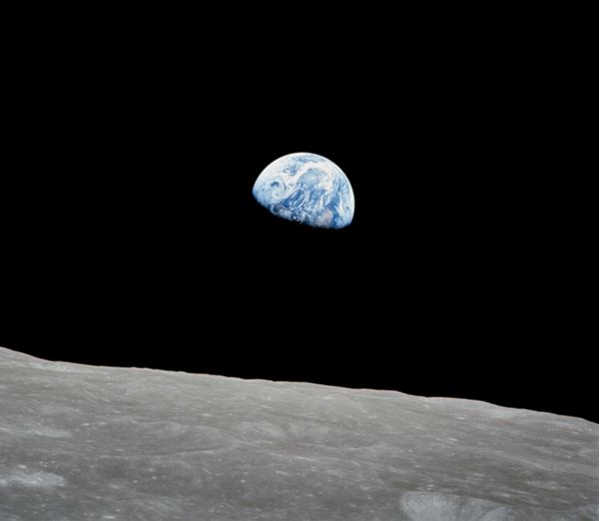
At the beginning of the fourth revolution, as they were about to round the backside of the moon, the astronauts caught sight of the Earth appearing above the lunar limb.
Anders snapped some of the most iconic photos of the Apollo program, first in black and white and then the more famous color Earthrise images.
Borman, Lovell, and Anders began their ninth revolution with a TV broadcast, first showing viewers the Earth and then pointing the camera down to the moon’s surface.
As the spacecraft flew on, they described the terrain they were seeing, including the possible landing site for the first lunar landing in the Sea of Tranquility.
Each crewmember provided the viewers with his personal impression of the moon and the mission.
They closed out the 27-minute broadcast by taking turns reading the first 10 verses from the Book of Genesis, and then signing off by wishing everyone on Earth a Merry Christmas.
It is estimated that one billion people in 64 countries around the world were tuned in to the Christmas Eve broadcast.
At the end of their 10th revolution, at 89 hours and 19 minutes into the flight and once again out of communication with Earth, the Apollo 8 astronauts fired the spacecraft’s SPS engine for the Trans Earth Injection burn.
While Mission Control waited for confirmation of the burn, the crew had its last look at the moon’s farside.
Then, precisely on schedule, contact was re-established indicating a successful three-minute and 23-second burn. Apollo 8 was heading home to Earth.
Lovell radioed to Houston, “Please be informed there is a Santa Claus.”
It was now Christmas Day in Houston.
Apollo 8’s Christmas Eve TV broadcast can be viewed below.
Currently, half of the world's measured precipitation that falls in a year falls in just 12 days, according to a new analysis of data collected at weather stations across the globe.
By century's end, climate models project that this lopsided distribution of rain and snow is likely to become even more skewed, with half of annual precipitation falling in 11 days.
These results are published in Geophysical Research Letters, a journal of the American Geophysical Union.
Previous studies have shown that we can expect both an increase in extreme weather events and a smaller increase in average annual precipitation in the future as the climate warms, but researchers are still exploring the relationship between those two trends.
"This study shows how those two pieces fit together," said Angeline Pendergrass, a scientist at the National Center for Atmospheric Research, or NCAR, and the lead author of the new study. "What we found is that the expected increases happen when it's already the wettest — the rainiest days get rainier."
The findings, which suggest that flooding and the damage associated with it could also increase, have implications for water managers, urban planners, and emergency responders. The research results are also a concern for agriculture, which is more productive when rainfall is spread more evenly over the growing season.
The research was supported by the U.S. Department of Energy and the National Science Foundation, which is NCAR's sponsor.
What it means to be extreme
Scientists who study extreme precipitation — and how such events may change in the future — have used a variety of metrics to define what qualifies as "extreme." Pendergrass noticed that in some cases the definitions were so broad that extreme precipitation events actually included the bulk of all precipitation.
In those instances, "extreme precipitation" and "average precipitation" became essentially the same thing, making it difficult for scientists to understand from existing studies how the two would change independently as the climate warms.
Other research teams have also been grappling with this problem. For example, a recent paper tried to quantify the unevenness of precipitation by adapting the Gini coefficient, a statistical tool often used to quantify income inequality, to instead look at the distribution of rainfall.
Pendergrass wanted to find something even simpler and more intuitive that could be easily understood by both the public and other scientists. In the end, she chose to quantify the number of days it would take for half of a year's precipitation to fall. The results surprised her.
"I would have guessed the number would be larger — perhaps a month," she said. "But when we looked at the median, or midpoint, from all the available observation stations, the number was just 12 days."
For the analysis, Pendergrass worked with Reto Knutti, of the Institute for Atmospheric and Climate Science in Zurich, Switzerland. They used data from 185 ground stations for the 16 years from 1999 through 2014, a period when measurements could be validated against data from the Tropical Rainfall Measuring Mission (TRMM) satellite. While the stations were dispersed globally, the majority were in North America, Eurasia, and Australia.
To look forward, the scientists used simulations from 36 of the world's leading climate models that had data for daily precipitation. Then they pinpointed what the climate model projections for the last 16 years of this century would translate to for the individual observation stations.
They found that total annual precipitation at the observation stations increased slightly in the model runs, but the additional precipitation did not fall evenly. Instead, half of the extra rain and snow fell over just six days.
This contributed to total precipitation also falling more unevenly than it does today, with half of a year's total precipitation falling in just 11 days by 2100, compared to 12 in the current climate.
"While climate models generally project just a small increase in rain in general, we find this increase comes as a handful of events with much more rain and, therefore, could result in more negative impacts, including flooding," Pendergrass said. "We need to take this into account when we think about how to prepare for the future."
The University Corporation for Atmospheric Research manages the National Center for Atmospheric Research under sponsorship by the National Science Foundation. Any opinions, findings and conclusions or recommendations expressed in this material do not necessarily reflect the views of the National Science Foundation.
By century's end, climate models project that this lopsided distribution of rain and snow is likely to become even more skewed, with half of annual precipitation falling in 11 days.
These results are published in Geophysical Research Letters, a journal of the American Geophysical Union.
Previous studies have shown that we can expect both an increase in extreme weather events and a smaller increase in average annual precipitation in the future as the climate warms, but researchers are still exploring the relationship between those two trends.
"This study shows how those two pieces fit together," said Angeline Pendergrass, a scientist at the National Center for Atmospheric Research, or NCAR, and the lead author of the new study. "What we found is that the expected increases happen when it's already the wettest — the rainiest days get rainier."
The findings, which suggest that flooding and the damage associated with it could also increase, have implications for water managers, urban planners, and emergency responders. The research results are also a concern for agriculture, which is more productive when rainfall is spread more evenly over the growing season.
The research was supported by the U.S. Department of Energy and the National Science Foundation, which is NCAR's sponsor.
What it means to be extreme
Scientists who study extreme precipitation — and how such events may change in the future — have used a variety of metrics to define what qualifies as "extreme." Pendergrass noticed that in some cases the definitions were so broad that extreme precipitation events actually included the bulk of all precipitation.
In those instances, "extreme precipitation" and "average precipitation" became essentially the same thing, making it difficult for scientists to understand from existing studies how the two would change independently as the climate warms.
Other research teams have also been grappling with this problem. For example, a recent paper tried to quantify the unevenness of precipitation by adapting the Gini coefficient, a statistical tool often used to quantify income inequality, to instead look at the distribution of rainfall.
Pendergrass wanted to find something even simpler and more intuitive that could be easily understood by both the public and other scientists. In the end, she chose to quantify the number of days it would take for half of a year's precipitation to fall. The results surprised her.
"I would have guessed the number would be larger — perhaps a month," she said. "But when we looked at the median, or midpoint, from all the available observation stations, the number was just 12 days."
For the analysis, Pendergrass worked with Reto Knutti, of the Institute for Atmospheric and Climate Science in Zurich, Switzerland. They used data from 185 ground stations for the 16 years from 1999 through 2014, a period when measurements could be validated against data from the Tropical Rainfall Measuring Mission (TRMM) satellite. While the stations were dispersed globally, the majority were in North America, Eurasia, and Australia.
To look forward, the scientists used simulations from 36 of the world's leading climate models that had data for daily precipitation. Then they pinpointed what the climate model projections for the last 16 years of this century would translate to for the individual observation stations.
They found that total annual precipitation at the observation stations increased slightly in the model runs, but the additional precipitation did not fall evenly. Instead, half of the extra rain and snow fell over just six days.
This contributed to total precipitation also falling more unevenly than it does today, with half of a year's total precipitation falling in just 11 days by 2100, compared to 12 in the current climate.
"While climate models generally project just a small increase in rain in general, we find this increase comes as a handful of events with much more rain and, therefore, could result in more negative impacts, including flooding," Pendergrass said. "We need to take this into account when we think about how to prepare for the future."
The University Corporation for Atmospheric Research manages the National Center for Atmospheric Research under sponsorship by the National Science Foundation. Any opinions, findings and conclusions or recommendations expressed in this material do not necessarily reflect the views of the National Science Foundation.
CLEARLAKE, Calif. – A fire on Sunday night destroyed a Clearlake home.
The fire in the 2900 block of 10th Street initially was reported shortly after 7 p.m., according to emergency radio traffic.
Lake County Fire Chief Willie Sapeta told Lake County News that the home was fully involved when it was reported, and that’s what firefighters found when they arrived.
Radio reports indicated the fire was knocked down before 7:30 p.m., but that it required at least two hours of overhaul by crews on scene.
Sapeta said the home – a newer modular – was a complete loss.
In addition to Lake County Fire, Cal fire responded, based on radio reports.
Altogether, four engines, a water tender, a medic unit and Sapeta responded to the fire, he said.
Sapeta said Sunday night that the fire’s cause was under investigation.
Earlier in the day, Lake County Fire Protection District and Cal Fire firefighters also responded to a report of a fire in a home in the 16000 block of 33rd Avenue. When they arrived, they found smoke coming from the roof.
Sapeta said that home wasn’t destroyed, with the fire’s damage limited to a room and its contents.
He said that fire’s cause also was being investigated.
Email Elizabeth Larson atThis email address is being protected from spambots. You need JavaScript enabled to view it. . Follow her on Twitter, @ERLarson, or Lake County News, @LakeCoNews.
The fire in the 2900 block of 10th Street initially was reported shortly after 7 p.m., according to emergency radio traffic.
Lake County Fire Chief Willie Sapeta told Lake County News that the home was fully involved when it was reported, and that’s what firefighters found when they arrived.
Radio reports indicated the fire was knocked down before 7:30 p.m., but that it required at least two hours of overhaul by crews on scene.
Sapeta said the home – a newer modular – was a complete loss.
In addition to Lake County Fire, Cal fire responded, based on radio reports.
Altogether, four engines, a water tender, a medic unit and Sapeta responded to the fire, he said.
Sapeta said Sunday night that the fire’s cause was under investigation.
Earlier in the day, Lake County Fire Protection District and Cal Fire firefighters also responded to a report of a fire in a home in the 16000 block of 33rd Avenue. When they arrived, they found smoke coming from the roof.
Sapeta said that home wasn’t destroyed, with the fire’s damage limited to a room and its contents.
He said that fire’s cause also was being investigated.
Email Elizabeth Larson at
LAKEPORT, Calif. – The Board of Supervisors will hold a special meeting this week – its last gathering of the year – to handle several items related to local emergencies.
The board will meet beginning at 10 a.m. Friday, Dec. 28, in the board chambers on the first floor of the Lake County Courthouse, 255 N. Forbes St., Lakeport.
The meeting can be watched live on Channel 8 and online at https://countyoflake.legistar.com/Calendar.aspx. Accompanying board documents, the agenda and archived board meeting videos also are available at that link.
The short meeting agenda includes continuing proclamations of local emergencies for the Mendocino Complex, Pawnee fire, Sulphur fire, Clayton fire and the atmospheric river storm.
The full agenda follows.
TIMED ITEMS
4.1, 10 a.m.: Consideration of continuing a proclamation of a local health emergency by the Lake County health officer due to the Mendocino Complex fire.
4.2, 10:01 a.m.: (a) Consideration of continuing a proclamation of a local emergency due to the Mendocino Complex fire incident (River and Ranch fires); and (b) update on the Mendocino Complex - River and Ranch fires recovery.
4.3, 10:02 a.m.: Consideration of continuing a proclamation of a local emergency due to the Pawnee fire incident.
4.4, 10:03 a.m.: Consideration of continuing a proclamation of a local emergency due to the Sulphur fire incident.
4.5, 10:04 a.m.: Consideration of continuing a proclamation of a local emergency due to Clayton fire.
4.6, 10:05 a.m.: Consideration of continuing a proclamation of a local emergency due to the atmospheric river storm.
Email Elizabeth Larson atThis email address is being protected from spambots. You need JavaScript enabled to view it. . Follow her on Twitter, @ERLarson, or Lake County News, @LakeCoNews.
The board will meet beginning at 10 a.m. Friday, Dec. 28, in the board chambers on the first floor of the Lake County Courthouse, 255 N. Forbes St., Lakeport.
The meeting can be watched live on Channel 8 and online at https://countyoflake.legistar.com/Calendar.aspx. Accompanying board documents, the agenda and archived board meeting videos also are available at that link.
The short meeting agenda includes continuing proclamations of local emergencies for the Mendocino Complex, Pawnee fire, Sulphur fire, Clayton fire and the atmospheric river storm.
The full agenda follows.
TIMED ITEMS
4.1, 10 a.m.: Consideration of continuing a proclamation of a local health emergency by the Lake County health officer due to the Mendocino Complex fire.
4.2, 10:01 a.m.: (a) Consideration of continuing a proclamation of a local emergency due to the Mendocino Complex fire incident (River and Ranch fires); and (b) update on the Mendocino Complex - River and Ranch fires recovery.
4.3, 10:02 a.m.: Consideration of continuing a proclamation of a local emergency due to the Pawnee fire incident.
4.4, 10:03 a.m.: Consideration of continuing a proclamation of a local emergency due to the Sulphur fire incident.
4.5, 10:04 a.m.: Consideration of continuing a proclamation of a local emergency due to Clayton fire.
4.6, 10:05 a.m.: Consideration of continuing a proclamation of a local emergency due to the atmospheric river storm.
Email Elizabeth Larson at