 How to resolve AdBlock issue?
News
The following cats at the Lake County Animal Care and Control shelter have been cleared for adoption.

Female domestic long hair
This female domestic long hair cat has a white and gray coat, and green eyes.
She’s in kennel No. 11, ID No. 11549.

Domestic short hair kitten
This male domestic short hair kitten has a gray tabby and white coat.
He’s in cat room kennel No. 36, ID No. 11500.

Female domestic short hair
This female domestic short hair has a brown tabby coat.
She’s in cat room kennel No. 47, ID No. 11452.

‘Havasu’
“Havasu is a male domestic short hair with a gray tabby and white coat, and green eyes.
He already has been neutered.
He’s in cat room kennel No. 52, ID No. 10973.

‘Scrounge’
“Scrounge” is a young white female domestic short hair cat with yellow eyes.
She is in cat room kennel No. 74, ID No. 11558.

‘Steve Purrwin’
“Steve Purrwin” is a male domestic short hair cat with a brown tabby coat and gold eyes.
He’s in cat room kennel No. 74, ID No. 11559.

Male domestic long hair
This male domestic long hair cat has a brown and gray tabby coat and green eyes.
He already has been neutered.
He’s in kennel No. 103, ID No. 11550.

Domestic short hair kitten
This male domestic short hair kitten has a black coat and gold eyes.
He’s in cat room kennel No. 107, ID No. 11567.

Male domestic long hair
This young male domestic long hair cat has a black and white tuxedo coat and green eyes.
He’s in kennel No. 111, ID No. 11556.

Domestic short hair kitten
This domestic short hair kitten has an all-black coat.
The kitten is in cat room kennel No. 139, ID No. 11566.
Lake County Animal Care and Control is located at 4949 Helbush in Lakeport, next to the Hill Road Correctional Facility.
Office hours are Monday through Friday, 11 a.m. to 5 p.m., and 11 a.m. to 3 p.m., Saturday. The shelter is open from 11 a.m. to 4 p.m. Monday through Friday and on Saturday from 11 a.m. to 3 p.m.
Visit the shelter online at http://www.co.lake.ca.us/Government/Directory/Animal_Care_And_Control.htm.
For more information call Lake County Animal Care and Control at 707-263-0278.
Email Elizabeth Larson at
Samuel Tobin, a 32-year-old homeless man from Lake County, was arrested in the incident, according to Misti Harris with the Sonoma County Sheriff’s Office.
At approximately 4:40 p.m. Sunday, the sheriff’s office received a call that a man had set up camp on private property without permission in the 6700 block of Palm Avenue in Sebastopol, Harris said.
A deputy responded to the scene, and he approached the man, later identified as Tobin. Harris said Tobin was crouched down with his back to the deputy and would not come toward the deputy when asked.
Harris said Tobin suddenly ran away from the deputy, heading east through a marshy field. The deputy chased Tobin approximately 200 yards before he slowed and started entering a creek.
Tobin had his back to the deputy with his arms in front of his body and would not follow orders. Concerned that Tobin may have a weapon, the deputy used his Taser, but it had no effect. Tobin swam across the creek and continued running, Harris said.
The Sonoma County Sheriff’s Office helicopter Henry 1 helped search for Tobin from the air, Harris said.
Harris said the deputy crossed the creek at a safer location and found the victim holding on to Tobin as he tried to cross another creek. They pulled Tobin out of the creek and he continued to fight by hiding his hands under his body and rolling around.
Another deputy and two Sebastopol Police officers arrived to help. Harris said Tobin fought with all four peace officers for up to a minute, refusing to be handcuffed. A Sebastopol Police officer used his Taser to help subdue Tobin, who was handcuffed shortly thereafter.
Tobin was treated by an ambulance crew at the scene, taken to the hospital for medical clearance, and booked into jail that night. He was arrested for misdemeanor trespassing and resisting arrest. He is being held on $2,500 bail, Harris said.
“We appreciate the assistance from the victim and we encourage community members to always keep their safety as a first priority,” Harris said.
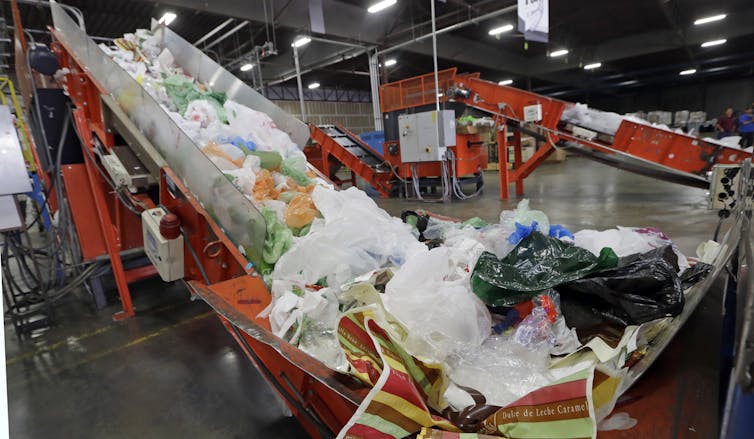 Conveyors carry mixed plastic into a device that will shred recycle them at a plastics recycling plant in Vernon, California. AP Photo/Reed Saxon,File
A global plastic waste crisis is building, with major implications for health and the environment. Under its so-called “National Sword” policy, China has sharply reduced imports of foreign scrap materials. As a result, piles of plastic waste are building up in ports and recycling facilities across the United States.
In response, support is growing nationally and worldwide for banning or restricting single-use consumer plastics, such as straws and grocery bags. These efforts are also spurred by chilling findings about how micro-plastics travel through oceans and waterways and up the food chain.
I have studied global trade in hazardous wastes for many years and am currently completing a book on the global politics of waste. In my view, today’s unprecedented level of public concern is an opportunity to innovate. There is growing interest in improving plastic recycling in the United States. This means getting consumers to clean and sort recyclables, investing in better technologies for sorting and reusing waste plastics, and creating incentives for producers to buy and use recycled plastic.
Critiques of recycling are not new, and critiques of recycling plastic are many, but I still believe it makes sense to expand, not abandon, the system. This will require large-scale investment and, in the long term, implementing upstream policies, including product bans.
Easy to use, hard to destroy
Plastics make products lighter, cheaper, easier to assemble and more disposable. They also generate waste, both at the start of their life cycles – the petrochemicals industry is a major source of pollution and greenhouse gas emissions – and after disposal.
The biggest domestic use by far for plastic resin is packaging (34 percent in 2017), followed by consumer and institutional goods (20 percent) and construction (17 percent). Many products’ useful lives can be measured in minutes. Others, especially engineered and industrial plastics, have a longer life – up to 35 years for building and construction products.
After disposal, plastic products take anywhere from five to 600 years to break down. Many degrade into micro-plastic fragments that effectively last forever. Rather like J.R.R. Tolkien’s One Ring, plastics can be permanently destroyed only through incineration at extremely high temperatures.
Why the United States recycles so little plastic
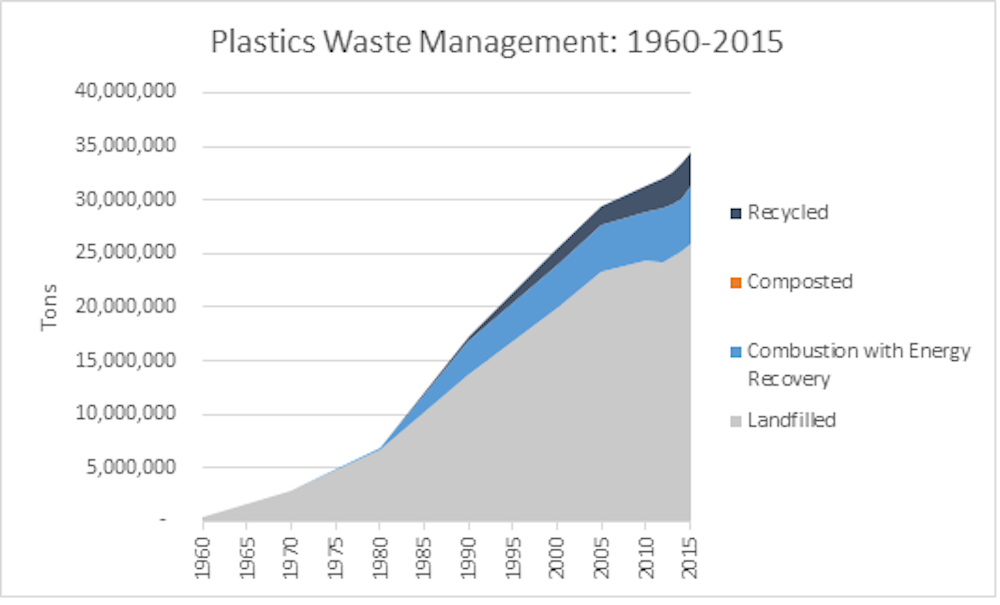
Less than 10 percent of discarded plastics entered the recycling stream in the United States in 2015, compared with 39.1 percent in the European Union and 22 percent in China. Another 15 percent of U.S. plastic waste is burned in waste-to-energy facilities. The remaining 75 percent goes to landfills. These figures do not include any dumping or illegal disposal.
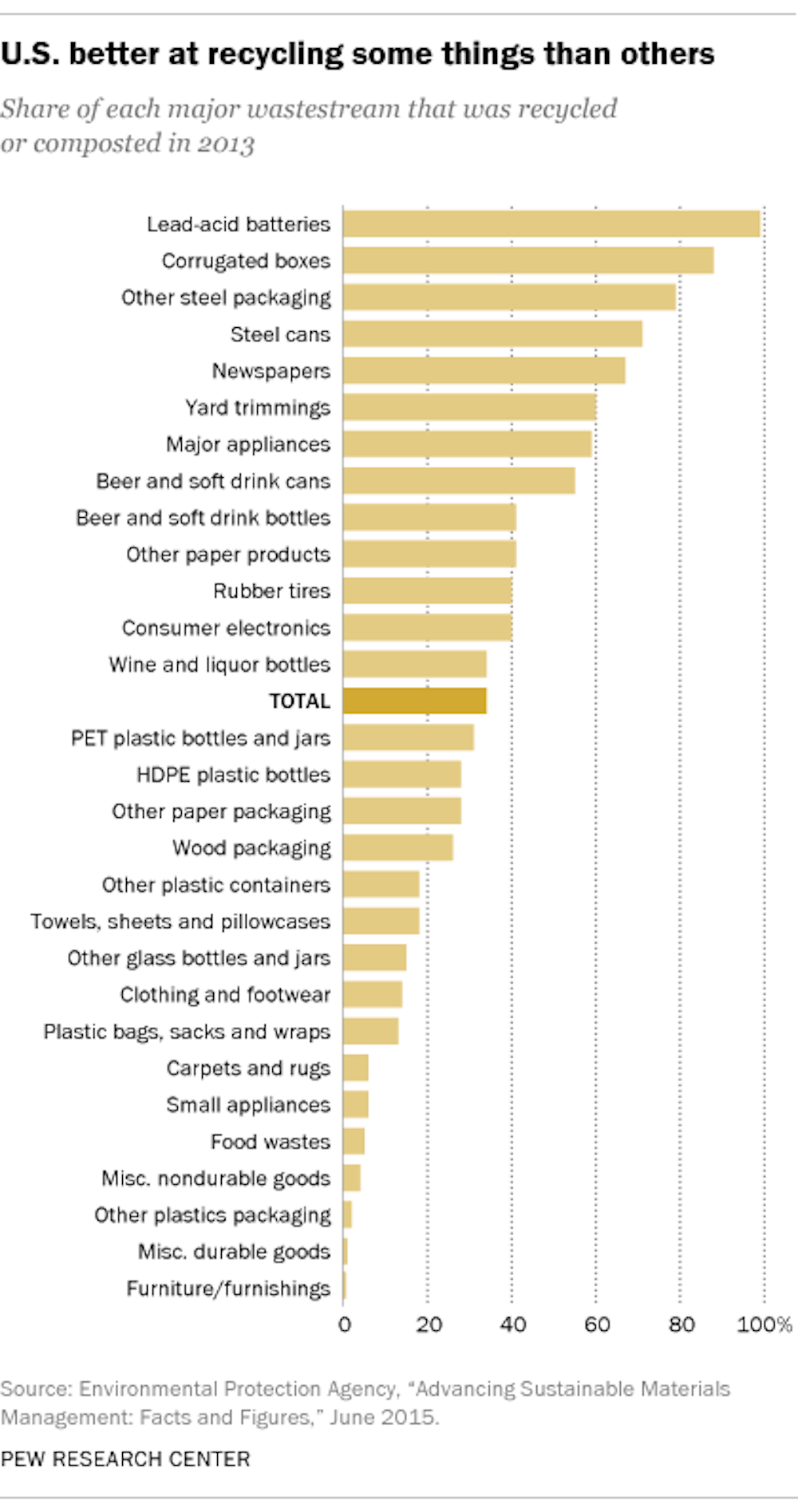
Even the most easily recyclable plastics have a lengthy journey from the recycling bin to their final destinations. Many barriers have become painfully apparent since China, which until recently accepted half of all U.S. plastic scrap, implemented its crackdown on March 1, 2018.
First, there are many different types of plastics. Of the seven resin identification codes stamped on the bottom of plastic containers, only 1’s and 2’s are easily recyclable. Public education campaigns have lagged, particularly with respect to cleaning and preparing plastics for recycling. Getting consumers to commit to more stringent systems is critical. But scolding can backfire, as experience with food waste shows.
Another factor is U.S. reliance on single-stream recycling systems, in which all recyclables are placed in the same receptacle. This approach is easier for consumers but produces a mixed stream of materials that is difficult and expensive to sort and clean at recycling facilities.
The United States currently has 633 materials recycling facilities, which can clean, sort and bale a total of 100,000 tons of recyclables per day. Today they are under growing pressure as scrap piles up. Even before China’s restrictions went into effect, materials recycling facilities operators threw out around half of what they received because of contamination. Most are not equipped to meet China’s stringent new contamination standards, and their processing rates have slowed – but garbage production rates have not.
Finally, since China was the U.S. plastic scrap market’s main buyer, its ban has eliminated a key revenue stream for municipal governments. As a result, some waste collection agencies are suspending curbside pickup, while others are raising prices. All 50 states have been affected to some extent.
No silver bullets
Numerous public and private entities are working to find a more viable solution for plastics recycling. They include plastics producers and recyclers, corporations such as Coca-Cola, colleges and universities, foundations, international organizations, advocacy groups and state governments.
Upgrading materials recycling facilities and expanding domestic markets for plastic scrap is an obvious priority but will require large-scale investments. Increasing waste-to-energy incineration is another option. Sweden relies on this approach to maintain its zero waste model.
But incineration is deeply controversial in the United States, where it has declined since 2001, partly due to strong opposition from host communities. Zero-waste and anti-incineration advocates have heavily criticized initiatives such as the Hefty EnergyBag Program, a recent pilot initiative in Omaha, Nebraska to divert plastics to energy production. But small companies like Salt Lake City-based Renewlogy are working to develop newer, cleaner ways to convert plastics to energy.
Efforts to cut plastic use in the United States and other wealthy countries are focusing on single-use products. Initiatives such as plastic straw and bag bans build awareness, but may not significantly reduce the problem of plastic trash by themselves. For example, plastic straws account for only 0.03 percent of the plastic that is likely to enter the oceans in any given year.
Industry is starting to push back, with corporations like McDonald’s resisting straw bans. Some U.S. states have passed measures forbidding plastic bag restrictions.
To stem ocean plastic pollution, better waste management on land is critical, including steps to combat illegal dumping and manage hard-to-recycle plastics. Examples include preventing BPA leaching from discarded products, dechlorinating polyvinyl chloride products, on-site recycling of 3D printer waste, and making virgin-quality plastic out of used polypropylene.
The European Union is developing a circular economy platform that contains a multi-part strategy to increase plastics recycling and control waste. It includes making all plastic packaging recyclable by 2030 and reducing leakage of plastic products into the environment. The United States is unlikely to adopt such sweeping policies at the national level. But for cities and states, especially those where support for environmental protection is strong, it could be a more attainable vision.
Kate O'Neill, Associate Professor, Global Environmental Politics, University of California, Berkeley
This article is republished from The Conversation under a Creative Commons license. Read the original article.
The findings suggest that regions of the world where seas have risen at higher than average rates – including the Eastern Seaboard of the United States and the Gulf of Mexico – can expect the trend to continue as the climate warms.
The study, published today in the Proceedings of the National Academy of Sciences, was authored by scientists John Fasullo at the National Center for Atmospheric Research, or NCAR, and Steve Nerem at the University of Colorado Boulder.
“By knowing that climate change is playing a role in creating these regional patterns, we can be more confident that these same patterns may linger or even intensify in the future if climate change continues unabated,” Fasullo said. “With sea levels projected to rise a couple of feet or more this century on average, information about expected regional differences could be critical for coastal communities as they prepare.”
The research was funded by the National Science Foundation, which is NCAR's sponsor, the NASA Sea Level Change Team, and the U.S. Department of Energy.
Finding the signal of climate change
For the study, Fasullo and Nerem, both members of the NASA Sea Level Change Team, analyzed the satellite altimetry sea level record, which includes measurements of sea surface heights stretching back to 1993. They mapped global average sea level rise as well as how particular regions deviated from the average.
For example, the oceans surrounding Antarctica and the U.S. West Coast have had lower-than-average sea level rise, while the U.S. East Coast and Southeast Asia, including the Philippines and Indonesia, have experienced the opposite. In some parts of the world, the rate of local sea level rise has been as much as twice the average.
Regional differences in sea level rise are influenced by where heat is stored in the ocean (since warm water expands to fill more space than cold water) and how that heat is transported around the globe by currents and wind. Uneven sea level rise is also influenced by ice sheets, which lose mass as they melt and shift the gravitational forces affecting regional sea surface height.
Natural shifts in ocean cycles – including the Pacific Decadal Oscillation, a pattern of sea surface temperatures similar to El Niño but longer lasting – are therefore known to affect sea levels. So scientists were not surprised to find that as the ocean rises, it rises unevenly. But it's been difficult to say whether these natural cycles were the dominant influence on regional differences.
To investigate the role of climate change, the scientists turned to two sets of climate model runs, known as “large ensembles”: one created using the NCAR-based Community Earth System Model and one created using the Earth System Model at the National Oceanic and Atmospheric Administration. These large ensembles – many model simulations by the same model, describing the same time period – allow researchers to disentangle natural variability from the impacts of climate change. With enough runs, these impacts can be isolated even when they are relatively small compared to the impacts from natural variability.
The climate models suggest that in regions that have seen more or less sea level rise than average, as much as half of that variation may be attributed to climate change. The scientists also found that the impacts from climate change on regional sea level rise sometimes mimic the impacts from natural cycles.
"It turns out the sea level rise response to climate change in the Pacific resembles what happens during a particular phase of the Pacific Decadal Oscillation," Fasullo said. "This explains why it's been so difficult to determine how much of the pattern was natural or not, until now."
Improving forecasts
The research findings have implications for local officials, who are interested in improved forecasts of sea level rise for the areas they oversee. In the past, forecasters have had to rely on the global rate of change – about 3 millimeters a year and accelerating – and knowledge of the uneven regional impacts associated with continued melting of the ice sheets covering Greenland and Antarctica.
The findings add the possibility that the regional patterns of sea level rise tied to climate change can also be included, because the models predict that the regional patterns observed in the satellite measurements will continue into the future.
"We now have a new tool – long-term satellite altimeter measurements – that we can use to help stakeholders who need information for specific locations," said Nerem, a fellow of the Cooperative Institute for Research in Environmental Sciences at the University of Colorado Boulder and a professor of aerospace engineering.
About the article
Title: Altimeter-Era Emergence of the Patterns of Forced Sea Level Rise in Climate Models and Implications for the Future
Authors: John T. Fasullo and R. Steven Nerem
Journal: Proceedings of the National Academy of Sciences, DOI: 10.1073/pnas.1813233115
The University Corporation for Atmospheric Research manages the National Center for Atmospheric Research under sponsorship by the National Science Foundation. Any opinions, findings and conclusions or recommendations expressed in this material do not necessarily reflect the views of the National Science Foundation.

LOWER LAKE, Calif. – California Department of Corrections and Rehabilitation officials are searching for a minimum-security inmate who walked away from Konocti Conservation Camp on Monday morning.
Inmate Nicolas Dunning, 32, was discovered missing at 7:40 a.m. Monday, officials said. It’s believed that he escaped sometime between 6:30 and 7:15 a.m.
Officials said a search of the camp buildings and grounds was immediately conducted.
The California Department of Corrections and Rehabilitation’s Office of Correctional Safety, Cal Fire, the California Highway Patrol and local law enforcement agencies have been notified and are assisting in the search.
Dunning is a white male, 6 feet, 2 inches tall, and weighing 181 pounds. He is bald with green eyes.
He was committed to California Department of Corrections and Rehabilitation from Imperial County in April with a five-year sentence for assault with a deadly weapon.
Anyone who sees Dunning should contact 911 or law enforcement authorities immediately. Anyone having information about or knowledge of the location of Dunning should contact the CCC Watch Commander at 530-257-2181, Extension 4173.
Since 1977, 99 percent of all offenders who have left an adult institution, camp or community-based program without permission have been apprehended, the California Department of Corrections and Rehabilitation reported.
The advisory is in effect from 9 a.m. to 6 p.m. Monday.
Officials said a wind advisory means that wind gusts of 40 miles per hour are expected, which it said can cause hazardous driving conditions for small cars or high profile vehicles.
The regional forecast calls for north winds of 15 to 30 miles per hour with gusts around 40 miles per hour.
The specific Lake County forecast anticipates wind gusts into the 50s in the south county and the northern Mountains.
Temperatures in Lake County are forecast to dip into the low 30s at night, rising into the high 50s during the daytime hours.
In other weather news, chances of showers are forecast to return this weekend.
Email Elizabeth Larson at