 How to resolve AdBlock issue?
News

Gov. Edmund G. Brown Jr. swore in Justice Joshua Groban to the California Supreme Court on Thursday in Sacramento, at a ceremony joined by Chief Justice Tani Cantil-Sakauye and other judicial and state officials.
"I see the great work of the court, of taking the utter complexity and making it as clear, as simple and as just as humanly possible. It’s a high calling, and Josh, I think you’re eminently equipped," said Gov. Brown at Thursday’s ceremony.
Justice Groban’s nomination to the court was unanimously confirmed by the Commission on Judicial Appointments on December 21, 2018.
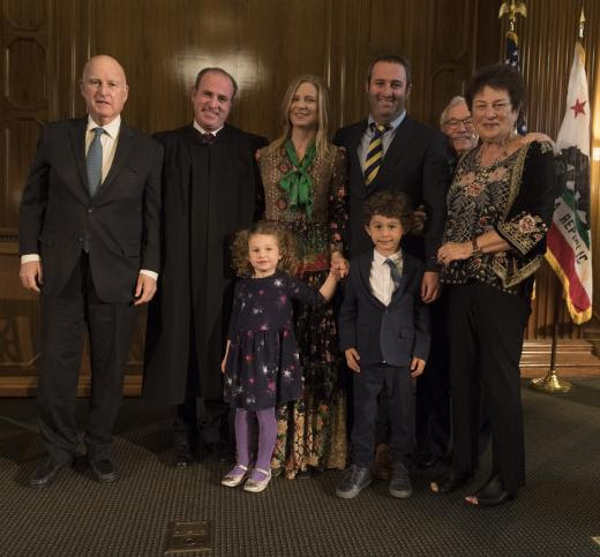
As senior advisor to the governor, Groban, 45, of Los Angeles, oversaw the appointment of 644 judges throughout the state since 2011. These appointments have been lauded as the most diverse in the state’s history.
Groban also advised the governor in high-profile litigation and policy issues involving education, the judiciary, criminal justice, national security and constitutional interpretation.
He was legal counsel for the Jerry Brown for Governor Campaign in 2010 and an attorney at Munger, Tolles and Olson LLP from 2005 to 2010 and at Paul, Weiss, Rifkind, Wharton and Garrison LLP from 1999 to 2005.
Groban served as a law clerk for the Honorable William C. Conner at the U.S. District Court, Southern District of New York from 1998 to 1999.
He has been a lecturer in state appellate practice at the University of California, Los Angeles School of Law since 2015.
Groban earned a Juris Doctor degree from Harvard Law School, where he graduated cum laude and a Bachelor of Arts degree from Stanford University, where he graduated with honors and distinction.

Gov. Brown on Thursday also released the final applicant and appointee data for the administration's judicial appointments. Since taking office in 2011, Gov. Brown has appointed 644 judges, including 193 from 2018 to January 2, 2019.
Last year, women accounted for more than half of Gov. Brown’s judicial appointees and nearly 6 percent of all appointees identified themselves as LGBT. Forty-one percent of all appointees identified themselves as non-white or other/unknown.
Over the last eight years, 44 percent of all judicial appointees were women and nearly 6 percent identified themselves as LGBT. Nearly 40 percent of all the governor’s judicial appointees identified themselves as non-white or other/unknown.
The governor's judicial appointees have included a number of notable firsts:
- Jim Humes, the first openly gay justice ever appointed to the California Court of Appeal;
- Kathleen O'Leary, the first woman presiding justice ever appointed to the Fourth District Court of Appeal, Division Three;
- Rupa Goswami, the first South Asian American woman judge ever appointed in California;
- Paul Lo, the first Hmong American judge ever appointed in the country;
- Halim Dhanidina, the first Muslim justice and the first South Asian American justice in the history of the California Courts of Appeal. Justice Dhanidina was also the first Muslim judge ever appointed in California;
- Joginder Dhillon, the first Sikh judge ever appointed to the Sacramento County Superior Court;
- Richard T. Fields, the first African-American man appointed to the Fourth District Court of Appeal;
- Gabriel P. Sanchez, the first male Latino justice ever appointed to the First District Court of Appeal;
- Monique S. Langhorne, the first African-American judge ever appointed to the Napa County Superior Court;
- Amarra A. Lee, the first African-American woman judge ever appointed to the San Mateo County Superior Court;
- Therese M. Stewart, the first openly lesbian justice ever appointed to the California Court of Appeal;
- Audra Ibarra, the first Filipino-American ever appointed to the Santa Clara County Superior Court and the first Filipino-American woman to serve as a superior court judge in the Bay Area;
- Carin T. Fujisaki, the first Asian-Pacific Islander woman justice ever appointed to the First District Court of Appeal;
- Alicia R. Ekland, the first woman judge ever appointed to the Glenn County Superior Court;
- Gregory A. Pulskamp, the first Muslim judge ever appointed to the Kern County Superior Court;
- Firdaus F. Dordi, the first Zoroastrian judge ever appointed in California;
- Michael W. Jones, the first Latino judge ever appointed to the Placer County Superior Court;
- Jesus A. Rodriguez, the first male Latino judge ever appointed to the Butte County Superior Court;
- Ruth Bermudez Montenegro, the first Latina judge ever appointed to the Imperial County Superior Court;
- Elia M. Ortiz, the first Latina judge ever appointed to the Napa County Superior Court;
- Yvette Durant, the first woman judge ever appointed to the Sierra County Superior Court;
- Nahal Iravani-Sani, the first Iranian-American judge ever appointed to the Santa Clara County Superior Court;
- Eumi K. Lee, the first Korean-American judge ever appointed to the Alameda County Superior Court;
- Roger C. Chan, the first Korean-American judge ever appointed to the San Francisco County Superior Court;
- Sonny S. Sandhu, the first Asian-Pacific Islander judge ever appointed to the Stanislaus County Superior Court;
- Dorothy C. Kim, the first Korean American justice in the history of the California Courts of Appeal;
- Vedica Puri, the first South Asian American judge ever appointed to the San Francisco County Superior Court;
- Shama H. Mesiwala, the first South Asian American judge ever appointed to the Sacramento County Superior Court;
- Somnath Raj Chatterjee, the first South Asian American judge ever appointed to the Alameda County Superior Court;
- Benjamin T. Reyes, the first Filipino-American judge ever appointed to the Contra Costa County Superior Court;
- Godofredo (O.G.) Magno, the first Filipino-American judge ever appointed to the Riverside County Superior Court;
- Winston S. Keh, the first Filipino-American judge ever appointed to the San Bernardino County Superior Court;
- Todd D. Irby, the first African-American judge ever appointed to the Placer County Superior Court;
- Gloria J. Cannon, the first African-American judge ever appointed to the Kern County Superior Court;
- Marco D. Nunez, the first openly gay judge ever appointed to the Imperial County Superior Court;
- Sonia Cortés, the first Latino judge ever appointed to the Yolo County Superior Court;
- Marsha G. Slough, the first openly gay justice in the history of the Fourth District Court of Appeal;
- Luis A. Lavin, the first openly gay justice ever appointed to the Second District Court of Appeal;
- Ferdinand P. Inumerable, the first Asian-Pacific Islander judge ever appointed to the Ventura County Superior Court;
- Von T. Nguyen Deroian, the first Asian-Pacific Islander judge ever appointed to the Santa Barbara County Superior Court;
- Lily L. Sinfield the first Asian-Pacific Islander woman judge ever appointed to the San Bernardino County Superior Court;
- Susanne S. Cho, the first Asian-Pacific Islander woman judge ever appointed to the Riverside County Superior Court;
- Truc T. Do, the first Vietnamese-American judge ever appointed to the San Diego County Superior Court;
- M. Bruce Smith, the first African-American justice ever appointed to the Fifth District Court of Appeal;
- Sunshine Sykes, the first American Indian judge ever appointed to the Riverside County Superior Court;
- Sunil Kulkarni, the first South Asian American judge ever appointed in Northern California;
- Miguel Marquez, the first Latino justice ever appointed to the Sixth District Court of Appeal;
- Rosendo Peña, the first Latino justice ever appointed to the Fifth District Court of Appeal;
- Chris Doehle, the first woman judge ever appointed to the Del Norte County Superior Court;
- Kimberly Colwell, the first openly lesbian judge ever appointed to the Alameda County Superior Court;
- Mark Andrew Talamantes, the first Latino judge ever appointed to the Marin County Superior Court; and
- Raquel Marquez, the first Latina judge ever appointed to the Riverside County Superior Court.
Under SB 56 and SB 182, the Governor is required to disclose aggregate statewide demographic data provided by all judicial applicants by March 1.
California’s Racial and Identity Profiling Advisory Board, or RIPA, has released its second annual report.
This year’s report builds on the foundation established by last year’s report for identifying and addressing racial and identity profiling in California.
The board is made up of 19 members coming from diverse backgrounds, including law enforcement, religious organizations, academia, community organizations and youth advocacy groups.
In this year’s report, the board aims to enhance the transparency of the stop data collection process by providing the public with detailed information on how this data is collected and submitted, and how enforcement agencies ensure the integrity of the data.
The report also provides recommendations that can be adopted by law enforcement agencies to enhance their policies, procedures, and trainings on topics that intersect with bias and racial and identity profiling. Additionally, the report includes an analysis of civilian complaints and use of force data collected in 2017.
"As the representative of the California State Sheriffs’ Association, we are committed as law enforcement leaders to work collectively with all members of our community regardless of race, religion, orientation and other demographics," said Kings County Sheriff Dave Robinson, Co-Chair of the RIPA Board and Designee of the President of the California State Sheriffs’ Association. "My participation on the RIPA Board has been uplifting and enlightening. As an association, we look forward to our continued strong relationships with our communities, while working towards strengthening them in those areas that are identified through this report and future reports."
“Our approach to implementing RIPA has been methodical and persistent,” said Executive Director of Alliance San Diego Andrea Guerrero. “The RIPA Advisory Board has engaged in tough conversations about problems and solutions, informed by the experiences of community members and law enforcement officers, and guided by experts and academics. We are determined to increase public safety for all Californians, and together we will, engaging in a process that generates actionable information that leads to meaningful results.”
“It is clear that the RIPA Board is committed to improving our communities,” said Attorney General Becerra. “The Board’s recommendations will help make our law enforcement agencies more transparent and promote critical steps to enhance, and in some cases, repair the public trust. I applaud the Board’s efforts to continue fostering trust between law enforcement and the communities they serve. We look forward to continuing this important work to make all California communities safer.”
The following information is included in this year’s report:
– Detailed information on how the stop data is collected and submitted and how the California Department of Justice and law enforcement agencies ensure the integrity of this data.
– Best practice recommendations for agencies drafting policies, procedures, and trainings regarding civilian complaints and racial and identity profiling.
– Data on civilian complaints, including complaints alleging racial and identity profiling. The data provides a snapshot of 9,459 complaints reported by 453 agencies. The data is broken down by agency, type of complaint, and demographic details.
– Data reported to the California Department of Justice by law enforcement agencies on use of force incidents. The data provides a snapshot of 707 complaints broken down by agency, type of complaint, and demographic details.
California’s Racial and Identity Profiling Act of 2015 requires nearly all California law enforcement agencies to collect, maintain, and analyze demographic data on all detentions and searches.
The RIPA Board was formed in July 2016 as part of this Act, to shepherd this data collection and provide public reports.
The California Legislature charged the board with an ambitious purpose – to eliminate racial and identity profiling and improve diversity and racial and identity sensitivity in law enforcement.
By unifying a diverse group of individuals from across different sectors – law enforcement, civil and human rights organizations, community groups, and academia – in a shared cause, the RIPA Board aims to improve law enforcement-community relations in California through collaboration, transparency, and accountability.
For additional information on the RIPA Board and for the datasets related to the report, please visit https://oag.ca.gov/ab953.
This year’s report builds on the foundation established by last year’s report for identifying and addressing racial and identity profiling in California.
The board is made up of 19 members coming from diverse backgrounds, including law enforcement, religious organizations, academia, community organizations and youth advocacy groups.
In this year’s report, the board aims to enhance the transparency of the stop data collection process by providing the public with detailed information on how this data is collected and submitted, and how enforcement agencies ensure the integrity of the data.
The report also provides recommendations that can be adopted by law enforcement agencies to enhance their policies, procedures, and trainings on topics that intersect with bias and racial and identity profiling. Additionally, the report includes an analysis of civilian complaints and use of force data collected in 2017.
"As the representative of the California State Sheriffs’ Association, we are committed as law enforcement leaders to work collectively with all members of our community regardless of race, religion, orientation and other demographics," said Kings County Sheriff Dave Robinson, Co-Chair of the RIPA Board and Designee of the President of the California State Sheriffs’ Association. "My participation on the RIPA Board has been uplifting and enlightening. As an association, we look forward to our continued strong relationships with our communities, while working towards strengthening them in those areas that are identified through this report and future reports."
“Our approach to implementing RIPA has been methodical and persistent,” said Executive Director of Alliance San Diego Andrea Guerrero. “The RIPA Advisory Board has engaged in tough conversations about problems and solutions, informed by the experiences of community members and law enforcement officers, and guided by experts and academics. We are determined to increase public safety for all Californians, and together we will, engaging in a process that generates actionable information that leads to meaningful results.”
“It is clear that the RIPA Board is committed to improving our communities,” said Attorney General Becerra. “The Board’s recommendations will help make our law enforcement agencies more transparent and promote critical steps to enhance, and in some cases, repair the public trust. I applaud the Board’s efforts to continue fostering trust between law enforcement and the communities they serve. We look forward to continuing this important work to make all California communities safer.”
The following information is included in this year’s report:
– Detailed information on how the stop data is collected and submitted and how the California Department of Justice and law enforcement agencies ensure the integrity of this data.
– Best practice recommendations for agencies drafting policies, procedures, and trainings regarding civilian complaints and racial and identity profiling.
– Data on civilian complaints, including complaints alleging racial and identity profiling. The data provides a snapshot of 9,459 complaints reported by 453 agencies. The data is broken down by agency, type of complaint, and demographic details.
– Data reported to the California Department of Justice by law enforcement agencies on use of force incidents. The data provides a snapshot of 707 complaints broken down by agency, type of complaint, and demographic details.
California’s Racial and Identity Profiling Act of 2015 requires nearly all California law enforcement agencies to collect, maintain, and analyze demographic data on all detentions and searches.
The RIPA Board was formed in July 2016 as part of this Act, to shepherd this data collection and provide public reports.
The California Legislature charged the board with an ambitious purpose – to eliminate racial and identity profiling and improve diversity and racial and identity sensitivity in law enforcement.
By unifying a diverse group of individuals from across different sectors – law enforcement, civil and human rights organizations, community groups, and academia – in a shared cause, the RIPA Board aims to improve law enforcement-community relations in California through collaboration, transparency, and accountability.
For additional information on the RIPA Board and for the datasets related to the report, please visit https://oag.ca.gov/ab953.
Racial and Identity Profili... by on Scribd
MIDDLETOWN, Calif. – With the South Lake County Fire Protection District’s Measure L fire tax passing in the November election, officials are planning their next steps as they prepare to enact the new tax.
Measure L needed a supermajority vote of at least 66.7 percent to pass on the November ballot. It received a 67.9 percent “yes” vote to a 32 percent “no” vote.
It assesses up to $10 per benefit unit, ranging from 16 units for vacant land of under an acre to 20 units for a single family dwelling, and up to 250 units for commercial buildings of 10,000 square feet and above.
Jim Comisky, president of the South Lake County Fire Protection District Board of Directors and himself a retired firefighter, said Measure L will appear on tax bills in the next tax cycle, at the end of 2019.
“We won’t see the money for almost a year,” he said.
Comisky said Measure L is estimated to generate $1.795 million annually.
No formal argument was filed against Measure L, with opposition to the tax coming from community members who questioned the need for more money at a time when the south county is continuing to rebuild from wildland fires including the 2015 Valley fire, one of the most destructive in state history.
However, district officials maintained that they had no choice if they were to maintain services.
Comisky said the district has a $1.3 million shortfall for the upcoming fiscal year, which the tax is meant to address.
He said the issues that led to the funding shortfall are twofold.
First, the district lost 1,958 structures in the Valley fire. Of that number, only 400 have been rebuilt, which Comisky said has had a huge impact on property tax. He said rebuilding is continuing, but many people have walked away, either building or buying elsewhere.
However, he said the biggest hit they took was the significant increase of more than $1 million annually in the cost for a contract the district currently has with Cal Fire to staff stations. Before the increase that contract totaled about $2.4 million annually.
When the minimum wage went up, Cal Fire had to raise seasonal wildland firefighters’ pay, Comisky said. “It was a domino effect.”
It was the first significant raise Cal Fire firefighters had had in years. “The costs for our contract had to reflect that,” Comisky explained.
He said the district had only half of what it needed to pay for the contract. “We very much value this relationship with Cal Fire.”
State Sen. Mike McGuire had helped secure $2 million annually from the state to cover the Cal Fire contract through 2018, but once those funds ran out, the district needed to pursue the fire tax.
Comisky said he cares about paramedics and ambulances being able to respond to help community members when needed. He said he doesn't care if his home burns down. “I can’t rebuild my family.”
He said the district is working with the county and also has hired an attorney specifically to handle issues related to the measure and to produce a document to guide the district as it moves forward. They also plan to educate taxpayers about what comes next.
Besides the measure, Comisky said the district will continue to explore more ways to deliver services to the community.
He said he’s talked with different fire chiefs and is looking at regional cooperation.
“We’re going to continue to have those discussions,” he said.
Email Elizabeth Larson atThis email address is being protected from spambots. You need JavaScript enabled to view it. . Follow her on Twitter, @ERLarson, or Lake County News, @LakeCoNews.
Measure L needed a supermajority vote of at least 66.7 percent to pass on the November ballot. It received a 67.9 percent “yes” vote to a 32 percent “no” vote.
It assesses up to $10 per benefit unit, ranging from 16 units for vacant land of under an acre to 20 units for a single family dwelling, and up to 250 units for commercial buildings of 10,000 square feet and above.
Jim Comisky, president of the South Lake County Fire Protection District Board of Directors and himself a retired firefighter, said Measure L will appear on tax bills in the next tax cycle, at the end of 2019.
“We won’t see the money for almost a year,” he said.
Comisky said Measure L is estimated to generate $1.795 million annually.
No formal argument was filed against Measure L, with opposition to the tax coming from community members who questioned the need for more money at a time when the south county is continuing to rebuild from wildland fires including the 2015 Valley fire, one of the most destructive in state history.
However, district officials maintained that they had no choice if they were to maintain services.
Comisky said the district has a $1.3 million shortfall for the upcoming fiscal year, which the tax is meant to address.
He said the issues that led to the funding shortfall are twofold.
First, the district lost 1,958 structures in the Valley fire. Of that number, only 400 have been rebuilt, which Comisky said has had a huge impact on property tax. He said rebuilding is continuing, but many people have walked away, either building or buying elsewhere.
However, he said the biggest hit they took was the significant increase of more than $1 million annually in the cost for a contract the district currently has with Cal Fire to staff stations. Before the increase that contract totaled about $2.4 million annually.
When the minimum wage went up, Cal Fire had to raise seasonal wildland firefighters’ pay, Comisky said. “It was a domino effect.”
It was the first significant raise Cal Fire firefighters had had in years. “The costs for our contract had to reflect that,” Comisky explained.
He said the district had only half of what it needed to pay for the contract. “We very much value this relationship with Cal Fire.”
State Sen. Mike McGuire had helped secure $2 million annually from the state to cover the Cal Fire contract through 2018, but once those funds ran out, the district needed to pursue the fire tax.
Comisky said he cares about paramedics and ambulances being able to respond to help community members when needed. He said he doesn't care if his home burns down. “I can’t rebuild my family.”
He said the district is working with the county and also has hired an attorney specifically to handle issues related to the measure and to produce a document to guide the district as it moves forward. They also plan to educate taxpayers about what comes next.
Besides the measure, Comisky said the district will continue to explore more ways to deliver services to the community.
He said he’s talked with different fire chiefs and is looking at regional cooperation.
“We’re going to continue to have those discussions,” he said.
Email Elizabeth Larson at
South Lake County Fire Prot... by on Scribd
On Wednesday, the California Supreme Court denied a police union’s last-minute petition to change a new police transparency law, rejecting the union’s effort to make the law – Senate Bill 1421 – apply only to records created after Jan. 1, 2019.
SB 1421, authored by Sen. Nancy Skinner (D-Berkeley), requires that certain personnel records and records relating to specified incidents, complaints and investigations involving peace officers and custodial officers to be made available for public inspection pursuant to the California Public Records Act – a sweeping change in California law.
In a one-sentence order issued Wednesday, the California Supreme Court rejected a petition filed on Dec. 18 by the San Bernardino County Sheriff’s Employees’ Benefit Association.
The First Amendment Coalition, or FAC, led a coalition of media groups in opposing the union’s effort, filing papers on Dec. 28 urging the court to deny the effort to gut the law.
“This is a great result for transparency and for the public,” said FAC Executive Director David Snyder. “We’re grateful the Supreme Court saw through the union’s Hail Mary effort to weaken this law, which will allow broad public access to police misconduct files.”
The union had asked the high court to rule that the bill, signed into law in September, applies only to records created after Jan. 1 – the bill’s effective date. That came after the county of San Bernardino stated in a Dec. 13 letter that it intended to retroactively apply the legislation’s amendments to personnel records, according to a union announcement when it filed the petition.
The union said the release of such records before the bill’s effective date would cause irreparable harm to the statutory and constitutional rights of its members, as peace officers’ personnel records received legal protection prior to SB 1421.
The Peace Officers Research Association of California, or PORAC, raised issue with the bill previously, saying its mandates are broad, and that it creates confusion and uncertainty in the administrative disciplinary process.
PORAC said the information that will be released because of this bill is already available to defendants in an action against the department through the “Pitchess” System that has been in law for 50 years, and through discovery, and raised concern that, should information about law enforcement discipline be publicized, a wave of habeas corpus petitions from convicted criminals would follow.
Joining FAC in the effort to oppose the union’s petition were the Los Angeles Times, KQED and the California News Publishers Association.
See the briefing filed by FAC here. See here for the petition filed by the police union.
The union employed Rains Lucia Stern St. Phalle & Silver P.C. to file the legal challenge on behalf of its members. FAC and the media coalition are represented in this matter by James Chadwick and Tenaya Rodewald of the Sheppard Mullin law firm.
SB 1421, authored by Sen. Nancy Skinner (D-Berkeley), requires that certain personnel records and records relating to specified incidents, complaints and investigations involving peace officers and custodial officers to be made available for public inspection pursuant to the California Public Records Act – a sweeping change in California law.
In a one-sentence order issued Wednesday, the California Supreme Court rejected a petition filed on Dec. 18 by the San Bernardino County Sheriff’s Employees’ Benefit Association.
The First Amendment Coalition, or FAC, led a coalition of media groups in opposing the union’s effort, filing papers on Dec. 28 urging the court to deny the effort to gut the law.
“This is a great result for transparency and for the public,” said FAC Executive Director David Snyder. “We’re grateful the Supreme Court saw through the union’s Hail Mary effort to weaken this law, which will allow broad public access to police misconduct files.”
The union had asked the high court to rule that the bill, signed into law in September, applies only to records created after Jan. 1 – the bill’s effective date. That came after the county of San Bernardino stated in a Dec. 13 letter that it intended to retroactively apply the legislation’s amendments to personnel records, according to a union announcement when it filed the petition.
The union said the release of such records before the bill’s effective date would cause irreparable harm to the statutory and constitutional rights of its members, as peace officers’ personnel records received legal protection prior to SB 1421.
The Peace Officers Research Association of California, or PORAC, raised issue with the bill previously, saying its mandates are broad, and that it creates confusion and uncertainty in the administrative disciplinary process.
PORAC said the information that will be released because of this bill is already available to defendants in an action against the department through the “Pitchess” System that has been in law for 50 years, and through discovery, and raised concern that, should information about law enforcement discipline be publicized, a wave of habeas corpus petitions from convicted criminals would follow.
Joining FAC in the effort to oppose the union’s petition were the Los Angeles Times, KQED and the California News Publishers Association.
See the briefing filed by FAC here. See here for the petition filed by the police union.
The union employed Rains Lucia Stern St. Phalle & Silver P.C. to file the legal challenge on behalf of its members. FAC and the media coalition are represented in this matter by James Chadwick and Tenaya Rodewald of the Sheppard Mullin law firm.
ANN ARBOR, Mich. – America lost 20,360 children and teens in 2016 – 60 percent of them to preventable injuries, a new study shows.
More than 4,100 of them died in motor vehicle crashes, though prevention efforts and better trauma care have cut the death rate of young people from such crashes in half in less than two decades.
Meanwhile, firearms – the No. 2 cause of death in youth – claimed the lives of more than 3,100 children and teens in 2016, according to the new findings from a University of Michigan team.
That’s about eight children a day, according to their special report in the New England Journal of Medicine.
Unlike vehicle crashes, the rate of firearm-related death for those ages 1 to 19 has stayed around the same for nearly the past two decades, the analysis shows. That rate is more than 36 times as high as the average rate across 12 other high-income countries.
The new study, by members of the U-M Injury Prevention Center, was done using publicly available data from the U.S. Centers for Disease Control and Prevention’s WONDER database of information from death certificates.
It’s the first time all causes of child and adolescent death have been tallied by both mechanism and intent, and that rates of these causes of death over time have been calculated for all the top causes.
Cancer, which accounted for more than 1,800 deaths of those ages 1 to 19, comes in third place, and its death rate has dropped since the start of the study period. Suffocation – mainly suicides by hanging and other means – was fourth, and is on the rise.
Those causes are followed by drowning, drug overdoses/poisonings and birth defects, each with just under 1,000 deaths and steady decreases in death rates over the last 17 years.
Lead author Rebecca Cunningham, director of the U-M Injury Prevention Center and professor of emergency medicine, says that firearm-related deaths occur at about the same rate in urban, rural and suburban settings.
“Firearm deaths of children and adolescents are an ‘everybody’ problem, not a problem for just certain population,” she said. “Homicides account for 60 percent of those deaths, suicide about 35 percent, unintentional or accidental injuries about 1 percent and mass shootings slightly less than 1 percent.
“By using a data-driven approach to studying these deaths, I hope we can guide the U.S. to apply our resources to help us understand what we can do to prevent these deaths across the country.”
More about firearm deaths
Since 1999, about 4 of every 100,000 American children and adolescents have died by a gun-related homicide, suicide or unintended shooting each year, the research shows.
Firearm deaths affect all areas of America. Urban adolescents are twice as likely to die in homicides as rural youth, while rural teens have a rate of suicides that’s twice as high as the rate for urban youth. Suburban teens who die of firearm-related causes do so of suicide and homicide at roughly equal rates.
For children between the ages of 1 and 9, unintentional injuries were the leading cause of firearm death.
Boys had firearm death rates five times that of girls, and African-American young people had a firearm death rate nearly three times that of white children and teens.
Other causes and a call for action
Co-author Maureen Walton, associate director of the Injury Prevention Center and U-M professor of psychiatry, notes that drug poisoning and overdose have risen to be the sixth-leading cause of death for young people.
This is largely due to increases in opioid overdoses, which the study shows account for more than half of drug overdoses among adolescents, says Walton, who is also associate director of child research at the U-M Addiction Center.
Motor vehicle crashes kill nearly three times as many children and teens per 100,000 in rural areas, compared with those in urban and near-urban areas—even when the researchers adjusted the data to account for the extra miles traveled each year by drivers in rural areas.
“Our country has spent billions to decrease car crash injuries and deaths for kids and adults, and has made it a leading priority for several federal agencies,” Cunningham said. “Safety in a crash is now a selling point for cars.”
This implementation of ‘prevention science’ has resulted in the steady decrease in motor vehicle crash deaths for children and teens over the past 20 years.
“At the same time, we have dozens of teams of scientists and clinicians working on prevention and treatment of pediatric cancers, congenital conditions and heart diseases, conditions where death rates have also fallen,” she said. “We hope these data help put firearm deaths of young people in the proper context, so we can study and test potential preventive measures while respecting the Second Amendment rights of gun owners.”
Some of the efforts to reduce firearm deaths among children and teens could be led by physicians, Cunningham says. She recalls learning about the early warning signs and diagnostic steps for childhood cancers such as leukemia, and for other serious childhood ailments, during her residency training.
But today’s medical students and residents get little or no training about how to ask parents if guns are present, and stored safely and securely, in their homes, she says.
U-M firearm injury prevention researcher and emergency physician Patrick Carter, assistant director of the Injury Prevention Center, co-authored the study.
“Firearm risk to children and adolescents, whether from unintentional or intentional use of a gun, is a serious medical issue that all of us in the profession can help address,” he said. “The results from this study certainly have inspired me as a physician to know that we need to be doing better.
“We hope that these findings will also encourage other physicians to know that this is indeed their ‘lane’ to be working in, to be preventing firearm related injury and death.”
Cunningham and Carter co-lead, and Walton is a member of, the Firearm Safety Among Children and Teens Consortium. Together with co-leader Marc Zimmerman of the U-M School of Public Health and researchers from around the country, FACTS is collecting and sharing research data on firearm-related topics in young people, while respecting gun ownership as an important part of the cultural fabric of the U.S.
All three authors are also members of the U-M Institute for Healthcare Policy and Innovation.
NORTHERN CALIFORNIA – On Friday, Jan. 4, the Napa County Office of Emergency Services will conduct a full scale active shooter drill in American Canyon and Calistoga.
The drill is expected to take place from 9 a.m. to 4 p.m. at the American Canyon Community Center, 100 Benton Way, American Canyon, and from 9 a.m. to 1 p.m. at the Calistoga Junior/Senior High School, 1608 Lake St.
School will be out of session and the locations will be closed to the public.
During the exercise, those in the immediate area may notice multiple law enforcement and fire vehicles, first responders, caution tape strung around the sites and loud noises/voices.
Businesses and those living within a half mile of each site were sent community advisory notices.
The purpose of the drill is to provide training and evaluate the immediate tactical response to an active shooter situation as well as identify future training needs and/or policies and procedures related to an emergency response.
Public Information staff will be on location at each site to provide traditional and social media updates throughout the day.
The drill is expected to take place from 9 a.m. to 4 p.m. at the American Canyon Community Center, 100 Benton Way, American Canyon, and from 9 a.m. to 1 p.m. at the Calistoga Junior/Senior High School, 1608 Lake St.
School will be out of session and the locations will be closed to the public.
During the exercise, those in the immediate area may notice multiple law enforcement and fire vehicles, first responders, caution tape strung around the sites and loud noises/voices.
Businesses and those living within a half mile of each site were sent community advisory notices.
The purpose of the drill is to provide training and evaluate the immediate tactical response to an active shooter situation as well as identify future training needs and/or policies and procedures related to an emergency response.
Public Information staff will be on location at each site to provide traditional and social media updates throughout the day.