How to resolve AdBlock issue?
News

UPPER LAKE, Calif. – A Lucerne man arrested in November after he was found in possession of a stolen county vehicle and a dead fox has been arrested again, this time for burglaries in Upper Lake.
William Kenneth Pimentel, 27, was taken into custody on Thursday, according to Lt. Corey Paulich of the Lake County Sheriff’s Office.
At 7:30 a.m. Thursday Lake County Sheriff’s deputies responded to an address in the 2900 block of West Highway 20 in Upper Lake, Paulich said.
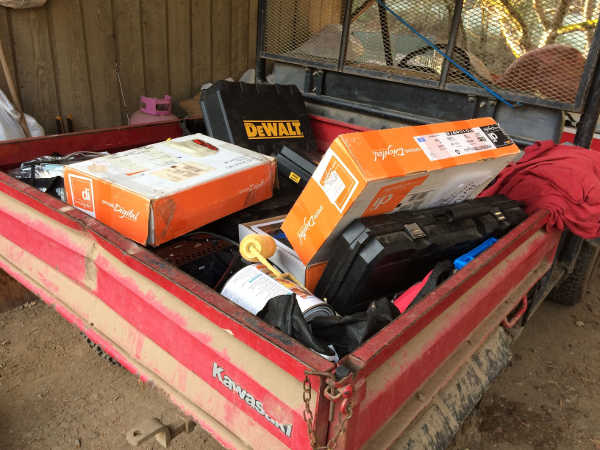
Paulich said residents at that location were reporting the keys to their ATVs were missing. They also reported that one of their ATVs was filled with art work and tools that did not belong to them.
The residents told the deputies that it appeared someone may be in a vacant house nearby, Paulich said.
The deputies checked the vacant house and located the sole occupant, identified as Pimentel, sleeping inside. Paulich said they also found the missing ATV keys near where Pimentel was sleeping.
Pimentel told the deputies he was on probation, but denied stealing anything, Paulich said.
While examining the property that was in the ATV, deputies developed information linking it to an address in the 4100 block of West Highway 20. Paulich said the deputies were able to make contact with residents at this address and determined there had been an unreported burglary to a barn on the property that occurred during the night.
Paulich said the victim of the burglary was able to identify the property found on the ATV as his and estimated the property was worth over $3,000.
The stolen property was returned to the owner and Pimentel was arrested and transported to the Lake County Jail where he was booked on charges of burglary and possession of stolen property, Paulich said.
Pimentel remains in custody with bail set at $50,000, according to jail records.
Pimentel had previously been booked at the Lake County Jail in November related to the theft of a county of Lake pickup, as Lake County News has reported.
The California Highway Patrol officer who arrested Pimentel found fresh white spray paint over the county’s emblems on the doors, as well as recently stolen bank cards within the vehicle which had been used to withdraw a large sum of money the same morning, along with a dead fox in the pickup truck’s bed.
Paulich said Pimentel had been released pending sentencing on that November case.
Pimentel is tentatively scheduled to appear in Lake County Superior Court on Monday, based on his booking records.
The California Department of Water Resources on Friday announced final basin prioritization for the majority of groundwater basins in the state as required under the Sustainable Groundwater Management Act, or SGMA.
Friday’s announcement finalizes the prioritization for 458 basins, identifying 56 basins that are required to create groundwater sustainability plans under SGMA.
For most basins, the results are a confirmation of prioritizations established in 2015.
Fifty-nine basins remain under review with final prioritization expected in late spring.
“Prioritizing groundwater basins is a critical step along the path of ensuring sustainable groundwater supplies for future generations of Californians,” said DWR Director Karla Nemeth. “Groundwater management is a big, complicated endeavor for California, which is why DWR is investing heavily to provide local planning entities with technical assistance to be successful.”
SGMA requires local agencies throughout the state to sustainably manage groundwater basins. Basins identified as high- or medium-priority are required to adopt groundwater sustainability plans beginning in 2020.
DWR is required to reassess groundwater basin prioritizations any time it updates basin boundaries.
This prioritization for 458 basins incorporates the basin boundary modifications finalized in 2016. Prioritization is based on factors such as population, irrigated acreage, and the number of wells in the basin. Changes in prioritization generally reflect changed conditions or new information about existing conditions.
In Lake County, the state’s SGMA dashboard lists several basins, all of them very low priority except for one, the Big Valley basin, which is as medium priority.
The Lake County basins are as follows:
– Big Valley: Population, 6,344; total wells, 872; irrigated acres, 7,906.
– Burns Valley: Population, 2,691; total wells, 115; irrigated acres, 378.
– Clear Lake Cache Formation: Population, 7,960; total wells, 134; irrigated acres, 158.
– Coyote Valley: Population, 2,252; total wells, 116; irrigated acres, 1,345.
– Gravelly Valley: Population, 11; total wells, 12; irrigated acres, 0.
– High Valley: Population, 34; total wells, 26; irrigated acres, 153.
– Long Valley: Population, 194; total wells, 19; irrigated acres, 518.
– Lower Lake Valley: Population, 2,694; total wells, 57; irrigated acres, 117.
– Middle Creek: Population, 10; total wells, 11; irrigated acres, 19.
– Scotts Valley: Population, 6,548; total wells, 518; irrigated acres, 1,208.
– Upper Lake Valley: Population 2,055; total wells, 282; irrigated acres, 2,017.
None of Lake County’s groundwater basins were modified in the latest announcement, according to the state basin dashboard.
Friday’s prioritization reflects updates based on new requirements under SGMA, including adverse impacts to habitat and streamflow, adjudicated areas, critically overdrafted basins and groundwater related transfers.
Twenty-one basins were changed to “very low” because they are covered by adjudicated areas with existing governance and oversight in place. Adjudicated areas are not required to prepare groundwater sustainability plans and are instead required to submit annual reports to DWR on their groundwater management and monitoring.
Draft prioritizations were announced in May 2018. These finalizations come after a 94-day public comment period and four public meetings that resulted in 500 individual comments and related datasets leading to some revisions in basin prioritization.

At 2:43 p.m. EST on Dec. 31, while many on Earth prepared to welcome the New Year, NASA’s OSIRIS-REx spacecraft, 70 million miles (110 million kilometers) away, carried out a single, eight-second burn of its thrusters – and broke a space exploration record.
The spacecraft entered into orbit around the asteroid Bennu, and made Bennu the smallest object ever to be orbited by a spacecraft.
“The team continued our long string of successes by executing the orbit-insertion maneuver perfectly,” said Dante Lauretta, OSIRIS-REx principal investigator at the University of Arizona, Tucson. “With the navigation campaign coming to an end, we are looking forward to the scientific mapping and sample site selection phase of the mission.”
Lauretta, along with his team, spent the last day of 2018 with his feet planted on Earth, but his mind focused on space. “Entering orbit around Bennu is an amazing accomplishment that our team has been planning for years,” Lauretta said.
Inching around the asteroid at a snail’s pace, OSIRIS-REx’s first orbit marks a leap for humankind. Never before has a spacecraft from Earth circled so close to such a small space object – one with barely enough gravity to keep a vehicle in a stable orbit.
Now, the spacecraft will circle Bennu about a mile (1.75 kilometers) from its center, closer than any other spacecraft has come to its celestial object of study. (Previously the closest orbit of a planetary body was in May 2016, when the Rosetta spacecraft orbited about four miles (seven kilometers) from the center of the comet 67P/Churyumov-Gerasimenko).
The comfortable distance is necessary to keep the spacecraft locked to Bennu, which has a gravity force only 5-millionths as strong as Earth’s. The spacecraft is scheduled to orbit Bennu through mid-February at a leisurely 62 hours per orbit.
Now that the OSIRIS-REx spacecraft is closer to Bennu, physical details about the asteroid will leap into sharper focus, and the spacecraft’s tour of this rubble pile of primordial debris will become increasingly detailed and focused.
“Our orbit design is highly dependent on Bennu’s physical properties, such as its mass and gravity field, which we didn’t know before we arrived,” said OSIRIS-REx’s flight dynamics system manager Mike Moreau, who is based at NASA’s Goddard Space Flight Center in Greenbelt, Maryland.
“Up until now, we had to account for a wide variety of possible scenarios in our computer simulations to make sure we could safely navigate the spacecraft so close to Bennu. As the team learned more about the asteroid, we incorporated new information to hone in on the final orbit design,” he said.
The simulations have played a critical role. The OSIRIS-REx mission, after all, was designed based on complex computer programs that predicted — quite accurately, as it turns out — the properties of Bennu and how the spacecraft’s trajectory would behave.
This diligent preparation allowed the team to navigate the vehicle safely to Bennu in December and put some questions to rest (there are, indeed, signs of ancient water preserved in Bennu’s rocks) and to fly over its poles and equator in a preliminary survey that led to some surprises (Bennu has many large boulders).
Having completed the preliminary survey of Bennu with a flyby of its south pole on December 16, the spacecraft moved to a safe 31 miles (50 kilometers) away from the asteroid to give the navigation team a chance to regroup and prepare for orbit insertion.
Next, Lockheed Martin engineers programmed the spacecraft to begin moving back to a position about nine miles (15 kilometers) over Bennu’s north pole to prepare for three burns of its thrusters over the course of 10 days that would place the spacecraft into orbit.
Even though OSIRIS-REx is in the most stable orbit possible, Bennu’s gravitational pull is so tenuous that keeping the spacecraft safe will require occasional adjustments, said Dan Wibben, OSIRIS-REx maneuver and trajectory design lead at KinetX Aerospace in Simi Valley, California.
“The gravity of Bennu is so small, forces like solar radiation and thermal pressure from Bennu’s surface become much more relevant and can push the spacecraft around in its orbit much more than if it were orbiting around Earth or Mars, where gravity is by far the most dominant force,” he said.
The OSIRIS-REx navigation team will use “trim” maneuvers to slightly thrust the spacecraft in one direction or another to correct its orbit and counter these small forces. If the spacecraft drifts away from Bennu, or some other problem forces it into safe mode, it has been programmed to fly away from the asteroid to stay safe from impact.
“It’s simple logic: always burn toward the Sun if something goes wrong,” said Coralie Adam, OSIRIS-REx lead optical navigation engineer at KinetX. Engineers can navigate the spacecraft back into orbit if it drifts away, Adam said, though that’s unlikely to happen.
The navigation and spacecraft operations teams are focused on the first orbital phase. Their primary goal is to transition away from star-based navigation, which allowed the team to locate the spacecraft based on pictures of the star formations around it taken by the cameras onboard.
Navigators use methods like this since there is no GPS in deep space and we can’t see the spacecraft from Earth-based telescopes. From this point forward, though, the OSIRIS-REx team will rely on landmarks on Bennu’s surface to track OSIRIS-REx, a more precise technique that will ultimately guide them to a sample-collection site clear of boulders and large rocks, said Adam.
“After conducting a global imaging and mapping campaign during our recent preliminary survey phase, the science team has created 3-D models of Bennu’s terrain that we’re going to begin using for navigation around the asteroid,” she said.
Another critical objective of this orbital phase, Adam said, is to get a better handle on Bennu’s mass and gravity, features that will influence the planning of the rest of the mission, notably the short touchdown on the surface for sample collection in 2020.
In the case of Bennu, scientists can only measure these features by getting OSIRIS-REx very close to the surface to see how its trajectory bends from Bennu’s gravitational pull.
“The Orbital A phase will help improve our detailed models for Bennu’s gravity field, thermal properties, orientation, and spin rate,” said Wibben. “This, in turn, will allow us to refine our trajectory designs for the even more challenging flight activities we will perform in 2019.”
The Dec. 31 maneuver to place the spacecraft into orbit about Bennu is the first of many exciting navigation activities planned for the mission. The OSIRIS-REx team will resume science operations in late February.
At that point, the spacecraft will perform a series of close flybys of Bennu for several months to take high-resolution images of every square inch of the asteroid to help select a sampling site.
During the summer of 2020, the spacecraft will briefly touch the surface of Bennu to retrieve a sample. The OSIRIS-REx mission is scheduled to deliver the sample to Earth in September 2023.
Goddard provides overall mission management, systems engineering and the safety and mission assurance for OSIRIS-REx.
Dante Lauretta of the University of Arizona, Tucson, is the principal investigator, and the University of Arizona also leads the science team and the mission’s science observation planning and data processing. Lockheed Martin Space in Denver built the spacecraft and is providing flight operations.
Goddard and KinetX Aerospace are responsible for navigating the OSIRIS-REx spacecraft. OSIRIS-REx is the third mission in NASA’s New Frontiers Program, which is managed by NASA’s Marshall Space Flight Center in Huntsville, Alabama for the agency’s Science Mission Directorate in Washington.
Lonnie Shekhtman is a science writer for NASA.
LAKE COUNTY, Calif. – The National Weather Service has issued a winter storm watch for Lake County and other parts of Northern California this weekend due to an impending storm.
The winter storm watch is in effect from 4 a.m. Saturday to noon on Sunday.
The forecast said a strong storm is expected to bring hazardous winter driving conditions to portions of the coast range and the Northern Sierra Nevada and mountains of western Plumas County starting Saturday morning.
The agency said a winter storm watch means there is potential for significant snow and blowing snow that may impact travel.
The National Weather Service’s Sacramento office said the impending storm is expected to be one of this winter’s coldest.
For most of Lake County, the weekend forecast calls primarily for rain, beginning on Friday night and then continuing until Thursday.
However, northern Lake County could see snow from Friday night through Sunday morning, based on the forecast.
Snow accumulations of 4 to 8 inches down to 3500 feet are expected, with localized amounts up to 24 inches higher elevations possible, the National Weather Service said.
Through the coming week, daytime temperatures are expected to peak in the low 50s, with nighttime temperatures down to the low 40s, according to the specific Lake County forecast.
Email Elizabeth Larson atThis email address is being protected from spambots. You need JavaScript enabled to view it. . Follow her on Twitter, @ERLarson, or Lake County News, @LakeCoNews.
The winter storm watch is in effect from 4 a.m. Saturday to noon on Sunday.
The forecast said a strong storm is expected to bring hazardous winter driving conditions to portions of the coast range and the Northern Sierra Nevada and mountains of western Plumas County starting Saturday morning.
The agency said a winter storm watch means there is potential for significant snow and blowing snow that may impact travel.
The National Weather Service’s Sacramento office said the impending storm is expected to be one of this winter’s coldest.
For most of Lake County, the weekend forecast calls primarily for rain, beginning on Friday night and then continuing until Thursday.
However, northern Lake County could see snow from Friday night through Sunday morning, based on the forecast.
Snow accumulations of 4 to 8 inches down to 3500 feet are expected, with localized amounts up to 24 inches higher elevations possible, the National Weather Service said.
Through the coming week, daytime temperatures are expected to peak in the low 50s, with nighttime temperatures down to the low 40s, according to the specific Lake County forecast.
Email Elizabeth Larson at

Lake County’s two members of Congress were sworn in on Thursday as part of the 116th Congress.
Congressman John Garamendi (California Third District), who represents the northern half of Lake County, and Congressman Mike Thompson (California Fifth District), who represents the southern portion of Lake County, took their oaths and looked forward to the work ahead.
“I am thankful to my constituents in Solano, Sacramento, Yolo, Sutter, Yuba, Colusa, Glenn and Lake counties for the privilege of representing them in the 116th Congress. Today, as I took my oath of office, I was reminded of the awesome responsibility I have to ‘create a more perfect union,’ to act in all ways consistent with the Constitution, to advance economic and social opportunities for all Americans, to protect our home, the Earth, from the destruction of climate change, and to secure the safety of our country from domestic and foreign threats,” Garamendi said upon leaving the House Chamber,” Garamendi said.
“As my Democratic colleagues and I assume our responsibilities as the majority party in the U.S. House of Representatives, we are determined to carry out the programs and policies on which we campaigned. Restore good paying middle class jobs with a robust infrastructure program, address climate change, guarantee quality and affordable health care to every American regardless of pre-existing conditions, enact tough anti-corruption laws, and make sure everyone has a good education to ensure they have the skills to succeed, all the while maintaining a strong military to address the many threats that confront our nation,” Garamendi said.
“Sadly, the first task facing our new Congress will be to negotiate an end to President Trump’s government shutdown. I want to secure our borders and curb illegal immigration. President Trump seems to just demand a ‘wall.’ Everyone knows that a wall alone will not solve illegal immigration and the multitude of issues in our out-of-date immigration laws. So today, the first day of the new 116th Congress, I joined my Democratic colleagues to fund all federal agencies through the remainder of this fiscal year (September 30) except the Department of Homeland Security, which we would fund until February 8 to create time for bipartisan negotiations on border security and immigration reform. Democrats are working to get your government back in operation and allow time for negotiations on the wall to continue,” he continued.
“Yes, I’m excited by the challenge and the work ahead, but I know that I can only succeed in meeting the challenge with the continued support and advice of my constituents,” he said.
Garamendi asked constituents to take the time to contact me through his Web site at http://garamendi.house.gov.
Thompson celebrated the historic majority’s priorities for the coming session.
“Across our district and our nation, the people sent a message at the ballot box in November – they wanted a new Congress that would actually work for them. Today, the new, historic Democratic majority delivered. I am honored to stand with the most diverse group of colleagues ever and honored that we are taking a stand to repair our democracy and bring integrity back to Congress,” he said.
“Make no mistake – this Congress will continue to make history. From working to prevent gun violence to strengthening protections for people with pre-existing conditions, we will take action the American people have been demanding.”
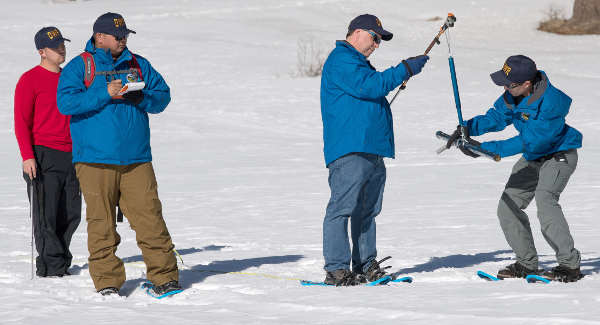
NORTHERN CALIFORNIA – On Thursday, the California Department of Water Resources conducted the first Phillips Station snow survey of 2019.
The manual survey recorded 25.5 inches of snow depth and a snow water equivalent of 9 inches, which is 80 percent of average for this location.
Statewide, the Sierra snowpack is 67 percent of average. The results confirm that despite early winter storms, Sierra water content is below average for this time of year.
“The last few years have shown how variable California’s climate truly is and what a profound impact climate change has on our water resources,” said DWR Director Karla Nemeth. “California’s significant weather variability means we can go from historic drought to record rainfall, with nothing in between. Climate change will continue to exacerbate the extremes, creating additional challenges for maintaining water supply reliability and the need for innovative solutions.”
Climate change has also shifted the balance of rain and snow, with rain falling at higher elevations than in the past.
DWR’s manual snow surveys, combined with our electronic snow sensors and emerging technology, enable successful runoff forecasts and water resource management.
“About two-thirds of California’s annual rainfall occurs December through March. Total precipitation so far this water year, which began Oct. 1, has been below average,” said DWR State Climatologist Michael Anderson. “We still have three wet season months ahead of us, so there’s time for the snowpack to build and improve before it begins to melt, which usually starts happening around April 1.”
On average, the snowpack supplies about 30 percent of California’s water needs as it melts in the spring and early summer.
The greater the snowpack water content, the greater the likelihood California’s reservoirs will receive ample runoff as the snowpack melts to meet the state’s water demand in the summer and fall.
DWR has conducted manual snow surveys at Phillips Station since 1964, recording both depth and snow water equivalent. Snow water equivalent is the depth of water that theoretically would result if the entire snowpack melted instantaneously. That measurement allows for a more accurate forecast of spring runoff.
DWR conducts five snow surveys each winter – near the first of January, February, March, April and May – at Phillips Station in the Sierra Nevada just off Highway 50 near Sierra-at-Tahoe.
The Phillips snow course is one of hundreds that will be surveyed manually throughout the winter.
Manual measurements augment the electronic readings from about 100 snow pillows in the Sierra Nevada that provide a current snapshot of the water content in the snowpack.