 How to resolve AdBlock issue?
News
Community Development Director Michalyn DelValle held the workshop with the board at its Dec. 18 meeting.
She said vacation rentals and short-term housing – such as are featured by AirBNB – are not currently regulated under the Lake County Zoning Ordinance.
Between 250 and 300 units are believed to be occupied in Lake County, she said. The county isn’t sure if they’re vacation units, beds and breakfasts.
DelValle said the zoning ordinance does currently regulate hotels, motels, bed and breakfasts, bed and breakfast inns and recreation vehicle parks. They are used for 30 calendar days or less, with the exception of bed and breakfasts, which have a maximum stay of 14 days.
Hotels and motels have to go through a design review process for permitting. Bed and breakfasts – which have two or fewer guest rooms – are permitted with a minor use permit in several zoning designations, except for two, where they’re permitted with a major use permit. A bed and breakfast inn has three to eight guest rooms.
DelValle said a recreational vehicle park can be permitted in various zoning districts subject to obtaining a major use permit.
She wanted to talk with the board about vacation rentals and how some other jurisdictions have been permitting them.
Based on DelValle’s research, most other jurisdictions permit vacation rentals with a zoning permit over the counter if they’re under a threshold of a certain number of rooms. Typically, they have a maximum occupancy, and septic and sewer system loads will limit the number of rooms that can be rented out.
Some jurisdictions limit the number of daytime visitors, and many set a limit of one vacation rental per parcel and specify the number of parking spaces, she said.
Regarding noise, DelValle said applicable noise standards already are in the Lake County Zoning Ordinance.
Some other jurisdictions have quiet hours, which typically are 10 p.m. to 7 a.m.; require that a property manager be located within a certain distance so they can respond to complaints and a notice must be posted regarding the property manager’s name and contact information; and require legal noticing to notify the neighbors even if the vacation rental can be permitted with the zoning permit, she said.
Other rules DelValle found in her research included trash management guidelines, a required distance between rentals and a complaint process that allows for permit revocation if there are three complaints within a year.
“Some jurisdictions flat-out prohibit them,” DelValle said of vacation rentals.
DelValle sought direction from the board regarding whether its members wanted to establish a permit process since the county doesn’t have one or if they want to simply prohibit them. She said typically vacation rentals are prohibited where single family dwellings are a permitted use.
Board members indicated their desire to consider the matter further.
Supervisor Moke Simon – who called AirBNB the world’s largest hotel – said he is seeing a lot of homes in his district rented out, and he wanted an in-depth discussion.
Supervisor Jeff Smith said parking is the biggest issue, and making sure there is plenty of it – at least one parking space for every two people.
The board agreed to hold a longer discussioni on the matter on Jan. 29.
Email Elizabeth Larson at
Residents of Sonoma, Lake, Napa, Colusa, Yolo and Solano counties can expect to see smoke in the air regularly, as their neighbors and Cal Fire prepare for the 2019 fire season.
Safe residential pile burning of forest residue by landowners is a crucial tool in reducing fire hazards, said Cal Fire Sonoma Lake Napa Unit Chief Shana Jones.
Jones said residents are responsible for making sure all guidelines and regulations from your local air quality management districts are followed.
Debris burning requirements include:
• Only dry, natural vegetative material such as leaves, pine needles and tree trimmings may be burned.
• The burning of trash, painted wood or other debris is not allowed.
• Do not burn on windy days.
• Piles should be no larger than four feet in diameter and in height. You can add to pile as it burns down.
• Clear a 10-foot line down to bare soil around your piles.
• Have a shovel and a water source nearby.
• An adult is required to be in attendance of the fire at all times.
Individuals are asked to use caution and follow all guidelines and maintain control of the fire at all times.
Residents must verify it is a permissive burn day prior to burning.
Call the Lake County Air Quality Management District at 707-263-7000.
Other regional fires districts are as follows:
• Northern Sonoma County Air Pollution Control District: 707-565-2876.
• Colusa County Air Pollution Control District: 530-458-0581.
• Yolo-Solano Air Quality Management District: 530-757-3660.
• Bay Area Air Quality (for Napa and southern Sonoma County): 415-749-5000.
For more information, visit the Cal Fire Web site at http://www.readyforwildfire.org/Debris-Burning/.
 Babies born 10 miles apart could represent a life expectancy difference of almost 33 years. Ana Prego/shutterstock.com
Newly released data on life expectancy across the U.S. shows that where we live matters for how long we live.
A person in the U.S. can expect to live an average of 78.8 years, according to the most recent numbers from the Centers for Disease Control and Prevention (CDC).
However, life expectancy varies widely across geography. A child born in Mississippi today could expect to never reach his or her 75th birthday. But a child born in California, Hawaii or New York could expect to reach their expect to live into the early 80s.
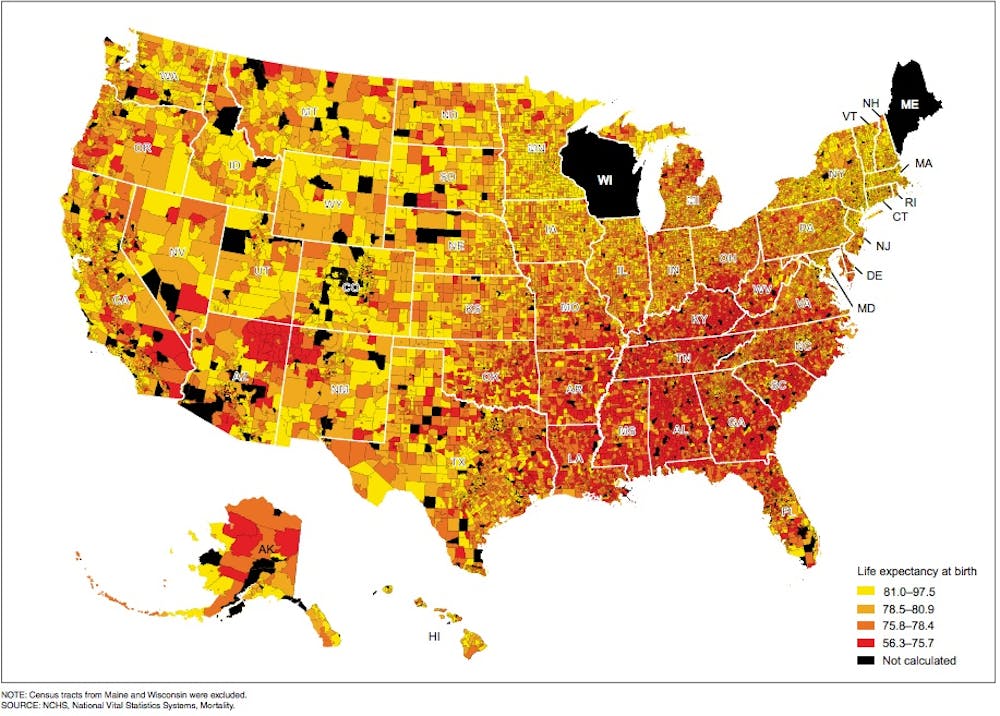
At the neighborhood level, these differences are sometimes even more drastic, appearing even when communities are only a few miles apart. In Washington, D.C., for example, people living in the Barry Farms neighborhood face a life expectancy of 63.2 years. Yet, less than 10 miles away, a baby born in Friendship Heights and Friendship Village can expect to live 96.1 year, according to CDC data.
Just 10 miles represent a life expectancy difference of almost 33 years, a generation lost due to premature deaths. Overall, any two census tracts in the U.S. can differ in expected life expectancy by 41.2 years, a staggering range. These missing lives have important social and economic costs, for families, communities and workplaces.
The opioid epidemic and increases in suicide rates are partially responsible for premature deaths and a decline in life expectancy, especially among working-class, middle-age whites. But these causes fail to explain long-standing differences in life expectancy across place, race and class.
Neighborhoods with large black populations tend to have lower life expectancies than communities that are majority white, Hispanic or Asian. Such racial differences reflect the places in which different races live, not the individual characteristics of people themselves. Research shows that black communities are less likely to have access to resources that promote health, like grocery stores with fresh foods, places to exercise and quality health care facilities. This is true even in middle-class neighborhoods.
These communities also have less opportunities for economic prosperity, with higher unemployment rates and fewer opportunities to work and quality education, all of which shape health outcomes across a lifespan.
How well a place is doing economically affects how long people who live there can expect to live. Places that are economically distressed, for example, tend to have the lowest life expectancies. As new research from the Census Bureau and researchers at Harvard and Brown universities shows, children from places that are economically disadvantaged tend to have worse outcomes as adults.
People who earn less also tend to die sooner. One study from Raj Chetty, a leading researcher on economic opportunity and health, and colleagues suggests that lower incomes are associated with shorter lifespans in the U.S. Income is not distributed evenly across the country. Uneven income patterns may reflect unequal public investments in social programs that help people earn more, like education.
Place, race and class shape how well, and how long, people live. But state and local governments could play a role in increasing life expectancies. Research shows that where local government spending is higher, life expectancies increase among those with lower incomes.
From my perspective of a public health researcher, investments that could improve health behaviors – such as building grocery stores, increasing exercise opportunities and discouraging smoking – could also increase life expectancy. Policies that promote economic prosperity and address the impacts of racial segregation – such as investments in quality education, safe and affordable housing, and improved public transportation – could also help.
Life expectancy is not the only or the best way to measure health and well-being in the U.S. But it is a good way to measure the country’s progress toward good health for all populations, regardless of where they live.
Jessica Young, Assistant Professor of Health Studies, American University
This article is republished from The Conversation under a Creative Commons license. Read the original article.
Depending on your own religious inclinations, the idea of saints conjures up different associations.
To some, they imagine comfort, protection, righteousness and concrete evidence of God’s presence in the world. To others, they imagine persecution, dogmatic adherence and clericalism.
Regardless of your views, I think it’s safe to say that many people don’t think of America, when they think of saints.
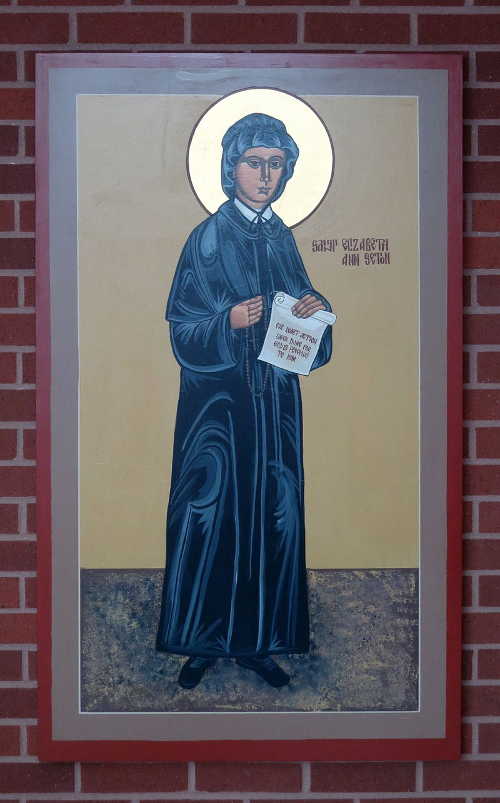
And yet, there is Elizabeth Ann Seton, the first American-born saint.
Elizabeth Ann Bayley couldn’t have been more American. She was an actual daughter of the American Revolution, having been born in 1774, just two years before the Declaration of Independence was penned.
By marriage and by parentage, she was the fruit of generations of wealthy and influential New Yorkers. Elizabeth’s father, Dr. Richard Bayley, raised her as a good Episcopalian, and she learned the disciplined religious observance characteristic of the Episcopal faith.
At 19, Elizabeth was the belle of New York and she liked it. She soon married William Magee Seton, a wealthy businessman. Over the next several years, the happy couple had five children.
Following in her father’s footsteps, Elizabeth Ann Seton became deeply involved in philanthropic work and in 1797, together with Isabella Graham and other women of elite New York society, she formed the Society for the Relief of Poor Widows with Small Children – the city’s first charitable organization.
Everything went to Hell for Elizabeth when her husband died of tuberculosis and the business failed. Widowed at just 30 and with five children to care for, she was terrified.
While her husband still lived, she had travelled with him to Italy to seek a cure for his ailment. While there, in the capital of the Catholic faith, she observed what she considered the quiet, but deep devotion to God’s will.
She also met some old friends of her husband’s, who were also Catholic, providing her a up-close look at the faith. Although her husband and her left with no cure, Elizabeth herself returned to America with a new interest.
After her husband’s death, against all sense and the wishes of family and friends, Elizabeth converted to Catholicism in March of 1805, one year after her husband’s death.
Herself now a widow with small children, she found it almost impossible to earn a living. Like many of the young women she had helped through the charitable organization, Elizabeth now had no support from her family and friends.
The moment she had converted, she was cast out from society almost entirely. For a time she operated a small school for boys, in order to scrape by, but things were still looking grim.
In early America, and for a century later, anti-Catholic sentiment was rampant. As ardent Protestants, the faithful in America held a deep-seated distrust for Catholics, in part stemming from what they perceived as their following to a distant potentate in Rome.
It didn’t help that Catholicism was so centralized compared to the more regional individuality of American Protestantism. It is easier to ascribe conspiratorial ambitions to an organized group with international reach.
Later in the 1830s, as nativist sentiment in America reached a fever pitch, lurid rumors about sexual slavery and infanticide spurred riots against Catholics in cities like Philadelphia.
For now, Elizabeth only had bigots to deal with. After facing difficulty with her school for boys, she accepted an invitation in 1808 from the priest (later bishop) Louis William Dubourg, president of St. Mary’s College in Baltimore, Maryland. Dubourg wanted Ann to open a school for Catholic girls in that city.
Together with several young women who joined in her work, Elizabeth transported her mission of charity in a new city. Meanwhile, members of the Catholic hierarchy and the Italian friends she had met in Italy, paid for the education of her two sons at Georgetown University.
With her children’s future secured, Elizabeth fulfilled a dream of hers and in 1809 founded a religious community. Seton and the other women she worked with took the oath and became the Sisters of St. Joseph, the first American-based Catholic sisterhood.
A few months later Mother Seton and the sisters moved their home and school to Emmitsburg, Maryland, where they provided free education for the poor girls of the parish.
Until her death in 1821, Mother Seton piloted what many consider the first Catholic parochial school in the United States.
Not all was rosy for Mother Seton. Two of her daughters died of the very disease that had taken her husband and Mother Seton herself continuously struggled with the disease. Ultimately, tuberculosis would claim her too.
Elizabeth Ann Seton’s legacy was legion, including the inspiration for Seton Hall College, which was named after her and remains a school of higher education to this day. She was officially canonized in 1975.
St. Elizabeth Ann Seton’s feast day is Jan. 4, and she is the patron saint of widows. She was the first American born Catholic saint. Often depicted in a voluminous, black dress and bonnet typical of New England at the time, St. Elizabeth Ann Seton certainly looks the part.
Antone Pierucci is curator of history at the Riverside County Park and Open Space District and a freelance writer whose work has been featured in such magazines as Archaeology and Wild West as well as regional California newspapers.
Dogs available for adoption this week include mixes of boxer, Chihuahua, Dachshund, husky, Labrador Retriever, pit bull, Shar Pei and shepherd.
Dogs that are adopted from Lake County Animal Care and Control are either neutered or spayed, microchipped and, if old enough, given a rabies shot and county license before being released to their new owner. License fees do not apply to residents of the cities of Lakeport or Clearlake.
If you're looking for a new companion, visit the shelter. There are many great pets hoping you'll choose them.
The following dogs at the Lake County Animal Care and Control shelter have been cleared for adoption (additional dogs on the animal control Web site not listed are still “on hold”).

‘Jax’
“Jax” is a male shepherd-husky mix with a short tan and white coat.
He’s in kennel No. 15, ID No. 11547.

Male pit bull terrier
This male pit bull terrier has a short brindle and white coat.
He’s in kennel No. 18, ID No. 11543.

Senior Chihuahua
This senior male Chihuahua has a short black and gray coat.
He already has been neutered.
He’s in kennel No. 19, ID No. 11560.

Shar Pei-Labrador Retriever
This female Shar Pei-Labrador Retriever has a medium-length red coat.
She’s in kennel No. 20, ID No. 11562.

‘Tank’
“Tank” is a male pit bull terrier with a short brown brindle coat.
He already has been neutered.
He’s in kennel No. 21, ID No. 7002.

Male boxer puppy
This male boxer puppy has a medium-length black and brown coat.
He already has been neutered.
He’s in kennel No. 26, ID No. 11537.

Male boxer puppy
This male boxer puppy has a medium-length tricolor coat.
He already has been neutered.
He’s in kennel No. 26, ID No. 11538.

Male boxer puppy
This male boxer puppy has a short black and brown coat.
He already has been neutered.
He’s in kennel No. 26, ID No. 11533.

Female boxer puppy
This female boxer puppy has a medium-length black and brown coat.
She has already been spayed.
She’s in kennel No. 27, ID No. 11534.

Female boxer puppy
This female boxer puppy has a medium-length black and brown coat.
She has already been spayed.
She’s in kennel No. 27, ID No. 11535.

Female boxer puppy
This female boxer puppy has a medium-length black and brown coat.
She has already been spayed.
She’s in kennel No. 27, ID No. 11536.

Male Dachshund puppy
This male Dachshund puppy has a short buff-colored coat.
He already has been neutered.
He’s in kennel No. 31a, ID No. 11553.

Male Dachshund puppy
This male Dachshund puppy has a short black and tan coat.
He already has been neutered.
He’s in kennel No. 31b, ID No. 11554.

‘Luna’
“Luna” is a female Dachshund with a short black and tan coat.
She’s in kennel No. 32, ID No. 11552.
Lake County Animal Care and Control is located at 4949 Helbush in Lakeport, next to the Hill Road Correctional Facility.
Office hours are Monday through Friday, 11 a.m. to 5 p.m., and 11 a.m. to 3 p.m., Saturday. The shelter is open from 11 a.m. to 4 p.m. Monday through Friday and on Saturday from 11 a.m. to 3 p.m.
Visit the shelter online at http://www.co.lake.ca.us/Government/Directory/Animal_Care_And_Control.htm.
For more information call Lake County Animal Care and Control at 707-263-0278.
Email Elizabeth Larson at
 What dangerous experiences lurk behind the use of this trackpad? Amy Walters/Shutterstock.com
Data breaches, widespread malware attacks and microtargeted personalized advertising were lowlights of digital life in 2018.
As technologies change, so does the advice security experts give for how to best stay safe. As 2019 begins, I’ve pulled together a short list of suggestions for keeping your digital life secure and free of manipulative disinformation.
1. Set your boundaries and stick to them
As part of my research, I’ve recently been speaking with a number of sex workers in Europe about their digital security and privacy. One consistent thing I’ve heard from them is, “The best way to stay safe is to set boundaries.” Decide – on your own, and in advance – what data you’re willing to share with apps and online services, and stick to those limits.
That way, when the latest new app asks you for a permission that oversteps what you’re willing to share, you’ll be more prepared to answer. Also set limits on the online discussions you’re willing to participate in; bow out when a discussion is hurting more than helping you. It’s even useful to set boundaries for how much time you’re willing to spend on digital security – which could be an endless task.
2. Burst your filter bubble
People who get their news primarily – or exclusively – from social media are subjecting themselves to the whims of the algorithms that decide what to display to each user.
Because of how these algorithms work, those people are likely to see articles only from news sources they already like and tend to agree with. This isolation from people with other views, and from evidence that might challenge particular perspectives, contributes to unprecedented levels of partisanship and disagreement in modern society.
Free online tools like AllSides and Purple Feed are some places that show news reports and social media posts from differing political perspectives, and identify information that’s generally agreed upon across the political spectrum.
3. Manage your passwords
The biggest threat to password security is no longer the strength of your passwords but the fact that many people reuse the same passwords for all, or many, of their accounts. Researchers are busy designing notifications to tell you when one of these reused passwords has been leaked to the world, but it’s safer to use different passwords, especially for your most valuable accounts.
You can use password manager software. Or, use the original low-tech method, writing your passwords down on paper. Believe it or not, it’s much safer to write them down than reuse the same password everywhere. Of course, this is true only if you’re sure the people you live with or frequent visitors to your home won’t try to get into your accounts.
4. Turn on multi-factor authentication
Adding an additional step for logging in to your most important social media, email and financial accounts can add lots of protection. Multi-factor authentication systems are best known for texting you a six-digit code to type in as part of your login process. While any multi-factor authentication is better than none, text messages can fairly easily be intercepted or spied on. An even safer route is to use a special code-generating app on your phone.


People who change phones or SIM cards often, or who want additional protection, might consider using a physical key that plugs into your computer to authorize a login. They can take a bit more time to set up initially, but then work much faster than most other methods.
5. Delete apps you don’t use
Smartphone apps track where you are very closely, and share your location data with advertising and marketing companies.
Just carrying a phone in your pocket can give tracking companies clues to where you go and how long you stay, and technical details about your phone can offer clues to your identity.
If you don’t use an app anymore, uninstall it from your phone. If you need it again, you can always reinstall it quickly – but in the meantime, it won’t be tracking you around the world and around the web.
6. Keep the apps you do use up-to-date
Software companies don’t always know about all the vulnerabilities in their programs – and when they issue updates users don’t always know if they’re fixing a major problem or something minor. The top piece of advice experts give is to keep your software up-to-date on your computers and your mobile devices.
Having spent 2018 worrying about how hackers, corporate executives and hurried programmers might be trying to exploit your data and your cognitive and digital vulnerabilities, resolve to be more secure in 2019.
Elissa Redmiles, Ph.D. Student in Computer Science, University of Maryland
This article is republished from The Conversation under a Creative Commons license. Read the original article.