 How to resolve AdBlock issue?
News
Hours will be 8 a.m. to 5 p.m.
Real estate and other major transactions frequently require critical documents to be recorded. This county service is integral to many local businesses, and supports numerous public priorities, such as ensuring appropriate documentation of private property ownership.
“Recordings typically increase on the last few days of the year, and much of the increase is generated through title companies,” said Ford. “To serve the public, our office always ramps up staffing during this key period. This year, with all county offices closed Dec. 24 through 26, we also felt it was important to make an exception to our normal public hours, and remain open on Friday, Dec.r 28.”
This year has been one “of meaningful positive change for county offices, despite the many consequences brought by disaster,” said County Administrative Officer Carol Huchingson. “I am excited that our Recorder’s Office will bring this year to a strong close with these additional public hours.”
“While most of our increase in business this time of year is driven by title companies, every transaction we complete and each document we record is meaningful to the individual we are serving,” states Ford. “It is a standing priority of our office to provide all of our customers the highest possible level of service.”
“This year, assuring the best possible public service has meant taking time to strengthen developing staff in many county departments,” notes Huchingson. “Our Friday closures have had significant benefit for all county departments in which they have been implemented.”
“The Assessor-Recorder’s Office has been able to prioritize critical training needs, for example, and for a developing team that has seen significant turnover in recent years, that is huge,” said Huchingson. “Recording staff are ready to provide excellent service during this end-of-the-year push because of those training opportunities. Our recorder’s decision to keep his office open Dec. 28 is a great service for Lake County’s title companies and the public.”
County residents will be able to access Recorder’s Office services, including:
– Deeds;
– Deeds of Trust;
– Title documents;
– Other documents related to real property.
All county offices will be open to the public Thursday, Dec. 27, and Monday, Dec. 31, from 8 a.m. to 5 p.m.
The Recorder’s Office can be reached at 707-263-2293.
To support its mission of providing the highest levels of safety, service, and security, the California Highway Patrol is highlighting several of these new laws.
Bicycle hit-and-run on bike path (AB 1755, Steinorth)
The provisions of the felony hit-and-run law are extended to cyclists on Class I bikeways (bike paths). Currently, in the California Vehicle Code, a driver involved in a collision resulting in death or injury to another party is required to stop at the scene. This law clarifies that the same vehicle code also applies on Class I bikeways and allows law enforcement to hold individuals accountable for reckless behavior.
Bicycle helmets (AB 3077, Caballero)
Persons under age 18 not wearing a helmet on a bicycle, scooter, skateboard, or skates will receive a “fix-it” ticket. A citation is considered non-punitive and correctable if proof that the minor has completed a bicycle safety course and has a helmet that meets safety standards is presented within 120 days to the issuing law enforcement agency.
Helmet use on motorized scooters (AB 2989, Flora)
Bicycle helmets are no longer required for riders of motorized scooters who are age 18 or older. Motorized scooters may operate within a Class IV bikeway as well as a Class II bikeway and on highways with speed limits up to 25 miles per hour. Local jurisdictions may pass ordinances to allow motorized scooters on highways with speed limits up to 35 miles per hour. It is still illegal to operate a motorized scooter on a sidewalk.
Certain vehicle exhaust violations no longer correctable (AB 1824, Committee on Budget)
A fine will become mandatory, not correctable, when loud motor vehicles and motorcycles are cited. Previously, a driver or motorcyclist who was cited for modified or excessively loud exhaust or muffler systems could correct the violation to avoid a fine.
Passing waste service vehicles (AB 2115, Santiago)
When approaching or overtaking a refuse collection vehicle with its amber lights flashing, drivers must move into an adjacent lane, if possible, and pass at a safe distance. If it is not possible, drivers must slow to a safe and reasonable speed. This law provides a safety margin for sanitation workers while they are actively working.
We have a tradition in my family, one I know we share with many.
On Christmas Eve when I was a kid, after our extended family had left for the night and my parents were gearing up for a late night of setting out presents, my brother and I would reach for a well-worn pop-up book copy of “Twas the Night Before Christmas.”
Many of the pop-up tabs had long since been torn, so that St. Nick didn’t so much “pop” as “dangle” from the page, but as kids, on the evening before the greatest day of the year, we didn’t care. My mother would read us the book.
It told a story both familiar and yet not – a true fairytale.
The tale had the usual cast of characters. We recognized Santa easily enough, although his coat was trimmed in more gold than our shabby Coca Cola version of him is. Other bits of the story were more foreign to us (what, after all, are sugar plums?), but that just added to the flair of the book.
Reading this short poem remains a tradition, even if my brother, mother and I aren’t always together every Christmas Eve, and my brother and I don’t sit on her lap when we are. You can imagine my surprise, then, when I discovered that the text of this most beloved of childhood storybooks was different, in some very key respects, to the original poem.
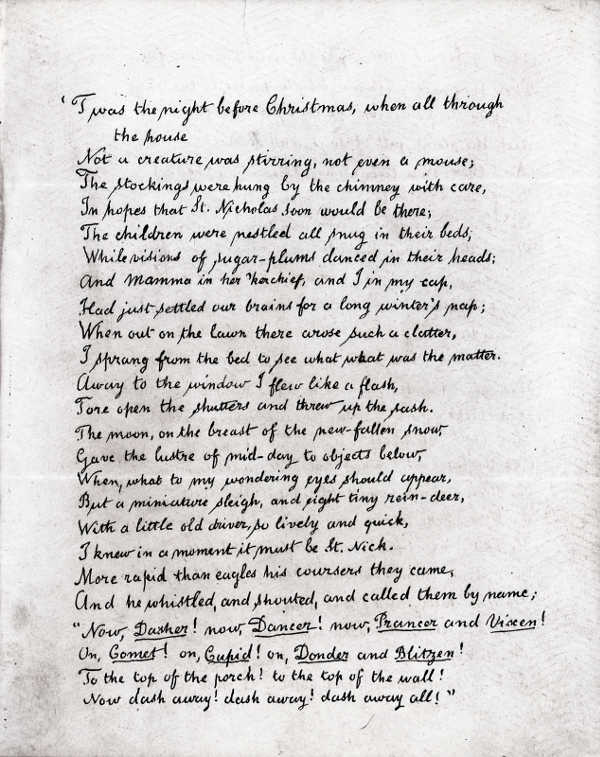
The original poem was published on Dec. 23, 1823, in New York's “Troy Sentinel.” Below is the complete text of the original poem:
‘Twas the night before Christmas, when all thro’ the house,
2 Not a creature was stirring, not even a mouse;
3 The stockings were hung by the chimney with care,
4 In hopes that St. Nicholas soon would be there;
5 The children were nestled all snug in their beds,
6 While visions of sugar plums danc’d in their heads,
7 And Mama in her ‘kerchief, and I in my cap,
8 Had just settled our brains for a long winter’s nap-
9 When out on the lawn there arose such a clatter,
10 I sprang from the bed to see what was the matter.
11 Away to the window I flew like a flash,
12 Tore open the shutters, and threw up the sash.
13 The moon on the breast of the new fallen snow,
14 Gave the lustre of mid-day to objects below;
15 When, what to my wondering eyes should appear,
16 But a minature sleigh, and eight tiny rein-deer,
17 With a little old driver, so lively and quick,
18 I knew in a moment it must be St. Nick.
19 More rapid than eagles his coursers they came,
20 And he whistled, and shouted, and call’d them by name:
21 “Now! Dasher, now! Dancer, now! Prancer, and Vixen,
22 “On! Comet, on! Cupid, on! Dunder and Blixem;
23 “To the top of the porch! to the top of the wall!
24 “Now dash away! dash away! dash away all!”
25 As dry leaves before the wild hurricane fly,
26 When they meet with an obstacle, mount to the sky;
27 So up to the house-top the coursers they flew,
28 With the sleigh full of Toys - and St. Nicholas too:
29 And then in a twinkling, I heard on the roof
30 The prancing and pawing of each little hoof.
31 As I drew in my head, and was turning around,
32 Down the chimney St. Nicholas came with a bound:
33 He was dress’d all in fur, from his head to his foot,
34 And his clothes were all tarnish’d with ashes and soot;
35 A bundle of toys was flung on his back,
36 And he look’d like a peddler just opening his pack:
37 His eyes - how they twinkled! his dimples how merry,
38 His cheeks were like roses, his nose like a cherry;
39 His droll little mouth was drawn up like a bow,
40 And the beard of his chin was as white as the snow;
41 The stump of a pipe he held tight in his teeth,
42 And the smoke it encircled his head like a wreath.
43 He had a broad face, and a little round belly
44 That shook when he laugh’d, like a bowl full of jelly:
45 He was chubby and plump, a right jolly old elf,
46 And I laugh’d when I saw him in spite of myself;
47 A wink of his eye and a twist of his head
48 Soon gave me to know I had nothing to dread.
49 He spoke not a word, but went straight to his work,
50 And fill’d all the stockings; then turn’d with a jerk,
51 And laying his finger aside of his nose
52 And giving a nod, up the chimney he rose.
53 He sprung to his sleigh, to his team gave a whistle,
54 And away they all flew, like the down of a thistle:
55 But I heard him exclaim, ere he drove out of sight-
56 Happy Christmas to all, and to all a good night.
Did you notice the differences? I’m sure our pop-up book version wasn’t the only one edited. The most important differences are in the names of the reindeer. Notice that “Donner and Blitzen” were originally “Dunder and Blixem.”
Why does this matter? Well, for one, it throws a wrench in ascribing the authorship of the poem.
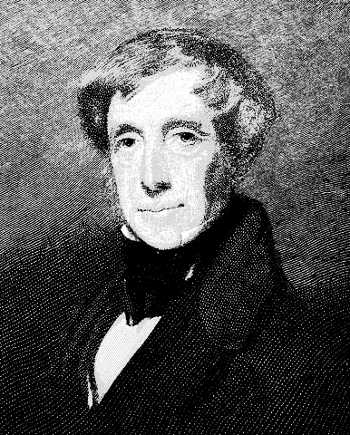
When it was published in 1823, it was printed with no name attached. It wasn’t until 13 years later that American professor and poet Clement Clarke Moore claimed ownership of the by-then famous holiday poem.
The problem was, the children of a certain Henry Livingston Jr. claimed their father had recited that poem to them every year for 15 years before it made its public debut.
And that’s where Dunder and Blixem come into play. Livingston came from a Dutch family, and the poem “A Visit from St. Nick” (the original title) has traces of Dutch references all over it.
The traditions of stockings and the depiction of St. Nick had long been features of Dutch Christmas tales (along with some other unsavory ones like Krampus, etc.).
The most explicit references are the names of two of the reindeer: Dunder, which means Thunder in Dutch, and Blixem, which means Lightening (later the spellings of the Dutch words changed to “donder” and “bliksem”).
In the poem, Blixem first became Blixen to better rhyme with “Vixen” and then in 1844, when Moore published the poem in an anthology of his poetry, he changed it to the German form of “Blitzen.” Moore changed Dunder to Donder and in the early 20th century, it became Donner.
Other clues have led people to suspect that Livingston had indeed authored the poem, including the fact that the poem is completely different – in tone, style and meter – from anything Moore ever wrote, but was similar to poems written by Livingston.
We’ll never know who really wrote the poem, although Moore’s name is still attached to each published version.
I guess in the end, it doesn’t matter whether St. Nick called on Dunder and Blixem or Donner and Blitzen. The story is what matters, and the memories attached to it.
Happy Christmas to all and to all a good night!
Antone Pierucci is curator of history at the Riverside County Park and Open Space District and a freelance writer whose work has been featured in such magazines as Archaeology and Wild West as well as regional California newspapers.
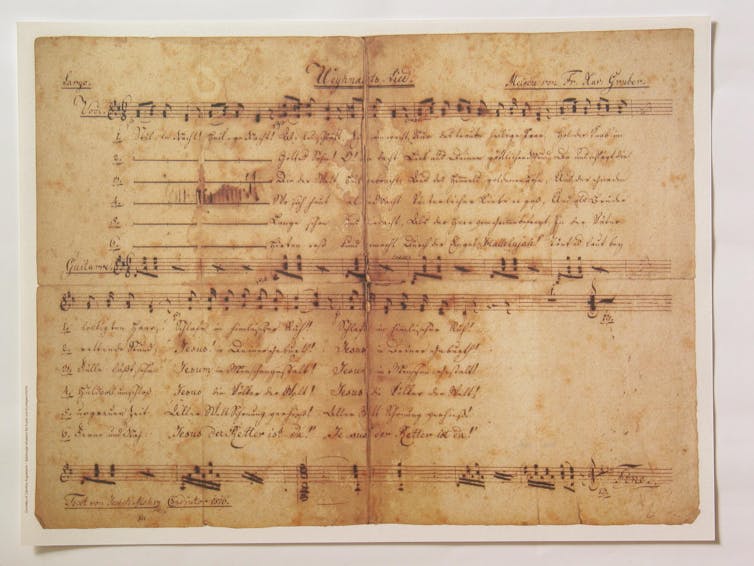 This undated score, written by Joseph Mohr and titled ‘Weynachts Lied’ (‘Christmas Carol’), is the earliest known surviving copy of ‘Silent Night.’ Salzburg Museum
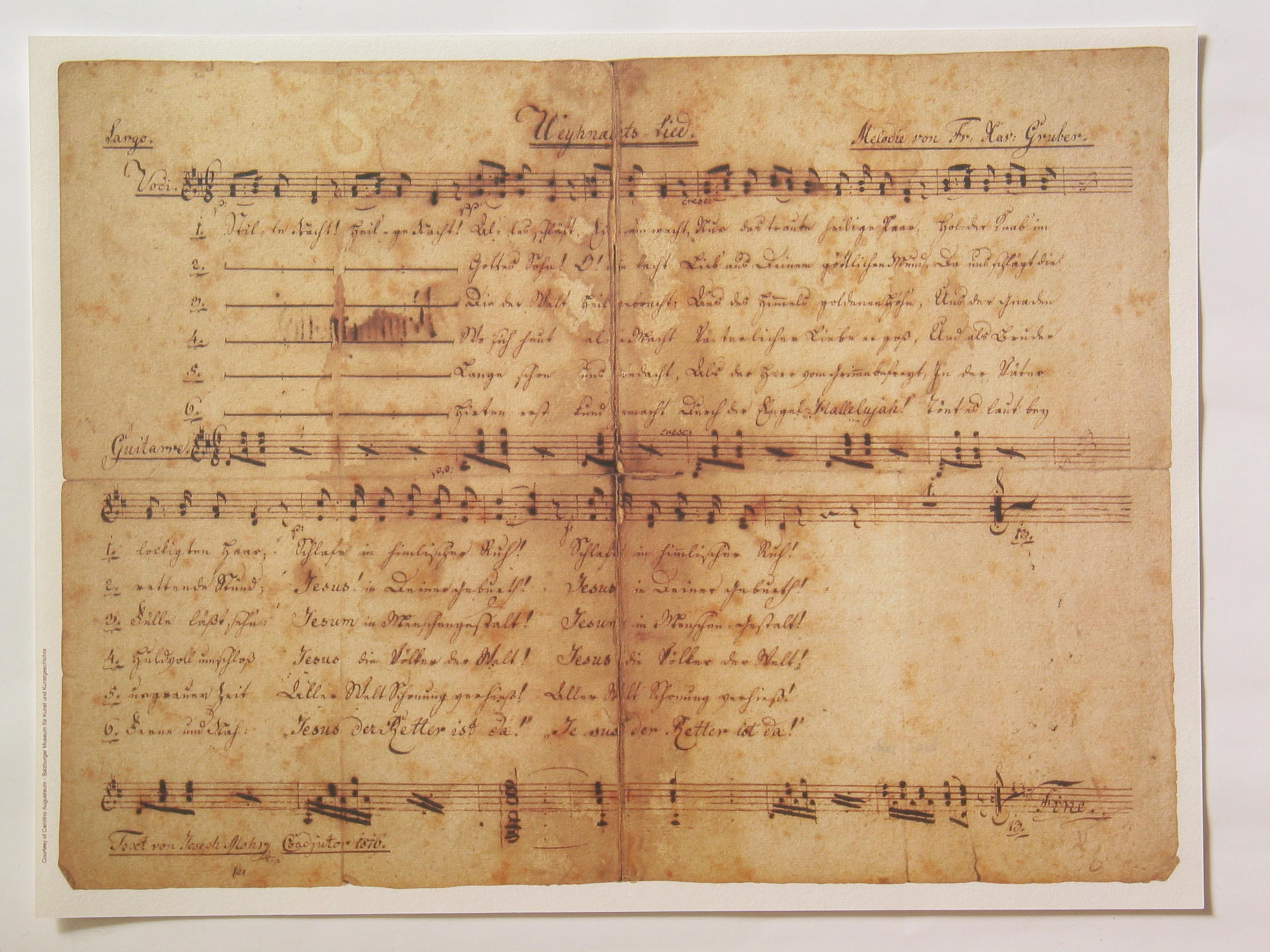
One of the world’s most famous Christmas carols, “Silent Night,” celebrates its 200th anniversary this year.
Over the centuries, hundreds of Christmas carols have been composed. Many fall quickly into obscurity.
Not “Silent Night.”
Translated into at least 300 languages, designated by UNESCO as a treasured item of Intangible Cultural Heritage, and arranged in dozens of different musical styles, from heavy metal to gospel, “Silent Night” has become a perennial part of the Christmas soundscape.
Its origins – in a small Alpine town in the Austrian countryside – were far humbler.
As a musicologist who studies historical traditions of song, the story of “Silent Night” and its meteoric rise to worldwide fame has always fascinated me.
Fallout from war and famine
The song’s lyrics were originally written in German just after the end of the Napoleonic Wars by a young Austrian priest named Joseph Mohr.
In the fall of 1816, Mohr’s congregation in the town of Mariapfarr was reeling. Twelve years of war had decimated the country’s political and social infrastructure. Meanwhile, the previous year – one historians would later dub “The Year Without a Summer” – had been catastrophically cold.
The eruption of Indonesia’s Mount Tambora in 1815 had caused widespread climate change throughout Europe. Volcanic ash in the atmosphere caused almost continuous storms – even snow – in the midst of summer. Crops failed and there was widespread famine.
Mohr’s congregation was poverty-stricken, hungry and traumatized. So he crafted a set of six poetic verses to convey hope that there was still a God who cared.
“Silent night,” the German version states, “today all the power of fatherly love is poured out, and Jesus as brother embraces the peoples of the world.”
A fruitful collaboration
Mohr, a gifted violinist and guitarist, could have probably composed the music for his poem. But instead, he sought help from a friend.
In 1817, Mohr transferred to the parish of St. Nicholas in the town of Oberndorf, just south of Salzburg. There, he asked his friend Franz Xaver Gruber, a local schoolteacher and organist, to write the music for the six verses.
On Christmas Eve, 1818, the two friends sang “Silent Night” together for the first time in front of Mohr’s congregation, with Mohr playing his guitar.
The song was apparently well-received by Mohr’s parishioners, most of whom worked as boat-builders and shippers in the salt trade that was central to the economy of the region.

The melody and harmonization of “Silent Night” is actually based on an Italian musical style called the “siciliana” that mimics the sound of water and rolling waves: two large rhythmic beats, split into three parts each.
In this way, Gruber’s music reflected the daily soundscape of Mohr’s congregation, who lived and worked along the Salzach River.
‘Silent Night’ goes global
But in order to become a worldwide phenomenon, “Silent Night” would need to resonate far beyond Oberndorf.
According to a document written by Gruber in 1854, the song first became popular in the nearby Zillertal valley. From there, two traveling families of folk singers, the Strassers and the Rainers, included the tune in their shows. The song then became popular across Europe, and eventually in America, where the Rainers sang it on Wall Street in 1839.
At the same time, German-speaking missionaries spread the song from Tibet to Alaska and translated it into local languages. By the mid-19th century, “Silent Night” had even made its way to subarctic Inuit communities along the Labrador coast, where it was translated into Inuktitut as “Unuak Opinak.”
The lyrics of “Silent Night” have always carried an important message for Christmas Eve observances in churches around the world. But the song’s lilting melody and peaceful lyrics also reminds us of a universal sense of grace that transcends Christianity and unites people across cultures and faiths.
Perhaps at no time in the song’s history was this message more important than during the Christmas Truce of 1914, when, at the height of World War I, German and British soldiers on the front lines in Flanders laid down their weapons on Christmas Eve and together sang “Silent Night.”
The song’s fundamental message of peace, even in the midst of suffering, has bridged cultures and generations. Great songs do this. They speak of hope in hard times and of beauty that arises from pain; they offer comfort and solace; and they are inherently human and infinitely adaptable.
So, happy anniversary, “Silent Night.” May your message continue to resonate across future generations.
Sarah Eyerly, Assistant Professor of Musicology and Director of the Early Music Program, Florida State University
This article is republished from The Conversation under a Creative Commons license. Read the original article.
Dogs available for adoption this week include mixes of Chihuahua and pit bull.
Dogs that are adopted from Lake County Animal Care and Control are either neutered or spayed, microchipped and, if old enough, given a rabies shot and county license before being released to their new owner. License fees do not apply to residents of the cities of Lakeport or Clearlake.
If you're looking for a new companion, visit the shelter. There are many great pets hoping you'll choose them.
The following dogs at the Lake County Animal Care and Control shelter have been cleared for adoption (additional dogs on the animal control Web site not listed are still “on hold”).

Male pit bull terrier
This male pit bull terrier has a short brindle and white coat.
He’s in kennel No. 16, ID No. 11543.

‘Tank’
“Tank” is a male pit bull terrier with a short brown brindle coat.
He already has been neutered.
He’s in kennel No. 21, ID No. 7002.

Senior Chihuahua
This senior male Chihuahua has a short black and gray coat.
He already has been neutered.
He’s in kennel No. 139, ID No. 11560.
Lake County Animal Care and Control is located at 4949 Helbush in Lakeport, next to the Hill Road Correctional Facility.
Office hours are Monday through Friday, 11 a.m. to 5 p.m., and 11 a.m. to 3 p.m., Saturday. The shelter is open from 11 a.m. to 4 p.m. Monday through Friday and on Saturday from 11 a.m. to 3 p.m.
Visit the shelter online at http://www.co.lake.ca.us/Government/Directory/Animal_Care_And_Control.htm.
For more information call Lake County Animal Care and Control at 707-263-0278.
Email Elizabeth Larson at
New NASA research confirms that Saturn is losing its iconic rings at the maximum rate estimated from Voyager 1 and 2 observations made decades ago.
The rings are being pulled into Saturn by gravity as a dusty rain of ice particles under the influence of Saturn’s magnetic field.
“We estimate that this ‘ring rain’ drains an amount of water products that could fill an Olympic-sized swimming pool from Saturn’s rings in half an hour,” said James O’Donoghue of NASA’s Goddard Space Flight Center in Greenbelt, Maryland. “From this alone, the entire ring system will be gone in 300 million years, but add to this the Cassini-spacecraft measured ring-material detected falling into Saturn’s equator, and the rings have less than 100 million years to live. This is relatively short, compared to Saturn’s age of over 4 billion years.”
O’Donoghue is lead author of a study on Saturn’s ring rain that appeared in Icarus Dec. 17.
Scientists have long wondered if Saturn was formed with the rings or if the planet acquired them later in life. The new research favors the latter scenario, indicating that they are unlikely to be older than 100 million years, as it would take that long for the C-ring to become what it is today assuming it was once as dense as the B-ring.
“We are lucky to be around to see Saturn’s ring system, which appears to be in the middle of its lifetime. However, if rings are temporary, perhaps we just missed out on seeing giant ring systems of Jupiter, Uranus and Neptune, which have only thin ringlets today!” O’Donoghue added.
Various theories have been proposed for the ring’s origin. If the planet got them later in life, the rings could have formed when small, icy moons in orbit around Saturn collided, perhaps because their orbits were perturbed by a gravitational tug from a passing asteroid or comet.
The first hints that ring rain existed came from Voyager observations of seemingly unrelated phenomena: peculiar variations in Saturn’s electrically charged upper atmosphere (ionosphere), density variations in Saturn’s rings, and a trio of narrow dark bands encircling the planet at northern mid-latitudes.
These dark bands appeared in images of Saturn’s hazy upper atmosphere (stratosphere) made by NASA’s Voyager 2 mission in 1981.
In 1986, Jack Connerney of NASA Goddard published a paper in Geophysical Research Letters that linked those narrow dark bands to the shape of Saturn’s enormous magnetic field, proposing that electrically charged ice particles from Saturn’s rings were flowing down invisible magnetic field lines, dumping water in Saturn’s upper atmosphere where these lines emerged from the planet.
The influx of water from the rings, appearing at specific latitudes, washed away the stratospheric haze, making it appear dark in reflected light, producing the narrow dark bands captured in the Voyager images.
Saturn’s rings are mostly chunks of water ice ranging in size from microscopic dust grains to boulders several yards (meters) across. Ring particles are caught in a balancing act between the pull of Saturn’s gravity, which wants to draw them back into the planet, and their orbital velocity, which wants to fling them outward into space.
Tiny particles can get electrically charged by ultraviolet light from the Sun or by plasma clouds emanating from micrometeoroid bombardment of the rings. When this happens, the particles can feel the pull of Saturn’s magnetic field, which curves inward toward the planet at Saturn’s rings.
In some parts of the rings, once charged, the balance of forces on these tiny particles changes dramatically, and Saturn’s gravity pulls them in along the magnetic field lines into the upper atmosphere.
Once there, the icy ring particles vaporize and the water can react chemically with Saturn’s ionosphere. One outcome from these reactions is an increase in the lifespan of electrically charged particles called H3+ ions, which are made up of three protons and two electrons.
When energized by sunlight, the H3+ ions glow in infrared light, which was observed by O’Donoghue’s team using special instruments attached to the Keck telescope in Mauna Kea, Hawaii.
Their observations revealed glowing bands in Saturn’s northern and southern hemispheres where the magnetic field lines that intersect the ring plane enter the planet. They analyzed the light to determine the amount of rain from the ring and its effects on Saturn’s ionosphere. They found that the amount of rain matches remarkably well with the astonishingly high values derived more than three decades earlier by Connerney and colleagues, with one region in the south receiving most of it.
The team also discovered a glowing band at a higher latitude in the southern hemisphere. This is where Saturn’s magnetic field intersects the orbit of Enceladus, a geologically active moon that is shooting geysers of water ice into space, indicating that some of those particles are raining onto Saturn as well.
“That wasn’t a complete surprise,” said Connerney. “We identified Enceladus and the E-ring as a copious source of water as well, based on another narrow dark band in that old Voyager image.”
The geysers, first observed by Cassini instruments in 2005, are thought to be coming from an ocean of liquid water beneath the frozen surface of the tiny moon. Its geologic activity and water ocean make Enceladus one of the most promising places to search for extraterrestrial life.
The team would like to see how the ring rain changes with the seasons on Saturn. As the planet progresses in its 29.4-year orbit, the rings are exposed to the Sun to varying degrees. Since ultraviolet light from the Sun charges the ice grains and makes them respond to Saturn’s magnetic field, varying exposure to sunlight should change the quantity of ring rain.
The research was funded by NASA and the NASA Postdoctoral Program at NASA Goddard, administered by the Universities Space Research Association. The W.M. Keck Observatory is operated as a scientific partnership among the California Institute of Technology, the University of California, and NASA, and the data in the form of its files are available from the Keck archive.
The authors wish to recognize the significant cultural role and reverence that the summit of Mauna Kea has within the indigenous Hawaiian community; they are fortunate to have the opportunity to conduct observations from this mountain.