 How to resolve AdBlock issue?
News
- Details
- Written by: Lara B. Fowler, Penn State
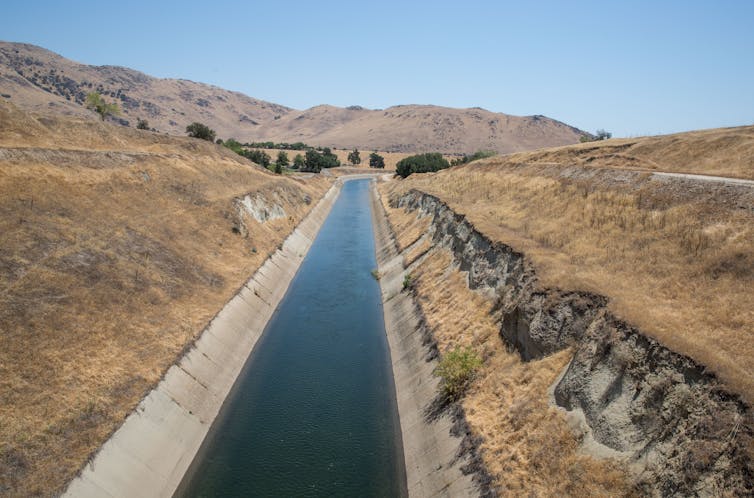
On Dec. 1, 2021, California triggered headlines heard around the world when officials announced how much water suppliers would be getting from the State Water Project. “California water districts to get 0% of requested supplies in an unprecedented decision,” one headline proclaimed. “No state water for California farms,” read another.
The headlines suggested a comparison with the “Zero Day” announcement in Cape Town, South Africa, during a drought in 2018. That was the projected date when water would no longer be available at household taps without significant conservation. Cape Town avoided a water shutoff, barely.
While California’s announcement represents uncharted territory and is meant to promote water conservation in what is already a dry water year, there is more to the story.
California’s drought solution
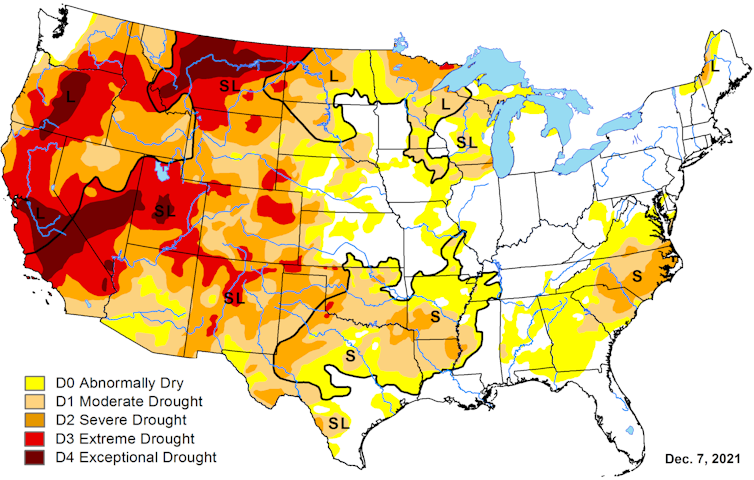
California is a semi-arid state, so a dry year isn’t a surprise. But a recent state report observed that California is now in a dry pattern “interspersed with an occasional wet year.” The state suffered a three-year drought from 2007 to 2009, a five-year drought from 2012 to 2016, and now two dry years in a row; 2020 was the fifth-driest year on record, and 2021 was the second-driest.
Coming into the 2022 water year – which began Oct. 1 – the ground is dry, reservoirs are low and, even with a multi-day storm forecast to bring rain and snow, predictions suggest another drier than normal year.
Over a century ago, well before climate change became evident, officials began planning ways to keep California’s growing cities and farms supplied with water. They developed a complex system of reservoirs and canals that funnel water from where it’s plentiful to where it’s needed.
Part of that system is the State Water Project.
First envisioned in 1919, the State Water Project delivers water from the relatively wetter and, at the time, less populated areas of Northern California to more populated and drier areas, mostly in Southern California. The State Water Project provides water for 27 million people and 750,000 acres of farmland, with about 70% for residential, municipal and industrial use and 30% for irrigation. There are 29 local water agencies – the state water contractors – that helped fund the State Water Project and in return receive water under a contract dating to the 1960s.
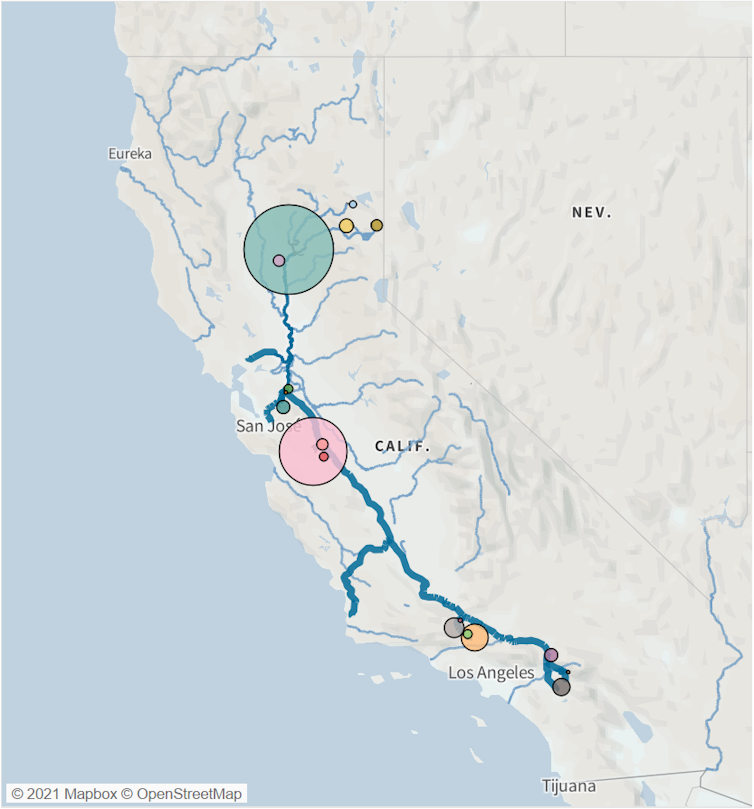
While the State Water Project is important to these local water agencies, it is usually not their only source of water. Nor is all water in California supplied through the State Water Project. Most water agencies have a portfolio of water supplies, which can include pumping groundwater.
What does 0% mean?
Originally, the State Water Project planned to deliver 4.2 million acre-feet of water each year. An acre-foot is about 326,000 gallons, or enough water to cover a football field in water 1 foot deep. An average California household uses around one-half to 1 acre-foot of water per year for both indoor and outdoor use. However, contractors that distribute water from the State Water Project have historically received only part of their allocations; the long-term average is 60%, with recent years much lower.
Based on water conditions each year, the state Department of Water Resources makes an initial allocation by Dec. 1 to help these state water contractors plan. As the year progresses, the state can adjust the allocation based on additional rain or snow and the amount of water in storage reservoirs. In 2010, for example, the allocation started at 5% and was raised to 50% by June. In 2014, the allocation started at 5%, dropped to 0% and then finished at 5%.
This year is the lowest initial allocation on record. According to the state Department of Water Resources, “unprecedented drought conditions” and “reservoirs at or near historic lows” led to this year’s headline-producing 0% allocation.
That’s 0% of each state water contractor’s allocation; however, the department committed to meet “unmet minimum health and safety needs.” In other words, if the contractors cannot find water from other sources, they could request up to 55 gallons per capita per day of water to “meet domestic supply, fire protection and sanitation needs.” That’s about two-thirds of what the average American uses.
The department is also prioritizing water for salinity control in the Sacramento Bay Delta area, water for endangered species, water to reserve in storage and water for additional supply allocations if the weather conditions improve.
Under the current plan, there will be no water from the State Water Project for roughly 10% of California’s irrigated land. As a result, both municipal and agricultural suppliers will be seeking to conserve water, looking elsewhere for water supplies, or not delivering water. None are easy solutions.
The problem with pumping groundwater
To weather previous droughts, many water suppliers relied on groundwater, which led to increased costs for wells, declines in groundwater levels, land subsidence and degraded water quality. California’s Sustainable Groundwater Management Act was enacted in 2014 to help address overpumping of groundwater, but it hasn’t turned these conditions around.
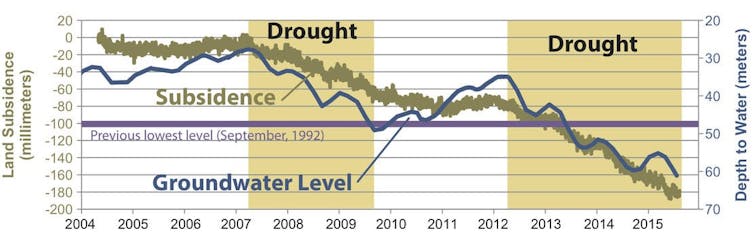
Those who can afford to dig deeper wells have done so, while others have no water as their wells have gone dry. During the 2012-2016 drought, the Public Policy Institute of California found that a majority of affected households that lost water access from their wells were in “small rural communities reliant on shallow wells – many of them communities of color.”
Gov. Gavin Newsom called on residents to voluntarily conserve 15% of their water during summer 2021. Statewide reductions were only 1.8% in July but jumped to 13.2% in October. This year’s snowpack, which acts as a natural reservoir, is far below normal.
Irrigators who depend on the federal Central Valley Project are facing similar drought conditions. Imports from the Colorado River system are also limited, as this basin is also facing its first-ever shortage declaration due to drought.
What’s next?
As someone who has worked in California and the Western U.S. on complex water issues, I am familiar with both drought and floods and the challenges they create. However, the widespread nature of this year’s drought – in California and beyond – makes the challenge even harder.
This “zero allocation” for California’s State Water Contractors is an unprecedented early warning, and likely a sign of what’s ahead.
A recent study warned that the snowpack in Western states like California may decline by up to 45% by 2050, with low- and no-snow years becoming increasingly common. Thirty-seven cities in California have already issued moratoriums on development because of water supply concerns.
If voluntary conservation does not work, enacting mandatory conservation measures like San Jose’s tough new drought rules may be needed. The state is now weighing emergency regulations on water use, and everyone is hoping for more precipitation.
[Over 140,000 readers rely on The Conversation’s newsletters to understand the world. Sign up today.]
Lara B. Fowler, Senior Lecturer in Law and Assistant Director for Outreach and Engagement, Penn State Institutes of Energy and the Environment, Penn State
This article is republished from The Conversation under a Creative Commons license. Read the original article.
- Details
- Written by: Jet Propulsion Laboratory
Engineers are developing the crucial hardware needed for a series of daring space missions that will be carried out in the coming decade.
Testing has already begun on what would be the most sophisticated endeavor ever attempted at the Red Planet: bringing rock and sediment samples from Mars to Earth for closer study.
The multi-mission Mars Sample Return campaign began when NASA’s Perseverance rover landed on Mars this past February to collect Martian rock samples in search of ancient microscopic life.
Out of Perseverance’s 43 sample tubes, four have been filled with rock cores and one with Martian atmosphere. Mars Sample Return seeks to bring select tubes back to Earth, where generations of scientists will be able to study them with powerful lab equipment far too large to send to Mars.
Getting those samples into terrestrial labs would take a decade and involve European partners and multiple NASA centers.
The European Space Agency, or ESA, is developing a rover for the effort, with engineers at NASA’s Glenn Research Center in Cleveland, Ohio, designing its wheels. The rover would transfer samples to a lander, being developed at NASA’s Jet Propulsion Laboratory in Southern California, that would use a robotic arm (developed by ESA) to pack the samples into a small rocket, called a Mars Ascent Vehicle, being designed by NASA’s Marshall Space Flight Center in Huntsville, Alabama.
The rocket would launch from the lander to deliver the sample capsule to an ESA spacecraft orbiting Mars. Inside the orbiter, the capsule would be prepared for delivery to Earth by hardware that a team led by NASA’s Goddard Space Flight Center in Greenbelt, Maryland, is developing.
This preparation would include sealing the sample capsule within a clean container to trap any Martian material inside, sterilizing the seal, and placing the sealed container into an Earth-entry capsule before the return trip to Earth.
The lander
To develop the lander, as well as the system that would help launch the sample-laden rocket from it, engineers at NASA’s JPL are drawing from a long history of Mars exploration: JPL has led nine successful Mars landings, including rovers and stationary landers.
But the Sample Retrieval Lander would be the largest, heaviest spacecraft of its type to ever go to Mars, and the Mars Ascent Vehicle launching from it would be the first rocket ever fired off another planet.
This is where the testing comes in.
To carry and launch the Mars Ascent Vehicle, the lander needs to be a sturdy platform, weighing about 5,291 pounds — almost twice as heavy as Perseverance, which was lowered to the Martian surface with cables from a rocket-powered jet pack.
The Sample Retriever Lander wouldn’t have a jet pack; its legs would have to absorb the impact of touchdown, relying on retrorockets to slow its descent, similar to recent Mars lander missions like InSight and Phoenix.
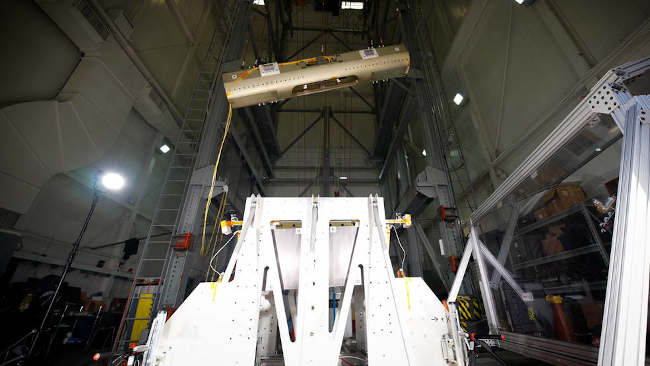
That’s why Pavlina Karafillis has been dropping a prototype lander — repeatedly — in a warehouselike space at JPL. As test engineer for the Sample Retrieval Lander’s legs, she and her colleagues have been using high-speed cameras to observe this prototype’s legs slam onto a base.
QR-code-like marks on each of the prototype’s “feet” help the cameras track the legs’ motion. The team uses slow-motion video to continually update their computer models, which help them understand how energy would be dispersed throughout the lander.
“The last step of the journey is really important,” Karafillis said. “There’s all kinds of landing conditions you have to take into account, like rocks, or really soft sand, or coming in at an angle. This is why we have to do all this testing.”
Karafillis and her colleagues have started with a prototype roughly one-third the size of what the actual spacecraft would be; a lighter prototype is one way to learn how the final lander design would move in Mars’ low gravity. Later in the program, they will drop a full-scale lander, as well.
The rocket
Surviving landing is just part of the challenge: Safely launching the nine-foot-long (2.8-meter-long) two-stage rocket that will sit atop the lander’s deck adds another level of difficulty. Mars’ gravity is one-third that of Earth’s, and the rocket’s weight, combined with its exhaust, could cause the lander to slip or tilt.
So engineers have conceived of a system to toss the rocket into the air just before it ignites. The whole process happens in a finger-snap, tossing the rocket at a rate of 16 feet (5 meters) per second.
During testing, a cradle equipped with gas-powered pistons flung an 881-pound (400-kilogram) mock rocket 11 feet (3.3 meters) in the air; cables suspended from a tower 44 feet (13 meters) high offloaded more than half of the test article’s weight to simulate Martian gravity.
“It’s kind of like being on a really fast roller coaster when someone hits the breaks,” said Chris Chatellier, the system’s lead engineer at JPL. “There are a lot of safety aspects to consider. Testing happens in a very controlled sequence of events with everyone outside of the building.”
This system, known as Vertically Ejected Controlled Tip-off Release (VECTOR) system, also adds a slight rotation during launch, which pitches the rocket up and away from the Martian surface.
“Launching with VECTOR means the lander could be oriented the wrong way on a slope, and we could still pull this off,” Chatellier said.
Chatellier and his team have conducted 23 tests this year, changing the rocket’s mass and center of gravity along the way. They also added springs to the bottom of their lander stand-in, watching how much “bounce” the launch system created. Next year, they’ll toss a heavier rocket even higher.
“We’re on the right path,” Chatellier said. “Our analysis and predicted models were very close to what we saw in the tests.”
More about Mars sample return
NASA’s Mars Sample Return, or MSR, will revolutionize our understanding of Mars by returning scientifically-selected samples for study using the most sophisticated instruments around the world.
The mission will fulfill a solar system exploration goal, a high priority since 1980 and the last two National Academy of Sciences Planetary Decadal Surveys.
This strategic partnership of NASA and ESA will be the first mission to return samples from another planet, including the first launch and return from the surface of another planet.
These samples collected by Perseverance during its exploration of an ancient river-delta are thought to be the best opportunity to reveal the early evolution of Mars, including the potential for life.
Find out more details about Mars Sample Return here.
- Details
- Written by: United States Forest Service
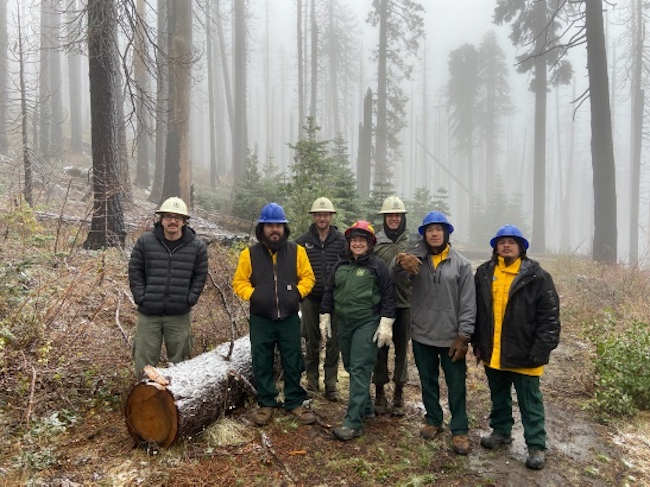
NORTHERN CALIFORNIA — In early November, a unique crew of U.S. Forest Service-certified sawyers from the Tribal EcoRestoration Alliance, or TERA, helped harvest more than 20 indoor-sized Christmas trees to decorate federal offices throughout the U.S. Capitol, as part of the Forest Service’s U.S. Capitol Christmas Tree initiative.
The Christmas tree initiative is not just about spreading holiday cheer. Removing smaller, densely packed trees also helps make national forests more fire resilient.
Small trees are ignitable fuels, according to Julia Everta, Six Rivers National Forest land and minerals specialist who oversaw the companion Christmas tree harvest.
“Gathering indoor Christmas trees thins small, crowded trees and reduces nutrient and water competition for remaining trees to grow,” Everta said.
Everta and her team began planning for the companion tree harvest on Six Rivers National Forest in February 2021.
There was a coordinated effort involving Forest Service staff and volunteers to scout the best trees with symmetrical limbs, dense crowns and straight trunks.
Behind the scenes, another Forest Service partner worked to get TERA involved in the Christmas tree harvest.
After learning the Forest Service needed certified sawyers to fell the Christmas trees, Judy deFreitas, community relations principal at Pacific Gas and Electric Company, connected Everta with TERA and helped PG&E sponsor TERA’s work on the Christmas tree initiative.
By the time the TERA crew arrived in November, the best red and white firs on the Mad River District were flagged for cutting, all at about 5,000 feet elevation or higher.
The biggest challenges during the harvest were weather and potential safety concerns, according to TERA crew member Lance McCloud of Robinson Rancheria Pomo Indians of California.
“Weather kept changing every half hour. It started snowing, then hailing, then raining,” said McCloud.
Even with the unpredictable weather, the three-person crew got the job done, felling more than 20 trees in a single day.
For Everta, TERA’s safety expertise and problem-solving skills were essential.
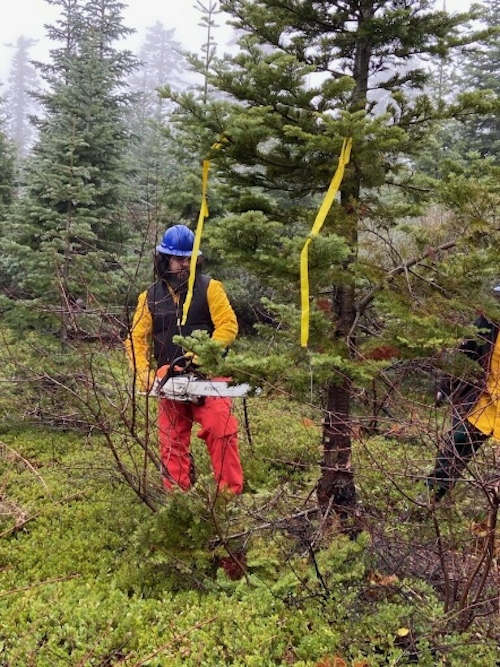
In March 2021, the TERA crew had been trained in the Forest Service’s safety culture and became certified to operate chainsaws on public lands by Mendocino National Forest’s Elk Mountain Hotshot Crew.
“Everyone on the team was engaged in making it a success,” said Everta. “Some of the trees were spread out, and we had to problem-solve to cut, carry and bail them in the truck.”
Once the trees were harvested, they were wrapped and secured for the 3,500-mile journey to Washington, D.C. The trees are now decorated and on display throughout Congress and federal offices.
Today, TERA works as a full-time, multi-tribal hand crew throughout Lake County and has agreements with the Mendocino National Forest to complete fuels reduction projects and share traditional ecological knowledge with the Forest Service.
Forest Service eager to learn and apply tribal approach to land management
The companion Christmas tree harvest is one illustration of the deliberate efforts being made to incorporate the tribal workforce and indigenous expertise on public lands.
In November, the Departments of Agriculture and the Interior issued a policy to facilitate agreements with tribes to improve collaboration and co-stewardship.
Mendocino National Forest, which began working nearly three years ago alongside the Robinson Rancheria Pomo and the Scotts Valley Band of Pomo Indians in partnership with TERA, is poised to take action that aligns with the new policy.
An integral part of the collaboration with TERA is the exchange of modern and traditional knowledge and practices, according to Hinda Darner, fuels specialist for the Upper Lake Ranger District.
“We are working with them in a way that we can learn from them also,” said Darner. “When Native Americans managed the landscape, it was much more resilient to wildfire.”
“We’ve heard from our tribal partners how incredibly impactful it has been for them to be working on their ancestral lands again,” said Mendocino District Ranger Frank Aebly.
TERA Program Director Lindsay Dailey is also inspired by the way TERA approaches land management, through its promotion of “good fire” or prescribed fire and cultural burning.
“We all have something to learn from that whether we’re native or not,” said Dailey. “This partnership with the Mendocino National Forest is a great model for how people and land managers everywhere need to be collaborating with tribes, listening, supporting and learning from them.”
- Details
- Written by: U.S. Department of Agriculture
In Lake County, Harbor View Mutual Water Co. in Kelseyville is allocated about $1.8 million to be used to construct steel tanks.
This funding will prevent leaks and increase storage which is essential as the current tank is not meeting current needs.
“When we invest in rural infrastructure, we invest in the livelihoods and health of people in rural America,” Vilsack said. “Under the leadership of President Biden and Vice President Harris, USDA is committed to building a better America by investing in America’s rural infrastructure, expanding access to broadband, clean drinking water and resilient power infrastructure. The investments we are announcing today will drive the creation of good-paying union jobs and grow the economy sustainably and equitably so that everyone gets ahead for decades to come.”
This announcement follows the recent passage of President Biden’s historic bipartisan infrastructure law and reflects the many ways USDA Rural Development’s programs are helping people, businesses and communities address critical infrastructure needs to help rural America build back better.
The other projects include the following.
In Fresno and Madera counties, The Ponderosa Telephone Co. is allocated $17,225,000. This loan will extend to the premises, or FTTP, and install attendant electronic equipment to the rural areas of their Auberry, Big Creek, Friant, North Fork, O'Neals, Shaver Lake, and Wishon exchanges, making these exchanges 100 percent FTTP. Upgraded radio electronics will only be installed in the Cima exchange. Ponderosa Telephone Company proposes to construct 78.15 miles of FTTP and install all associated electronics. The improvements will sustain customer demand in broadband connectivity.
In Madera and Mariposa counties, the Sierra Telephone Co. Inc. is allocated $40,228,000. This Rural Development investment will be used to expand fiber-to-the-premise service in Coarsegold, Mariposa and Raymond exchanges. Fiber will be deployed in all three exchanges using a passive optical network design that will allow up to 1Gbps service. The new facilities will be constructed in the town areas of each exchange and in the more densely populated rural areas. In addition to the loan funds, a general fund of $52,711,00 will be contributed to accomplish the project. Sierra Telephone Co.'s current 15,761 subscribers will benefit from this investment.
In Alameda County, $157,600 is allocated to Earth Island Institute. They also received another for $62 thousand. These Rural Development investments will be used to provide technical assistance and training through direct and indirect assistance to 26 California, seven Arizona, 13 Nevada and four New Mexico federally recognized tribes to reduce their solid waste streams. The project will accomplish this task by providing one-on-one direct consultations, workshops and tutorials with rural and remote tribes that fit the criteria including population, median household income, poverty levels, and underserved trust areas. The project is designed to empower tribal environmental programs and governments with tools and training that increase innovation in problem solving while improving their waste management infrastructure and protecting tribal environments.
The city of Yreka is allocated more than $6 million to be used to replace aging infrastructure, reduce inflow and infiltration, provide adequate hydraulic capacity, and ensure safe and reliable transmission of wastewater to the city's wastewater treatment plant. The proposed project includes improvements to the City's sewer collection system within the Caltrans road right-of-way along Highway 3 (Main Street) between Lennox Road and Oberlin Road.
The Tuolumne Utilities District is allocated a loan for approximately $9 million and a grant for $4.3 million. The investment will be used to make renovations to the Sonora Regional Wastewater Treatment Facility. Deficiencies will be addressed by making improvements to each unit process: secondary treatment, disinfection, sludge stabilization and drying, and sludge dewatering. This will allow the system to increase the treatment capacity — including full nitrification/denitrification, handle variable flow and load including septage, and improve the effluent quality to ensure regulatory compliance.
Sierra County Waterworks District No. 1 is allocated $499,000 to resolve a fire flow issue that Sierra County Waterworks District No. 1-Calpine has been dealing with over the last couple of years. The Calpine Water System was cited for violating the Health and Safety Code on March 4, 2015 (arsenic issues, which is resolved), but now are faced with inadequate water flow during a fire, which resulted in four homes being burned down over the last couple of years. The Calpine Water System Improvement project consists of construction of a new water tank with 140,000-gallon capacity, new piping, inlets and outlets, erosion control, foundation building, and site restoration. The new water tank will allow the district to take down their other water tank and do needed maintenance, as well as enable the district to have sufficient water supply for daily water demand, fire storage and the possibility of expansion. The project will not only ensure safe, clean drinking water is provided to all residents of the Big Bend service area, but the insurance of extra water flow during a fire event.
In Napa County, more than $9 million is allocated to the City of St. Helena, to install a packaged MBR Treatment plant. This Rural Development investment will be used for a treatment pond retrofit for influent flow equalization and emergency storage. As well as the construction of a new influent lift station, retrofit of existing treatment pond distribution box structure and construction of mechanical screening and disposal system. This Rural Development investment will also be used to construct a sludge dewatering and disposal system, flow meter reconstruction, chlorine disinfection system upgrades. This Rural Development investment will be used to install an underground effluent pipeline for distribution to pond 5 or Napa River outfall, electrical improvements, Supervisory Control and Data Acquisition system, site improvements, and construction of a noise-barrier wall.
In Imperial County, more than $180,000 is allocated to Ocotillo Mutual Water Co. to install approximately 4,100 feet of eight-inch polyvinyl chloride, or PVC, sewer main and install manholes along Monroe Street near the Torres-Martinez Desert Cahuilla Indian Reservation in southwestern Riverside County. The new 8-inch sewer main will be connected to an existing 33-inch sewer main, owned and operated by the Coachella Valley Water District. The new sewer main will connect a subdivision, church, and community building located within the Torres-Martinez Desert Cahuilla Indian Reservation to the existing sewer collection system operated by CVWD. The housing units and facilities that will connect to the new sewer main currently discharge sewage into septic tanks located on each property. The Torres-Martinez Desert Cahuilla Indian tribe has determined that these tanks are failing and have caused seepage of sewage to ground water and in cases sewage has been detected above ground. The proposed project will allow the tribe to abandon the failing septic tanks and allow them to connect to CVWD's existing sewage treatment system.
In Yolo County, $900,000 is allocated to Rural Community Assistance Corp. to establish a revolving loan fund to repair or replace individually owned water wells or wastewater disposal systems for eligible homeowners.
In Orange County, $90,000 is allocated to Walking Shield American Indian Society Inc. to build the capacity of the three rural Native American Indian tribes to address critical needs associated with clean drinking water and wastewater management impacting residents living on the reservations. They will conduct a comprehensive assessment of the identified water deficiency projects with recommendations to develop action plans for solutions.
In Sacramento County, $138,000 is allocated to OCT Water Quality Academy to provide training to water operators and associated personnel to improve management and operation of water and wastewater disposal facilities.