 How to resolve AdBlock issue?
News
- Details
- Written by: CALIFORNIA GOVERNOR’S OFFICE
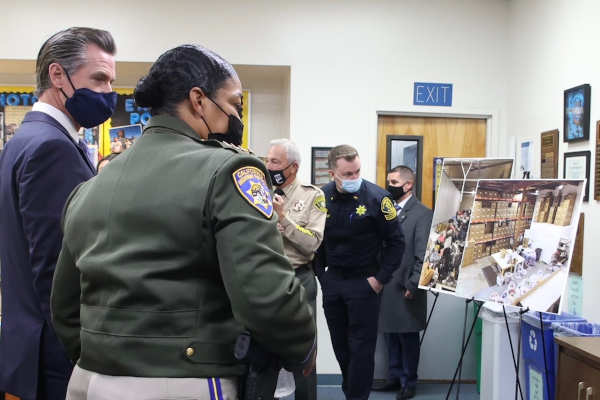
On Friday, Gov. Gavin Newsom unveiled a multipronged plan to fight and prevent crime in California.
The Governor’s Real Public Safety Plan focuses on new investments that will bolster local law enforcement response, ensure prosecutors hold perpetrators accountable and get guns and drugs off our streets.
“We're doubling down on our public safety investments and partnerships with law enforcement officials up and down the state to ensure Californians and small businesses feel safe in their communities — a fundamental need we all share,” said Newsom. “Through robust new investments and ongoing coordination with local agencies, this plan will bolster our prevention, deterrence and enforcement efforts to aggressively curb crime, hold bad actors to account and protect Californians from the devastating gun violence epidemic.”
While long-term crime trends in California are down in almost every category, states across America have seen a recent uptick in organized retail theft and other violent crimes, particularly those involving a firearm.
The Governor’s Real Public Safety Plan will support existing efforts and new initiatives, including a permanent Smash and Grab Enforcement Unit led by CHP, funding for a statewide organized theft team in the Attorney General’s Office to prosecute cross-jurisdictional theft-related crimes, the largest gun buyback program in the country and grants for local law enforcement, prosecutors, and small businesses victimized by retail theft.
Gov. Newsom announced the plan alongside Attorney General Rob Bonta, CHP Commissioner Amanda Ray, Alameda County District Attorney Nancy O’Malley, California Office of Emergency Services Director Mark Ghilarducci and other state and local leaders at the CHP’s Dublin Area Office.
“Every family in every neighborhood in California deserves to feel safe and be safe as they live, work, and play in their communities,” said California Attorney General Rob Bonta. “That’s what the Real Public Safety Plan is about — keeping Californians safe by doubling down and allocating additional resources to fight and prevent crime. My office is proud to partner with the governor in this effort, and build upon our existing work to combat organized retail crime, dismantle gangs, defend our common sense gun laws, and hold those who commit crime accountable.”
“On behalf of retailers across California, I want to thank Gov. Newsom for his commitment to addressing the growing problem of organized retail crime,” said President and CEO of the California Retailers Association Rachel Michelin. “The Smash and Grab Enforcement Unit and other state- level theft teams will provide more regions of the state with the vital expertise necessary to bring resolution to these often challenging and complex crimes without further compromising local resources.”
Building on the administration’s ongoing efforts, the Real Public Safety Plan’s three core areas of focus crack down on crime to keep communities safe by:
Bolstering local law enforcement response to stop and apprehend criminals
• Increased local law enforcement to combat retail theft: The Real Public Safety Plan includes $255 million in grants for local law enforcement over the next three years to increase presence at retail locations and combat organized, retail crime so Californians and small businesses across the state can feel safe.
• Smash and Grab Enforcement Unit: Gov. Newsom’s Plan includes a permanent Smash and Grab Enforcement Unit. Operated by the California Highway Patrol, the unit will consist of enforcement fleets that will work with local law enforcement to crack down on organized retail, auto and rail theft in the Bay Area, Sacramento, San Joaquin Valley, Los Angeles and San Diego regions.
• Keeping Our Roads Safe: With the Real Public Safety Plan, CHP will now be able to strategically deploy more patrols based on real-time data to help keep our roads safe. Gov. Newsom will also work with the Legislature to upgrade highway camera technology to gather information to help solve crimes.
• Support for Small Businesses Victimized by Retail Theft: Gov. Newsom’s Plan will create a new grant program to help small businesses that have been the victims of smash-and-grabs to get back on their feet quickly.
More prosecutors to hold perpetrators accountable
• Dedicated retail theft prosecutors: The plan will ensure District Attorneys are effectively and efficiently prosecuting retail, auto and rail theft-related crime by providing an additional $30 million in grants for local prosecutors over three years.
• Fighting crime statewide: The Real Public Safety Plan will allow the Attorney General to continue leading anti-crime task forces around the state, including High Impact Investigation Teams, LA interagency efforts and task forces to combat human trafficking and gangs.
• Statewide Organized Theft Team: Gov. Newsom’s plan includes $18 million over three years for the creation of a dedicated state team of special investigators and prosecutors in the Attorney General’s Office to go after perpetrators of organized theft crime rings that cross jurisdictional lines.
Getting guns and drugs off our streets
• The largest gun buyback program in America: The governor’s plan will create a new statewide gun buyback program, working with local law enforcement to provide matching grants and safe-disposal opportunities to get guns off our streets and promote awareness of gun violence.
• Holding the gun industry accountable: In light of the recent U.S. Supreme Court decision, the Governor is working with the California Legislature to propose a nation-leading law that would allow private citizens to sue anyone who manufactures, distributes or sells unlawful assault weapons, as well as “ghost guns,” ghost gun kits or their component parts.
• Leading the nation’s gun violence research efforts: When Congress refused to allow America to study the impacts of gun violence, California stepped up. The Real Public Safety Plan includes additional funding for California’s nation-leading gun violence research center at UC Davis.
• Intercepting Drugs: The governor’s plan will keep drugs off our streets and includes $20 million to support the National Guard’s drug interdiction efforts, targeting transnational criminal organizations.
Newsom’s office said protecting public safety and addressing organized retail crime has been a top priority.
Last month Newman directed CHP to increase its presence in highly-trafficked shopping areas through the holiday season to assist allied partners in the apprehension of criminals.
In July the governor took action to extend the California Highway Patrol Organized Retail Crime Task Force, which coordinates with allied law enforcement agencies and district attorneys to identify and prosecute organized theft rings, recover lost merchandise and collaborate with the retail industry to reduce theft and improve safety for shoppers.
- Details
- Written by: Dennis Fordham
A trustee has a so-called “fiduciary” duty — i.e, a duty that involves legal responsibility and accountability to the trust beneficiary — to manage the assets of a trust strictly according to the terms of the trust for the sole benefit of the beneficiaries.
A Trustee cannot favor the interests of one beneficiary over another beneficiary (i.e, the “duty of impartiality”) unless the trust instrument so allows.
In California, a trustee must execute his or her fiduciary duties using the authority granted in the trust instrument and in the Probate Code, as further defined by case law.
Some provisions in the trust are mandatory — i.e, must be implemented — and often involve “objective” (measurable) standards to be carried out.
Other provisions, however, are permissive and/or are mandatory but still involve subjective standards for implementation. Anything that is permissive or subjective involves discretion and usually gives the trustee some flexibility as to whether, how and when to act.
Whether a decision is mandatory or discretionary and how much flexibility the trustee has is primarily determined by the trust instrument, but secondarily determined by the Probate Code and any relevant case law decisions.
Mandatory provisions involve no trustee discretion. For example, “the trustee shall distribute principal for the beneficiary’s health, education, maintenance and support.” The use of the word “shall” requires the trustee to meet the beneficiary’s needs.
However, other provisions involve trustee discretion. That is, a trustee must use his or her best judgment in a fiduciary capacity.
For example, “the trustee may distribute principal for the beneficiary’s maintenance and support as the trustee sees appropriate.”
The use of the word “may” requires the trustee to exercise his or her best judgment under the prevailing circumstances, in good faith, and in furtherance of the purpose of the trust.
As a general rule, section 16040(a) of the Probate Code provides that, “[t]he trustee shall administer the trust with reasonable care, skill, and caution under the circumstances then prevailing that a prudent person acting in a like capacity would use in the conduct of an enterprise of like character and with like aims to accomplish the purposes of the trust as determined from the trust instrument.”
California case law has further defined the foregoing “prudent person” standard to mean that a trustee must act in good faith and with reasonable prudence, discretion and intelligence.
Next, the general rule regarding a trustee’s investment decisions in particular is section 16047(a) of the Probate Code which provides that, “[a] trustee shall invest and manage trust assets as a prudent investor would, by considering the purposes, terms, distribution requirements, and other circumstances of the trust. In satisfying this standard, the trustee shall exercise reasonable care, skill, and caution.”
However, a trust can expressly remove the prudent person and prudent investor standards and provide the trustee with “absolute” discretion.”
Even then section 16081 (a) of the Probate Code provides that, “… if a trust instrument confers ‘absolute,’ ‘sole,’ or ‘uncontrolled’ discretion on a trustee, the trustee shall [still] act in accordance with fiduciary principles and shall not act in bad faith or in disregard of the purposes of the trust.”
Thus, a trustee as a fiduciary still must always act appropriately given all relevant considerations and the purposes of the trust. A trustee with absolute discretion still cannot simply disregard the trust’s purpose or act in bad faith. To do so would defeat the purpose(s) of the trust which would violate the trustee’s fiduciary duty of loyalty to the trust.
When a trustee breaches a fiduciary duty or fails to act (i.e, a nonperforming trustee), a beneficiary can petition the court for instructions regarding the administration of the trust and/or for removal of the trustee.
Doing so is litigation and leads to a trial or a negotiated settlement. Selecting a competent and capable trustee and having a well drafted trust can minimize these risks.
The foregoing is not legal advice. Consult an attorney if you are confronting these issues.
Dennis A. Fordham, attorney, is a State Bar-Certified Specialist in estate planning, probate and trust law. His office is at 870 S. Main St., Lakeport, Calif. He can be reached at
- Details
- Written by: Mara Johnson-Groh
For the first time in history, a spacecraft has touched the Sun. NASA’s Parker Solar Probe has now flown through the Sun’s upper atmosphere — the corona — and sampled particles and magnetic fields there. Credits: NASA's Goddard Space Flight Center/Joy Ng.
For the first time in history, a spacecraft has touched the Sun.
NASA’s Parker Solar Probe has now flown through the Sun’s upper atmosphere — the corona — and sampled particles and magnetic fields there.
The new milestone marks one major step for Parker Solar Probe and one giant leap for solar science. Just as landing on the Moon allowed scientists to understand how it was formed, touching the very stuff the Sun is made of will help scientists uncover critical information about our closest star and its influence on the solar system.
"Parker Solar Probe ‘touching the Sun’ is a monumental moment for solar science and a truly remarkable feat," said Thomas Zurbuchen, the associate administrator for the Science Mission Directorate at NASA Headquarters in Washington. "Not only does this milestone provide us with deeper insights into our Sun's evolution and its impacts on our solar system, but everything we learn about our own star also teaches us more about stars in the rest of the universe.”
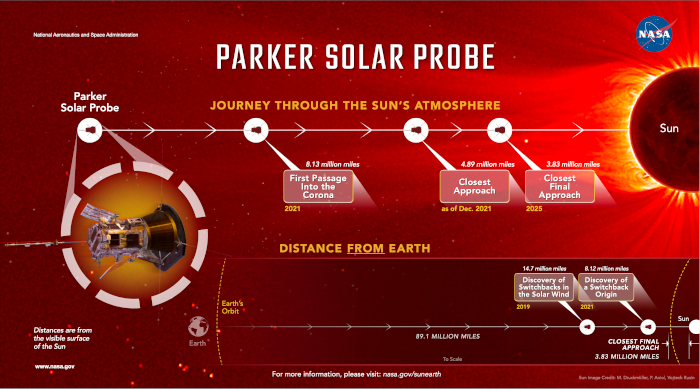
As it circles closer to the solar surface, Parker is making new discoveries that other spacecraft were too far away to see, including from within the solar wind — the flow of particles from the Sun that can influence us at Earth. In 2019, Parker discovered that magnetic zigzag structures in the solar wind, called switchbacks, are plentiful close to the Sun. But how and where they form remained a mystery. Halving the distance to the Sun since then, Parker Solar Probe has now passed close enough to identify one place where they originate: the solar surface.
The first passage through the corona — and the promise of more flybys to come — will continue to provide data on phenomena that are impossible to study from afar.
“Flying so close to the Sun, Parker Solar Probe now senses conditions in the magnetically dominated layer of the solar atmosphere — the corona — that we never could before,” said Nour Raouafi, the Parker project scientist at the Johns Hopkins Applied Physics Laboratory in Laurel, Maryland. “We see evidence of being in the corona in magnetic field data, solar wind data, and visually in images. We can actually see the spacecraft flying through coronal structures that can be observed during a total solar eclipse.”
Closer than ever before
Parker Solar Probe launched in 2018 to explore the mysteries of the Sun by traveling closer to it than any spacecraft before. Three years after launch and decades after first conception, Parker has finally arrived.
Unlike Earth, the Sun doesn’t have a solid surface. But it does have a superheated atmosphere, made of solar material bound to the Sun by gravity and magnetic forces. As rising heat and pressure push that material away from the Sun, it reaches a point where gravity and magnetic fields are too weak to contain it.
That point, known as the Alfvén critical surface, marks the end of the solar atmosphere and beginning of the solar wind. Solar material with the energy to make it across that boundary becomes the solar wind, which drags the magnetic field of the Sun with it as it races across the solar system, to Earth and beyond.
Importantly, beyond the Alfvén critical surface, the solar wind moves so fast that waves within the wind cannot ever travel fast enough to make it back to the Sun — severing their connection.
Until now, researchers were unsure exactly where the Alfvén critical surface lay. Based on remote images of the corona, estimates had put it somewhere between 10 to 20 solar radii from the surface of the Sun — 4.3 to 8.6 million miles.
Parker’s spiral trajectory brings it slowly closer to the Sun and during the last few passes, the spacecraft was consistently below 20 solar radii (91 percent of Earth’s distance from the Sun), putting it in the position to cross the boundary — if the estimates were correct.
On April 28, 2021, during its eighth flyby of the Sun, Parker Solar Probe encountered the specific magnetic and particle conditions at 18.8 solar radii (around 8.1 million miles) above the solar surface that told scientists it had crossed the Alfvén critical surface for the first time and finally entered the solar atmosphere.
“We were fully expecting that, sooner or later, we would encounter the corona for at least a short duration of time,” said Justin Kasper, lead author on a new paper about the milestone published in Physical Review Letters, and deputy chief technology officer at BWX Technologies, Inc. and University of Michigan professor. “But it is very exciting that we’ve already reached it.”

Into the eye of the storm
During the flyby, Parker Solar Probe passed into and out of the corona several times. This is proved what some had predicted — that the Alfvén critical surface isn’t shaped like a smooth ball. Rather, it has spikes and valleys that wrinkle the surface.
Discovering where these protrusions line up with solar activity coming from the surface can help scientists learn how events on the Sun affect the atmosphere and solar wind.
Six panels of images taken from inside a coronal streamer. They appear grayish with white streaks showing particles in the solar wind.
At one point, as Parker Solar Probe dipped to just beneath 15 solar radii (around 6.5 million miles) from the Sun’s surface, it transited a feature in the corona called a pseudostreamer. Pseudostreamers are massive structures that rise above the Sun’s surface and can be seen from Earth during solar eclipses.
Passing through the pseudostreamer was like flying into the eye of a storm. Inside the pseudostreamer, the conditions quieted, particles slowed, and number of switchbacks dropped — a dramatic change from the busy barrage of particles the spacecraft usually encounters in the solar wind.
For the first time, the spacecraft found itself in a region where the magnetic fields were strong enough to dominate the movement of particles there. These conditions were the definitive proof the spacecraft had passed the Alfvén critical surface and entered the solar atmosphere where magnetic fields shape the movement of everything in the region.
The first passage through the corona, which lasted only a few hours, is one of many planned for the mission. Parker will continue to spiral closer to the Sun, eventually reaching as close as 8.86 solar radii (3.83 million miles) from the surface. Upcoming flybys, the next of which is happening in January 2022, will likely bring Parker Solar Probe through the corona again.
“I’m excited to see what Parker finds as it repeatedly passes through the corona in the years to come,” said Nicola Fox, division director for the Heliophysics Division at NASA Headquarters. “The opportunity for new discoveries is boundless.”
The size of the corona is also driven by solar activity. As the Sun’s 11-year activity cycle — the solar cycle — ramps up, the outer edge of the corona will expand, giving Parker Solar Probe a greater chance of being inside the corona for longer periods of time.
“It is a really important region to get into because we think all sorts of physics potentially turn on,” Kasper said. “And now we're getting into that region and hopefully going to start seeing some of these physics and behaviors.”
Narrowing down switchback origins
Even before the first trips through the corona, some surprising physics was already surfacing. On recent solar encounters, Parker Solar Probe collected data pinpointing the origin of zig-zag-shaped structures in the solar wind, called switchbacks. The data showed one spot that switchbacks originate is at the visible surface of the Sun — the photosphere.
By the time it reaches Earth, 93 million miles away, the solar wind is an unrelenting headwind of particles and magnetic fields.
But as it escapes the Sun, the solar wind is structured and patchy. In the mid-1990s, the NASA-European Space Agency mission Ulysses flew over the Sun’s poles and discovered a handful of bizarre S-shaped kinks in the solar wind’s magnetic field lines, which detoured charged particles on a zigzag path as they escaped the Sun.
For decades, scientists thought these occasional switchbacks were oddities confined to the Sun’s polar regions.
In 2019, at 34 solar radii from the Sun, Parker discovered that switchbacks were not rare, but common in the solar wind. This renewed interest in the features and raised new questions: Where were they coming from? Were they forged at the surface of the Sun, or shaped by some process kinking magnetic fields in the solar atmosphere?
The new findings, in press at the Astrophysical Journal, finally confirm one origin point is near the solar surface.
The clues came as Parker orbited closer to the Sun on its sixth flyby, less than 25 solar radii out. Data showed switchbacks occur in patches and have a higher percentage of helium — known to come from the photosphere — than other elements. The switchbacks’ origins were further narrowed when the scientists found the patches aligned with magnetic funnels that emerge from the photosphere between convection cell structures called supergranules.
In addition to being the birthplace of switchbacks, the scientists think the magnetic funnels might be where one component of the solar wind originates. The solar wind comes in two different varieties — fast and slow — and the funnels could be where some particles in the fast solar wind come from.
“The structure of the regions with switchbacks matches up with a small magnetic funnel structure at the base of the corona,” said Stuart Bale, professor at the University of California, Berkeley, and lead author on the new switchbacks paper. “This is what we expect from some theories, and this pinpoints a source for the solar wind itself.”
Understanding where and how the components of the fast solar wind emerge, and if they’re linked to switchbacks, could help scientists answer a long-standing solar mystery: how the corona is heated to millions of degrees, far hotter than the solar surface below.
While the new findings locate where switchbacks are made, the scientists can’t yet confirm how they’re formed. One theory suggests they might be created by waves of plasma that roll through the region like ocean surf. Another contends they’re made by an explosive process known as magnetic reconnection, which is thought to occur at the boundaries where the magnetic funnels come together.
“My instinct is, as we go deeper into the mission and lower and closer to the Sun, we're going to learn more about how magnetic funnels are connected to the switchbacks,” Bale said. “And hopefully resolve the question of what process makes them.”
Now that researchers know what to look for, Parker’s closer passes may reveal even more clues about switchbacks and other solar phenomena. The data to come will allow scientists a glimpse into a region that’s critical for superheating the corona and pushing the solar wind to supersonic speeds.
Such measurements from the corona will be critical for understanding and forecasting extreme space weather events that can disrupt telecommunications and damage satellites around Earth.
“It’s really exciting to see our advanced technologies succeed in taking Parker Solar Probe closer to the Sun than we’ve ever been, and to be able to return such amazing science,” said Joseph Smith, Parker program executive at NASA Headquarters. "We look forward to seeing what else the mission discovers as it ventures even closer in the coming years."
Parker Solar Probe is part of NASA’s Living with a Star program to explore aspects of the Sun-Earth system that directly affect life and society.
The Living with a Star program is managed by the agency’s Goddard Space Flight Center in Greenbelt, Maryland, for NASA’s Science Mission Directorate in Washington.
The Johns Hopkins University Applied Physics Laboratory in Laurel, Maryland, manages the Parker Solar Probe mission for NASA and designed, built, and operates the spacecraft.
Mara Johnson-Groh works for NASA’s Goddard Space Flight Center in Greenbelt, Maryland.
- Details
- Written by: Elizabeth Larson
In a meeting that ran just under 30 minutes, the council unanimously supported the separate sale and purchase proposals, which address the city’s goals of increasing its housing stock and pursuing the construction of a major shopping center that will front Highway 53.
The property sale involves 29 acres at 2890 Old Highway 53, which is owned by the former successor agency to the city’s former redevelopment agency.
City Manager Alan Flora was not sure of exactly when the agency took over the property, explaining that a developer who had planned a subdivision on the land — for which a tentative map had been adopted — lost the property when the project fell apart as a result of the Great Recession. The redevelopment agency bought it shortly afterward.
Last year, the council accepted a proposal from TJG/Summitt Development for a subdivision there, but the company notified the city in May that it wasn’t moving forward with the project.
Flora said the city was required by state law to notice and list the property as surplus to public agencies and through the California Department of Housing and Community Development’s database for affordable housing development.
Over the summer, four developers came forward and two provided proposals, including Danco Communities, which has another project in the city.
Danco is planning to build an 84-unit mixed income multifamily housing project on a five-acre parcel at 14795 Burns Valley Road. That project is expected to be built in 2022, Flora said.
The land where that project is being built is a portion of a 31-acre property the city purchased last December. The other 26 acres will include a new city sports complex and corporation yard.
As proposed, the new project on Old Highway 53 would be consistent with the previous one, which Flora said calls for 22 lots, each 1.25 acres in size.
The proposed sale price is $100,000, with a $5,000 deposit, after which Flora said escrow would be opened. Escrow will close after the tentative map is recorded.
Danco Communities President Chris Dart, who attended the meeting via Zoom, said the company plans to build the subdivision as previously intended, on the 51,000 square foot lots.
He said the homes will be 2,000- to 3,000-square-foot ranch style homes.
The project is similar to one they are now building in Humboldt County on one-acre lots, Dart said.
The city received two emails from a family living nearby who didn’t want the subdivision built because it would impact the quiet neighborhood and country atmosphere. They said they would have loved to have the opportunity to purchase the property to build stables there.
In response to questions submitted during the meeting by Lake County News regarding the time to develop the site, Flora said they have some “generous” time frames in the sale agreement.
Flora said development of the subdivision project should begin at some point next year as the apartment complex is being built on Burns Valley Road.
“This is the most difficult type of housing to develop either in Clearlake or Lake County,” Flora said, adding he isn’t aware of a similar project under development anywhere else in Lake County.
Regarding the comments about the sale prices from the neighbors, Flora said the market value in normal situations for such a property is significantly above $100,000. The reason it’s been offered to the developer at that price is to encourage its development for housing of this type.
He said the taxpayers have invested in purchasing this property. “Letting it sit as green space is probably not really an option, at least from my perspective,” Flora said, noting housing development is badly needed.
Dart said they are going to work on the entitlements on the property right away, and that could take six to 12 months.
He said they are going to build the subdivision out while they are under construction with the affordable housing project. That’s a way to make it work, to already be under construction on another project, as there are efficiencies.
Flora said the county’s redevelopment oversight board will have to approve the sale. He hopes to schedule a meeting of that board in January, noting it’s been OK with similar deals previously.
Mayor Dirk Slooten said the city sorely lacks market rate housing and he’s excited about the project.
It’s a place where nurses and schoolteachers will be able to live. “We don’t have that in this town,” Slooten said.
Vice Mayor Russ Perdock and Councilman Russ Cremer agreed.
Cremer said the property has been subdivided for a number of years and waiting for the right moment.
He said he was thrilled Danco is stepping in to do the project.
Cremer then moved to approve the sale agreement with Danco Communities, which Perdock seconded. The council approved the agreement 4-0; Councilwoman Joyce Overton was absent.
Property purchase to facilitate intersection construction
The council then moved on to discuss Flora’s request to approve the agreement with Edwin Jinks to purchase from him properties at 6461 Manzanita Ave. and 6452 Francisco Ave. for $550,000.
The properties, each of which has a large self-storage building on it, together total just under half an acre, according to county property records.
They are located just to the west of the Highway 53 and 18th Avenue intersection, on the edge of the city-owned property that previously was the Pearce Field airport.
The parcels the city is purchasing from Jinks will be added to a 40-acre area along Highway 53 where the city is conducting strategic master planning for a commercial and retail development.
Flora explained that the city has been working on a lot of things related to the airport retail development. That includes intersection and road design in order to extend 18th Avenue from Highway 53 west to Old Highway 53.
“In order to have a safe and attractive intersection there, there’s a need to construct the road through one of these parcels,” he said.
The city had been in talks with Jinks for some time and reached agreement on the $550,000 sale price, Flora said.
Flora asked for the council’s approval to give him the authority to sign the agreement.
He said the sale should close between 45 and 60 days.
Once Jinks’ personal property is removed, Flora said they can start work on the road project.
There was no public comment before Cremer moved to approve the agreement, which was seconded by Councilman David Claffey. The council approved the agreement 4-0.
Email Elizabeth Larson at