 How to resolve AdBlock issue?
News
- Details
- Written by: Elizabeth Larson
Bonta said the work will help Californians who have such convictions to promptly obtain the relief they are entitled to under the law, namely, AB 1793, of which he was lead author.
Before July 2019, the California Department of Justice identified and provided county prosecuting agencies with a list of Californians that might have convictions eligible to be reduced or removed under AB 1793, Bonta’s office reported.
However, to date, Bonta’s office said there are still past convictions in the state's database that are potentially eligible for resentencing.
“Since this law went into effect, tens of thousands of Californians have been able to turn the page and make a fresh start — but unfortunately there are still some who are waiting for relief. I urge counties to prioritize processing their records so that these Californians can finally get the relief they deserve. My team is available as a resource, and we won't stop working until every Californian eligible for relief under AB 1793 is experiencing the law’s intended benefits,” Bonta said.
In 2016, California voters passed Proposition 64, legalizing the possession, cultivation and sale of cannabis by adults 21 years and older.
At the same time, Proposition 64 allowed individuals convicted of the possession, cultivation or sale of cannabis to petition, as appropriate, for resentencing.
Bonta, then a member of the Assembly, wrote AB 1793 to streamline the process, requiring the Department of Justice to review records in the state summary criminal history information database and to identify past convictions potentially eligible for recall or dismissal of sentence, dismissal and sealing, or re-designation.
If there is no challenge to the resentencing, Bonta’s office said courts are required to automatically reduce or dismiss the conviction and to notify the Department of Justice to update the state summary criminal history information database to reflect the resentencing.
Krones told Lake County News that the law required the Department of Justice to compile a list of marijuana convictions for each county.
She had until July 1, 2020, to review them all and decide if she was going to challenge the reduction or dismissal of any of the convictions.
“I did not oppose any of the cases to be reduced or dismissed,” she said.
Krones received assistance in organizing the information about the cases from Code for America, whose projects include criminal record clearance and expungement.
The nonprofit helps write computer programs to assist in analyzing data in a format that can be easier to understand. Krones said they used the information provided by the Department of Justice.
She sent 550 cases to the courts to be reduced or resentenced by the July 2020 deadline.
“The courts now have the list of cases that should be reduced or dismissed and will need to do the next steps to take action on them,” Krones said.
Bonta’s bulletin to county agencies can be read here.
Email Elizabeth Larson at
- Details
- Written by: Elizabeth Larson
The City of Clearlake Animal Association also is seeking fosters for the animals waiting to be adopted.
Call the Clearlake Animal Control shelter at 707-273-9440, or email
Visit Clearlake Animal Control on Facebook or on the city’s website.
The newest dogs are listed at the top of the following list.

‘Gingy’
“Gingy’ is a female terrier mix with a tan and white coat.
She is dog No. 49228146.

‘Priscilla’
“Priscilla” is a female Brittany spaniel mix with a white and copper coat.
She is dog No. 49089138.

‘Bear No. 2’
“Bear No. 2” is a male American pit bull mix with a short tan coat.
He has been neutered.
He is dog No. 48731556.

‘Andy’
“Andy” is a male American pit bull mix with a short gray and white coat.
He is dog No. 48995415.

‘Arnold’
“Arnold” is a male American Staffordshire terrier mix with a short brindle coat with white markings.
He is dog No. 49029348.

‘Bear’
“Bear” is a male Labrador retriever-American pit bull mix with a short charcoal and fawn coat.
He has been neutered.
He is dog No. 48443153.

‘Bella’
“Bella” is a female American pit bull mix with a short gray brindle coat.
She has been spayed.
She is dog No. 48448381.

‘Levi’
“Levi” is a male golden retriever-Labrador retriever mix.
He has a short golden coat.
He is dog No. 48975687.

‘Maria’
“Maria” is a female Shar-Pei mix with a short tan coat.
She is dog No. 49047315.

‘Mitzi’
“Mitzi” is a female Australian cattle dog mix with a medium-length black and white coat.
She has been spayed.
She is dog No. 48443306.

‘Nala’
“Nala” is a 1-year-old female German shepherd mix.
She has a medium-length black and tan coat.
She is dog No. 48289638.

‘Sassy’
“Sassy” is a female American pit bull mix with a short black coat.
She has been spayed.
She is dog No. 48443128.

‘Snowball’
“Snowball” is a male American Staffordshire mix terrier with a white coat.
He is dog No. 49159168.

‘Tanisha’
“Tanisha” is a female Australian cattle dog mix with a short red and white coat.
She has been spayed.
She is dog No. 48443302.

‘Terry’
“Terry” is a male shepherd mix with a short brindle coat.
He is dog No. 48443693.

‘Turk’
“Turk” is a male chocolate Labrador retriever mix.
He is dog No. 48911836.

‘Willie’
“Willie” is a male Chihuahua mix with a short black coat and white markings.
He is dog No. 49141640.
Email Elizabeth Larson at
- Details
- Written by: Sybil Derrible, University of Illinois at Chicago; Juyeong Choi, Florida State University, and Nazli Yesiller, California Polytechnic State University
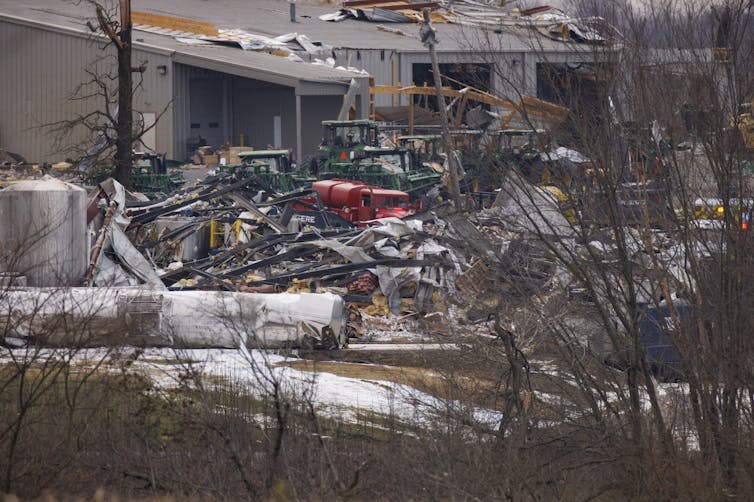
Communities across the U.S. Southeast and Midwest will be assessing damage from the deadly and widespread tornado outbreak on Dec. 10-11, 2021 for some time. But it’s clear that the cleanups will take months, and possibly years.
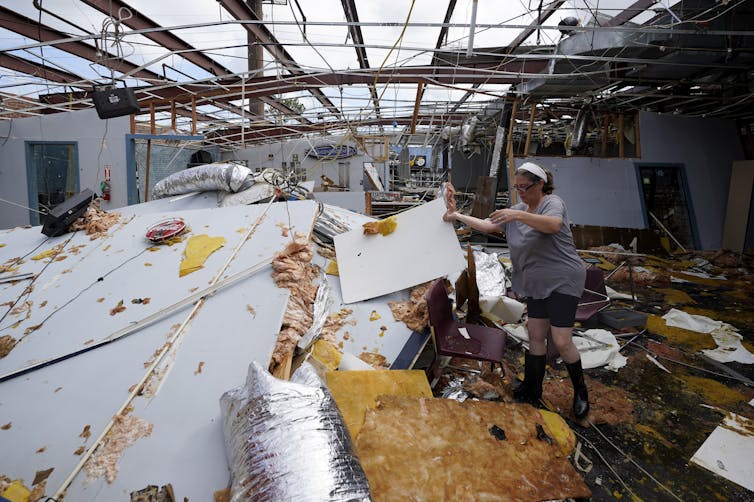
Dealing with enormous quantities of debris and waste materials is one of the most significant challenges for communities in the wake of natural disasters. Often this task overwhelms local waste managers, leaving waste untouched for weeks, months or even years.
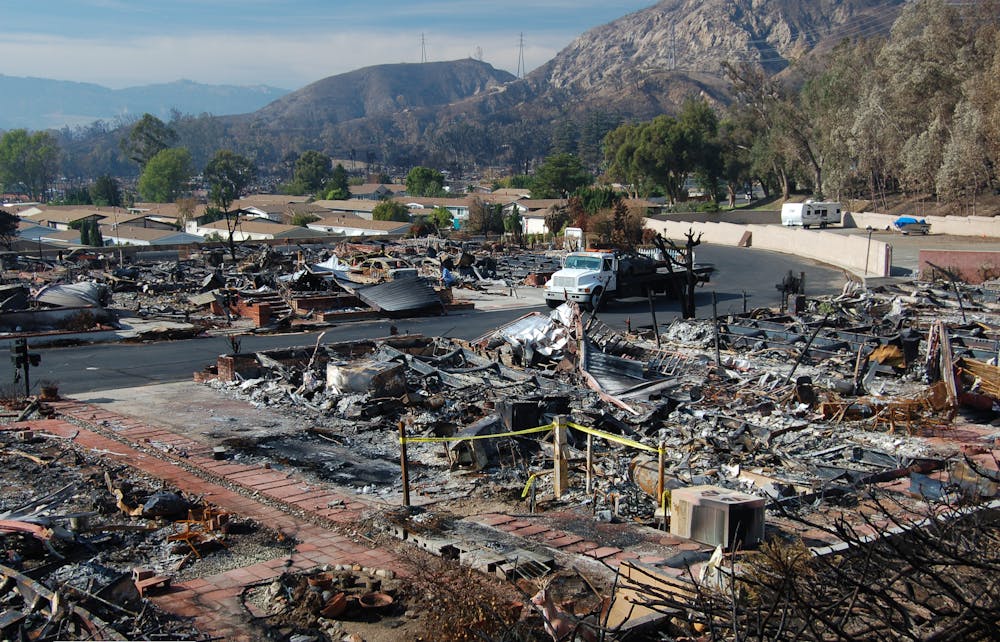
The most destructive and costliest wildfire in California’s history, the Camp Fire, killed 85 people and destroyed nearly 19,000 structures in November 2018. A year later, crews were still collecting and carrying away piles of wood, metals, appliances, contaminated soil, toxic household chemicals, and other debris and waste totaling more than 3.2 million metric tons – roughly the weight of 2 million cars.
Hurricane Michael, which hit Florida in October 2018, left about 13 million cubic meters of debris. To visualize what that looks like, picture a pile of 13 million boxes, each the size of a washer and dryer. More than a year later, crews were still removing the waste.
As researchers who study urban engineering, disaster management and planning, and waste management, we see this as a critical and under-studied problem. Disasters will continue to happen and the losses they cause will continue to grow as a result of climate change, population growth, urbanization, deforestation and aging infrastructures. Societies urgently need better strategies for dealing with the wastes these events leave behind.
Trails of wreckage
Climate-related disasters like floods, landslides, storms, wildfires, and extreme hot and cold waves afflict millions of people around the world. These events have been increasing over time, particularly over the past several decades, and so have the losses they cause.
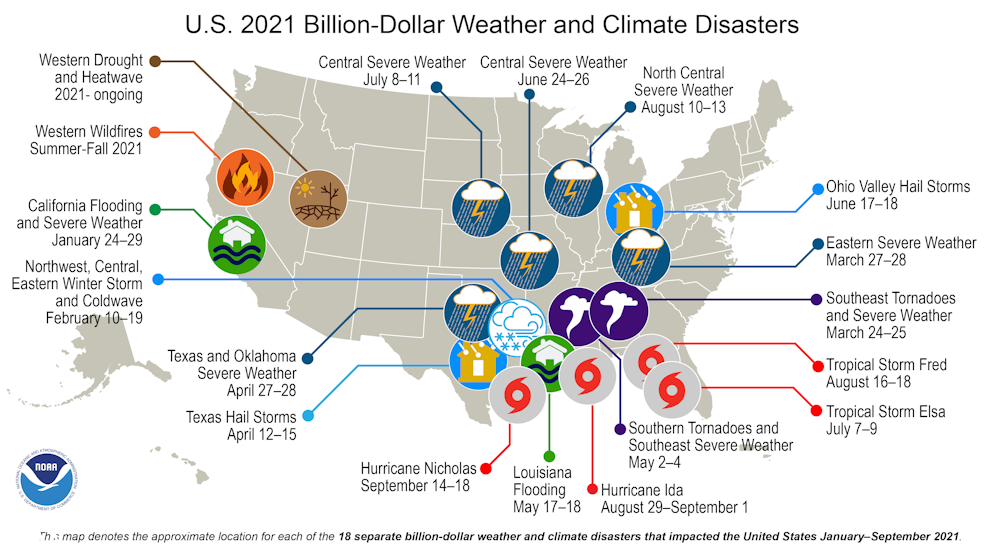
In 2020, the U.S. experienced a record-setting 22 natural disasters that each caused at least a billion dollars in damages. For 2021, the count stood at 18 such events through early October. The mid-December tornado outbreak doubtlessly will add to it.
Disasters commonly produce thousands to millions of tons of debris in a single event. For example, waste from hurricanes includes vegetation, such as trees and shrubs; municipal solid waste, such as household garbage; construction and demolition materials; vehicles; and household hazardous materials, including paints, cleaning agents, pesticides and pool chemicals.
Debris from wildfires largely consists of ash, contaminated soils, metal and concrete, along with other structural debris and household hazardous items such as paints, cleaners, solvents, oils, batteries, herbicides and pesticides.
Dangerous and in the way
Debris collection and cleanup following a disaster is a slow, expensive and dangerous process. First, crews clear out debris from roads used for rescue efforts. They then move the material to temporary storage areas. No one has yet invented a way to easily sort or contain hazardous materials, so they remain mixed into the debris mass. This poses major challenges for reusing and recycling post-disaster waste.
Beyond direct health and safety risks, debris also threatens the environment. It can emit air pollutants and contaminate groundwater, surface waters and soil. Uncollected debris and waste can hamper rescue and recovery efforts and slow down rebuilding efforts.
As an example, when Hurricane Katrina flooded New Orleans in 2005, it left behind an estimated 75 million cubic meters of waste that interfered with and slowed down recovery efforts. The debris included close to 900,000 white goods, such as refrigerators, 350,000 cars and more than 16,000 metric tons of rotten meat. Cleanup costs were estimated at roughly US$4 billion.
Toward reusing disaster waste
At an expert workshop that we organized in 2019, we identified steps for sustainably managing disaster debris and waste. As we see it, the key tasks are to (1) identify what is contained in these wastes; (2) find better approaches to recycling and reuse; (3) design new technologies to identify hazardous components and sort the different types of waste; and (4) develop markets to promote reuse and recycling.
Today public officials and planners know little about the amount and types of materials generated during disasters – what they contain, in what proportions, whether they are large and sortable versus fine and mixed, and how much can be reused or recycled. Developing new technologies and management approaches that can assist debris characterization, reuse and recycling should be a top priority.

For example, drones and autonomous sensing technologies can be combined with artificial intelligence to estimate amounts and quality of debris, the types of materials it contains and how it can be repurposed rapidly. Technologies that allow for fast sorting and separation of mixed materials can also speed up debris management operations.
[ Deep knowledge, daily. Sign up for The Conversation’s newsletter. ]
Turning the problem around, creating new sustainable construction materials – especially in disaster-prone areas – will make it easier to repurpose debris after disasters.
Finally, new business models can help generate demand for and access to waste and recycled products. With proper sorting, some disaster materials can be used to make new products or materials. For example, downed whole trees can become timber resources for furniture makers. Today, opportunities to match materials with markets are wasted – pun intended.
This is an updated version of an article originally published on Dec. 10, 2019.
Sybil Derrible, Associate Professor of Sustainable Infrastructure Systems, University of Illinois at Chicago; Juyeong Choi, Assistant Professor, Florida A&M University-Florida State University College of Engineering, Florida State University, and Nazli Yesiller, Director, Global Waste Research Institute, California Polytechnic State University
This article is republished from The Conversation under a Creative Commons license. Read the original article.
- Details
- Written by: Elizabeth Larson
The board considered a proposed resolution with language that was identical to resolutions approved last week by the boards of Lucerne Elementary, Konocti Unified and Lakeport Unified school districts.
The resolutions local districts have been considering and approving are in response to Gov. Gavin Newsom’s October announcement that he would mandate that the COVID-19 vaccine be added to the list of required vaccinations for students to have for in-person instruction and that school employees also would be required to be vaccinated.
The language of the documents all ask the state to recommend, and not require, the COVID-19
vaccine for students and staff.
As of last week, as the first resolutions were being approved in Lake County, the California Department of Public Health told Lake County News that only six districts among 1,037 statewide had requested changes or modifications to the COVID-19 vaccination requirements.
Middletown Superintendent Tim Gill said the resolution promotes local control.
“I totally understand the desire to pass a resolution like this,” said Annette Lee, an educator and new board member appointed earlier this month to fill one of two board vacancies.
However, Lee said she couldn’t accept it as written because she didn’t believe it represented the district’s entire constituency. She also suggested it was a time for everyone to work together, and not take a position to divide the community further.
She offered alternative language that addressed the need for choice. Her revision called for the district to uphold California citizens’ rights to provide informed consent, and for Middletown Unified to petition the state to ensure and maintain the personal belief exemption in any and all upcoming COVID-19 legislation.
Board President Misha Grothe said she didn’t think the original resolution was divisive, adding people who want to vaccinate their children have ample opportunity to do so.
“I don’t understand why we need to support a mandate,” Grothe said, adding she felt people needed to have a choice.
Lee said she was trying to be mindful of getting to the same result while respecting the beliefs of more than one set of the people that the district serves. “We’re not making policy today, we’re making a statement.”
Board member Zoi Bracisco said she felt it was important that parents have a choice to vaccinate their children and she also didn’t support adding Lee’s changes because she didn’t see a difference in the language.
Lee said there are people in the school district who are very much in favor of a mandate — who want teachers and students alike to be vaccinated — and her wording was meant to validate their concerns. It also offered the ability to opt out of vaccinations.
Board member Larry Allen said they had heard a lot about the issue from one side — referring to those who oppose the mandate — and not as much from the other side. If you take one side, you’re ignoring the other half, he added.
Under Newsom’s mandate, the personal belief exemption remains in place. Gill pointed out that if the state Legislature gets involved and adds the COVID-19 vaccine to the list of vaccines required to go to school, there will be no personal belief exemption.
Grothe said several state senators are proposing to mandate it through the Legislature.
During public comment, Charise Reynolds asked Gill if the district had done surveys to ask teachers about the mandate, and to find out if teachers would quit or if parents would pull their children from school if the mandate went through.
Gill said no, although he’s working on a survey on another topic and could look at doing that.
“This feels a little premature to be making this decision at this time,” said Reynolds.
She said it’s hard for some people to come to the meetings, recalling how he was shouted down at a previous meeting when she asked people in the room to mask up. Reynolds added that she wanted them to make sure they are acting in the interests of constituents.
Sharon Huggins, president of the Middletown Teachers Association, said they have surveyed teachers. Some feel strongly about freedom and a small group thinks COVID-19 is ridiculous and they want the board to be brave.
“There is a segment of our teacher population that is just surviving,” she said.
Another segment wants the board to protect them with mandated vaccines and masks, and they would feel abandoned, unsafe and insecure, and it would be one more stressor. Huggins said another group believes that, whatever the board decides, it needs to stick with that decision and enforce it.
“You really do need to make sure you’re representing the entirety of your population,” she said, adding that the teacher population leans more toward the protection of masking and vaccines.
Community member Jennifer Hughes said the resolution was not preventing people from being vaccinated, and she said the government was taking charge of people’s bodies.
Eileen Anderson questioned there being an ongoing public emergency due to Lake County’s low case rates.
She also challenged the vaccine’s efficacy and said the state mandate is unconstitutional.
Allen moved to add Lee’s language to the resolution but the motion failed.
Bracisco then said she wanted more information and moved to table or postpone the discussion. That motion was approved 5-0.
Grothe asked Gill to bring the matter back to the board for further discussion in January.
Kelseyville Unified Superintendent Dave McQueen said his board also will consider its version of the resolution next month.
Upper Lake Unified had its last regular meeting of the year this week and the resolution wasn’t on it. That district so far has not reported if it will consider the matter in January.
Email Elizabeth Larson at