 How to resolve AdBlock issue?
News
- Details
- Written by: Gabriel Filippelli, IUPUI
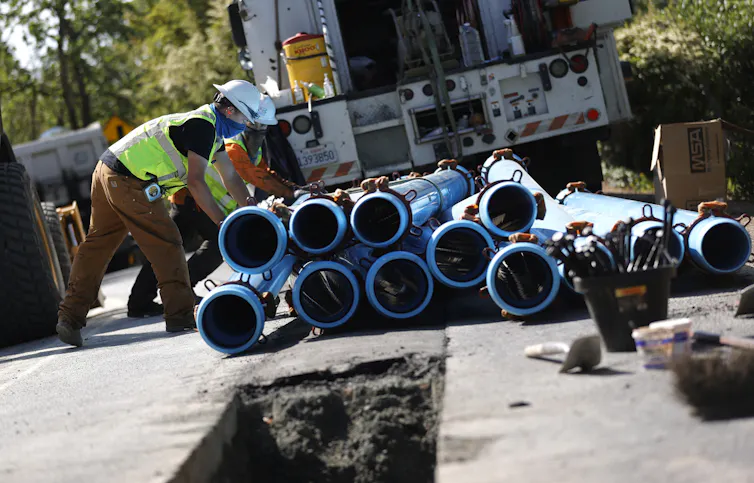
The Biden administration has released a plan to accelerate removal of lead water pipes and lead paint from U.S. homes. As a geochemist and environmental health researcher who has studied the heartbreaking impacts of lead poisoning in children for decades, I am happy to see high-level attention paid to this silent killer, which disproportionately affects poor communities of color.
Childhood lead poisoning has declined significantly in the U.S. over the past 50 years. That’s largely due to the elimination of leaded gasoline in the 1980s and the banning of most lead-based paints.
But the U.S. Environmental Protection Agency estimates that up to 10 million households and 400,000 schools and child care centers have service lines or other fixtures that contain lead. These pipes are ticking time bombs that can leach toxic lead into drinking water if they corrode. As long as they remain in service, children and families are vulnerable.
The same is true of lead paint, which is still present in many homes built before consumer use of lead paint was banned in 1978. Because it tastes sweet, children sometimes chew on paint chips or painted wood.
The Biden administration will spend US$15 billion from the recently enacted infrastructure bill to replace lead service lines, faucets and fixtures over the next five years and is seeking additional money in the pending Build Back Better Act to reduce lead hazards in public housing and low-income communities. I see this as a key priority, since Black children and children living in poverty have average blood lead levels that are 13% higher than the national average.
Lead poisoning does permanent damage
Lead poisoning is a major public health problem because lead has permanent impacts on the brain, particularly in children. Young brains are still actively forming the amazing network of neurons that comprise their hardware.
Neurons are designed to use calcium, the most abundant mineral in the human body, as a transmitter to rapidly pass signals. Lead molecules look a lot like calcium molecules, so if they are present in a child’s body, they can penetrate the brain, impair neuron development and cause permanent neural damage.
Children with lead poisoning have lower IQs, poor memory recall, high rates of attention deficit disorder and low impulse control. They tend to perform poorly at school, which reduces their earning potential as adults. They also face increased risk of kidney disease, stroke and hypertension as they age. Research has found strong connections between lead poisoning and incarceration for violent crimes.
Today researchers estimate that about 500,000 U.S. children still have elevated blood lead levels. Health experts widely agree that there is no known “safe” blood lead concentration.
Where are the lead pipes?
The Biden administration’s plan calls for replacing 100% of lead service lines across the nation – a goal that the EPA aims to write into regulations by 2024. Step 1 is finding the pipes.
Most U.S. cities have countless miles of lead service lines buried beneath streets and sidewalks and feeding into people’s homes. Utilities don’t know where many of these aging lines are and don’t have enough data to map them. Replacing them will require significant analysis, modeling, data and some guesswork.
Old service lines have caused lead poisoning outbreaks in such places as Washington, D.C.; Flint, Michigan; and Newark, New Jersey. The chemistry is a bit different in each case.
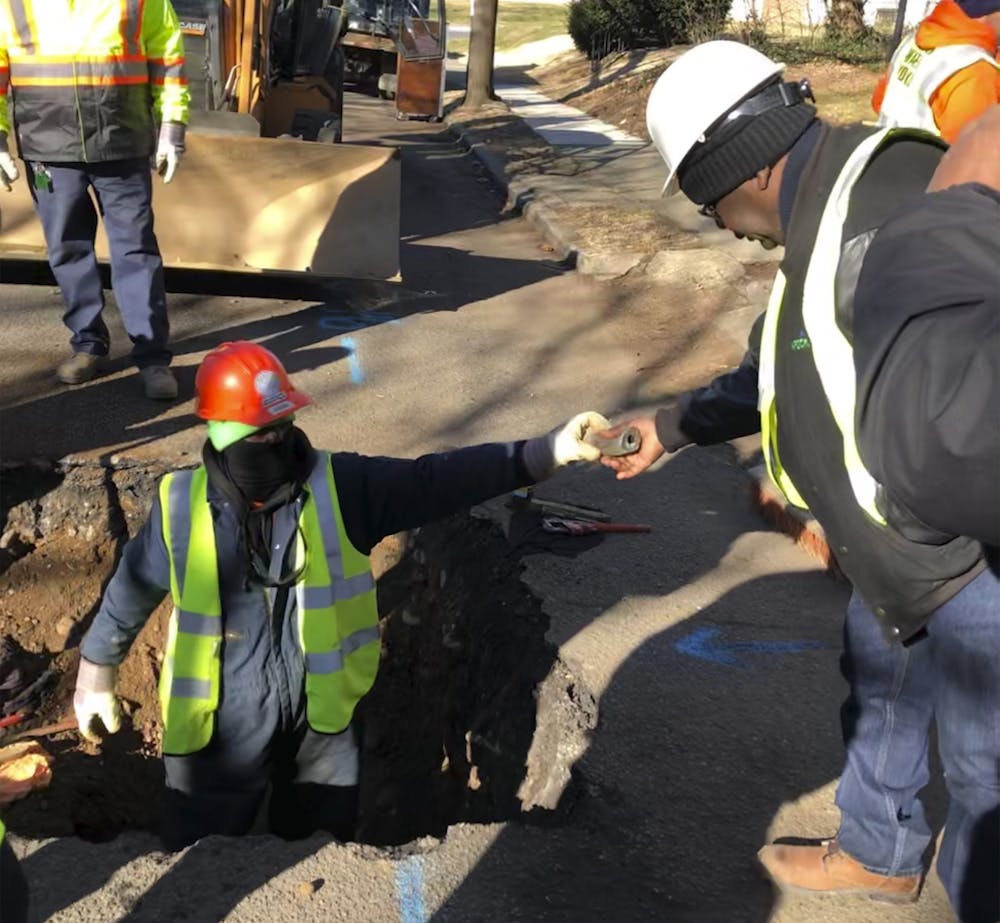
Lead service lines typically develop a protective “plaque” of minerals on their inside walls after a short time, which effectively separates the toxic lead pipe from the water flowing through it. This coating, which is called scale, remains stable if the chemistry of the water coursing through it doesn’t change. But if that chemistry is altered, disaster can ensue.
In 2002, Washington, D.C., shifted from chlorine to chloramine for treating its water supply. Chloramine is a more modern disinfectant that does not form dangerous reactive chlorinated byproducts as chlorine can.
This rapidly corroded the protective plaque lining the city’s pipes, flushing highly absorbable lead into homes. Tens of thousands of children were exposed over two years before the problem was adequately identified and fixed.
In Flint, state-appointed managers decided to save money during a fiscal crisis in 2014 by switching from Detroit water to water from the Flint River. But regulators did not require enough chemical analysis to determine what additives should be used to maintain the pipe plaque. And they skipped the typical step of adding phosphate, which binds chemically with lead and prevents it from leaching out of pipes, in order to save about $100 per day.
Corrosion chemistry is well controlled in many U.S. cities, but it is not a perfect science. And utilities don’t always have detection systems that adequately alert water suppliers to dangers at the tap. That’s why removing lead pipes is the only sure way to avoid the threat of more water crises.
Cities will need to innovate
While $15 billion is a big investment, experts agree that it’s not enough to replace all lead pipes nationwide. For example, the estimated cost of replacing all of Flint’s lead service lines is about $50 million – and there are thousands of U.S. cities to fix.
My own city, Indianapolis, has a population of about 850,000 – about 10 times larger than Flint – and officials have only a rough idea of where to find the lead service lines. There are ways to statistically model the likelihood that a given portion of the water system has lead service lines, using information such as water main sizes, locations and construction dates, but they are imperfect.
Cities will need to get creative to make whatever funds they get go as far as possible. As one example, I am working with colleagues to develop a citizen science project that will provide thousands of tests for lead at taps around Indianapolis. This effort, a partnership with the University of Notre Dame funded by the U.S. Department of Housing and Urban Development, may augment modeling with real data on levels of lead in homes, and will increase public awareness of this issue.
[Over 140,000 readers rely on The Conversation’s newsletters to understand the world. Sign up today.]
In spite of these challenges, I believe more urgency on this issue is long overdue. Every lead pipe that’s replaced will pay off in higher lifetime earnings and lower rates of illness for families that gain access to safer tap water.
This is an updated version of an article originally published on May 4, 2021.
Gabriel Filippelli, Chancellor's Professor of Earth Sciences and Executive Director, Indiana University Environmental Resilience Institute, IUPUI
This article is republished from The Conversation under a Creative Commons license. Read the original article.
- Details
- Written by: Elizabeth Larson
The National Weather Service’s forecast for Lake County anticipates the potential for showers every day this week.
The forecast says as much as an inch and a quarter of rain could fall during the day and night on Tuesday, with about an inch possible on Wednesday.
Specific rainfall estimates for the rest of the week are not available.
The rain will be accompanied by cold temperatures in the 40s during the day and dropping into the low 30s.
On Christmas day, daytime temperatures are forecast to be in the low 40s, reaching the low 30s at night, the coldest temperatures forecast for this week.
While it’s still too early to be certain, the National Weather Service’s forecast says there are indications that “much more impactful and widespread winter weather” is on the way, with the potential for heavy snow at lower elevations during the holiday weekend.
Email Elizabeth Larson at
- Details
- Written by: Elizabeth Larson
The board will meet beginning at 9 a.m. Tuesday, Dec. 21, in the board chambers on the first floor of the Lake County Courthouse, 255 N. Forbes St., Lakeport.
The meeting can be watched live on Channel 8, online at https://countyoflake.legistar.com/Calendar.aspx and on the county’s Facebook page. Accompanying board documents, the agenda and archived board meeting videos also are available at that link.
To participate in real-time, join the Zoom meeting by clicking this link.
The meeting ID is 939 7015 1338, pass code 797313. The meeting also can be accessed via one tap mobile at +16699006833,,93970151338#,,,,*797313#.
All interested members of the public that do not have internet access or a Mediacom cable subscription are encouraged to call 669-900-6833, and enter the Zoom meeting ID and pass code information above.
To submit a written comment on any agenda item visit https://countyoflake.legistar.com/Calendar.aspx and click on the eComment feature linked to the meeting date. If a comment is submitted after the meeting begins, it may not be read during the meeting but will become a part of the record.
The board will get an update on COVID-19 from Public Health staff at 9:06 a.m.
At 10:30 a.m., the board will consider a proposed resolution from Chair Bruno Sabatier to memorialize the board’s support of the Community Development Department in its discretion in applying the appropriate standards under the California Environmental Quality Act to determine the necessary level of environmental review for all projects.
“Cannabis projects are becoming more controversial in our communities. The projects are getting closer to rural communities. The growing number of acres already approved, the drought concerns, and the proximity to communities has aided in increasing public participation in questioning these projects,” Sabatier wrote in his memo to the board.
He added, “The environmental impacts being reviewed are not limited to solely flora and fauna. It is also ground water sustainability analysis as well as community impacts, such as odor, increased traffic and activity.”
He said he wants to assure the Community Development director and staff that “the Board of Supervisors holds our environment (nature and community) as the highest of priorities to protect. The department's exercise of discretion to utilize a more stringent CEQA process (i.e. Environmental Impact Report), for those projects that may not have impacts reduced to less than significant, will be supported by the Board of Supervisors.”
At 10:45 a.m., the board will have a discussion regarding potentially separating Public Works and Water Resources.
The two departments have been consolidated since 2019; before that, they had been standalone departments for several years.
County Administrative Officer Carol Huchingson’s report to the board explains, “The basis for the present discussion is the impending, extraordinary surge of federal infrastructure funding coming to Lake County and whether local need can be best served by again separating PW [Public Works] and WR [Water Resources], thus enabling PW to focus on the advancement of critical infrastructure projects.”
She said staff will present the board wil options and return on a future date with necessary actions.
In an untimed item, the board will consider the Recovery and Revitalization Plan proposed by staff to allocate the $12.5 million the county is receiving through the American Rescue Plan Act, or ARPA.
The plan’s priorities include building sustainable housing and long-term planning, removing barriers to childhood success and dignified aging, acting now on water and infrastructure projects, and preparing to effectively meet emergent public needs.
In other untimed items, the board will consider approving the proposed findings of fact and decision in the appeal of Don and Margie Van Pelt’s appeal of the Sourz HVR Inc. project on High Valley Ranch in Clearlake Oaks, which the board approved in November, and will consider amending the micro home kitchen operation ordinance.
The full agenda follows.
CONSENT AGENDA
5.1: Approve correction to the start date of the appointment of Jonathan Portney to Health Services Director to be effective Jan. 11, 2022.
5.2: Approve agreement between county of Lake and AirMedCare Network for air ambulance services, and authorize the director of Human Resources to sign.
5.3: Second reading of ordinance rescinding Ordinance Number 2958 which amended Article II, Section 2-4, of Chapter 2 of the Lake County Code establishing the boundaries of the supervisorial district for the county of Lake, Pursuant to Sections 21500 Et Seq of the California Elections Code.
5.4: Adopt resolution approving Agreement No. 21-0516-009-SF with California Department of Food and Agriculture to authorize execution of the Asian Citrus Psyllid Winter Trapping Program in the amount of $9,107 beginning Oct. 1, 2021 through May 31, 2022.
5.5: Approve Board of Supervisors meeting minutes Oct. 19, Dec. 9 and Dec. 14.
5.6: Approve continuation of resolution authorizing teleconferenced meetings while a state of emergency continues to exist.
5.7: Adopt resolution amending Resolution 2017-79 that approved a request from county of Lake Health Services Department to submit a renewal application for the California Department of Public Health Immunization Assistance Grant Program for fiscal years 2017-18 through 2021-22 in the amount of $197,715, and authorized the Health Services director to sign.
5.8: Approve the continuation of a local health emergency related to the 2019 Coronavirus (COVID-19) as proclaimed by the Lake County Public Health officer.
5.9: Approve the continuation of a local health emergency and order prohibiting the endangerment of the community through the unsafe removal, transport, and disposal of fire debris for the LNU Complex Wildfire.
5.10: Adopt resolution approving the renewal application and certification statement for the state Department of Health Services, CMS Branch’s Child Health & Disability Program, Health Care Program for Children in Foster Care Program, monitoring oversight of Foster Children Treated with Psychotropic Meds and Caseload Relief grant for fiscal year 2019-20 and authorize the board chair to sign said certification statement.
5.11: Approve continuation of a local health emergency by the Lake County Health officer for the Cache fire.
5.12: a) Waive the formal bidding requirement; and b) authorize the IT Director to issue a purchase order to AMS.net for Cisco Networking Switches for Behavioral Health locations in the amount of $49,085.42.
5.13: Approve the continuation of a local emergency due to the Pawnee fire Incident.
5.14: Approve the continuation of a local emergency In Lake County in response to the LNU Lightning Complex wildfire event.
5.15: Approve the continuation of an emergency declaration for drought conditions.
5.16: Approve the continuation of a local emergency due to COVID-19.
5.17: Approve the continuation of a local emergency due to the Mendocino Complex fire incident (River and Ranch fires).
5.18: Approve continuation of a local emergency by the Lake County Sheriff/Office of Emergency Services director for the Cache fire.
5.19: Approve the continuation of a local emergency In Lake County in response to the LNU Lightning Complex wildfire event.
5.20: Adopt resolution authorizing the acceptance of the 2022-23 Boating Safety and Enforcement financial aid funding from the state of California, Department of Parks and Recreation, Division of Boating and Waterways in the amount of $315,312.
5.21: (a) Waive the formal bidding process, pursuant to Lake County Code Section 38.2, as it is not in the public interest due to the unique nature of goods or services; and (b) approve agreement between county of Lake and Harmony Research, for fiscal year 2021-22 for professional research services related to tax default land sales in an amount not to exceed $147,750.00 and authorize the chair to sign.
5.22: Sitting as the Board of Directors for the Lake County Watershed Protection District, consideration and approval of memorandum of understanding between Lake County Watershed Protection District and Habematolel Pomo of Upper Lake to execute a Bureau of Indian Affairs Endangered Species Hitch Study Grant in a shared amount not to exceed $43,912.60 and authorize the Board Chair to sign said MOU.
TIMED ITEMS
6.2, 9:06 a.m.: Consideration of update on COVID-19.
6.3, 10 a.m.: Public hearing, Greg Hanson, general plan amendment (GPAP 20-02), rezone; (RZ 20-02), initial study (IS 20-91).
6.4, 10:30 a.m.: Consideration of resolution supporting the Community Development Department in processing commercial cannabis permits while ensuring appropriate environmental protection to our communities.
6.5, 10:45 a.m.: Discussion/consideration of making Public Works and Water Resources separate, standalone departments.
UNTIMED ITEMS
7.2: Consideration of ordinance amending the micro home kitchen operation ordinance.
7.3: Consideration of recovery and revitalization plan for Lake County, an American Rescue Plan Act Spending priorities statement.
7.4: Consideration of MOU between CalMHSA and participating counties and the California Department of State Hospitals for the purchase of state hospital beds for fiscal year 2021-22.
7.5: Consideration of participation agreement Between Lake County Behavioral Health Services and the California Mental Health Services authority for the Superior Regional Partnership, OSHPD WET Grant FY 2021-25.
7.6: Consideration of extension of the use of County Juvenile Hall Facility for a temporary support shelter targeting Lake County’s chronically homeless population through March 31, 2022.
7.7: Consideration of the following advisory board appointments: Maternal, Child and Adolescent Health Advisory Board.
7.8: Consideration of planning services contract amendment No. 1 between the county of Lake and LACO to extend the term of the contract and increase the compensation.
7.9: Consideration of proposed findings of fact and decision in the appeal of Don and Margie Van Pelt (AB 21-04).
7.10: Consideration of agreement with the Regents of the University of California on behalf of the Tahoe Environmental Research Center for Clear Lake sediment sampling analysis for a 16-month period not to exceed $74,995 and authorize the Water Resources director to sign.
7.11: Sitting as the Board of Directors, Lake County Watershed Protection District, presentation of Big Valley Groundwater Basin Sustainable Groundwater Management Act progress and next steps.
CLOSED SESSION
8.1: Public employee appointment pursuant to Gov. Code Section 54957(b)(1): Appointment of Public Health officer.
8.2: Conference with legal counsel: Existing litigation pursuant to Government Code section 54956.9 (d)(1): Nichols v. County of Lake, et al.
Email Elizabeth Larson at
- Details
- Written by: Elizabeth Larson
Call Lake County Animal Care and Control at 707-263-0278 or visit the shelter online at http://www.co.lake.ca.us/Government/Directory/Animal_Care_And_Control.htm for information on visiting or adopting.
The following cats at the shelter have been cleared for adoption.

‘Dinky’
“Dinky” is a 10-year-old female domestic shorthair cat with a tortie coat.
She is in cat room kennel No. 24, ID No. LCAC-A-2375.

Male domestic shorthair
This young male domestic shorthair cat has a gray and white coat.
He is in cat room kennel No. 53a, ID No. LCAC-A-2384.

‘Blackette’
“Blackette” is a young male domestic shorthair with a black and white coat.
He is in kennel No. 53b, ID No. LCAC-A-2385.

‘Blackie’
“Blackie” is a young male domestic shorthair with a black and white coat.
He is in cat room kennel No. 53c, ID No. LCAC-A-2386.

Male domestic shorthair
This young male domestic shorthair has a unique striped gray tabby coat.
He is in cat room kennel No. 53d, ID No. LCAC-A-2383.

Male domestic shorthair kitten
This male domestic shorthair kitten has an orange tabby coat.
He is in cat room kennel No. 96a, ID No. LCAC-A-1871.

Male domestic shorthair kitten
This male domestic shorthair kitten has an orange tabby coat.
He is in cat room kennel No. 96c, ID No. LCAC-A-1873.

Female domestic shorthair kitten
This female domestic shorthair kitten has an orange tabby coat.
She is in cat room kennel No. 96d, ID No. LCAC-A-1874.

Female domestic shorthair kitten
This female domestic shorthair kitten has a gray tabby coat.
She is in cat room kennel No. 101a, ID No. LCAC-A-1945.
Email Elizabeth Larson at