How to resolve AdBlock issue?
News
- Details
- Written by: LAKE COUNTY NEWS REPORTS
More than 40 state parks and over 50 guided hikes will take place across the state in this national-led effort by the First Day Hikes program, which encourages individuals and families to experience the beautiful natural and cultural resources found in the outdoors so that they may be inspired to take advantage of these treasures throughout the year.
“First Day Hikes are a great opportunity to improve one’s physical, mental and social health and what better way to start the new year than by connecting with nature,” said California State Parks Director Armando Quintero. “The state’s iconic and beautiful outdoor places support healthy, affordable, physical and social activities. Join staff, docents and volunteers as well as fellow outdoor enthusiasts to welcome 2022.”
In Lake County, both Anderson Marsh State Historic Park and Clear Lake State Park will host the hikes.
At Anderson Marsh, the hike will start at the main parking lot at noon.
Join State Park volunteers for a guided loop three-mile hike following nature trail, connecting to Cache Creek trail and back along the Anderson Flats Trail.
This guided hike will be on the dirt trail and the boardwalk along Cache Creek providing opportunities to see various species of birds along the various habitat zones of the park unit.
The hike is considered easy to moderate and will take about three hours. All ages are welcome; children need to be accompanied by a parent or guardian.
The hike at Clear Lake State Park will begin at 10 a.m. on Jan. 1. Meet at the main Visitor Center parking lot.
The leisurely one mile walk will follow along portions of Kelsey Creek, and out to the shoreline of Clear Lake and back to the parking lot.
Hikers will experience oak woodlands, willow and cottonwood riparian habitats and a large expansive view of the lake. Hikers may encounter a variety of migrating and resident birds and other wildlife.
The hike should take between two and two and a half hours. Participants are welcome to walk part way and make an early return at their own pace. Because this area is along natural habitat and wildlife, no dogs may be brought on this walk.
Participants on the hikes should bring water and snacks and binoculars if they have them, and a hat for protection against the weather. Sturdy shoes that can handle a little mud are recommended.
Rain will cancel the hikes.
Anderson Marsh is located at 8400 Highway 53 in Lower Lake.
Clear Lake State Park is located at 5300 Soda Bay Road in Kelseyville.
- Details
- Written by: Melissa Chim, General Theological Seminary
.jpg)
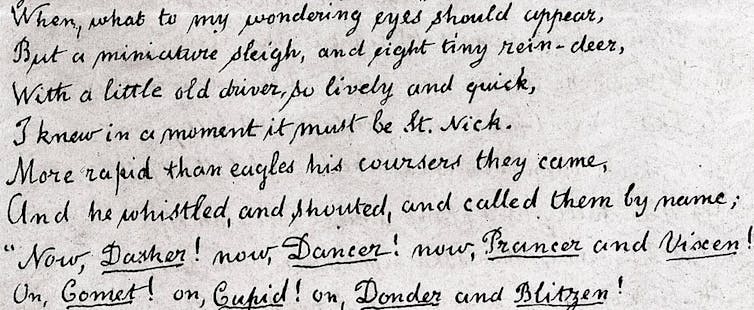
The poem “A Visit from St. Nicholas,” better known by its opening line “‘Twas the Night before Christmas,” has a special place among Christmas traditions, right alongside hot chocolate, caroling and bright lights. It has also inspired the modern image of Santa Claus as a jolly old man sporting red and a round belly.
But this poem has been steeped in controversy, and debate still looms over who the true author is. Traditionally, Clement C. Moore – a 19th-century scholar at the General Theological Seminary in New York, where I work as a reference librarian – has been credited with writing the poem in 1822 for his children. Every December, library staff shares our multiple copies of the poem in an exhibit to celebrate the holiday season.
No matter who wrote it, the poem is a fascinating object that has shaped Christmases past, present – and maybe yet to come.
A changing Santa Claus
Santa Claus had undergone many makeovers in the Western imagination by the time readers were introduced to “‘Twas the Night before Christmas.”
Some scholars argue that the idea of a magical being bringing gifts and good cheer can be traced all the way back to the Greek goddess Artemis. St. Nicholas, an early Christian bishop in what is now Turkey, was said to have destroyed a temple to Artemis, which he believed was idolatrous. Afterward, some of Artemis’ traits began showing up in legends as characteristics of St. Nicholas. He became known for generosity, such as giving children presents and gifting dowries to young women in need.
His feast day, Dec. 6, became a popular celebration in medieval Europe. By the modern era, images of St. Nick portrayed him as a tall, thin, stern man in a bishop’s hat who brought children both gifts and punishments. In German legend, he was accompanied by Krampus, a half-goat, half-demon creature that meted out a range of punishments to bad children, from mild to violent.
In Victorian Britain, Christmas became a festive holiday, with much feasting and drinking in addition to a religious celebration. In the early 19th century, Santa was sometimes depicted as a reveler from the lower classes – someone in need of charity, rather than a gift-giver himself.
As Christmas began to evolve into a family holiday, the image of Santa changed as well. Now, his jolliness came from the Christmas spirit, not feasting, and his rosy cheeks were the result of joy, not alcohol.
“‘Twas the Night before Christmas” was instrumental in crafting the modern American version of Santa Claus. The poem describes St. Nicholas as “dressed all in fur, from his head to his foot,” with twinkling eyes, rosy cheeks, a snow white beard and a round belly. Throughout the poem, Santa is depicted as a jolly elf bringing joy with his reindeer-led sleigh to both children and adults.
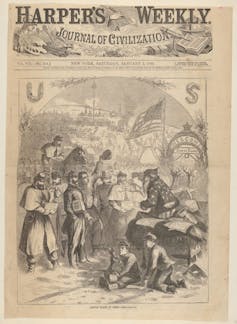
Thomas Nast, a Civil War-era cartoonist with the magazine Harper’s Weekly, created the enduring image of Santa Claus in a series of 33 drawings published between 1863 and 1886. The first of these drawings is inspired by the poem’s depiction of Santa carrying a sack full of presents with his sled pulled by reindeer.
Our library holds a copy of Nast’s book “Christmas Drawings for the Human Race,” containing his illustrations for “‘Twas the Night Before Christmas.” The introduction to our copy is written by Nast’s grandson, Thomas Nast St. Hill, who inscribed and donated it to the library in 1971. In some images, Nast used Santa to send a political message – such as one illustration that depicts him with toys related to battle, showing his support for Union soldiers.
Authorship debate
Two hundred years after the poem debuted, one fundamental question remains: Who is its true author?
The poem first appeared anonymously in a New York newspaper, the Troy Sentinel, on Dec, 23, 1823, and was reprinted many times. The New York Book of Poetry cited Moore, the 19th-century biblical scholar, as the author in 1837, and in 1844 he included it in his book of poems. Several years after the poem’s publication in the Sentinel, editor Orville Holley wrote that the author was “by birth and residence [belonging] to the city of New York, and that he is a gentleman of more merit as a scholar and writer than many of more noisy pretensions.” That’s an apt description of Moore, according to Niels Sonne, a librarian at General Theological Seminary in the 20th century who published an article about the authorship controversy. Moore was officially cited as the author in The New York Book of Poetry in 1837.
But the descendants of Henry Livingston Jr., a poet and farmer from an influential New York family, argue that he wrote the famous poem as early as 1808 and was never properly credited. Relatives of Livingston have claimed that his manuscript was brought to Wisconsin, where it was destroyed in a fire in 1847. His defenders point to similarities with other poetry and witty satires he wrote, and argue that his fun personality was much more in keeping with “A Visit from St. Nicholas” than Moore’s. His grandson, William Sturgus Thomas, spent years collecting evidence in his grandfather’s favor, and his papers are housed at the New York Historical Society.
The story continues
Every December, the Seminary library displays all the original copies of the poem we own in addition to more modern retellings and illustrations. Our copy of Moore’s 1844 “Poems” has one significant detail: it’s signed by Moore to the Reverend Samuel Seabury, who was a professor at General Theological Seminary and also the grandson of the first Episcopal American bishop, Samuel Seabury. The inscription says: “To the Reverend Dr. Seabury, with the respect of his friend the author, July 1844.”
[Over 140,000 readers rely on The Conversation’s newsletters to understand the world. Sign up today.]
The library also owns Moore’s rare follow-up work, titled “The Night after Christmas,” which was published after his death in 1863. In this version, the children are visited by their doctor after having too many treats delivered by Santa – and the physician shares some similarities with Santa himself:
“His eyes how they twinkled! Had the doctor got merry? His cheeks looked like Port and his breath smelt of Sherry…
But a wink of his eye when he physicked our Fred Soon gave me to know I had nothing to dread…”

Melissa Chim, Adjunct Professor and Reference Librarian, General Theological Seminary
This article is republished from The Conversation under a Creative Commons license. Read the original article.
- Details
- Written by: US Census Bureau
To commemorate this time of year, the U.S. Census Bureau presents the following holiday-related facts and figures from its vast collection of statistics.
The following facts are made possible by the invaluable responses to the Census Bureau’s surveys.
Did you know?
$14.6 billion
The estimated retail sales for the nation’s department stores in December 2020, a decrease of 20.0% from $18.3 billion in December 2019.
Source: Monthly Retail Trade Survey
Season's greetings
15.1%
The estimated percentage that December sales accounted for of total hobby, toy and game store sales in 2020.
Source: Monthly Retail Trade Survey
$96.2 billion
The estimated value of retail sales by electronic shopping and mail-order houses in December 2020, the highest estimated total for any month last year.
Source: Monthly Retail Trade Survey
$33.4 billion
The fourth quarter 2020 seasonally adjusted after-tax profits for retail trade corporations with assets of $50 million and over, down $10.4 billion from the third quarter of 2020.
Source: Quarterly Financial Report
$2.6 billion
The value of U.S. imports of Christmas decorations from China for 2020. China led the way with 92.03% of the U.S. total imports of Christmas decorations.
Source: International Trade Statistics, Harmonized System Codes 9505.10
$462.2 million
The value of U.S. imports of Christmas tree lights for 2020. Cambodia led the way with 60.1% of the total U.S. imports of Christmas tree lights.
Source: International Trade Statistics, Harmonized System Code 9405.30
515 establishments
The number of establishments nationwide that primarily produced dolls, toys and games in 2019, a decrease of 17 establishments from 2018 (532 establishments); they employed 6,268 workers in the pay period including March 12, an increase of 31 employees from 2018 (6,237 employees). California led the nation with 94 establishments in 2019.
Source: County Business Patterns
$701.9 million
The value of U.S. imports of tapered candles in 2020. Most of these came from Vietnam, representing more than 48.1% of America’s imported tapered candles, followed by Canada with 21.6%.
Source: International Trade Statistics, Harmonized System Code 3406
Holiday names
There are many holiday-sounding places in the United States.
For example, more than a dozen areas have Holly in their names, including Holly Pond, Ala. (851), Holly Grove, Ark. (460), Holly, Colo. (837), Holly Hill, Fla. (12,958), Holly Springs, Ga. (16,213), Holly Village, Mich. (5,997), Holly Springs, Miss. (6,968), Mount Holly, N.C. (population 17,703); Holiday, Fla. (24,939), and Holiday Shores, Ill. (2,840).
There’s also Snowflake, Ariz. (6,104); Santa Claus, Ind. (2,586); North Pole, Alaska (2,243); Noel, Mo. (2,124); and — if you know about reindeer — Dasher, Ga. (890), and Rudolph, Wis. (433). There is also Unity, Ore. (40) and Garland, Texas (246,018).
Source: 2020 Decennial Census
- Details
- Written by: NATIONAL AERONAUTICS AND SPACE ADMINISTRATION
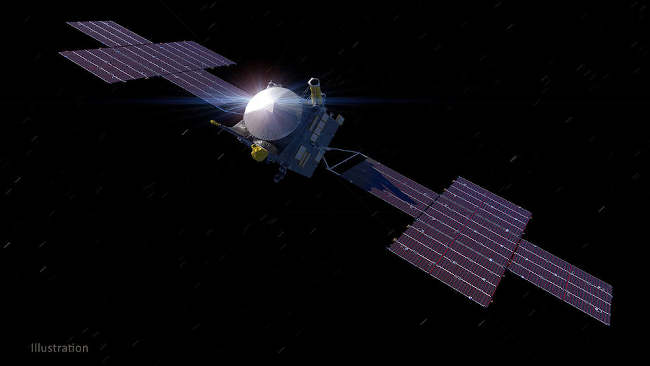
Launching in August 2022 and arriving at the asteroid belt in 2026, NASA’s Psyche spacecraft will orbit a world we can barely pinpoint from Earth and have never visited.
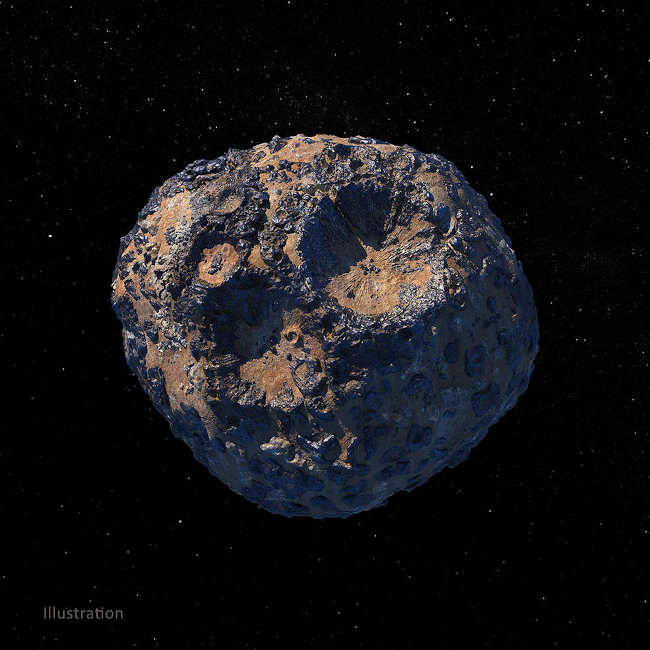
The target of NASA’s Psyche mission — a metal-rich asteroid, also called Psyche, in the main belt between Mars and Jupiter — is an uncharted world in outer space. From Earth- and space-based telescopes, the asteroid appears as a fuzzy blur. What scientists do know, from radar data, is that it’s shaped somewhat like a potato and that it spins on its side.
By analyzing light reflected off the asteroid, scientists hypothesize that asteroid Psyche is unusually rich in metal. One possible explanation is that it formed early in our solar system, either as a core of a planetesimal — a piece of a planet — or as primordial material that never melted.
This mission aims to find out, and in the process of doing so, they expect to help answer fundamental questions about the formation of our solar system.
“If it turns out to be part of a metal core, it would be part of the very first generation of early cores in our solar system,” said Arizona State University’s Lindy Elkins-Tanton, who as principal investigator leads the Psyche mission. “But we don’t really know, and we won’t know anything for sure until we get there. We wanted to ask primary questions about the material that built planets. We’re filled with questions and not a lot of answers. This is real exploration.”
Elkins-Tanton led the group that proposed Psyche as a NASA Discovery-class mission; it was selected in 2017. A huge challenge, she said, was choosing the mission’s science instruments: How do you make sure you’ll get the data you need when you’re not sure of what, specifically, you’ll be measuring?
For example, to determine what exactly the asteroid is made of and whether it’s part of a planetesimal core, scientists needed instruments that could account for a range of possibilities: nickel, iron, different kinds of rock, or rock and metal mixed together.
They selected a payload suite that includes a magnetometer to measure any magnetic field; imagers to photograph and map the surface; and spectrometers to indicate what the surface is made of by measuring the gamma rays and neutrons emitted from it. Scientists continue to hypothesize about what Psyche is made of, but “no one’s been able to come up with a Psyche that we can’t handle with the science instruments we have,” Elkins-Tanton said.
How to tour an unknown world
But before scientists can put those instruments to work, they’ll need to reach the asteroid and get into orbit. After launching from NASA’s Kennedy Space Center in August 2022, Psyche will sail past Mars nine months later, using the planet’s gravitational force to slingshot itself toward the asteroid. It’s a total journey of about 1.5 billion miles (2.4 billion kilometers).
The spacecraft will begin its final approach to the asteroid in late 2025. As the spacecraft gets closer to its target, the mission team will turn its cameras on, and the visual of asteroid Psyche will morph from the fuzzy blob we know now into high-definition, revealing surface features of this strange world for the first time.
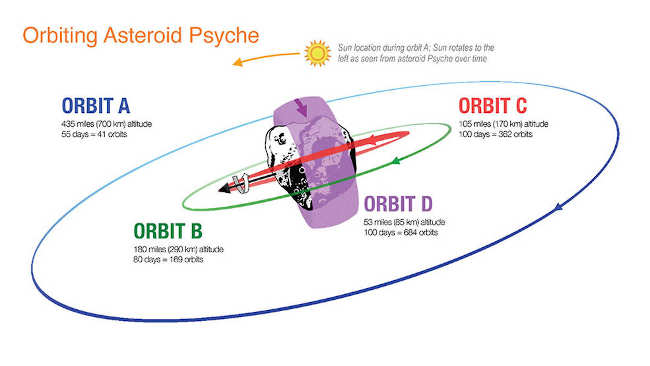
The imagery also will help engineers get their bearings as they prepare to slip into orbit in January 2026. The spacecraft’s initial orbit is designed to be at a high, safe altitude — about 435 miles (700 kilometers) above the asteroid’s surface.
During this first orbit, Psyche’s mission design and navigation team will be laser-focused on measuring the asteroid’s gravity field, the force that will keep the spacecraft in orbit. With an understanding of the gravity field, the team can then safely navigate the spacecraft closer and closer to the surface as the science mission is carried out in just under two years.
Psyche appears to be lumpy, wider across (173 miles, or 280 kilometers, at its widest point) than it is from top to bottom, with an uneven distribution of mass. Some parts may be less dense, like a sponge, and some may be more tightly packed and more massive. The parts of Psyche with more mass will have higher gravity, exerting a stronger pull on the spacecraft.
Scientists don’t yet have images of the asteroid Psyche; this interactive version is based on modeling. To see how it compares to other asteroids, zoom in and give it a spin. View the full interactive experience and fly along with the mission in real time at Eyes on the Solar System. Credit: NASA/JPL-Caltech
To solve the gravity-field mystery, the mission team will use the spacecraft’s telecommunications system. By measuring subtle changes in the X-band radio waves bouncing back and forth between the spacecraft and the large Deep Space Network antennas around Earth, engineers can precisely determine the asteroid’s mass, gravity field, rotation, orientation, and wobble.
The team has been working up scenarios and have devised thousands of “possible Psyches” — simulating variations in the asteroid’s density and mass, and orientation of its spin axis — to lay the groundwork for the orbital plan. They can test their models in computer simulations, but there’s no way to know for sure until the spacecraft actually gets there.
Over the following 20 months, the spacecraft will use its gentle electric propulsion system to dip into lower and lower orbits. Measurements of the gravity field will grow more precise as the spacecraft gets closer, and images of the surface will become higher resolution, allowing the team to improve their understanding of the body. Eventually, the spacecraft will establish a final orbit about 53 miles (85 kilometers) above the surface.
It’s all in an effort to solve the riddles of this unique asteroid: Where did Psyche come from, what is it made of, and what does it tell us about the formation of our solar system?
“Humans have always been explorers,” Elkins-Tanton said. “We’ve always set out from where we are to find out what is over that hill. We always want to go farther; we always want to imagine. It’s inherent in us. We don’t know what we’re going to find, and I’m expecting us to be entirely surprised.”
More about the mission
ASU leads the Psyche mission. JPL is responsible for the mission’s overall management, system engineering, integration and test, and mission operations. The mission phase — known as assembly, test and launch operations — is currently underway at JPL.
JPL also is providing a technology demonstration instrument called Deep Space Optical Communications that will fly on Psyche in order to test high-data-rate laser communications that could be used by future NASA missions.
Psyche is the 14th mission selected as part of NASA’s Discovery Program.
For more information about NASA’s Psyche mission go to http://www.nasa.gov/psyche and https://psyche.asu.edu/.