How to resolve AdBlock issue?
News
- Details
- Written by: Elizabeth Larson
LAKE COUNTY, Calif. — While California is still considered to be in a drought, 2021 has been a better year for rainfall based on National Weather Service data.
The US Drought Monitor reported that all of California is in a drought, with much of it in the “extreme” designation and an area of the state’s southern portion is in the “exceptional” category.
Lake County is among the areas reported as being in an extreme drought, for a second year in a row.
The US Drought Monitor reports that Lake County has been in some state of drought — ranging from abnormally dry to extreme and exceptional drought — seven of the last 11 years.
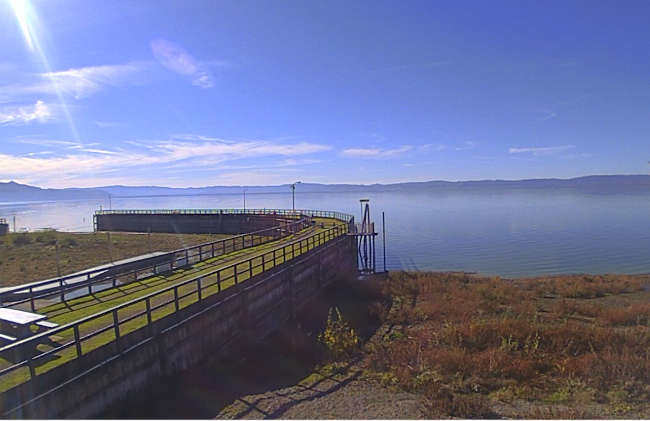
This year, Clear Lake has fallen to its lowest since the drought of the late 1970s, reaching nearly -2.5 feet Rumsey, the special measure for the lake, in November, according to United States Geological Survey data.
However, the rains so far this fall and winter are improving conditions.
As of 1 a.m. Thursday, Clear Lake was at -0.02 feet Rumsey, having risen nearly a foot and a half since the second week of December, according to the US Geological Survey gauge on the lake.
The National Weather Service’s Eureka office said it didn’t have reliable or consistent snow data for Lake County for 2020 or 2021, but it did have rainfall totals for five sites for both years. Totals for 2021 are as of Tuesday afternoon.
That information showed that southeast Clearlake received 4.35 inches of rain in 2020, compared to 13.13 inches in 2021; northeast Clearlake Oaks, 5.59 inches in 2020 and 22 inches in 2021; north Lakeport, 6.96 inches in 2020 and 24.01 inches in 2021; southeast Middletown, 20.48 inches of rain in 2020, 43.61 inches in 2021; and western Upper Lake, 16.11 inches in 2020, 36.53 inches in 2021.
The fall and winter storms have bulked up California’s snowpack.
As of early Thursday, the California Department of Water Resources’ California Data Exchange Center said the Northern Sierra was 145% of normal for this date, with the Central Sierra at 162% of normal and the Southern Sierra at 167% of normal.
Following the early winter storms, the California Department of Water Resources said it will conduct the first Phillips Station snow survey of the season on Thursday.
Email Elizabeth Larson at
- Details
- Written by: CALIFORNIA HIGHWAY PATROL
To encourage safe travel for those who are out on the road, the California Highway Patrol will conduct a maximum enforcement period, or MEP, starting at 6:01 p.m. on Friday, Dec. 31, through 11:59 p.m. on Sunday, Jan. 2.
“Ringing in the new year should be an exciting time filled with celebration and hope,” CHP Commissioner Amanda Ray said. “To help keep the roadways safe through the holiday and beyond, our officers will be out in force to deter, detect, and remove impaired drivers.”
During the previous New Year’s Day MEP, 56 people were killed in crashes in California. The CHP said half of the vehicle occupants killed in the crashes were not wearing a seat belt.
During that same 78-hour MEP, CHP officers made 709 arrests for driving under the influence throughout the state.
To help bolster this year’s holiday traffic safety effort across state lines, the CHP will again partner with the National Highway Transportation Safety Administration and the Washington, Oregon, Idaho, Arizona, Nevada, Colorado, Utah, Montana, Wyoming, North Dakota, and South Dakota state patrols in a Western States Traffic Safety Coalition for the “Drive High, Get a DUI,” campaign.
With the focus of the New Year’s operation to identify and remove impaired drivers from the road, the CHP will have all available personnel on patrol, including Drug Recognition Evaluators to conduct evaluations of suspected impaired drivers.
For daily MEP updates and other valuable traffic safety-related information, follow @CHP_HQ on Twitter.
- Details
- Written by: TAYELOR VALERIO, ROSE M. KREIDER AND WAN HE
As the United States ages and the youngest baby boomers are now 58, the remarkable changes American families have gone through in recent decades highlight a new phenomenon: older adults without children.
Declines in marriage and fertility and increased cohabitation in the general population are starting to be reflected in the lives of aging adults.
Whether by choice or circumstance, many older adults do not have children. A new Census Bureau report, Childless Older Americans: 2018, provides much-needed information on these older adults and their well-being.
How many older adults are childless?
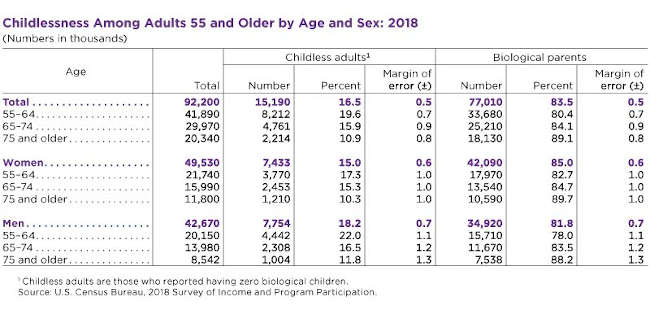
Of the 92.2 million adults ages 55 and older in 2018, 15.2 million (16.5%) are childless, defined here as having no biological children.
Moreover, childlessness is more common among the younger cohort of older adults. This suggests that childless adults will make up an even greater share of the older adult population in the future.
How do childless older adults compare to older parents?
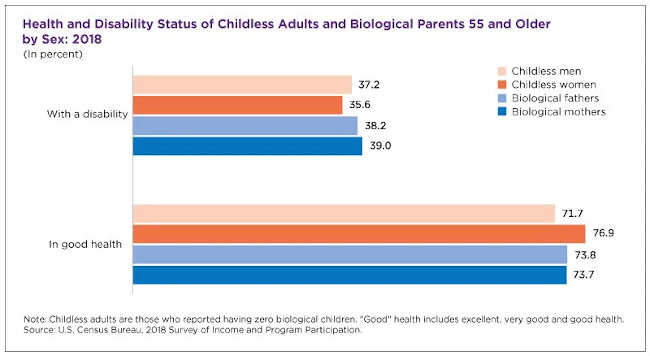
Childless adults have higher levels of personal net worth and educational attainment than older parents of biological children. They also are less likely to have a disability.
However, childless older adults are also more likely than parents to receive financial support from friends or family and more likely to be in poverty.
This suggests that the childless older adult population is multifaceted, with a portion who are socioeconomically well-off and another who may be at greater risk of financial hardship.
Other differences emerge when we analyze older childless women and men separately:
• Childless women have higher median personal net worth ($173,800) than childless men ($132,500).
• Childless women are also more likely to consider themselves in good health (77%), compared to 72% of childless men.
Who supports older childless adults?
While we do not have direct measures of caregiving, we use the detailed relationship information collected for all household members to identify potential sources of support within their household.
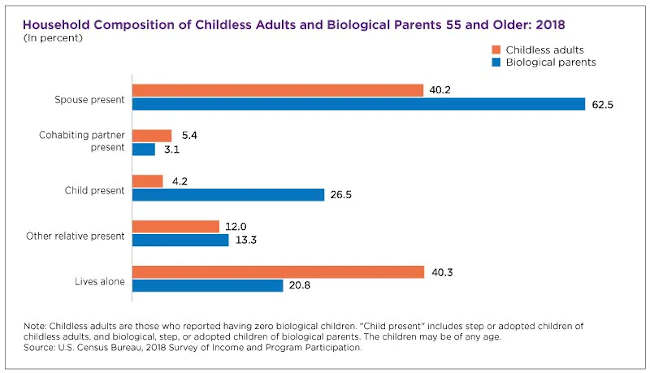
Childless older adults have fewer sources of potential support within their households: about 4 in 10 childless older adults live alone, compared to 2 in 10 parents.
Childless adults are also less likely to have gotten married and, therefore, less likely to be living with a spouse than are parents.
About 40% of childless adults are living with a spouse, compared to 63% of parents.
They are more likely than parents to be living with a cohabiting partner, but these relationships are still relatively uncommon among older adults: only 5% of childless adults and 3% of parents are cohabiting.
About 13% of older parents and 12% of older childless adults live with another type of relative such as an aunt/uncle, cousin, nephew, or parent.
It is important to remember that although childless adults have fewer sources of potential support within their households, those with more resources may be in a better position to obtain paid care than parents.
These data come from the 2018 Survey of Income and Program Participation, or SIPP. The SIPP is a nationally representative longitudinal survey administered by the U.S. Census Bureau that provides comprehensive information on the dynamics of income, employment, household composition, and government program participation.
Because the SIPP provides detailed socioeconomic and relationship information about household members, along with well-being indicators and complete fertility histories of men and women, this report provides a holistic view of this growing population.
More information about SIPP data quality is available on the SIPP website's Technical Documentation page.
Note: This research was supported in part by the National Institute on Aging.
Tayelor Valerio is a survey statistician and Rose M. Kreider is a branch chief in the Census Bureau’s Social, Economic, and Housing Statistics Division. Wan He is director of the Aging Research Program in the Census Bureau’s Population Division.
- Details
- Written by: Elizabeth Larson
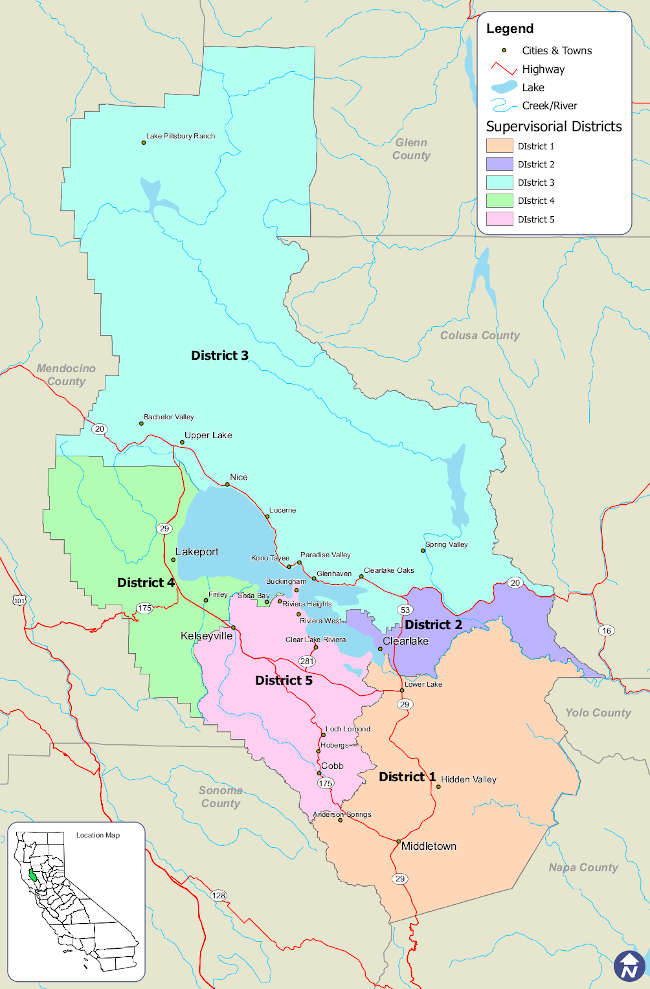
The second and final reading of an ordinance adopting the new supervisorial district boundaries took place as part of the board’s consent agenda at its Dec. 21 meeting. Approval of the consent agenda was unanimous.
Like the state, the board is required to do the redistricting every 10 years, once new census data have been completed and delivered to the state and counties.
Following a series of public meetings that began in late summer, county staff, assisted by consultant Margaret Long, proposed several maps with slightly different configurations of the five supervisorial districts.
At the board’s Nov. 30 meeting, it selected a final map and directed staff to come back with the necessary resolution and ordinance to adopt it.
Staff returned with the resolution on Dec. 14, at which time the board approved the resolution and held the first reading of the ordinance to establish the new district boundaries.
The deadline for the board to take that action was Dec. 15, said Deputy County Administrative Officer Matthew Rothstein, who oversaw the county’s redistricting process.
Based on the county’s population, each supervisorial district has to have 13,633 residents, or be within a 10% deviation.
The final map places the population this way: District 1, 13,479; District 2, 14,243; District 3, 13,875; District 4, 12,957; and District 5, 13,609.
Lake County’s supervisorial redistricting process has been more smooth than other counties, board members noted during the Dec. 14 meeting.
The process has been reportedly controversial in counties including Butte, Mendocino and Sonoma, where community pushback was reported on some of the options those boards of supervisors considered. Butte County’s board was divided in its final vote and in Sonoma County there have been allegations of gerrymandering.
Board Chair Bruno Sabatier said he wanted to make Lake County’s final map available for the next 10 years on its GIS site as it’s very confusing to look at the districts by census blocks.
“All of the draft maps will be retained over the next 10 years,” said Rothstein.
Supervisor Moke Simon offered three separate motions at that meeting: to adopt the resolution, to waive the ordinance reading and have it read in title only and to advance the ordinance for a second reading at the Dec. 21 meeting.
The board adopted all three motions unanimously.
Sabatier thanked Long and her office and Simon added his thanks to the public for participating in the process, whether it was attending meetings in person or virtually.
A week later, the Board of Supervisors took its final vote to approve that map at its final 2021 meeting.
The board’s last action on Dec. 21 was six days ahead of the final steps in the California Citizens Redistricting Commission’s process, which is a concurrent but separate procedure.
The state commission delivered its final maps for congressional, State Senate, State Assembly and Board of Equalization districts to the California Secretary of State’s Office on Tuesday, Dec. 27, the deadline set by the California Supreme Court.
The statewide maps showing where Lake County is placed in the newly drawn districts for Congress, the state Legislature and Board of Equalization can be seen here.
Email Elizabeth Larson at