How to resolve AdBlock issue?
News
- Details
- Written by: Elizabeth Larson
The CHP is planning its New Year’s maximum enforcement period, or MEP, from 6:01 p.m. on Friday, Dec. 31, through 11:59 p.m. on Sunday, Jan. 2.
The agency also held a maximum enforcement period to ensure road safety over the Christmas weekend, from Friday, Dec. 24, to Sunday, Dec. 26.
Officer Efrain Cortez of the Clear Lake Area CHP office reported that during that Christmas enforcement, 28 people were killed in vehicle crashes throughout California.
Cortez said no fatalities occurred in Lake County over the Christmas weekend.
That's compared to at least 38 people who were killed in crashes throughout the state during the Christmas holiday enforcement period of 2020, Cortez said.
As wet weather and heavy snow continue to cover Northern California, Cortez said the CHP is advising drivers to pay attention to road hazards, Caltrans employees and emergency personnel.
“Please be aware of the road conditions, wear your seat belt, turn on your headlights when your windshield wipers are activated, and please don’t drive while impaired,” he said.
Email Elizabeth Larson at
- Details
- Written by: LAKE COUNTY NEWS REPORTS
Dr. Gary Pace said surrounding counties are finding Omicron, which he said “almost certainly is spreading through our community.”
“We anticipate a large climb in cases in the coming weeks, and encourage businesses, schools, and families to prepare for many people testing positive and getting sick. Unvaccinated people are considered especially vulnerable to severe illness,” Pace said Thursday.
Statewide, Pace said there is a rapid increases in cases, with a slower increase in the hospitalizations. Death rates have remained stable.
“The lower proportion of serious illness may be due to Omicron causing milder disease, or simply lag time from catching the virus and having the infection become severe. Hospitals locally and around the state are pretty full, as is often the case this time of year. Further surges in COVID cases could quickly become overwhelming,” Pace said.
Pace said businesses and health care facilities are concerned about staffing. If large numbers of workers get sick and have to isolate, or have to quarantine as a close contact, it can cause real strain.
He urged residents to get vaccinated. “Without a doubt, the best strategy to slow this wave of Omicron-driven COVID-19 infections is to get fully vaccinated and boosted.”
Vaccination with a booster seems to provide good protection from serious illness, as seen in the United States and around the world. Pace said vaccinated people are still getting infected and can be contagious, although at lower rates than unvaccinated people. “The booster offers important additional protection, and everyone who is eligible should get one ASAP.”
In Lake County, Pace said more than one-third of the total population, greater than 20,000 people, have no vaccine-related immunity (residents younger than age 5 remain ineligible to be vaccinated, and 32-33% of those eligible are unvaccinated).
Lake County’s eight regular ICU beds and ongoing shortages in EMS ambulance transport out of county make it particularly vulnerable if large numbers of people get ill at once, Pace said.
Pace said the Health Department, county leaders, healthcare partners, and community organizations are all trying to work together to prepare, in case things get worse.
He encouraged people to wear masks indoors, and to upgrade to KN95 or N95 masks, when possible as Omicron appears especially able to transmit through the air.
In addition, Pace suggested those who are symptomatic or who have come into close contact with an infected person to get tested. Testing resources are available here.
Pace said the county is requesting state resources to help get a van that can be part of providing mobile vaccine sites in the coming weeks.
In other parts of the world, Pace said the Omicron spike rose rapidly, then dropped four to six weeks later.
“We encourage people to take extra precautions in the next few weeks, especially if you are at higher risk or unvaccinated. Hopefully, this wave will pass fairly quickly, and we can return to a more regular lifestyle. Taking some extra steps these next few weeks could be critical in preventing severe outcomes,” Pace said.
- Details
- Written by: CALIFORNIA DEPARTMENT OF WATER RESOURCES
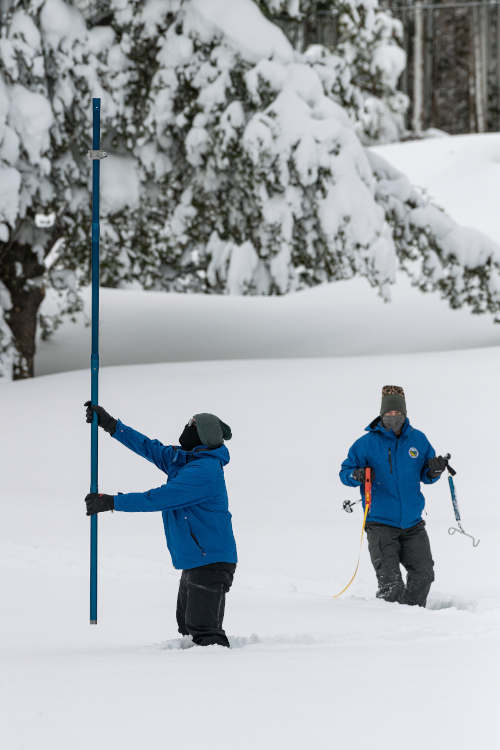
Early winter storms this month provided a strong start to the season and some drought relief, but California remains in a drought.
That was the report from the California Department of Water Resources, which conducted the first snow survey of the season at Phillips Station on Thursday.
Thursday’s manual survey recorded 78.5 inches of snow depth and a snow water equivalent of 20 inches, which is 202 percent of average for this location on this date.
The snow water equivalent measures the amount of water contained in the snowpack and is a key component of DWR’s water supply forecast. Statewide the snowpack is 160 percent of average for this date.
“We could not have asked for a better December in terms of Sierra snow and rain,” said DWR Director Karla Nemeth. “But Californians need to be aware that even these big storms may not refill our major reservoirs during the next few months. We need more storms and average temperatures this winter and spring, and we can’t be sure it’s coming. So, it’s important that we continue to do our part to keep conserving – we will need that water this summer.”
Californians only need to look to last winter and the state’s disappointing snowpack runoff due to high temperatures, dry soil and evaporation as a reminder that changes to our climate mean it will take more than an average year to recover from drought.
“California continues to experience evidence of climate change with bigger swings between wet and dry years and even extreme variability within a season. A wet start to the year doesn’t mean this year will end up above average once it’s all said and done,” said Sean de Guzman, Manager of DWR’s Snow Surveys and Water Supply Forecasting Unit.
December is the first of the three typically wettest months of California’s water year. Significant January and February precipitation would be required to generate enough runoff to make up for the previous two winters that were California’s fifth- and second-driest water years on record.
California has experienced wet Decembers before only to have storms disappear for the remainder of the season.
In 2013, the first snow survey provided promising results after a wet December, similar to this year. However, the following January and February were exceptionally dry, and the year ended as the driest on record, contributing to a record-breaking drought.
On average, the Sierra snowpack supplies about 30 percent of California’s water needs and the snowpack is an important factor in determining how DWR manages the state’s water resources. Its natural ability to store water is why the Sierra snowpack is often referred to as California's “frozen reservoir.”
As spring sets in, the snowpack begins to melt. Water that is not absorbed into the ground, called “runoff,” trickles into mountain streams, which feed rivers and eventually aqueducts and reservoirs, where it can be stored for use throughout the dry season. Climate change is affecting California’s snowpack, as more precipitation falls as rain and less as snow. Excessively dry soils and dry, warm spring temperatures are also reducing yearly runoff.
Due to these climate-induced changes, DWR is investing in partnerships and implementing emerging and proven technologies to improve forecasts of precipitation, seasonal snowpack, and runoff to support more efficient water management now and to help estimate the impacts of climate change on future flood and drought conditions. Forecast improvements and monitoring enhancements increase the reliability of data used to inform water managers about flood risks, allowing opportunities to create more storage in reservoirs ahead of big storms while also ensuring water supply reliability in periods of dry or drought conditions.
DWR conducts five media-oriented snow surveys at Phillips Station each winter near the first of each month from January through April and, if necessary, May.
- Details
- Written by: Elizabeth Larson
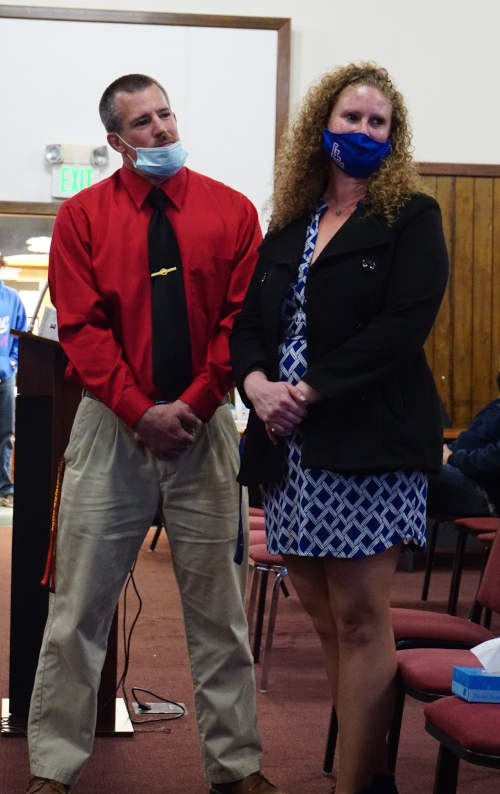
It was during the district’s Dec. 8 board meeting that it formally accepted the resignations of Ed and Sarah Fuchs.
Their last day with the district is this Friday, Dec. 31.
They’ve been in the community for 25 years and said they are excited for the next adventure, which will take them to Wisconsin.
Ed Fuchs is an eighth grade physical education teacher, eighth grade class adviser and boys’ wrestling coach, while his wife has worked as the College and Career Center adviser, testing coordinator and athletic director at Lower Lake High School.
Beginning as an assistant football coach and working up to a PE position, Ed Fuchs said in his resignation letter that he was “beyond grateful to have been able to give back to my community that I grew up in for over 20 years.”
He said the decision to leave wasn’t an easy one. “I will bleed Trojan Blue for as long as I live and I will never forget where I come from,” and he concluded by thanking the board and Superintendent Dr. Becky Salato for the “the greatest opportunity that I have experienced in my life.”
Sarah Fuchs also grew up in the community, graduating from Lower Lake High in 2002 and coming back to work in the district. “Coming to work for Konocti was one of the best decisions I could have made for my career and future,” she wrote in her resignation letter.
They also spoke briefly during the meeting’s public comment portion, and received a standing ovation.
Ed Fuchs said he was “beyond grateful.”
“You’ll be greatly missed. Greatly missed,” said Board member Mary Silva.
During the agenda item in which the board needed to accept personnel changes, including the resignations, Board member Bill Diener thanked the couple, noting the difficulty of losing staff members who are so special to the community and are in the middle of their careers.
“I love both of you,” said Diener, who has worked with Sarah Fuchs and coached with her husband.
He said he’s going to miss them a lot. “I can’t explain how much you’ve done for the community, this district and the students you’ve touched,” noting they’ve touched a lot of students’ lives and changed things for the better.
Despite them moving to Wisconsin, Diener said he will “never, ever” be a Green Bay Packers fan.
Board member Joan Mingori said that as athletic director, Sarah Fuchs didn’t miss games. She also took over ACT and SAT testing.
“You don’t realize how much you have touched the lives of this community,” said Mingori.
The board then voted unanimously to accept the resignations. As they did so, Sarah Fuchs, who had a box of tissue sitting beside her, wiped her eyes.
Salato told them they will never be gone due to the hearts they’ve touched in the community.
“Always remember where you came from,” Silva said.
In her resignation letter, Sarah Fuchs offered her gratitude for opportunities to grow professionally, and to work with incredible co-workers “whose dedication to these students has always been a constant reminder of why we do what we do.”
She said she will be forever grateful to everyone who gave her the chance to make a difference in the lives of students.
She concluded, “How lucky am I to have something that makes saying goodbye so hard?”
Email Elizabeth Larson at