How to resolve AdBlock issue?
Refresh this page
How to resolve AdBlock issue?
Refresh this page
Lake County News,California
  • Home
    • Registration Form
  • News
    • Education
    • Veterans
    • Community
      • Obituaries
      • Letters
      • Commentary
    • Police Logs
    • Business
    • Recreation
    • Health
    • Religion
    • Legals
    • Arts & Life
    • Regional
  • Calendar
  • Contact us
    • FAQs
    • Phones, E-Mail
    • Subscribe
  • Advertise Here
  • Login

News

Solo vehicle crash results in fatality Sunday evening

LAKE COUNTY, Calif. — A solo-vehicle wreck in south Lake County on Sunday evening became the second to claim a life over the weekend.

The crash in the 19000 block of Big Canyon Road at Harbin Springs Road near Middletown was first reported just before 7 p.m. Sunday, according to radio and California Highway Patrol online reports.

The first fire units on scene found a red pickup on its side, blocking all of Big Canyon Road.

A firefighter arriving at the scene asked Cal Fire dispatch to send an air ambulance, as one person was trapped under the bed of the truck and a second person was sitting outside of the vehicle.

Shortly after 7:15 p.m., units at the scene confirmed that one person had died and a coroner was dispatched.

Later on Sunday, the CHP reported that the vehicle had been towed and booked into evidence.

The CHP’s online reports said the driver had suffered minor injuries, including lacerations to their face and back. 

The Sunday night crash followed a solo-vehicle crash — also involving a pickup — on Saturday afternoon on Bartlett Springs Road that killed one person. 

On Saturday night there also was another solo-vehicle crash on Bartlett Springs Road east of Walker Ridge Road that resulted in one person being flown by air ambulance to a regional trauma center.

Email Elizabeth Larson at This email address is being protected from spambots. You need JavaScript enabled to view it.. Follow her on Twitter, @ERLarson, and on Bluesky, @erlarson.bsky.social. Find Lake County News on the following platforms: Facebook, @LakeCoNews; X, @LakeCoNews; Threads, @lakeconews, and on Bluesky, @lakeconews.bsky.social. 

Supervisors to discuss economic development plans, air quality fee hike and CEO-style government

LAKE COUNTY, Calif. — The Board of Supervisors this week will hear updates on economic development initiatives, revisit a proposed air quality management fee hike and consider a report from a governance workshop exploring a shift to a “chief executive officer” model for county government. 

The‌ ‌board will meet beginning ‌at‌ ‌9‌ ‌a.m. Tuesday, July 22, in the board chambers on the first floor of the Lake County Courthouse, 255 N. Forbes St., Lakeport.

The‌ ‌meeting‌ ‌can‌ ‌be‌ ‌watched‌ ‌live‌ ‌on‌ ‌Channel‌ ‌8, ‌online‌ ‌at‌ ‌https://countyoflake.legistar.com/Calendar.aspx‌‌ and‌ ‌on‌ ‌the‌ ‌county’s‌ ‌Facebook‌ ‌page. ‌Accompanying‌ ‌board‌ ‌documents, ‌the‌ ‌agenda‌ ‌and‌ ‌archived‌ ‌board‌ ‌meeting‌ ‌videos‌ ‌also‌ ‌are‌ ‌available‌ ‌at‌ ‌that‌ ‌link. ‌ ‌

To‌ ‌participate‌ ‌in‌ ‌real-time, ‌join‌ ‌the‌ ‌Zoom‌ ‌meeting‌ ‌by‌ ‌clicking‌ ‌this‌ ‌link‌. ‌ ‌

The‌ ‌meeting‌ ‌ID‌ ‌is‌ 865 3354 4962, ‌pass code 726865.‌ ‌The meeting also can be accessed via one tap mobile at +16694449171,,86533544962#,,,,*726865#. The meeting can also be accessed via phone at 669 900 6833.

At 10 a.m., the board will discuss the Health Services Department’s request regarding whether it should scale back its involvement in addressing the issue of cyanobacteria in Clear Lake, since other external agencies are now handling much of the testing and monitoring more efficiently.

According to the staff memo, the department has been organizing a multi-agency task force since before COVID where there was limited understanding of the bacteria and the toxins. The task force has involved water services providers and local tribes. 

At 11:15 a.m., the board will review a report from consulting firm Municipal Resource Group on a governance and organizational workshop attended by the board and staff in March in which they discussed the possibility of moving from a chief administrative officer to a chief executive officer model. 

At 1 p.m., the board will hear an update on the county’s ongoing economic development initiatives and new legislation that may have a significant local economic impact.

These initiatives include the county’s Capital Improvement Plan, microgrid request for quote, health education and regional training hub federal funding and the upcoming application for the Community Development Block Grant. 

In the untimed items, the board will continue the conversation on the Lake County Air Quality Management District’s draft replacement fee schedule.

Last week, the agency proposed a significant fee increase, phased in over three years, with a 35% increment for the first year. Supervisors pushed back and asked for a longer rollout.

The district this week brings back to the board a four-year and five-year implementation plan for consideration.

The board will also be asked to grant the appeal of the permit revocation for a commercial outdoor cannabis cultivation of up to 110,000 square feet located at Lake Pillsbury, operated by Pillsbury Family Farms. 

In March, the Community Development Department recommended revoking the project’s major use permit, citing prior violations and failure in background checks of the company’s chief financial officer. 

The farm appealed the case in front of the board at the June 17 meeting. Now staff comes back with updated findings and a recommendation to approve of the appeal with the condition of clearing a “live scan” background check by the Lake County Sheriff’s Office. 

The full agenda follows. 

CONSENT AGENDA

5.1: Adopt resolution approving Cooperative Agreement #25-0191-000-SA with the State of California, Department of Food and Agriculture for State Organic Inspection Program for the County of Lake for the period July 1, 2025, through June 30, 2026.

5.2: Adopt resolution approving Amended Agreement No. 25-0002-011-SF with the State of California, Department of Food and Agriculture for the Insect Trapping Program in the amount of $35,460.00 for FY 2025-26.

5.3: Adopt resolution amending Resolution No. 2025-76 establishing position allocations for Fiscal Year 2025-26, Budget Unit No. 1903 Department of Public Works.

5.4: Adopt a proclamation designating the week of July 20–26, 2025, as Probation Services Week in Lake County.

5.5: Approve second amendment to the contract between County of Lake and Redwood Toxicology Laboratory, Inc. for drug and alcohol testing, in the amount of $35,000.00 from July 1, 2023, to June 30, 2024, and $50,000.00 per fiscal year from July 1, 2024, to June 30, 2026, and authorize the chair to sign.

5.6: (Sitting as the Board of Directors for the Lake County Watershed Protection District) Review and approve “Just Compensation” estimates for the purchase of properties within the Middle Creek Flood Damage Reduction and Ecosystem Restoration Project and authorize the chair of the Board of Directors to sign the approval.

5.7: Approve travel to exceed the 1500-mile maximum for Water Resources staff member Taylor Woodruff to San Antonio, Texas from August 9, 2025, to August 14, 2025, for the 155th Annual American Fisheries Society Meeting.

TIMED ITEMS

6.1, 9:02 a.m.: Public input.

6.2, 9:03 a.m.: Pet of the Week.

6.3, 9:07 a.m.: Presentation of proclamation designating the week of July 20–26, 2025, as Probation Services Week in Lake County.

6.4, 9:20 a.m.: Consideration of a letter of commitment for the “Enhancing Wildfire Prevention through Targeted Defensible Space and Fuels Reduction Projects in Lake County’s High-Risk Clearlake and North Shore Neighborhoods” project of the Lake County Resource Conservation District – CAL FIRE Wildfire Prevention Grant (#78873218).

6.5, 9:30 a.m.: Consideration of presentation on Phases One and Two of the Climate Health Adaptation and Resilience Mobilization (CHARM) Lake County Program.

6.6, 10 a.m.: Consideration of recommendation from Health Services Department regarding participation in the Clear Lake Cyanobacteria Task Force.

6.7, 10:30 a.m.: Consideration of an update on N. Lakeport FLASHES projects.

6.8, 11:15 a.m.: Consideration of a report from Municipal Resource Group on your Board’s March 21, 2025, training workshop on general governance, priority development, and organizational effectiveness.

6.9, 1 p.m.: Consideration of county economic development and housing initiatives.

NON-TIMED ITEMS

7.1: Supervisors’ weekly calendar, travel, and reports.

7.2: Sitting as the Lake County Air Quality Management District Board of Directors, continued discussion of the draft replacement fee schedule (Rules 660–668).

7.3: Consideration of proposed findings of fact and decision in the appeal of John Evans / Pillsbury Family Farms, Inc. (AB-PL-25-85).

7.4: Consideration of (a) designating one member of the Lake County Board of Supervisors to serve as a member of the AAA Governing Board, and another supervisor to serve as the alternate; and (b) appointing Amy Schimansky, Deputy Director of Social Services, as the second member representing Lake County on the AAA Governing Board.

7.5: Consideration of (a) waiving the formal bidding process pursuant to County Ordinance 3137 Section 2-38, Subsection 38.1, extension of annual agreements; and (b) approving contract between County of Lake and The Regents of the University of California for training services, in the amount of $339,915.00 from July 1, 2025, to June 30, 2026, and authorize the chair to sign.

CLOSED SESSION

8.1, 1:30 p.m.: Closed session: Employee grievance complaint pursuant to Gov. Code sec. 54957.

8.2: Conference with legal counsel: Existing litigation pursuant to Government Code section 54956.9(d)(1): McSorley v. Lake County.

Email staff reporter Lingzi Chen at This email address is being protected from spambots. You need JavaScript enabled to view it.. 

How the ‘big, beautiful bill’ will deepen the racial wealth gap – a law scholar explains how it reduces poor families’ ability to afford food and health care

President Donald Trump and Secretary of State Marco Rubio watch Speaker of the House Mike Johnson on television after the House passed the bill on July 3, 2025. Joyce N. Boghosian/White House via AP

President Donald Trump has said the “big, beautiful bill” he signed into law on July 4, 2025, will stimulate the economy and foster financial security.

But a close look at the legislation reveals a different story, particularly for low-income people and racial and ethnic minorities.

As a legal scholar who studies how taxes increase the gap in wealth and income between Black and white Americans, I believe the law’s provisions make existing wealth inequalities worse through broad tax cuts that disproportionately favor wealthy families while forcing its costs on low- and middle-income Americans.

The widening chasm

The U.S. racial wealth gap is stark. White families’ median wealth between 2019 and 2022 grew to more than $250,000 higher than Black families’ median wealth.

This disparity is the result of decades of discriminatory policies in housing, banking, health care, taxes, education and employment.

The new legislation will widen these chasms through its permanent extension of individual tax cuts in Trump’s 2017 tax reform package. Americans have eight years of experience with those changes and how they hurt low-income families.

The nonpartisan Congressional Budget Office, for example, predicted that low-income taxpayers would gain US$70 a year from the 2017 tax cuts. But that figure did not include the results of eliminating the individual mandate that encouraged uninsured people to get health insurance through the federal marketplace. That insurance was heavily subsidized by the federal government.

The Republican majority in Congress predicted that the loss of the mandate would decrease federal spending on health care subsidies. That decrease cost low-income taxpayers over $4,000 per person in lost subsidies.

The Congressional Budget Office examined the net effect of the 2025 bill by combining the tax changes with cuts to programs like Medicaid and food assistance. It found that the bill will reduce poor families’ ability to obtain food and health care.

A woman speaks outdoors in front of a microphone as several peopple holding a banner stand behind her.
Rep. Melanie Stansbury of New Mexico speaks during a news conference at the Capitol focused on the One Big Beautiful Bill Act, on June 3, 2025. AP Photo/Rod Lamkey Jr.

Wealth-building for whom?

Perhaps the most revealing part of the bill is how it turns ideas for helping low-income families on their head. They are touted as helping the poor – but they help the wealthy instead.

A much publicized feature of the bill is the creation of “Trump Accounts,” a pilot program providing a one-time $1,000 government contribution to a tax-advantaged investment account for children born between 2025 and 2028.

While framed as a “baby bonus” to build wealth, the program’s structure is deeply flawed and regressive. Although the first $1,000 into the accounts comes from the federal government, the real tax benefits go to wealthy families who can avoid paying taxes by contributing up to $5,000 per year to their children’s accounts.

As analysts from the Roosevelt Institute, a progressive economic and social policy think tank, have pointed out, this design primarily benefits affluent families who already have the disposable income to save and can take full advantage of the tax benefits.

For low-income families struggling with daily expenses, making additional contributions is not a realistic option. These accounts do not address the fundamental barrier to saving for low-income families – a lack of income – and are more likely to widen the wealth gap than to close it.

This regressive approach – regressive because the wealthy get larger benefits – to wealth-building is mirrored in the bill’s renewal and enhancement of the New Markets Tax Credit program. Although extended by the “big, beautiful bill” to drive investment into low-income communities by offering capital gains tax breaks to investors, the program subsidizes luxury real estate projects that do little to benefit existing low-income residents and accelerate gentrification and displacement. Studies show that there is very little increase in salaries or education in areas with these benefits.

A harsh new rule

The child tax credit is another part of the bill that purports to help the poor and working classes while, in fact, giving the wealthy more money.

A family can earn up to $400,000 and still get the full $2,200 tax credit per child, which reduces their tax liability dollar for dollar. In contrast, a family making $31,500 or less cannot receive a tax credit of more than $1,750 per child. And approximately 17 million children – disproportionately Black and Latino – will not receive anything at all.

More significantly, the law tightens eligibility by requiring not only the child but also the taxpayer claiming the credit to have a Social Security number. This requirement will strip the credit from approximately 4.5 million U.S. citizen children in mixed-status families – families where some people are citizens, legal residents and people living in the country without legal permission – where parents may file taxes with an Individual Taxpayer Identification Number but lack a Social Security number, according to an April 2025 study.

A man in suit and tie sits outdoor at a table holding a gavel as dozens of people stand behind him and clap.
President Donald Trump, joined by Republican lawmakers, holds a gavel after signing the One, Big Beautiful Bill Act into law, on July 4, 2025 in Washington, DC. Eric Lee/Getty Images

A burden on the poor

Perhaps most striking is the law’s “pay-fors” – the provisions designed to offset the cost of the tax cuts.

The legislation makes significant changes to Medicaid and the Supplemental Nutrition Assistance Program, lifelines for millions of low-income families.

The law imposes new monthly “community engagement” requirements, a form of work requirement, for able-bodied adults to maintain Medicaid coverage. The majority of such adults enrolled in Medicaid already work. And many people who do not work are caring full time for young children or are too disabled to work. The law also requires states to conduct eligibility redeterminations twice a year.

Redeterminations and work requirements have historically led to eligible people losing coverage. For SNAP, the bill expands work requirements to some Americans who are up to 64 years old and the parents of older children and revises benefit calculations in ways that will reduce benefits.

By funding tax cuts for the wealthy while making cuts to essential services for the poor, the bill codifies a transfer of resources up the economic ladder.

In my view, the “big, beautiful bill” represents a missed opportunity to leverage fiscal policy to address the American wealth and income gap. Instead of investing in programs to lift up low- and middle-income Americans, the bill emphasizes a regressive approach that will further enrich the wealthy and deepen existing inequalities.The Conversation

Beverly Moran, Professor Emerita of Law, Vanderbilt University

This article is republished from The Conversation under a Creative Commons license. Read the original article.
An aging nation: U.S. median age surpassed 39 in 2024


The U.S. median age — the age at which half the population is aged above and the other half below — has increased by 0.6 years from April 2020 to July 2024 when it reached 39.1, according to U.S. Census Bureau population estimates.

Between April 2020 and July 2024, the median age rose in 329 of the nation’s 387 metro areas. At the same time, 47 metro areas experienced a decline in median age — many of which were in the South, including some in Florida.

Given that nearly 294 million people (86% of the U.S. population) lived in one of the nation’s 387 metro areas in 2024, many metro areas saw an increase in their median ages, too.

Median ages in metro areas in 2024 ranged between 26.4 and 68.1, with 192 metro areas having a median age higher than the nation’s.

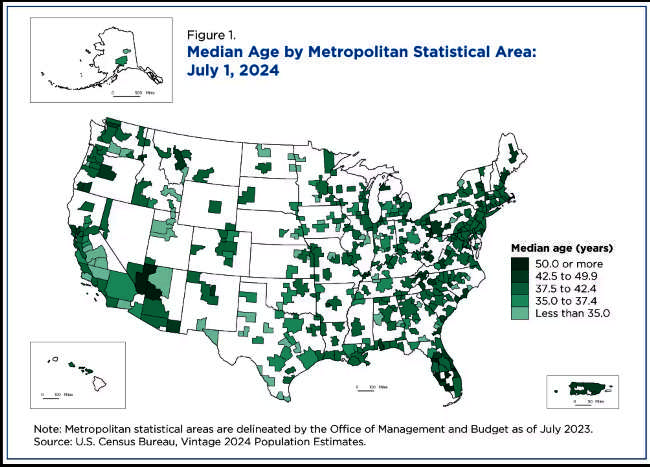
Many of the metro areas with the highest median ages were in Florida and Arizona, both popular retirement destinations (Figure 1).

Metro areas with the lowest median ages tended to have one of two things: a relatively high proportion of young adults, often due to the presence of a college/university or large military installation; or a relatively high proportion of children. Some had both.

Metro area aging trends

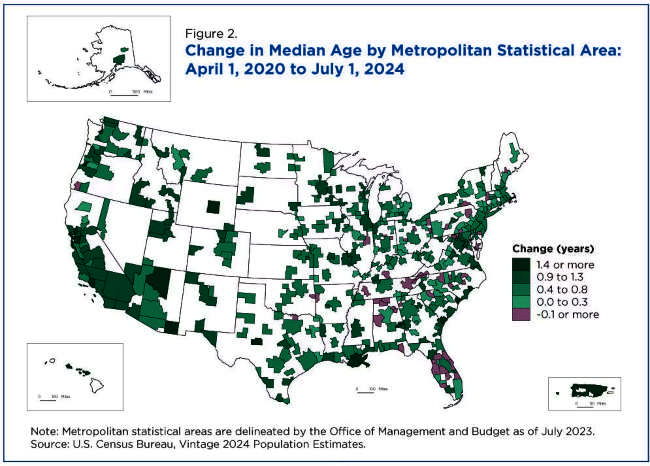
Between April 2020 and July 2024, the median age rose in 329 of the nation’s 387 metro areas (Figure 2). 

At the same time, 47 metro areas experienced a decline in median age — many of which were in the South, including some in Florida. 

The median ages of 11 metro areas did not change during the period.

Metro areas with oldest and youngest median ages

The median age increase in many metro areas aligned with the national aging trend: 61.2 million people aged 65 and over lived in the United States in 2024, up 13% from 54.2 million in 2020, in contrast to a decline in the number of children (ages 0 to 17).

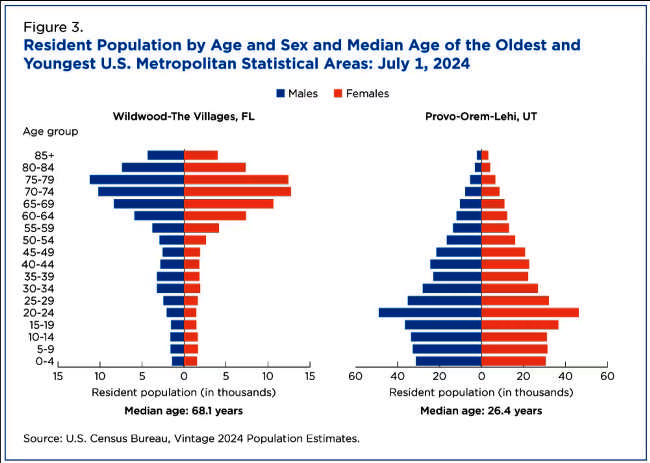
The metro area with the highest median age in 2024 (68.1) was Wildwood-The Villages, FL, where 57% of the population was 65 and older reflecting the presence of a large retirement community. 

Two other Florida metro areas — Punta Gorda and Homosassa Springs — followed closely with the second- (60.1) and third-highest (56.8) median ages, respectively. More than 35% of both populations were 65 and older.

Metro areas with the youngest median age were in Provo-Orem-Lehi, UT (26.4 years) and Logan, UT-ID (27). Both metro areas have a large university.

The result was two vastly different age structures in the nation’s oldest and youngest metro areas in 2024: Older adults dominated the population in Wildwood-The Villages, while there was a higher share of children and young adults in Provo-Orem-Lehi (Figure 3).

Rising and falling median ages

Some metro areas with relatively large shares of the aging population experienced sharper increases in median age than others. 

For instance, South Carolina’s Hilton Head Island-Bluffton-Port Royal and Myrtle Beach-Conway-North Myrtle Beach metro areas had the largest median age hikes from 2020 to 2024: 3.1 and 2.1 years, respectively.

Despite growth in the 65-and-older demographic, the median age in 47 metro areas decreased between 2020 and 2024. 

While the United States is characterized by its increasingly large older adult population — a byproduct of factors such as a sizable baby boomer population and declining 0-17 demographic — these exceptions underscore that age patterns can differ, especially in some fast-growing metro areas.

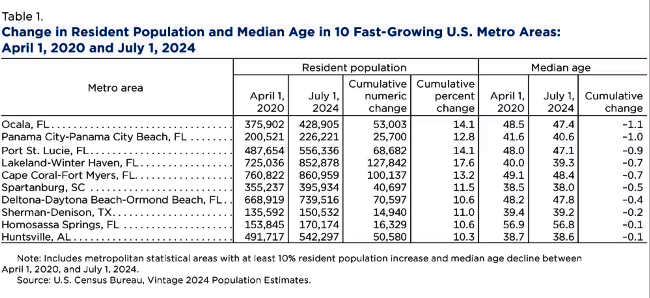
Between 2020 and 2024, 10 metro areas – all of them in the South and seven in Florida – had their total populations rise by at least 10% and their median ages drop (Table 1).

For instance:

Ocala, FL, saw a 14.1% increase in population while its median age dropped by 1.1 years to 47.4.

Lakeland-Winter Haven, FL, and Cape Coral-Fort Myers, FL, had respective population gains of 17.6% and 13.2% and median age dips of 0.7 years to 39.3 and 48.4, respectively.

The population of Sherman-Denison, TX, increased by 11.0%, while its median age went down 0.2 years to 39.2.

In those 10 metro areas, where positive net domestic migration tended to play an important role in their population growth, increases in the number of children and the younger adult population at least partially helped offset aging patterns. 

That resulted in a decline in median age even amid growth in the number of older adults. This contrast underscores a more nuanced picture of the intersection of population growth and aging in U.S. metro areas.

Kristie Wilder is a demographer and Paul Mackun is a geographer in the Census Bureau’s Population Estimates Branch.

Fatality reported in crash near Bartlett Springs

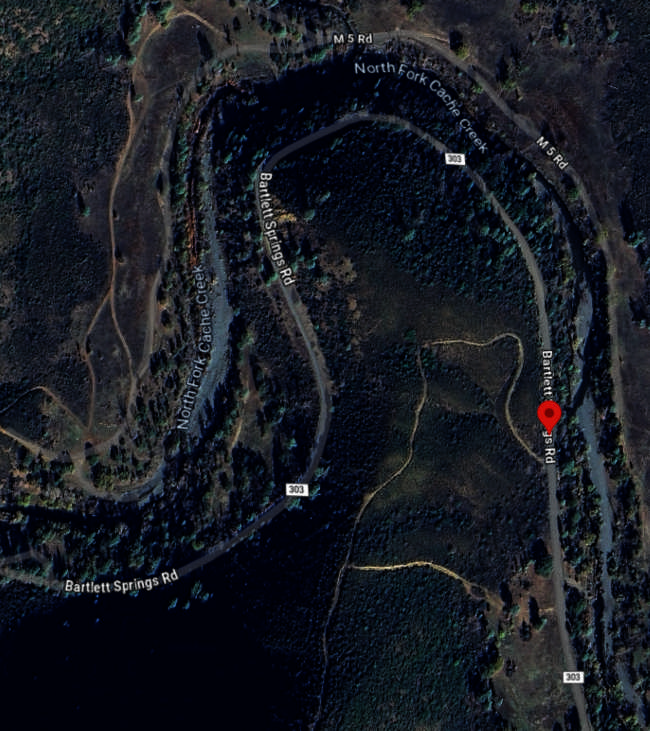
A Google map showing the site of a fatal wreck near Bartlett Springs in Lake County, California, on Saturday, July 19, 2025. 

LAKE COUNTY, Calif. — One person was reported to have been killed in a solo-vehicle crash on Saturday afternoon in a remote part of Lake County.

The wreck, involving a Ford Raptor pickup, occurred shortly before 3:15 p.m. Saturday on Bartlett Springs Road above Lucerne.

The initial dispatch stated there was one subject trapped in a tree and another was with the vehicle about 10 feet over the embankment.

The California Highway Patrol’s online incident reports stated that the pickup was wrapped around a tree.

In addition to Northshore Fire, units from Williams Fire and Cal Fire responded. Cal Fire sent its helicopter from the Boggs Helitack to assist with the rescue, and the California Highway Patrol’s copter also was requested but later canceled.

Shortly before 4 p.m., units on scene stated over the air that there was a fatality.

The CHP left the scene around 7:30 p.m., but other units stayed on scene until the early morning hours on Sunday waiting for a tow truck to remove the pickup.

Another serious solo-vehicle crash occurred on Bartlett Springs Road east of Walker Ridge Road just before 9:30 p.m., according to the CHP and radio traffic.

That rollover crash was reported to have involved four individuals, with one being unconscious.

The injured individual was set to be flown by air ambulance to a regional trauma center.

Email Elizabeth Larson at This email address is being protected from spambots. You need JavaScript enabled to view it.. Follow her on Twitter, @ERLarson, and on Bluesky, @erlarson.bsky.social. Find Lake County News on the following platforms: Facebook, @LakeCoNews; X, @LakeCoNews; Threads, @lakeconews, and on Bluesky, @lakeconews.bsky.social. 

Clawback of $1.1B for PBS and NPR puts rural stations at risk – and threatens a vital source of journalism

Nathan Heffel and Grace Hood rehearse their Colorado Public Radio public affairs program in Centennial, Colo., in 2017. Andy Cross/The Denver Post via Getty Images

The U.S. Senate and the House of Representatives approved by narrow margins on July 17 and 18, 2025, a law that claws back federal funding for the Corporation for Public Broadcasting. Once President Donald Trump signs it into law, the US$9 billion rescissions package will withdraw $1.1 billion Congress had previously approved for the Corporation for Public Broadcasting, which distributes money to NPR, PBS and their affiliate stations, to receive in the 2026 and 2027 fiscal years.

In addition, it makes deep foreign aid cuts. All Democrats present voted against the measure in both chambers. They were joined in the Senate by two Republicans: Sens. Susan Collins of Maine and Lisa Murkowski of Alaska. Two House Republicans also voted no: Michael R. Turner of Ohio and Brian Fitzpatrick of Pennsylvania. The Conversation U.S. asked Allison Perlman and Josh Shepperd, who are both media scholars, to explain why the measure will have a big impact on public broadcasters.

What will happen to NPR, PBS and local stations?

NPR and PBS provide programming to local public television and radio stations across the country. The impact on them will be direct and indirect.

Both NPR and PBS receive money from the Corporation for Public Broadcasting, an independent nonprofit corporation Congress created in 1967 to receive and distribute federal money to public broadcasters. More than 70% of the money it distributes flows directly to local stations. Some stations get up to half of their budgets from the CPB.

But NPR and PBS get much of their funding from foundation grants, viewers’ and listeners’ donations, and corporate underwriting. And local public radio and TV stations also get support from an array of sources besides CPB.

“There’s nothing more American than PBS,” said the network’s CEO, Paula Kerger, at a congressional hearing on March 26, 2025.

Only about 1% of NPR funding, and 15% of PBS funding, comes directly from the government via the CPB. However, once local radio and television stations lose federal funding, they’ll be less able to pay NPR and PBS for the programs they produce.

The nearly 1,500 public media stations in the U.S. rely on a mix of NPR, PBS and third-party producer programming, such as American Public Media and PRX, for the programs they offer. Local stations also produce and air regional news and provide emergency broadcasts for the government.

In rural areas with few broadcast stations and spotty cellphone coverage, public broadcast stations are vital sources of information about important community news and updates during emergencies. Federal support is essential for the programming and day-to-day operations of many local stations and allows for the maintenance of equipment and personnel to operate these vital community resources.

We believe that stations in communities that most need them, especially in rural locations, will be hit especially hard because they rely heavily on CPB funding.

Why are Republicans taking this step?

Public broadcasting has long been a target of conservative Republicans.

They say that with a highly diversified media landscape, the public no longer needs media that is subsidized by federal dollars. They also claim that public broadcasting has a liberal bias and taxpayers should not be required to fund media that slants to the left politically.

Why is public media necessary when there’s news on the internet?

As journalism revenue has plummeted, public broadcasting has remained a vital source for news in communities across the nation. This is especially true in rural communities, where economic and political pressures have threatened the survival of local journalism.

In addition, with much online news coverage placed behind paywalls, public radio and television plays an important role in making quality journalism available to the American public.

An online ad for a program, 'Water News,' on a public radio station.
Want crucial information about water systems in your drought-prone community? Public radio station KVMR in Nevada City, Calif., has a program for you. KVMR screenshot

Why did Congress approve these funds 2 years ahead?

Public broadcasting has gotten roughly $550 million per year from the federal government in recent years.

The CPB has always approved and designated those funds two years in advance, due to a provision in the Public Broadcasting Act of 1967, after Congress has voted to provide that money. The CPB then has distributed that funding primarily through grants to PBS and NPR affiliate stations to support their technical infrastructure, program development and audience research.

What are the consequences for Native communities?

Dozens of Native American stations are at risk of closing once the CPB is defunded. Native Public Media, a network of 57 radio stations and four TV stations, is a key source of news and information for tribal communities across the nation and relies on CPB support.

U.S. Sen. Mike Rounds, a South Dakota Republican, publicly stated that he secured an agreement with the White House to move $9.4 million in Interior Department funding to two dozen Native American stations. But there is no provision related to this promise within the legislation.

This article was updated after the House passed the measure.The Conversation

Allison Perlman, Associate Professor of Film & Media Studies, University of California, Irvine and Josh Shepperd, Associate Professor of Media Studies, University of Colorado Boulder

This article is republished from The Conversation under a Creative Commons license. Read the original article.
  • 145
  • 146
  • 147
  • 148
  • 149
  • 150
  • 151
  • 152
  • 153
  • 154

Community

  • Lake County Wine Alliance offers sponsor update; beneficiary applications open 

  • Mendocino National Forest announces seasonal hiring for upcoming field season

Public Safety

  • Lakeport Police logs: Thursday, Jan. 15

  • Lakeport Police logs: Wednesday, Jan. 14

Education

  • Woodland Community College receives maximum eight-year reaffirmation of accreditation from ACCJC

  • SNHU announces Fall 2025 President's List

Health

  • California ranks 24th in America’s Health Rankings Annual Report from United Health Foundation

  • Healthy blood donors especially vital during active flu season

Business

  • Two Lake County Mediacom employees earn company’s top service awards

  • Redwood Credit Union launches holiday gift and porch-to-pantry food drives

Obituaries

  • Rufino ‘Ray’ Pato

  • Patty Lee Smith

Opinion & Letters

  • The benefits of music for students

  • How to ease the burden of high electric bills

Veterans

  • CalVet and CSU Long Beach team up to improve data collection related to veteran suicides

  • A ‘Big Step Forward’ for Gulf War Veterans

Recreation

  • Wet weather trail closure in effect on Upper Lake Ranger District

  • Mendocino National Forest seeking public input on OHV grant applications

  • State Parks announces 2026 Anderson Marsh nature walk schedule 

  • BLM lifts seasonal fire restrictions in central California

Religion

  • Kelseyville Presbyterian to host Ash Wednesday service and Lenten dinner Feb. 18

  • Kelseyville Presbyterian Church to hold ‘Longest Night’ service Dec. 21

Arts & Life

  • Auditions announced for original musical ‘Even In Shadow’ set for March 21 and 28

  • ‘The Rip’ action heist; ‘Steal’ grounded in a crime thriller

Government & Politics

  • Lake County Democrats issue endorsements in local races for the June California Primary

  • County negotiates money-saving power purchase agreement

Legals

  • March 3 hearing on ordinance amending code for commercial cannabis uses

  • Feb. 12 public hearing on resolution to establish standards for agricultural roads

How to resolve AdBlock issue?
Refresh this page