 How to resolve AdBlock issue?
News
LAKE COUNTY, Calif. — In an ongoing discussion over raising permit fees issued by the Lake County Air Quality Management District, the Board of Supervisors this week pushed back on a proposed three-year rollout.
The Lake County Air Quality Management District is “one of 35 local regulatory agencies in California responsible for ambient (outdoor) air quality in our geographic region,” the agency’s website states. “It’s our duty to ensure the fair and consistent implementation of local, state and federal air quality regulations.”
For nearly 30 years, the district has kept its fees flat — a move district officials say has strained staffing and operation. Now the agency is proposing a significant fee increase, phased in over three years, with a 35% increment for the first year. But the Board of Supervisors was hesitant to move forward.
At the end of Tuesday’s discussion, the board asked the district to consider a five-year implementation plan instead with a 20% first-year increase. The matter will return for further discussion at a follow-up meeting.
If approved, this would be the district’s first major fee increase since 1996, aside from the introduction of a burn permit fee in 2003 and yearly adjustments tied to the Consumer Price Index, or CPI.
While supervisors were concerned that such a huge extent of increase may bring undesirable impact to local economic development, Air Pollution Control Officer Douglas Gearhart maintained that the fee changes — after three decades — are both urgent and necessary.
For the district, CPI adjustments alone no longer suffice, Gearhart said.
“We're probably at 50 to 60% cost recovery on the permit programs,” said Gearhart at the board’s June 10 meeting when the matter was first brought forward to the supervisors. That means only about half to 60% of the true cost of running the permit programs is being covered by the fees they charge.
Gearhart mentioned that the district has to carry “lots of state and federal mandates, all of which are unfunded.”
“And they are unfunded because the state Legislature passes laws and says districts have fee authority, therefore adopt a fee to pay for it, and so we haven't had to do that. We've been able to avoid that for, well, since I've been here over 25 years,” said Gearhart. “We've gotten to the point where we're just, we're not able to sustain that.”
The board agreed to proceed with the rule changes such as lifting the annual burn ban but raised concerns for the impact of fee increases and requested a side-by-side analysis of the new fees at the June meeting.
Supervisors ask for five-year rollout, annual review
About a month following the first hearing, Gearhart this week came back with a fee study summary based on staff time to perform tasks and a side-by-side comparison of the current fees against the proposed new fees.
A three-year rollout plan was proposed for existing permitted facilities, with 35% increments each year.
At the Tuesday meeting, supervisors pointed toward the magnitude of these increases.
“It’s not just a 100% increase; it’s a very large increase,” Supervisor Bruno Sabatier said, citing examples of fees jumping from $300 to $3000. “This impacts agriculture; this impacts economic development, any kind of development.”
Gearhard reminded the board that the increase will be incremental over three years.
Sabatier later said that he would like the board to have a year-by-year review to approve it annually and also suggested lengthening the rollout time from three years to four years.
In the fee comparison table, the less significant changes proposed include an increase from $335.38 to $950 for a type of authority to construct or from $20,122.98 to $21,095 for a type of permit to operate.
The more significant changes include a type of permit to operate fee that currently costs $670.78 and is proposed to increase to $23,438 for a power plant modification permit.
Later, when Supervisor Helen Owen questioned this change, Gearhart explained that this resulted from a changed fee structure. The over $20,000 fees were just issued in a different way in the past, he said.
Gearhart also explained that some increases are more significant because the task is much tougher than the standard ones while paying the same, lower fee.
The permit for “aggregate extraction and process for over 100,000 tons per year” has been charged $670.78 as a standard generator, for example.
“Aggregate extraction is a much bigger, much more complicated facility with a lot more emissions, a lot more equipment; the time required for inspections, the time required for reporting that goes into that is much more significant. So that's why the change is so much more significant for that,” Gearhart responded when Owen inquired on this item. “It was an unfair system for the people with smaller equipment and people with larger facilities ended up getting a lot more for their money.”
Later, Supervisor Brad Rasmussen proposed a five-year implementation period with the first-year increase around 20% rather than 35% to mitigate economic impact.
“I understand you have limitations and whatnot. I just know that this is going to limit a lot of the agencies and businesses that are trying to, you know, put forth anything,” said Supervisor Eddie Crandell. “So for me, I’d like to see six phases.”
Gearheart said that the district has been working on a replacement fee schedule for the last five to 10 years. The process was initially planned to start in 2020, he said. “Then we had COVID, then we had fires … So we've been putting this off to prevent the economic impacts and the impacts to the community because we had the salary savings, because we didn't have staff, we couldn't keep staff here.”
“We're not an economic development agency. We are here to protect the community from air pollution,” he continued. “We're not trying to balance what's the potential growth of the county versus impacts from smoke and the community health impacts related to equipment and emissions.”
At the end of the discussion, the Board of Supervisors came to a consensus to offer a five-year period to implement the fee raises, with the requirement to come back to the board for review and approval every year.
“I’m good with that,” said Rasmussen. “So we’re not locking ourselves in for five years.”
The discussion is ongoing and no final action has been taken at this point. A follow-up meeting will be scheduled for this agenda.
Email Lingzi Chen at
Lake County’s member of Congress on Thursday criticized a bill passed by Congressional Republicans to take back federal funding from public media stations and foreign aid programs that was already approved by Congress and signed into law.
“Make no mistake: These clawbacks are an attack on public safety,” said Congressman Mike Thompson. “Our public radio and TV stations, especially those in rural communities, are often the only trusted local news source. Publicly funded media stations are the ones covering our kids’ high school sports games, providing high-quality educational programming to our kids, and distributing essential public safety information during natural disasters. To slash this funding is to attack these important services.
“At the same time, Congressional Republicans are pulling funding from Ukraine and other allies. When our allies are unsafe, we are all unsafe. Cuts to foreign aid undermine our national security,” Thompson said.
“Congressional Republicans’ claims that this is about saving money are laughable considering they just passed a bill that will add nearly $5 trillion to our national debt in order to give tax breaks to their billionaire donors who don’t need the help. They are pulling the rug out from under our allies and our local news stations. The American people will pay the price,” Thompson added.
Congressman Mike Thompson represents California’s Fourth Congressional District, which includes all or part of Lake, Napa, Solano, Sonoma and Yolo Counties. He is a senior member of the House Committee on Ways and Means. Rep. Thompson is Chairman of the House Gun Violence Prevention Task Force. He is also Co-Chair of the bipartisan, bicameral Congressional Wine Caucus and a member of the fiscally-responsible Blue Dog Coalition.
A new report shows that foreclosure activity is up nationwide in the first half of this year, continuing an upward trend.
The Mid-Year 2025 U.S. Foreclosure Market Report, created by the real estate analytics firm ATTOM, shows there were a total of 187,659 U.S. properties with foreclosure filings — default notices, scheduled auctions or bank repossessions — in the first six months of 2025.
That figure is up 5.8 percent from the same time period a year ago and up 1.1 percent from the same time period two years ago.
“Foreclosure activity continued its upward trend in the first half of 2025, with increases in both starts and completed foreclosures compared to last year,” said Rob Barber, CEO at ATTOM. “While the overall numbers remain below pre-pandemic levels, the persistent rise suggests that some homeowners are still facing financial challenges amid today’s housing and economic landscape.”
States that saw the greatest increases in foreclosure activity compared to a year ago in the first half of 2025 included Alaska (up 55 percent); Rhode Island (up 51 percent); Wyoming (up 46 percent); Utah (up 46 percent); and Colorado (up 41 percent).
Nationwide, 0.13 percent of all housing units (one in every 758) had a foreclosure filing in the first half of 2025.
States with the worst foreclosure rates in the first half of 2025 were Illinois (0.23 percent of housing units with a foreclosure filing); Delaware (0.23 percent); Nevada (0.21 percent); Florida (0.21 percent); and South Carolina (0.20 percent).
Other states with first-half foreclosure rates among the 10 worst nationwide were Indiana (0.18 percent); New Jersey (0.18 percent); Connecticut (0.17 percent); Ohio (0.16 percent); and Texas (0.15 percent).
Foreclosure starts up 7 percent from last year
A total of 140,006 U.S. properties started the foreclosure process in the first six months of 2025, up 7 percent from the first half of last year and up 41 percent from the first half of 2020.
States that saw the greatest number of foreclosure starts in the first half of 2025 included Texas (17,680 foreclosure starts); Florida (15,198 foreclosure starts); California (14,751 foreclosure starts); Illinois (7,922 foreclosure starts); and New York (6,585 foreclosure starts).
Lenders foreclosed (REO) on a total of 21,007 U.S. properties in the first six months of 2025, up 12 percent from the first half of 2024 but down 7 percent from the first half of 2023.
States that posted the greatest number of REOs in the first half of 2025 included Texas (2,207 REOs); California (1,799 REOs); Pennsylvania (1,461 REOs); Illinois (1,439 REOs); and Michigan (1,260 REOs).

CLEARLAKE, Calif. — Clearlake Animal Control has a great group of adoptable dogs waiting for their new homes.
The shelter has 50 adoptable dogs listed on its website.
This week’s dogs include “Zero,” a 3-year-old male terrier mix with a brown brindle and white coat.
The shelter is located at 6820 Old Highway 53. It’s open from 9 a.m. to 6 p.m. Tuesday through Saturday.
For more information, call the shelter at 707-762-6227, email
This week’s adoptable dogs are featured below.
Email Elizabeth Larson at
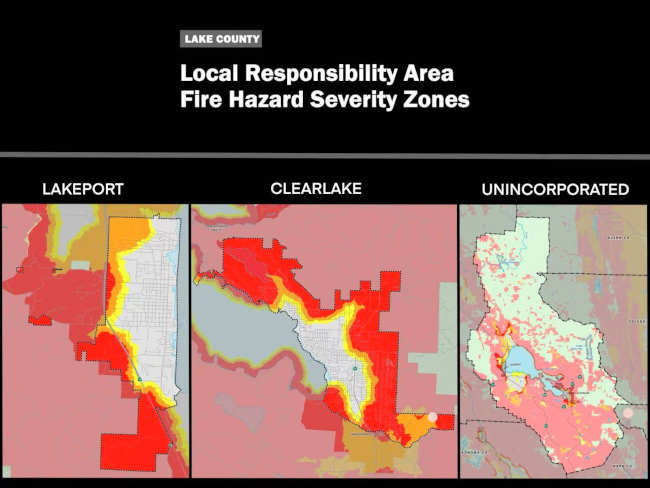
LAKE COUNTY, Calif. — By the end of June, the Board of Supervisors and two city councils voted to approve an ordinance adopting the state’s new fire hazard severity zone map, which has significantly expanded the county’s highest fire hazard acreage designation.
The new map will take effect by the end of July — 30 days after each jurisdiction held its second public hearing approving the ordinance.
Under current state policies and local considerations, properties within the higher severity zones will be subjected to mandatory disclosure during real estate transactions and stricter standards on building code, road width, water supply and defensible space, according to Clearlake City Manager Alan Flora in the city’s first public hearing in May.
The state’s “Zone 0” policy — prohibiting combustible materials within five feet of structures — will also apply to the most hazardous zones.
The biggest concern across the board remains the accessibility and affordability of fire insurance for Lake County homeowners, many of whom are already experiencing difficulties, according to county and city officials.
Despite reluctance and concerns, elected officials voted to adopt the map. All supervisors except Supervisor Helen Owen voted in favor of adoption. In Clearlake and Lakeport, all council members voted yes, albeit reluctantly.
The most common criticism of the map has been the lack of genuine and sufficient local input in creating and adjusting the map.
After all, local map adoption through an ordinance is mandated by the state law.
“I'm a little confused on how it can be required by the state, and yet we still have to accept it, in all honesty,” Owen said during the Board of Supervisors’ second hearing of the tension between a mandate and a majority vote.
In an earlier interview with Lake County News, Supervisor Bruno Sabatier said local jurisdictions can technically vote against the map, but such noncompliance could create problems and obstacles for future development projects. “I see no other step to take than to approve the maps as provided by the state,” he said.
This new map, released by Cal Fire in February, designated “local responsibility areas,” or LRA — areas managed by city and county governments — into “very high,” “high” and “moderate” fire hazard severity zones.
It marks the first update to the LRA designations since 2011 and adds 14,000 acres in Lake County to the “very high” zone — an 878% expansion in acreage classified as the most hazardous.
According to Cal Fire, the maps assess fire hazard based on “the physical conditions that create a likelihood and expected fire behavior over a 30- to 50-year period.”
Cal Fire says the long-term projection method means local fire mitigation efforts — which are considered short-term — would not reduce the zone rating in the map.
As the state law requires, local jurisdictions can adopt the map as is or make it more stringent; they cannot lower the rating.
Local government and fire officials have spoken against the 50-year projection since the release of the map. At Lakeport’s first public hearing on the map in June, Councilmember Kenny Parlet again criticized the rationale of basing the map rigidly on such a long-term projection.
“I would say that we oppose a 50-year map of any kind for anything most of the time, because things change, and it's just — it's ridiculous, because we don't know what kind of new technology, or what kind of different mitigations we can do as a city,” Parlet said. “And I think that is just ludicrous that someone in office now could tell our great, great-grandchildren what their fire severity is. I just think that is absolutely ridiculous.”
‘Split-zoned parcels’ dilemma
The fire hazard severity zones in the map, however, do not align with the parcel boundaries that local jurisdictions use for planning.
As a result, despite uniform adoption, the three local governments have chosen different approaches to parcels that stride across more than one severity-zone designations, namely “split-zone parcels.”
Clearlake adopted a modified version of the fire map to only reflect the higher designation for such parcels for better clarity. The Board of Supervisors and Lakeport City Council, however, adopted the map as is without adjusting any zone rating.
For Lakeport, City Manager Kevin Ingram said during the first public hearing that the city has some “long and skinny” parcels that stretch across three fire severity zones. Some parcels at the north end of the city may have 40% “moderate” and a small sliver of “very high.” Staff, therefore, did not recommend treating this entire parcel as “very high.”
During the Board of Supervisors’ first hearing, there was some discussion on whether the rating for a split-zoned parcel could be based on the lowest rated zone. It was brought up that some other jurisdictions did so, but Supervisor Bruno Sabatier doubted the legitimacy of such action, citing the state law prohibiting lowering the zone ratings.
Paul Duncan of Cal Fire said it makes little difference in Lake County, where most structures must already comply with the most stringent building code — 7A — since the majority of the county falls within the Wildland-Urban Interface area.
Duncan said the only real effect is the “exposure requirement” for selling properties within the “high” and “very high” zones.
The “bigger elephant in the room,” Duncan said, is lowering fire hazard and insurance costs for property owners.
Supervisor Owen made a point here and said such hazard disclosure was exactly what the insurance companies say they are not looking at. “You know they’re going to,” she added.
“The state likes to stress that the map is not for insurance,” said County Chief Climate Resiliency Officer/Tribal Liaison Terre Logsdon at the beginning board meeting. “Insurance Commissioner Lara issued a California consumer alert that says it's not — we all know that they do look at it.”
Supervisor Jessica Pyska urged the board to approve the state’s map as is and work internally for local details.
“It’s not our map; they are not ours,” said Pyska. “We can make changes internally as we see fit, but we don't have to make those decisions today. We can just adopt these maps and move down the road and work on what works best for Lake County on our timeline.”
During public comment, Lakeport Fire Protection District Chief Patrick Reitz also voiced his support for adopting the map as is instead of upzoning split-zoned parcels to the highest designation, to offer an option for property owners to build their house in the less severe zones within their parcel.
“I'd appreciate it if you leave my lot alone — if I have a split lot,” said Reitz.
For an “unfunded mandate” as Reitz called it, “Don't waste any time. Don't waste any money. We've got a lot of big issues to deal with. This isn't one,” he said.
Local governments agreed to send letters of disapproval
Alongside the adoption, all three governments during their public hearings agreed to send letters to express disapproval of the map and the process.
Clearlake’s letter pointed to a lack of genuine local decision making in the “blanket adoption” that “fails to consider the unique characteristics and existing mitigation efforts of individual communities.”
“Our community suffers from a high level of poverty and many will not be able to meet the standards of the ordinance on their own,” the letter stated. “We expect significant numbers of insurance non-renewals that are likely to devastate a large percentage of our population.”
The letter continued to ask for genuine local input on the matter: “We urge you to respect more local input into similar mandates and instead allow for a more collaborative process that respects local decision-making.”
The Clearlake City Council members approved the letter, addressed to Gov. Gavin Newsom, in their June 5 meeting.
The Board of Supervisors and the Lakeport City Council have not sent out the letter. Both told Lake County News that they were to discuss the matter in July.
Email staff reporter Lingzi Chen at
LAKE COUNTY, Calif. — The Lake County Registrar of Voters Office said an election will take place this fall to fill seats on the Scotts Valley Water Conservation District Board.
The general district election will be held on Nov. 4.
On the ballot will be two seats that will become vacant on the first Friday in December.
The seats up for election area:
• Division I: One vacancy, two-year unexpired term.
• Division II: One vacancy, four-year term.
Official declaration of candidacy forms for eligible candidates desiring to file for the seats may be obtained from the Lake County Registrar of Voters Office, 707-263-2372, 325 N Forbes St. in Lakeport during regular business hours of 8 a.m. to 5 p.m. Monday through Friday.
The filing period began on Monday, July 14, and ends on Friday, Aug. 8, at 5 p.m.