How to resolve AdBlock issue?
Refresh this page
How to resolve AdBlock issue?
Refresh this page
Lake County News,California
  • Home
    • Registration Form
  • News
    • Education
    • Veterans
    • Community
      • Obituaries
      • Letters
      • Commentary
    • Police Logs
    • Business
    • Recreation
    • Health
    • Religion
    • Legals
    • Arts & Life
    • Regional
  • Calendar
  • Contact us
    • FAQs
    • Phones, E-Mail
    • Subscribe
  • Advertise Here
  • Login

News

Space News: Dune patterns in California desert hold clues that help researchers map Mars’ shifting sands

The author did some of her fieldwork at the Algodones Dunes in California. Ryan Ewing

Our two-person team loaded the car with a GPS, a drone, notebooks, sample bags, a trowel and a flat spatula lovingly called a scoopula. Then we drove 30 minutes in our rented truck from Yuma, Arizona, to the Algodones Dunes, a sandy field bordering California, Arizona and Mexico. The day was sunny, with a strong breeze. Turning off the highway, we carefully headed onto a gravelly path that acted as our road.

After making decent – if bumpy – progress, we pulled off onto the sand flats and drove slowly toward the dunes, worried we might get stuck in the sand. Having arrived on the outskirts of the Algodones, we stopped and loaded our backpacks, then set off into the desert on foot.

An image of desert sand.
The coarse- and fine-grained sand at the Algodones Dunes. Lauren Berger

It was November 2022. As a graduate student at Texas A&M University, I was beginning part of my Ph.D. research with my adviser, geology professor Ryan Ewing. We were looking for coarse-grained sand ripples, which are patterned piles of sand shaped by wind. Sand ripples and sand dunes are types of aeolian bedforms, which are wind-created geologic features.

Aeolian bedforms are common on Earth and across the solar system, including on Mars, Venus, Pluto, the Saturn moon Titan, the Neptune moon Triton, and Comet 67P. These geological features, among the first landforms observed by remote images of planetary surfaces, are robust indicators of a world’s wind patterns.

A woman in the desert, near a tripod and a GPS target.
Flying a drone at Algodones. Note the GPS on the tripod, and a GPS target on the ground, which was also a landing pad for the drone. Ryan Ewing

Measuring sand patterns in person

The shapes and patterns of aeolian bedforms can reveal the environmental conditions that created them.

Two sizes of the same bedform, such as small dunes on top of big dunes, are called compound bedforms. I study compound bedforms at two scales – the meter- and centimeter-sized coarse-grained ripples at the dunes here on Earth, and the kilometer- and meter-sized dunes on Mars.

At the Algodones, I measured the height of each large coarse-grained sand ripple and the distance between neighboring ripples. Then we flew our drone low and steady, above the ripples, to create high-resolution images. The drone data allows us to do further measurements on the ripples later, back at my desk.

On that day, I learned an essential rule of fieldwork in the desert: Don’t forget a shovel. Otherwise, if your vehicle gets stuck, as ours did, you’ll have to dig it out by hand. Luckily for us, a dune buggy driver passing by helped us out and we were able to get back to Yuma in time for dinner.

Four aerial photographs of sand ripples.
High-resolution drone images of the sand ripples at Algodones. Lauren Berger

My introduction to Mars

I first became interested in aeolian bedforms during my sophomore year of college, when I interned at the NASA Jet Propulsion Laboratory. My job was to view surface images of Mars and then map the sand ripples in the regions where Perseverance, the Mars rover, might land. I assessed the areas where ripples could be hazards – places where the rover could get stuck in the sand, the way our rental truck did in the Algodones.

I mapped those sand ripples on Mars for two years. But while I mapped, I became fascinated with the patterns the ripples made.
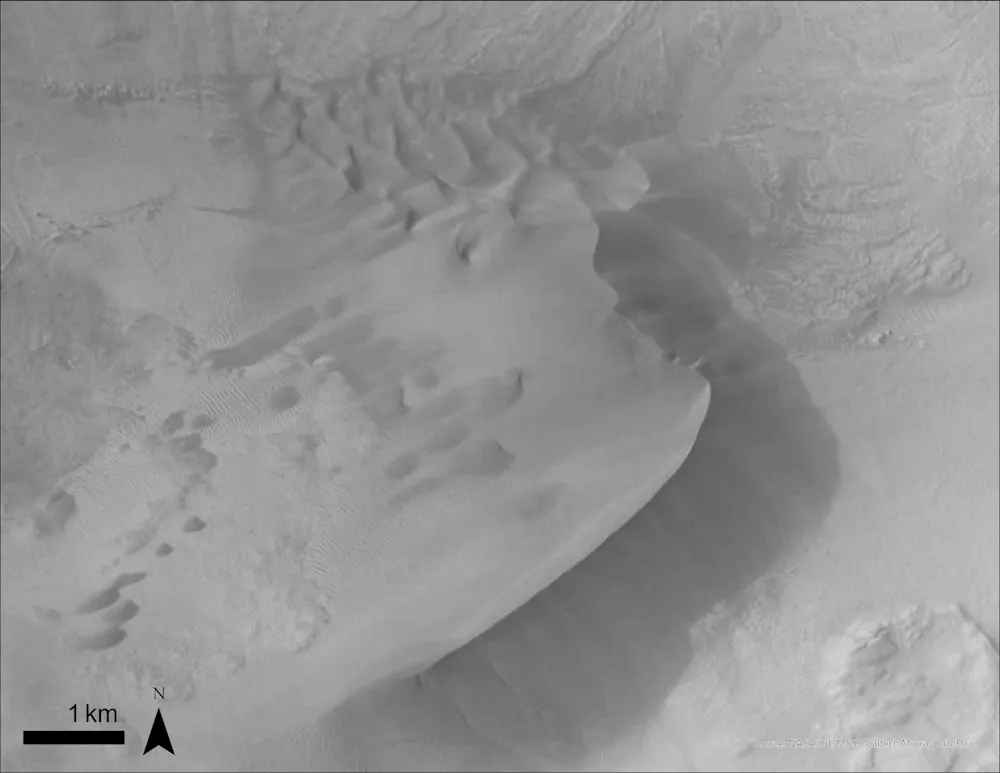
A black and white aerial image of a dune on Mars.
A potential compound dune on Mars. NASA/JPL-Caltech

Now, as a graduate student and aspiring planetary geologist, my time is split between work in the field and at my computer, where I have stitched together the drone’s photographs of the Algodones to create a large image of the entire study area. I then look for compound dunes on the Martian surface in images taken by the Mars reconnaissance orbiter’s context camera.

Scientists already know about Earth’s weather patterns, sand grain size and wind data. By measuring different parts of bedforms on both planets – such as their height, shape and spacing – I can compare the similarities and differences of the bedforms to find clues to the wind patterns, grains and atmosphere on Mars. Slowly but surely, as I listen to Studio Ghibli soundtracks, I’m creating the first database of compound dunes on Mars.
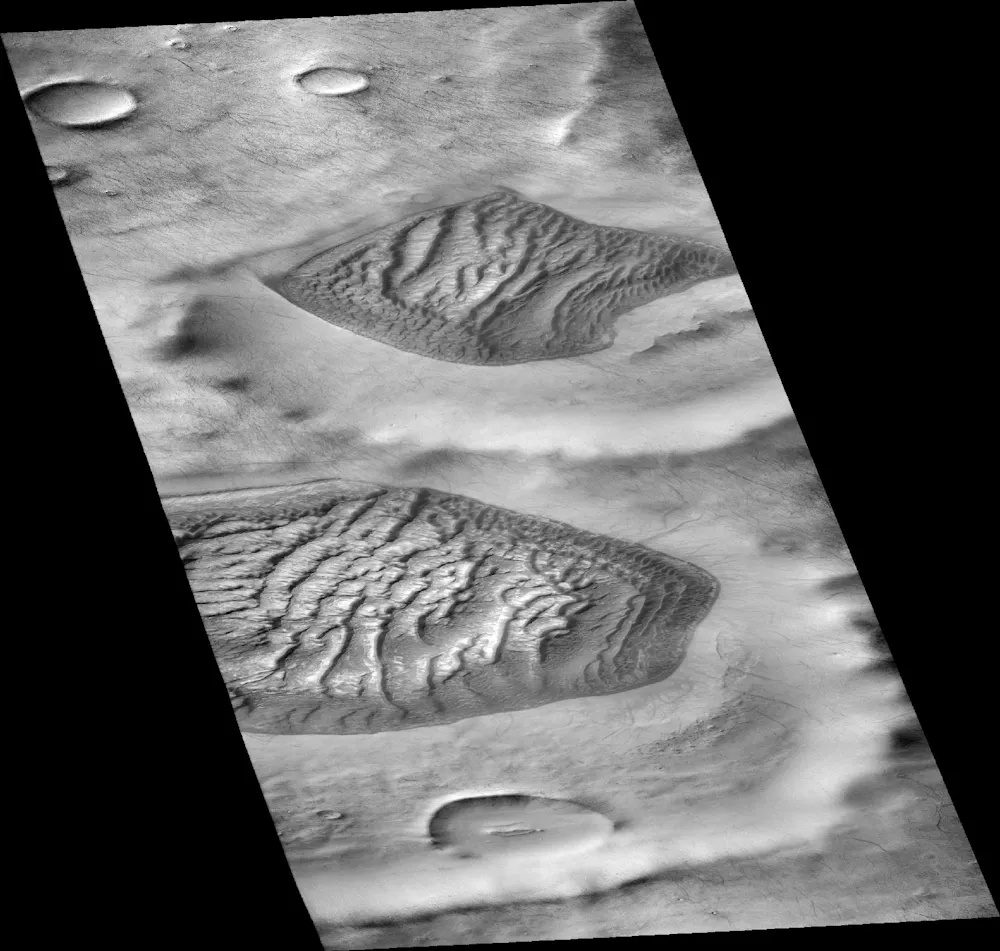
A black and white aerial images of dune fields on Mars.
Two dune fields on Mars, both inside an impact crater. NASA/JPL-Caltech

Developing this database is essential to the proposed human mission to Mars. Dust storms are frequent, and some can encircle the entire planet. Understanding aeolian bedforms will help scientists know where to put bases so they don’t get buried by moving sand.

It is wonderful to spend an afternoon ping-ponging all over a planet that’s 140 million miles from us, seeing gorgeous terrain while I try to answer questions about the compound dunes on Mars. How common are they? Where do they form? How do they compare to those on Earth? I hope to answer these questions as I work toward earning my Ph.D in geology.The Conversation

Lauren Berger, Ph.D. Student in Geology, Texas A&M University

This article is republished from The Conversation under a Creative Commons license. Read the original article.
Californians urged to take precautions as state endures triple digit heat, smoky conditions

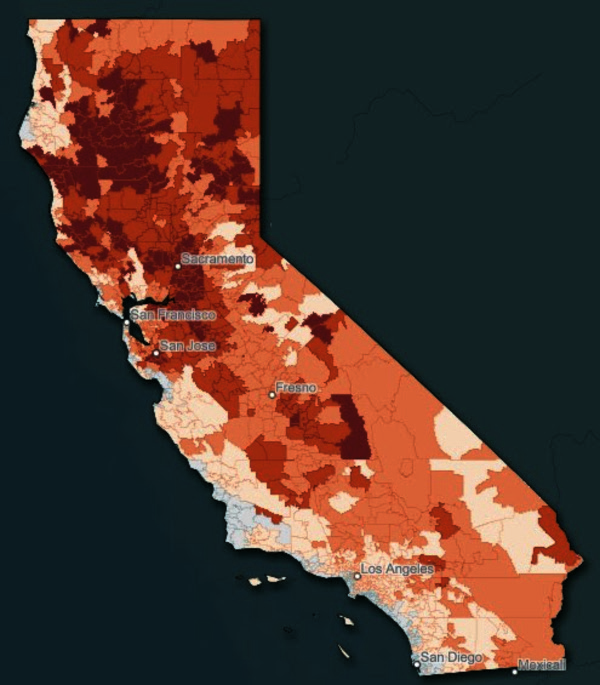
CalHeatScore map results from Friday, July 11, 2025.


Officials are encouraging residents to prepare for dangerous heat throughout California, and smoky conditions in the far northern part of the state, through early next week. 

The National Weather Service has issued heat advisories in many portions of the state on Friday and Saturday, extending through Sunday in parts of the Central Valley.  

In Northern California, areas west of Redding are under extreme heat warnings due to triple digit temperatures that are expected to linger into the first part of next week. 

Air quality will also be impacted due to smoke from several wildfires burning in remote California and Oregon locations.  

On Friday, temperatures topped 100 degrees in Lake County, where the air was thick with drift smoke from outside of the area.

“As temperatures soar across our state, I urge Californians to take precautions and utilize state and local resources to protect from dangerous heat illness and unhealthy air,” said Gov. Gavin Newsom.

The recently launched CalHeatScore heat-ranking tool indicates much of northern and central California will be impacted by moderate to severe heat conditions through Monday, with some areas feeling the heat through Wednesday. 

Residents can check their area by zip code for local conditions. 

Here are a few tips and considerations for Californians – especially those with access and functional needs, children and older residents – to stay safe from heat and reduce health risks: 

Have a heat plan: Monitor weather forecasts and advisories to know when excessive heat is expected and how long it’s expected to last. Create a heat plan and encourage others to stay safe during a heat event. 

Keep cool: Visit a local cooling center or air-conditioned space, such as a library, community center or shopping center. If you’re unable to travel or find an air-conditioned space, consider the following at home: 

• Close windows, doors, shades and curtains to prevent hot air and sunlight from entering your home during high heat days. 
• Place a cool, damp towel on the back of your neck and wear light-colored, loose-fitting clothes. 
• Use cool compresses and take a cool shower or bath to help reduce body temperature and provide relief from the heat.

Use your support networks: Identify individuals in your life, such as family, friends and neighbors, who could help support you during heat events. Remember, creating an emergency preparedness plan based on your personal needs is critical to ensure you and your loved ones remain safe during an emergency. 

Sign up for alerts and notifications: Sign up for emergency alerts with your county or local officials. You can choose how to get alerts sent to you when you sign up, including cell phone, home phone, email, text messages and, in some cases, TTY devices. 

Sign up for a medical baseline program: This is an assistance program for people who depend on power for certain medical needs. Participation is important to ensure you receive additional notification of current or upcoming power shutoff events, which may occur during extreme heat events. 

Legislators secure major funding for Cal Fire in new state budget

As wildfire season intensifies across the state, California is investing more resources in Cal Fire than ever before thanks to critical funding secured by legislative leadership in this year’s state budget. 

This year’s historic investment begins the landmark transition of Cal Fire’s antiquated seasonal firefighter staffing plan to a modern day staffing model, which will eventually transition all 3,000 seasonal Cal Fire firefighters to full-time status 365 days per year. 

The 2025-26 state budget includes funding to begin the transition of hundreds of seasonal firefighters, who will officially be on the fire lines full-time early next year.

Facing longer and more destructive fire seasons each year, the investments build on massive efforts by Democratic leaders over the past decade, which have nearly doubled the ranks of Cal Fire firefighters from 6,700 to over 12,000 today. 

Another 2,100 Cal Fire firefighters will be hired over the next 48 months thanks to a previous budget agreement championed by state Democrats.

“January’s LA firestorm was a painful reminder that wildfire season is now year round in the Golden State,” said Senate President pro Tempore Mike McGuire (D-North Coast). “We know that firefighters have been facing deteriorating conditions, longer and hotter fire seasons, and overwhelming fatigue as they battle the largest mega fires in American history. This year’s budget is a historic first that will pivot away from an antiquated seasonal staffing model and implement what our communities need right now — an all-hands-on-deck approach with every Cal Fire firefighter full-time and prepared to respond 24 hours per day, 365 days a year.”

The Golden State and the entire West are burning at historic rates and have presented firefighters with new challenges, devastating conditions, and long, grueling hours. 

Eight of the most destructive wildfires in California history have hit over the past five years, with two of the deadliest wildfires burning over 16,000 homes and businesses in Los Angeles County this January.

Across California, more than $4 billion has been allocated in vegetation management projects to reduce ongoing wildfire risks. 

This includes hazardous fuel reduction projects, vegetation management, defensible space programs, and cutting-edge technology to prevent devastating wildfires.

And recently passed legislation includes California Environmental Quality Act, or CEQA, exemptions for wildfire fuel breaks, shady fuel breaks, roadside fuel breaks and prescribed burns. 

Legislators said this new state law will significantly speed up wildfire mitigation projects and help make communities across the Golden State more fire safe.

“The conditions Cal Fire firefighters are facing is like nothing we’ve ever seen before, and we needed the state to have our backs so that we can keep fighting these blazes morning, noon and night, every season of the year,” said Tim Edwards, president of Cal Fire local 2881. “I’m so grateful for the leadership of Sen. McGuire who’s been fighting to fix the Cal Fire firefighter shortage for years. While we have more work ahead, the progress we’re making is remarkable. This year’s budget action — and the expanded resources over the last several years — are game changers to make the Golden State more wildfire safe.”

“The fires that ravaged LA earlier this year were a devastating reminder that firefighters are stretched thin, and their health and safety must be a priority,” said Sen. Tim Grayson (D-Concord). “We rely on them to protect our communities and our families, and we want them to know they can rely on the state for the resources they desperately need to do their jobs.” 

“A promise made is a promise kept. I was grateful to meet and work with Pro Tem McGuire and Senator Grayson, along with fire service leadership across the state, on these important and commonsense measures to expedite wildfire mitigation projects. They have followed through on their commitment to deliver for our communities, and now we can get to work on making California, and our residents, safer from wildfire thanks to their efforts,” said Chief Lewis Broschard of the Contra Costa County Fire Protection District.

McGuire is president pro tempore of the California Senate. He represents the North Coast of California, which stretches from the Golden Gate Bridge to the Oregon border, including Del Norte, Trinity, Humboldt, Lake, Mendocino, Sonoma and Marin counties.  


Little Hoover Commission to hold July 24 hearing on electricity costs

On Thursday, July 24, the Little Hoover Commission will conduct a virtual public hearing on California electricity costs.

The hearing will begin at 10 a.m. It will be conducted via Zoom and will also be accessible at 925 L Street, Suite 175, Sacramento, CA 95814. No commissioners will be present at this location. 

The following commissioners will attend the hearing remotely: Pedro Nava, Anthony Cannella, Dion Aroner, David Beier, Senator Christopher Cabaldon, Assemblymember Phillip Chen, Gil Garcetti, José Atilio Hernández, Jason Johnson, Senator Roger Niello, Gayle Miller, Assemblymember Liz Ortega, and Janna Sidley.

Members of the public can attend the hearing in person or listen to the hearing by joining online or by phone. Click the URL to join online: https://bit.ly/44ydZnb. To join via phone, call toll-free from the U.S. by dialing (888) 788-0099. The webinar ID is 940-9105-7377. The passcode is 846791. 

It’s highly recommended that members of the public access the hearing through the Zoom app. Visit the Zoom website for instructions on how to download the Zoom app onto a computer or smartphone.
 
Public comments will be heard during the public hearing and will be limited to three minutes per speaker and to a total of 30 minutes. Remote attendees may indicate to staff that they wish to make public comment by using the “raise” hand feature in Zoom or sending an email to This email address is being protected from spambots. You need JavaScript enabled to view it. with your question and the phone number from which you have joined the event. 

Agenda items may be taken out of order to accommodate speakers and to maintain a quorum. The hearing may be canceled without notice.

Space News: Spacecraft equipped with a solar sail could deliver earlier warnings of space weather threats to Earth’s technologies

The SWIFT constellation, shown not to scale in this illustration, will fly farther than its predecessors to improve space weather warning time. Steve Alvey

The burgeoning space industry and the technologies society increasingly relies on – electric grids, aviation and telecommunications – are all vulnerable to the same threat: space weather.

Space weather encompasses any variations in the space environment between the Sun and Earth. One common type of space weather event is called an interplanetary coronal mass ejection.

These ejections are bundles of magnetic fields and particles that originate from the Sun. They can travel at speeds up to 1,242 miles per second (2,000 kilometers per second) and may cause geomagnetic storms.

They create beautiful aurora displays – like the northern lights you can sometimes see in the skies – but can also disrupt satellite operations, shut down the electric grid and expose astronauts aboard future crewed missions to the Moon and Mars to lethal doses of radiation.

An animation shows coronal mass ejection erupting from the Sun.

I’m a heliophysicist and space weather expert, and my team is leading the development of a next-generation satellite constellation called SWIFT, which is designed to predict potentially dangerous space weather events in advance. Our goal is to forecast extreme space weather more accurately and earlier.

The dangers of space weather

Commercial interests now make up a big part of space exploration, focusing on space tourism, building satellite networks, and working toward extracting resources from the Moon and nearby asteroids.

Space is also a critical domain for military operations. Satellites provide essential capabilities for military communication, surveillance, navigation and intelligence.

As countries such as the U.S. grow to depend on infrastructure in space, extreme space weather events pose a greater threat. Today, space weather threatens up to US$2.7 trillion in assets globally.

In September 1859, the most powerful recorded space weather event, known as the Carrington event, caused fires in North America and Europe by supercharging telegraph lines. In August 1972, another Carrington-like event nearly struck the astronauts orbiting the Moon. The radiation dose could have been fatal. More recently, in February 2022, SpaceX lost 39 of its 49 newly launched Starlink satellites because of a moderate space weather event.

Today’s space weather monitors

Space weather services heavily rely on satellites that monitor the solar wind, which is made up of magnetic field lines and particles coming from the Sun, and communicate their observations back to Earth. Scientists can then compare those observations with historical records to predict space weather and explore how the Earth may respond to the observed changes in the solar wind.

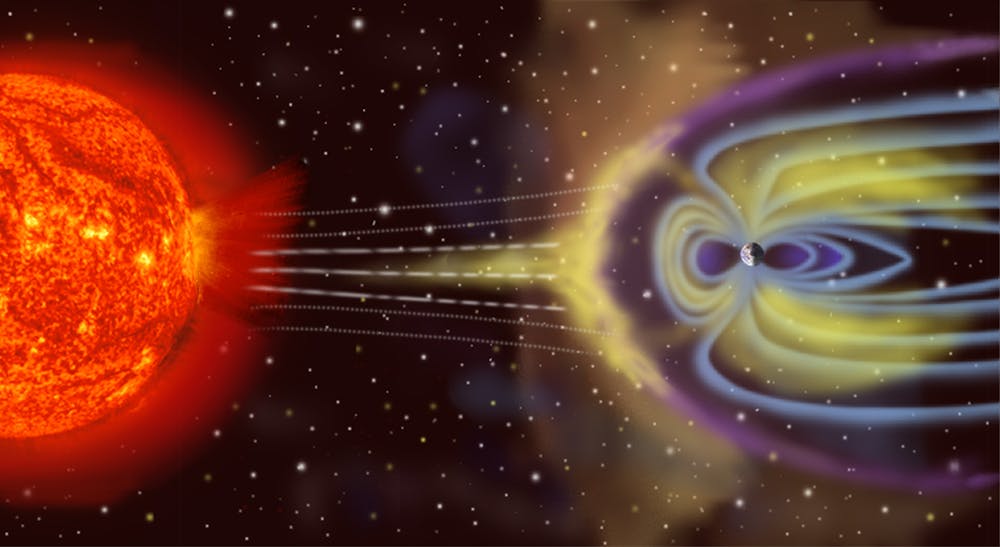
A drawing showing the Earth surrounded by a magnetic field with solar energy compressing one side.
The Earth’s magnetic field acts as a shield that deflects most solar wind. NASA via Wikimedia Commons

Earth’s magnetic field naturally protects living things and Earth-orbiting satellites from most adverse effects of space weather. However, extreme space weather events may compress – or in some cases, peel back – the Earth’s magnetic shield.

This process allows solar wind particles to make it into our protected environment – the magnetosphere – exposing satellites and astronauts onboard space stations to harsh conditions.

Most satellites that continuously monitor Earth-bound space weather orbit relatively close to the planet. Some satellites are positioned in low Earth orbit, about 100 miles (161 kilometers) above Earth’s surface, while others are in geosynchronous orbit, approximately 25,000 miles (40,000 km) away.

At these distances, the satellites remain within Earth’s protective magnetic shield and can reliably measure the planet’s response to space weather conditions. However, to more directly study incoming solar wind, researchers use additional satellites located farther upstream – hundreds of thousands of miles from Earth.

The U.S., the European Space Agency and India all operate space weather monitoring satellites positioned around the L1 Lagrange point – nearly 900,000 miles (1,450,000 km) from Earth – where the gravitational forces of the Sun and Earth balance. From this vantage point, space weather monitors can provide up to 40 minutes of advance warning for incoming solar events.

A diagram showing the Earth, the Sun and the Moon, with the five Lagrange points labeled. L1 is beyond the Moon's orbital path around Earth, closer to the Sun.
The Lagrange points are equilibrium points for smaller objects, like the Earth, that orbit around a larger object, like the Sun. The L1 point is between the Earth and the Sun, where the gravitational pulls of the two objects balance out. Since the Sun’s pull is so much stronger than the Earth’s, the point is much closer to Earth. Xander89/Wikimedia Commons, CC BY-SA

Advance warning for space weather

Increasing the warning time beyond 40 minutes – the current warning time – would help satellite operators, electric grid planners, flight directors, astronauts and Space Force officers better prepare for extreme space weather events.

For instance, during geomagnetic storms, the atmosphere heats up and expands, increasing drag on satellites in low Earth orbit. With enough advance warning, operators can update their drag calculations to prevent satellites from descending and burning up during these events. With the updated drag calculations, satellite operators could use the satellites’ propulsion systems to maneuver them higher up in orbit.

Airlines could change their routes to avoid exposing passengers and staff to high radiation doses during geomagnetic storms. And future astronauts on the way to or working on the Moon or Mars, which lack protection from these particles, could be alerted in advance to take cover.

Aurora lovers would also appreciate having more time to get to their favorite viewing destinations.

The Space Weather Investigation Frontier

My team and I have been developing a new space weather satellite constellation, named the Space Weather Investigation Frontier. SWIFT will, for the first time, place a space weather monitor beyond the L1 point, at 1.3 million miles (2.1 million kilometers) from Earth. This distance would allow scientists to inform decision-makers of any Earth-bound space weather events up to nearly 60 minutes before arrival.

Satellites with traditional chemical and electric propulsion systems cannot maintain an orbit at that location – farther from Earth and closer to the Sun – for long. This is because they would need to continuously burn fuel to counteract the Sun’s gravitational pull.

To address this issue, our team has spent decades designing and developing a new propulsion system. Our solution is designed to affordably reach a distance that is closer to the Sun than the traditional L1 point, and to operate there reliably for more than a decade by harnessing an abundant and reliable resource – sunlight.

SWIFT would use a fuelless propulsion system called a solar sail to reach its orbit. A solar sail is a hair-thin reflective surface – simulating a very thin mirror – that spans about a third of a football field. It balances the force of light particles coming from the Sun, which pushes it away, with the Sun’s gravity, which pulls it inward.

While a sailboat harnesses the lift created by wind flowing over its curved sails to move across water, a solar sail uses the momentum of photons from sunlight, reflected off its large, shiny sail, to propel a spacecraft through space. Both the sailboat and solar sail exploit the transfer of energy from their respective environments to drive motion without relying on traditional propellants.

A solar sail could enable SWIFT to enter an otherwise unstable sub-L1 orbit without the risk of running out of fuel.

NASA successfully launched its first solar sail in 2010. This in-space demonstration, named NanoSail-D2, featured a 107-square-foot (10 m2 ) sail and was placed in low Earth orbit. That same year, the Japanese Space Agency launched a larger solar sail mission, IKAROS, which deployed a 2,110 ft2 (196 m2 ) sail in the solar wind and successfully orbited Venus.

An illustration of a solar sail, which looks like a large, thin square of foil, flying through space.
An illustration of the solar sail used on the IKAROS space probe. These sails use light particles as propulsion. Andrzej Mirecki, CC BY-SA

The Planetary Society and NASA followed up by launching two sails in low Earth orbit: LightSail, with an area of 344 ft2 (32 m2 ), and the advanced composite solar sail system, with an area of 860 ft2 (80 m2 ).

The SWIFT team’s solar sail demonstration mission, Solar Cruiser, will be equipped with a much larger sail – it will have area of 17,793 ft2 (1,653 m2 ) and launch as early as 2029. We successfully deployed a quadrant of the sail on Earth early last year.

If successful, the Solar Cruiser mission will pave the way for a small satellite constellation that will monitor the solar wind.

To transport it to space, the team will meticulously fold and tightly pack the sail inside a small canister. The biggest challenge to overcome will be deploying the sail once in space and using it to guide the satellite along its orbital path.

If successful, Solar Cruiser will pave the way for SWIFT’s constellation of four satellites. The constellation would include one satellite equipped with sail propulsion, set to be placed in an orbit beyond L1, and three smaller satellites with chemical propulsion in orbit at the L1 Lagrange point.

The satellites will be indefinitely parked at and beyond L1, collecting data in the solar wind without interruption. Each of the four satellites can observe the solar wind from different locations, helping scientists better predict how it may evolve before reaching Earth.

As modern life depends more on space infrastructure, continuing to invest in space weather prediction can protect both space- and ground-based technologies.The Conversation

Mojtaba Akhavan-Tafti, Associate Research Scientist, University of Michigan

This article is republished from The Conversation under a Creative Commons license. Read the original article.
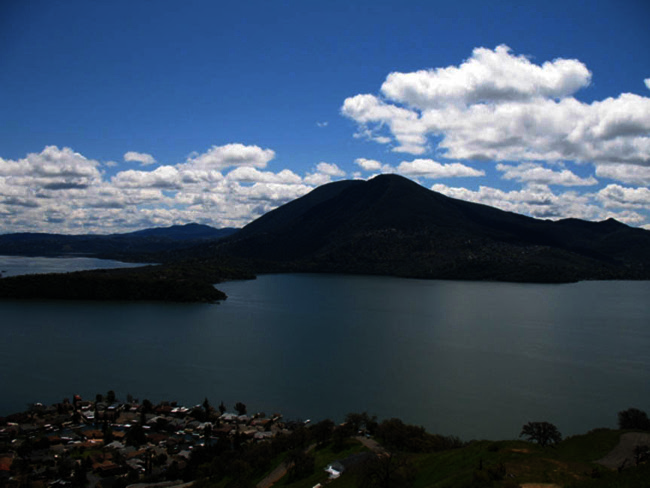
Clear Lake named nation’s best bass lake for 2025

California's Clear Lake has claimed the top spot in the 2025 Bassmaster Magazine 100 Best Bass Lakes standings. Photo courtesy of Lake County Marketing Program/B.A.S.S.


LAKE COUNTY, Calif. — After a year of record-setting catches and jaw-dropping tournament results, Bassmaster Magazine has unveiled its annual list of the 100 Best Bass Lakes in America for 2025 — and this year, a powerhouse lake returns to the top spot.

California’s Clear Lake takes the crown as the best bass fishery in the country, edging out some of the sport’s most celebrated waters. 

Topping Bassmaster’s 100 Best Bass Lakes list in 2020, the 43,785-acre Clear Lake continues to churn out double-digit largemouth like clockwork — including a staggering 102.81-pound, 15-bass total landed by John Pearl in the WON Bass Open this spring. 

Biologists and anglers alike agree: despite heavy pressure, Clear Lake is a big-bass factory like no other.

“This fishery has endured decades of tournament traffic and still produces monsters year-round,” said B.A.S.S. Conservation Director Gene Gilliland. “It’s a testament to both the ecosystem’s productivity and sound fisheries management.”

Rounding out the Top 3 nationally are Texas' O.H. Ivie Lake, long regarded as a bucket-list destination for trophy bass seekers, and the ever-reliable Lake Fork, also in the Lone Star State.

The 2025 rankings were developed through a combination of tournament data, fishery reports from state wildlife agencies and feedback from thousands of anglers across the country. More than 500 bodies of water were evaluated in the process.

California leads the pack this year with an unmatched 10 lakes in the Top 100, followed by Texas with nine and New York with seven.

The full list — segmented by region and topped with the national Top 10 — showcases a wide diversity of waters, from sprawling Southern impoundments to remote glacial lakes teeming with smallmouth. Whether you’re chasing personal bests or scenic solitude, there’s a lake on this list calling your name.

Full rankings can be found in the July/August issue of Bassmaster Magazine and on Bassmaster.com. 

Bassmaster Magazine’s Top 10 Best Bass Lakes of 2025

1.   Clear Lake, California
2.   O.H. Ivie Lake, Texas
3.   Lake Fork, Texas
4.   St. Lawrence River (Thousand Islands), New York
5.   Lake Casitas, California
6.   Orange Lake, Florida
7.   Santee Cooper Lakes, South Carolina
8.   Mille Lacs Lake, Minnesota
9.   Lake Erie, New York
10. Lake St. Clair, Michigan

Best Bass Lakes – Central Division

1.   O.H. Ivie Lake, Texas
2.   Lake Fork, Texas
3.   Mille Lacs Lake, Minnesota
4.   Sam Rayburn Reservoir, Texas
5.   Bussey Brake Reservoir, Louisiana
6.   Toledo Bend Reservoir, Louisiana/Texas
7.   Caney Creek Reservoir, Louisiana
8.   West Okoboji Lake, Iowa
9.   Lake J.B. Thomas, Texas
10. Grand Lake O’ the Cherokees, Oklahoma
11. Lake Claiborne, Louisiana
12. Lake of the Ozarks, Missouri
13. Upper Mississippi River, Wisconsin
14. Lake Oahe, South Dakota/North Dakota
15. Bull Shoals, Arkansas
16. Lake O’ the Pines, Texas
17. Table Rock Lake, Missouri
18. Bois d’Arc Lake, Texas
19. Caddo Lake, Louisiana/Texas
20. Millwood Lake, Arkansas
21. Newton Lake, Illinois
22. Lake Conroe, Texas
23. Lake Hamilton, Arkansas
24. Lake Tenkiller, Oklahoma
25. Black Bayou Lake/Hosston Lake, Louisiana

Best Bass Lakes – Southeastern Division

1.   Orange Lake, Florida
2.   Santee Cooper Lakes, South Carolina
3.   Lake Guntersville, Alabama
4.   Albemarle Sound & Connected Rivers, North Carolina
5.   Lake Murray, South Carolina
6.   Fellsmere Reservoir/Headwaters/Lake Egan, Florida
7.   Pickwick Lake, Alabama/Tennessee/Mississippi
8.   Jordan Lake, North Carolina
9.   Withlacoochee River/Lake Rousseau, Florida
10. Lake Lanier, Georgia
11. Falls Lake, North Carolina
12. Lake Seminole, Florida/Georgia
13. Lake Tohopekaliga, Florida
14. Kentucky Lake, Tennessee/Kentucky
15. High Rock Lake, North Carolina
16. Dale Hollow Reservoir, Tennessee/Kentucky
17. Clarks Hill Reservoir, Georgia/South Carolina
18. Lake Eufaula, Alabama/Georgia
19. Chickamauga Lake, Tennessee
20. Lake Chatuge, Georgia/North Carolina
21. Wheeler Lake, Alabama
22. South Holston Reservoir, Tennessee/Virginia
23. Lake Hartwell, South Carolina/Georgia
24. Ross Barnett Reservoir, Mississippi
25. Lake Okeechobee, Florida

Best Bass Lakes – Northeastern Division

1.   St. Lawrence River (Thousand Islands), New York
2.   Lake Erie/Upper Niagara River, New York
3.   Lake St. Clair, Michigan
4.   Lake Erie, Ohio/Michigan
5.   Lake Champlain, New York/Vermont
6.   Burt/Mullett Lakes, Michigan
7.   Grand Traverse Bay, Michigan
8.   Cayuga Lake, New York
9.   Lake Charlevoix, Michigan
10. Bays de Noc, Michigan
11. Smith Mountain Lake, Virginia
12. Cobbosseecontee Lake, Maine
13. China Lake, Maine
14. Great Pond, Maine
15. Candlewood Lake, Connecticut
16. Presque Isle Bay/Lake Erie Central Basin, Pennsylvania
17. Oneida Lake, New York
18. Upper Chesapeake Bay, Maryland
19. Otisco Lake, New York
20. Potomac River, Maryland/West Virginia/Virginia
21. Saginaw Bay, Michigan
22. Chautauqua Lake, New York
23. Lake Winnipesaukee, New Hampshire
24. Pymatuning Reservoir, Ohio/Pennsylvania
25. Lake Cumberland, Kentucky

Best Bass Lakes – Western Division

1.   Clear Lake, California
2.   Lake Casitas, California
3.   Lake Berryessa, California
4.   Diamond Valley Lake, California
5.   Lake Coeur d’Alene, Idaho
6.   Sacramento-San Joaquin Delta, California
7.   Lake Mead, Nevada/Arizona
8.   Lake Perris, California
9.   Siltcoos Lake, Oregon
10. Lake Washington, Washington
11. Lake Havasu, Arizona/California
12. Roosevelt Lake, Arizona
13. Lower Colorado River, Arizona/California
14. Moses Lake, Washington
15. Lake Powell, Utah/Arizona
16. Don Pedro Reservoir, California
17. Lake Mohave, Nevada/Arizona
18. Lake Sammamish, Washington
19. Lower Otay Reservoir, California
20. Elephant Butte Reservoir, New Mexico
21. Navajo Lake, New Mexico/Colorado
22. Alamo Lake, Arizona
23. Columbia River, Oregon/Washington
24. Fort Peck Reservoir, Montana
25. Dworshak Reservoir, Idaho

  • 151
  • 152
  • 153
  • 154
  • 155
  • 156
  • 157
  • 158
  • 159
  • 160

Community

  • Lake County Wine Alliance offers sponsor update; beneficiary applications open 

  • Mendocino National Forest announces seasonal hiring for upcoming field season

Public Safety

  • Lakeport Police logs: Thursday, Jan. 15

  • Lakeport Police logs: Wednesday, Jan. 14

Education

  • Woodland Community College receives maximum eight-year reaffirmation of accreditation from ACCJC

  • SNHU announces Fall 2025 President's List

Health

  • California ranks 24th in America’s Health Rankings Annual Report from United Health Foundation

  • Healthy blood donors especially vital during active flu season

Business

  • Two Lake County Mediacom employees earn company’s top service awards

  • Redwood Credit Union launches holiday gift and porch-to-pantry food drives

Obituaries

  • Rufino ‘Ray’ Pato

  • Patty Lee Smith

Opinion & Letters

  • The benefits of music for students

  • How to ease the burden of high electric bills

Veterans

  • CalVet and CSU Long Beach team up to improve data collection related to veteran suicides

  • A ‘Big Step Forward’ for Gulf War Veterans

Recreation

  • Wet weather trail closure in effect on Upper Lake Ranger District

  • Mendocino National Forest seeking public input on OHV grant applications

  • State Parks announces 2026 Anderson Marsh nature walk schedule 

  • BLM lifts seasonal fire restrictions in central California

Religion

  • Kelseyville Presbyterian to host Ash Wednesday service and Lenten dinner Feb. 18

  • Kelseyville Presbyterian Church to hold ‘Longest Night’ service Dec. 21

Arts & Life

  • Auditions announced for original musical ‘Even In Shadow’ set for March 21 and 28

  • ‘The Rip’ action heist; ‘Steal’ grounded in a crime thriller

Government & Politics

  • Lake County Democrats issue endorsements in local races for the June California Primary

  • County negotiates money-saving power purchase agreement

Legals

  • March 3 hearing on ordinance amending code for commercial cannabis uses

  • Feb. 12 public hearing on resolution to establish standards for agricultural roads

How to resolve AdBlock issue?
Refresh this page