How to resolve AdBlock issue?
Refresh this page
How to resolve AdBlock issue?
Refresh this page
Lake County News,California
  • Home
    • Registration Form
  • News
    • Education
    • Veterans
    • Community
      • Obituaries
      • Letters
      • Commentary
    • Police Logs
    • Business
    • Recreation
    • Health
    • Religion
    • Legals
    • Arts & Life
    • Regional
  • Calendar
  • Contact us
    • FAQs
    • Phones, E-Mail
    • Subscribe
  • Advertise Here
  • Login

News

Lakeport’s 10th Street corridor made safer for pedestrian and bicycle access

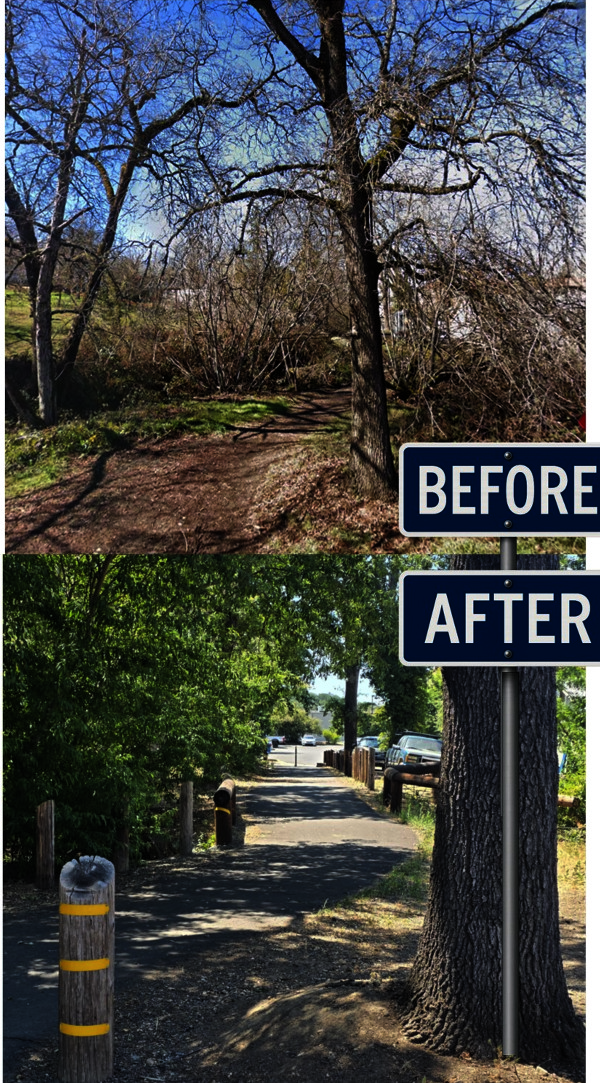
The 10th Street corridor in Lakeport, California, before and after recent work to improve pedestrian and bicycle access. Photos courtesy of the city of Lakeport.


LAKEPORT, Calif. — The city of Lakeport has made significant progress in transforming 10th Street into a safer and more accessible east-west route for pedestrians and cyclists. 

As a low-traffic residential street that parallels the heavily traveled 11th Street corridor, 10th Street offers a safer alternative for residents traveling between neighborhoods and key destinations, including Safeway, CVS, the post office, banks and local restaurants.

Recent upgrades include the installation of a 215-foot Class I path that connects 10th Street to the shopping center via Manzanita Drive. 

Class I paths are fully separated from vehicle traffic and provide a designated, paved route for walking, biking, and using mobility devices, offering a safe and user-friendly connection away from busy roads.

This new link eliminates a longstanding dead end and improves access to commercial services.

Additional improvements include ADA-compliant curb ramps and new sidewalks at the 10th Street and North Street intersection, supported by a voluntary sidewalk extension from a nearby homeowner. 

To promote safer crossings, a rectangular rapid flashing beacon has been installed at the intersection of 11th and High Street. This feature enhances pedestrian visibility and encourages use of the 10th Street route.

Upcoming project phases will focus on:
 
• Completing sidewalk gaps on the north side of 10th Street.
• Installing a mid-block RRFB at Main Street for safer downtown crossings.
• Repairing roadway surfaces and applying edge-line striping to establish advisory bike lanes while preserving on-street parking.

“These improvements reflect the city’s phased, cost-effective strategy for enhancing pedestrian safety and connectivity,” the city said in an announcement. “The project supports Lakeport’s long-term vision for a more walkable, bike-friendly community while maximizing available resources.”

For more information, contact the Lakeport Public Works Department at 707-263-3578 or visit www.cityoflakeport.com. 

District 3 residents invited to take survey on community issues

LAKE COUNTY, Calif. — Residents of Lake County’s District 3 are being invited to take a survey about community issues that are most important to them.

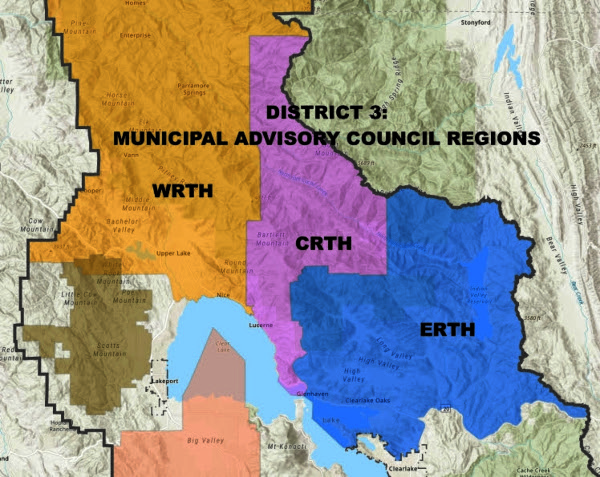
The three Municipal Advisory Councils, or MACs, of District 3 — East Region Town Hall, Central Region Town Hall and Western Region Town Hall — wish to jointly tackle issues shared along Lake County’s Northshore area.

The MACs need the community’s help in prioritizing which projects are most important to the communities. 

From code enforcement to public safety issues, local economy to the environment, they want to hear from Northshore residents.

“By working together, we can have a greater impact in helping our communities thrive,” the groups said in an announcement.

The survey can be found online here.

It can also be accessed via the ERTH website.

California becomes largest economy in the world to achieve clean energy milestone


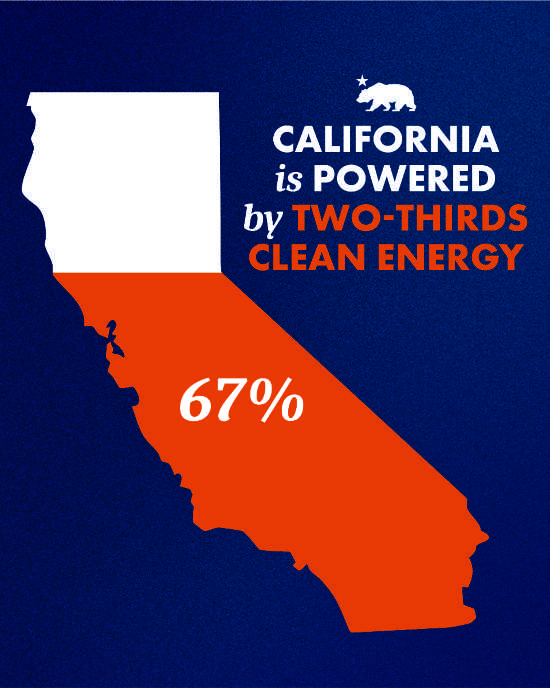
California has achieved an historic milestone: The state was powered by two-thirds clean energy in 2023, the latest year for which data is available. 

California is the largest economy in the world to achieve this level of clean energy. 

The state released new data showing California’s continued progress toward a clean energy future with 67% of the state’s retail electricity sales in 2023 coming from renewable and zero-carbon electricity generation — compared to just 61% the previous year and around 41% a decade ago. 

Sources of clean energy include generation from solar, wind, hydro, nuclear, geothermal and biomass. 

In 2024, the state added a record-breaking 7,000 megawatts (MW) of clean capacity to the grid, representing the largest single-year increase in clean energy capacity added to the grid in state history. 

This new figure broke the previous records set in both 2022 and 2023, marking a third consecutive year of unprecedented clean energy growth.

“As the federal government turns its back on innovation and commonsense, California is making our clean energy future a reality. The world’s fourth largest economy is running on two-thirds clean power — the largest economy on the planet to achieve this milestone,” said Gov. Gavin Newsom. “And for the first time ever, clean energy provided 100% of the state’s power nearly every day this year for some part of the day. Not since the Industrial Revolution have we seen this kind of rapid transformation.” 

Historic investments over the past 15 years have led to an extraordinary pace of development in new clean energy generation. And as the grid is increasingly powered by clean energy, pollution is down and the economy is up. 

Greenhouse gas emissions in California are down 20% since 2000 — even as the state’s GDP increased 78% in that same time period. 

The power sector is a major driver of the decline in greenhouse gases — emissions from electric power have been cut in half since 2009, helping the state achieve its emissions reductions goals years ahead of schedule.

California is home to the most clean energy jobs in the U.S. and the state’s renewable energy and clean vehicle industries lead the nation in growth. Officials reported that California boasts more than a half-million green jobs and has seven times more clean jobs than fossil fuel jobs. 

Solar and wind jobs account for a majority of green jobs, and battery storage and grid modernization is the second-fastest growing sector within California’s clean energy workforce.  

California continues to move at a rapid pace on bringing clean energy online. Since 2019, a record 25,000 MW of new energy resources statewide have been added to the grid, with most of that being solar and battery storage. 

This aligns with the governor’s roadmap to the state’s clean energy future released in 2023, which called for 148,000 megawatts (MW) of new clean power by 2045.

“California has achieved yet another major milestone on our journey to a clean energy future. The latest numbers show how our state is demonstrating that clean energy is mainstream and is here to stay,” said California Energy Commission Chair David Hochschild. 

Sources eligible under the state’ Renewables Portfolio Standard — such as solar and wind — made up 43% of the power mix in 2023, up from 39% in 2022. 

Other zero carbon resources continue to power the grid with large hydro accounting for 12% and nuclear power at 12% in 2023.

“California has set ambitious clean energy goals, and utilities and community choice aggregators have stepped up to deliver clean resources at competitive prices to communities up and down the state,” said California Public Utilities Commission President Alice Reynolds. “We are bringing renewable energy online at an unprecedented scale and pace never seen before.”

Solar represents the technology with the largest amount of installed renewable energy capacity in the state — over 21,000 MW of solar capacity operates the electric grid and another 19,000 MW of behind-the-meter generation. The California grid regularly breaks solar generation peak record levels — the latest solar peak recorded in late May was over 21,500 MW of solar generation.

Officials said the state is also doubling down on its goals by swiftly increasing its battery energy storage capacity. 

The state’s battery fleet now stands at over 15,000 MW — 1,944% higher than when the governor took office in 2019. The state’s storage fleet is regularly storing any available extra solar energy generated during the day, and supporting the grid by dispatching during the evening.  

Clean energy days

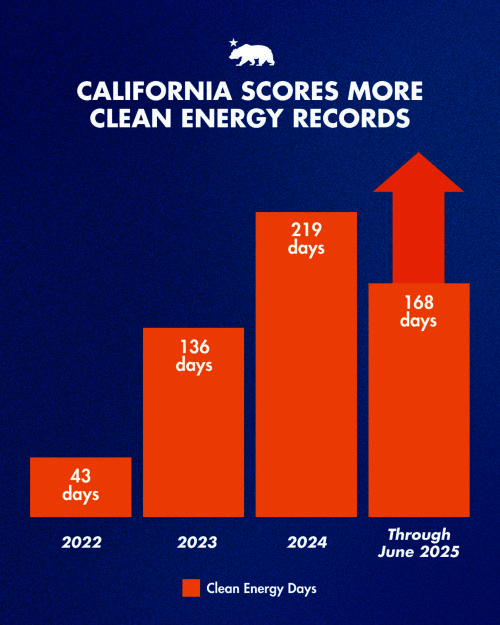
More than 9 out of 10 days so far this year have been powered by 100% clean energy for at least some part of the day in California. In 2025, California’s grid has run on 100% clean electricity for an average of 7 hours a day.

Data compiled by the California Energy Commission shows clean energy has powered the equivalent of 51.9 days in the state — nearly 30% of the year to date running on 100% clean electricity. 

That already surpasses the amount of “clean energy days” last year — and represents a 750% increase in clean energy days since 2022.

FEMA’s flood maps often miss dangerous flash flood risks, leaving homeowners unprepared

A deadly flash flood on July 4, 2025, swept through Nancy Callery’s childhood home in Hunt, Texas. Brandon Bell/Getty Images

Deadly and destructive flash flooding in Texas and several other states in July 2025 is raising questions about the nation’s flood maps and their ability to ensure that communities and homeowners can prepare for rising risks.

The same region of Texas Hill Country where a flash flood on July 4 killed more than 130 people was hit again with downpours a week later, forcing searchers to temporarily pause their efforts to find missing victims. Other states including New Mexico, Oklahoma, Vermont and Iowa also saw flash flood damage in July.

The U.S. Federal Emergency Management Agency’s flood maps are intended to be the nation’s primary tool for identifying flood risks. Originally developed in the 1970s to support the National Flood Insurance Program, these maps, known as Flood Insurance Rate Maps, or FIRMs, are used to determine where flood insurance is required for federally backed mortgages, to inform local building codes and land-use decisions, and to guide flood plain management strategies.

In theory, the maps enable homeowners, businesses and local officials to understand their flood risk and take appropriate steps to prepare and mitigate potential losses.

A flood risk map.
A federal flood map of Kerrville, Texas, with the Guadalupe River winding through the middle in purple, shows areas considered to have a 1% annual chance of flooding in blue and a 0.2% annual chance of flooding in tan. During a flash flood on July 4, 2025, the river rose more than 30 feet at Kerrville. FEMA

But while FEMA has improved the accuracy and accessibility of the maps over time with better data, digital tools and community input, the maps still don’t capture everything – including the changing climate. There are areas of the country that flood, some regularly, that don’t show up on the maps as at risk.

I study flood-risk mapping as a university-based researcher and at First Street, an organization created to quantify and communicate climate risk. In a 2023 assessment using newly modeled flood zones with climate-adjusted precipitation records, we found that more than twice as many properties across the country were at risk of a 100-year flood than the FEMA maps identified.

Even in places where the FEMA maps identified a flood risk, we found that the federal mapping process, its overreliance on historical data, and political influence over the updating of maps can lead to maps that don’t fully represent an area’s risk.

What FEMA flood maps miss

FEMA’s maps are essential tools for identifying flood risks, but they have significant gaps that limit their effectiveness.

One major limitation is that they don’t consider flooding driven by intense bursts of rain. The maps primarily focus on river channels and coastal flooding, largely excluding the risk of flash flooding, particularly along smaller waterways such as streams, creeks and tributaries.

This limitation has become more important in recent years due to climate change. Rising global temperatures can result in more frequent extreme downpours, leaving more areas vulnerable to flooding, yet unmapped by FEMA.

A map overlay shows how two 100-year flood maps compare. First Street shows many more streams.
A map of a section of Kerr County, Texas, where a deadly flood struck on July 4, 2025, compares the FEMA flood map’s 100-year flood zone (red) to First Street’s more detailed 100-year flood zone (blue). The more detailed map includes flash flood risks along smaller creeks and streams. Jeremy Porter

For example, when flooding from Hurricane Helene hit unmapped areas around Asheville, North Carolina, in 2024, it caused a huge amount of uninsured damage to properties.

Even in areas that are mapped, like the Camp Mystic site in Kerr County, Texas, that was hit by a deadly flash flood on July 4, 2025, the maps may underestimate their risk because of a reliance on historic data and outdated risk assessments.

Political influence can fuel long delays

Additionally, FEMA’s mapping process is often shaped by political pressures.

Local governments and developers sometimes fight to avoid high-risk designations to avoid insurance mandates or restrictions on development, leading to maps that may understate actual risks and leave residents unaware of their true exposure.

An example is New York City’s appeal of a 2015 FEMA Flood Insurance Rate Maps update. The delay in resolving the city’s concerns has left it with maps that are roughly 20 years old, and the current mapping project is tied up in legal red tape.

On average, it takes five to seven years to develop and implement a new FEMA Flood Insurance Rate Map. As a result, many maps across the U.S. are significantly out of date, often failing to reflect current land use, urban development or evolving flood risks from extreme weather.

This delay directly affects building codes and infrastructure planning, as local governments rely on these maps to guide construction standards, development approvals and flood mitigation projects. Ultimately, outdated maps can lead to underestimating flood risks and allowing vulnerable structures to be built in areas that face growing flood threats.

How technology advances can help

New advances in satellite imaging, rainfall modeling and high-resolution lidar, which is similar to radar but uses light, make it possible to create faster, more accurate flood maps that capture risks from extreme rainfall and flash flooding.

However, fully integrating these tools requires significant federal investment. Congress controls FEMA’s mapping budget and sets the legal framework for how maps are created. For years, updating the flood maps has been an unpopular topic among many publicly elected officials, because new flood designations can trigger stricter building codes, higher insurance costs and development restrictions.
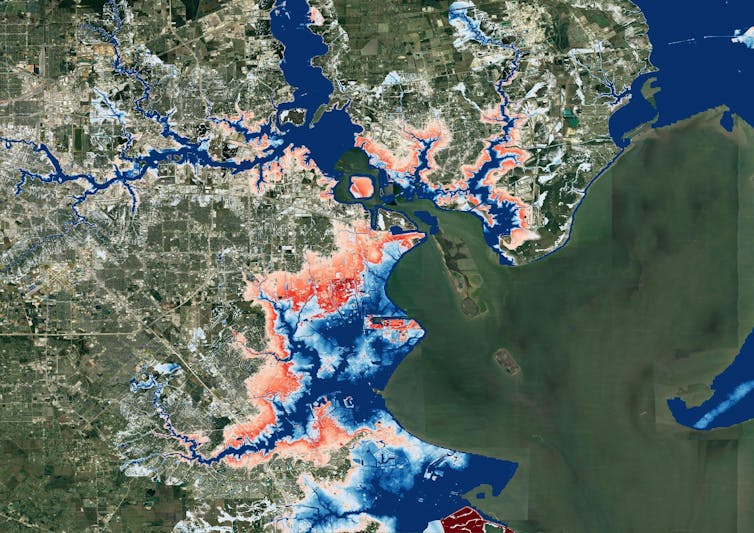
A map of Houston showing flooding extending much farther inland.
A map of Houston, produced for a 2022 study by researchers at universities and First Street, shows flood risk changing over the next 30 years as climate change worsens. Blue areas are today’s 100-year flood-risk zones. The red areas reflect the same zones in 2050. Oliver Wing et al., 2022

In recent years, the rise of climate risk analytics models and private flood risk data have allowed the real estate, finance and insurance industries to rely less on FEMA’s maps. These new models incorporate forward-looking climate data, including projections of extreme rainfall, sea-level rise and changing storm patterns – factors FEMA’s maps generally exclude.

Real estate portals like Zillow, Redfin, Realtor.com and Homes.com now provide property-level flood risk scores that consider both historical flooding and future climate projections. The models they use identify risks for many properties that FEMA maps don’t, highlighting hidden vulnerabilities in communities across the United States.

Research shows that the availability, and accessibility, of climate data on these sites has started driving property-buying decisions that increasingly take climate change into account.

Implications for the future

As homebuyers understand more about a property’s flood risks, that may shift the desirability of some locations over time. Those shifts will have implications for property valuations, community tax-revenue assessments, population migration patterns and a slew of other considerations.

However, while these may feel like changes being brought on by new data, the risk was already there. What is changing is people’s awareness.

The federal government has an important role to play in ensuring that accurate risk assessments are available to communities and Americans everywhere. As better tools and models evolve for assessing risk evolve, FEMA’s risk maps need to evolve, too.

This article, originally published July 12, 2025, has been updated with another round of flooding in Texas on July 13.The Conversation

Jeremy Porter, Professor of Quantitative Methods in the Social Sciences, City University of New York

This article is republished from The Conversation under a Creative Commons license. Read the original article.

Supervisors to discuss state grant applications, pause on cannabis permits 

LAKE COUNTY, Calif. — The Board of Supervisors this week will discuss preparations for new state grant applications and consider a proposal to temporarily halt the issuance of commercial cannabis permits in the unincorporated area as staff continues work on drafting the county’s cannabis ordinance.

The‌ ‌board will meet beginning ‌at‌ ‌9‌ ‌a.m. Tuesday, July 15, in the board chambers on the first floor of the Lake County Courthouse, 255 N. Forbes St., Lakeport.

The‌ ‌meeting‌ ‌can‌ ‌be‌ ‌watched‌ ‌live‌ ‌on‌ ‌Channel‌ ‌8, ‌online‌ ‌at‌ ‌https://countyoflake.legistar.com/Calendar.aspx‌‌ and‌ ‌on‌ ‌the‌ ‌county’s‌ ‌Facebook‌ ‌page. ‌Accompanying‌ ‌board‌ ‌documents, ‌the‌ ‌agenda‌ ‌and‌ ‌archived‌ ‌board‌ ‌meeting‌ ‌videos‌ ‌also‌ ‌are‌ ‌available‌ ‌at‌ ‌that‌ ‌link. ‌ ‌

To‌ ‌participate‌ ‌in‌ ‌real-time, ‌join‌ ‌the‌ ‌Zoom‌ ‌meeting‌ ‌by‌ ‌clicking‌ ‌this‌ ‌link‌. ‌ ‌

The‌ ‌meeting‌ ‌ID‌ ‌is‌ 865 3354 4962, ‌pass code 726865.‌ ‌The meeting also can be accessed via one tap mobile at +16694449171,,86533544962#,,,,*726865#. The meeting can also be accessed via phone at 669 900 6833.

At 9:15 a.m., the board will discuss this year's community and economic development projects eligible for a state grant called Community Development Block Grant, or the CDBG.

The staff memo noted that eligible cities and counties may submit up to three sub-applications not to exceed $3,600,000. Each economic development or housing project application cannot exceed $1,500,000.

The county currently contracts with Community Development Services, a Kelseyville firm, to prepare grant applications and implement CDBG funded activities, according to the staff memo. 

Jeff Lucas of the firm will present about the grant and application process.

At 10:30 a.m., the board will consider an annual marketing report from the Lake County Tourism Improvement District, or Visit Lake County. The report covers the organization’s finance, performance and the economic impact of tourism in Lake County. 

At 1 p.m., the board will consider Supervisor Helen Owen’s proposal to place a moratorium — a temporary pause — on issuing permits for commercial cultivation of cannabis within the county’s unincorporated area.

The staff memo noted that in March, the board disbanded a task force working on the county’s zoning ordinance that comprises the “Cannabis Ordinance.” Now, the Community Development Department staff is drafting a new article of the zoning ordinance. 

Owen is proposing a temporary halt to permit issuance while the new regulations are developed. 

“I have significant concern moving forward with additional permitting of Cannabis operations in the absence of appropriate regulation is not in the interest of our county and the residents we were elected to serve,” said Owen in the staff memo. “Pausing permit issuance and taking reasonable time to amend and adopt zoning regulations, as needed, make good sense.”

In the untimed items, the board will consider multiple county agreements with contractors, including one for accounting and advisory services not to exceed $150,000 and several Behavioral Health services totaling $3.7 million.

The board will consider the increase in the maximum compensation to $100,000 with interim Public Health Officer Dr. Anju Goel. 

Goel stepped into the interim role in April after the resignation of former Public Officer Dr. Noemi Doohan.

At the time of her appointment, her contract capped total compensation over a one-year period — or six months until September, in this case — at $49,860.

The board will also consider a Public Services proposal to purchase a used 2020 dump truck for the Eastlake Landfill, at a cost not to exceed $370,012.5. The purchase was included in the fiscal year 2025-26 budget approved by the board two weeks ago during the budget hearings.

According to the staff memo, a new truck of the same type would cost approximately $655,000. 

The board will also consider awarding two contracts for materials needed in the years’ chip seal resurfacing project, with rock materials to Granite Construction and emulsion materials to Western Emulsions, Inc. 

The project will cover approximately 37 miles of roadway and will be funded through the county’s allocation of SB 1 revenues. 

The full agenda follows. 

CONSENT AGENDA

5.1: Approve continuation of proclamation declaring a Clear Lake Hitch emergency.

5.2: Approve continuation of proclamation of the existence of a local emergency due to pervasive tree mortality.

5.3: Approve continuation of emergency proclamation declaring a shelter crisis in the County of Lake.

5.4: Adopt resolution approving amended MOU between County of Lake and Lake County Resource Conservation District for management of Goatsrue in Lake County for July 1, 2023, through December 31, 2027, in the amount of $72,716.00.

5.5: Approve closure of the Community Development Department to the public on Thursday, July 31, 2025, from 3 to 5 p.m. for all-staff training.

5.6: a) Approve budget transfer in Budget Unit 2302 – Probation from Transportation and Travel (723.29-50) in the amount of $14,353.00, Support and Care of Persons (723.40-70) in the amount of $85,000.00, and Local Community Corrections (723.54-02) in the amount of $53,000.00 for a total of $153,378.00 to Capital Asset Account 723.62-72; and b) amend the list of capital assets of the 2024-2025 budget to add 3 Probation vehicles in the amount of $153,378.00, and authorize the chair to sign.

5.7: (Sitting as the Board of Directors, Lake County Watershed Protection District) a) Waive the formal bidding process, pursuant to Lake County Code Section 38.2, as it is not in the public interest due to the unique nature of the goods and services; and b) authorize the County of Lake Water Resources Director to sign a Memorandum of Understanding amendment agreement between the Lake County Watershed Protection District and the Tribal EcoRestoration Alliance for the time period of June 1, 2024 – December 31, 2026.

5.8: Approve the agreement between County of Lake and Clean Lakes, Inc. for the Aquatic Vegetation Management Program for Fiscal Year 2025-2026 not to exceed an amount of $271,210 and authorize the chair to sign.

TIMED ITEMS

6.1, 9:02 a.m.: Public input.

6.2, 9:03 a.m.: Pet of the Week.

6.3, 9:15 a.m.: Discussion and consideration of the Community and Economic Development allocations of the California Community Development Block Program.

6.4, 10:30 a.m.: Consideration of Lake County Tourism Improvement District 2024 Annual Marketing Report.

6.5, 11:00 a.m.: (Sitting as the Lake County Air Quality Management District Board of Directors) Consideration of the continued discussion of the draft replacement fee schedule (Rules 660-668).

6.6, 1:00 p.m.: Consideration of an interim urgency ordinance placing a moratorium on the issuance of use permits for commercial cultivation of cannabis within the unincorporated area of the County of Lake.

NON-TIMED ITEMS

7.1: Supervisors’ weekly calendar, travel and reports.

7.2: Consideration of the following advisory board appointments: Food Policy Council.
7.3: Consideration of amendment between County of Lake and CliftonLarsonAllen LLP for accounting and advisory services; an increase of $50,000 total compensation not to exceed $150,000.

7.4: Consideration of the agreement between County of Lake and Kno'Qoti Nation Native Wellness Inc. in the amount of $1,000,000 for fiscal years 2025-2030.

7.5: Consideration of the agreement between County of Lake and Crestwood Behavioral Health, Inc. for adult residential support services and specialty mental health services for Fiscal Year 2025-26 in the amount of $1,200,000.
7.6: Consideration of agreement between the County of Lake and Redwood Community Services, Inc. for provision of the Lake County Wrap Program, Foster Care Program, and Intensive Services Foster Care (ISFC) Program for specialty mental health services for Fiscal Year 2025-26 in the amount of $1,500,000.

7.7: Consideration of Amendment 1 to professional services contract with Anju Goel, MD, MPH for an increase in the maximum compensation amount to $100,000.

7.8: Consideration of quarterly report of construction contract change orders approved under delegation of authority to Public Services Director for the Lake County Sheriff Administration Facility Renovation Project.

7.9: Consideration of a) determination that competitive bidding would not be in the public’s interest, pursuant to Lake County Code Section 38.2 (2), and; b) authorization of the Public Services Director/Assistant Purchasing Agent to sign a purchase order not to exceed $370,012.50 to Peterson CAT for a used 2020 Caterpillar 730 Articulated Dump Truck for the Eastlake Landfill.

7.10: Consideration of a) award of 2025 chip seal rock materials to Granite Construction; and b) award of 2025 chip seal emulsion materials to Western Emulsions, Inc.

CLOSED SESSION

8.1: Conference with legal counsel: Existing litigation pursuant to Government Code section 54956.9 (d)(1): McSorley v. Lake County.

Email Lingzi Chen at This email address is being protected from spambots. You need JavaScript enabled to view it..

Lakeport City Council to consider new power option and $1.2 million paving project

LAKEPORT, Calif. — The Lakeport City Council is set to review an updated feasibility study from Sonoma Clean Power on new power options and consider awarding a $1.2 million construction contract for the Martin & Lakeshore Repaving Project slated for this fall. 

The council will meet Tuesday, July 15, at 6 p.m. in the council chambers at Lakeport City Hall, 225 Park St. 

The agenda can be found here. 

If you cannot attend in person, and would like to speak on an agenda item, you can access the Zoom meeting remotely at this link or join by phone by calling toll-free 669-900-9128 or 346-248-7799. 

The webinar ID is 973 6820 1787, access code is 477973; the audio pin will be shown after joining the webinar. Those phoning in without using the web link will be in “listen mode” only and will not be able to participate or comment. 

Comments can be submitted by email to This email address is being protected from spambots. You need JavaScript enabled to view it.. To give the city clerk adequate time to print out comments for consideration at the meeting, please submit written comments before 3:30 p.m. on Tuesday, July 15.

Under council business, the council will hear a presentation from Sonoma Clean Power evaluating the feasibility of expanding their Community Choice Aggregation program, or the CCA program, into Lake County. 

The staff report said that the CCA model “allows local governments to procure cleaner, often more affordable electricity on behalf of their communities.”

In 2019, the company did a first feasibility study and concluded that the program would not be “financially viable” for the county as it would project rates 5% to 8% higher than the PG&E rates. 

Their new report, however, suggests that the program could now offer “competive, and potentially lower, electricity rates for Lake County customers compared to PG&E,” the staff report said.

The council will also discuss the city’s mission and community vision statement and provide direction on the public input process.

The council will also consider the Martin & Lakeshore Repaving Project and award a construction contract to Ghilotti Construction Co. The contract, including a 10% contingency, will not exceed $1.21 million.

The staff report noted that the city received three bids and Ghilotti was the lowest bidder. 

The project involves pavement rehabilitation to improve road safety and infrastructure, with construction expected from the beginning of September to the end of October this year. The project is exempted from further California Environmental Quality Act review. 

On the consent agenda — items considered noncontroversial and usually accepted as a slate on one vote — are ordinances; minutes of the previous meeting on June 17 and the special meeting on June 30; approval of application 2025-035, with staff recommendations, for the Recovery Happens event; approval of application 2025-036, with staff recommendations, for the Harvest Festival; approval of a resolution rescinding Resolution 2973 (2024) and revising the Master Pay Schedule in conformance with California Code of Regulations, Title 2, Section 570.5; approval of the designated temporary disabled parking on both sides of C and D Streets, between South Forbes Street and the respective fairgrounds entrance gates, from 4:00 p.m. on Thursday, August 31 to midnight on Sunday, September 3, 2025.

Email staff reporter Lingzi Chen at This email address is being protected from spambots. You need JavaScript enabled to view it.. 


  • 149
  • 150
  • 151
  • 152
  • 153
  • 154
  • 155
  • 156
  • 157
  • 158

Community

  • Lake County Wine Alliance offers sponsor update; beneficiary applications open 

  • Mendocino National Forest announces seasonal hiring for upcoming field season

Public Safety

  • Lakeport Police logs: Thursday, Jan. 15

  • Lakeport Police logs: Wednesday, Jan. 14

Education

  • Woodland Community College receives maximum eight-year reaffirmation of accreditation from ACCJC

  • SNHU announces Fall 2025 President's List

Health

  • California ranks 24th in America’s Health Rankings Annual Report from United Health Foundation

  • Healthy blood donors especially vital during active flu season

Business

  • Two Lake County Mediacom employees earn company’s top service awards

  • Redwood Credit Union launches holiday gift and porch-to-pantry food drives

Obituaries

  • Rufino ‘Ray’ Pato

  • Patty Lee Smith

Opinion & Letters

  • The benefits of music for students

  • How to ease the burden of high electric bills

Veterans

  • CalVet and CSU Long Beach team up to improve data collection related to veteran suicides

  • A ‘Big Step Forward’ for Gulf War Veterans

Recreation

  • Wet weather trail closure in effect on Upper Lake Ranger District

  • Mendocino National Forest seeking public input on OHV grant applications

  • State Parks announces 2026 Anderson Marsh nature walk schedule 

  • BLM lifts seasonal fire restrictions in central California

Religion

  • Kelseyville Presbyterian to host Ash Wednesday service and Lenten dinner Feb. 18

  • Kelseyville Presbyterian Church to hold ‘Longest Night’ service Dec. 21

Arts & Life

  • Auditions announced for original musical ‘Even In Shadow’ set for March 21 and 28

  • ‘The Rip’ action heist; ‘Steal’ grounded in a crime thriller

Government & Politics

  • Lake County Democrats issue endorsements in local races for the June California Primary

  • County negotiates money-saving power purchase agreement

Legals

  • March 3 hearing on ordinance amending code for commercial cannabis uses

  • Feb. 12 public hearing on resolution to establish standards for agricultural roads

How to resolve AdBlock issue?
Refresh this page