How to resolve AdBlock issue?
Refresh this page
How to resolve AdBlock issue?
Refresh this page
Lake County News,California
  • Home
    • Registration Form
  • News
    • Education
    • Veterans
    • Community
      • Obituaries
      • Letters
      • Commentary
    • Police Logs
    • Business
    • Recreation
    • Health
    • Religion
    • Legals
    • Arts & Life
    • Regional
  • Calendar
  • Contact us
    • FAQs
    • Phones, E-Mail
    • Subscribe
  • Advertise Here
  • Login

News

Crash involving vehicle hitting building results in major injuries

LAKE COUNTY, Calif. — A Wednesday night crash involving a vehicle hitting a building sent one person to a trauma center.

The crash occurred at the Sandpiper RV Park, 2630 Lakeshore Blvd. in Nice, shortly after 10:30 p.m. Wednesday.

Reports from the scene said a midsized Mazda SUV hit a home at the resort.

The vehicle, which was seen weaving and swerving before the crash, took out the entire building, according to scene reports.

Incident command reported over the radio that one person had moderate injuries and one had major injuries.

A REACH air ambulance was requested to respond to the scene to transport one of the injured people.

The California Highway Patrol’s online reports said a wrecker was requested to come to the scene to remove the SUV, which was wedged between the building and a telephone pole, and sitting on a fire hydrant.

The Wednesday night trash was the latest in a series of several serious wrecks that have taken place over the last week.

Email Elizabeth Larson at This email address is being protected from spambots. You need JavaScript enabled to view it.. Follow her on Twitter, @ERLarson, and on Bluesky, @erlarson.bsky.social. Find Lake County News on the following platforms: Facebook, @LakeCoNews; X, @LakeCoNews; Threads, @lakeconews, and on Bluesky, @lakeconews.bsky.social. 

Following increased CHP operations, California sees 13% reduction in stolen vehicles statewide

State officials said Wednesday that, following the COVID-induced crime surge, the number of vehicles stolen statewide has dropped by 13% from 2023 to 2024 — the first year-over-year decrease since 2019. 

Of those vehicles stolen, nearly 92% of cars, trucks and SUVs successfully recovered.

“We continue to put the safety of California communities first. Through strategic funding and partnerships with local and state law enforcement partners, we are putting a brake on lawlessness and criminals disrupting our way of life,” said Gov. Gavin Newsom.

Of the stolen vehicles in California, nearly 94% cars and 90% personal trucks and SUVs were recovered. 
 
Significant regional investment by the state

Through expanded regional efforts with the California Highway Patrol and local law enforcement agencies, Gov. Newsom sought to strengthen efforts to fight vehicle theft through crime suppression operations in key areas, including Oakland, Bakersfield and San Bernardino. 

These ongoing regional operations have shown positive results throughout the broader communities in Alameda, Kern and San Bernardino counties. 

Working closely with local law enforcement agencies, auto thieves, repeat offenders and organized crime groups have been disrupted, and their activities have been thwarted. 

As a result of these public safety collaborations, each of these counties saw a significant drop in vehicle thefts in 2024:

• Alameda: down 18% from 2023.
• Kern: down 28% from 2023.
• San Bernardino: down 11% from 2023.

Other notable drops by county in stolen vehicles from 2023 includes:

• Imperial: down 13%.
• Orange: down 16%.
• Riverside: down 24%.
• Sacramento: down 23%.
• San Diego: down 11%.
• San Francisco: down 17%.
• Santa Barbara: down 29%.
• Tulare: down 22%.
• Yolo: down 24%.

“We are proud to see fewer vehicles being stolen across the state,” said CHP Commissioner Sean Duryee. “The CHP and our law enforcement partners are working hard every day to stop these crimes, protect California’s communities and hold criminals responsible.”

Automobiles are a vital part of daily life for work, school and family. When a vehicle is stolen, it impacts more than just property — it can take away a person’s freedom and sense of security. View the 2024 report on stolen vehicles and their recoveries here.
 
Stronger enforcement, serious penalties, real consequences

California has invested $1.6 billion since 2019 to fight crime, help local governments hire more police, and improve public safety. 

In 2023, as part of California’s Public Safety Plan, Newsom announced the largest-ever investment to combat organized retail crime in state history, an annual 310% increase in proactive operations targeting organized retail crime, and special operations across the state to fight crime and improve public safety.

Last August, Gov. Newsom signed into law the most significant bipartisan legislation to crack down on property crime in modern California history. These bipartisan bills offer new tools to bolster ongoing efforts to hold criminals accountable for smash-and-grab robberies, property crime, retail theft, and auto burglaries. 

While state officials said California’s crime rate remains at near historic lows, Newsom’s office said these laws help California adapt to evolving criminal tactics to ensure perpetrators are effectively held accountable.

How the nature of environmental law is changing in defense of the planet and the climate

A 2017 New Zealand law recognizes inherent rights of the Whanganui River. Jason Pratt, CC BY-SA

While the dangerous effects of climate change continue to worsen, legal efforts to address a range of environmental issues are also on the rise.

Headlines across the globe tout many of these legal actions: South Korea’s Climate Law Violates Rights of Future Generations; Ukraine is Ground Zero in Battle for Ecocide Law; Paris Wants to Grant the River Seine Legal Personhood; and Montana Court Rules Children Have the Right to a Healthy Environment, to name a few recent examples.

As an environmental lawyer, I see that most of these suits use one of five legal strategies that have been developed over the past couple of decades. These approaches vary in terms of who is filing the lawsuit, against whom, and whether the underlying legal perspective is based on protecting human rights or the rights of the environment itself. But they all share an innovative approach to protect all life on this planet.

1. Right to a healthy environment

In 2022, the United Nations declared that humans have “the right to a clean, healthy and sustainable environment … essential to protecting human life, well-being and dignity.” More than 150 countries have similar declarations in their constitutions or laws, often alongside protections for other human rights, such as those to education and medical care.

These rights are held by humans, so people can sue for alleged violations. Typically they sue one or more government agencies, whose responsibility it is to protect human rights.

One recent case using this approach was Held v. Montana, in which a group of young people in 2024 won a lawsuit against the state of Montana for violating the state constitution’s right to a “clean and healthful environment.” The state Supreme Court agreed with the plaintiffs and struck down a law barring the consideration of climate effects when evaluating proposals for fossil fuel extraction. Similar cases have been heard in the U.S. and other countries around the world.

The International Court of Justice, the primary judicial body of the United Nations, ruled on July 23, 2025, that a “clean, healthy and sustainable environment” is a human right and said in a nonbinding decision that governments that do not protect people and the planet from climate change could be legally liable for the resulting harms.
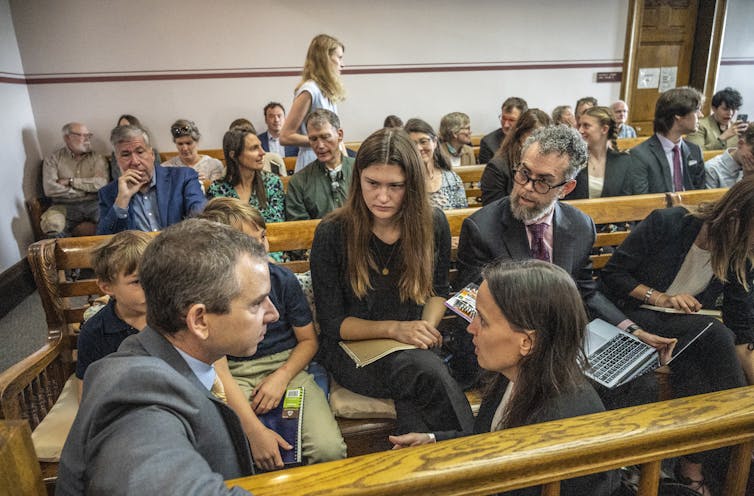
A young woman and two young boys listen as lawyers talk. Young people fill two rows of benches behind them in the small court room.
Rikki Held, the lead plaintiff in the Montana case, center seated, confers with the Our Children’s Trust legal team before the start of the trial on June 12, 2023. William Campbell/Getty Images

2. The rights of future generations

A legal concept called “intergenerational equity” is the idea that present generations must “responsibly use and conserve natural resources for the benefit of future generations.” First codified in international law in the 1972 Stockholm Declaration, the principle has been gaining popularity in recent decades. International organizations and national governments have enshrined this principle in law.

Focused on humans’ rights, these laws allow people and groups to bring claims, usually against governments, for allowing activities that are altering the environment in ways that will harm future generations. One well-known case that relied on this legal principle is Future Generations v. Ministry of the Environment and Others, in which a Colombian court in 2018 agreed with young people who had sued, finding that the Colombian government’s allowance of “rampant deforestation in the Amazon” violated the pact of intergenerational equity.

3. Government responsibility

Another human-centered approach is the public trust doctrine, which establishes “that certain natural and cultural resources are preserved for public use” and that governments have a responsibility to protect them for everyone’s benefit.

While the concept of “public trust” has long existed in the law, recently it has been used to bring suit against governments for their failure to address climate change and other environmental degradation. In Urgenda Foundation v. the State of the Netherlands, a Dutch court held in 2019 that the government has a responsibility to mitigate the effects of climate change due to the “severity of the consequences of climate change and the great risk of climate change occurring.” Since the decision, the Dutch government has sought to reduce emissions by phasing out the use of coal, increasing reliance on renewable energy and aiming to achieve carbon neutrality by 2050.

Government responsibility for the public trust was also a basis of the Juliana v. U.S. case, where a group of young people sued the U.S. government for breaching the public trust by not doing enough to curb greenhouse gas emissions. The U.S. Supreme Court ultimately declined to hear an appeal of a lower court’s ruling, but the lack of a specific ruling by the nation’s highest court has given continued hope to new cases, which continue to be filed based on the same principle.

A documentary examining the movement to protect the rights of nature.

4. Rights of nature

The rights of nature is one of the fastest-growing environmental legal strategies of the past decade. Since Ecuador recognized the rights of Pachamama, the Quechua name for Mother Earth, in its Constitution in 2008, more than 500 laws on the rights of nature have been enacted around the world.

The principle recognizes the legal rights of natural entities, such as rivers, mountains, ecosystems or even something as specific as wild rice. The laws that grant these rights don’t focus on humans but rather nature itself, often including language that the natural entity has the right to “exist and persist.”

The laws then provide a mechanism for the natural entity – whether through a specific group assigned legal guardianship or other community efforts – to protect itself by filing lawsuits in court. In the 2018 Colombian case, the court found that the Amazon ecosystem has rights, which must be respected and protected.

Similarly, in Bangladesh in 2019 the courts recognized the rights of all the country’s rivers, requiring, among other things, a halt on damaging development along the rivers that block their natural flow. The court also created a commission to serve as legal guardians of the country’s rivers.

People walk through an area of rocks to a grassy plain.
The destruction of a dam in Ukraine, which emptied this former reservoir, is being investigated as a possible crime of ecocide. Tarasov/Ukrinform/Future Publishing via Getty Images

5. Defining a new crime: Ecocide

In 2024, the governments of Vanuatu, Fiji and Samoa formally proposed that the international community recognize a new crime under international law. Called “ecocide,” the principle takes a nature-focused approach and includes any unlawful act committed with “the knowledge that there is a substantial likelihood of severe and either widespread or long-term damage to the environment.”

Put another way, what genocide is to humans, ecocide is to nature. It is being proposed as an addition to the 2002 Rome Statute, which created the International Criminal Court to prosecute war crimes, genocide and crimes against humanity.

While the idea is relatively new, in addition to the international efforts, several countries have incorporated ecocide into their laws – including Vietnam, France, Chile and Ukraine. A Ukrainian prosecutor is currently investigating the June 2023 destruction of a dam in a Russian-occupied area of the country as a potential crime of ecocide, because of the widespread flooding and habitat destruction that resulted.

The European Union has also incorporated ecocide into its Environmental Crime Directive, which applies to all EU member countries, providing them with a mechanism to hear ecocide claims in their national courts.

Using these ideas

Each of these legal concepts has the potential to increase protection for the environment – and the people who live in it. But determining which strategy has the greatest chance of success depends on the details of the existing law and legal system in each community.

All of these legal strategies have a role in the fight to protect and preserve the environment as an integral, interdependent living thing that is vitally important to us as humans but also in its own right.

This article, originally published July 23, 2025, was updated later that day to reflect the ruling from the International Court of Justice.The Conversation

Dana Zartner, Professor of International Studies, University of San Francisco

This article is republished from The Conversation under a Creative Commons license. Read the original article.

Former Clearlake resident receives 200 years to life sentence for sex abuse case

NORTH COAST, Calif. — A former Clearlake resident has been sentenced to a 200-years-to-life prison sentence for a sexual abuse case involving children that lasted several years.

On Monday, Sonoma County Superior Court Judge Troye Shaffer handed down the sentence to Gerald Martin Bloom III, 40.

The Sonoma County District Attorney’s Office told Lake County News that the offenses occurred between 2014 and 2020.

All of the charges involve committing a lewd and lascivious act upon a child under the age of 14, the District Attorney’s Office said.

Authorities said the case involved two victims.

Bloom was previously a Lake County resident, most recently residing in Clearlake, the District Attorney’s Office said.

Case records show that the initial report came from the Rohnert Park Police Department, with the case filed in August 2023. He was reported to have been living in Rohnert Park at the time of the offenses, and then moved to Clearlake, where he was taken into custody.

Court records show that, at the end of an 11-day trial, a jury found Bloom guilty in March of eight felony charges, including four for forcible lewd act upon a child and four for lewd or lascivious acts with a child under age 14.

Additionally, the jury found to be true eight special allegations of sex crimes, based on court records.

The District Attorney’s Office said that, in giving Bloom a 200 years to life sentence, Judge Shaffer handed down the maximum possible sentence.  

Lake County News asked the agency if, based on the sentence, the Bloom case was amongst the worst cases their office has prosecuted in recent years.

“We prosecute many significant cases every year with lengthy sentences,” said Assistant District Attorney Brian Staebell. 

“However,” Staebell added, “this was a very serious and sad case, and the sentence was very appropriate.”

Email Elizabeth Larson at This email address is being protected from spambots. You need JavaScript enabled to view it.. Follow her on Twitter, @ERLarson, and on Bluesky, @erlarson.bsky.social. Find Lake County News on the following platforms: Facebook, @LakeCoNews; X, @LakeCoNews; Threads, @lakeconews, and on Bluesky, @lakeconews.bsky.social. 

CDPH recommends families add vaccines to back-to-school checklists

During National Immunization Awareness Month in August, the California Department of Public Health, or CDPH, is highlighting the importance of routine vaccines as students return to school. 

Vaccination prevents the spread of serious illnesses, reduces hospitalizations, saves lives, and helps keep kids in school and doing the activities they love.

While California’s immunization rates for kindergarten students remain higher than the national average, CDPH wants to keep rates high and continue to protect California children and communities from vaccine-preventable diseases. 

CDPH recommends families stay up to date on all vaccinations for the new school year.

“When our youngest Californians are healthy and able to participate in learning and doing the things they love, the future of California is brighter,” said Dr. Erica Pan, CDPH director and state Public Health officer. “As a parent and a pediatrician, I am grateful for and confident in the safety and effectiveness of vaccines, which have transformed the leading causes of childhood deaths away from infectious diseases. CDPH remains committed to ensuring all California families have access to safe and effective vaccines, and the information they need to understand that vaccine recommendations are based on credible, transparent, and science-based evidence."

Due to large outbreaks in other states, the number of measles cases in the U.S. as of July 2025 are already higher than any year since 2000, when the World Health Organization declared the disease eliminated in the United States due to vaccination. 

Over 90% of this year’s cases were not vaccinated, and more than 1 in 10 of those infected with measles were hospitalized, some in intensive care units. 

Three people have died this year from this entirely preventable disease, reminding us of the importance of immunization.

California continues to report more than 95% coverage among kindergarteners for the measles, mumps, and rubella, or MMR, vaccine.

While the state has maintained the level of vaccination necessary to prevent community spread for nearly a decade, it remains critical that our children and communities stay protected through continued vaccination.

Required Immunizations: California law requires students to receive age-specific immunizations to attend public and private schools and licensed childcare centers. Schools and licensed childcare centers are required to enforce immunization requirements, maintain immunization records of all children enrolled, and report children’s immunization status to CDPH.

Families can visit CDPH’s “Shots for School” and “Don’t Wait – Vaccinate!” webpages for information on immunization laws and required vaccinations for students in California.

Resources for Families: CDPH encourages families to seek reliable information to learn more about vaccines, including visiting the CDPH Vaccine Facts webpage. 

Families can also speak to their health care providers or contact their local health provider for help in finding a place to get immunized. Most health plans cover recommended vaccinations with no out-of-pocket costs. 

Children without insurance coverage qualify for the Vaccines for Children Program, which provides no-cost vaccines for eligible children.

Padilla, Schiff, Booker announce bill to make access to equitable health care a protected civil right

U.S. Senators Alex Padilla (D-Calif.), Adam Schiff (D-Calif.) and Cory Booker (D-N.J.) have announced the Equal Health Care for All Act, bicameral legislation that would make equal access to medical care a protected civil right to help address the racial inequities and structural failures in America’s health care system that have led to higher mortality rates in communities of color. 

As President Trump and Republicans gut critical health care funding, the Equal Health Care for All Act would establish a definition for inequitable health care to help ensure that hospitals provide the same high quality health care services to all patients, regardless of race, national origin, sexual orientation, gender identity, disability, age or religion.

Republicans voted to gut Medicaid by over $900 billion, stripping health care from 17 million Americans, including over 2.3 million Californians. 

They cut more than $4 billion in funding for California hospitals, which will lead to hospital closures and higher health care costs, all to pay for tax cuts for the ultra-wealthy.

“By gutting billions of dollars for hospitals and other essential Medicaid services, the Trump Administration is hurting our patients and their pocketbooks in communities across the country,” said Sen. Padilla. “Our bill would treat equitable health care as a civil right to provide every patient with the access to the high-quality care they deserve.”

“Everyone deserves equal access to comprehensive, high-quality health care, free from discrimination,” said Sen. Booker. “However, this is not the reality for most communities across our country, with communities of color, especially women of color, bearing the disproportionate burden of poor health outcomes due to a lack of access to quality medical care. The Equal Health Care for All Act is legislation to combat the stark inequalities that exist in our health care system, and ensure every American has access to affordable, equitable care.”

“As the Trump administration rolls back access to funding for health care, it is imperative to protect the right to these essential services for all communities. I’m proud to co-lead the Equal Health Care Act for All to continue supporting high quality health care for all, because equal access is a fundamental right, and one that every American should enjoy,” said Sen. Schiff.

The Equal Health Care for All Act aims to remedy structural and systemic failures in America’s health care system that have led to Black, Hispanic, and indigenous individuals disproportionately suffering from a range of illnesses, from asthma to heart disease.

Black women are more likely than white women to die from breast cancer and during childbirth. Hispanic individuals suffer from higher rates of chronic diseases, including an 80 percent higher rate of diabetes.

Specifically, the Equal Health Care for All Act would:

• Require the Health and Human Services secretary to promote regulations requiring health care providers and facilities to disaggregate data on health outcomes by demographic characteristics;
• Require inclusion of quality measures of equitable health care in hospital value-based purchasing programs;
• Empower Medicare and Medicaid providers to enforce equitable health care standards;
• Rename the HHS “Office on Civil Rights” to “Office of Civil Rights and Health Equity;”
• Prohibit health care providers from providing inequitable health care to patients;
• Establish a Federal Health Equity Commission; and
• Authorize grants for hospitals to promote equitable health care outcomes.
 
The bill is also cosponsored by U.S. Sen. Ruben Gallego (D-Ariz.) and is supported by NAACP, National Urban League, American Diabetes Association and American Cancer Society.

  • 143
  • 144
  • 145
  • 146
  • 147
  • 148
  • 149
  • 150
  • 151
  • 152

Community

  • Lake County Wine Alliance offers sponsor update; beneficiary applications open 

  • Mendocino National Forest announces seasonal hiring for upcoming field season

Public Safety

  • Lakeport Police logs: Thursday, Jan. 15

  • Lakeport Police logs: Wednesday, Jan. 14

Education

  • Woodland Community College receives maximum eight-year reaffirmation of accreditation from ACCJC

  • SNHU announces Fall 2025 President's List

Health

  • California ranks 24th in America’s Health Rankings Annual Report from United Health Foundation

  • Healthy blood donors especially vital during active flu season

Business

  • Two Lake County Mediacom employees earn company’s top service awards

  • Redwood Credit Union launches holiday gift and porch-to-pantry food drives

Obituaries

  • Rufino ‘Ray’ Pato

  • Patty Lee Smith

Opinion & Letters

  • The benefits of music for students

  • How to ease the burden of high electric bills

Veterans

  • CalVet and CSU Long Beach team up to improve data collection related to veteran suicides

  • A ‘Big Step Forward’ for Gulf War Veterans

Recreation

  • Wet weather trail closure in effect on Upper Lake Ranger District

  • Mendocino National Forest seeking public input on OHV grant applications

  • State Parks announces 2026 Anderson Marsh nature walk schedule 

  • BLM lifts seasonal fire restrictions in central California

Religion

  • Kelseyville Presbyterian to host Ash Wednesday service and Lenten dinner Feb. 18

  • Kelseyville Presbyterian Church to hold ‘Longest Night’ service Dec. 21

Arts & Life

  • Auditions announced for original musical ‘Even In Shadow’ set for March 21 and 28

  • ‘The Rip’ action heist; ‘Steal’ grounded in a crime thriller

Government & Politics

  • Lake County Democrats issue endorsements in local races for the June California Primary

  • County negotiates money-saving power purchase agreement

Legals

  • March 3 hearing on ordinance amending code for commercial cannabis uses

  • Feb. 12 public hearing on resolution to establish standards for agricultural roads

How to resolve AdBlock issue?
Refresh this page
