How to resolve AdBlock issue?
Refresh this page
How to resolve AdBlock issue?
Refresh this page
Lake County News,California
  • Home
    • Registration Form
  • News
    • Education
    • Veterans
    • Community
      • Obituaries
      • Letters
      • Commentary
    • Police Logs
    • Business
    • Recreation
    • Health
    • Religion
    • Legals
    • Arts & Life
    • Regional
  • Calendar
  • Contact us
    • FAQs
    • Phones, E-Mail
    • Subscribe
  • Advertise Here
  • Login

News

Supervisors to review housing plans, road project concerns, and funding loss for Clear Lake mussel prevention

LAKE COUNTY, Calif. — The Board of Supervisors this week will hold a special meeting to review the county’s housing challenges and strategies, consider allocating an additional $1 million to address quality concerns in the Cobb road rehabilitation project, and respond to the unexpected loss of a critical state funding for monitoring invasive mussels in Clear Lake.

The‌ ‌board will meet beginning ‌at‌ ‌9‌ ‌a.m. Tuesday, July 29, in the board chambers on the first floor of the Lake County Courthouse, 255 N. Forbes St., Lakeport.

The‌ ‌meeting‌ ‌can‌ ‌be‌ ‌watched‌ ‌live‌ ‌on‌ ‌Channel‌ ‌8, ‌online‌ ‌at‌ ‌https://countyoflake.legistar.com/Calendar.aspx‌‌ and‌ ‌on‌ ‌the‌ ‌county’s‌ ‌Facebook‌ ‌page. ‌Accompanying‌ ‌board‌ ‌documents, ‌the‌ ‌agenda‌ ‌and‌ ‌archived‌ ‌board‌ ‌meeting‌ ‌videos‌ ‌also‌ ‌are‌ ‌available‌ ‌at‌ ‌that‌ ‌link. ‌ ‌

To‌ ‌participate‌ ‌in‌ ‌real-time, ‌join‌ ‌the‌ ‌Zoom‌ ‌meeting‌ ‌by‌ ‌clicking‌ ‌this‌ ‌link‌. ‌ ‌

The‌ ‌meeting‌ ‌ID‌ ‌is‌ 865 3354 4962, ‌pass code 726865.‌ ‌The meeting also can be accessed via one tap mobile at +16694449171,,86533544962#,,,,*726865#. The meeting can also be accessed via phone at 669 900 6833.

Housing strategy discussion

At 9:01 a.m., the board will review the Lake County Housing Action and Implementation Plan, or HAIP, addressing housing issues in the county. 

The HAIP includes analysis of the county’s housing problems, strategies to tackle them and action steps and resources. It will cover the unincorporated area of the county, as well as the cities of Clearlake and Lakeport.

The HAIP report identifies the county’s primary housing challenge as attracting residential developers and maintaining sufficient funding for housing-related programs. According to the report, this issue stems from the series of wildfires over the past decade.  

Cobb road project under scrutiny 

At 11 a.m., the board will discuss the quality concerns of the ongoing Cobb Area Road Rehabilitation Project. Staff recommends an additional $1 million to be allocated to the project. The board will consider options provided and discuss sources of funding. 

On April 8, the county entered into a $5.1 million road construction contract with Argonaut Constructors. 

The contract covers pulverization of the existing road surfaces in the Cobb area, followed by a chip seal surface application for many roads and a hot mix asphalt surfacing for other roads, according to the staff memo. 

As construction has proceeded, residents raised concerns over the quality and durability of the chip seal surfacing. 

To investigate the matter, the county requested the final design report from Nichols Consulting Engineers, or the NCE — the firm contracted by the county to prepare the design for the project. 

The NCE’s July 23 report found that former county staff working on the project recommended many roads be surfaced with a double chip seal. 

NCE staff will attend the board meeting to answer the board’s questions regarding the decision-making process. 

“Concerns remain regarding the long-term durability of the chip sealed roads and the best available investment decisions for County Road Maintenance funds,” the staff memo said.

Staff recommends amending the contract with Argonaut Constructors to include asphalt paving for the problematic roads, which will cost additional $1 million, according to the staff memo. 

The memo said that Supervisor Jessica Pyska has expressed willingness to commit $225,000 in Cannabis discretionary funding. “Staff are likewise exploring options for the estimated remaining total of $875,000,” the memo added. 

Clear Lake mussel prevention funding loss

At 1 p.m., the board will discuss the state’s unexpected cut on a critical funding for monitoring quagga and zebra mussels in the Clear Lake. 

The Lake County Watershed Protection District was recently notified that their 2025 Quagga and Zebra Mussel Infestation Prevention Grant application, facilitated by the California State Parks Division of Boating and Waterways, was not successful. 

“This was a $399,520 request to support the Clear Lake Mussel Prevention Project, and the majority of the funding would have gone to support ramp monitor staffing costs,” the staff memo said. 

A July 14 email from the state said that the county’s application was “incomplete” because “the applicant did not provide the California Department of Fish and Wildlife (CDFW) Prevention Plan Acceptance Letter.” 

In the staff memo, Water Resources Director Pawan Upadhyay said the application was denied due to a “clerical oversight” of excluding the letter the county received in 2019, not based on “any substantive concern or deficiency.”

The memo indicated that Upadhyay contacted the state’s program staff on July 23, “emphasizing the potentially profound consequences of disruption to this critical funding,” and filed a formal appeal on July 24. 

“Should monitoring for Quagga, Zebra and Golden Mussels be suspended, it may just be a matter of time before infestation occurs, due to introduction by vessels visiting Clear Lake,” the staff memo said of potential impact of the funding loss. “This is a significant threat, and loss of Clear Lake as a vibrant fishery and habitat would have dramatic implications for our county and the state.”

Upadhyay is requesting that the board co-sign a letter to Gov. Newsom and state legislators, “strongly encouraging them to interview.” He also requested to partner with Nielsen Merksamer, a policy advocacy firm in urging the state department to reconsider their decision.

To continue ramp monitoring, the department is requesting $341,445.86 in county funds, as interim funding until the department can re-apply for grant funding in the next spring — if the appeal is unsuccessful. 

Email staff reporter Lingzi Chen at This email address is being protected from spambots. You need JavaScript enabled to view it..

Western Region Town Hall to hold special July 30 meeting 

UPPER LAKE, Calif. — The Western Region Town Hall will hold a special meeting on Wednesday, July 30, to discuss a presentation to the supervisors.

The meeting will take place from 5:30 to 7 p.m. at the Habematolel community center, 9460 Main St.

Community members also can attend via Zoom; the webinar ID is 833 1071 8838, the pass code is 058669. It also will be broadcast live on 

On the agenda is a single action item regarding the proposed presentation to the Board of Supervisors.

District 3 Supervisors EJ Crandell, who is the Board of Supervisors chair this year, has invited the WRTH to make a presentation to the board concerning its activities since formation.

WRTH members will discuss the subjects to be included in that presentation. 

WRTH members are Chairman Thomas Aceves, Vice-Chairman Tim Chiara, and members Lisa Benavides, David Eby, Kathryn Parankema and Claudine Pedroncelli.

The community is encouraged to attend.

Property insurance costs can be high in every U.S. region

You don’t have to live on the hurricane-prone Gulf Coast or in “Tornado Alley” to face high property insurance costs.

At least one state in each of the nation’s four census regions (the Northeast, South, Midwest and West) made the list of the most expensive in which to insure a mortgaged home.

Over 5.3 million households paid more than $4,000 a year for their property insurance in 2023 but costs varied across the country, according to the U.S. Census Bureau’s American Community Survey (ACS).

Information on property insurance cost is collected from all homeowners, regardless of whether their home has a mortgage, and is counted as part of their monthly housing costs.

Property insurance costs for mortgaged homes

States with among the highest annual insurance costs are not just located along the coasts but throughout the country.

Of those 10 states with among the highest annual insurance costs for mortgaged homes in 2023 (Table 1):

• Five were in the South: Florida, Louisiana, Oklahoma, Texas, and Mississippi.
• Three were in the Midwest: Nebraska, Kansas, and Minnesota.
• One was in the West: Colorado.
• One was in the Northeast: Rhode Island.

One might assume high property insurance costs, regardless of a mortgage, are limited to regions known for extreme weather — the Gulf Coast with its hurricanes, parts of the Midwest and South with tornadoes, the West with wildfires.

One of these high insurance states is far from the Gulf and mostly outside of Tornado Alley: Rhode Island.

The median annual property insurance cost for Rhode Island ($1,538) was lower than in the most expensive states. For households with a mortgage, Florida ($2,273) had the highest median annual insurance costs in 2023, followed by Louisiana ($2,140) and Oklahoma ($2,041).

Property insurance costs without a mortgage

Florida’s rate of $2,273 for mortgaged homes was the nation’s highest median property insurance cost, but median Florida households without a mortgage paid $1,442 a year, $831 less.

Colorado and Nebraska’s property insurance rates were the highest in the country for homeowners without a mortgage (Table 2).

States with low-cost property insurance

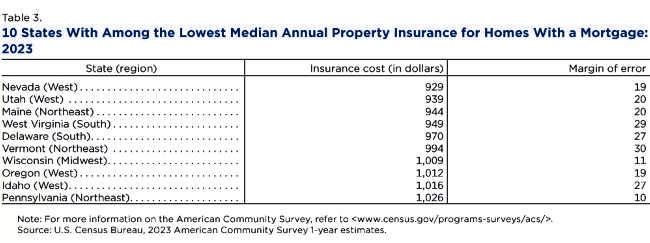
Like their high-cost counterparts, states with low-cost annual property insurance for mortgaged homes were spread across the country (Table 3).

In 2023, the price of property insurance in those lowest-cost states differed by about $100 compared to the $700 range in the highest-cost states for mortgaged homes (Tables 3 and 1, respectively).

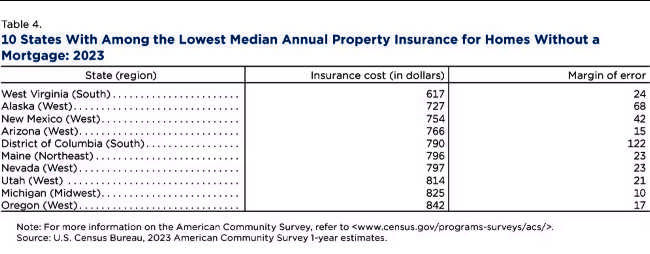
Conversely, states with some of the lowest costs for homes without a mortgage were concentrated in the South, led by West Virginia ($617), and the West (Table 4).

Selected monthly owner costs

Most homeowners have some amount of property insurance on their home, often required by their mortgage lender. While not typically the largest household expense, insurance can be a big chunk of homeowner costs.

The size, type and value of a home, as well as the risk profile of the region it’s in, may contribute to different insurance rates across states.

The “selected monthly owner cost” metric adds up monthly bills and fees homeowners must pay, including the following:

• Mortgage payments or loans on the property.
• Real estate taxes.
• Insurance (fire, hazard, and flood).
• Utilities and heating fuel costs like oil, coal, kerosene and wood.

Table 5 shows how monthly insurance costs can contribute to monthly home ownership costs by dividing by 12 the cost estimates of the 10 states that have among the highest annual insurance rates for mortgaged homes in 2023 (Table 1).

High property insurance rates do not necessarily mean high selected monthly owner costs.

Homeowners in Florida and Louisiana, states with the highest mortgaged property insurance costs in 2023, had a lower median monthly housing cost than homeowners in states like Rhode Island and Colorado that had comparatively lower mortgaged property insurance costs. (Table 5).

The Census Bureau has been releasing information on property insurance since the 2023 ACS 1-year estimates and is set to release additional information on costs facing homeowners.

Caroline Short is a survey statistician in the Census Bureau's Social, Economic, and Housing Statistics Division.


Deportation tactics from 4 US presidents have done little to reduce the undocumented immigrant population

Immigration and Customs Enforcement agents escort a detained immigrant into an elevator on June 17, 2025, in New York. AP Photo/Olga Fedorova

All modern U.S. presidents, both Republican and Democratic, have attempted to reduce the population of millions of undocumented immigrants. But their various strategies have not had significant results, with the population hovering around 11 million from 2005 to 2022.

President Donald Trump seeks to change that.

With harsh rhetoric that has sowed fear in immigrant communities, and policies that ignore immigrants’ due process rights, Trump has pursued deportation tactics that differ dramatically from those of any other modern U.S. president.

As a scholar who examines the history of U.S. immigration law and enforcement, I believe that it remains far from clear whether the Trump White House will significantly reduce the undocumented population. But even if the administration’s efforts fail, the fear and damage to the U.S. immigrant community will remain.

Presidents Bush and Obama

To increase deportations, in 2006 President George W. Bush began using workplace raids. Among these sweeps was the then-largest immigration workplace operation in U.S. history at a meat processing plant in Postville, Iowa in 2008.

U.S. Immigration and Customs Enforcement deployed 900 agents in Postville and arrested 398 employees, 98% of whom were Latino. They were chained together and arraigned in groups of 10 for felony criminal charges of aggravated identity theft, document fraud and use of stolen Social Security numbers. Some 300 were convicted, and 297 of them served jail sentences before being deported.

Several men seated on the ground are seen in a holding cell.
Men wait in a holding cell on June 21, 2006, in Nogales, Arizona. Spencer Platt/Getty Images

In 2008, Bush also initiated Secure Communities, a policy that sought to deport noncitizens – both lawful permanent residents as well as undocumented immigrants – who had been arrested for crimes. Some 2 million immigrants were deported during Bush’s two terms in office.

The Obama administration limited Secure Communities to focus on the removal of noncitizens convicted of felonies. It deported a record 400,000 noncitizens in fiscal year 2013, which led detractors to refer to President Barack Obama as the “Deporter in Chief.”

Obama also targeted recent entrants and national security threats and pursued criminal prosecutions for illegal reentry to the U.S. Almost all of these policies built on Bush’s, although Obama virtually abandoned workplace raids.

Despite these enforcement measures, Obama also initiated Deferred Action for Childhood Arrivals, or DACA, in 2012. The policy provided relief from deportation and gave work authorization to more than 500,000 undocumented immigrants who came to the United States as children.

Obama deported about 3 million noncitizens, but the size of the undocumented population did not decrease dramatically.

The first Trump administration and Biden

Trump’s first administration broke new immigration enforcement ground in several ways.

He began his presidency by issuing what was called a “Muslim ban” to restrict the entry into the U.S. of noncitizens from predominantly Muslim nations.

Early in Trump’s first administration, federal agents expanded immigration operations to include raids at courthouses, which previously had been off-limits.

In 2017, Trump tried to rescind DACA, but the Supreme Court rejected Trump’s effort in 2020.

In 2019, Trump implemented the Remain in Mexico policy that for the first time forced noncitizens who came to the U.S. border seeking asylum to wait in Mexico while their claims were being decided. He also invoked Title 42 in 2020 to close U.S. borders during the COVID-19 pandemic.

Trump succeeded in reducing legal immigration numbers during his first term. However, there is no evidence that his enforcement policies reduced the size of the overall undocumented population.

President Joe Biden sought to relax – although not abandon – some immigration enforcement measures implemented during Trump’s first term.

His administration slowed construction of the border wall championed by Trump. Biden also stopped workplace raids in 2021, and in 2023, he ended Title 42.

In 2023, Biden sought to respond to migration surges in a measured fashion, by temporarily closing ports of entry and increasing arrests.

In attempting to enforce the borders, his administration at times pursued tough measures. Biden continued deportation efforts directed at criminal noncitizens. Immigrant rights groups criticized his administration when armed Border Patrol officers on horseback were videotaped chasing Haitian migrants on the U.S.-Mexico border.

As of 2022, the middle of the Biden’s term, an estimated 11 million undocumented immigrants lived in the U.S.

Several people holding signs and an American flag walk in a protest march.
Immigration-rights activists stage a rally outside President Barack Obama’s Democratic Congressional Campaign Committee fundraiser in Los Angeles, after the president signed a bill that tightened security at the Mexico border in August 2010. Mark Ralston/AFP via Getty Images

A second chance

Since his second inauguration, Trump has pursued a mass deportation campaign through executive orders that are unprecedented in their scope.

In January 2025, he announced an expanded, expedited removal process for any noncitizen apprehended anywhere in the country – not just the border region, as had been U.S. practice since 1996.

In March, Trump issued a presidential proclamation to deport Venezuelan nationals who were members of the Tren de Aragua gang, designated a foreign terrorist organization by the State Department. In doing so, he invoked the Alien Enemies Act of 1798 – an act used three times in U.S. history during declared wars that empowers presidents to remove foreign nationals from countries at war with the U.S.

Declaring an “invasion” of migrants into the U.S. in June, Trump deployed the military to assist in immigration enforcement in Los Angeles.

Trump also sought to dramatically upend birthright citizenship, the Constitutional provision that guarantees citizenship to any person born in the U.S. He issued an executive order in January that would bar citizenship to people born in the U.S. to undocumented parents.

Several men in military gear stand watch on the steps of a building.
California National Guard members stand in formation during a protest in Los Angeles on June 14, 2025. David Pashaee/Middle East Images/AFP via Getty Images

The birthright executive order has been challenged in federal court and is mostly likely working its way up to the Supreme Court.

Under the second Trump administration, immigration arrests are up, but actual deportation numbers are in flux.

ICE in June arrested the most people in a month in at least five years, roughly 30,000 immigrants. But deportations of noncitizens – roughly 18,000 – lagged behind those during the Obama administration’s record-setting year of 2013 in which more than 400,000 noncitizens were deported.

The gap between arrests and deportations shows the challenges the Trump administration faces in making good on his promised mass deportation campaign.

Undocumented immigrants often come to the U.S. to work or seek safety from natural disasters and mass violence.

These issues have not been seriously addressed by any modern U.S. president. Until it is, we can expect the undocumented population to remain in the millions.The Conversation

Kevin Johnson, Dean and Professor of Public Interest Law and Chicana/o Studies, University of California, Davis

This article is republished from The Conversation under a Creative Commons license. Read the original article.


PG&E files final surrender application and decommissioning plan for Potter Valley Project

The Scott Dam at Lake Pillsbury in Lake County, California. File photo/courtesy of Pacific Gas and Electric Co.


LAKE COUNTY, Calif. — Pacific Gas and Electric said it has filed the necessary documents to decommission — and eventually remove — the Potter Valley Project, which includes the Scott Dam and Lake Pillsbury in Lake County.

The utility announced on Friday that it had filed the final surrender application and decommissioning plan for the project with the Federal Energy Regulatory Commission, or FERC.

The Potter Valley Project is located in Lake and Mendocino counties. 

It consists of two dams along the upper main stem of the Eel River, the Scott Dam and the Cape Horn Dam — as well as the Potter Valley powerhouse, the 80,000-acre-foot Lake Pillsbury in Lake County, the Van Arsdale Reservoir, a fish passage structure and salmon and steelhead counting station at the Cape Horn Dam, and and 5,600 acres of land.

The filing comes six years after PG&E initially informed FERC that it would not pursue a renewed operating license.

The draft of the surrender application and decommissioning plan was released for public comment at the end of January and closed in March.

Dave Gabbard, vice president of power generation for PG&E, said the filing “marks the next step of a thoughtful and transparent decommissioning journey for the Potter Valley Project — but it does not change our operational responsibilities or obligations. We remain fully committed to meeting all current FERC requirements as we work through the decommissioning up until the license is terminated by FERC. As stewards of public resources and partners to the communities we serve, our priority is clear: to move forward responsibly, collaboratively, and with the continued reliability our stakeholders expect."

While Gabbard said PG&E will “move forward responsibly, collaboratively, and with the continued reliability our stakeholders expect,” the company’s announcement doesn’t specifically mention working with Lake County while referencing numerous other regional stakeholders, many of whom have participated in a “two basin solution” that sought to exclude Lake County’s interests from the beginning, according to local leaders.

“As PG&E moves forward with plans to decommission and eventually remove Cape Horn and Scott dams, PG&E continues to coordinate closely with parties to support a new water diversion facility, including Sonoma County Water Agency, Inland Water & Power Commission of Mendocino County, Round Valley Tribes, Humboldt County, Cal Trout, Trout Unlimited and California Department of Fish & Wildlife,” the company said.

PG&E said its FERC submittal includes a request to allow the Eel-Russian Project Authority to construct the New Eel-Russian Facility at the current location of Cape Horn Dam. That facility will provide diversion flows from the Eel River to the Russian River watershed after PG&E’s removal of Cape Horn Dam and Scott Dam.

Reached for comment on the documents’ release, Lake County District 2 Supervisor Bruno Sabatier said Friday that neither he nor the rest of the county of Lake’s leadership were prepared at that point to offer a comment on the massive filing.

PG&E’s five documents for the application and plan released Friday — four days ahead of schedule — total 2,324 pages.

The documents can be downloaded at the PG&E Potter Valley Project Surrender Application and Decommissioning Plan Stakeholder website. Select “Documents” and enter the credentials “PV_Surrender” when the “Guest Area” comes up.

Project history and importance

PG&E acquired the Potter Valley Project in 1930.

In May of 2017, the company said it planned to begin auctioning off the project the following year. 

When that auction began the following year, PG&E said it wanted to find a new owner “with the appropriate qualifications and experience to operate the project in a safe and compliant fashion.”

“The project has unique characteristics and we believe they have the potential to yield significant value for the right owner,” said Alvin Thoma, then the senior director of power generation at PG&E. He retired in 2021.

Since then, however, PG&E has taken a different approach. The company changed course from seeing it continue and instead decided to abandon the project and support its removal, emphasizing improved habitat for salmon and steelhead and removal of the project due to seismic concerns that Lake County officials have questioned.

The company’s main justification for not continuing to operate the project has been its claim that it’s not economic for its customers, which was a determination made “after years of internal analysis,” PG&E said in the Friday afternoon announcement.

Estimates have put PG&E’s annual losses from the project at between $5 million and $10 million. 

These estimates have arisen at the same time as PG&E has been criticized for the compensation given to its chief executive officer, Patricia Poppe, who is reported to be the highest paid utility CEO in the nation, taking home $17 million in 2023.

To get rid of the project, PG&E also intends to pass the cost on to customers.

During a May 28 town hall held in Lakeport on the future of the project, Lake County District 3 Supervisor EJ Crandell — who along with Sabatier has led the county’s effort to advocate against the project’s removal — said the cost analysis is $100 million for fish passage and $300 for seismic retrofit, while decommissioning could cost $500 million and will increase PG&E rates. 

“They’re forcing us and you to pay for the decommissioning costs,” Crandell said.

At that town hall, opponents of the decommissioning plan also pointed repeatedly to the importance of Lake Pillsbury as a source of water to fight the region’s many wildland fires.

With the surrender application and decommissioning plan now submitted, PG&E said the official FERC proceeding will begin. It includes a 30-day public comment period that the federal agency will announce.

To register for the FERC distribution list for the Potter Valley Project, which is FERC Docket No. P-77-000, visit the FERC website.

This past week, PG&E also announced that it will have an online meeting on the surrender application and decommissioning plan, the regulatory process and public participation opportunities from 3 to 5 p.m. Aug. 11. That meeting can be accessed here.

The company previously held an online meeting about its plans to abandon the project earlier this year, but so far has not been willing to hold an in-person meeting in Lake County regarding the matter. 

PG&E representatives also weren’t present at the May 28 town hall held in Lakeport in which leaders from around the region shared their views and concerns about the plans to decommission and remove the Potter Valley Project.

County officials push back against project removal

County officials including Sabatier and Crandell have fought to stop the project’s removal, arguing that Lake County has been kept out of much of the process of negotiation when it comes to the future of the project and, in particular, Lake Pillsbury.

In 2023, the county of Lake released a video titled “Keeping Lake County Whole: The True Cost of Decommissioning” that looks at the matter from the perspective of Lake Pillsbury residents, firefighters, community leaders and county officials. That video is shown above.

In February, the Board of Supervisors voted unanimously to submit comments to PG&E opposing its plans. 

At the same time, it approved a letter to Gov. Gavin Newsom raising issue with the state taking sides in the process when they said it should have been neutral. That letter points out that removal of the Scott Dam contradicts Newsom’s own January executive order on maximizing water storage, and that the California Department of Water Resources is a party to a memorandum of understanding on the process to remove the project that does not include Lake County.

The board also wrote to President Donald Trump’s secretaries of Energy, Interior, Agriculture, Defense, Homeland Security, Commerce and U.S. Attorney General Pam Bondi, asking them to intervene and pointing out that destroying and draining Lake Pillsbury “would constitute an expensive and irresponsible gamble with regional water supply in an area that has repeatedly been threatened by catastrophic wildfire events.”

In its communication with the federal government, county leadership said that if FERC approved the dam’s removal, it would directly contradict Trump’s Executive Order No. 14181, “Emergency Measures To Provide Water Resources in California and Improve Disaster Response in Certain Areas.”

More stakeholders tout plan excluding Lake County

In related news, on Friday, the Mendocino County Inland Water and Power Commission released a statement heralding its “landmark” water diversion agreement with other partners, in tandem with the filing of the PG&E surrender application and decommissioning plan.

The Mendocino County Inland Water and Power Commission said the agreement, developed by it and “key” regional and tribal partners, “will guide how future water diversions are managed after PVP [Potter Valley Project] facilities are removed. The agreement also supports environmental restoration and ensures that communities relying on Russian River water have a sustainable, reliable supply.”

The commission said the agreement is anchored in a memorandum of understanding signed earlier this year, and that the agreement “protects the water supply relied upon by communities, farms, and businesses throughout Mendocino, Sonoma, and Marin counties.”

The statement, which touts collaboration, notably makes no mention of Lake County or its interests as being among the key regional partners. 

“Water diversions through the Potter Valley Project have been the backbone of our regional water system for generations,” said Mari Rodin, Ukiah City council member and Inland Water and Power Commission representative. “We knew we couldn’t stop PG&E from exiting, but we could work to create a viable plan for the future for our communities. That’s exactly what we’ve done.”

The statement goes on to state that, “With both the Water Diversion Agreement advancing and the license surrender filing submitted, the region is positioned to move forward with critical infrastructure planning, including environmental review of the New Eel-Russian Facility, and pursuit of long-term strategies for increased water storage like the potential modernization of Coyote Valley Dam.”

Rodin said that due to the pressure of drought, climate change and aging infrastructure, “We must be proactive about storage, diversions, and environmental stewardship. These agreements help us do exactly that – they’re the foundation of a future water system that works for people, farms, fish, and the environment.”

Email Elizabeth Larson at This email address is being protected from spambots. You need JavaScript enabled to view it.. Follow her on Twitter, @ERLarson, and on Bluesky, @erlarson.bsky.social. Find Lake County News on the following platforms: Facebook, @LakeCoNews; X, @LakeCoNews; Threads, @lakeconews, and on Bluesky, @lakeconews.bsky.social. 

Which wildfire smoke plumes are hazardous? New satellite tech can map them in 3D for air quality alerts at neighborhood scale

Smoke from Canadian wildfires prompted air quality alerts in Chicago as it blanketed the city on June 5, 2025. Scott Olson/Getty Images

Canada is facing another dangerous wildfire season, with burning forests sending smoke plumes across the provinces and into the U.S. again. The pace of the 2025 fires is reminiscent of the record-breaking 2023 wildfire season, which exposed millions of people in North America to hazardous smoke levels.

For most of the past decade, forecasters have been able to use satellites to track these smoke plumes, but the view was only two-dimensional: The satellites couldn’t determine how close the smoke was to Earth’s surface.

The altitude of the smoke matters.

If a plume is high in the atmosphere, it won’t affect the air people breathe – it simply floats by far overhead.

But when smoke plumes are close to the surface, people are breathing in wildfire chemicals and tiny particles. Those particles, known as PM2.5, can get deep into the lungs and exacerbate asthma and other respiratory and cardiac problems.

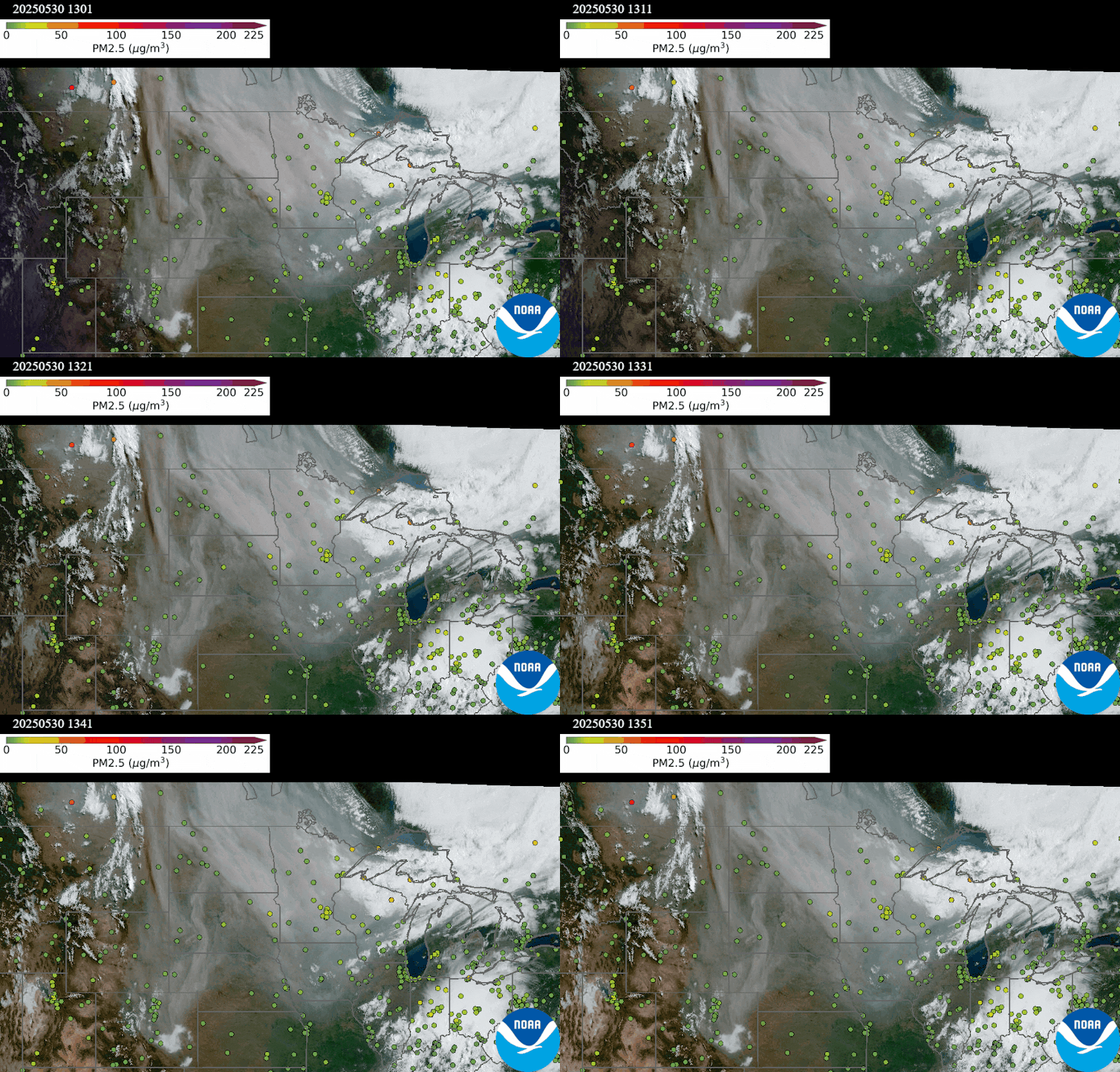
An animation shows mostly green (safe) air quality from ground-level monitors. However, in Canada, closer to the fire, the same plume shows high levels of PM2.5.
An animation on May 30, 2025, shows a thick smoke plume from Canada moving over Minnesota, but the air quality monitors on the ground detected minimal risk, suggesting it was a high-level smoke plume. NOAA NESDIS Center for Satellite Applications and Research

The Environmental Protection Agency uses a network of ground-based air quality monitors to issue air quality alerts, but the monitors are few and far between, meaning forecasts have been broad estimates in much of the country.

Now, a new satellite-based method that I and colleagues at universities and federal agencies have been working on for the past two years is able to give scientists and air quality managers a 3D picture of the smoke plumes, providing detailed data of the risks down to the neighborhood level for urban and rural areas alike.

Building a nationwide smoke monitoring system

The new method uses data from a satellite that NASA launched in 2023 called the Tropospheric Emissions: Monitoring of Pollution, or TEMPO, satellite.

A map shows blue over the Dakotas, Nebraska and western parts of Minnesota and Iowa. Pink is over Pennsylvania up through Maine.
Data from the TEMPO satellite shows the height of the smoke plume, measured in kilometers. Light blue areas are closest to the ground, suggesting the worst air quality. Pink areas suggest the smoke is more than 2 miles (3.2 kilometers) above the ground, where it poses little risk to human health. The data aligns with air monitor readings taken on the ground at the same time. NOAA NESDIS Center for Satellite Applications and Research

TEMPO makes it possible to determine a smoke plume’s height by providing data on how much the oxygen molecules absorb sunlight at the 688 nanometer wavelength. Smoke plumes that are high in the atmosphere reflect more solar radiation at this wavelength back to space, while those lower in the atmosphere, where there is more oxygen to absorb the light, reflect less.

Understanding the physics allowed scientists to develop algorithms that use TEMPO’s data to infer the smoke plume’s altitude and map its 3D movement in nearly real time.

An illustration shows a satellite, Sun and smoke plume at different heights. Higher plumes reflect more light.
Aerosol particles in high smoke plumes reflect more light back into space. Closer to Earth’s surface, there is more oxygen to absorb light at the 688 nanometer wavelength, so less light is reflected. Satellites can detect the difference, and that can be used to determine the height of the smoke plume. Adapted from Xu et al, 2019, CC BY

By combining TEMPO’s data with measurements of particles in the atmosphere, taken by the Advanced Baseline Imager on the NOAA’s GOES-R satellites, forecasters can better assess the health risk from smoke plumes in almost real time, provided clouds aren’t in the way.

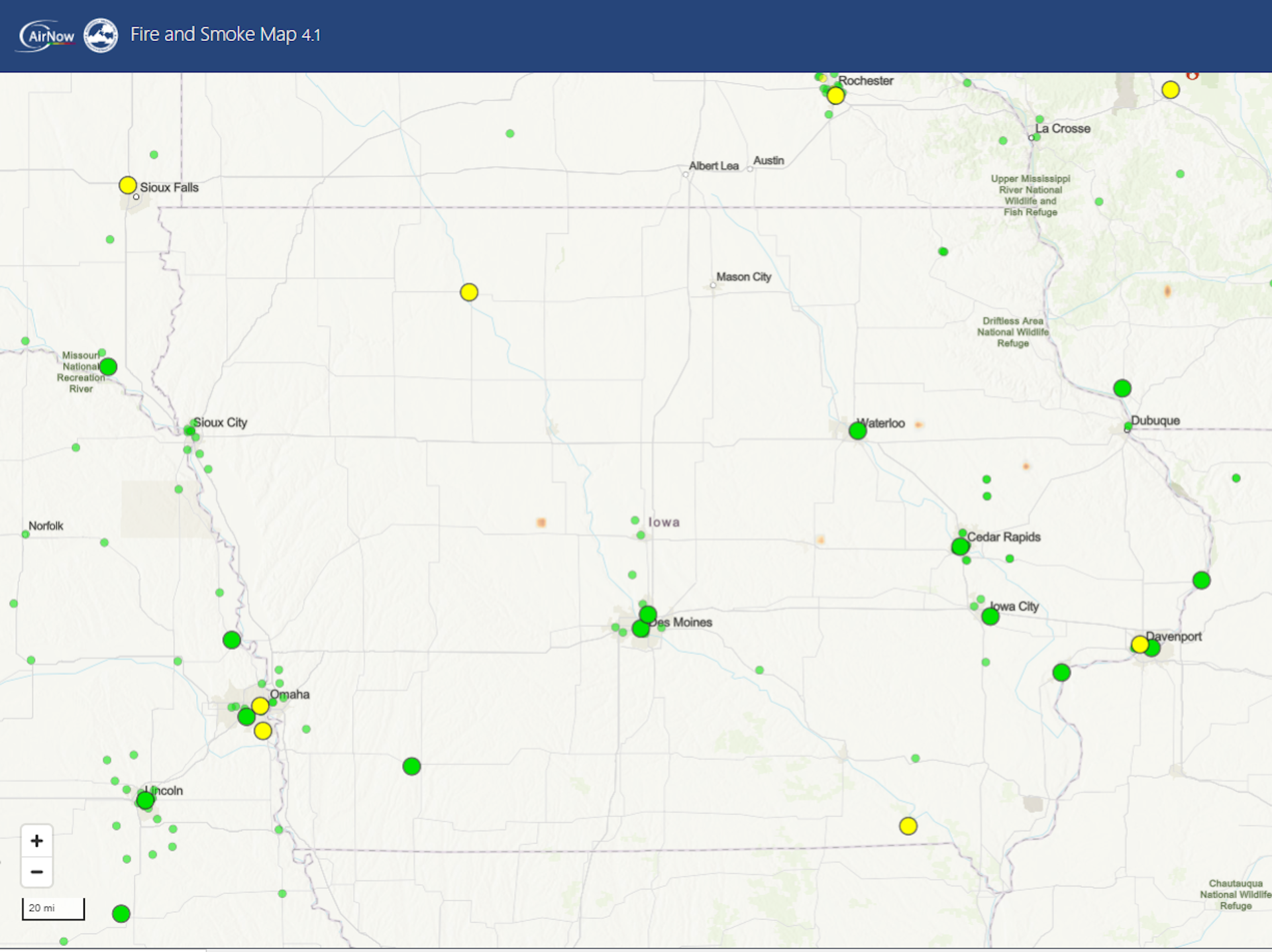
That’s a big jump from relying on ground-based air quality monitors, which may be hundreds of miles apart. Iowa, for example, had about 50 air quality monitors reporting data on a recent day for a state that covers 56,273 square miles. Most of those monitors were clustered around its largest cities.

NOAA’s AerosolWatch tool currently provides a near-real-time stream of wildfire smoke images from its GOES-R satellites, and the agency plans to incorporate TEMPO’s height data. A prototype of this system from my team’s NASA-supported research project on fire and air quality, called FireAQ, shows how users can zoom in to the neighborhood level to see how high the smoke plume is, however the prototype is currently only updated once a day, so the data is delayed, and it isn’t able to provide smoke height data where clouds are also overhead.

Wildfire health risks are rising

Fire risk is increasing across North America as global temperatures rise and more people move into wildland areas.

While air quality in most of the U.S. improved between 2000 and 2020, thanks to stricter emissions regulations on vehicles and power plants, wildfires have reversed that trend in parts of the western U.S. Research has found that wildfire smoke has effectively erased nearly two decades of air quality progress there.

Our advances in smoke monitoring mark a new era in air quality forecasting, offering more accurate and timely information to better protect public health in the face of these escalating wildfire threats.The Conversation

Jun Wang, Professor of Chemical and Biochemical Engineering, University of Iowa

This article is republished from The Conversation under a Creative Commons license. Read the original article.
  • 140
  • 141
  • 142
  • 143
  • 144
  • 145
  • 146
  • 147
  • 148
  • 149

Community

  • Lake County Wine Alliance offers sponsor update; beneficiary applications open 

  • Mendocino National Forest announces seasonal hiring for upcoming field season

Public Safety

  • Lakeport Police logs: Thursday, Jan. 15

  • Lakeport Police logs: Wednesday, Jan. 14

Education

  • Woodland Community College receives maximum eight-year reaffirmation of accreditation from ACCJC

  • SNHU announces Fall 2025 President's List

Health

  • California ranks 24th in America’s Health Rankings Annual Report from United Health Foundation

  • Healthy blood donors especially vital during active flu season

Business

  • Two Lake County Mediacom employees earn company’s top service awards

  • Redwood Credit Union launches holiday gift and porch-to-pantry food drives

Obituaries

  • Rufino ‘Ray’ Pato

  • Patty Lee Smith

Opinion & Letters

  • The benefits of music for students

  • How to ease the burden of high electric bills

Veterans

  • CalVet and CSU Long Beach team up to improve data collection related to veteran suicides

  • A ‘Big Step Forward’ for Gulf War Veterans

Recreation

  • Wet weather trail closure in effect on Upper Lake Ranger District

  • Mendocino National Forest seeking public input on OHV grant applications

  • State Parks announces 2026 Anderson Marsh nature walk schedule 

  • BLM lifts seasonal fire restrictions in central California

Religion

  • Kelseyville Presbyterian to host Ash Wednesday service and Lenten dinner Feb. 18

  • Kelseyville Presbyterian Church to hold ‘Longest Night’ service Dec. 21

Arts & Life

  • Auditions announced for original musical ‘Even In Shadow’ set for March 21 and 28

  • ‘The Rip’ action heist; ‘Steal’ grounded in a crime thriller

Government & Politics

  • Lake County Democrats issue endorsements in local races for the June California Primary

  • County negotiates money-saving power purchase agreement

Legals

  • March 3 hearing on ordinance amending code for commercial cannabis uses

  • Feb. 12 public hearing on resolution to establish standards for agricultural roads

How to resolve AdBlock issue?
Refresh this page