 How to resolve AdBlock issue?
News
LAKE COUNTY, Calif. – On Thursday, Gov. Gavin Newsom announced a series of new measures and restrictions that the state is poised to implement due to the continued rise of COVID-19 cases across California, which he said is now in the midst of the pandemic’s third wave.
“If we don’t act now, our hospital system will be overwhelmed,” and the death rate will continue to climb, Newsom said.
Statewide, Public Health departments on Thursday reported more than 1,285,900 cases and nearly 19,600 deaths.
In Lake County, Public Health officials reported 995 confirmed cases on Thursday, with 21 deaths. At that time, 12 residents were reported to be hospitalized, a figure that has doubled over the past week.
Newsom said that pursuant to the state’s Blueprint for a Safer Economy, he is pulling an emergency brake meant to address the late fall case surge.
To blunt the surge and save lives, he is planning to issue regional stay home orders that are fundamentally predicated on the need to avoid meeting with people outside of one’s household, to keep most activities outside and to use face coverings, which Newsom is the “most important nonpharmaceutical intervention.”
All nonessential travel is temporarily restricted statewide as well, the governor said.
The regional stay home orders are based on a breakdown of the state into five regions:
– Northern California: Del Norte, Glenn, Humboldt, Lake, Lassen, Mendocino, Modoc, Shasta, Siskiyou, Tehama, Trinity.
– Bay Area: Alameda, Contra Costa, Marin, Monterey, Napa, San Francisco, San Mateo, Santa Clara, Santa Cruz, Solano, Sonoma.
– Greater Sacramento: Alpine, Amador, Butte, Colusa, El Dorado, Nevada, Placer, Plumas, Sacramento, Sierra, Sutter, Yolo, Yuba.
– San Joaquin Valley: Calaveras, Fresno, Kern, Kings, Madera, Mariposa, Merced, San Benito, San Joaquin, Stanislaus, Tulare, Tuolumne.
– Southern California: Imperial, Inyo, Los Angeles, Mono, Orange, Riverside, San Bernardino, San Diego, San Luis Obispo, Santa Barbara, Ventura.
Newsom said the regions were considered and constructed based on the preexisting mutual aid system in the state.
Dr. Mark Ghaly, California Health and Human Services secretary, said they are using a regional approach in part because that’s how hospitals and health care delivery systems work; when capacity can’t be met within a specific county they lean on neighboring counties and systems for assistance.
The public health order that includes the regional stay at home order framework takes effect at 12:59 p.m. on Saturday, Dec. 5.
Thereafter, if a region falls to a point that’s less than 15 percent of the intensive care unit threshold, it will have 24 hours to implement the stay at home order. Newsom said it will remain under the order for three weeks.
The counties in those regions will face additional restrictions, with temporary closures to take place for bars, wineries, personal services, and hair salons and barbershops, he said.
He said schools that have received waivers, critical infrastructure, retail (with occupancy at 20 percent capacity to reduce exposure) and restaurants – takeout and delivery – will be allowed to remain open.
The state said hotels and lodging will only be allowed to open for critical infrastructure support in areas under the stay home orders, while entertainment production including professional sports will only be allowed to operate without live audiences and places of worship will have to have outdoor services only.
With the exception of the Bay Area, all of the regions are expected to fall below the 15 percent ICU capacity by early December, with the Bay Area to hit that mark later in the month.
The Northern California region, which includes Lake County, is the area closest to falling below that trigger level.
On Thursday, the state said the Northern California region’s ICU capacity was at 18.6 percent.
The California Department of Public Health reported ICU capacity for the other regions as follows:
– Bay Area: 25.4 percent.
– Greater Sacramento: 22 percent.
– San Joaquin Valley: 19.7 percent.
– Southern California: 20.6 percent.
Newsom encouraged people to stay active and healthy by going outdoors to parks, hiking, biking, fishing, doing yoga and meditation, walking dogs, running with a partner, skiing, snowboarding and sledding.
He said this is a temporary moment. “This is not a permanent state,” but a situation that many had predicted, Newsom said.
Newsom said this is the final surge in the pandemic and that real progress with the vaccine is only a few months away.
“We do not anticipate having to do this once again,” but everyone needs to step up, Newsom said.
The governor said the state is doing everything in its power to help hospitals prepare for the surge while also supporting businesses and workers impacted by COVID-19.
Newsom said 11 facilities outside of the state’s health care system are being prepared to accept patients. Those facilities are located in Contra Costa, Fresno, Orange, Riverside, Sacramento, San Diego, San Francisco, San Mateo and Tulare counties.
The most notable of the facilities is the Arco/Sleep Train Arena practice facility in Sacramento, which will be able to accept 224 patients, Newsom said.
Newsom also reported that California now has 14,233 ventilators in the state inventory, with 6,996 still available in hospitals.
The governor said the COVID-19 vaccine is also set to arrive this month, with the state anticipating receiving 327,000 doses from Dec. 12 to 15.
He said the plan is to distribute those vaccine doses first to acute care, psychiatric and correctional facilities, skilled nursing and assisted living facilities, frontline medical and emergency workers such as paramedics and EMTs, dialysis centers, home health care and in-home support services workers, community health workers and Public Health field staff, primary health care clinics, specialty clinics, laboratory workers, dental and oral health clinics, and pharmacy staff.
Email Elizabeth Larson atThis email address is being protected from spambots. You need JavaScript enabled to view it. . Follow her on Twitter, @ERLarson, or Lake County News, @LakeCoNews.
“If we don’t act now, our hospital system will be overwhelmed,” and the death rate will continue to climb, Newsom said.
Statewide, Public Health departments on Thursday reported more than 1,285,900 cases and nearly 19,600 deaths.
In Lake County, Public Health officials reported 995 confirmed cases on Thursday, with 21 deaths. At that time, 12 residents were reported to be hospitalized, a figure that has doubled over the past week.
Newsom said that pursuant to the state’s Blueprint for a Safer Economy, he is pulling an emergency brake meant to address the late fall case surge.
To blunt the surge and save lives, he is planning to issue regional stay home orders that are fundamentally predicated on the need to avoid meeting with people outside of one’s household, to keep most activities outside and to use face coverings, which Newsom is the “most important nonpharmaceutical intervention.”
All nonessential travel is temporarily restricted statewide as well, the governor said.
The regional stay home orders are based on a breakdown of the state into five regions:
– Northern California: Del Norte, Glenn, Humboldt, Lake, Lassen, Mendocino, Modoc, Shasta, Siskiyou, Tehama, Trinity.
– Bay Area: Alameda, Contra Costa, Marin, Monterey, Napa, San Francisco, San Mateo, Santa Clara, Santa Cruz, Solano, Sonoma.
– Greater Sacramento: Alpine, Amador, Butte, Colusa, El Dorado, Nevada, Placer, Plumas, Sacramento, Sierra, Sutter, Yolo, Yuba.
– San Joaquin Valley: Calaveras, Fresno, Kern, Kings, Madera, Mariposa, Merced, San Benito, San Joaquin, Stanislaus, Tulare, Tuolumne.
– Southern California: Imperial, Inyo, Los Angeles, Mono, Orange, Riverside, San Bernardino, San Diego, San Luis Obispo, Santa Barbara, Ventura.
Newsom said the regions were considered and constructed based on the preexisting mutual aid system in the state.
Dr. Mark Ghaly, California Health and Human Services secretary, said they are using a regional approach in part because that’s how hospitals and health care delivery systems work; when capacity can’t be met within a specific county they lean on neighboring counties and systems for assistance.
The public health order that includes the regional stay at home order framework takes effect at 12:59 p.m. on Saturday, Dec. 5.
Thereafter, if a region falls to a point that’s less than 15 percent of the intensive care unit threshold, it will have 24 hours to implement the stay at home order. Newsom said it will remain under the order for three weeks.
The counties in those regions will face additional restrictions, with temporary closures to take place for bars, wineries, personal services, and hair salons and barbershops, he said.
He said schools that have received waivers, critical infrastructure, retail (with occupancy at 20 percent capacity to reduce exposure) and restaurants – takeout and delivery – will be allowed to remain open.
The state said hotels and lodging will only be allowed to open for critical infrastructure support in areas under the stay home orders, while entertainment production including professional sports will only be allowed to operate without live audiences and places of worship will have to have outdoor services only.
With the exception of the Bay Area, all of the regions are expected to fall below the 15 percent ICU capacity by early December, with the Bay Area to hit that mark later in the month.
The Northern California region, which includes Lake County, is the area closest to falling below that trigger level.
On Thursday, the state said the Northern California region’s ICU capacity was at 18.6 percent.
The California Department of Public Health reported ICU capacity for the other regions as follows:
– Bay Area: 25.4 percent.
– Greater Sacramento: 22 percent.
– San Joaquin Valley: 19.7 percent.
– Southern California: 20.6 percent.
Newsom encouraged people to stay active and healthy by going outdoors to parks, hiking, biking, fishing, doing yoga and meditation, walking dogs, running with a partner, skiing, snowboarding and sledding.
He said this is a temporary moment. “This is not a permanent state,” but a situation that many had predicted, Newsom said.
Newsom said this is the final surge in the pandemic and that real progress with the vaccine is only a few months away.
“We do not anticipate having to do this once again,” but everyone needs to step up, Newsom said.
The governor said the state is doing everything in its power to help hospitals prepare for the surge while also supporting businesses and workers impacted by COVID-19.
Newsom said 11 facilities outside of the state’s health care system are being prepared to accept patients. Those facilities are located in Contra Costa, Fresno, Orange, Riverside, Sacramento, San Diego, San Francisco, San Mateo and Tulare counties.
The most notable of the facilities is the Arco/Sleep Train Arena practice facility in Sacramento, which will be able to accept 224 patients, Newsom said.
Newsom also reported that California now has 14,233 ventilators in the state inventory, with 6,996 still available in hospitals.
The governor said the COVID-19 vaccine is also set to arrive this month, with the state anticipating receiving 327,000 doses from Dec. 12 to 15.
He said the plan is to distribute those vaccine doses first to acute care, psychiatric and correctional facilities, skilled nursing and assisted living facilities, frontline medical and emergency workers such as paramedics and EMTs, dialysis centers, home health care and in-home support services workers, community health workers and Public Health field staff, primary health care clinics, specialty clinics, laboratory workers, dental and oral health clinics, and pharmacy staff.
Email Elizabeth Larson at
CLEARLAKE, Calif. – This weekend’s Clearlake Christmas Parade has been canceled.
The city of Clearlake said it has consulted with the Clear Lake Chamber of Commerce, the sponsor of the 2020 Clearlake Christmas Parade, and made the joint determination to cancel the parade due to the impact of the coronavirus on the planning of the parade and the risk of spreading infection among the audience and participants.
The parade is traditionally held on the first Saturday of December and is one of the most anticipated and attended events of the year.
With the increase in COVID-19 cases both statewide and locally, the decision was made to postpone the parade until the event can be staged safely.
“We are sad that we have to cancel this annual community tradition, but we make the health and safety of our volunteers, staff and parade partners a priority,” City Manager Alan Flora stated. “We look forward to 2021 and hopefully a return to holding community events bigger and better than ever.”
The city of Clearlake said it has consulted with the Clear Lake Chamber of Commerce, the sponsor of the 2020 Clearlake Christmas Parade, and made the joint determination to cancel the parade due to the impact of the coronavirus on the planning of the parade and the risk of spreading infection among the audience and participants.
The parade is traditionally held on the first Saturday of December and is one of the most anticipated and attended events of the year.
With the increase in COVID-19 cases both statewide and locally, the decision was made to postpone the parade until the event can be staged safely.
“We are sad that we have to cancel this annual community tradition, but we make the health and safety of our volunteers, staff and parade partners a priority,” City Manager Alan Flora stated. “We look forward to 2021 and hopefully a return to holding community events bigger and better than ever.”
NORTHERN CALIFORNIA – Two moderately sized earthquakes occurred early Friday morning near the Cobb area.
The US Geological Survey reported that the 3.5- and 3.2-magnitude quakes occurred three minutes apart, shortly before 3 a.m. Friday.
They were centered just inside the boundaries of northern Sonoma County, according to USGS maps.
The USGS said the 3.5-magnitude quake occurred at 2:45 a.m. with an epicenter 4.6 miles west of Cobb.
The 3.2-magnitude quake took place at 2:48 a.m. It was centered 4.8 miles west of Cobb, the USGS reported.
Email Elizabeth Larson atThis email address is being protected from spambots. You need JavaScript enabled to view it. . Follow her on Twitter, @ERLarson, or Lake County News, @LakeCoNews.
The US Geological Survey reported that the 3.5- and 3.2-magnitude quakes occurred three minutes apart, shortly before 3 a.m. Friday.
They were centered just inside the boundaries of northern Sonoma County, according to USGS maps.
The USGS said the 3.5-magnitude quake occurred at 2:45 a.m. with an epicenter 4.6 miles west of Cobb.
The 3.2-magnitude quake took place at 2:48 a.m. It was centered 4.8 miles west of Cobb, the USGS reported.
Email Elizabeth Larson at
LAKE COUNTY, Calif. – The Lake County Sheriff’s Office has identified the local man who died Wednesday afternoon after he was struck while riding his bicycle by a vehicle whose driver fled the scene.
Lt. Corey Paulich said Terry Lee Cook, 73, of Lakeport, was the victim of the hit-and-run crash, which took place shortly before 2 p.m. Wednesday on Lakeshore Boulevard, north of Hill Road East in north Lakeport.
The California Highway Patrol’s Clear Lake Area office said Cook was riding his bicycle southbound on Lakeshore Boulevard when he was hit by a white 2005 Kia Sorrento driven by 33-year-old Amber Bruhn, 33, of Nice, who also was traveling southbound.
The CHP said the impact of the crash threw Cook over Bruhn’s vehicle and onto the roadway. Despite the efforts of medical personnel who arrived at the scene to treat him, Cook died of his injuries.
Bruhn fled the scene of the crash and left the Kia at a nearby hotel. CHP officers found her within hours of the crash and determined she was the vehicle’s driver, the CHP said.
The CHP’s initial Wednesday night report said she was arrested. However, the CHP said Thursday that she was not formally arrested or booked into the Lake County Jail. Officials don’t suspect alcohol or drugs were involved.
The investigation is ongoing, the CHP said Thursday.
Anyone who witnessed the crash is asked to call the CHP’s office in Kelseyville at 707-279-0103.
Email Elizabeth Larson atThis email address is being protected from spambots. You need JavaScript enabled to view it. . Follow her on Twitter, @ERLarson, or Lake County News, @LakeCoNews.
Lt. Corey Paulich said Terry Lee Cook, 73, of Lakeport, was the victim of the hit-and-run crash, which took place shortly before 2 p.m. Wednesday on Lakeshore Boulevard, north of Hill Road East in north Lakeport.
The California Highway Patrol’s Clear Lake Area office said Cook was riding his bicycle southbound on Lakeshore Boulevard when he was hit by a white 2005 Kia Sorrento driven by 33-year-old Amber Bruhn, 33, of Nice, who also was traveling southbound.
The CHP said the impact of the crash threw Cook over Bruhn’s vehicle and onto the roadway. Despite the efforts of medical personnel who arrived at the scene to treat him, Cook died of his injuries.
Bruhn fled the scene of the crash and left the Kia at a nearby hotel. CHP officers found her within hours of the crash and determined she was the vehicle’s driver, the CHP said.
The CHP’s initial Wednesday night report said she was arrested. However, the CHP said Thursday that she was not formally arrested or booked into the Lake County Jail. Officials don’t suspect alcohol or drugs were involved.
The investigation is ongoing, the CHP said Thursday.
Anyone who witnessed the crash is asked to call the CHP’s office in Kelseyville at 707-279-0103.
Email Elizabeth Larson at
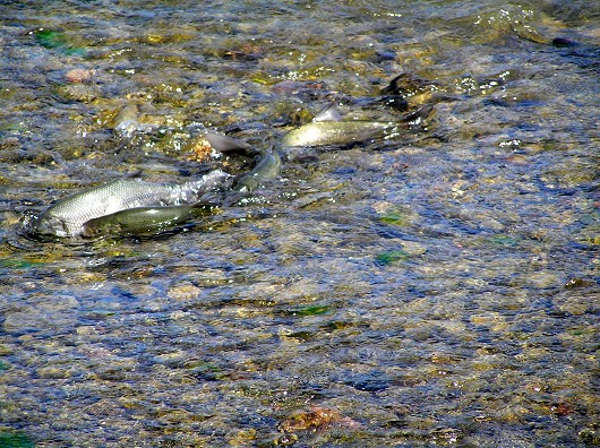
LAKE COUNTY, Calif. – A long-running effort to list the Clear Lake hitch under the federal Endangered Species Act led this week to the U.S. Fish and Wildlife Service deciding against it, an action that the environmental organization that sought the listing said was based on “misinformation” and “nonsense.”
The U.S. Fish and Wildlife Service reported Wednesday that its determination, “based on the best available science,” is that the Clear Lake hitch does not warrant listing under the Endangered Species Act, or ESA.
In response, the Center for Biological Diversity, which sought the listing, said U.S. Fish and Wildlife’s determination “is based on misinformation and contradicts the conclusions of native fish experts and findings by the California Department of Fish and Wildlife and California Fish and Game Commission, which designated the hitch as a threatened species under California’s state Endangered Species Act in 2014.”
“It’s infuriating but not surprising that Trump’s Interior Department is denying protection for one of California’s most threatened native fish based on misinformation, nonsense and climate change denial,” said Jeff Miller, a senior conservation advocate at the Center for Biological Diversity.
The Clear Lake hitch, Lavinia exilicauda chi, is a large freshwater minnow that is endemic to the Clear Lake watershed.
The hitch reside in Clear Lake and Thurston Lake until the spring, when they migrate up several local creeks to spawn before going back to their lake home.
The fish has been a staple for local Pomo for centuries and local residents recount seeing the fish migrating through creeks by the thousands up until about 30 years ago. Over the last 20 years, the hitch population has been reported to be in significant decline, with small numbers of them now tracked on their annual migration.
The Center for Biological Diversity submitted the state and federal listing petitions on the Clear Lake hitch in September 2012, as Lake County News has reported.
The petitions were supported by local tribes, including the Habematolel Pomo of Upper Lake, Big Valley Rancheria Band of Pomo Indians, Scotts Valley Band of Pomo Indians and Robinson Rancheria Band of Pomo, as well as the California Indian Environmental Alliance and California native fish expert Dr. Peter Moyle of the University of California at Davis.
Miller, who authored the hitch listing petition eight years ago, said the hitch once numbered in the millions, with spawning runs entering every tributary of Clear Lake each spring. “It’s now reduced to numbers in the hundreds to low thousands regularly spawning in just a few tributaries.”
In March 2013, the California Fish and Game Commission approved listing candidacy for the hitch, and in August of 2014 the commission approved the California Department of Fish and Wildlife's recommendation to list the Clear Lake hitch as a threatened species under the California Endangered Species Act.
That made the hitch the first aquatic listed species in the Clear Lake Basin, said Miller.
Federal listing decision to face challenge
U.S. Fish and Wildlife said it received a petition from the Center for Biological Diversity on Sept. 25, 2012, to list the Clear Lake hitch as threatened or endangered under the authority of the Endangered Species Act of 1973.
The agency issued a 90-day finding on April 10, 2015, stating the petition presented substantial information that listing the Clear Lake hitch may be warranted.
In the intervening years, however, the ESA faced potential alterations, with the Trump administration announcing last year that it planned changes including reducing protections for species listed as threatened and that economic factors would be considered before a decision on listing a species as threatened or endangered was made.
California Attorney General Xavier Becerra and a coalition of 20 attorneys general sued last year to stop the changes and in May won a ruling that allowed the lawsuit to advance.
However, the suit didn’t appear to impact the hitch’s listing proceedings.
After reviewing “the best available scientific and commercial information,” U.S. Fish and Wildlife said it has determined that the Clear Lake hitch does not warrant ESA protection.
The agency said the hitch is primarily impacted by habitat loss, degradation and modification; poor lake water quality; increased predation and competition; and drought.
“However, none of these threats are likely to adversely affect the overall viability of the fish to a point that it meets the definition of threatened or endangered. The long lifespan, high reproductive capacity and flexibility in spawning locations (from streams to lakeshore), demonstrate resiliency that will enable the species to persist despite ongoing threats,” U.S. Fish and Wildlife said in its Wednesday announcement.
The Center for Biological Diversity said the state of California’s status review for the hitch conducted in 2014 found significant habitat degradation, with wetland habitat loss of 85 percent, spawning habitat loss of 92 percent, and significantly degraded water quality in the lake and most tributaries.
The group said the California Department of Fish and Wildlife concluded that predation and competition by introduced fishes have a significant impact on hitch and predicted that climate change impacts to hitch annual spawning cycles and the Clear Lake watershed stream flows will be significant.
The center also challenged the federal government’s findings, which state that the hitch do not require tributary streams to spawn but can also spawn successfully in Clear Lake itself, giving them “behavioral flexibility to variable environmental conditions.”
“This misinformation appears to be based on recent anecdotal reports of large numbers of hitch purportedly spawning in the lake, which turned out to be schools of misidentified non-native fish,” the group said Wednesday.
The center said the state status review for the hitch found the hitch require tributary streams to successfully spawn, and a 2019 USGS study states that within-lake spawning is not a significant source of Clear Lake hitch production and recruitment.
U.S. Fish and Wildlife said that while it determined that the Clear Lake hitch is not warranted for listing, “we consider it to be an important component of the biodiversity of the Clear Lake watershed. As such, we will continue to work alongside the California Department of Fish and Wildlife, local government agencies and Tribes to develop and implement a conservation plan for the species.”
The U.S. Fish and Wildlife analysis of the Clear Lake hitch will be published in the Federal Register on Dec. 3. The final species assessment can be viewed at www.regulations.gov by searching under docket number FWS-R8-ES-2020-0112.
Also on Wednesday, the Trump administration denied protection to 10 other species, including the southern white-tailed ptarmigan, tufted puffin, three species of Nevada springsnail, a rare Nevada fish, Rocky Mountain monkeyflower, tidewater amphipod, Doll’s daisy and Puget Oregonian snail.
“As with the hitch, the administration ignored serious threats of habitat destruction and climate change to a number of these species,” the Center for Biological Diversity reported.
The center reported that it is evaluating those findings, as well as more than 100 others denied by the Trump administration, and plans to ask the Biden administration to reconsider many of them, as well as potentially challenge denials in court.
Email Elizabeth Larson at
LAKE COUNTY, Calif. – The Lake County Office of Education is offering assistance to families of children ages birth to 5 who are looking to create an Early Learning Pod.
With a decreased student capacity in preschools and current social distancing protocols in Lake County due to COVID-19, there is an identified need for parents to be able to prepare their children for kindergarten while also giving them a social outlet.
Many of Lake County’s Early Learning Centers are closed until further notice, which limits playgroup opportunities for children up to age 5.
An Early Learning Pod is a cohort of no more than six children and one designated adult per child where socialization days are set. This allows children to interact freely, play and potentially have learning days with focused curriculum.
According to the California Department of Public Health, or CDPH, guidelines, a cohort is a group of no more than 14 children or youth and no more than two supervising adults.
Each small pod will consist of children and parents that have designated socialization days with developmentally appropriate activities and also follow the CDPH guidelines for COVID-19 prevention.
“Children need opportunities for social interaction and learning environments within their communities. We want to help create a sustainable, engaging and appropriate environment for families to meet,” said LCOE’s Lake County Quality Counts Coordinator Angela Cuellar-Marroquin.
This program will be for parents, guardians and caregivers throughout Lake County who cannot access a formal program for early learning and socialization due to COVID-19 restrictions.
A Lake County Quality Counts Coach will guide parents in how to effectively create a learning pod for early learning environments through a virtual training seminar/webinar. Information covered in the webinar includes health and safety considerations, developmentally appropriate activities, choosing a curriculum focus for the children and Kindergarten Readiness.
Upon completion of the webinar and program application, participants will receive an early learning toolkit for their pod.
Depending on what kind of Early Learning Pod a parent is looking to have will depend on what materials are provided.
The Lake County Quality Counts Team has set up three levels of participation in Early Learning Pods. Depending on the level, each pod could potentially receive dry erase board kits, math kits, gross motor kits, crafting supplies, cleaning supplies and books.
All children will receive developmental screenings and receive assistance from one of the Lake County Quality Counts Coaches.
“Our focus is the students. Being able to prepare our children for kindergarten is one of the initial stepping stones to student success in Lake County,” said Lake County Superintendent of Schools Brock Falkenberg.
For more information, please visit www.lakecoe.org/EarlyLearningPods.
With a decreased student capacity in preschools and current social distancing protocols in Lake County due to COVID-19, there is an identified need for parents to be able to prepare their children for kindergarten while also giving them a social outlet.
Many of Lake County’s Early Learning Centers are closed until further notice, which limits playgroup opportunities for children up to age 5.
An Early Learning Pod is a cohort of no more than six children and one designated adult per child where socialization days are set. This allows children to interact freely, play and potentially have learning days with focused curriculum.
According to the California Department of Public Health, or CDPH, guidelines, a cohort is a group of no more than 14 children or youth and no more than two supervising adults.
Each small pod will consist of children and parents that have designated socialization days with developmentally appropriate activities and also follow the CDPH guidelines for COVID-19 prevention.
“Children need opportunities for social interaction and learning environments within their communities. We want to help create a sustainable, engaging and appropriate environment for families to meet,” said LCOE’s Lake County Quality Counts Coordinator Angela Cuellar-Marroquin.
This program will be for parents, guardians and caregivers throughout Lake County who cannot access a formal program for early learning and socialization due to COVID-19 restrictions.
A Lake County Quality Counts Coach will guide parents in how to effectively create a learning pod for early learning environments through a virtual training seminar/webinar. Information covered in the webinar includes health and safety considerations, developmentally appropriate activities, choosing a curriculum focus for the children and Kindergarten Readiness.
Upon completion of the webinar and program application, participants will receive an early learning toolkit for their pod.
Depending on what kind of Early Learning Pod a parent is looking to have will depend on what materials are provided.
The Lake County Quality Counts Team has set up three levels of participation in Early Learning Pods. Depending on the level, each pod could potentially receive dry erase board kits, math kits, gross motor kits, crafting supplies, cleaning supplies and books.
All children will receive developmental screenings and receive assistance from one of the Lake County Quality Counts Coaches.
“Our focus is the students. Being able to prepare our children for kindergarten is one of the initial stepping stones to student success in Lake County,” said Lake County Superintendent of Schools Brock Falkenberg.
For more information, please visit www.lakecoe.org/EarlyLearningPods.