 How to resolve AdBlock issue?
News
The meeting will begin at 9 a.m. Tuesday, Dec. 1.
The supervisors will meet in the board chambers on the first floor of the Lake County Courthouse, 255 N. Forbes St., Lakeport, for a hybrid meeting format which also will include the opportunity for community members to continue to participate virtually.
The meeting can be watched live on Channel 8, online at https://countyoflake.legistar.com/Calendar.aspx and on the county’s Facebook page. Accompanying board documents, the agenda and archived board meeting videos also are available at that link.
To participate in real-time, join the Zoom meeting by clicking this link at 9 a.m. The meeting ID is 923 0801 0857, password 456759.
To submit a written comment on any agenda item please visit https://countyoflake.legistar.com/Calendar.aspx and click on the eComment feature linked to the meeting date. If a comment is submitted after the meeting begins, it may not be read during the meeting but will become a part of the record.
At 9:10 a.m., the board will present a proclamation commending Jan Coppinger for her 12 years of service to the county of Lake.
Coppinger has served as Special Districts administrator since 2016. Earlier this month, the board selected her deputy administrator, Scott Harter, to succeed her, as Lake County News has reported.
At 9:15 a.m., the board will present a proclamation honoring Calpine Corp. the Geysers for 60 years of power.
That will be followed at 9:20 a.m. by an update on COVID-19 from Public Health Officer Dr. Gary Pace.
The full agenda follows.
CONSENT AGENDA
5.1: Second reading of ordinance allowing microenterprise home kitchen operations with a pilot program.
5.2: Adopt proclamation for Calpine Corp. the Geysers for 60 years of power.
5.3: Adopt proclamation commending Jan Coppinger for her 12 years of service to the county of Lake.
5.4: Approve Amendment No. 1 to agreement for Sulphur, Pawnee and Mendocino Complex wildfires structural burn debris removal insurance cost recovery and invoicing in Lake County.
5.5: Approve amendment to the county of Lake Covid-19 Public Health Emergency Return to Work – Worksite Protection Protocol.
5.6: Approve amended agreement with California Department of Food and Agricultural Industrial Hemp Cultivation Agreement No. 20-0328-000-SA for a revision in terms and conditions.
5.7: Approve MOU between county of Lake and Lake County Resource Conservation District for management of goat’s rue in Lake County for FY 2020-2021 in the amount of $60,000.
5.8: Approve Agreement No. 20-0153 with the state of California, Department of Food and Agriculture and authorize the execution of post-consumer certification contract and contractor certification clause and signatures for insect trapping in the amount of $131,716.00 for activities in FY 20-22.
5.9: Sitting as the Lake County Air Quality Management District Board of Directors, reappointment Cameron Reeves to the LCAQMD Hearing Board.
5.10: Approve Amendment No. 1 to the agreement between county of Lake and Redwood Community Services Inc. for the Lake County WRAP Program, Foster Care Program and Intensive Services Foster Care Program for specialty mental health services for Fiscal Year 2020-21 and authorize the board chair to sign the amendment.
5.11: Approve minutes of the Board of Supervisors meetings for Aug. 11, Oct. 27, Nov. 3, Nov. 12 and Nov. 19.
5.12: Approve contract between the county of Lake Health Services Department and Sarah Katz for epidemiologist services in support of the Public Health COVID-19 crisis response for a term starting Nov. 1, 2020, through Nov. 17, 2022, not to exceed a maximum amount of $165,000, and authorize the board chair to sign.
5.13: Adopt resolution to amend the budget for FY 2020-2021 by appropriating unanticipated revenue for Public Health Services and authorize the Health Services Director to sign necessary documents to secure these funds.
5.14: (a) Approve the purchase of three livescan fingerprinting machines with DataWorks Plus and year two maintenance agreements in the amount of $52,111 and (b) authorize the sheriff or his designee to sign the purchase order.
5.15: Approve the Department of Boating and Waterways 2021/22 application for financial aid in the amount of $350,458.20; and authorize the sheriff to sign.
5.16: Approve designation of subrecipient’s agent resolution, authorizing County Administrative Officer Carol Huchingson and Auditor-Controller Cathy Saderlund to provide to the California Governor’s Office of Emergency Services the assurances and agreements required.
5.17: Approve Amendment No. 1 to the agreement between county of Lake on Behalf of CSA #20 Soda Bay Water System and Yolo County Flood Control and Water Conservation District extending the agreement for an additional two-year term.
5.18: Approve Amendment No. 1 to the agreement between county of Lake on Behalf of CSA #21 North Lakeport Water System and Yolo County Flood Control and Water Conservation District extending the agreement for an additional two-year term.
5.19: Sitting as the Board of Directors for the Lake County Watershed Protection District, (a) waive the formal bidding process, pursuant to Lake County Code Section 38.2, as it is not in the public interest due to the unique nature of the goods or services, and (b) approve the agreement between the county of Lake and Monument Inc. for appraisal and acquisition services for the Middle Creek Flood Damage Reduction and Ecosystem Restoration Project and authorize the chair of the board of directors to sign the agreement.
5.20: Adopt resolution authorizing the Lake County Watershed Protection District to file a grant application for a Building Resilient Infrastructure and Communities Pre-Disaster and Flood Mitigation Assistance Grant Program for FY 2020/2021 Titled Middle Creek Flood Damage Reduction and Ecosystem Restoration Project: Parcel Acquisition.
TIMED ITEMS
6.1, 9:01 a.m.: Public input.
6.2, 9:10 a.m.: Presentation of proclamation commending Jan Coppinger for her 12 years of service to the county of Lake.
6.3, 9:15 a.m.: Presentation of proclamation for Calpine Corp. the Geysers for 60 years of power.
6.4, 9:20 a.m.: Consideration of update on COVID-19.
UNTIMED ITEMS
7.2: Consideration of advisory board appointment: Callayomi County Water District, Board of Directors.
CLOSED SESSION
8.1: Public employee evaluations: County Administrative Officer Carol Huchingson, Director of Child Support Services Gail Woodworth.
8.2: Conference with legal counsel: Significant exposure to Litigation pursuant to Government Code section 54956.9(d)(2), (e)(3) – Claim of McQueen.
8.3: Conference with legal counsel: Decision whether to initiate litigation pursuant to Government Code section 54956.9 (d)(4) – One potential case.
Email Elizabeth Larson at
The council will meet at 6 p.m. Tuesday, Dec. 1.
The meeting will be by teleconference only. The city council chambers will not be open to the public.
The agenda can be found here.
To speak on an agenda item, access the meeting remotely here or join by phone by calling toll-free 669-900-9128 or 346-248-7799. The webinar ID is 973 6820 1787, access code is 477973; the audio pin will be shown after joining the webinar. Those phoning in without using the web link will be in “listen mode” only and will not be able to participate or comment.
Comments can be submitted by email to
Indicate in the email subject line "for public comment" and list the item number of the agenda item that is the topic of the comment. Comments that read to the council will be subject to the three minute time limitation (approximately 350 words). Written comments that are only to be provided to the council and not read at the meeting will be distributed to the council prior to the meeting.
The main item on the agenda is the council’s consideration of cosigning or authoring a letter to Gov. Gavin Newsom regarding the most recent changes to the COVID-19 shelter in place structure.
Those changes resulted in Lake County being moved into the purple or most restrictive tier on the state’s Blueprint for a Safer Economy on Saturday, as Lake County News has reported.
City Manager Kevin Ingram’s letter to the council cites the letter recently sent by the Board of Supervisors to Gov. Newsom requesting a restructuring of the tiered shelter-in-place orders and identifying the unique economic impact on small communities.
“Staff is presenting the City Council with the Board’s letter for consideration of co-signing this letter or authoring a different letter,” Ingram said.
The supervisors’ letter is on pages 123 and 124 of the agenda packet, published below.
On the consent agenda – items considered noncontroversial and usually accepted as a slate on one vote – are ordinances; minutes of the regular council meeting on Nov. 17; adoption of a resolution proclaiming the termination of the local emergency due to the Mendocino Complex fire; adoption of a resolution proclaiming the termination of the local emergency due to the February 2019 Atmospheric River Storm System; adoption of a resolution proclaiming the termination of the local emergency due to the October 2019 Public Safety Power Shutoff; adoption of a resolution of the Lakeport City Council approving the CIRA joint powers agreement and bylaws and approving the REMIF fourth amended and restated joint powers agreement and bylaws; and approval of the Language Assistance Plan for the city of Lakeport and adoption of the proposed resolution.
Email Elizabeth Larson at
120120 Lakeport City Council agenda packet by LakeCoNews on Scribd
The following cats at the shelter have been cleared for adoption.
Call Lake County Animal Care and Control at 707-263-0278 or visit the shelter online at http://www.co.lake.ca.us/Government/Directory/Animal_Care_And_Control.htm for information on visiting or adopting.

Male orange tabby kitten
This male orange tabby kitten has a short coat and gold eyes.
He is in cat room kennel No. 1b, ID No. 14159.

Male brown tabby kitten
This male brown tabby kitten has a short coat and gold eyes.
He is in cat room kennel No. 1c, ID No. 14160.

Female domestic short hair
This female domestic short hair kitten has a black coat and gold eyes.
She is in cat room kennel No. 1f, ID No. 14163.

Male domestic short hair kitten
This male domestic short hair kitten has a gray and white coat and green eyes.
He is in cat room kennel No. 108, ID No. 14169.

‘Coconut’
“Coconut” is a male domestic medium hair kitten with a black coat.
He is in cat room kennel No. 120, ID No. 14175.
Email Elizabeth Larson at

The biopharmaceutical company AstraZeneca has released data on what is now the third promising vaccine candidate against COVID-19 – and it has several advantages over those of its competitors, Pfizer and Moderna.
Last Monday, AstraZeneca released interim analysis of its phase 3 trial data of 23,000 volunteers from the U.K. and Brazil. These results show that the test vaccine is between 70% and 90% effective in stopping COVID-19, depending on the vaccine doses administered. Although less effective than the reported results from the Pfizer or Moderna COVID-19 vaccine candidates, this vaccine is still more effective than annual influenza vaccines that reduce the risk of flu by between 40% and 60%. Notably none of the vaccinated participants needed hospitalizations or reported severe disease.
Like most vaccine experts, I am intrigued by large differences in effectiveness between two tested dosages of AstraZeneca’s vaccine. Until March, I was developing vaccine candidates against Zika and dengue. Now I am coordinating a large crowd-sourced international effort to better understand the scope and severity of COVID-19 in cancer patients. The COVID-19 vaccine trials generally exclude most people with a history of cancer, so I am eagerly awaiting vaccine efficacy data for this risk group when these vaccines become widely available.
Intriguing dose response
AstraZeneca’s vaccine was originally planned to be given in two full doses, four weeks apart, as injections in the upper arm. A third of the volunteers were injected with a dummy saline placebo.
One of the few details that AstraZeneca released is that of 131 cases of COVID-19, only 30 cases were detected among 11,636 who were given the vaccine; 101 cases occurred among the volunteers who got the placebo. That suggests that the vaccine is 70% effective overall.
However, an error in the early stages of the trial meant that some participants received only a half-dose in the first round. In the group of 2,741 volunteers who received a lower dose of the vaccine candidate followed a month later by a full booster dose, the efficacy was 90%, according to AstraZeneca. The efficacy was only 62% among the 8,895 volunteers who received both full doses.
It is not clear why the half-dose plus the full dose sequence of the vaccine performs better than two full doses. One explanation could be that since the vaccine is based on a common, although nonhuman, cold virus, the immune system probably attacks and destroys it when the first dose is too large.
It is also possible that progressively increasing the dose more closely mimics a natural coronavirus infection. Beginning with a lower first dose might be a better way of kicking the immune system into action; then a stronger, more effective immune response occurs after the second full booster dose. Despite enormous progress in human immunology, scientists still don’t understand the best strategies for inducing protective immunity.
These results are based on the evaluation of about one-third of volunteers who are expected to participate in this trial, which is ongoing in other parts of the world and will enroll up to 60,000 people.
AstraZeneca will now seek approval from the FDA to also evaluate the half-dose protocol in the ongoing U.S. trial. The current trial involves 30,000 participants and is evaluating only the two full-dose regimen. AstraZeneca’s trials in the U.S. were halted temporarily in early September after a study participant in the U.K. fell ill, but resumed in the U.K., Brazil, South Africa and Japan.
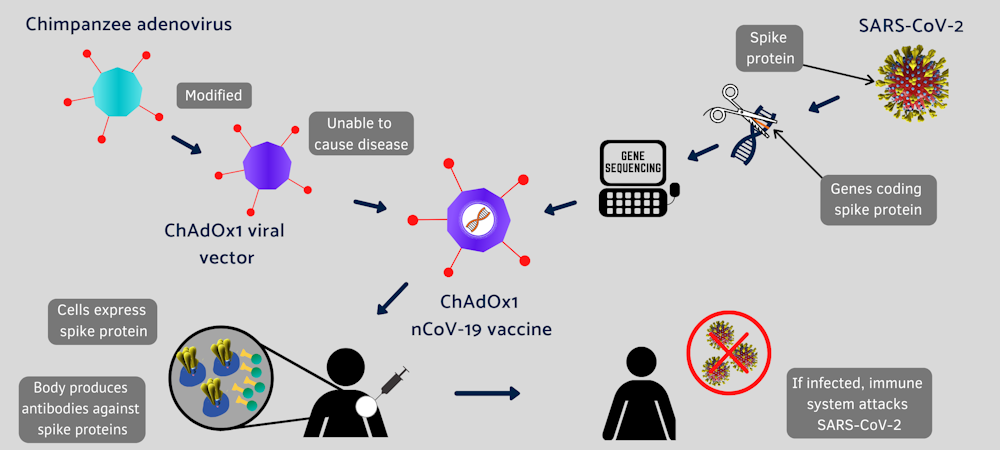

A modified chimpanzee cold virus
The Oxford-AstraZeneca vaccine is another example of a new strategy being used to rapidly develop vaccines against the coronavirus that has already infected over 58 million people worldwide.
A vaccine works as a primer to train the immune system against a pathogen.
Conventional vaccines are made by weakened viruses or by purifying their disease-causing protein, such as the spike protein, which decorates the surface of a coronavirus. But these methods can take decades to develop new vaccines. Coinvented by the University of Oxford and its spinout company, Vaccitech, this vaccine uses different molecular tools to provide a preview of the SARS-CoV-2 virus to the human body.
Instead of making weaker viruses, or delivering mRNA that encodes the spike protein, as Moderna and Pfizer did, the Oxford vaccine packs the DNA that codes for the spike protein in the shell of a genetically altered chimpanzee virus.
The original adenovirus causes common cold in chimpanzees and it rarely, if ever, infects humans. The virus is further modified to ensure that this chimp virus cannot grow in people. The AstraZeneca vaccine uses the modified virus as a vehicle to deliver the COVID-19-causing spike or S-protein of the SARS-CoV-2 virus.
Under the agreement with the University of Oxford, AstraZeneca is responsible for development, worldwide manufacturing and distribution of the vaccine.
This isn’t the first time that University of Oxford scientists have tried a vaccine using this harmless virus. Previously, it tested the concept against a closely related coronavirus that causes Middle East respiratory syndrome (MERS) in animal studies. So this time, soon after the sequence of the novel SARS-CoV-2 became available, the Oxford scientists retooled the chimp virus for a vaccine that induced robust immune response against SARS-CoV-2 in mice and rhesus macaques.
Not-so-frigid storage requirement
Despite a somewhat later arrival, with less than the effectiveness claimed by its competitors, AstraZeneca’s vaccine might be favored because it can be stored, transported and handled at standard refrigerated conditions of between 36 and 46 degrees Fahrenheit for at least six months.
The competing mRNA vaccines by Moderna and Pfizer/BioNTech require ultracold temperatures for stability. So the AstraZeneca vaccine will be easier to use in normal clinics, especially in rural America and the developing world.
Another important advantage of the AstraZeneca vaccine, which is being tested in collaboration with a larger number of global sites, is that it should cost less because of AstraZeneca’s commitment to COVAX, a global initiative that aims to distribute low-cost vaccines to low- and middle-income countries. Pfizer and Moderna have not joined the COVAX initiative, but AstraZeneca has agreed to make the vaccine on a not-for-profit basis for the duration of the pandemic.
Wait and watch
However, like all other candidate vaccines for COVID-19, AstraZeneca’s vaccine is also lacking in key details such as the breakdown in infections, the durability, or the efficacy in the different age groups of trial participants.
[Deep knowledge, daily. Sign up for The Conversation’s newsletter.]
For all the vaccine candidates, we have only preliminary data from a small number of infections, and none of the groups developing the COVID-19 vaccine candidates has so far published complete data. So it is difficult to fully assess the differences between them.
We will have to wait for more follow-up and longer-term data to evaluate the effectiveness of all the COVID-19 vaccines in finally getting the COVID-19 pandemic under control.
Sanjay Mishra, Project Coordinator & Staff Scientist, Vanderbilt University Medical Center, Vanderbilt University
This article is republished from The Conversation under a Creative Commons license. Read the original article.
Public Health Officer Dr. Gary Pace said Lake County is now in the purple tier of the state’s Blueprint for a Safer Economy after weeks of being in the red, or second most restrictive, tier.
Lake is now among 51 of 58 counties in the purple tier, representing 39.7 million people or 99.1 percent of California's population.
Pace did not give an update on the total number of cases in Lake County. The last time Public Health updated the numbers on its website was Wednesday, and on Saturday those numbers remained unchanged, with 886 cases and 19 deaths reported.
Across California, the caseload continues to climb. The Public Health departments of the state’s 58 counties reported a total of approximately 1,195,649 cases and 19,122 deaths as of Saturday night.
Impacting Lake County’s caseload is an outbreak that is continuing in the Lake County Jail, Pace said.
In addition, Pace said a large case cluster has emerged in the Native American community, “a variety of businesses are experiencing new cases, and we see continued spread in households and social settings. Many people had smaller gatherings in observance of Thanksgiving, and we expect a significant post-holiday elevation in numbers.”
Over the course of the week, Lake County’s hospitalizations have nearly doubled. Pace said 11 people were hospitalized due to COVID-19-related issues on Friday, which is about twice the number of hospitalizations the county has had in the last month.
Pace said eight of those patients have since been transferred to other counties.
“Our hospitals are maintaining now, and plans are in place if there are significant surges,” he said.
Epidemiologist Sarah Marikos is tracking COVID-19 case trends in Lake County, and has found that the positivity rate has tripled over the last three weeks, from 1.9 percent to 6.3 percent, Pace said. During the same period, the county’s daily case rate increased about 2.5 times, from 5 to 13 per 100,000.
In addition, since mid-October, there has been a steady increase in the weekly number of cases, from a low of 21 per week to 57 in mid-November. For the week of Nov. 22 to 28, there already are 39 known cases, Pace reported.
Regarding how people are becoming infected, Pace said Marikos has found that from Nov. 1 to 20, nearly 2 in 5 cases – or 39 percent – are believed to have resulted from community contact, and about 1 in 3 via household contact.
“Limiting community transmission is key to decreasing the overall number of cases, and it will reduce the number of people who become infected through household contact,” said Pace.
Marikos’ research has found that in November, about 80 percent of the known cases lived in the following places: Kelseyville (26 percent of cases), Clearlake (21 percent), Lakeport (20 percent), Clearlake Oaks (8 percent) and Hidden Valley Lake (5 percent).
Cases in November have increased among white, non-Hispanic individuals and Native Americans, and there has been a decrease in Latino cases, Pace reported.
Lake County now under increased restrictions; sheriff won’t enforce orders
Along with being moved into the most restrictive COVID-19 tier comes enhanced restrictions on businesses and social movement in Lake County that Pace said will go into effect on Sunday in an effort to slow the spread of this virus.
Among the restrictions, schools that were already open can remain open, while schools that have not yet opened need to remain closed until the county returns to the red tier. Pace said elementary schools can apply for a waiver that may allow reopening.
As for businesses, Pace said hair salons, personal care services and barbershops can remain open with modifications, and retail establishments can open indoors with modifications and a maximum capacity of 25 percent.
Restaurants cannot have indoor dining and must go to outdoor-only with modifications. Also required to move to outdoors-only activities are museums, places of worship, and gyms and fitness centers, Pace said.
Only outdoor private gatherings are permitted, with modifications, with a maximum of three households for a two-hour duration.
Pace said Lake County also will now be under the limited stay at home order issued by the state Public Health officer on Nov. 19.
That order requires that all gatherings with members of other households and all activities conducted outside the residence, lodging or temporary accommodation with members of other households cease between 10 p.m. and 5 a.m. “except for those activities associated with the operation, maintenance, or usage of critical infrastructure or required by law.” It doesn’t apply to the homeless.
The full order can be found here.
In response to the state’s action on Saturday, Sheriff Brian Martin – whose department for weeks has been working to control the jail outbreak – issued a statement on his Facebook page in which he said that Government Code Section 8627 authorizes the governor, during a state of emergency, to “promulgate, issue, and enforce such orders and regulations as are deemed necessary.”
Government Code Section 8567 states such orders “shall have the force and effect of law” and Section 8665 makes violation of such an order a misdemeanor, Martin said.
“However, section 26602 gives the sheriff the authority, but not the obligation to enforce such orders,” Martin noted.
“In accordance with the authority granted under section 26602, the Lake County Sheriff’s Office will not be determining compliance with, or enforcing compliance of any health or emergency orders related to curfews, staying at home, or other social gathering inside or outside the home, maximum occupancy, or mask mandates,” Martin said.
“Further, we will not dispatch deputies for these purposes; callers will be transferred or advised to contact the County Public Health Department, in accordance with Health and Safety Code section 101030. Of course, if there is potential criminal behavior or the potential for impacts to public or personal safety, we will continue to respond appropriately,” he said.
Martin concluded, “Please understand this applies only to the Lake County Sheriff’s Office. Other State, County, and City agencies may be actively enforcing these orders.”
Meanwhile, Pace is asking the community to take the coronavirus seriously. “It is spreading freely throughout the community now,” he said.
Pace added, “Stay home, wear masks, and be super careful. The next few months will be tough, but we will make it through this period a lot better off if we consider each other’s needs and vulnerabilities when we are thinking about going out and doing things with other people.”
Email Elizabeth Larson at
Even average residents of wealthy countries belonging to the Organization for Economic Cooperation and Development, or OECD, such as Japan, were on par with or outliving affluent Americans in 2018, said UC Berkeley demographer Magali Barbieri, associate director of the Human Mortality Database and author of the report funded by the Society of Actuaries and published Nov. 17.
“Life expectancy for the most affluent American men was one year less than for the average Japanese man,” Barbieri said. “Meanwhile, the gap between average Japanese women and the most affluent American women reached nearly 3.5 years.”
Using U.S. Census and other national vital statistics data, Barbieri tracked mortality rates for residents in dozens of U.S. counties based on education, income, employment, occupation, housing costs and quality, and other socioeconomic characteristics. She calculated the average lifespans of men and women, separately, in all these counties for every year from 1999 to 2018.
Notably, Barbieri discovered that, in 2018, men in the most affluent U.S. category could expect to live at least seven years longer than those in the most disadvantaged U.S. group (80.5 vs. 73.2 years). For women, that gap was six years (84.9 vs. 79.9 years). The socioeconomic gap was particularly high for children and for adults between the ages of 40 and 60.
By comparison, the socioeconomic gap in life expectancy in 1999 amounted to 5.5 years for men and 3.4 years for women.
Although she did not factor in data for 2019 and 2020, which is still being collected, mortality rates in the U.S. and worldwide are projected to rise sharply due to the COVID-19 pandemic.
Over the last century, life expectancy in the United States and other OECD nations has risen at a rate of three to four months per year.
But Barbieri found that, after 2010, life expectancy in the U.S. leveled off and then decreased from 2014 to 2017, going up slightly in 2018. The higher death toll, she said, is partly due to the opioid epidemic and unsuccessful efforts to control cardiovascular disease, the leading cause of death in the U.S.
While the most disadvantaged U.S. counties saw a rise in mortality between 2010 and 2014, the life expectancy of affluent Americans increased only slightly over that same period.
As for how the lifespan of Americans compares to that of other industrialized countries, Barbieri finds the U.S. is losing ground.
“Overall, Americans are lagging further and further behind in life expectancy, compared to similarly wealthy democratic countries where mortality has continued to decline at a relatively fast pace over the first two decades of the 21st century,” Barbieri said.
“Only the 10 percent of Americans in the most affluent U.S. counties can now expect to live as long as their peers in similarly wealthy nations,” she added. “And, when compared with Japan where the length of life is particularly long, and where progress has continued unabated, all socioeconomic categories of Americans are falling further and further behind.”
Yasmin Anwar writes for the UC Berkeley News Center.