 How to resolve AdBlock issue?
News
The public can play a critical role in shaping the plan by participating in a map-based survey.
The survey allows people to tell Caltrans where they have bicycling and walking concerns along or near the state highway system.
Survey responses will provide Caltrans with specific data about the type and location of improvements needed.
When combined with the technical analysis and input from agency and organizational partners, Caltrans will be able to evaluate these locations for developing future projects.
Working with local and regional stakeholders, the Caltrans Active Transportation Plans are a critical step on the path toward a robust and reliable bicycle and pedestrian network.
To take the survey, visit https://survey.catplan.org/.
The survey closes on Dec. 31.
For more information about the Caltrans Active Transportation Plans, visit www.catplan.org/district-plans.
The order, issued by Presiding Judge Michael Lunas, cited Lake County moving into the purple tier – the most restrictive on the state’s Blueprint for a Safer Economy – as well as the “imminent regional stay-at-home order,” which is expected in the coming weeks should regional intensive care capacity drop below 15 percent.
Late last week, a similar action was taken in Mendocino County, where Presiding Superior Court Judge Ann Moorman issued an order on Dec. 4 saying that the court had received emergency relief from the California Supreme Court chief justice and was vacating all trials from Dec. 7 to Jan. 8. Moorman also cited the rise in cases and the governor’s stay-home order.
On Monday, Lake County’s COVID-19 cases had risen to 1,092, an increase of 70 cases since Lake County Public Health last updated the statistics on Friday.
“The court is in constant contact with Public Health Officer, Dr. Gary Pace in an effort to continue to provide necessary and essential services to court users while protecting the health of all who come before or work within the court. In response to public health orders the court has limited the number of cases on calendar, requires social distancing in court facilities, requires face coverings and will continue to handle matters via remote means whenever possible,” the Lake County Superior Court order explained.
The order instituted changes beginning immediately, including that no jury trials will take place before Dec. 30. Those who have received a jury summons for any date prior to Dec. 30 do not need to appear.
Since trials were reinstituted earlier this year, the courts had shifted jury selection and trials to the Phil Lewis Hall at the Lake County Fairgrounds in Lakeport and away from the cramped quarters on the fourth floor of the Lake County Courthouse, as Lake County News has reported.
Under the new order, transportation of in-custody defendants from the jail to the Lake County Courthouse in downtown Lakeport also is being limited whenever possible. Court officials said they are taking that action in consultation with the Public Health officer, the Lake County Jail, the District Attorney’s Office and the public defender contract administrators.
Lunas’ order also shifts court calendars that were being handled in-person to remote appearance only, until further notice.
As of Dec. 7, the following court calendars are moving online:
– In-custody daily criminal arraignment calendar.
– Felony law and motion, Department 3, Tuesdays.
– Felony settlements, Department 4, Tuesdays.
– Misdemeanor arraignments, Department 1, Tuesdays.
– Misdemeanor disposition/setting and motions, Department 1, Mondays.
– Misdemeanor settlement conferences, Department 1, Tuesdays.
– Trial assignment, Department 4, Fridays.
Beginning on Dec. 14, the court will move all civil and family law court trials and evidentiary hearings to remote appearance only until further notice.
On Dec. 21, the court will shift the following calendars to remote appearance until further notice:
– Unlawful detainer hearings and trials, Mondays at 8:30 a.m.
– Small claims trials, Mondays at 9 a.m.
– Unlawful detainer and small claims status conferences, Mondays at 11 a.m.
– Traffic arraignments, Mondays at 1:30 p.m.
– Traffic trials, Mondays at 3 p.m.
For all of the impacted calendars, attorneys and parties are to appear by phone or video, the court said.
All other calendars currently being conducted by remote means will continue to be held remotely, court officials said.
Public counters and telephone assistance at the Court Clerk’s Office will continue to be provided between 8 a.m. and 4 p.m. daily. The court said no changes are planned yet due to the low volume of individuals seeking in-person assistance, the relatively short interactions and the ability to maintain social distancing. The court encourages the use of drop boxes, which remain available at both courthouses.
The court will continue to post updates and more information on its website, www.lake.courts.ca.gov.
Email Elizabeth Larson at
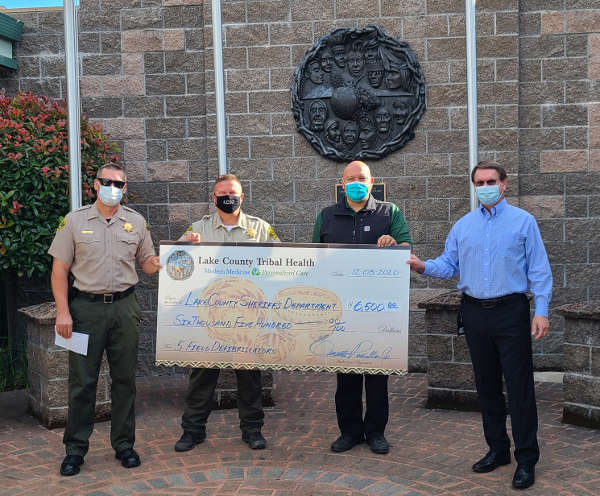
LAKE COUNTY, Calif. – Lake County Tribal Health Consortium is providing funding to help the Lake County Sheriff’s Office purchase life-saving medical devices.
On Thursday, Tribal Health Chief Executive Officer Ernesto Padilla and Chief Financial Officer Bret Woods presented a check for $6,500 to Sheriff Brian Martin.
The sheriff’s office said the funds will be used to purchase five defibrillators or automated external devices, also known as AEDs, to be used in field operations.
“Many times deputies arrive on scene of medical emergencies prior to medical personnel. In cases of cardiac events, our deputies will be able to use these devices to provide assistance and save lives. Lake County Tribal Health’s support and collaboration is greatly appreciated,” the sheriff’s office reported.
The commission will meet via webinar beginning at 5:30 p.m. Wednesday, Dec. 9.
The agenda is available here.
To speak on an agenda item, access the meeting remotely here; the meeting ID is 961 1522 8016, passcode 069271.
Comments can be submitted by email to
Please indicate in the email subject line "for public comment" and list the item number of the agenda item that is the topic of the comment. Comments that read to the council will be subject to the three minute time limitation (approximately 350 words). Written comments that are only to be provided to the council and not read at the meeting will be distributed to the council prior to the meeting.
On the agenda is an application for an architectural and design review for 1575 North High
St., the location of a PG&E service yard.
The application is to allow the replacement of the existing 6-foot chain-link fence with barbed wire along the top with an 8-foot decorative black metal fencing around the perimeter of the property and replacing an existing wood retaining wall with a concrete retaining wall.
A separate item relating to the same property is seeking an application for an architectural and design review that allows the placement of a backup generator and supporting equipment.
Also on the agenda is an application from Tom Jordan and Scotts Valley Energy Co. for a use permit for biochar processing, light manufacturing in the C-2, Major Retail zoning district at 2150 S. Main St.
The project would allow offices in the front of the building and biochar processing in the rear building on the property formerly occupied by the Record-Bee newspaper.
In other business, the commissioners will discuss the environmental review for the Lakefront Park at 800 and 810 N. Main St.
The commission also is being asked to consider the ordinance recently adopted by the Lake County Board of Supervisors to permit microenterprise home kitchens in accordance with AB 626, and give city staff necessary direction.
Email Elizabeth Larson at
Aguiar-Curry has also reached an agreement to work in partnership with Sen. Lena Gonzalez (D-Long Beach) to revolutionize the state’s broadband deployment program under the California Advanced Services Program and provide new and increased funding to bring California into the technological 21st century.
The two members, who individually advanced legislation elevating the discussion of the sorry state of Internet connectivity in the state, have joined forces to bring forward the funding and reforms necessary to truly achieve Internet for all.
The bills will build on the extension of the California Advanced Services Fund program under AB 1665, signed into law in 2017 and joint authored by Assemblymembers Garcia, Aguiar-Curry, Holden, McCarty, Bonta, Gallagher, Low, Santiago, Wood, and then-Assemblymember, now Senator Brian Dahle.
The ongoing COVID pandemic has laid bare the massive gaps in internet connectivity at sufficient speeds for too many Californians.
As more families have struggled to conduct distance learning, virtual work, access telehealth services and safeguard small business participation in the virtual marketplace, the need to connect the state at sufficient speeds with adaptable technology has reached crisis proportion.
AB 14 reflects Aguiar-Curry’s steadfast commitment to achieve our state’s digital connectivity goals, serving as a product of the knowledge gained through this year’s introduction of her own bill, AB 570 (Aguiar-Curry, the “Internet for All Act of 2020”) and the negotiations between both houses of the State Legislature and the Governor’s Administration through the 2020 legislative session.
“The heartbreaking reality is that 1 in 8 California homes still do not have internet access and communities of color face even higher numbers of students and families who remain disconnected,” said Aguiar-Curry.
“Only miles from our State Capitol there are areas of our state where Californians have no access to broadband connectivity,” added Aguiar-Curry. “California, the home of the Silicon Valley, cannot continue to sustain the 5th largest economy in the world with third world technology. In partnership with Sen. Gonzalez and nearly two dozen of our Legislative colleagues, we have the momentum to get this effort across the finish line early next year.”
“As a proud principal coauthor of AB 14, I look forward to continuing working with Assemblywoman Aguiar-Curry, the Newsom Administration and stakeholders to help fund broadband infrastructure and provide fast internet connectivity to more families across our state. The COVID-19 pandemic has shown us how critical it is that families have access to fast internet connectivity to meet the needs of daily life,” said Sen. Gonzalez.
“The digital divide impacts low income, rural, and urban communities of color the most. That is a huge injustice and that is why we must address the digital divide with urgency, to make sure all Californians have the internet connectivity they need to learn, work and socialize online, especially as we continue to work through the challenges of this global pandemic,” Gonzalez said.
The Internet for All Act of 2021 prioritizes the deployment of broadband infrastructure in California’s most vulnerable and unserved rural and urban communities by extending the ongoing collection of funds deposited into the California Advanced Services Fund to provide communities with grants necessary to bridge the digital divide.
AB 14 provides a vital pathway to connect California’s workforce to gainful employment, harness the life-saving technology of telemedicine, democratize distance learning, enable precision agriculture, and sustain economic transactions in the 21st Century E-Marketplace.
The act extends eligibility for grants administered by the California Public Utilities Commission to local and tribal governments, who are willing and able to quickly and efficiently connect households, community anchor institutions (including educational institutions, fairgrounds for emergency response, and healthcare facilities), small businesses, and employers.
AB 14 offers a measured and meaningful approach to building a statewide fiber middle-mile network that will provide higher speeds and access to connectivity to all those who are unserved along the path of deployment.
Assemblymember Aguiar-Curry and Sen. Gonzalez have worked collaboratively to construct a package that joins their efforts of last legislative year to secure the necessary funding, technological capability, and program reforms included in AB 14 through the legislative recess and are eager to get the job done for California families, communities, and statewide economic recovery, as soon as possible.
Aguiar-Curry represents the Fourth Assembly District, which includes all of Lake and Napa Counties, parts of Colusa, Solano and Sonoma counties, and all of Yolo County except West Sacramento.
Sen. Gonzalez represents the 33rd Senate District, which includes the city of Long Beach and portions of South East Los Angeles including the cities of Bell, Bell Gardens, Cudahy, Huntington Park, Lakewood, Lynwood, Maywood, Paramount, Signal Hill and South Gate.

As we face rising COVID infection rates, the possibility of additional quarantines rises. Although stay-at-home orders might protect individuals from the virus, home isn’t safe for everyone. Studies show that domestic violence calls to police and shelters in the U.S. have risen between 6% and 21% (variation depending on data source) since the start of the pandemic, with the largest increase happening the first five weeks of quarantine.
Calls to shelters and hotlines have also increased. Google searches for information about domestic violence hotlines have also gone up, with spikes last April, a time when most of the U.S. was under stay-at-home orders.
This is not surprising to those of us who study domestic violence. With COVID-19 came higher unemployment and financial strain, both correlated with domestic violence. As quarantines and social distancing continue, isolation increases, social support lessens, mobility decreases, access to resources is strained, and stress from the changes in routine, like work and school closures, rises. Life is turned upside down.
As researchers who study intimate partner violence, we know the pandemic has only exacerbated many of the risk factors for the escalation of violence. One example: Partners’ spending more time together than usual, such as during the holidays, increases risks of family violence.
Stress, economic hardship, a lack of social support, gun ownership, lower educational status, and drug or alcohol abuse are risk factors for intimate partner violence. All of these factors are exacerbated during a pandemic.
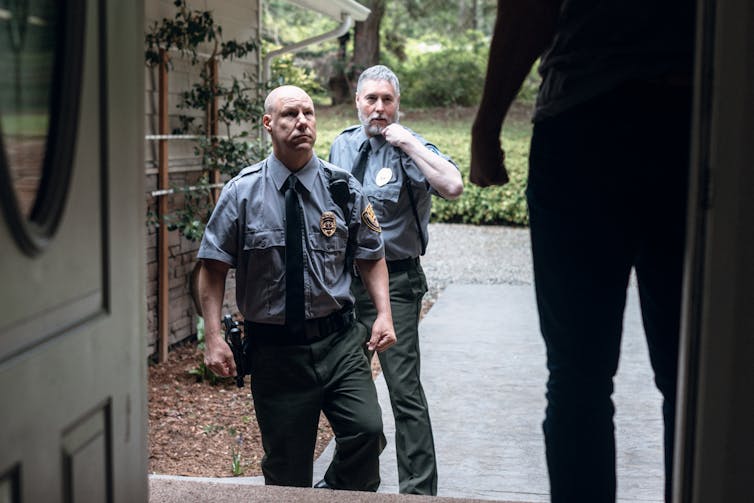
Getting reliable data
All of these factors are red flags, indicating that victims may be at heightened risk during these trying times. However, getting data during a pandemic is particularly difficult. Under the best of circumstances, data must be collected, processed, and analyzed before numbers can be presented to the public. That always takes time. A pandemic complicates things even more. Right now, we do not have updated national statistics on victim reports of domestic violence during the pandemic. That’s why, to get immediate numbers, we rely largely on the police call or shelter call data.
But that 6% to 21% jump in calls likely underestimates the problem. Interactions with police officers are down overall, in part, because of social distancing policies and practices. However, even before the outbreak, domestic violence was an underreported crime.
The increase in calls appears to be coming largely from households where police have not made contact before and those in rental complexes, perhaps a result of neighbors reporting because, in spending more time at home, they are more likely to be witnesses. In contrast, incidents in rural communities where housing is spaced far apart are likely underrepresented in our current data. Even before COVID-19, the severity of domestic physical abuse was worse in rural areas compared with urban. The lack of public transportation in rural areas adds to the problem because it is more difficult for victims to escape or reach shelters that are often in urban locations. These issues have only been heightened by the pandemic.

What can help
One possible way to improve response is to let victims report abuse in nontraditional spaces, like pharmacies. This approach has been used successfully in France and Spain. For instance, in Spain, victims use a code word – “Mask 19” – when speaking to pharmacists to identify the need for help. Traditional sources, like hotlines and 911, could allow for coded reporting also. With shelters less available during the pandemic, hotels have been used to house victims.
Social media outlets could offer innovative ways to make reporting easier; for instance, private features, such as hidden “customer service” chat rooms on platforms that link to the national hotline, could benefit victims trying to reach out while their abuser is nearby. Shortening the hotline number to three digits – a more memorable, quicker dial – could also help. All of these changes, particularly now, can help victims find the privacy they need so they can safely report the abuse.
If you need help in a domestic violence case, call the National Domestic Violence Hotline at 1-800-799-SAFE (7233); text LOVEIS at 22522; or visit this website.
[Deep knowledge, daily. Sign up for The Conversation’s newsletter.]
Megan Stubbs-Richardson, Assistant Research Professor, Mississippi State University and H. Colleen Sinclair, Associate Professor of Social Psychology, Mississippi State University
This article is republished from The Conversation under a Creative Commons license. Read the original article.