 How to resolve AdBlock issue?
News
MATH opened nominations for three seats in October, with the nominations also open last month and again on Thursday night.
The seats to be filled – which Chair Tom Darms said include two representing Middletown proper and one at-large seat, not the other way around as had been stated on the agenda – currently are held by Darms, Vice Chair Sally Peterson and Secretary Paul Baker.
MATH’s board also includes Rosemary Córdova and Lisa Kaplan, who are at-large members.
MATH, whose members reported having less participation since the meetings have been held virtually and not in person, went into Thursday night’s meeting with no formal nominations having been accepted at its last two meetings.
By the end of the Thursday night discussion, however, a slate of three candidates formed and will be presented to the town hall for acceptance at its January meeting.
The candidates are Ken Gonzales, who previously served on the MATH board; businesswoman Monica Rosenthal; and Baker, who this time agreed to serve but said he didn’t want to continue to be the board secretary.
All three accepted their nominations.
At the November meeting, MATH approved bylaws updates which included making December the month in which nominations close and setting the election in January. While the group has typically held elections in January, the bylaws previously didn’t give a specific time for elections.
The November bylaws updates also include allowing for nominations by proxy for those who can’t attend a meeting in person, which previously hadn’t been allowed.
MATH went over further bylaws changes regarding clarification to the board election procedures which will be presented for acceptance at the January meeting.
Darms said the new board members will be approved in January. At that time, they are expected to discuss having alternates in place for the board in order to ensure they can have a quorum at future meetings.
In other business, the group received a report from Community Development Director Scott De Leon on the granting of a permit to Verizon for the use of an existing cell tower in Middletown.
A previous iteration of the project was denied by the Lake County Planning Commission last year but De Leon said he is allowing this new permit to go forward because it’s his conclusion that the county can’t deny it and comply with federal law.
Email Elizabeth Larson at
The grant runs through June of 2023.
The purpose of the grant is to support programs aimed at improving student outcomes by reducing truancy and supporting students who are at risk of dropping out of school.
“Lake County has a high rate of chronic absenteeism. The grant allowed us to create a local solution that will work for us here in Lake County,” said Lake County Deputy Superintendent of Schools Cynthia Lenners.
Chronic absenteeism is defined as missing two or more days of school, excused or unexcused, a month.
“When students improve their attendance rates, they improve their academic prospects and chances for graduating,” said Lake County Superintendent of Schools Brock Falkenberg.
The Lake County Office of Education has seven job openings for the implementation and operation of this program. There are six attendance liaison positions and one attendance coordinator position.
The Learning Communities for Student Success Program staff will provide extra support and school site services to students and their families related to attendance.
They will be hired through the Lake County Office of Education but will be assigned to one of the local school districts in Lake County.
“Although we would like our attendance liaisons to have an Associated Arts degree, the most important qualification for the job is for a person to have the passion to make things better for our students in Lake County,” Lenners said.
The attendance coordinator position requires a Bachelor’s of Arts degree.
For information on how to apply for these positions, please visit lakecoe.org and click on the “careers” button. Application deadlines are Friday, Dec. 18.
The event runs from Friday, Dec. 11, through Sunday, Dec. 13.
Hours are 4 to 8 p.m. Friday and Saturday, and noon to 4 p.m. Sunday.
MAMA said the event takes place rain or shine.
Organizers ask visitors to wear their masks throughout the event so they can celebrate together safely.
MAMA said this year’s event is spread over three days to encourage social distancing.
The event also will include businesses with storefronts and without, participating in the Love (& Shop) Where You Live punch card program.
For more information, visit MAMA’s Facebook page.
The free, mobile technology is now available to all Californians and can be accessed on mobile devices.
Californians can now receive notifications informing them if they have been exposed to someone who has tested positive for the virus so they can take immediate actions around quarantine and testing.
Californians with iPhones can enable CA Notify in their settings and Android phone users can download the CA Notify app from the Google Play Store to immediately start receiving exposure alerts on their phones.
Use of the technology is completely voluntary, private and secure. CA Notify does not collect the location of a phone or individual to detect exposure, and it does not share a user’s identity. Californians opt in to use the tool and may to opt out at any time.
“We want all Californians to add their phone to the fight to slow the spread of COVID-19 because the tool works best when more people sign up,” said Dr. Erica Pan, acting State Public Health Officer. “Combined with other actions like physical distancing and wearing masks, CA Notify helps Californians anonymously keep themselves, their loved ones, and their communities safe.”
When individuals voluntarily activate CA Notify, the tool uses Bluetooth technology to exchange random codes between phones without revealing the user’s identity or location.
When someone is tested for COVID-19, they will receive a text message from 855-976-8462. This text will remind CA Notify users who receive a positive test result from a provider or laboratory to enter their verification code into their phone using CA Notify.
Any other CA Notify users who were within 6 feet of the COVID-19 positive individual for 15 minutes or more when that person was most likely to be infectious will get an anonymous notification of possible exposure.
“The technology is 100-percent voluntary and secure and provides Californians immediate information and links to resources when they’ve been exposed to COVID-19,” said Amy Tong, director of California Department of Technology. “We are proud the Golden State is making this innovative tool available statewide to encourage more Californians to do their part to keep others safe.”
The state launched a pilot in September for students, staff, and faculty at UC San Diego and UC San Francisco and expanded it to include five other UC campuses in mid-November.
The privacy-first focus of CA Notify does not allow the state to know how many people opted into the system, but the UC system estimates more than 250,000 individuals are utilizing the technology as part of the pilot.
CA Notify has helped identify exposed individuals early, allowing them to quickly quarantine and reduce virus transmission. The CA Notify pilot has been successfully evaluated, and similar programs have been launched in other states.
“Our pilot experience starting at UC San Diego and expanding to other UC campuses showed this technology was effective in identifying exposed individuals early for quarantine and testing, and helping keep our communities as safe as possible,” said Christopher Longhurst, MD, chief information officer of UC San Diego Health. “This free and reliable smartphone technology can help all Californians. As we enter a new, and hopefully final, surge in the pandemic, now more than ever is the time to put every possible tool to use to slow the spread of the virus.”
CA Notify is not a contact tracing app but augments the contact tracing process by issuing exposure notifications to people you may not know.
Contact tracing identifies the close contacts of someone who has tested positive for COVID-19, and contact tracers reach those individuals by phone, email, and text. CA Notify does not track or trace information about the people you are in contact with and does not collect or exchange any personal information.
Visit CANotify.ca.gov to learn more about how CA Notify works.
Read the Governor’s Dec. 7 announcement.
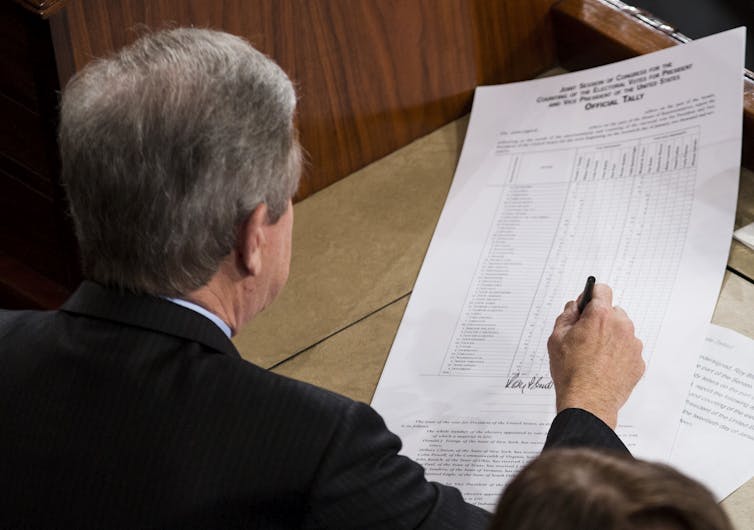
On Dec. 14, the members of the Electoral College will meet in state capitols across the country and cast their ballots for president and vice president. The expected vote total: 306 for Democrat Joe Biden and 232 for Republican Donald Trump. It will be their votes – not the votes of the nearly 160 million Americans who cast ballots on or before Nov. 3 – that will determine whose presidential term will begin on Jan. 20, 2021.
Over the past several months, The Conversation has asked scholars of the Electoral College to explain how this system was developed and how it works and to describe whether – and how – it gives advantages to certain people based on where they live. We’ve collected highlights from several of those articles here.
1. Where did it come from?
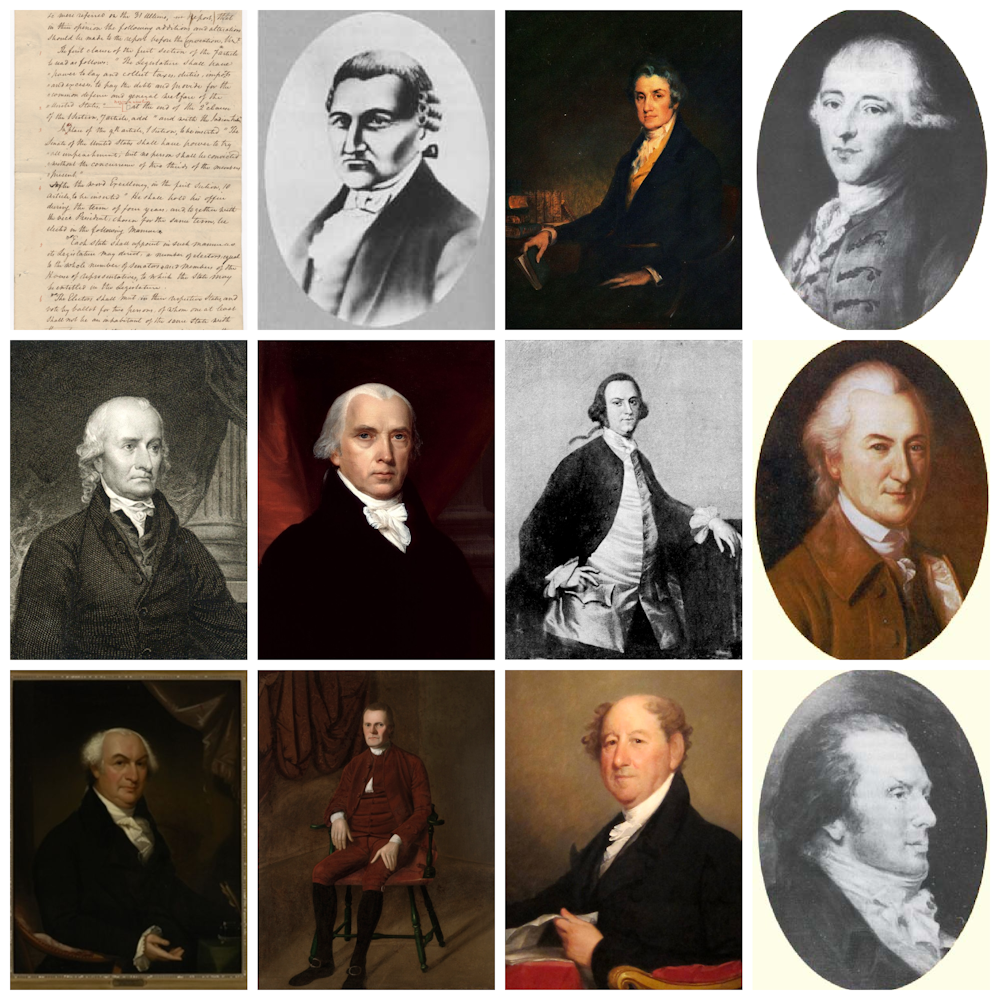
Delegates to the Constitutional Convention in 1787 debated three potential ways to pick a president, explains Purdue University civics educator Philip J. VanFossen: “election by Congress, selection by state legislatures and a popular election – though the right to vote was generally restricted to white, landowning men.”
The idea of a popular election – where the candidate who got the most votes won – was attractive. But the 11 committee members realized the Southern states would not agree, because they wanted to wield more political power based on their ownership of enslaved people.
They ultimately settled, VanFossen writes, on “a system of electors, through which both the people and the states would help choose the president. [It] was a partly national and partly federal solution, and … mirrored other structures in the Constitution.”
That system assigned two U.S. senators to each state, and a number of U.S. representatives based on states’ relative populations – and a number of electors equal to the sum of the senators and representatives. No state would have fewer than three electors, no matter how few people lived there.
2. Benefiting less populous states
That system means voters in different states are treated differently, writes LaGrange College political scientist John Tures.
As he explains, “some critics have complained that the Electoral College system encourages candidates to ignore voters in smaller states like Oklahoma and Mississippi, instead focusing on campaigning in big states like California and New York, which have lots of electoral votes.”
But in reality, the Electoral College gives an advantage to voters in less populous states, Tures finds: “[V]oters in small states have more Electoral College votes per capita than larger, more diverse states, using several different measures – and therefore more power to choose a president than they would have in a national popular election.”
He notes that a similar system for electing Georgia’s governor was overturned in 1963 in a U.S. Supreme Court “ruling that it violated the fundamental principle of ‘one person, one vote.’”
3. A matter of race
Ignoring that principle has repercussions today, reports political scientist William Blake of the University of Maryland, Baltimore County: “The system continues to give more power to states whose populations are whiter and more racially resentful.”
His analysis of states’ racial breakdowns and electoral votes finds that “states whose people exhibit more intense anti-Black attitudes, based on their answers to a series of survey questions, tend to have more electoral votes per person.” That’s a measure of how many electoral votes a state has in proportion to the number of people who live there.
Statistically, he found that “if two states’ population numbers indicate each would have 10 electoral votes, but one had substantially more racial resentment, the more intolerant state would likely have 11.”
4. Vulnerable to interference
The Electoral College makes American democracy more vulnerable to hackers, fraudsters and others who might seek to alter the results, explains mathematician Steven Heilman at USC Dornsife.
Noting that “changing just 269 votes in Florida from George W. Bush to Al Gore would have changed the outcome of the entire [2000] national election,” Heilman highlights just how close so many national elections have been over the course of the country’s history.
As he details, “The Electoral College divides one big election into 51 smaller ones – one for each state, plus the District of Columbia. Mathematically speaking, this system is built to virtually ensure narrow victories, making it very susceptible to efforts to change either voters’ minds or the records of their choices.”
5. Is there a better way?
Westminster College political scientist Joshua Holzer describes the various ways that different countries pick their presidents, and “found better human rights protections in countries that elect presidents who are supported by a majority of voters – which is something U.S. Electoral College does not guarantee.”
He explains plurality voting – a method widely used across the U.S., in which the person who gets the most votes wins. He also looks at runoff voting, with “potentially two rounds of voting. If someone wins more than half the votes in the first round, that candidate is declared the winner. If not, the two candidates with the most first-round votes face off in a second round of voting.”
After laying out other variations, including contingent voting and ranked-choice voting, that let voters express more nuanced preferences, Holzer concludes with a description of an effort that is underway right now, to effectively convert the Electoral College system into a nationwide popular vote.
But, as he observes, that would come with its own problems – just different ones.
Editor’s note: This story is a roundup of articles from The Conversation’s archives.
Jeff Inglis, Politics + Society Editor, The Conversation
This article is republished from The Conversation under a Creative Commons license. Read the original article.
Due to COVID-19 cases, Kelseyville Unified closes offices until January, maintains social distancing
The district said the offices will reopen on Jan. 4, at the end of winter break, which begins on Dec. 18.
“We test everybody, all of our staff,” said Superintendent Dave McQueen.
Some positive cases came back and the district reported that it made the decision to close for the rest of this month.
The employees who tested positive were not in contact with any students and contact tracing is underway for any adults at risk for infection, the district said.
The district said the affected staff members are currently in quarantine and will not return to work until such time as Lake County Public Health determines it is safe to do so.
“The health and safety of our students and staff remain our top priority. We wish our COVID-positive colleagues a speedy recovery,” McQueen said.
McQueen said he sent out a letter to parents reporting that some staffers had tested positive for COVID-19.
The district said all students will attend school full-time via distance learning. The small cohorts of students that were on campus will transition to distance learning until further notice.
Kelseyville Unified’s Food Services Department will continue to provide meals as it has throughout the pandemic and McQueen will remain in close contact with Lake County Public Health Director Dr. Gary Pace about pandemic-related issues.
The district had planned to reopen for a hybrid, in-person learning model on Nov. 30, but McQueen said they couldn’t open the doors after Lake County moved from the red tier, the second-most restrictive on the state’s Blueprint for a Safer Economy, to the most restrictive, purple, on Nov. 29.
The students who want to come back for in-person learning and those who want to remain on distance learning form about a 50-50 split, which McQueen said actually works out well, as it will help them keep numbers down in the classrooms and so allow for social distancing when the time comes for in-person school to resume.
“We’re ready. If it goes back to red, we could open,” McQueen said.
In the meantime, the district asked parents to direct questions to their school sites. Although the offices are closed, phone lines will be monitored and calls returned.
Email is the best way to communicate with site administrators. Visit www.kvusd.org and click on the District menu; then choose Staff Directory to send an email.
Email Elizabeth Larson at