 How to resolve AdBlock issue?
News
LAKE COUNTY, Calif. — The Lakeport City Council gave staff further direction on Tuesday regarding input on maps released by the California Citizens Redistricting Commission.
The commission redraws State Assembly, State Senate and congressional districts every 10 years, based on the latest data from the U.S. Census Bureau.
At its Nov. 2 meeting, the council had directed City Manager Kevin Ingram to write a letter to the commission expressing support for the latest “visualizations,” or scenarios, for how Lake County would be grouped.
However, Ingram reported that before he could get a letter completed, more changes were released.
Since then, the commission has moved from visualizations into draft maps.
Ingram told the council during its brief discussion of the matter on Tuesday evening that he expected to see smaller changes to the mapping going forward.
The process has been moving quickly in recent weeks, and between the time Ingram completed his report to the council last week and the Tuesday meeting, newer maps were posted on the commission’s website, supplanting what was in Ingram’s report.
Current maps can be found here.
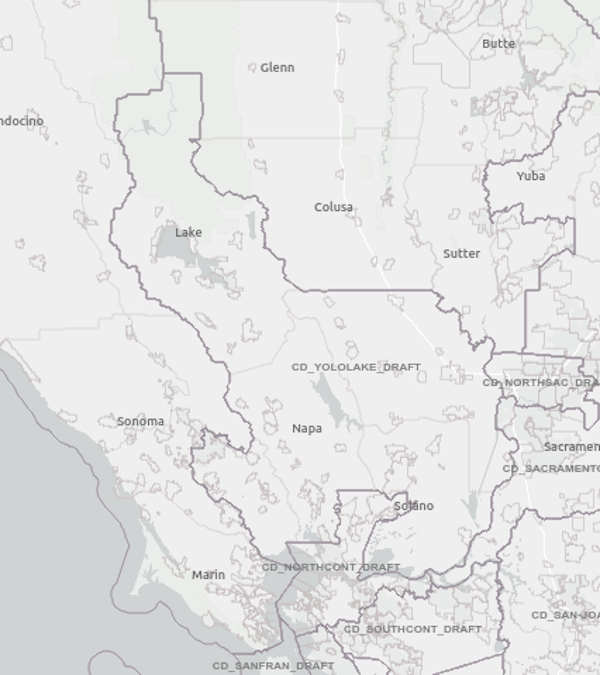
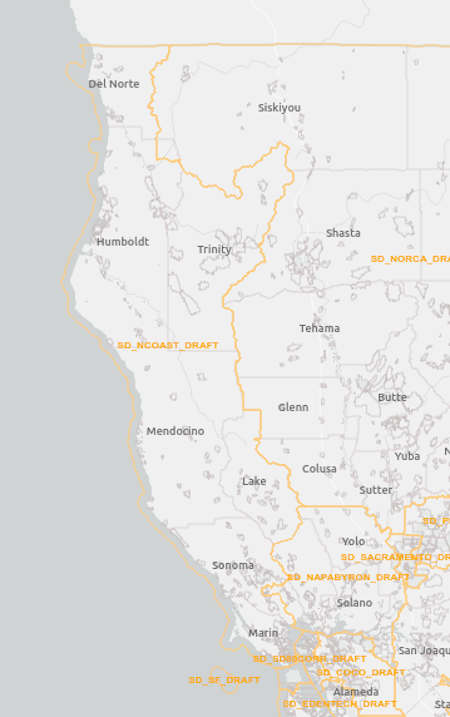
The draft maps now show Lake County being grouped with Colusa, Glenn, Napa, Tehama and Yolo counties for the State Assembly, and with Del Norte, Humboldt, Marin, Mendocino, Sonoma and Trinity for State Senate.
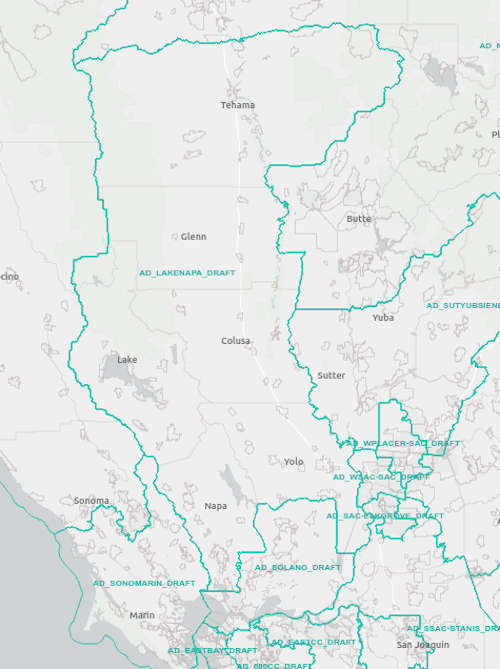
For Congress, Lake County is proposed to be bundled with Napa, Solano and Yolo counties. It’s a scenario that would no longer have Lake County split over two congressional districts, as has been the case over the past 10 years.
“It is our overriding priority to just keep Lake County whole,” said Councilwoman Mireya Turner.
She moved to direct staff to prioritize redistricting efforts to make sure Lake County is not split into different districts and to keep the county aligned with strategic agricultural and economic
partners.
That’s an approach that Ingram said will allow staff to craft a tailored response to each proposed mapping change and ensure that the city’s voice is presented to the commission.
The council approved the motion with a 5-0 vote.
The council also voted unanimously to cancel its second meeting of December, which was set for Dec. 21.
The cancellation was proposed because city offices will be closed beginning on Dec. 22 to observe the Christmas holidays and there are no urgent pending items for the Dec. 21 meeting.
Ingram’s written report said, if it was necessary to handle any urgent business, a special meeting could be called Dec. 13 or the week of Dec. 27.
Ingram said it will require them to move the council reorganization — the election of the mayor and mayor pro tem — to the end of the Dec. 7 meeting, and that action usually takes place at the second meeting in December.
Email Elizabeth Larson at
The event will take place from 2 to 6 p.m. at the campus, located at 15880 Dam Road Extension, Clearlake.
During the event, community members will have the opportunity to learn about the more than 50 degree and certificate programs available at the college and the supportive services offered to students and the community.
In conjunction with the Open House, the campus’s culinary club will be holding a Street Food Festival with local food vendors, family-friendly activities, face painting, hula dancing from Kehaulani Hula Studio, Pomo dancers and much more. Food will be available for purchase.
The college invites community members to attend the event, learn more about this local community college and enjoy an afternoon of fun.
For more information contact Mary Wilson at 707-995-7913 or
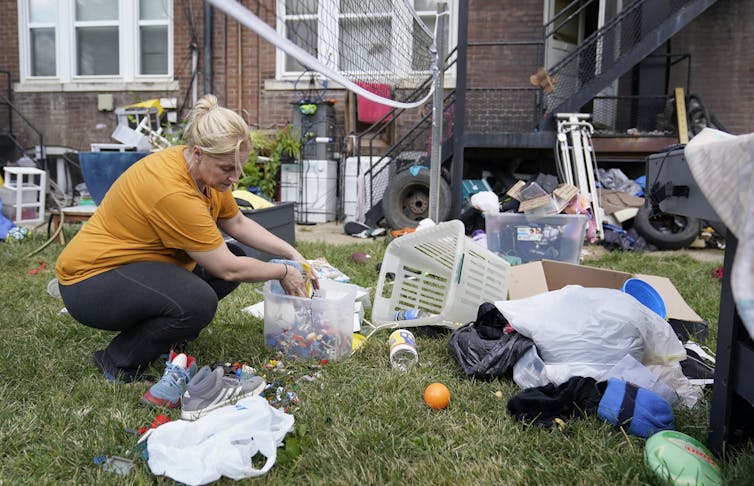
Even before 2020, the U.S. faced an acute housing affordability crisis. The COVID-19 pandemic made it a whole lot worse after millions of people who lost their jobs fell behind on rent. While eviction bans forestalled mass homelessness – and emergency rental assistance has helped some – most moratoriums have now been lifted, putting a lot of people at risk of losing their homes.
One solution pushed by the White House, state and local lawmakers and many others is to increase the supply of affordable housing, such as by reforming zoning and other land-use regulations.
As experts on housing policy, we agree that increasing the supply of homes is necessary in areas with rapidly rising housing costs. But this won’t, by itself, make a significant dent in the country’s affordability problems – especially for those with the most severe needs.
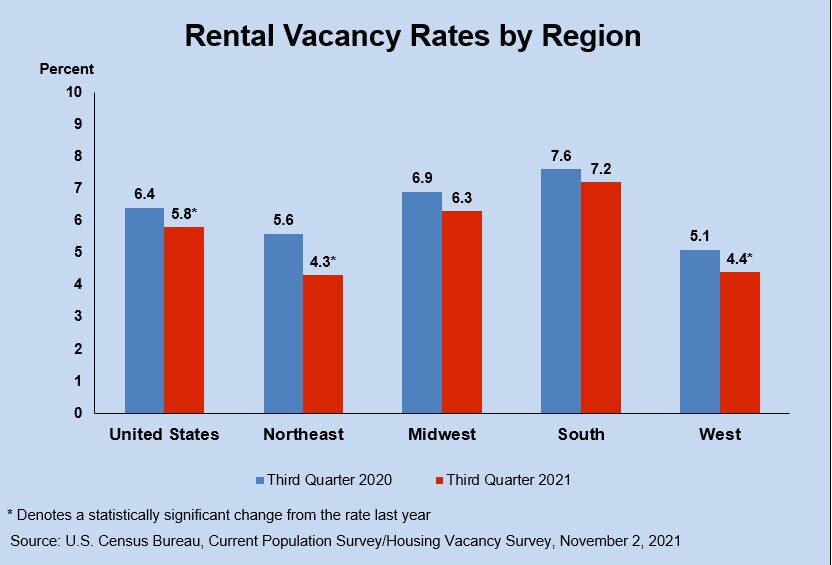
In part that’s because in much of the country, there is actually no shortage of rental housing. The problem is that millions of people lack the income to afford what’s on the market.
Where the crisis hits hardest
Renters with the most severe affordability problems have extremely low incomes.
Nationally, about 45% of all renter households spend more than 30% of their pretax income on rent – the widely recognized threshold of affordability. About half of these renters, 9.7 million in total, spend more than 50% of their income on housing, greatly impairing their ability to meet other basic needs and putting them at risk of becoming homeless.
Nearly two-thirds of renters paying at least half of their income on housing earn less than US$20,000, which is below the poverty line for a family of three. Renters with somewhat higher incomes also struggle with housing affordability, but the problem is most pervasive and most severe among very-low income households.
For a household earning $20,000, $500 per month is the highest affordable rent, assuming the affordability standard of spending no more than 30% of income on housing. In contrast, the median rent in the U.S. in 2019 was $1,097, a level that’s affordable to households earning no less than $43,880.
And homes that rent for $500 or less are exceedingly scarce. Fewer than 10% of all occupied and vacant housing units rent for that price, and 31% are occupied by households earning more than $20,000, pushing low-income renters into housing they cannot afford.
A pervasive problem
The problem of housing affordability doesn’t affect only a few high-cost cities. It’s pervasive throughout the nation, in the priciest housing markets with the lowest vacancy rates like New York and San Francisco, and the least expensive markets with high vacancy rates, such as Cleveland and Memphis.
For example, in Cleveland, with a median rent of $725, 27% of all renters spend more than half of their income on rent. In San Francisco, with a median rent of $1,959, 18% of renters spend at least half their income on rent. And it’s even worse for the poorest residents. In both cities, more than half of all extremely low-income renters spend at least 50% of their income on rent.
In fact, there is not a single state, metropolitan area or county in which a full-time minimum wage worker can afford the “fair market rent” for a two-bedroom home, as designated by the U.S. Department of Housing and Urban Development.
Even the smallest, most basic housing units are often unaffordable to people with very low incomes. For example, the minimum rent necessary to sustain a new a 225-square-foot efficiency apartment with a shared bathroom in New York City built on donated land is $1,170, affordable to households earning a minimum of $46,800. That’s way out of reach for low-income households.
At the heart of the nation’s affordability crisis is the fact that the cost to build and operate housing simply exceeds what low-income renters can afford. Nationally, the average monthly operating cost for a rental unit in 2018 was $439, excluding mortgage and other debt-related expenses.
In other words, even if landlords set rents at the bare minimum needed to cover costs – with no profit – housing would remain unaffordable to most very-low-income households – unless they also receive rental subsidies.
The subsidy solution
Covering the difference between what these renters can afford and the actual cost of the housing, then, is the only solution for the nearly 9 million low-income households that pay at least half their income on rent.
The U.S. already has a program designed to help these people afford homes. With Housing Choice Vouchers, also known as Section 8, recipients pay 30% of their income on rent, and the program covers the balance. While some landlords have refused to accept tenants using vouchers, overall the program has made a meaningful difference in the lives of those receiving them.
[Over 115,000 readers rely on The Conversation’s newsletter to understand the world. Sign up today.]
The $26 billion program currently serves about 2.5 million households, or only 1 in 4 of all eligible households. The current version of Democrats’ social spending bill would gradually expand the program by about 300,000 over five years at a total cost of $24 billion.
While this would be the single largest increase in the program’s nearly 50-year history, it would still leave millions of low-income renters unable to afford a home. And that’s not a problem more supply can solve.
Alex Schwartz, Professor of Urban Policy, The New School and Kirk McClure, Professor of Urban Planning, University of Kansas
This article is republished from The Conversation under a Creative Commons license. Read the original article.
The Habematolel Pomo of Upper Lake has donated $100,000 to the California Tribal Families Coalition to help fund the launch of the coalition’s Legal Council of Tribes, which organizers said is a groundbreaking legal services project aimed at providing the state’s tribes comprehensive legal and social welfare services.
Specifically, the coalition’s efforts will focus on compliance with the Indian Child Welfare Act, or ICWA, a 1978 statute passed by Congress in response to Native American children being removed from their homes at higher rates than any other group, said California Tribal Families Coalition Executive Director Delia Sharpe.
Legal Counsel for Tribes is a newly developed project of the California Tribal Families Coalition to address the inequity in the courtroom, where tribes are unrepresented, leaving the promises of ICWA unmet.
The coalition is aiming to recruit the best Native American legal talent to ensure that no tribe walks into a court without the best representation the Legal Council of Tribes has to offer, as well as to build a better legal system that respects tribal sovereignty in complicated welfare cases that all too often result in violations of federal Indian law.
Sharpe said they want to have Native American lawyers or lawyers of other backgrounds with a high degree of knowledge in federal ICWA and child welfare, who understand tribal sovereignty.
“Indian child welfare is a very unique area of law,” said Habematolel Tribal Chair Sherry Treppa. “It is sadly not well represented.”
Treppa said she’s seen such issues impact Habematolel’s members, with some court cases involving children being adjudicated in ways the tribe didn’t prefer.
She said ICWA also continues to be challenged, pointing to a Fifth Circuit Court decision in the Brackeen case earlier this year in which the state of Texas challenged the statute’s constitutionality.
ICWA gives tribes the legal right to be parties to cases involving their children. However, in many cases the tribes have not been represented by attorneys, which creates significant equity issues, Sharpe said.
Thus the endeavor to recruit young attorneys out of college and start training them to be dedicated to this mission, Treppa said.
Sharpe said they are trying to craft a program so that in every case involving a tribal member child, there would be an attorney with the knowledge necessary to help them.
Sharpe said Habematolel is a member of the California Tribal Families Coalition. “They have been a leader in this work from the very beginning.”
She said Habematolel’s contribution will be a cornerstone for the launch of the rest of the program. “Their support and leadership is imperative to the success of this work.”
Addressing the ‘typical experience’
Treppa said that in counties not familiar with working with tribes, the typical experience has been children getting lost in the system and going into foster care rather than with a family or tribal member.
Tribes with resources have the ability to hire special attorneys that are well versed in ICWA and working in California specifically. However, Treppa noted that a lot of tribal members don’t have the resources to be able to address those situations on their own.
In those cases, had the tribe been involved and notified, they could have found placement within the tribal community with family or a representative the tribe prepared for foster care, Treppa said.
She said the situation in California has been improving because of the state’s position.
However, disparities continue. In California, more than 90% of Native American children available for adoption are still placed in nonnative homes, Sharpe said.
Treppa said she believes Lake County “is getting there” and improving thanks to the positive intergovernmental relationships her tribe has with local government agencies.
Sharpe said the idea for the Legal Council of Tribes started with the California Indian Child Welfare Act Compliance Task Force, convened at the invitation of then-Attorney General Kamala Harris.
That task force created a report documenting compliance concerns with ICWA that was submitted to Harris’ successor, Xavier Becerra, in 2017.
The report included 20 targeted recommendations from the tribal perspective that, if done properly, would increase ICWA compliance across the state, Sharpe said.
She said the No. 1 issue is inequity in the courts; that includes not having the needed legal counsel.
Sharpe said that based on recent data collected by the state of California there are 1,257 children to whom ICWA applies for placement through California courts as of April 1, 2021.
However, while the state of California keeps data on child welfare cases, Sharpe said they have readily acknowledged it is not entirely accurate.
As a result, the exact number of children considered Indian under ICWA isn’t known, Sharpe said.
A phased approach
Sharpe said the new Legal Council of Tribes program is being rolled out in phases, with small targeted goals and regions.
When talking to tribes, the coalition is engaging in a phased up scaling, with targeted goals and regions. “We want to be very, very thoughtful and sustainable in our overall approach,” Sharpe said.
Phase one finalizes the development of the coalition’s internal structure, partnerships with law schools, holding teaching workshops and seminars, starting the law clerk program, recruiting attorneys and doing their own briefing.
That’s largely done, with recruitment continuing. “We have taken on our first case,” she said.
Sharpe said they are now hiring attorneys for the program, working with law schools that have programs specifically dedicated to federal Indian law. They’re also creating a law clerk program to get the law students experience before taking and passing the bar.
They have already hired three fully licensed lawyers, with another law student who had yet to sit for the bar beginning as an advocate in August with the goal of later coming on as the first dedicated legal counsel for tribes.
Sharpe said the coalition believes that within three years they will have a lawyer available for every case in California involving Indian children.
By that point, they also will have the data necessary to back up final reports and recommendations for the overall project and development of a law school curriculum so students will come out of law school with targeted knowledge.
Phase two is launching in three counties with the highest impact, number of tribes and cases, where the coalition also has relationships with the judiciary and can access the entirety of the county’s child welfare system.
The first region set for rollout includes Inyo and Mono counties. Riverside County will be included in phase two, Sharpe said.
From there, they will be looking to add new regions. They’re already looking at Humboldt, where Sharpe said the native population is well under 10% for children, but yet they make up 30 to 50% of the children in the foster care system.
Other counties with high proportionality are Del Norte, Inyo and Lake counties, and are expected to be added in future phases, Sharpe said.
Phase three will overlap with phase two, and will include assessments on the program’s effectiveness and the collaborations, with listening sessions to take place in pilot counties and statewide to determine what counties come. Sharpe said they also have created evaluation tools about which counties will come next.
Phase four will include launching an appellate project to ensure tribes are represented there as well. In phase five, they will publish data and develop law school curriculum, Sharpe said.
“This model doesn’t exist anywhere in the country,” Sharpe said.
“Over time one would hope that as a result of this federal statute that we would see a remediation of this issue,” she said.
To keep the program going, Sharpe said the goal is to pair tribal contributions with public funding.
On Sept. 24, Native American Day, Gov. Gavin Newsom signed AB 873, written by Assemblymember James Ramos, the first and only California Native American serving in the California Legislature.
Ramos’ office said the bill ensures that tribal foster youth have tribal representation during court proceedings involving possible removal from their homes. It also requires the California Department of Social Services to assist tribes in implementing agreements regarding care and custody of Indian children and jurisdiction over Indian child custody proceedings. Additionally, the bill clarifies the path to federal and state funding to ensure tribes have the resources needed to aid native youth and families during legal child custody hearings.
“It’s essential that children and tribes have the representation and tools to protect these kids as decisions are made about the most important factor in a child’s life — who will care for them as loving and responsible parents,” Ramos said. “Removing children from their Native American parents and their tribes is traumatic. It evokes the inhumane practices of the removal of children to force assimilation at boarding schools. This is a positive and healing step forward for Native families.”
Sharpe said that bill is expected to channel some funding into the Legal Council of Tribes.
“We believe that is ongoing funding that will allow the program to be sustainable over time,” Sharpe said.
Treppa said her tribe wants to support these types of positive changes and developments throughout California. “We are always going to be an advocate for positive change,” she said, adding, “We’re kind of helping to plant the seed.”
She said she expects it will reach its full potential. “They will be busy full time,” she said, noting there are not enough resources.
With tribes historically lacking resources, “This kind of legal resource is vital,” Treppa said.
Added Sharpe, “We are excited to bring together truly exceptional native law graduates to provide a place for them to launch their careers in Indian law.”
While the Habematolel Pomo has made the initial investment to help get the program off the ground, California Tribal Families Coalition is still seeking more donations to reach its full potential.
Information on becoming involved is available at the group’s website.
Email Elizabeth Larson at
The meeting will begin at 9 a.m. Thursday, Nov. 18, in the board chambers on the first floor of the Lake County Courthouse, 255 N. Forbes St., Lakeport.
The agenda is here.
To participate in real-time, join the Zoom meeting by clicking this link.
The webinar ID is 999 4435 7938, the pass code is 903857.
Access the meeting via one tap mobile at +16699006833,,99944357938#,,,,*903857# or dial in at 669-900-6833.
The meeting also can be viewed on the county’s website or Facebook page.
In an item timed for 9:25 a.m., the commission — which did not meet on Oct. 28 as planned — will reconsider approving the use permit sought by WeGrow LLC, owned by Zarina Otchkova.
Otchkova received the commission’s approval of a previous iteration of the project, to be located on her 309-acre Middletown property located at 16750 Herrington Road, 17610 Sandy Road and 19678 Stinson Road. The nine-acre cultivation site is at the Herrington Road location.
However, neighbors in the area appealed and in June the Board of Supervisors upheld an appeal against the project due to questions about the environmental analysis, but did so without prejudice, allowing her to reapply.
The project, as proposed, includes 32 90-foot by 125-foot greenhouses, two 90-foot by 125-foot greenhouses for immature plant starts, four 50-foot by 100-foot drying buildings, one 200 square foot shed, 20 5,000 gallon water tanks, one 6-foot-tall galvanized woven wire fence covered with privacy mesh to screen the greenhouses from public view.
It also will remove 100 blue oak trees, which will require a three to one ratio tree replacement using similar species trees, a replacement that county planning documents said must take place before cultivation starts.
Other cannabis items on the Thursday agenda include Lake Vista Farms LLC’s project at 2050 and 2122 Ogulin Canyon Road in Clearlake with up to 25.8 acres of cannabis, and modifications to existing projects, Green Bear Farms Cali LLC at 4680 Clark Drive in Kelseyville and Sunny S Ranch at 19424 Butts Canyon Road in Middletown.
In other business, at 9:05 a.m. the commission will consider an application from Laurie Dohring for the vacation of Dillard Avenue in Kelseyville. The property is located at 3440, 3430, 3420, and 3400 Dillard Ave. and 6420 Soda Bay Road in Kelseyville.
At 9:10 a.m., the commission is scheduled to consider approving a use permit for Sunrise Shore Mutual Water Co., which is planning to update some of its facilities.
The construction is proposed to include a new filtration building, abandonment of two wells, new pipelines for the water system, two new 45,000 gallon water tanks on concrete slabs, a new concrete retaining wall and removal of two 15,000 gallon redwood water tanks and concrete pads. The project will not require the removal of any trees, or any significant earth movement.
The full agenda follows.
AGENDA
Consideration of the approval of minutes from the Oct. 14 Planning Commission meeting.
Consideration of the approval of minutes from the Oct. 28 Planning Commission meeting.
Consideration of the adoption of Assembly Bill 361 findings authorizing teleconference meetings during a state of emergency.
Consideration of proposed 2022 planning commissioner regular meeting calendar.
9:05 a.m.: Public hearing to consider general plan conformity (GPC 21-01; CE 21-38). Applicant/owner: Laurie Dohring. Proposed project: Application for a general plan conformity for the vacation of Dillard Avenue in Kelseyville, California. The Lake County Public Works Department is currently processing the application for the vacate of Dillard Avenue. Location: 3440, 3430, 3420, and 3400 Dillard Ave. and 6420 Soda Bay Road, Kelseyville, CA 95451. (Laura Hall)
9:10 a.m.: Public hearing to consider approving Use Permit UP 21-18. Applicant: Brelje and Race Consulting Engineers. Owner: Sunrise Shore Mutual Water Co. Project description: General improvements to the existing Sunrise Shore Mutual Water Co. facility. Location: 6030 Sunrise Court and 6200 Sunrise Drive, Lower Lake. (Eric Porter)
9:15 a.m.: Public hearing to consider approving modification (MMU 21-20) of original Use Permit UP 18-43. Applicant/owner: Sunny S Ranch/Shannon Sanders. Proposed project: Four 2,499 square foot nursery areas (greenhouses) for immature cannabis plants in conjunction with previously approved file No. User Permit 18-43. Location: 19424 Butts Canyon Road, Middletown. (Planner Eric Porter)
9:20 a.m.: Public hearing to consider approving modification (MMU 21-22) of original Use Permit UP 18-35. Applicant/owner: Green Bear Farms Cali LLC / Wais Amin. Proposed Project: Amendment to original canopy/cultivation area; 16 additional greenhouses, and one A-Type 13 Self Distribution license to allow legal transport of cannabis to and from the site. Location: 4680 Clark Drive, Kelseyville. (Planner Eric Porter)
9:25 a.m. Public hearing to reconsider approving Use Permit UP 20-22. Applicant/Owner: WeGrow LLC/Zarina Otchkova. Proposed project: 15 A-Type 3B mixed light commercial cannabis cultivation licenses and one A-Type 13 “self distribution” license. The applicant is proposing 32 90-foot by 125-foot greenhouses, two 90-foot by 125-foot greenhouses for immature plant starts, four 50-foot by 100-foot drying buildings, one 200 square foot shed, 20 5,000 gallon water tanks, one 6-foot-tall galvanized woven wire fence covered with privacy mesh to screen the greenhouses from public view. Total proposed cultivation area is 387,600 square feet (roughly nine acres); total proposed canopy area is 330,000 square feet. The applicant is also proposing the removal of 100 blue oak trees, which will require a 3:1 tree replacement using similar species trees before the start of cultivation. Location: 16750 Herrington Road, Middletown (cultivation site); 17610 Sandy Road, Middletown, CA and 19678 Stinson Road, Middletown consisting of 309-plus acres. (Planner Eric Porter)
9:30 a.m.: Public hearing to consider major use permit (UP 19-36). Applicant: Brian D. Pensack and Garrett W. Burdick (Lake Vista Farms LLC). Owner: Lake Vista Farms LLC. Proposed project: Applicant is applying for 15 acres of outdoor commercial cannabis canopy area within five fenced cultivation areas, up to 25.8 acres. Cultivation accessory items include portable toilets, trash enclosures, vegetative waste storage area, 2,500-gallon water storage tanks at each cultivation area, and Conex shipping containers and/or 8-foot by 8-foot storage sheds (or similar) for storage of pesticides, fertilizers and hazardous materials. On-site nursery within an existing barn. Renovated 10-foot by 30-foot shipping container to house security equipment and camera monitors, and 6-foot-tall security fencing, secured by locked gates, to enclose cultivation areas. Address: 2050 and 2122 Ogulin Canyon Road, Clearlake. (Planner Michael Taylor)
Email Elizabeth Larson at
First, the wind: The forecast calls for gusting winds of 20 to 30 miles per hour across ridgetops in Lake County from Tuesday night into Wednesday morning.
Lake County’s forecast calls for daytime temperatures in the 60s with nighttime conditions in the mid-40s on Tuesday and Wednesday.
Then, the rain: A storm system with a cold front is approaching the West Coast and the National Weather Service said it’s expected to bring widespread rain to the region.
The forecast calls for a chance of showers during the day Thursday, with up to a quarter of an inch of rain predicted across Lake County on Thursday night.
Temperatures on Thursday may fall into the mid-50s and remain in the mid-40s at night, the forecast said.
There also is potential for rain on Friday before conditions clear into early next week.
Friday’s temperatures are expected to be similar to Thursday’s, before edging up into the low 60s through the weekend and on Monday. Nighttime conditions during that time period are forecast to remain in the low to mid 40s.
Email Elizabeth Larson at