 How to resolve AdBlock issue?
News
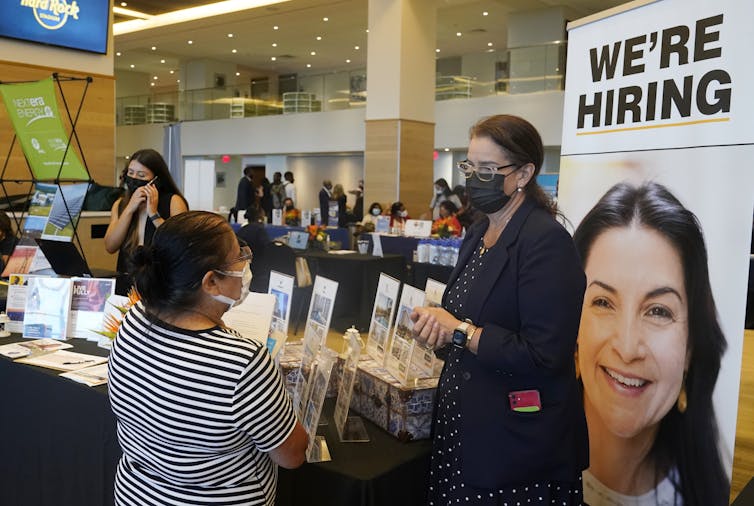
Finding good employees has always been a challenge - but these days it’s harder than ever. And it is unlikely to improve anytime soon.
The so-called quit rate – the share of workers who voluntarily leave their jobs – hit a new record of 3% in September 2021, according to the latest data available from the Bureau of Labor and Statistics. The rate was highest in the leisure and hospitality sector, where 6.4% of workers quit their jobs in September. In all, 20.2 million workers left their employers from May through September.
Companies are feeling the effects. In August 2021, a survey found that 73% of 380 employers in North America were having difficulty attracting employees – three times the share that said so the previous year. And 70% expect this difficulty to persist into 2022.
Observers have blamed a wide variety of factors for all the turnover, from fear of contracting COVID-19 by mixing with co-workers on the job to paltry wages and benefits being offered.
As a professor of human resource management, I examine how employment and the work environment have changed over time and the impact this has on organizations and communities. While the current resignation behavior may seem like a new trend, data shows employee turnover has been rising steadily for the past decade and may simply be the new normal employers are going to have to get used to.
The economy’s seismic shifts
The U.S. – alongside other advanced economies – has been moving away from a focus on productive sectors like manufacturing to a service-based economy for decades.
In recent years, the service sector accounted for about 86% of all employment in the U.S. and 79% of all economic growth.
That change has been seismic for employers. A majority of the jobs in service-based industries require only generalizable occupational skills such as competencies in computing and communications that are often easily transportable across companies. This is true across a wide range of professions, from accountants and engineers to truck drivers and customer services representatives. As a result, in service-based economies, it is relatively easy for employees to move between companies and maintain their productivity.
And thanks to information technology and social media, it has never been easier for employees to find out about new job opportunities anywhere in the world. The growing prevalence of remote working also means that in some cases employees will no longer need to physically relocate to start a new job.
Thus, the barriers and transition costs employees incur when switching employers have been reduced.
Greater options and lower costs to move mean that employees can be more selective and focus on picking jobs that best fit their personal needs and desires. What people want from work is inherently shaped by their cultural values and life situation. The U.S. labor market is expected to become far more diverse going forward in terms of gender, ethnicity and age. Thus, employers that cannot provide greater flexibility and variety in their working environment will struggle to attract and retain workers.
Employers now have a greater obligation than in the past to convince existing and would-be employees why they should stay or join their organizations. And there is no evidence to suggest this trend will change going forward.
What companies can do to adapt
It has been estimated that the cost to the employer of replacing a departing employee is on average 122% of that employee’s annual salary in terms of finding and training a replacement.
Thus, there is a large incentive for businesses to adapt to the new labor market conditions and develop innovative approaches to keeping workers happy and in their jobs.
A May 2021 survey found that 54% of employees surveyed from around the world would consider leaving their job if they were not afforded some form of flexibility in where and when they work.
Given the heightened priority employees place on finding a job that fits their preferences, companies need to adopt a more holistic approach to the types of rewards they provide. It’s also important that they tailor the types of financial, social and developmental incentives and opportunities they provide to individual employees’ preferences. It’s not just about paying workers more. There are even examples of companies providing employees the choice of simply being paid in a cryptocurrency like bitcoin as an inducement.
While customizing the package of rewards each employees receives may potentially increase an organization’s administrative costs, this investment can help retain a highly engaged workforce.
Managing the new normal
Companies should also plan on high employee mobility to be endemic and reframe how they approach managing their workers.
One way to do this is by investing deeply in external relationships that help ensure consistent access to high-quality talent. This can include enhancing the relationships they have with educational institutions and former employees.
For example, many organizations have adopted alumni programs that specifically recruit former employees to rejoin.
These former employees are often less expensive to recruit, bring access to needed human capital and possess both an understanding of an organization’s processes and an appreciation of the organization’s culture.
The quit rate is likely to stay elevated for some time to come. The sooner employers accept that and adapt, the better they’ll be at managing the new normal.
[You’re smart and curious about the world. So are The Conversation’s authors and editors. You can read us daily by subscribing to our newsletter.]
Ian O. Williamson, Dean of the Paul Merage School of Business, University of California, Irvine
This article is republished from The Conversation under a Creative Commons license. Read the original article.

LAKE COUNTY, Calif. — A jury on Wednesday convicted an Upper Lake man of the June 2017 beating death of his longtime girlfriend, a tribal member whose death illustrated on the local level the violence Indigenous women face.
The verdict in the murder trial of Willy Tujays Timmons was read out in Judge J. David Markham’s courtroom on Wednesday afternoon.
Timmons, 41, was convicted of the murder and torture of 35-year-old Vanessa Yvette Niko on June 30, 2017.
He also was found guilty of inflicting injury resulting in a traumatic condition and aggravated mayhem, with several special allegations — including use of a deadly weapon and personally inflicting bodily injury — also found to be true.
The jury deadlocked on prior allegations, specifically, two misdemeanor prior domestic violations orders that Timmons was on probation for at the time of the crime.
Deputy District Attorney Rachel Abelson said the prior allegations didn’t constitute a really contentious issue — and hadn’t actually been argued at trial — so she wasn’t sure why the jury hung on them. Following the reading of the verdict, she moved to dismiss them.
Niko, a member of the Habematolel tribe who also was of Samoan descent, has become the local face of the effort to bring more awareness to the epidemic of missing and murdered Indigenous women, also known as MMIW, which in many cases has a root in domestic violence.
Niko’s cousin, Ida Morrison, who attended every day of the trial, told Lake County News in a Wednesday night interview that she was relieved with the outcome.
“I am happy with the verdict,” she said.
She saw three of Niko’s children on Wednesday, and said they were also relieved that Timmons will serve time for killing their mother.
With Timmons’ defense attorney considering filing a motion for a new trial, Judge Markham scheduled a hearing at 8:15 a.m. Tuesday, Dec. 7, in his Department 2 courtroom, at which time the sentencing date will be determined.
It was not immediately clear how much prison time Timmons could be facing. However, it is expected to be substantial.
In addition to the murder conviction, Timmons’ conviction on the torture charge itself could result in a life sentence with the possibility of parole under state law.
The story of a murdered Indigenous woman
Niko was a mother of six; Timmons was the father of three of her children. The youngest of her children was 11 months old when she died.
In a previous interview with Lake County News, Morrison recounted how Timmons and Niko had a difficult relationship and often had to stay away from each other for periods of time.
On the day he killed Niko, Timmons came to pick her up, taking her to a home on Bridge Arbor Road in Upper Lake where, hours later, a deputy would respond to find Timmons assaulting Niko. Authorities said he struck her in the head with a rock and fatally injured her. She died at the scene shortly after the deputy arrived.
“I wouldn’t wish this on anybody,” Morrison said of what her cousin endured. “She didn’t deserve that.”
In May, a mural of Niko, with a theme calling attention to missing and murdered Indigenous women, was dedicated in downtown Upper Lake.
Niko’s life was celebrated and friends and family sought to bring attention not just to her case but those of untold others across the nation.
Morrison — who in the years since Niko’s death has fought to keep her memory alive and keep focus on the case — was credited for her work to help bring about that mural project.
She said she believes the mural has brought a lot of awareness to the community about the violence — including from domestic partners — that Indigenous women face.
Morrison said she still gets emails and messages about the mural. “It continues to keep me humble.”
She said her journey with MMIW awareness isn’t complete, and she plans to continue to stay involved in honor of her cousin.
Morrison said she has wanted to not just raise awareness of MMIW but also of the larger issue of domestic violence and its impacts on victims, female and male alike.
She encourages people in the midst of it to reach out, for others to support them by breaking the silence around it and for an emphasis to be placed on prevention.
“We need to start speaking against violence and continue to stay vigilant with that,” Morrison said.
Bearing witness
In the four years since Niko’s murder, the case had moved slowly through the courts, with numerous trial dates set and then vacated. Complicating the case in its early days was that Timmons at one point had entered a plea of not guilty by reason of insanity in the case.
More recently, COVID-19 and its impacts on the courts would see this and many other cases delayed also.
Then the trial was set again for August, only to be rescheduled once again.
Morrison and other friends and family members continued to try to raise the case’s visibility. On Sept. 21, they stood outside of the Courthouse Museum in downtown Lakeport, holding signs that read “Justice for Vanessa Niko” and “You are not forgotten,” as well as stylized outlines symbolizing Indigenous women.
That same day, across the street at the courthouse, a case management conference to finalize the details of the new trial date, set for Oct. 20, took place.
That date held, and the delays came to an end when the trial started.
Evidence in the trial began on Oct. 27. Held at the Lake County Fairgrounds to ensure the ability for social distancing due to COVID-19 concerns, the trial ran Wednesdays through Fridays.
Morrison was there for every day of the trial, along with several family members — an aunt, cousins from Lake County as well as from Chico — and a family friend. ‘We minded our p’s and q’s,” she said, not wanting anything to be held against them in the proceedings.
During the trial, Timmons took the stand, giving what Morrison said was detailed testimony.
But asked about the important statements he and others made at the trial, she said, “I don’t care to remember any of it, honestly,” nor did she care to speculate about what he was thinking or why he killed Niko.
The trial had been expected to go as late as the middle of December, but everything moved more quickly than expected, Morrison said. “I’m grateful that the trial was as speedy as it was.”
The jury began deliberations on Friday. Those deliberations continued through this week, finally ending on Wednesday. Markham convened court to hear the verdict read just after 3:30 p.m.
For the family, the verdict is a relief, and Morrison said they are still looking forward to the light at the end of the tunnel, once Timmons is sentenced. And then there is life beyond that.
“We’re just going to continue to be strong,” Morrison said.
She believes her cousin’s tragedy “has turned into her purpose,” which is to bring awareness to situations such as hers.
At the same time, Morrison expects the verdict will give hope to people who have had to endure domestic violence.
For those in a relationship marked by domestic violence, “Please get help. Reach out,” said Morrison. “As hard as it may seem, keep holding on. There is hope. There is light.”
Email Elizabeth Larson at
Following a Wednesday morning preliminary hearing, Judge J. David Markham ordered Tammy Grogan-Robinson, 57, to be held for trial for killing Charles Vernon McClelland.
McClelland, 56, of Rohnert Park, died after being shot four times in the torso by Grogan-Robinson early on the morning of July 7.
She was taken into custody in Missouri, where she has family, in August on an arrest warrant issued by the Lake County Superior Court, and extradited back to Lake County.
Grogan-Robinson entered a not guilty plea in the case last month. She is represented by Lakeport attorney Mitch Hauptman.
Grogan-Robinson initially told investigators that she shot McClelland in self-defense after he sexually assaulted her in her unit of the duplex he owned on Island Circle Drive in Clearlake Oaks.
However, in the testimony presented on Wednesday, it was stated that Grogan-Robinson had shot McClelland multiple times as she pursued him through the house.
During the hearing, Deputy District Attorney Rich Watson called four witnesses: Kenneth Hobbs, who had become friends with Grogan-Robinson after meeting her on an adult dating app, and Lake County Sheriff’s detectives Jeffrey Mora, Todd Dunia and Richard Kreutzer, all of whom were involved in the investigation of McClelland’s death.
Hauptman called no witnesses of his own, instead conducting a brief cross examination of each of the four men who took the stand.
Watson questioned Hobbs, an El Dorado County resident, about his interactions with Grogan-Robinson, who he had met earlier this year on an adult dating site that he said was more for “sexual hookups.”
She posted pictures of herself in lingerie and they texted for several weeks, talking about sex and meeting up.
Over the July 4 weekend she texted Hobbs, telling him that her ex-boyfriend — McClelland — was there and that they had become sexually involved again.
On the night of July 6, Grogan-Robinson sent Hobbs the first of several texts in which she said she was going to shoot her ex-boyfriend in the face. Hobbs said Grogan-Robinson was upset that McClelland was texting his then-girlfriend.
Hobbs said she sent five more texts, and their lengthy exchange discussed her being upset. She also said more than once that she was going to kill McClelland.
She then asked Hobbs to delete the messages. He asked why, and told her even if he did, they could be retrieved from the cell carrier.
When she first brought up shooting McClelland, Hobbs said he thought she was joking. “I told her she should not do it.”
The texts continued until late on the night of July 6.
The next morning, they had their first phone call when Grogan-Robinson called Hobbs to say she had shot McClelland and that he was dead.
She told Hobbs that McClelland had entered through her bedroom window, that her handgun was on the nightstand and there was a struggle for it, that he had sexually assaulted her and she shot him.
Hobbs said he told her that they ought not to be speaking to each other, because he said he knew she was facing legal actions, and he was looking out for her as well as for himself.
Grogan-Robinson, who was staying in a hotel room after the shooting, also texted Hobbs to ask him to come and see her.
Hobbs said he saved screenshots of their text exchanges as a precaution but didn’t call law enforcement, stating that he believed that they would find him. They eventually contacted him and he provided them with the screenshots of the texts.
Detectives testify about investigation
Mora said he responded to Sutter Lakeside Hospital on the morning of July 7 to interview Grogan-Robinson, who told him she had been sexually assaulted and then shot the person.
“She stated that she was in an on-and-off relationship with Mr. McClelland for about five years,” and that they had broken up in March, Mora said.
Grogan-Robinson lived in Unit A of the residence and McClelland lived in Unit B; while he was her landlord, he lived primarily in Rohnert Park. He came up to Lake County on July 2 and they were periodically hanging out.
She told Mora that she and McClelland didn’t have consensual sex during that visit, and that while he had suggested they should she declined because he had another girlfriend.
On the night of July 6, they had dinner and drinks, she had marijuana edibles and he smoked marijuana before going back to his residence, which she assumed was because he was texting his girlfriend.
She said that around midnight early on July 7, she was in bed and woke up to McClelland entering her bedroom. He had a 9 millimeter handgun that belonged to her and forced her at gunpoint to have sex with him.
Grogan-Robinson said she fell asleep and woke up shortly before 6:30 a.m. when her phone vibrated due to receiving a text from her job supervisor.
That’s when she saw the firearm on the bedside table opposite from where she was lying. She said she got up to put it away and McClelland came into the room and asked her if she was ready to go again.
In her statement to Mora, she said she told McClelland no, cursed at him, grabbed the firearm and began shooting as he walked toward her. Mora noted she said nothing about struggling with McClelland for the gun — a claim she’d made to others — and estimated she shot three to five rounds.
Mora said Grogan-Robinson underwent a sexual assault exam at the hospital and her home was processed for evidence.
When Deputy Joe Lyons collected the sexual assault kit at the hospital the nurse told him there were no physical findings of sexual assault. However, as of Wednesday, Mora said the sheriff’s office hadn’t received the Department of Justice’s analysis of the kit.
Det. Dunia said when responding deputies arrived at Grogan-Robinson’s residence, they found McClelland’s body just inside the front door.
Dunia said he believed one of the shots was made in the master bedroom, but he wasn’t sure if it was that shot that made a hole in the closet door.
In an interview with Dunia, Grogan-Robinson said McClelland was at the front door when she fired the last shot. She also told him she was in the bedroom when she shot McClelland, but due to the home’s layout, Dunia said the only possible way to take the final shot was to come out of the bedroom.
Dunia said he believed she was pursuing McClelland. “I believe he was trying to exit the residence.”
Grogan-Robinson also told Dunia she wasn’t sure where the bullets hit McClelland because his arms were up.
Kreutzer said he found the handgun — a Sturm, Ruger & Co. five-round 9 millimeter — in the nightstand.
He said Dr. Bennet Omalu, who conducted the autopsy, identified McClelland’s injuries as being consistent with defensive wounds.
Kreutzer said the bullets entered the left and right sides of McClelland’s torso, specifically, hitting his forearms, biceps and sides.
In his final report, Omalu ruled the cause of death as gunshot wounds to the trunk, Kreutzer said.
Watson argued at the end of the hearing that Grogan-Robinson had planned to shoot McClelland. “She carried out those acts even though the person she was texting with tried to talk her down.”
He said she shot McClelland first while in the bedroom and then pursued him through the house before hitting him with the final shot.
Judge Markham found sufficient evidence that Grogan-Robinson was responsible for the killing and ordered her to stand trial.
She will be arraigned at 9 a.m. Nov. 30 in his Department 2 courtroom.
At that time, Markham also scheduled a bail review for Grogan-Robinson. As a result of a hearing in late September, Markham had ordered she be held without bail because he considered her a flight risk and a danger to the community.
Email Elizabeth Larson at

LAKEPORT, Calif. — November is National Hospice and Palliative Care Month, a time to recognize and celebrate this specialized type of care — care for the whole person, including medical, emotional, personal and spiritual care, as well as grief support for the person’s loved ones.
“Hospice Services of Lake County encourages everyone to learn more about the many benefits of comfort care to help a person to experience as much quality in life as possible despite a serious or life-limiting illness,” said Hospice Services Executive Director Cindy Sobel.
Hospice care is provided wherever a patient calls home and is covered 100 percent by Medicare, Medi-Cal and many private insurance plans.
Hospice care is provided by a full team that includes the medical director, Dr. Peter Stanley, registered nurses, licensed vocational nurses, home health aides, social workers, spiritual care givers and specially trained volunteers. Grief counseling is also offered to the patient and family.
Services include medication for symptom management and pain relief, medical equipment such as oxygen, a hospital bed or a wheelchair and supplies, as appropriate for the patient’s care.
Patients interested in comfort care may have a wide range of diagnoses such as Alzheimer’s disease, liver failure, heart or lung disease, or cancer. No matter a patient’s age or condition, comfort care is available for anyone with a life-limiting illness meeting eligibility requirements, regardless of ability to pay.
When people are not feeling their best, they want to be home — out of the hospital — and live as normally as possible. Seven in 10 Americans say they would prefer to die at home, according to a Time/CNN poll. Comfort care is part of a solution that honors people’s wishes and ability to stay at home at a time when each moment is precious.
Sooner is better. If you are interested in information about comfort care, you are encouraged to contact Hospice Services of Lake County, and sooner is better. Sometimes we need help but are not sure what we need or what is available. You don’t have to be referred by a physician to start the inquiry process.
“By contacting our office, we can help you determine if the time is right,” said Sobel. “We’ll discuss your greatest needs and goals and answer questions to help make informed decisions. One important thing to remember is that you have a choice. Even if you do not have a referral from a doctor, you can still reach out to start the process.”
Choosing a compassionate, professional hospice is an important decision. Examining your options earlier is always best.
Robert Coats said of the hospice care provided for his mother Mary Coats, a longtime resident of Clearlake, “The hospice team is supporting our family by giving expert care to make sure my mother’s final months are as content and comfortable as possible. Hospice staff are not only medical professionals but also have become our friends.”
“This time at the end of life is often difficult and stressful, but Hospice Services of Lake County is there with care and support so that patients and loved ones can find meaning and peace,” said Sobel.
Hospice Services of Lake County is a nonprofit organization serving the community for 43 years.
For assistance or information on hospice and palliative care services, to donate or to volunteer, please contact 707-263-6222, or
Janine Smith-Citron is director of development for Hospice Services of Lake County.
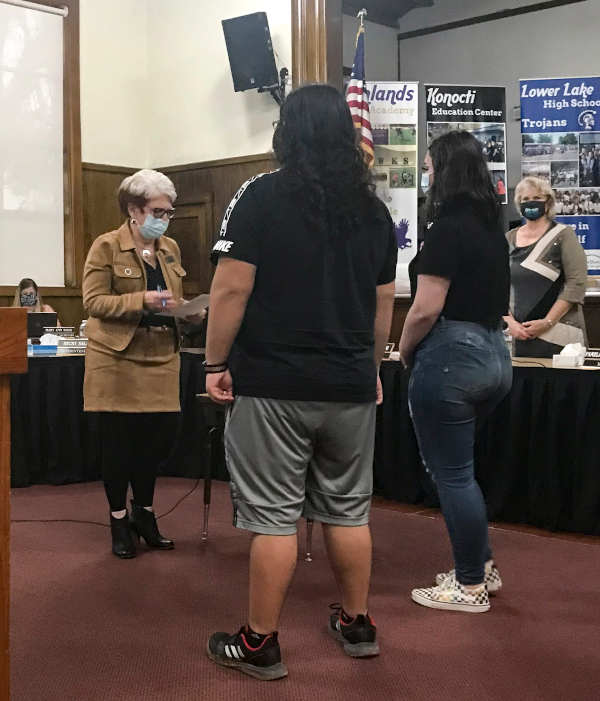
LAKE COUNTY, Calif. — On Oct. 27, Konocti Unified School District Board members welcomed two student representatives to their ranks: Amethyst McCoy and Isaac Huffman, both high school seniors.
After swearing in the students, Superintendent Becky Salato congratulated them and told them she looks forward to hearing their perspectives on a range of issues important to local students.
“The best way to be responsive to our students’ needs is to fully understand those needs. What better way than to hear from the students directly? Amethyst and Isaac are excellent choices to represent Konocti students because they value education and are willing to engage in the process to help things improve,” Salato said.
McCoy, who refers to themself as non-binary and prefers the pronouns they/them, is a senior at Lower Lake High School where they participate in Upward Bound, a class that provides opportunities for participants to succeed in their precollege performance and ultimately in their higher education pursuits, or as McCoy put it, to help students overcome barriers to college and to discuss real-world problems.
McCoy’s Upward Bound teacher, Michael McMurtrey, invited McCoy to consider the role of student board representative, in large part, because they have demonstrated the ability to see issues clearly and to engage in discussions about how to address them.
Huffman, a senior at Konocti Education Center and a Middle College student, is the other student representative.
Huffman currently serves as Associated Student Body president and senior class vice president, so when his civics teacher and school principal asked whether he would be interested in taking on the role of student board representative, he said he was happy to do so, as it is another way to represent and advocate for fellow students.
Both student representatives have attended at least one board meeting so far. Using the example of managing COVID — keeping schools safe, paying contractors for COVID testing, and more — McCoy said they believe most students are unaware of and uninterested in these types of issues, and probably will remain so unless students can understand how the issues affect them directly.
Huffman believes one of the most important issues facing Konocti Unified is the continuing effects of the pandemic on students’ emotional states. He said social norms are in the process of being reestablished at school.
“Power dynamics between grades are indeterminate. And some [students] are still trying to accept the fact that we've missed two years in school. People are still catching up, readapting to social dynamics,” he said.
He encouraged schools to continue to inform students about the services available through social-emotional counseling, and he encouraged students to speak up if they need support.
“I think schools are doing a pretty good job. Ultimately, you can only help people as much as they want to be helped. I’d say some people are struggling, but most are adapting,” Huffman said.
In the wake of COVID-19, another issue affecting students is the lack of teachers.
“Mainly, I want the district to work on hiring more teachers or more subs, because at the moment, a lot of teachers are out every day,” said McCoy. “At least three or four classes are held in the MPR and two classes are in the library.”
McCoy expressed concern that those locations would be difficult to evacuate in the event of an emergency.
“There is good stuff happening at Lower Lake High School,” McCoy said. “A lot of teachers are trying to teach as much as they can, even with the interruptions of disruptive students. They are trying really hard to get through as much curriculum as they can.”
Both students are pleased to represent their classmates on the school board. They come from different backgrounds but share a belief in the importance of education.
McCoy has been in Lake County for the past seven years after moving to the area from Illinois. When they’re not at school, they spend their time studying, playing video games, watching anime, and “obsessing over BTS,” a popular K-pop band.
After college, McCoy plans to travel to South Korea to teach English, and then return to Lake County to teach the Korean language to local students, “so native Spanish speakers would have another language option.”
Huffman was born and raised in Lake County. In fact, his grandfather, Bud Shipley, served as a school board member years ago, and is quite pleased with Huffman’s appointment to the board.
When Huffman graduates this spring, he hopes to have both a high school diploma and his associate degree from Woodland Community College’s Lake County Campus. In the fall, he hopes to attend a four-year university majoring in engineering or education, though he is keeping his options open.
Both students look forward to sharing their ideas with board members and informing their classmates about board issues.
McCoy admitted to feeling nervous about speaking up but said they “absolutely” felt welcome and encouraged to speak their mind.
“I get nervous about bringing stuff up, but I want to make the school a better place, so I will,” McCoy said.
Huffman said he plans to bring forth student issues and updates on what is going on at Konocti Education Center. He said his first board meeting “exceeded expectations,” as he was sworn in and then seated with the elected board members.
LAKE COUNTY, Calif. — For the third time this year, the Board of Supervisors overrode its planning commission and granted an appeal of a major cannabis operation.
In a 3-2 vote that followed about four and a half hours of testimony and discussion, the board upheld an appeal filed by Don and Margie Van Pelt against the Sourz HVR Inc. project on the 1,640-acre High Valley Ranch, the former PSI World property, located at 11650 High Valley Road in Clearlake Oaks.
The Lake County Planning Commission approved the project’s major use permit and adoption of initial study for a commercial cannabis cultivation license in July over the objections of neighbors like the Van Pelts.
The company, which also received permission for early activation of its project, proposed 80 acres of outdoor cannabis cultivation, five acres of nursery area, a distribution license to allow for transport of cannabis goods, the construction of 11 buildings for drying and storage totaling 111,000 square feet and the use of the existing 13,000 square foot conference center for packing, distribution and office space on a 649-acre portion of the ranch.
The Van Pelts, who own a number of local businesses including Cache Creek Vineyards and Winery, appealed the planning commission’s decision within a week, as is required by law.
They faulted the project on all of its key points — from dust and odor, to traffic, water usage and other issues that, together, they argued will detrimentally impact the quality of life in High Valley.
The appeal was scheduled to be heard on Oct. 19 but was held over for a month after the Van Pelts’ attorney, Brad Johnson, requested more time. At that point, the county was busy working to fulfill a large Public Records Act request submitted by Johnson on Sept. 17.
Late Monday afternoon, Johnson submitted a 145-page brief to the county elaborating on the existing arguments and placing additional emphasis on issues with grading.
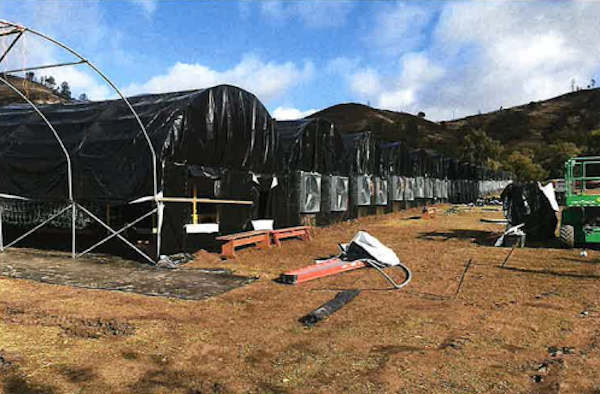
But what appeared to be a larger problem for the project was the temporary installation of structures that Sourz said were hoop houses needed for drying cannabis.
County code states, “The early activation permit shall not allow any construction, grading, or removal of mature trees on the property.”
That put Sourz in a position where it didn’t have a facility for drying the crop, which led to erecting what the company’s attorney, George MacDonald, insisted were temporary structures.
On Oct. 25, Code Enforcement Officer Marcus Beltramo and Assistant Planner Katherine Schaefers visited High Valley Ranch and found 21 fully constructed 4,000-square-foot hoop houses, each 20 feet wide by 200 feet long, with another three under construction and a 2,000 square foot structure to be used for storage.
County staff said they didn’t meet the definition of hoop houses — which must not have electrical equipment. In this case, the structures had heaters, lights and fans. Hoop houses also are supposed to be made of translucent material, and the ones on High Valley Ranch were black materials over metal framework.
Beltramo’s inspection report said there was evidence to substantiate 25 violations of the conditions of approval for early activation and 25 violations of building code due to there being no electrical permits issued for the structures.
The county’s Code Enforcement Division subsequently issued a notice of violation for the structures.
Had the structures actually met the definition of hoop houses, they would have been allowed without a permit for the purposes of agricultural cultivation.
Attorney targets supervisor over text messages
Planning consultant Richard Knoll, who formerly served as the city of Lakeport’s Community Development director, was part of the team representing the Van Pelts, who he said asked for his help after the planning commission decision.
Knoll said he had suggested Don Van Pelt hire an attorney, and recommended Brad Johnson, who MacDonald pointed out later in the meeting is the attorney for two other large-scale cannabis projects, Bar X and Lake Vista Farms.
Knoll also is connected to Lake Vista Farms, having represented it before the Clearlake City Council last year. Last week, he represented Ogulin Hills Holdings LLC before the Clearlake Planning Commission in its 21-acre cannabis project. One of the partners in that project, Brian Pensack, is listed as the manager of Ogulin Hills Holdings as well as Lake Vista Farms, both of which are LLCs registered in the state of Delaware and share the same San Rafael address.
In his remarks to the board, Knoll said county ordinance seemed to require an objective analysis of the project to determine if it will be detrimental to health and safety. The ordinance, he added, doesn’t say it’s OK to simply refer to an initial study under the California Environmental Quality Act.
“The county has an opportunity handed to them to analyze this project in real-time,” Knoll said, and to look at the work done during the early activation, read comments and complaints, and assess if it’s actually creating detrimental impacts.
In his review, Knoll said the High Valley neighborhood didn’t get an objective or reasoned review, with Van Pelt and other neighbors being detrimentally impacted.
In his presentation, Johnson took an unusual approach when he used documents he received from his Public Records Act request to allege that county officials — in particular, Board Chair Bruno Sabatier — were showing favoritism toward Sourz. Specifically, he showed texts between Sabatier, county staff and Sourz staff discussing efforts to move the project along in an attempt to prove the point.
Johnson wanted Sabatier to recuse himself from the discussion, and Sabatier refused. When Johnson continued his statements about the text messages, Sabatier attempted to give context to the messages. Johnson told him to stop interrupting.
“I suggest counsel watch his tone with the board,” County Counsel Anita Grant said to Johnson in a rare admonishment.
Johnson faulted the project for inadequate analysis on myriad topics including traffic, the hoop houses and grading that led to violations from the California Department of Fish and Wildlife. He claimed county staffers were pressured by the applicant to push the project through the process.
He also questioned the project’s use of water from nearby Brassfield Winery via an aboveground pipeline that MacDonald said has been dismantled.
“Today’s discussion is not about who’s right,” but whether there is enough information submitted that there is a fair argument that the project may have a significant impact on the environment, Johnson said.
If so, he said the county has to do an environmental impact report, or EIR, on the project.
Johnson went on to ask the board to grant the appeal, deny the project, abate the current activities and start the EIR. He said he was concerned that county staff would attempt to resubmit the project after the violations were abated and before an EIR was done.
Applicant’s attorney points to conflicts
For his part, MacDonald argued that nothing new with regard to the project had been revealed due to Johnson’s Public Records Act request. Rather, MacDonald stressed Johnson’s conflicts of interest.
In a 19-page letter to the board submitted on Nov. 12, MacDonald said, “the involvement of Mr. Johnson in this matter should be viewed by the Board of Supervisors with great scrutiny because he is representing the interests of market competitors ‘Bar X’ and ‘Lake Vista Farms.’”
Bar X proposes to grow up to 80 acres of cannabis on the Bar X Ranch, located on 1,600 acres near Middletown. Lake Vista Farms, located at 2050 and 2122 Ogulin Canyon Road, Clearlake, plans for nearly 26 acres of cultivation.
“Mr. Johnson’s clients, Bar X and Lake Vista Farms, are large scale commercial cannabis operations in Lake County. Thus, the Sourz Project is a direct market competitor of these similar Projects,” wrote MacDonald.
He said Bar X’s prospectus supplement, used to attract investors and shareholders, “boasts that the Bar X project will have a maximum ‘capacity to grow up to 80 acres of cannabis’ and that it ‘will be the largest cannabis cultivation operation in the region.’ Once the Sourz Project becomes fully operational, these representations made by Bar X to its investors and shareholders will no longer be true. Thus, Bar X, and its attorney Bradley Johnson, are highly motivated to disrupt and interfere with the Sourz Project for pure market competition and manipulation purposes having nothing to do with environmental concerns.”
Regarding the results of the Public Records Act request, “Appellant has cherry picked text messages and taken them out of context to say they prove things they don’t,” MacDonald told the board on Tuesday, adding that what occurred at the meeting was textbook for “dirty litigation practices,” and constituted “trial by ambush.”
MacDonald said High Valley is an agricultural area, that there is a right to farm act in California, and that PSI Seminars had far more traffic than this project is expected to have.
He maintained that the planning commission didn’t approve it due to preferential treatment.
Regarding the hoop house structures, MacDonald said that as soon as the violation was filed against them, the work started to take them down. As of Monday night, six had been removed.
Praise and criticism
During public comment, Richard Derum, a Realtor, cannabis grow and consultant who has supported the project as it has made its way through the county’s approval processes — including making appearances at planning commission meetings — told the board that the plan is the most comprehensive he’s seen.
He called opposition to it “NIMBY on steroids” — NIMBY standing for “not in my backyard” — and that the applicants have been put through too much.
On the other side was neighbor Maria Kann, a consistent project opponent who has lived in High Valley for 22 years. She said she’s experiencing harm from the project, citing issues of dust, stress, litter, unsafe and impaired drivers, noise and traffic around the lock.
Another neighbor, Bryan Valentine, also stated his opposition due to noise, smell, traffic, environmental destruction and water usage. He said they needed to do what’s right, and that it’s not all about the “mighty dollar.”
Lake County Cannabis Alliance President Jennifer Smith said the project meets the land use components for the county’s cannabis program.
She called it a “landmark situation” that will set the tone for the rest of Lake County and impacts projects still in the queue.
Sabatier had indicated a desire to continue the public hearing to early December to give time to review the additional documents and testimony. He felt the noncompliant hoop houses were a glaring issue but he still wanted to find a way to say yes to the project.
However, Supervisor EJ Crandell in whose district the project is located, said the project needed more mitigation for neighbors. Crandell, attending the meeting via Zoom, moved to uphold the appeal. Supervisor Moke Simon seconded the motion.
When the vote was called, Crandell and Simon voted yes, and supervisors Tina Scott and Jessica Pyska voted no. Sabatier, who continued to struggle with finding a legitimate pathway forward, finally added his own yes vote.
In voting 3-2 to uphold the appeal, the board granted it without prejudice, which allows Sourz HVR to reapply.
Last month the board granted an appeal of Blue Lake Organics LLC’s project in Upper Lake and remanded it back to the planning commission for further environmental review and earlier this year upheld an appeal of the WeGrow project near Hidden Valley Lake, also without prejudice, citing a faulty environmental document. WeGrow is set to appear before the Lake County Planning Commission this week with the newest version of its project.
Email Elizabeth Larson at