LAKE COUNTY, Calif. — With drought conditions deepening, the Board of Supervisors this week will discuss implementing an urgency ordinance that would place a temporary moratorium on the approval of new agriculture and cannabis cultivation projects in an effort to protect the county’s water supply.
The board will meet beginning at 9 a.m. Tuesday, April 12, in the board chambers on the first floor of the Lake County Courthouse, 255 N. Forbes St., Lakeport.
The meeting ID is 922 6873 1689, pass code 053458. The meeting also can be accessed via one tap mobile at +16699006833,,92268731689#,,,,*053458#.
All interested members of the public that do not have internet access or a Mediacom cable subscription are encouraged to call 669-900-6833, and enter the Zoom meeting ID and pass code information above.
At 3:30 p.m., the board will consider an interim urgency ordinance proposed by Supervisor Bruno Sabatier that would place a temporary, 45-day moratorium on new agricultural and cannabis cultivation projects.
In his written report, Sabatier quotes a recent study that said the current drought “represents the largest Southwestern North American area to experience a top-five 22 year drought-severity ranking in at least 1,200 years.”
He said Lake County Water Resources has reported that the drought conditions may cause Clear Lake’s levels to drop close to the 1976 and 1977 lake levels, “one of our worst documented droughts of our recent past.”
Sabatier noted in his report, “Lake County needs to do a better job of conserving water and not adding any new burden to an already stressed water system any more than it already is.”
On the topic of pausing the permitting of projects, Sabatier wrote, “Adding more agricultural operations and cannabis cultivation projects to a 22 year drought that is currently exhibiting severe drought conditions is not appropriate. We do not know how much longer this drought will continue. We know that all water purveyors struggled last year, and this year is not proving to be any different.”
He’s asking for a 45-day moratorium on new projects relating to agriculture and cannabis due to the drought with possible extensions in the future, during which the county would come up with protection and conservation measures.
Sabatier said agricultural operations converting native land to ag land will be prohibited under this moratorium.
However, he said both cannabis cultivation and agricultural operation projects that have already had their projects sent to the state clearinghouse can continue with their approval process. Other projects would not be able to obtain final approval until the moratorium has been lifted.
He said projects can and will continue the planning process so they can be approved once the moratorium is over.
Sabatier also wants the board to consider a letter to Gov. Gavin Newsom requesting a halt on new cannabis cultivation licensing statewide, while the county pauses in providing more cannabis cultivation licenses “until the state finds itself in a better drought situation.”
As part of that discussion, Sabatier is asking the board to consider directing the Lake County Drought Task Force to come up with new drought guidelines for agriculture and cannabis, along with new standards for hydrology reports as well as review standards.
“By creating these new guidelines and standards, we can continue to approve future ag and cannabis projects with an elevated standard to meet so that their activities will be successful and not have a cumulative impact to neighboring areas whether or not there is a drought,” he wrote.
The board also will discuss other potential actions to respond to the drought, such as taking actions against illegal cannabis grows, regulating commercial water sales and enforcement on drought issues.
In other business, at 9:15 a.m., the board, sitting as the Lake County Housing Authority Board of Commissioners, will consider the first amendment to the 2021 agreement to develop affordable housing by and between the Lake County Housing Authority and the Rural Communities Housing Development Corporation and also discuss a request for an audit.
In an item timed for 11 a.m., the board will discuss cannabis tax reform and consider a resolution amending the county’s cannabis cultivation tax due dates.
At 9:07 a.m., the board will present a proclamation designating the month of April 2022 as Sexual Assault Awareness Month and at 9:10 a.m. they will declare the week of April 10 to 16, 2022, as National Public Safety Dispatchers Week.
The full agenda follows.
CONSENT AGENDA
5.1: Adopt ordinance amending Ordinance 3062, revising Section 2-192.1, Article XXVI, Chapter 2 of the Lake County Code, providing authority to execute leases and licenses.
5.2: Adopt resolution approving Agreement No. 22-73-06-0256-RA with the USDA Animal and Plant Health Inspection Services for period July 1, 2022 through June 30, 2023 for the amount of $118,048.
5.3: Adopt resolution amending Agreement No. 20-0153 with the state of California, Department of Food and Agriculture and authorize the execution of post-consumer certification contract and contractor certification clause and signatures for insect trapping in the amount of $145,115.00 for activities in FY 20-22.
5.4: Sitting as Lake County Air Quality Management District Board of Directors: Authorize the air pollution control officer to sign and submit an application for Carl Moyer Program Year 24 funding and sign all other program documents.
5.5: Approve to waive the 900 hour limit for certain client service assistant positions within the Department of Behavioral Health Services.
5.6: Approve Amendment No. 1 to the agreement between county of Lake — Lake County Behavioral Health Services as lead agency for the Lake County Continuum of Care and Elijah House Foundation for fiscal years 2020-21, 2021-22, and 2022-23 and authorize the board chair to sign.
5.7: Adopt proclamation designating the month of April 2022 as Sexual Assault Awareness Month in Lake County.
5.8: Approve revised Board of Supervisors meeting minutes for Sept. 28, 2021.
5.9: Adopt resolution amending Resolution No. 2021 – 116 Establishing position allocations for recommended FY 2021-2022, Budget Unit 2702.
5.10: Approve addendum to corrected certification of county elections official of results of the official canvass of election returns and the results of the 1% manual tally of randomly selected voting precincts for the Sept. 14, 2021, Statewide Special Election.
5.11: Adopt resolution amending Resolution No. 2021-116 establishing position allocations for fiscal year 2021-2022, Budget Unit No.2302, Probation.
5.12: Adopt proclamation designating the Week of April 10 to 16, 2022, as National Public Safety Dispatchers Week.
5:13: a) Approve purchase of the 34 Dell 5430 Rugged Mobile Data Computer and authorize the sheriff or his designee to issue a purchase order in an amount not to exceed $110,000; and b) authorize the sheriff or his designee to issue a purchase order to Precision Wireless for the removal and installation of the units in each patrol vehicle in an amount not to exceed $30,000; and c) approve the budget transfer into object code 62.74 for the capital asset.
5.14: Approve contract between county of Lake and North Coast Opportunities Inc. for the Housing Support Program, for the term of Dec. 1, 2021, to June 30, 2022, in the amount of $774,816, and authorize the chair to sign.
TIMED ITEMS
9:05 a.m.: Pet of the week.
6.3, 9:07 a.m.: Presentation of proclamation designating the month of April 2022 as Sexual Assault Awareness Month in Lake County.
6.4, 9:10 a.m.: Presentation of proclamation designating the week of April 10 to 16, 2022, as National Public Safety Dispatchers Week.
6.5, 9:15 a.m.: Sitting as the Lake County Housing Authority Board of Commissioners, a) consideration of first amendment to the 2021 agreement to develop affordable housing by and between the Lake County Housing Authority and the Rural Communities Housing Development Corporation; and b) consideration of request for an audit.
6.6, 9:30 a.m.: Public hearing on account and proposed assessment for 7268 Liberty St., Nice, CA, 95464.
6.7, 10 a.m.: Public hearing, discussion and consideration of appeal (AB 21-05) of Planning Commission approval of Major Use Permit 19-36 and IS/MND 19-56 “Lake Vista Farms, LLC”, Clearlake. APN’s 010-053-01 and 010-053-02.
6.8, 11 a.m.: a) Discussion of cannabis tax reform; and b) consideration of resolution amending cannabis cultivation tax due dates.
6.9, 3:30 p.m.: a) Consideration of interim urgency ordinance placing a moratorium on new agricultural and cannabis cultivation projects; and b) consideration of letter to Gov. Newsom requesting a halt on new cannabis cultivation licensing statewide; and c) consideration of requesting the Lake County Drought Task Force discuss, draft, and provide ag/cannabis guidelines during drought conditions; and d) consideration of discussion of other actions regarding drought.
UNTIMED ITEMS
7.2: Consideration of Community Project Funding Resolution: a) Middle Creek and Community Project Funding Resolution; b) Middle Creek Flood Damage Reduction and Ecosystem Restoration.
7.3: Consideration of the following advisory board appointments: Lucerne Area Town Hall.
CLOSED SESSION
8.1: Public employee appointment pursuant to Gov. Code Section 54957(b)(1): Interview of interim county administrative officer; appointment of interim county administrative officer.
8.2: Employee disciplinary appeal (EDA 22-01) Pursuant to Gov. Code sec. 54957.
Email Elizabeth Larson at This email address is being protected from spambots. You need JavaScript enabled to view it.. Follow her on Twitter, @ERLarson, or Lake County News, @LakeCoNews.
Congressman Mike Thompson will host a virtual town hall this week to discuss community members’ concerns about the economy, inflation and the global market.
The town hall will take place beginning at 7 p.m. Pacific Time on Wednesday, April 13.
Thompson’s special guest on Wednesday will be Ronnie Chatterji, chief economist for the United States Department of Commerce, to discuss and answer questions regarding inflation, gas prices, how we are strengthening supply chains, and effort to increase the country’s competitiveness in the global market by supporting Buy American policies.
Thompson (D-CA-05) represents California’s Fifth Congressional District, which includes all or part of Contra Costa, Lake, Napa, Solano and Sonoma counties.
If you are not able to make the town hall but have any questions about his work, upcoming legislation to tackle high prices, or issues that affect business in the district, call him at one of his district offices in Napa (707-226-9898), Santa Rosa (707-542-7182), and Vallejo (707-645-1888) or email This email address is being protected from spambots. You need JavaScript enabled to view it..
LAKE COUNTY, Calif. — Lake County Animal Care and Control has three beautiful female cats waiting for new homes this week.
Call Lake County Animal Care and Control at 707-263-0278 or visit the shelter online for information on visiting or adopting.
The following cats at the shelter have been cleared for adoption.
“Maddie” is a 6-year-old female Persian cat in cat room kennel No. 7, ID No. LCAC-A-3267. Photo courtesy of Lake County Animal Care and Control. ‘Maddie’
“Maddie” is a 6-year-old female Persian cat with a long fluffy white coat.
She is in cat room kennel No. 7, ID No. LCAC-A-3267.
This 5-year-old female Siamese cat is in cat room kennel No. 68, ID No. LCAC-A-3238. Photo courtesy of Lake County Animal Care and Control. Female Siamese
This 5-year-old female Siamese cat has a short white coat with gray markings.
She is in cat room kennel No. 68, ID No. LCAC-A-3238.
“Delilah” is a 2-year-old female domestic longhair cat in cat room kennel No. 103, ID No. LCAC-A-3070. Photo courtesy of Lake County Animal Care and Control. ‘Delilah’
“Delilah” is a 2-year-old female domestic longhair cat with a gray coat with white markings.
She is in cat room kennel No. 103, ID No. LCAC-A-3070.
We have a private, single drinking water intake that takes in water from Clear Lake and provides tap water and wash water to our lakeside summer vacation cottage. With the drought and algae concerns this year, what do I need to know about being able to safely drink and use our water?
— Carly at the Cottage
Dear Carly,
Thank you for reaching out about this topic! I am also glad that you are asking this topical question and thinking ahead. Right now is a good time to be preparing for the summer season, with expected low water levels due to drought combined with warm summer temperatures, we can expect a very heavy cyanobacteria season. Heavy cyanobacteria means that drinking water systems, both public and private, will require more attention to operate safely.
Let’s remind ourselves that cyanobacteria are not algae, they are in completely different categories in the “biological kingdoms of living things.” Cyanobacteria, since they are bacteria, are in the monera kingdom with other prokaryotic bacterias. Green algae, or phytoplankton are grouped into the protista kingdom.
In Clear Lake, the green algae does not produce toxins or pose human health concerns when exposed or ingested. Some types of cyanobacteria in Clear Lake, especially in the warm and long days of summer and fall, produce high concentrations of toxins that can pose health concerns to humans and pets when exposed to the skin or ingested.
Not every person responds the same way to a cyanobacteria exposure, it’s comparable to allergies in that everyone is affected differently and has different symptoms. Some people never notice when they swim in water or ingest a small amount of water with cyanobacteria and some people go wading one time and get rashes or flu-like symptoms for a day or more.
These cyanobacterias are the main concern for small, individual drinking water systems on Clear Lake, as high concentrations of cells, and the toxin they produce, can overwhelm smaller systems, making the filtering and chemical treatments uneffective, increasing the potential for exposure through drinking or bathing water.
Understanding what type of drinking water system you have
To reiterate, today’s column will mostly focus on small, or single, private, individual drinking water systems (less than 14 connections or homes). These systems start with an intake pipe, usually on a private, residential property, that takes water directly from Clear Lake, and into a small treatment or filter system on your property or inside your home. Sometimes a few neighbors, cottages, or a small resort or mobile home estate will have private systems with less than 14 connections. These are all considered small, private, individual, or very small drinking water treatment systems.
These types of small, individual systems are not regulated by the State or the County. Safe operation, maintenance, and monitoring of these systems is provided by the homeowner or property manager.
Today’s column will notfocus on large public or private purveyor drinking water systems. If you pay a bill to a company that treats and distributes your drinking water to your home, and your neighbors, through a pipe, then you are on a public, or municipal, or large private company drinking water treatment system. These systems are fully regulated by the State’s Drinking Water Division.
If you do have municipal, public, or large private drinking water that you pay a company every month or every other month, I will refer you to several references where you can find more information about those types of systems and the monitoring that is done.
I wrote about drought and drinking water systems, and cyanobacteria, in my “Distressed about Drought” column on July 25 2021. This column would be a good refresher to drought impacts on larger drinking water systems.
To access your public or large private system monitoring data, as well as other system information, visit the CA Drinking Water Watch website. This website includes information like system details, facilities, monitoring results and schedules, violations or enforcement actions, and copies of consumer confidence reports. This resource is provided by the Drinking Water Division of California and provides information for all state-regulated systems, not just those with intakes on Clear Lake.
To learn about cyanobacteria monitoring that is done on these public, municipal, or large private systems, you can watch an informative County of Lake Water Quality Wednesday webinar from the Lake County Water Resources, Public Health Department, and Special Districts that was recorded on Sept. 1, 2021.
Recording of Water Quality Wednesday Webinar September 1, 2021. Clear Lake Drinking Water and Cyanobacteria. Presenters included Rachel Kennard (UC Davis and Cal Rural Water Association) and Sarah Ryan (Big Valley EPA).
Unregulated individual drinking water systems
If you have been out on the lake so far this season, you might have noticed that it looks pretty good. Some areas are even blue and very clear. While so far things seem relatively fine, we should prepare for a point in the season when we will see an interaction of quantity (low lake levels) and quality (extremely severe blooms of algae and cyanobacteria) impacting small, individual drinking water systems.
The upcoming low water levels, combined with hot and long summer days might cause trouble for small or individual systems with smaller treatment or filter capacities. These systems are unregulated by any local or state government, and not monitored for effectiveness or performance. Therefore a household may be paying a significant amount of money for a service provider to “be treating” their water that comes directly from Clear Lake, but there is no oversight to these type of systems or laws to protect the consumer, like there are for public, municipal, or professionally large treatment systems and purveyors.
The owner of the system is the responsible party for ensuring these systems are maintained and serviced regularly. Additionally, some small treatment service providers are unfamiliar with the unique and special needs of being a small, individual treatment system on Clear Lake, a unique lake that is enriched with 500,000 years of organic matter and suffers from very frequent and sometimes severe toxic cyanobacteria blooms.
These small, individual systems are usually capable of providing safe drinking water from natural water sources, but during the late summer, when Clear Lake experiences frequent and severe cyanobacteria bloom events, the amount of organic material in the water can overwhelm these private, small systems. Even boiling or chlorinating the water will not remove cyanobacteria cells or the toxins they produce, in fact these methods make the toxins more pronounced and cause more exposure risk.
Public,municipal and large private professional systems on the other hand, are much larger, with multiple layers of treatment and filters in place that adequately remove cyanobacteria cells from the raw water of Clear Lake, before entering the chemical treatment process. In fact, in 2021, the State of California Drinking Water Division of the State Water Resources Control Board, mandated cyanobacteria monitoring of all the 18 public, municipal and large private drinking water systems on Clear Lake. Every system that was monitored at the tap resulted in no exceedances for cyanobacteria microcystis toxins and were safe for drinking.
Be aware of drinking water advisories
Last year the concentrations of toxins produced by some cyanobacteria in Clear Lake were sampled at such high, concerning levels that the Public Health Officer issued an advisory, followed by a news release, urging some households on small, private, individual systems in certain areas of the lake to stop drinking their water.
This release was issued on Sept. 16, 2021, when the summer months and low water levels had created perfect conditions for exceptionally large and severe cyanobacteria blooms to occur. People on private, small individual systems, in mostly the Oaks and Jago Bay area, were warned to not drink the water from their tap, only if they were part of a small system of 14 connections or less, or had a single intake directly from the lake into their home and managed their own drinking water treatment system.
The advisory also recommended homeowners to purchase their drinking water or fill up clean containers from alternative filling stations provided by commercial or public treatment systems. These companies were Konocti Municipal Water Company (Kelseyville) and Golden State Water Company (Clearlake). These two large private, professionally-treated drinking water purveyors were providing treated, potable water for those in areas who had private intakes providing temporarily unsafe water.
It really is amazing how the community and businesses come together in times of crisis to support one another; we are grateful to these companies to step up to provide safe drinking water sources for free during a time of need.
Be prepared and get help monitoring your small or individual drinking water intake
If you or your household is on one of these small, individual systems (less than 14 connections) then you might want to be more vigilant this year about monitoring your drinking water at the tap. Luckily, local tribal organizations and partners have developed a program to monitor and track this information at no cost to the homeowners.
Big Valley Band of Pomo Indians, working with Tracking California, the Institute of Health, and the Drinking Water Division of the California Water Resources Control Board, are currently working on a grant program to monitor cyanobacteria — and other contaminants — in private, small, individual drinking water systems of Clear Lake. This program is called the California Water: Assessment of Toxins for Community Health Project, or Cal-WATCH. Visit the Tracking California Cal-Watch Project website here.
The Cal-Watch program started last year in 2021, and Big Valley EPA Director, Sarah Ryan, and the Cal-Watch team have learned a plethora of information about public health when it comes to private, individual drinking water systems on Clear Lake.
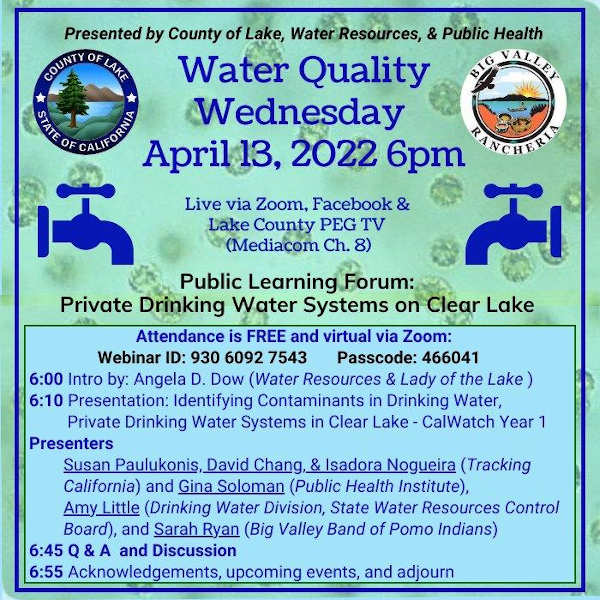
The results from the 2021 Cal-Watch project will be presented this coming Wednesday. April 13th 2022, at 6 p.m. at an online Water Quality Wednesday Public Learning Forum. This webinar is hosted by the County of Lake, Water Resources Department, and Public Health Department.
This webinar is free, open to the public, and will be accessible through zoom, County of Lake Facebook Live, and through PegTV (Mediacom Channel 8). The webinar will be recorded and available on the County of Lake YouTube channel and Water Resources Department Cyanobacteria webpage. To access the webinar through zoom, use Webinar ID: 930 6092 7543 and Pass code: 466041.
This webinar will present the data and results from monitoring for contaminants in private, small drinking water systems on Clear Lake, in addition to some well monitoring data. The presenters will talk about their findings from a monitoring during a drought year, which will be applicable for this coming summer during the third year of drought conditions.
What to do?
Now, if you are like Carly and her cottage, and your small, individual private drinking water system is questionable or incapable of effectively treating Clear Lake source water during high bloom events, such as were experienced last year, there really is not an easy fix. There is no magic small treatment system that can handle the conditions Clear Lake sometimes contains.
The absolute best and safest solution would be to try to connect to a municipal, public or large private system that is regulated and mandated by the state to monitor and remove cyanobacteria from their systems. Currently large systems, adjacent to areas with no municipal water sources, are looking at plans for expanding their connections into these areas. If you are concerned or curious, you can call the treatment purveyor closest to you and ask about these plans and feasibility of including your home as a connection. If the company knows that they might have customers in the area, it might increase the rate and speed of expansion of their system to your area.
The next solution, if the first one isn’t possible, is to be prepared for not using your drinking tap water when a significant and severe bloom occurs and a public health advisory is released for your area. This doesn’t happen every year, but is more likely to occur during times of drought and longer, warmer summers. Again, this recommendation is only for small, individual private intake systems that are located in areas identified in a public health advisory notice. This does not apply to large private, public or municipal drinking water systems, as their tap water is regularly monitored and safe to drink.
Being prepared means having extra gallons of drinking water on hand as well as having an alternative source for drinking water. Make sure to have clean containers and reliable transportation to get those containers filled if needed.
If you don’t have access to reliable transportation to get to and from a filling station, contact your neighbors, family, or friends, to see if you can pool resources, or combine efforts, to get clean, safe water to drink.
How do I know if I am close to a large private, public, or municipal drinking water provider?
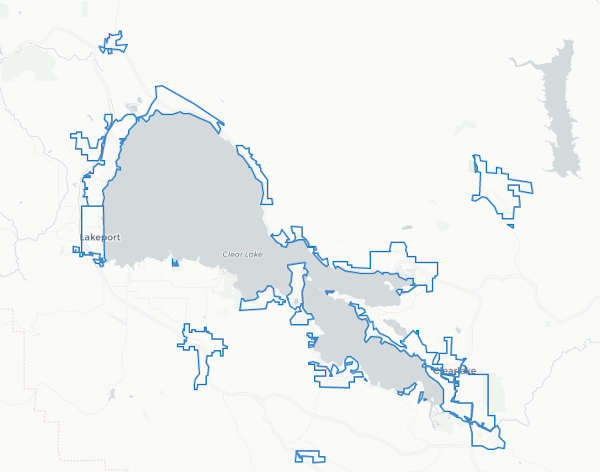
To find out where the public, municipal, or large drinking water system providers are located around Clear Lake, and the rest of Lake County, you can visit the Tracking California Drinking Water Mapping Tool online.
This tool provides information on the locations of Community Drinking Water sources, that include both groundwater and surface waters, like Clear Lake. This is an interactive mapping tool, using an ESRI-based platform, so it deserves some time exploring to find out the full extent of information and data that the tool can provide. I suggest turning on and off layers and making different selections to see what type of information is available on the map and what it can tell you.
The Tracking California Drinking Water Tool is available at the following website (as of April 5, 2022).
According to the Tracking California Drinking Water Mapping Tool, the blue outlines indicate Community Drinking Water areas in the general vicinity around Clear Lake. In the Mapping Tool, you can hover over a specific outlined area, and it will provide the name of that company providing water to that service area. I have taken an excerpt of the mapping tool showing the Community Water Systems layer selected. This shows the companies, public, municipal, and large private systems that are located around Clear Lake. If you live outside these highlighted areas, you may receive your water from a groundwater provider, a private well, or you may be on an unregulated, small, individual system with less than 14 connections.
If the latter is the case, please be prepared for the summer cyanobacteria season especially when it comes to having a safe, drinking water source for you, your family, your pets, and your home.
Sincerely, Lady of the Lake
Angela De Palma-Dow is a limnologist (limnology = study of fresh inland waters) who lives and works in Lake County. Born in Northern California, she has a Master of Science from Michigan State University. She is a Certified Lake Manager from the North American Lake Management Society, or NALMS, and she is the current president/chair of the California chapter of the Society for Freshwater Science. She can be reached at This email address is being protected from spambots. You need JavaScript enabled to view it..
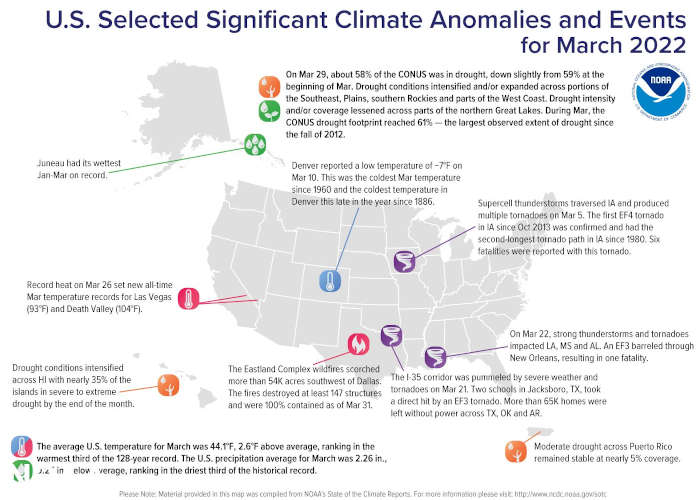
A map of the United States plotted with significant climate events that occurred during March 2022. Photo credit: NOAA NCEI. March 2022 marked the third month in a row where precipitation was below average across the contiguous U.S., which led to an expanding drought and areas of record dryness throughout the West.
March also brought several rounds of severe weather that pounded parts of the nation.
Below are more takeaways from NOAA’s latest monthly U.S. climate report:
Climate by the numbers: January through March 2022
The average contiguous U.S. temperature for the year to date was 36.3 degrees F (1.2 degrees above average), which ranks in the middle third of the record.
The year-to-date average rainfall was 5.66 inches — 1.30 inches below average — ranking as the seventh-driest January-March period for the U.S. on record.
The current multi-year drought across the western U.S. is the most extensive and intense drought in the 22-year history of the U.S. Drought Monitor. Across some parts of the West, precipitation for the first three months of 2022 was at or near record-low levels.
During March, drought coverage across the contiguous U.S. reached 61% — the largest observed extent of drought since fall of 2012.
With below-average snow cover and critically low reservoirs in some places, concerns are mounting that the western drought will continue to intensify and strain water supplies.
March 2022
The average monthly temperature across the contiguous U.S. was 44.1 degrees F (2.6 degrees above the 20th-century average) and ranked in the warmest third of the 128-year climate record.
Temperatures for the month were warmer than average across much of the West, and from the Midwest to the East Coast. Alaska also saw above-average temperatures across much of the state, with Anchorage and Talkeetna both reporting a top-10 warm March.
The average precipitation in the contiguous U.S. last month was 2.26 inches (0.25 of an inch below average), ranking in the driest third of the climate record.
Precipitation was below average across much of the West, northern and southern Plains, and from the Tennessee Valley to the Mid-Atlantic and parts of the Northeast.
Above-average precipitation fell from the central Plains to the Great Lakes, as well as across parts of the Deep South and Southeast. North Dakota saw its seventh-driest March on record, while Michigan had its eighth wettest.
Other notable climate events in March
• Tornadoes took a toll: Several severe weather outbreaks produced strong and damaging tornadoes last month. On March 5, supercell thunderstorms produced at least 13 confirmed tornadoes across Iowa, including a confirmed EF4 tornado in Winterset. From March 21-22, severe weather and tornadoes were reported from Texas to Alabama, including an EF3 tornado that substantially damaged two schools in Jacksboro, Texas; an EF3 tornado that ripped through the New Orleans metro area; and a severe weather outbreak impacted the Gulf Coast states from March 30-31, with at least 14 tornadoes and two fatalities.
• Billion-dollar disasters update: So far in 2022, no billion-dollar weather and climate disasters have been confirmed, although several events are currently being evaluated. An updated analysis based on a 2022 Consumer Price Index adjustment calculates that the U.S. has sustained 323 separate weather and climate disasters since 1980, where overall damages and costs reached or exceeded $1 billion. The total cost of these 323 events exceeds $2.195 trillion.
LAKE COUNTY, Calif. — Lake County Animal Care and Control has a new group of dogs this week that includes puppies and little dogs.
Dogs available for adoption this week include mixes of Akita, Australian cattle dog, Australian Kelpie, border collie, boxer, Chihuahua, dachshund, Entlebucher mountain dog, German shepherd, husky, Jack Russell terrier, Labrador retriever, pit bull and miniature wire haired terrier.
Dogs that are adopted from Lake County Animal Care and Control are either neutered or spayed, microchipped and, if old enough, given a rabies shot and county license before being released to their new owner. License fees do not apply to residents of the cities of Lakeport or Clearlake.
The following dogs at the Lake County Animal Care and Control shelter have been cleared for adoption.
Call Lake County Animal Care and Control at 707-263-0278 or visit the shelter online for information on visiting or adopting.
This 3-year-old female Entlebucher mountain dog is in kennel No. 2, ID No. LCAC-A-3250. Photo courtesy of Lake County Animal Care and Control. Female Entlebucher mountain dog
This 3-year-old female Entlebucher mountain dog has a short tricolor coat.
She is in kennel No. 2, ID No. LCAC-A-3250.
This 4-year-old female Jack Russell terrier-Chihuahua is in kennel No. 3, ID No. LCAC-A-3251. Photo courtesy of Lake County Animal Care and Control. Female Jack Russell terrier-Chihuahua
This 4-year-old female Jack Russell terrier-Chihuahua has a short liver and white coat.
She is in kennel No. 3, ID No. LCAC-A-3251.
“Kona” is a 1-year-old female German shepherd-Akita mix in kennel No. 5, ID No. LCAC-A-3239. Photo courtesy of Lake County Animal Care and Control. ‘Kona’
“Kona” is a 1-year-old female German shepherd-Akita mix with a short black and white coat.
She is in kennel No. 5, ID No. LCAC-A-3239.
This 1-year-old male pit bull terrier is in kennel No. 7, ID No. LCAC-A-2821. Photo courtesy of Lake County Animal Care and Control. Male pit bull terrier
This 1-year-old male pit bull terrier has a short white and tan coat.
He is in kennel No. 7, ID No. LCAC-A-2821.
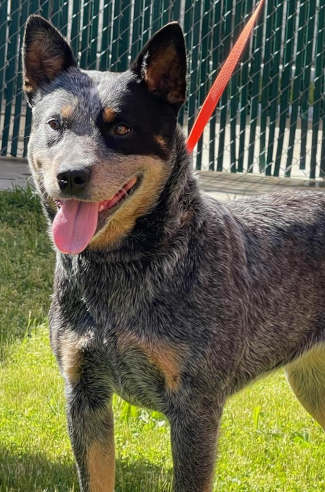
This 2-year-old female Australian cattle dog is in kennel No. 8, ID No. LCAC-A-3231. Photo courtesy of Lake County Animal Care and Control. Female Australian cattle dog
This 2-year-old female Australian cattle dog has a short blue, black and tan coat.
She is in kennel No. 8, ID No. LCAC-A-3231.
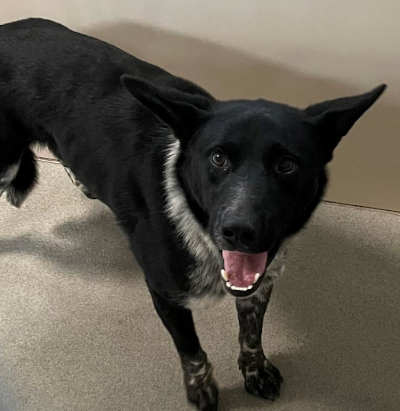
This 3-year-old male cattle dog is in kennel No. 14, ID No. LCAC-A-3228. Photo courtesy of Lake County Animal Care and Control. Male cattle dog
This 3-year-old male cattle dog has a short black coat with white markings.
He is in kennel No. 14, ID No. LCAC-A-3228.
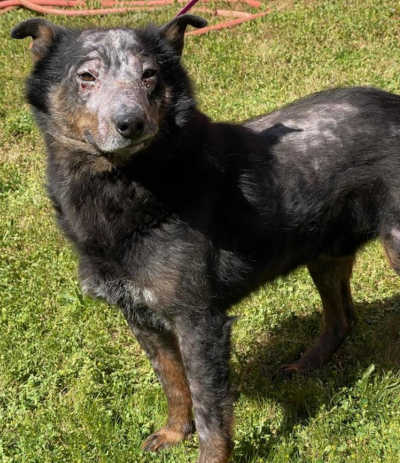
This 3-year-old male Australian cattle dog is in kennel No. 16, ID No. LCAC-A-3131. Photo courtesy of Lake County Animal Care and Control. Australian cattle dog
This 3-year-old male Australian cattle dog has a black coat with tan markings.
He is in kennel No. 16, ID No. LCAC-A-3131.
This young male border collie is in kennel No. 17, ID No. LCAC-A-3207. Photo courtesy of Lake County Animal Care and Control. Male border collie
This young male border collie has a short black and white coat.
He is in kennel No. 17, ID No. LCAC-A-3207.
“Max” is a 4-year-old male Australian Kelpie mix in kennel No. 18, ID No. LCAC-A-2852. Photo courtesy of Lake County Animal Care and Control. ‘Max’
“Max” is a 4-year-old male Australian Kelpie mix with a black and tan coat with white markings.
She is in kennel No. 18, ID No. LCAC-A-2852.
“Chaos” is a 1-year-old male pit bull in kennel No. 19, ID No. LCAC-A-3268. Photo courtesy of Lake County Animal Care and Control. ‘Chaos’
“Chaos” is a 1-year-old male pit bull with a short brown brindle coat.
He is in kennel No. 19, ID No. LCAC-A-3268.
This 2-year-old male Chihuahua-dachshund-miniature wire haired terrier mix is in kennel No. 21, ID No. LCAC-A-3244. Photo courtesy of Lake County Animal Care and Control. Chihuahua-dachshund-miniature wire haired mix
This 2-year-old male Chihuahua-dachshund-miniature wire haired terrier mix has a short tan and brown coat.
He is in kennel No. 21, ID No. LCAC-A-3244.
“Blue” is a 4-year-old female husky in kennel No. 25, ID No. LCAC-A-2816. Photo courtesy of Lake County Animal Care and Control. ‘Blue’
“Blue” is a 4-year-old female husky with a gray and white coat, and blue eyes.
She is in kennel No. 25, ID No. LCAC-A-2816.
This 3-month-old female Labrador retriever mix puppy is in kennel No. Kennel#27a, ID No. LCAC-A-3241. Photo courtesy of Lake County Animal Care and Control. Labrador retriever mix puppy
This 3-month-old female Labrador retriever mix puppy has a short golden coat.
She is in kennel No. Kennel#27a, ID No. LCAC-A-3241.
This 3-month-old female Labrador retriever mix puppy is in kennel No. 27b, ID No. LCAC-A-3242. Photo courtesy of Lake County Animal Care and Control. Labrador retriever mix puppy
This 3-month-old female Labrador retriever mix puppy has a short golden coat.
She is in kennel No. 27b, ID No. LCAC-A-3242.
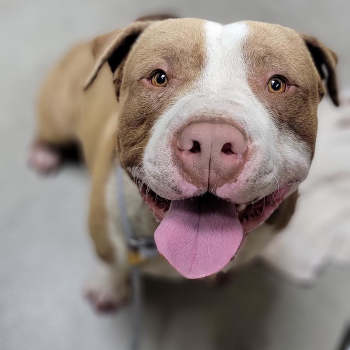
“King” is a 1-year-old American bulldog in kennel No. 32, ID No. 3109. Photo courtesy of Lake County Animal Care and Control. ‘King’
“King” is a 1-year-old American bulldog with a short brown and white coat.
He is in kennel No. 32, ID No. 3109.
This 3-year-old male Australian cattle dog is in kennel No. 34, ID No. LCAC-A-3130. Photo courtesy of Lake County Animal Care and Control. Male Australian cattle dog
This 3-year-old male Australian cattle dog has a short black, tan and white coat.
He is in kennel No. 34, ID No. LCAC-A-3130.
Email Elizabeth Larson at This email address is being protected from spambots. You need JavaScript enabled to view it.. Follow her on Twitter, @ERLarson, or Lake County News, @LakeCoNews.
 How to resolve AdBlock issue?