 How to resolve AdBlock issue?
News
Recent data from the U.S. Census Bureau’s Survey of Income and Program Participation, or SIPP, shows that in 2019, prior to the pandemic, roughly 33.2 million children received school meals, including about 21.3 million who received free school lunches.
However, when the COVID-19 pandemic hit the United States a year later, it disrupted many facets of life, including closing schools for many and jeopardizing access to school meals.
According to the Census Bureau’s experimental Household Pulse Survey (HPS), roughly 20% of at-risk households with children reported being food insecure — defined as sometimes or often not having enough to eat — in the early weeks of the pandemic, when many schools were closed.
But as new policies were enacted in response to COVID-19, such as expanded eligibility for school lunch programs, food insecurity in households with children declined.
New school meal policies during COVID
There were many policy changes designed to compensate for the loss of school meals due to pandemic-related school closures. Among them:
• Many school districts offered meals that could be picked up or delivered via school bus transportation during this period.
• The Pandemic Electronic Benefit Transfer program (P-EBT) provided emergency funds for nutritional benefits that were directly loaded on EBT cards for households with children that would normally receive free or reduced cost lunch if their schools were not partially or fully closed.
• The U.S. Department of Agriculture (USDA) waived the eligibility requirements for free lunch to allow school meal programs to provide safe, free healthy meals to all children and these flexibilities were extended through June of this year.
As these policies were implemented throughout the pandemic, food insecurity in households with children declined.
The decline is likely due in part to improving economic circumstances over the course of the pandemic (as well as the Child Tax Credit and stimulus payments). But our research shows that the change in food security still holds true when we control for economic variables.
Among households with children facing economic insecurity — defined here as those in which an adult indicated concern about their ability to pay the next month’s rent or mortgage — food insecurity fell by about 7 percentage points between the start of the pandemic (21.3% in April/May of 2020) and summer 2021 (14.2% in July/August 2021) when the most recent USDA policy changes were implemented.
Between summer 2021 and the back-to-school period in the fall, food insecurity levels among these at-risk households were not significantly different.
Free meals for all changed who receives meals
When most kids returned to school last fall, school meal receipt looked more like it did pre-pandemic. HPS data collected December 1-13, 2021, show that 18.3 million school-enrolled children were reported to be receiving free meals at school.
However, expanded eligibility and availability changed who received school meals in the fall of 2021, which included some higher income households.
For example, roughly 58% of HPS households that received free school meals owned their homes in December, 2021, compared to 47% of SIPP householders in homes receiving free or reduced-price meals in 2019.
School meals still part of safety net
These same HPS data show that although more households had access to free school meals during the pandemic, receipt was still higher in households that demonstrated financial need.
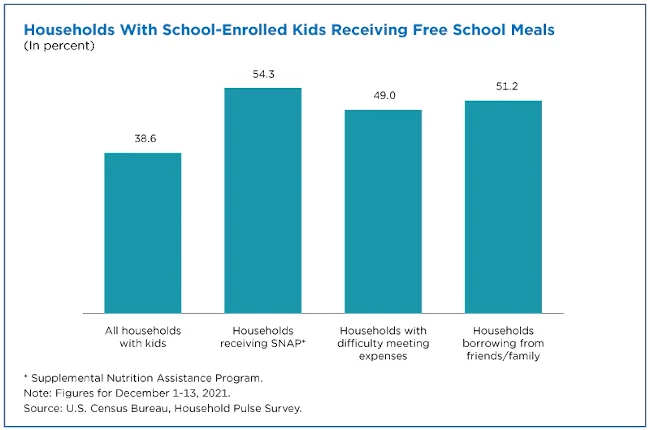
For example, roughly 39% of all households with children in school reported their child was receiving free school meals in December. However, 54% of households with kids that received funds from the Supplemental Nutrition Assistance Program or SNAP, a means-tested food assistance program, reported receiving school meals.
Roughly half of adults in households with kids that reported difficulty meeting expenses reported receiving free school meals. The same was true of households with kids in which adults reported borrowing from friends and family to make ends meet.
Note that the estimates for SNAP households and households that borrowed to make ends meet was not significantly different.
Families benefit from program expansions
HPS data also show the extent to which families continued to rely on pandemic-related expanded national school meals programs. In December 2021:
• Roughly 15 million children ate meals on-site, at school or other locations.
• Over 5 million children picked up meals at school or other locations.
• Roughly 12 million school-enrolled children ages 5-18 received assistance through the expanded SNAP/P-EBT program.
About the data
The HPS is designed to provide near real-time data on how the pandemic is affecting people’s lives.
Information on the methodology and reliability of these estimates can be found in the source and accuracy statements for each data release.
Part of the Census Bureau’s Experimental Data Product series, the HPS was designed to have low respondent burden, provide quick turnaround on product releases and produce estimates that meet urgent public needs.
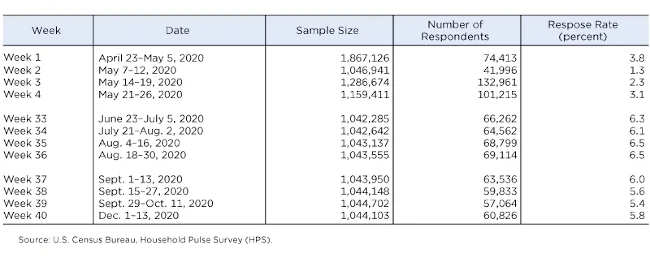
Most HPS data used in this analysis come from HPS Week 40, which was collected between December 1-13, 2021. However, HPS data used to make comparisons over time come from pooled collection periods that are reweighted to account for the pooling.
Data used here to describe the "early weeks of the pandemic" come from HPS Weeks 1-4. Data used to describe the summer of 2021 come from HPS Weeks 33-36, and data covering fall of 2021 come from HPS Weeks 37-40. (Note that collection periods after Week 12 are generally two weeks in length, but the HPS continues to refer to collection periods as "week" for continuity with earlier collections.)
The dates, sample sizes and response rates for all these collections are as follows:
The SIPP is a nationally representative survey of the civilian, noninstitutionalized population. More information about the SIPP, including data on receipt of food assistance programs, is available on the SIPP website. Source and accuracy statements are available on the technical documentation page.
SIPP data about school meal receipt in 2019 were collected for the calendar year and therefore include more than one school year. In contrast, the HPS asks about school meal receipt in the prior seven days.
Lestina Dongo and Lindsay Monte are researchers in the Census Bureau’s Social, Economic, and Housing Statistics Division.
LAKE COUNTY, Calif. — The Board of Supervisors on Tuesday rejected a proposal from one of its members to enact an interim urgency ordinance that would have placed a 45-day moratorium on new agricultural and cannabis cultivation projects.
Supervisor Bruno Sabatier presented the item to his colleagues, asking for them to pass the 45-day temporary moratorium in order to come up with solutions about how to protect the county water supply amid deepening drought conditions.
“This is climate change. Whether you want to agree that this is manmade or not is not the discussion,” he said.
However, with the urgency ordinance requiring a four-fifths vote of the board, it became clear early in the discussion that it would not have enough votes to pass after three board members voiced their opposition.
Sabatier said he believed he had brought traditional agriculture and cannabis growers together with his request. During public comment, both groups would voice opposition.
He presented data showing that Clear Lake is on track to drop to levels not seen since the drought of 1976 and 1977.
Sabatier said his goal was not to prohibit growth but to make sure the county has the vetting tools needed to protect the environment while making sure things are done correctly.
He said no ag projects currently were in the queue. The only cannabis projects that would be able to go through during the moratorium period would be about 14 that have already submitted plans to the state clearinghouse.
Sabatier said he’d spoken to the agricultural commissioners and the Lake County Cannabis Alliance about the matter. He said he’d received mostly positive input from the general public.
With the current drought reported to be the harshest in more than 1,200 years, Sabatier said it felt like the county was waiting for something to happen before taking any action. He said he wanted to make sure Lake County continues to be a farming community.
“It’s a tough topic. It gets very personal for those who are in the industries,” he said.
Despite Sabatier’s belief that the county could have a plan within 90 days to move forward, the majority of the board refused to support it.
Supervisor Tina Scott said she didn’t agree with the moratorium proposal, and that they needed to let Community Development Director Mary Darby complete work on updating county rules.
She said it is going to punish the good actors, but the bad actors will continue to waste water. “It’s just not going to solve the issues.”
Scott said she wanted to see enhanced hydrology standards, but added that the county cannot have knee jerk reactions.
The harshest criticism came from Supervisor Jessica Pyska, who said county staff was weeks away from coming back with proposals for how to rework the planning process to address issues like water.
She said Sabatier’s temporary moratorium would derail that, and that staff only had so much time available to work on these matters.
Citing staff issues and turnover, Pyska said, “To say that nothing’s been happening is wholly untrue.” She added that if Sabatier hadn’t seen any action it was because he wasn’t on the committee working with Community Development.
Pyska said the end goal is to get to a place of sustainability in our county and staff is now researching the watershed.
“This drought didn’t come out of nowhere,” said Psyka, adding that they have to work collaboratively and can’t just pile things on staff all the time.
Supervisor Moke Simon said he completely agreed with Scott and Pyska. “We’re doing the work.”
Simon said people need to think about how they’re living on the earth, bringing up issues with lawn grass, water storage and the local tribes’ lack of say on Clear Lake’s water rights.
“That’s our water,” he said. “Our tribal communities were not at the table when it was taken.”
Board Chair EJ Crandell was the only board member to offer any support for Sabatier,
Noting that in his Northshore district and its town halls there has been a lot of discussion of water in general, Crandell agreed that the county is working on addressing the situation and that the tribes were not considered when water rights were being determined.
He said he thought a 45-day moratorium would allow county staff to catch up on its works.
“I would have no problem considering a moratorium for 45 days despite the fact that it would affect some of you here, many of you here,” he said to the community members in the room.
The comments offered by community members were almost entirely against even a temporary pause.
Farmer and cannabis consultant Richard Derum noted, “Legalization has brought us new challenges.”
He said changes are needed in the industry itself, explaining that mixed light greenhouses are more sustainable than traditional outdoor grows.
Derum said those waiting in the approval queue likely can’t grow a crop this year anyway, so he didn’t see the need for an urgency ordinance.
As a consultant, Serum said he saw a “flip” in the industry last year, with the push going to fresh cannabis that’s more easily obtained through greenhouses.
Sarah Bodnar, a policy adviser for the Lake County Cannabis Alliance, said everyone acknowledges that the drought is a problem and that they are ready to work on solutions. “A moratorium isn’t one of them.”
She said they are farmers. “Without water we cannot farm.”
Ultimately, the board took no action on the proposal.
Sabatier said he appreciated everyone’s feedback and wished the county could come back sooner rather than later with solutions.
Email Elizabeth Larson atThis email address is being protected from spambots. You need JavaScript enabled to view it. . Follow her on Twitter, @ERLarson, or Lake County News, @LakeCoNews.
Supervisor Bruno Sabatier presented the item to his colleagues, asking for them to pass the 45-day temporary moratorium in order to come up with solutions about how to protect the county water supply amid deepening drought conditions.
“This is climate change. Whether you want to agree that this is manmade or not is not the discussion,” he said.
However, with the urgency ordinance requiring a four-fifths vote of the board, it became clear early in the discussion that it would not have enough votes to pass after three board members voiced their opposition.
Sabatier said he believed he had brought traditional agriculture and cannabis growers together with his request. During public comment, both groups would voice opposition.
He presented data showing that Clear Lake is on track to drop to levels not seen since the drought of 1976 and 1977.
Sabatier said his goal was not to prohibit growth but to make sure the county has the vetting tools needed to protect the environment while making sure things are done correctly.
He said no ag projects currently were in the queue. The only cannabis projects that would be able to go through during the moratorium period would be about 14 that have already submitted plans to the state clearinghouse.
Sabatier said he’d spoken to the agricultural commissioners and the Lake County Cannabis Alliance about the matter. He said he’d received mostly positive input from the general public.
With the current drought reported to be the harshest in more than 1,200 years, Sabatier said it felt like the county was waiting for something to happen before taking any action. He said he wanted to make sure Lake County continues to be a farming community.
“It’s a tough topic. It gets very personal for those who are in the industries,” he said.
Despite Sabatier’s belief that the county could have a plan within 90 days to move forward, the majority of the board refused to support it.
Supervisor Tina Scott said she didn’t agree with the moratorium proposal, and that they needed to let Community Development Director Mary Darby complete work on updating county rules.
She said it is going to punish the good actors, but the bad actors will continue to waste water. “It’s just not going to solve the issues.”
Scott said she wanted to see enhanced hydrology standards, but added that the county cannot have knee jerk reactions.
The harshest criticism came from Supervisor Jessica Pyska, who said county staff was weeks away from coming back with proposals for how to rework the planning process to address issues like water.
She said Sabatier’s temporary moratorium would derail that, and that staff only had so much time available to work on these matters.
Citing staff issues and turnover, Pyska said, “To say that nothing’s been happening is wholly untrue.” She added that if Sabatier hadn’t seen any action it was because he wasn’t on the committee working with Community Development.
Pyska said the end goal is to get to a place of sustainability in our county and staff is now researching the watershed.
“This drought didn’t come out of nowhere,” said Psyka, adding that they have to work collaboratively and can’t just pile things on staff all the time.
Supervisor Moke Simon said he completely agreed with Scott and Pyska. “We’re doing the work.”
Simon said people need to think about how they’re living on the earth, bringing up issues with lawn grass, water storage and the local tribes’ lack of say on Clear Lake’s water rights.
“That’s our water,” he said. “Our tribal communities were not at the table when it was taken.”
Board Chair EJ Crandell was the only board member to offer any support for Sabatier,
Noting that in his Northshore district and its town halls there has been a lot of discussion of water in general, Crandell agreed that the county is working on addressing the situation and that the tribes were not considered when water rights were being determined.
He said he thought a 45-day moratorium would allow county staff to catch up on its works.
“I would have no problem considering a moratorium for 45 days despite the fact that it would affect some of you here, many of you here,” he said to the community members in the room.
The comments offered by community members were almost entirely against even a temporary pause.
Farmer and cannabis consultant Richard Derum noted, “Legalization has brought us new challenges.”
He said changes are needed in the industry itself, explaining that mixed light greenhouses are more sustainable than traditional outdoor grows.
Derum said those waiting in the approval queue likely can’t grow a crop this year anyway, so he didn’t see the need for an urgency ordinance.
As a consultant, Serum said he saw a “flip” in the industry last year, with the push going to fresh cannabis that’s more easily obtained through greenhouses.
Sarah Bodnar, a policy adviser for the Lake County Cannabis Alliance, said everyone acknowledges that the drought is a problem and that they are ready to work on solutions. “A moratorium isn’t one of them.”
She said they are farmers. “Without water we cannot farm.”
Ultimately, the board took no action on the proposal.
Sabatier said he appreciated everyone’s feedback and wished the county could come back sooner rather than later with solutions.
Email Elizabeth Larson at
LAKE COUNTY, Calif. — As Lake County’s administrative officer prepares to step down at the end of this month, one of her staffers has been chosen to succeed her in an interim capacity.
The Board of Supervisors emerged from a closed session just after 3:30 p.m. Tuesday afternoon to announce that they had voted unanimously to appoint Assistant County Administrative Officer Susan Parker as interim county administrative officer.
The appointment is effective April 30, the day after County Administrator Carol Huchingson departs.
The board held closed-door interviews for the interim position on Tuesday.
Deputy County Administrative Officer Matthew Rothstein told Lake County News that there were three candidates for the interim position. “Two were determined qualified, and one withdrew.”
Lake County News asked Parker if there was a restriction preventing her from applying for the job on a permanent basis and if she was planning to seek the job long term.
She said she was unaware of any restrictions. “And yes, I do plan to apply for the permanent position,” she said in an email response.
At its March 22 meeting, the week following Huchingson’s sudden announcement that she was leaving, the supervisors approved a plan to recruit a new county administrative officer that included an in-house interim appointment, an open recruitment to fill the job overseen by the Human Resources Department and preparation of a request for proposals for a headhunting firm, if needed.
Human Resources Director Pam Samac said the goal was to have the interim county administrative officer in place to work with Huchingson for a “thorough download” and some basic training for several weeks.
For several years, Human Resources has been overseen by the County Administrator’s Office, which has in turn raised questions about how much influence Huchingson will bring to bear on choosing her successor.
And with Parker’s appointment as the interim, and her intention to seek the job permanently, the county has not addressed how it intends to address the potential conflict of interest for her to oversee the recruitment for a position she is pursuing.
Parker joined the county as assistant county administrative officer on March 28, 2019, Rothstein said.
She has a Master’s in Public Affairs and Public Administration from the Robert M. Lafollette Institute of Public Affairs at the University of Wisconsin, according to a statement from the County Administrative Office.
That same statement said she’s held previous executive jobs in the states of Wisconsin, Nevada, Colorado and North Carolina before coming to Lake County following what the county of Lake described as “a rigorous nationwide search.”
In the county’s statement, Board Chair E.J. Crandell was quoted as saying that Parker comes to the position with 20 years of experience as a high level government executive and administrator, “and she understands the unique needs and challenges facing Lake County’s communities.”
The statement attributed to Crandell continued, “During her time here, Susan has repeatedly proven herself to be an insightful leader and effective collaborator. She knows what needs to be done to continue to move Lake County forward, and we truly look forward to seeing Susan positively influence conditions for every Lake County resident with this interim appointment.”
Parker, quoted in the county’s statement, said she came to Lake County because she believed its future was bright.
“In getting to know many community leaders and making this my home,” Parker was quoted as saying. “I have grown increasingly confident we can make tremendous progress. Lake County is a very special place.”
Email Elizabeth Larson atThis email address is being protected from spambots. You need JavaScript enabled to view it. . Follow her on Twitter, @ERLarson, or Lake County News, @LakeCoNews.
The Board of Supervisors emerged from a closed session just after 3:30 p.m. Tuesday afternoon to announce that they had voted unanimously to appoint Assistant County Administrative Officer Susan Parker as interim county administrative officer.
The appointment is effective April 30, the day after County Administrator Carol Huchingson departs.
The board held closed-door interviews for the interim position on Tuesday.
Deputy County Administrative Officer Matthew Rothstein told Lake County News that there were three candidates for the interim position. “Two were determined qualified, and one withdrew.”
Lake County News asked Parker if there was a restriction preventing her from applying for the job on a permanent basis and if she was planning to seek the job long term.
She said she was unaware of any restrictions. “And yes, I do plan to apply for the permanent position,” she said in an email response.
At its March 22 meeting, the week following Huchingson’s sudden announcement that she was leaving, the supervisors approved a plan to recruit a new county administrative officer that included an in-house interim appointment, an open recruitment to fill the job overseen by the Human Resources Department and preparation of a request for proposals for a headhunting firm, if needed.
Human Resources Director Pam Samac said the goal was to have the interim county administrative officer in place to work with Huchingson for a “thorough download” and some basic training for several weeks.
For several years, Human Resources has been overseen by the County Administrator’s Office, which has in turn raised questions about how much influence Huchingson will bring to bear on choosing her successor.
And with Parker’s appointment as the interim, and her intention to seek the job permanently, the county has not addressed how it intends to address the potential conflict of interest for her to oversee the recruitment for a position she is pursuing.
Parker joined the county as assistant county administrative officer on March 28, 2019, Rothstein said.
She has a Master’s in Public Affairs and Public Administration from the Robert M. Lafollette Institute of Public Affairs at the University of Wisconsin, according to a statement from the County Administrative Office.
That same statement said she’s held previous executive jobs in the states of Wisconsin, Nevada, Colorado and North Carolina before coming to Lake County following what the county of Lake described as “a rigorous nationwide search.”
In the county’s statement, Board Chair E.J. Crandell was quoted as saying that Parker comes to the position with 20 years of experience as a high level government executive and administrator, “and she understands the unique needs and challenges facing Lake County’s communities.”
The statement attributed to Crandell continued, “During her time here, Susan has repeatedly proven herself to be an insightful leader and effective collaborator. She knows what needs to be done to continue to move Lake County forward, and we truly look forward to seeing Susan positively influence conditions for every Lake County resident with this interim appointment.”
Parker, quoted in the county’s statement, said she came to Lake County because she believed its future was bright.
“In getting to know many community leaders and making this my home,” Parker was quoted as saying. “I have grown increasingly confident we can make tremendous progress. Lake County is a very special place.”
Email Elizabeth Larson at
LAKE COUNTY, Calif. — The Lake County Planning Commission will meet this week to consider a resort and two cannabis projects.
The meeting will begin at 9 a.m. Thursday, April 14, in the board chambers on the first floor of the Lake County Courthouse, 255 N. Forbes St., Lakeport.
The agenda is here.
To participate in real-time, join the Zoom meeting by clicking this link.
The webinar ID is 933 4337 3108, the pass code is 307141.
Access the meeting via one tap mobile at +16699006833,,93343373108#,,,,*307141# or dial in at 669-900-6833.
The meeting also can be viewed on the county’s website or Facebook page.
On the agenda at 9:05 a.m. is a public hearing to consider a resort project held over from the March 24 meeting.
Nikki Island is seeking a design review and a mitigated negative declaration for a small resort at 5835 and 5825 Highway 20 in Lucerne.
The project would include nine overnight lodging units; conversion of the existing dwelling to a social gathering room, lobby, kitchen and dining room; an outdoor kitchen; in-ground pool and hot tub; removal of asphalt and an existing driveway; and new landscaping, parking and pedestrian paths.
Also on Thursday, the commission will hold a public hearing for a major use permit and a mitigated negative declaration for Joyce Kirstein/Spring Valley Organics. The project, which would include a small amount of outdoor cultivation and a self-transport distributor license, is located at 2593 New Long Valley Road, Clearlake Oaks.
The commission also will consider a major use permit and a mitigated negative declaration sought by Igor Stolper/Jerusalem Grade Farms/RMI Ventures. The project would include outdoor cultivation and a self-transport distributor license.
Another project on the agenda for Auto Canna LLC is being rescheduled for May.
The full agenda follows.
AGENDA
Approval of the Minutes from the March 10, 2022, and the March 24, 2022, Planning Commission hearing.
9:05 a.m.: Continued from March 24, public hearing on consideration of a design review (DR 21-01) and a mitigated negative declaration (IS 22-06).The applicant, Nikki Island, is proposing, a small resort, containing nine overnight lodging units; conversion of the existing dwelling to a social gathering room, lobby, kitchen and dining room; outdoor kitchen; in-ground pool and hot tub; site improvements including removal of 1,100+ sq. ft. of asphalt and the western driveway leading to Highway 20; landscaping, parking and interior access aisles and pedestrian pathways. The project location is 5835 and 5825 Highway 20, Lucerne, and further described as APN’s 034-421-20 and 034-421-21.
9:10 a.m.: Public hearing on consideration of a major use permit (UP 19-21) and a mitigated negative declaration (IS 19-37). The applicant, Joyce Kirstein/Spring Valley Organics is proposing one A-Type 3: “Outdoor” license: Outdoor cultivation for adult use cannabis without the use of light deprivation and/or artificial lighting in the canopy area at any point in time from 10,001 square feet to one acre, inclusive, of total canopy size per license on one premise; and a Type 13 “Distributor Transport Only, Self-Transport Distribution” license: The transport of cannabis goods between entities licensed pursuant to California Code. The project is located at 2593 New Long Valley Rd., Clearlake Oaks; Assessor Parcel Numbers: 620-071-04.
9:15 a.m.: Continued to the May 12 Planning Commission meeting at 9:05 a.m., public hearing on consideration of a major use permit (UP 19-44) and a mitigated negative declaration (IS 19-63). The applicant, Auto Canna LLC (Auto Canna) is proposing Four (4) A-Type 3: “Outdoor” license: Outdoor cultivation for adult use cannabis without the use of light deprivation and/or artificial lighting in the canopy area at any point in time from 10,001 square feet to one acre, inclusive, of total canopy size per license on one premise; and a Type 13 “Distributor Transport Only, Self-Transport Distribution” license: The transport of cannabis goods between entities licensed pursuant to California Code. The project is located at 21258 Morgan Valley Road, Lower Lake; Assessor Parcel Numbers: 012-069-57.
9:20 a.m.: Continued from Dec. 16, 2021, public hearing on consideration of major use permit (UP 20-13) and a mitigated negative declaration (IS 20-15). The applicant, Igor Stolper/Jerusalem Grade Farms/RMI Ventures is proposing one A-Type 3: “Outdoor” license: Outdoor cultivation for adult use cannabis without the use of light deprivation and/or artificial lighting in the canopy area at any point in time from 10,001 square feet to one acre, inclusive, of total canopy size per license on one premise; and a Type 13 “Distributor Transport Only, Self-Transport Distribution” license: The transport of cannabis goods between entities licensed pursuant to California Code. The project is located at 22644 Jerusalem Grade Road, Middletown; Assessor Parcel Numbers: 136-051-04.
Email Elizabeth Larson atThis email address is being protected from spambots. You need JavaScript enabled to view it. . Follow her on Twitter, @ERLarson, or Lake County News, @LakeCoNews.
The meeting will begin at 9 a.m. Thursday, April 14, in the board chambers on the first floor of the Lake County Courthouse, 255 N. Forbes St., Lakeport.
The agenda is here.
To participate in real-time, join the Zoom meeting by clicking this link.
The webinar ID is 933 4337 3108, the pass code is 307141.
Access the meeting via one tap mobile at +16699006833,,93343373108#,,,,*307141# or dial in at 669-900-6833.
The meeting also can be viewed on the county’s website or Facebook page.
On the agenda at 9:05 a.m. is a public hearing to consider a resort project held over from the March 24 meeting.
Nikki Island is seeking a design review and a mitigated negative declaration for a small resort at 5835 and 5825 Highway 20 in Lucerne.
The project would include nine overnight lodging units; conversion of the existing dwelling to a social gathering room, lobby, kitchen and dining room; an outdoor kitchen; in-ground pool and hot tub; removal of asphalt and an existing driveway; and new landscaping, parking and pedestrian paths.
Also on Thursday, the commission will hold a public hearing for a major use permit and a mitigated negative declaration for Joyce Kirstein/Spring Valley Organics. The project, which would include a small amount of outdoor cultivation and a self-transport distributor license, is located at 2593 New Long Valley Road, Clearlake Oaks.
The commission also will consider a major use permit and a mitigated negative declaration sought by Igor Stolper/Jerusalem Grade Farms/RMI Ventures. The project would include outdoor cultivation and a self-transport distributor license.
Another project on the agenda for Auto Canna LLC is being rescheduled for May.
The full agenda follows.
AGENDA
Approval of the Minutes from the March 10, 2022, and the March 24, 2022, Planning Commission hearing.
9:05 a.m.: Continued from March 24, public hearing on consideration of a design review (DR 21-01) and a mitigated negative declaration (IS 22-06).The applicant, Nikki Island, is proposing, a small resort, containing nine overnight lodging units; conversion of the existing dwelling to a social gathering room, lobby, kitchen and dining room; outdoor kitchen; in-ground pool and hot tub; site improvements including removal of 1,100+ sq. ft. of asphalt and the western driveway leading to Highway 20; landscaping, parking and interior access aisles and pedestrian pathways. The project location is 5835 and 5825 Highway 20, Lucerne, and further described as APN’s 034-421-20 and 034-421-21.
9:10 a.m.: Public hearing on consideration of a major use permit (UP 19-21) and a mitigated negative declaration (IS 19-37). The applicant, Joyce Kirstein/Spring Valley Organics is proposing one A-Type 3: “Outdoor” license: Outdoor cultivation for adult use cannabis without the use of light deprivation and/or artificial lighting in the canopy area at any point in time from 10,001 square feet to one acre, inclusive, of total canopy size per license on one premise; and a Type 13 “Distributor Transport Only, Self-Transport Distribution” license: The transport of cannabis goods between entities licensed pursuant to California Code. The project is located at 2593 New Long Valley Rd., Clearlake Oaks; Assessor Parcel Numbers: 620-071-04.
9:15 a.m.: Continued to the May 12 Planning Commission meeting at 9:05 a.m., public hearing on consideration of a major use permit (UP 19-44) and a mitigated negative declaration (IS 19-63). The applicant, Auto Canna LLC (Auto Canna) is proposing Four (4) A-Type 3: “Outdoor” license: Outdoor cultivation for adult use cannabis without the use of light deprivation and/or artificial lighting in the canopy area at any point in time from 10,001 square feet to one acre, inclusive, of total canopy size per license on one premise; and a Type 13 “Distributor Transport Only, Self-Transport Distribution” license: The transport of cannabis goods between entities licensed pursuant to California Code. The project is located at 21258 Morgan Valley Road, Lower Lake; Assessor Parcel Numbers: 012-069-57.
9:20 a.m.: Continued from Dec. 16, 2021, public hearing on consideration of major use permit (UP 20-13) and a mitigated negative declaration (IS 20-15). The applicant, Igor Stolper/Jerusalem Grade Farms/RMI Ventures is proposing one A-Type 3: “Outdoor” license: Outdoor cultivation for adult use cannabis without the use of light deprivation and/or artificial lighting in the canopy area at any point in time from 10,001 square feet to one acre, inclusive, of total canopy size per license on one premise; and a Type 13 “Distributor Transport Only, Self-Transport Distribution” license: The transport of cannabis goods between entities licensed pursuant to California Code. The project is located at 22644 Jerusalem Grade Road, Middletown; Assessor Parcel Numbers: 136-051-04.
Email Elizabeth Larson at
MIDDLETOWN, Calif. — The Middletown Area Town Hall is returning to in-person meetings this week.
The group will meet at 7 p.m. Thursday, April 14, in the community meeting room located in between the Middletown Senior Center and the Library, 21256 Washington St.
The meeting is open to the public and also will be available via Zoom; the meeting ID is 659 964 1209. Call in at 669-900-6833.
Beginning at 7:05 p.m., the group will hear from several speakers: Lake County Public Services staff will discuss the Clean California grant, Battalion Chief Mike Wink of South Lake County Fire will give a seasonal fire prevention update and they will get the latest from the Tree Mortality Committee.
Under business, which is scheduled for 7:45 p.m., they will get updates on area cannabis projects including WeGrow and BarX.
They also will discuss the grievance committee update and review the January minutes and alternate election process.
At 8:20 p.m., Supervisor Moke Simon will give an update and take questions.
The MATH Board includes Chair Monica Rosenthal, Vice Chair Ken Gonzales, Secretary Todd Fiora, Rosemary Córdova and Bill Waite, and alternates Lisa Kaplan and Marlene Elder.
MATH — established by resolution of the Lake County Board of Supervisors on Dec. 12, 2006 — is a municipal advisory council serving the residents of Anderson Springs, Cobb, Coyote Valley (including Hidden Valley Lake), Long Valley and Middletown.
For more information emailThis email address is being protected from spambots. You need JavaScript enabled to view it. .
Email Elizabeth Larson atThis email address is being protected from spambots. You need JavaScript enabled to view it. . Follow her on Twitter, @ERLarson, or Lake County News, @LakeCoNews.
The group will meet at 7 p.m. Thursday, April 14, in the community meeting room located in between the Middletown Senior Center and the Library, 21256 Washington St.
The meeting is open to the public and also will be available via Zoom; the meeting ID is 659 964 1209. Call in at 669-900-6833.
Beginning at 7:05 p.m., the group will hear from several speakers: Lake County Public Services staff will discuss the Clean California grant, Battalion Chief Mike Wink of South Lake County Fire will give a seasonal fire prevention update and they will get the latest from the Tree Mortality Committee.
Under business, which is scheduled for 7:45 p.m., they will get updates on area cannabis projects including WeGrow and BarX.
They also will discuss the grievance committee update and review the January minutes and alternate election process.
At 8:20 p.m., Supervisor Moke Simon will give an update and take questions.
The MATH Board includes Chair Monica Rosenthal, Vice Chair Ken Gonzales, Secretary Todd Fiora, Rosemary Córdova and Bill Waite, and alternates Lisa Kaplan and Marlene Elder.
MATH — established by resolution of the Lake County Board of Supervisors on Dec. 12, 2006 — is a municipal advisory council serving the residents of Anderson Springs, Cobb, Coyote Valley (including Hidden Valley Lake), Long Valley and Middletown.
For more information email
Email Elizabeth Larson at
LAKE COUNTY, Calif. — Authorities have identified the two Lake County residents who died in separate traffic crashes on Friday and Saturday.
Alisa Anne Pettey-Torres, 59, of Hidden Valley Lake, died in a head-on crash on Highway 29 just south of Grange Road on Friday, said Lt. Corey Paulich of the Lake County Sheriff’s Office.
Paulich said Walter William Toupal, 53, of Clearlake died in a solo-motorcycle crash on Highway 20 just west of Bruner Drive between Lucerne and Glenhaven on Saturday afternoon.
The California Highway Patrol’s on Pettey-Torres’ wreck said that on Friday at 5:18 p.m., she was driving a 2005 Toyota Corolla southbound on Highway 29, north of the Bar X entrance Road.
David Thurber, 49, of Hidden Valley Lake was driving a 2012 BMW X5 northbound on Highway 29, approaching Pettey-Torres’ Toyota sedan, the CHP said.
For reasons still under investigation, the CHP said Pettey-Torres’ Toyota crossed over the highway’s solid double yellow lines and she collided head-on with the BMW. Both vehicles became disabled on the northbound shoulder.
The CHP said Pettey-Torres was extricated from the vehicle and after life saving measures, she succumbed to her injuries on scene.
Neither drugs nor alcohol are suspected to be factors in this collision, the CHP said. Both drivers were using their safety equipment.
In the case of Toupal’s crash, the CHP said he was riding his 2001 Harley Davidson eastbound on Highway 20, west of Bruner Drive at 2:16 p.m. Saturday when, for reasons still under investigation, he allowed his motorcycle to veer off the south side of the roadway.
Toupal’s motorcycle struck several boulders, impacted the shoreline and went into the lake, the CHP said.
A nearby fishing boat came across the motorcycle and the rider in the lake, pulled the rider to the shore and called 911, authorities said.
Medics who arrived on scene shortly afternoon pronounced Toupal deceased at the scene, the CHP said.
The CHP said alcohol appears to be a factor in this crash.
These two crashes were among four that have resulted in fatalities in less than a week. The other fatal wrecks occurred on Wednesday near Blue Lakes and on Sunday on the Mendocino National Forest near Upper Lake.
Email Elizabeth Larson atThis email address is being protected from spambots. You need JavaScript enabled to view it. . Follow her on Twitter, @ERLarson, or Lake County News, @LakeCoNews.
Alisa Anne Pettey-Torres, 59, of Hidden Valley Lake, died in a head-on crash on Highway 29 just south of Grange Road on Friday, said Lt. Corey Paulich of the Lake County Sheriff’s Office.
Paulich said Walter William Toupal, 53, of Clearlake died in a solo-motorcycle crash on Highway 20 just west of Bruner Drive between Lucerne and Glenhaven on Saturday afternoon.
The California Highway Patrol’s on Pettey-Torres’ wreck said that on Friday at 5:18 p.m., she was driving a 2005 Toyota Corolla southbound on Highway 29, north of the Bar X entrance Road.
David Thurber, 49, of Hidden Valley Lake was driving a 2012 BMW X5 northbound on Highway 29, approaching Pettey-Torres’ Toyota sedan, the CHP said.
For reasons still under investigation, the CHP said Pettey-Torres’ Toyota crossed over the highway’s solid double yellow lines and she collided head-on with the BMW. Both vehicles became disabled on the northbound shoulder.
The CHP said Pettey-Torres was extricated from the vehicle and after life saving measures, she succumbed to her injuries on scene.
Neither drugs nor alcohol are suspected to be factors in this collision, the CHP said. Both drivers were using their safety equipment.
In the case of Toupal’s crash, the CHP said he was riding his 2001 Harley Davidson eastbound on Highway 20, west of Bruner Drive at 2:16 p.m. Saturday when, for reasons still under investigation, he allowed his motorcycle to veer off the south side of the roadway.
Toupal’s motorcycle struck several boulders, impacted the shoreline and went into the lake, the CHP said.
A nearby fishing boat came across the motorcycle and the rider in the lake, pulled the rider to the shore and called 911, authorities said.
Medics who arrived on scene shortly afternoon pronounced Toupal deceased at the scene, the CHP said.
The CHP said alcohol appears to be a factor in this crash.
These two crashes were among four that have resulted in fatalities in less than a week. The other fatal wrecks occurred on Wednesday near Blue Lakes and on Sunday on the Mendocino National Forest near Upper Lake.
Email Elizabeth Larson at