 How to resolve AdBlock issue?
News
The COVID-19 pandemic has exposed the challenges in our community to address low literacy skills.
To increase participation, the program is offering both in-person and virtual options for tutoring and is looking to the community for support to grow the program.
The Adult Literacy Program recruits and trains volunteers from the community to work one-on-one with individuals who need help to improve basic reading, writing, and comprehension skills, offering study sessions that are geared to what the student wants to learn.
The program also offers assistance for GED or High School Equivalency preparation, written driving tests, citizenship applications and more.
In addition, the program aims to increase digital literacy for those wanting to improve their skills with computers, cell phones, office computer programs, and more. A grant application is currently in progress to implement an English as a Second Language Program as well.
No experience is necessary to become a literacy tutor. Tutor training, where volunteers learn useful techniques for teaching adults to read, is provided free of cost, and ongoing support and meetings are offered including a monthly meeting with all active tutors and an annual tutor recognition event sponsored by the Lake County Literacy Coalition.
Upon completion of tutor training, tutors will be matched with adult learners in a variety of settings around the county.
Volunteering is flexible for both the tutor and learner, with sessions typically held once per week for one hour. Sessions can take place at library branches, in local park settings, or online via Zoom.
A Family Literacy Program is also available to families of adult learners with young children to help their children become readers and encourage family activities.
As part of the family program, children receive free books from any of our library branch locations and our free monthly newsletter that includes reading recommendations, family activities, and more.
Both programs are available to the public to promote literacy and lifelong learning for all ages.
Becoming a tutor can help someone to a better future. Many adults want to improve their reading and writing skills so they can access better jobs, further their own education, advocate for their children, and overall improve their way of life. Through hard work and perseverance, adult learners can change their own, and their family’s lives, for the better.
The program is supported in part by the California Library Literacy Services and by the Lake County Literacy Coalition.
Since 1986, the Coalition, with the help of literacy volunteers, has conducted the annual fundraising Walk/Run for Literacy and has used funds raised for books, training materials, and tutor support including recognition events.
Survey data from the Program for the International Assessment of Adult Competencies from the first survey cycle (2012/2014/2017), determined that Lake County had a 26% literacy proficiency level of at or below level 1.
According to ProLiteracy, an organization whose mission is to change lives and communities through the power of adult literacy, more than 43 million adults in the United States cannot read, write, or do basic math above a third-grade level.
Workers who have less education than a high school diploma have the lowest median weekly earnings ($592), three times less than the highest level of education.
After the retirement of Virginia “Ginny” DeVries, the program’s dedicated coordinator for over 30 years, the Lake County Library hired local resident and Lake County Poet Laureate Georgina Marie Guardado to fill the position.
She has prioritized recruiting new learners and tutors for this program and revitalizing the program after the COVID-19 pandemic greatly impacted overall retention.
If you are interested in becoming a literacy tutor or know someone who could benefit from our services, please call 707-263-7633 or email
Visit the Adult Literacy Program’s page on the Lake County Library website at http://library.lakecountyca.gov.
Visit the Lake County Literacy Coalition’s website at https://lclcoalition.wixsite.com/lclc and like their Facebook page at https://www.facebook.com/LakeCountyCALiteracyCoalition/.
The commission will meet at 5:30 p.m. Wednesday, April 13, in the council chambers at Lakeport City Hall, 225 Park St.
The council chambers will be open to the public for the meeting. Masks are highly encouraged where 6-foot distancing cannot be maintained.
The agenda is available here.
To speak on an agenda item, access the meeting remotely here; the meeting ID is 986 6166 5155. To join by phone, dial 1-669-900-9128.
Comments can be submitted by email to
Please indicate in the email subject line "for public comment" and list the item number of the agenda item that is the topic of the comment. Comments that are read to the council will be subject to the three minute time limitation (approximately 350 words). Written comments that are only to be provided to the council and not read at the meeting will be distributed to the council before the meeting.
On the agenda is an application from Metro Investment Inc. for a use permit and a categorical exemption to allow for a short-term rental located at 366 Third St.
The commission also will consider an application from Vicki and William Lane for a use permit and a categorical exemption to allow for a short-term rental located at 785 Sixth St.
In other business, the commission will consider Sandra Kacharos’ application for a lot line adjustment to reconfigure lands between two existing lots of record located at 2365 and 2375 Parallel Drive.
Also on Wednesday, the commission will review its goals and those of the city’s planning department and work program for the 2022 calendar year.
The commissioners also will get a report on the housing production and implementation of housing related programs and policies contained in the sixth cycle housing element.
Email Elizabeth Larson at
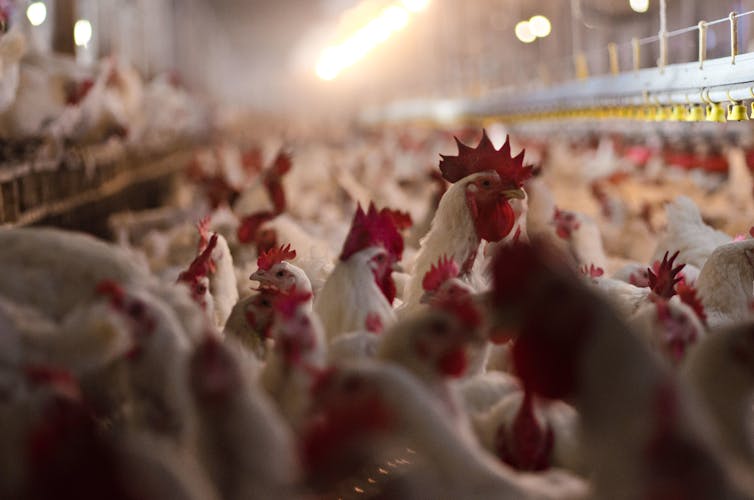
An outbreak of Highly Pathogenic Avian Influenza in chicken and turkey flocks has spread across 24 U.S. states since it was first detected in Indiana on Feb. 8, 2022. Better known as bird flu, avian influenza is a family of highly contagious viruses that are not harmful to wild birds that transmit it, but are deadly to domesticated birds. As of early April, the outbreak had caused the culling of some 23 million birds from Maine to Wyoming. Yuko Sato, an associate professor of veterinary medicine who works with poultry producers, explains why so many birds are getting sick and whether the outbreak threatens human health.
Why is avian influenza so deadly for domesticated birds but not for wild birds that carry it?
Avian influenza (AI) is a contagious virus that affects all birds. There are two groups of AI viruses that cause disease in chickens: highly pathogenic AI and low pathogenic AI.
HPAI viruses cause high mortality in poultry, and occasionally in some wild birds. LPAI can cause mild to moderate disease in poultry, and usually little to no clinical signs of illness in wild birds.
The primary natural hosts and reservoir of AI viruses are wild waterfowl, such as ducks and geese. This means that the virus is well adapted to them, and these birds do not typically get sick when they are infected with it. But when domesticated poultry, such as chickens and turkeys, come in direct or indirect contact with feces of infected wild birds, they become infected and start to show symptoms, such as depression, coughing and sneezing and sudden death.
There are multiple strains of avian influenza. What type is this outbreak, and is it dangerous to humans?
The virus of concern in this outbreak is a Eurasian H5N1 HPAI virus that causes high mortality and severe clinical signs in domesticated poultry. Scientists who monitor wild bird flocks have also detected a reassortant virus that contains genes from both the Eurasian H5 and low pathogenic North American viruses. This happens when multiple strains of the virus circulating in the bird population exchange genes to create a new strain of the virus, much as new strains of COVID-19 like omicron and delta have emerged during the ongoing pandemic.
According to the U.S. Centers for Disease Control and Prevention, the risk to public health from this outbreak is low. No human illnesses have been associated with this virus in North America. That was also true of the last H5N1 outbreak in the U.S. in 2014 and 2015.
Should people avoid poultry products until this outbreak ends?
No, that’s not necessary. Infected poultry or eggs do not enter the food supply chain.
To detect AI, the U.S. Department of Agriculture oversees routine testing of flocks done by farmers and carries out federal inspection programs to ensure that eggs and birds are safe and free of virus. When H5N1 is diagnosed on a farm or in a backyard flock, state and federal officials will quarantine the site and cull and dispose of all the birds in the infected flock. Then the site is decontaminated.
After several weeks without new virus detections, the area is required to test negative in order to be deemed free of infection. We call this process the four D’s of outbreak control: diagnosis, depopulation, disposal and decontamination.
Avian influenza is not transmissible by eating properly prepared and cooked poultry, so eggs and poultry are safe to eat. The USDA recommends cooking eggs and poultry to an internal temperature of 165 degrees Fahrenheit (74 Celsius).
Are avian influenza outbreaks happening more frequently around the world, or do we just hear more about them than we did 20 or 30 years ago?
The dynamics of the spread of avian influenza viruses are very complex. HPAI is a transboundary disease, which means it is highly contagious and spreads rapidly across national borders.
Some research indicates that detection of HPAI viruses in wild birds has become more common. Reports are seasonal, with a peak in February and a low point in September. There are ongoing outbreaks of HPAI in wild birds in Asia, Europe and Africa. Many migratory bird species travel thousands of miles between continents, posing a continuing risk of AI virus transmission.
In addition, we have better diagnostic tests for much more rapid and improved detection of avian influenza compared to 20 to 30 years ago, using molecular diagnostics such as polymerase chain reaction (PCR) tests – the same method labs use to detect COVID-19 infections.
What’s the prospect of developing a vaccine for poultry that could reduce the economic harm from outbreaks?
Many factors would have to be weighed before adopting vaccination as a strategy for controlling HPAI. At this time, the Department of Agriculture has not approved the use of vaccination in the U.S. for protecting birds from avian influenza.
One reason for this is that using vaccines would potentially affect international trade and poultry exports. Importers would not be able to distinguish vaccinated birds from infected birds based on the routine testing, so they might ban all U.S. poultry exports.
Vaccination also could delay outbreak detection, since it can potentially hide non-apparent infections in infected birds. And if infections go unnoticed, they could spread to other farms before farmers can put control measures in place.
Avian influenza vaccines can reduce clinical signs, sickness and death rates in domestic poultry, but they would not prevent birds from becoming infected with the virus. Ultimately, the USDA’s goal is to eradicate HPAI quickly after it is detected. However, vaccines could be used to help control an outbreak, and this is an option that the agency is investigating now.
[You’re smart and curious about the world. So are The Conversation’s authors and editors. You can read us daily by subscribing to our newsletter.]
Yuko Sato, Associate Professor of Veterinary Medicine, Iowa State University
This article is republished from The Conversation under a Creative Commons license. Read the original article.
Rex B. Powell, 68, died in the crash, which the California Highway Patrol’s Clear Lake Area office said occurred on an off-highway vehicle trail on the Mendocino National Forest’s Upper Lake Ranger District Sunday morning.
The CHP said Powell was riding his 2022 Husqvarna motorcycle on the trail at 9:50 a.m. Sunday when he came upon debris blocking the trail and applied the brakes to his motorcycle.
The braking caused Powell to be thrown from the bike and into the brush, the CHP said.
Despite Powell being in full protective gear, the CHP said he was impaled by a broken branch.
Medical aid was attempted at the crash scene before Powell was moved to the Middle Creek Campground staging area, where an individual who wasn’t involved called 911, the CHP said.
The CHP said emergency crews arrived and attempted to render medical aid, however, Powell was pronounced deceased at the scene.
Neither alcohol nor drugs are factors in this crash, the CHP said.
This was the fourth fatal crash in Lake County in less than a week. The other wrecks occurred near Upper Lake on Wednesday, Middletown on Friday and Lucerne on Saturday.
Email Elizabeth Larson at
The Slide fire started on Friday, Aug. 8, at around 5:30 p.m., forest officials reported.
It was located approximately 2.3 miles west of Soda Creek Station and south of Elk Mountain Road on the Upper Lake Ranger District.
Investigators say the fire was human-caused and not related to the nearby Westshore prescribed burn.
Shortly after forest law enforcement identified a column of smoke, resources that were managing the Westshore prescribed burn shifted over to respond to the Slide fire, officials said.
The forest reported that engines from Mendocino National Forest, Lake Pillsbury, Cal Fire’s Sonoma-Lake-Napa Unit and Konocti Crew 2 helped contain the fire.
On Friday at 10 p.m., firefighters reported the Slide fire size was being held at 1.5 acres.
Separately, on Friday at 10:50 a.m., firefighters patrolling the Westshore prescribed fire reported a tree had fallen across the containment line for the prescribed fire.
The Slide fire was contained at 100% as of Monday morning, the forest reported.
A steady, wetting rain fell early Monday morning, and officials said fire behavior was minimal at that time.
Officials said crews will continue to mop up and patrol the fire this week.
Additional updates will be provided when there are significant changes in fire activity or conditions, the forest headquarters said in its Monday report.
The agency said Lake County could see rainfall totaling about an inch, with cool and unsettled weather expected to continue through the week as another storm system passes through late Wednesday into Thursday.
The forecast also predicts widespread northwest winds early this week with gusts of up to 45 miles per hour over the county’s ridgetops.
The specific Lake County forecast anticipates rain on Monday, coupled with winds with gusts of nearly 25 miles per hour.
There also are chances of rain from Tuesday through Saturday. Wednesday night and into Thursday morning could see up to half an inch of rainfall.
Conditions are expected to clear by Saturday night, continuing into Sunday.
Daytime temperatures this week will range from the high 40s on Monday to the low 60s by Sunday. Nighttime conditions will drop into the mid 30s early in the week, topping out in the high 40s.
Email Elizabeth Larson at