How to resolve AdBlock issue?
News
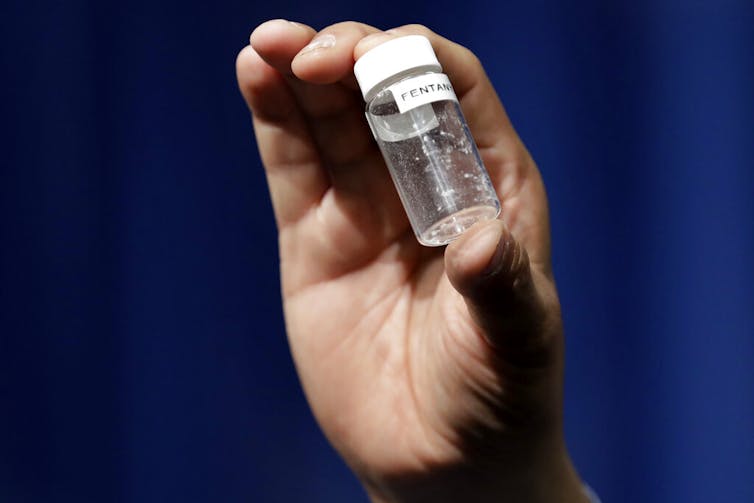
Buying drugs on the street is a game of Russian roulette. From Xanax to cocaine, drugs or counterfeit pills purchased in nonmedical settings may contain life-threatening amounts of fentanyl.
Physicians like me have seen a rise in unintentional fentanyl use from people buying prescription opioids and other drugs laced, or adulterated, with fentanyl. Heroin users in my community in Massachusetts came to realize that fentanyl had entered the drug supply when overdose numbers exploded. In 2016, my colleagues and I found that patients who came to the emergency department reporting a heroin overdose often only had fentanyl present in their drug test results.
As the Chief of Medical Toxicology at UMass Chan Medical School, I have studied fentanyl and its analogs for years. As fentanyl has become ubiquitous across the U.S., it has transformed the illicit drug market and raised the risk of overdose.
Fentanyl and its analogs
Fentanyl is a synthetic opioid that was originally developed as an analgesic – or painkiller – for surgery. It has a specific chemical structure with multiple areas that can be modified, often illicitly, to form related compounds with marked differences in potency.
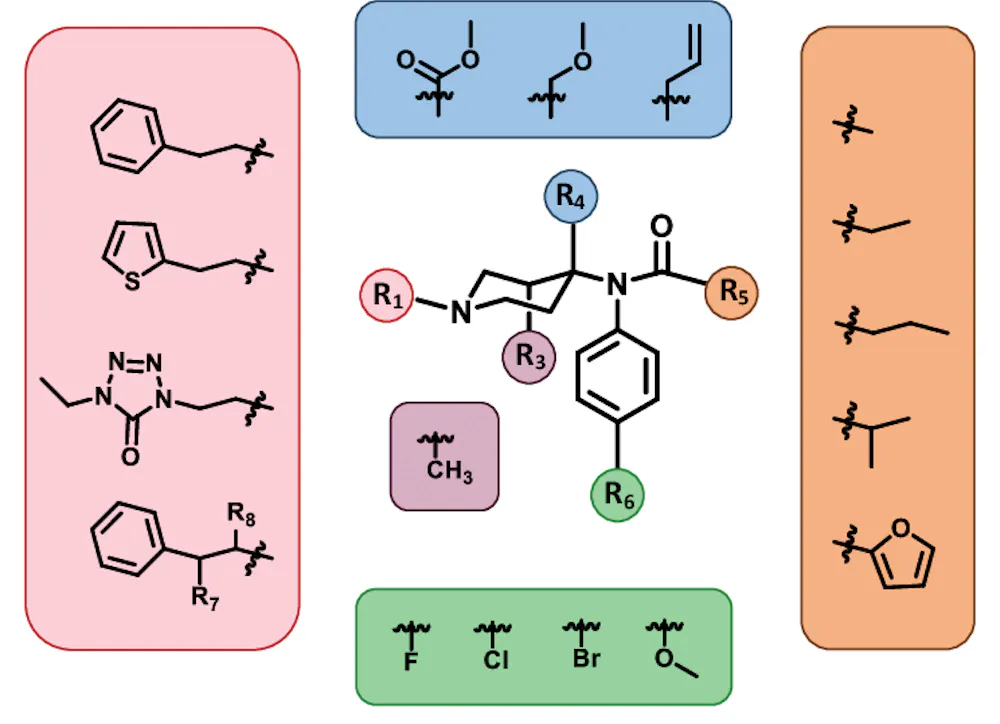
For example, carfentanil, a fentanyl analog formed by substituting one chemical group for another, is 100 times more potent than its parent structure. Another analog, acetylfentanyl, is approximately three times less potent than fentanyl, but has still led to clusters of overdoses in several states.
Despite the number and diversity of its analogs, fentanyl itself continues to dominate the illicit opioid supply. Milligram per milligram, fentanyl is roughly 50 times more potent than heroin and 100 times more potent than morphine.
Lacing or replacing drugs with fentanyl
Drug dealers have used fentanyl analogs as an adulterant in illicit drug supplies since 1979, with fentanyl-related overdoses clustered in individual cities.
The modern epidemic of fentanyl adulteration is far broader in its geographic distribution, production and number of deaths. Overdose deaths roughly quadrupled, going from 8,050 in 1999 to 33,091 in 2015. From May 2020 to April 2021, more than 100,000 Americans died from a drug overdose, with over 64% of these deaths due to synthetic opioids like fentanyl and its analogs.
Illicitly manufactured fentanyl is internationally synthesized in China, Mexico and India, then exported to the United States as powder or pressed pills. Additionally, the emergence of the dark web, an encrypted and anonymous corner of the internet that’s a haven for criminal activity, has facilitated the sale of fentanyl and other opioids shipped through traditional delivery services, including the U.S. Postal Service.
Fentanyl is both sold alone and often used as an adulterant because its high potency allows dealers to traffic smaller quantities but maintain the drug effects buyers expect. Manufacturers may also add bulking agents, like flour or baking soda, to fentanyl to increase supply without adding costs. As a result, it is much more profitable to cut a kilogram of fentanyl compared to a kilogram of heroin.
Unfortunately, fentanyl’s high potency also means that even just a small amount can prove deadly. If the end user isn’t aware that the drug they bought has been adulterated, this could easily lead to an overdose.
Preventing fentanyl deaths
As an emergency physician, I give fentanyl as an analgesic, or painkiller, to relieve severe pain in an acute care setting. My colleagues and I choose fentanyl when patients need immediate pain relief or sedation, such as anesthesia for surgery.
But even in the controlled conditions of a hospital, there is still a risk that using fentanyl can reduce breathing rates to dangerously low levels, the main cause of opioid overdose deaths. For those taking fentanyl in nonmedical settings, there is no medical team available to monitor someone’s breathing rate in real time to ensure their safety.
One measure to prevent fentanyl overdose is distributing naloxone to bystanders. Naloxone can reverse an overdose as it occurs by blocking the effects of opioids.
Another measure is increasing the availability of opioid agonists like methadone and buprenorphine that reduce opioid withdrawal symptoms and cravings, helping people stay in treatment and decrease illicit drug use. Despite the lifesaving track records of these medications, their availability is limited by restrictions on where and how they can be used and inadequate numbers of prescribers.
Other strategies to prevent overdose deaths include lowering the entry barrier to addiction treatment, fentanyl test strips, supervised consumption sites and even prescription diamorphine (heroin).
Despite the evidence supporting these measures, however, local politics and funding priorities often limit whether communities are able to give them a try. Bold strategies are needed to interrupt the ever-increasing number of fentanyl-related deaths.
Kavita Babu, Professor of Emergency Medicine, UMass Chan Medical School
This article is republished from The Conversation under a Creative Commons license. Read the original article.
The three-day event will take place from Friday, May 13, through Sunday, May 15.
On the shores of the highly productive and ancient Clear Lake, the little town of Clearlake Oaks transforms once a year when the best catfishing tournament west of the Mississippi draws hundreds of fishing enthusiasts and their families into town for the ever-popular Catfish Derby.
The traffic along Highway 20 through the Clearlake Oaks community gets heavy at times but increases substantially at derby time as trucks hauling fishing boats line up to check in.
“It gets pretty congested, but nobody complains,” said Dennis Locke, the Catfish Derby Committee chairman. “It’s like a festival setting in any small rural town, where people gather and excitement builds in anticipation of a grand finale. In the case of the derby, the grand finale occurs on the last day at noon, when the announcement ceremony draws a huge crowd.”
After a scaled-down tournament last year, event organizers are ready to resume the signature fundraiser for the Clearlake Oaks-Glenhaven Business Association, who sponsors the event.
“All proceeds from the derby go right back into the community,” said Association President Alvaro Valencia.
In its 38th year, the family-oriented event brings people in from all over the state and beyond who shop, stay in hotels and resorts, and enjoy dining and other opportunities found on the shores of Clear Lake.
“It’s fun and benefits the entire Lake County economy,” Valencia said. “Last year, after missing a year due to the pandemic, we raised over $30,000. We’re hoping to do even better this year.”
“We’re expecting about 1,000 entries, adults and kids,” said Locke. “Sign-ups are going very well. It’s great to see some of the regulars, like the Lanes who have been coming to the Derby for years — all the way from Oregon. They signed up early.”
The fishing contest begins on Friday and concludes on Sunday at noon.
As in past years, the event will be at the Northshore Fire Protection District 75 station on 12655 Highway 20.
Locke explained that although the first day of fishing begins on Friday, event volunteers are set up the day before, Thursday, when many anglers arrive to check in early to begin fishing at noon on Friday.
“Due to low lake levels, derby contestants will be weighing in on Friday and Saturday at the Clearlake Oaks public launch ramp, 12684 Island Drive,” Locke said.
Registrations, Sunday weigh-ins, and the awards ceremony will be at the fire station.
As anglers bring in their best catch, volunteers weigh the fish and record the information on a large billboard at the boat launch for all to view.
The data is also entered into a database and results are posted on the derby website and social media sites including Facebook and Twitter, which have become popular with participants and followers who enjoy keeping up with the latest results.
“Many of the posts and comments we see on these social media sites are from family and friends of Derby contestants who want to stay current on how their friends and family members are doing,” Locke said.
A total of $10,000 in cash prizes will be awarded in the adult and kids categories combined. The prize for the biggest catch is $5,000. Kids can participate in the adult division but must pay the adult entry fee of $50 compared to $10 for the two kids’ divisions.
In addition to the cash prizes $2,500 in raffle prizes are awarded throughout the event. Derby T-shirts, food and beverages will also be available for sale Saturday and Sunday.
“The last day of the derby is open to all and always draws a big crowd. In addition to the anglers and their families, people from around the county show up to celebrate with the winners and enjoy the great food and camaraderie.
The derby committee is supported by volunteers from around the county. Locke said the main committee couldn’t put on the event without the fantastic locals — about 50 — who show up throughout the six-month planning process to help with everything from stuffing envelopes to checking in the contestants to weighing the fish as anglers bring them in.
Most of the volunteers come from Clearlake Oaks, but the derby is also supported by volunteers all around the lake.
“Mary Heare Amodio has been driving in from Lakeport for years to help out as has Russell Jonas from Clearlake, to name just a few,” Locke said. “We are grateful to all, including the support from Northshore Fire Chief Mike Ciancio, who provides the venue.”
There’s still time to sign up for the Derby online or in person at the Derby beginning at noon on Thursday, May 12.
For details about entering the Derby, fees, and other information visit www.clearlakeoaks.org/derby or call 707-596-0248.
The performances will take place from 4 to 6 p.m. Saturday, May 14, and Sunday, May 15, at the Passion Play grounds at 7010 Westlake Road near Upper Lake, located off Highway 29 about four miles north of Lakeport.
Admission is free but donations are gratefully accepted.
The play portrays the passion, death, resurrection and ascension of Jesus Christ.
Organizers said the play “is a prayerful expression of the faith of the people involved. Men, women, and children from many denominations have come together to make this a truly ecumenical experience, touched by the Holy Spirit.”
Spectators are urged to bring their own chairs.
Water is available, as are facilities for the handicapped.
There is no smoking, food, drink or pets permitted on the grounds.
For more information, visit the Passion Play Facebook page or the website, or call 707-263-0349.
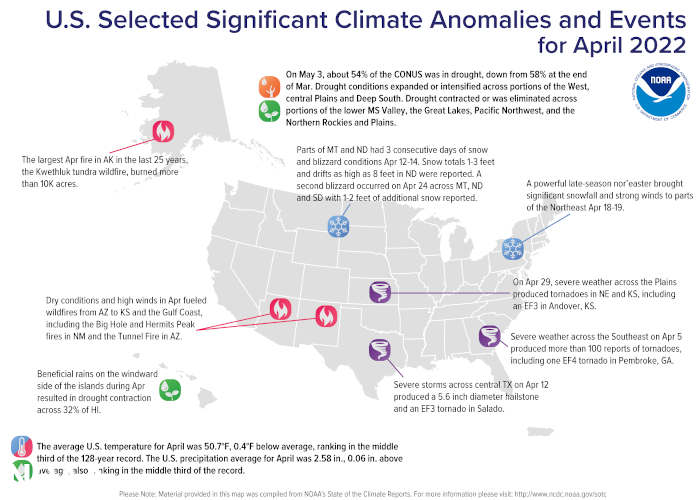
April 2022 was slightly cooler and wetter than normal across the contiguous U.S., according to the National Centers for Environmental Information.
What made the month standout was an early start to the wildfire season, several tornado outbreaks and a widespread Western drought.
Below are more take-aways from NOAA’s latest monthly U.S. climate report:
Climate by the numbers
April 2022
The average April temperature across the contiguous U.S. was 50.7 degrees F (0.4 of a degree below the 20th-century average), ranking in the middle third of the 128-year record.
Temperatures from the Northwest to the Great Lakes and into the mid-Mississippi Valley were generally below average, while much of the Southwest, Deep South and portions of the East Coast saw above-average temperatures.
The average precipitation for the month was 2.58 inches — 0.06 of an inch above average — which places the month in the middle third of the historical record.
Above-average precipitation fell across portions of the Northwest, northern Rockies and Plains, Great Lakes and Northeast, while the Southwest and the central and southern Plains saw below-normal precipitation.
Year to date
The average U.S. temperature for the year to date — YTD, January through April 2022 — was 39.9 degrees F (0.8 of a degree above average), ranking in the warmest third of the climate record.
Temperatures were above average across parts of the West and also along the East Coast, with California seeing its sixth-warmest such YTD on record.
The average precipitation for the first four months of 2022 was 8.25 inches (1.22 inches below normal), which ranked as the 13th-driest January-through-April YTD on record. California had its driest YTD on record for this four-month period, while Nevada and Utah had their third driest.
Other notable climate events in April
Wildfire season kicked off early: Dry and windy conditions across the Southwest and Plains contributed to an active start to the wildfire season in April. As of May 3, the largest fire across the U.S., the Hermits Peak Fire in New Mexico, consumed more than 145,000 acres and was 20% contained. Across all 50 states, 1.1 million acres have burned since January 1— 160% of average for this time of year.
Tornadoes were numerous: Several tornado outbreaks occurred during April, contributing to an above-average tornado count for the month. A dayslong outbreak in early April brought tornadoes and severe weather from the Dallas/Fort Worth, Texas, metro area to the Carolinas. Another outbreak mid-month struck the Great Plains, Midwest and Deep South, with another round of severe thunderstorms and tornadoes raking the central Plains on April 29-30.
Drought conditions improved overall: According to the May 3 U.S. Drought Monitor report, 53.8% of the contiguous U.S. was in drought, down approximately 4 percentage points from the end of March. Drought conditions expanded or intensified across portions of the West, central Plains and Deep South. Drought conditions lessened or were eliminated across portions of the lower Mississippi Valley, the Great Lakes, the Northern Rockies and Plains, Pacific Northwest and across portions of Hawaii.
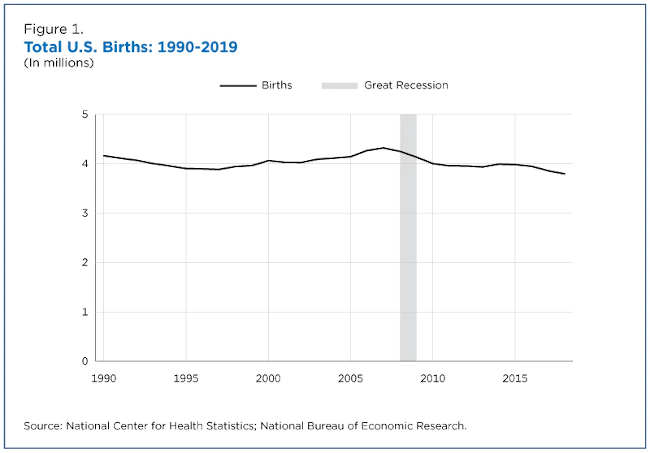
Overall fertility trends from 1990 to 2019 were relatively stable, compared to previous decades but varied significantly by age, according to a Census Bureau analysis.
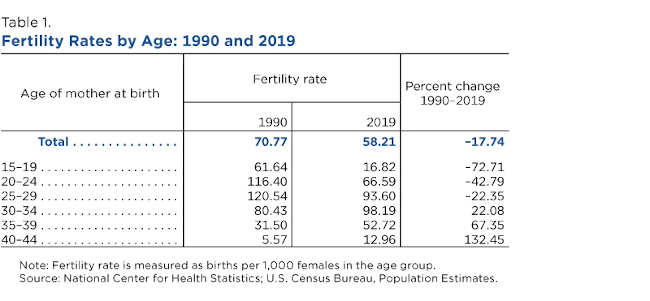
The analysis, which looked at Census Bureau and National Center for Health Statistics data, shows fertility rates of women ages 20-24 declined by 43%, while those of women ages 35-39 increased by 67% during the roughly 30-year period.
Together, the data paint a compelling picture of how the age at which American women give birth has changed over time.
Fertility trends: 1990-2019
Fertility rates in the United States gradually declined from 1990 to 2019. In 1990, there were about 70.77 births each year for every 1,000 women ages 15-44. By 2019, there were about 58.21 births per 1,000 women in that age group.
While broadly stable, annual births in the United States declined from about 4.1 million to 3.7 million from 1990 to 2019 (Figure 1).
Shifting age structures
The gradual decline in overall fertility rates masks more variation by age.
Fertility rates of younger women fell substantially: There were 116.40 births for every 1,000 women ages 20-24 in 1990. In 2019, there were only 66.59 births to every 1,000 women in that age range — a 42.79% decline. This contributed to the overall decline.
During the same period, the fertility rates of older women rose significantly.
In 1990, there were 31.50 births for every 1,000 women ages 35-39. In 2019 there were 52.72 births for every 1,000 women ages 35-39 — a 67.35% increase. But overall fertility rates declined because the jump in birthrates of older women was not enough to offset declines in birthrates of younger women (See Table 1).
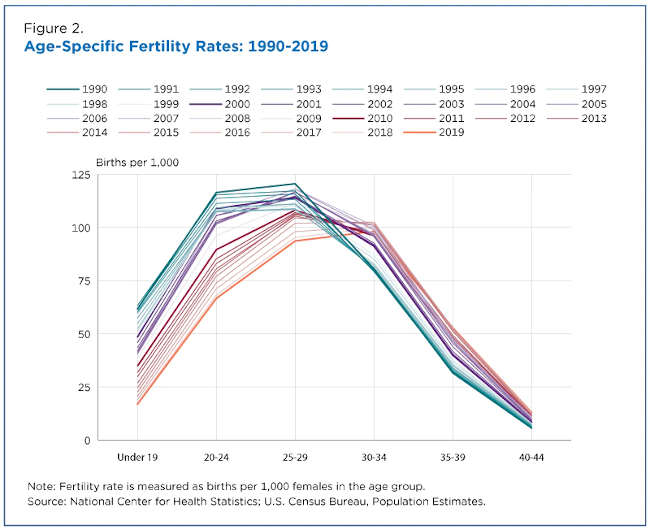
This pattern is not sensitive to the years we compare; Figure 2 shows that this is indeed a persistent trend from 1990-2019.
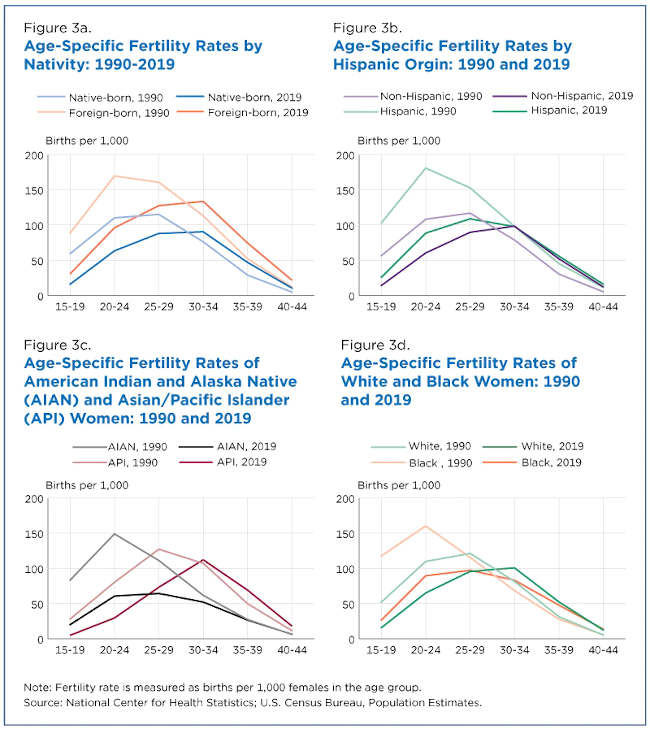
This general pattern also holds true for population subgroups in the United States. Fertility rates increased at older ages, but not enough to make up for declines at younger ages.
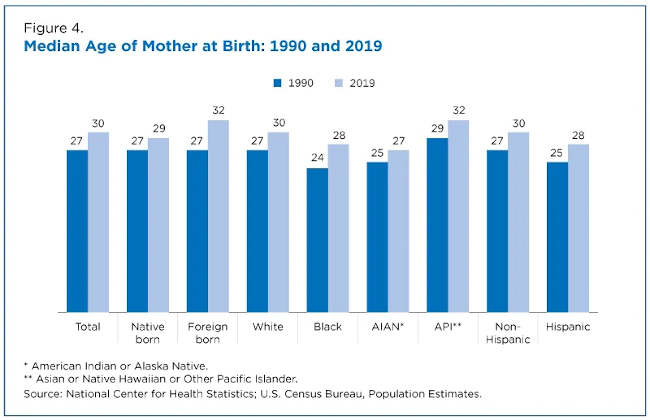
These changing fertility rates by age shifted the median age at which women gave birth in the United States from age 27 in 1990 to age 30 in 2019.
The largest increase was among foreign-born and Black women, which rose from 27 to 32 years old and from 24 to 28 years old, respectively. The smallest increase in age (from 27 to 29 years old) was among women born in the United States.
Early 2000s mini birth boom
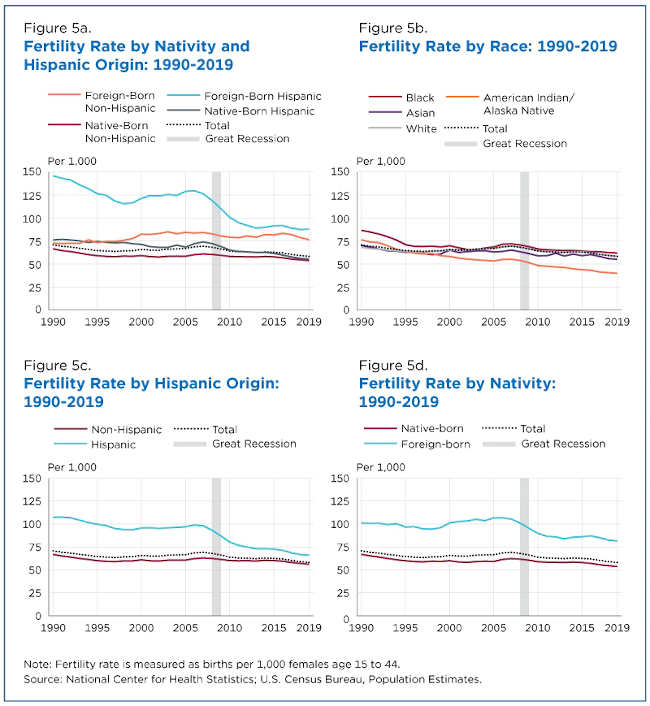
While fertility rates broadly declined in the United States from 1990-2019, there was a mini baby boom in the early 2000s.
This increase was driven by foreign-born Hispanic women.
This mini baby boom to foreign-born Hispanics ended in 2007, just before the Great Recession began later that year. The Great Recession officially began in December 2007, ending in June 2009, according to the National Bureau of Economic Research.
It is not clear what portion of the fertility decline to foreign-born Hispanics can be attributed to the economic downturn since the decline began before the Great Recession started. This decline may partially be due to the end of the mini baby boom for foreign-born Hispanic women and a return to long-term downward fertility trend.
Historical fertility patterns
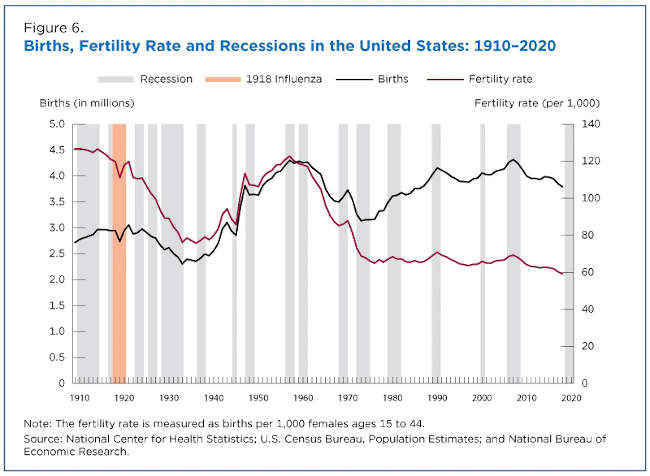
Despite the slight declines and mini-baby boom from 1990 to 2019, contemporary fertility trends are actually quite stable when viewed from a historical perspective.
During the 20th century, there were several periods of substantial change: the precipitous decline in fertility at the beginning of the century, the baby boom of the 1950s, and the decline in fertility rates that began in the 1960s.
Within these overall changes, there were smaller, short-term fluctuations.
For example, during the broad fertility decline of the early 20th century, fertility dipped and increased following the 1918 influenza pandemic. During the 1950s baby boom, fertility stagnated in response to an economic recession in 1953.
Such changes were clearly short-term deviations within broader trends. A longer-term view can help differentiate between broad, generational changes and small year-to-year fluctuations.
These diverse patterns in fertility throughout the years highlight the variety of phenomena that may affect fertility — from generational changes to disease. They also provide an in-depth view of the changing face of fertility in America over time.
Anne Morse is a demographer in the Census Bureau’s Estimates and Projections Area of the Population Division.
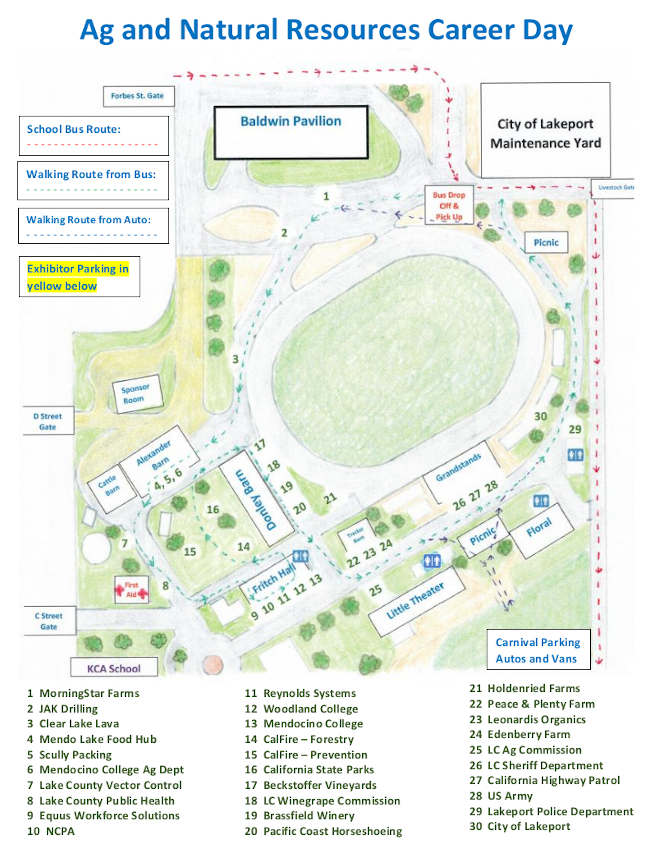
The inaugural Agriculture and Natural Resources Career Day will be held from 9 a.m. to noon Wednesday, May 11, at the Lake County Fairgrounds, 401 Martin St. in Lakeport.
All Lake County high school students are invited to attend in hopes of gaining knowledge
and excitement about ag and natural resource careers, and those that support these
Industries.
Participating farms, businesses and other organizations include MorningStar Farms, JAK Drilling, Clear Lake Lava, Mendo Lake Food Hub, Scully Packing, Mendocino College Ag Department, Lake County Vector Control, Lake County Public Health, Equus Workforce Solutions, NCPA, Reynolds Systems, Woodland College, Mendocino College, Cal Fire – Forestry, Cal Fire – Prevention, California State Parks, Beckstoffer Vineyards, Lake County Winegrape Commission, Brassfield Winery, Pacific Coast Horseshoeing, Holdenried Farms, Peace & Plenty Farm, Leonardis Organics, Edenberry Farm, Lake County Agriculture Commissioner, Lake County Sheriff’s Office, California Highway Patrol, US Army, Lakeport Police Department and the city of Lakeport.
The foundation reported that the event wouldn’t have been possible without support from the community, especially Beckstoffer Vineyards, the 49th District Agricultural Association, the Lake County Sheriff’s Volunteers, and the many business, colleges and exhibitors who will be sharing information about their work and why these careers are so important in Lake County.