 How to resolve AdBlock issue?
News
CLEARLAKE OAKS, Calif. — Another busy weekend of fishing, weigh-ins and competition is over, with a Kelseyville man hooking the top prize in the annual Catfish Derby.
The derby, which began on Friday, closed on Sunday afternoon to the applause of locals and out-of-towners who waited to go home until after the results were announced by Committee Chair Dennis Locke.
“Welcome to the 38th annual Catfish Derby” Locke announced. “One thing we know for certain — while this is arguably the biggest catfishing derby west of the Mississippi — we know it is the largest fishing event of any kind, ever, on Clear Lake! We appreciate your continued support – all 957 of you who entered the derby this year - and your families.”
The pandemic had resulted in the 2020 event being canceled. However, the largest catfish derby west of the Mississippi began making its way back in a scaled-back fashion in 2021.
That led to this weekend’s event, which was back to what organizers termed “normal” operations, with total entries up by 75 over 2021.
Once again, the derby drew participants from across the United States.
Derby organizers said entrants came from as far East as Muskogee, Oklahoma; as far north as Enumclaw, Washington; and from all parts of California – 61% traveled to Clear Lake; 39% were from Lake County.
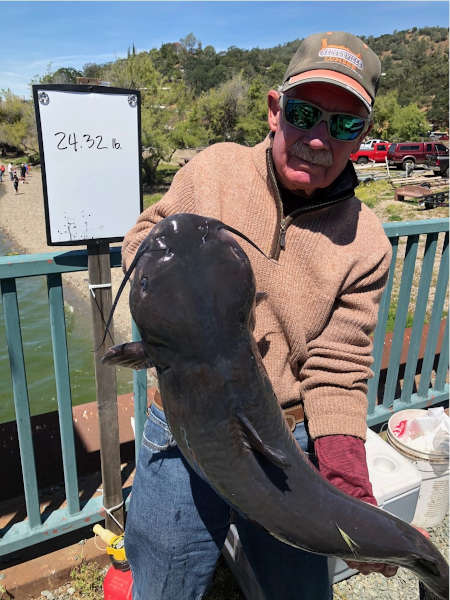
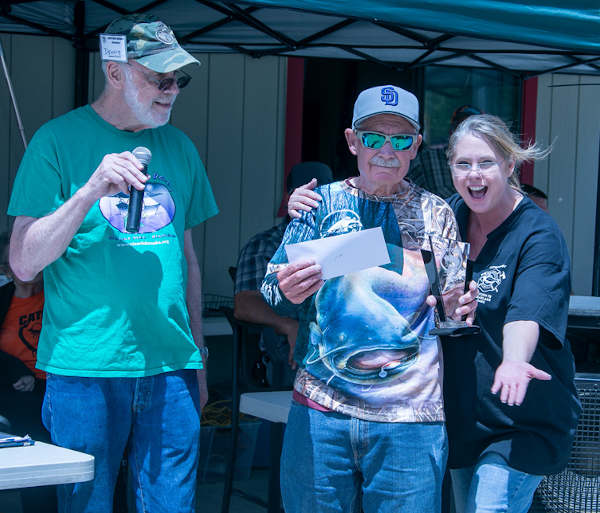
Dan Sansome of Kelseyville took home the top prize, $5,000 for his 24.32-pound catfish. “This is my 10th year entering the catfish derby,” he said.
Formerly from San Diego, Sansome was the captain of a long-range fishing boat, the “American Angler.” He has been entering the catfish derby since retiring to fish on Clear Lake.
“I’ve wanted to live here all my life,” he said. “I fish for bass too, but this is the only tournament I enter. I love the challenge of catfishing and the high volume of fish in the lake. As much fishing as I do, winning 1st prize this year is mighty special,” Sansome said.
With Sansome was his longtime friend, Ed Puente, who placed third in 2019 with a 26.73-pound catfish.
Puente was all smiles at his friend's good fortune this year. “I met Dan years ago when I took a multi-day fishing trip on his party boat out of San Diego. I hadn’t seen or heard from him for many years when, about 8 years ago, I saw his picture in one of the local tackle shops. I looked him up and we’ve been fishing together ever since. He’s an expert fisherman.”
Second place winner, Daniel Shelton, also from Kelseyville, took home $1,000 for his 24.10-pound catch.
The third place winner, Corey West, drove in from Yuba City and took home $800 for his 23.82-pounder.
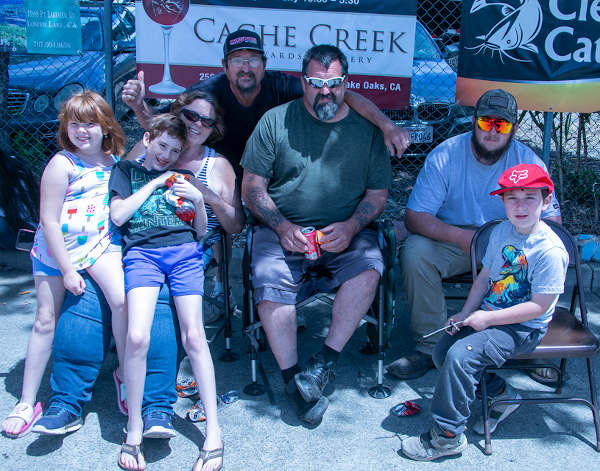
The Pearsons, a family of eight from Clearlake, are regulars at the derby and stayed until the end.
“We didn’t place this year but we’ll definitely be back next year,” said Dan Pearson. “Fishing and camping, that’s what we love doing as a family.”
In the older kids division, ages 11 to 15, Kianii Hill Bourlet of Reno took home the first place prize of $100 for her 18.28-pound catfish; Josiah Lopez of Folsom took home second place prize of $50 for his 17.91-pound catfish; and Scarlett Ocheltree of Yuba City placed third with her 17.64-pound catch and took home $25 in prize money.
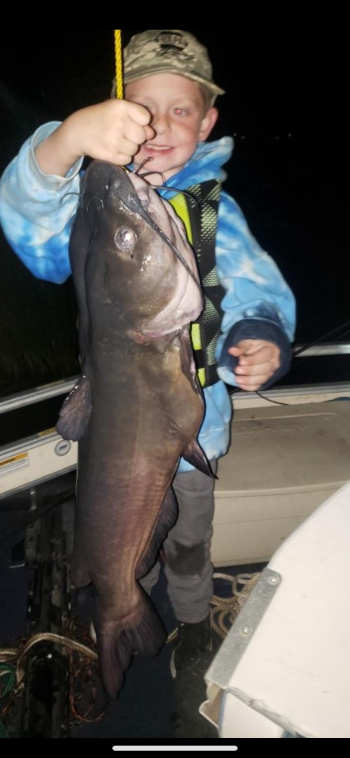
In the younger kids division, up to 10 years old, Tommy Higman of Fairfield took home the first place prize of $100 for his 17.64-pound catfish; Hazel Allen of Kelseyville took home the second place prize, $50, for her 17.16 pounder; and Arthur Weatherwax IV, also from Kelseyville, took home the third place prize, $25 for his 16.68-pounder.
If some names of the young derby winners sound familiar there’s good reason. “Many of the young people that participated this year have been fishing since they were strong enough to hold a fishing rod,” said Barbara Higman, a derby volunteer whose family has fished Clear Lake — and the derby — for years. “I’m so proud of my grandson, Tommy, for his first place win. He’s a third generation fisherman!”
Lee Her, from Antelope, has been fishing the derby for years and was back this year with his nephew, Darrel Her. Lee placed eight this year with his 22.06-pound catch.
“In 2018, I won first place with my 24.34-pound catch — almost the same weight as this year’s first place win by Dan Sansome of 24.32 pounds,” Her said. “I love to fish. I learned to fish when I was young from my uncle and now, I’m teaching my nephew. Of course, winning is part of the allure but it’s so much more than that. It’s coming together as a family, reconnecting with some of the derby people who I see year after year, and building on great memories, that’s what it’s all about.”
As for Darrel Her, “I’m hooked, I’ll definitely be back next year with my uncle,” he said.
For all scores visit clearlakeoaks.org/derbystandings and for interesting comments and photos about the derby go to Catfish Derby At The Oaks on Facebook.

LAKE COUNTY, Calif. — On Friday the Lake County Sheriff's Office arrested a man reported to have had enough fentanyl in his possession to kill the entire population of Lake County, along with other drugs and multiple firearms, including a “ghost” gun.
Brandon Charles Weilert, 38, of Nice, also known as Brandon Grendis, was arrested for multiple felony crimes, including distributing and selling narcotics and possessing a machine gun on Friday, said Lauren Berlinn, spokesperson for the Lake County Sheriff’s Office.
She said Weilert is prohibited from possessing firearms and ammunition as a result of a prior felony conviction.
Berlinn said information received from the community over the past several months regarding ongoing drug activity and suspicious behavior led to the sheriff’s office investigating a residence in the 2800 block of Merced Street in Nice.
As a result of the information obtained during the investigation, Berlinn said the Lake County Sheriff’s Major Crimes Unit authored a search warrant, which was approved and signed by a judge.
On Friday, detectives and personnel from the Lake County Sheriff’s Office served the search warrant for the property, Berlinn said.
During the search warrant service, approximately 1,538 grams or 3.4 pounds of methamphetamine, 139 grams or 4.8 ounces of fentanyl, and 24 grams of heroin were seized, Berlinn said.
For perspective, a lethal dose of fentanyl is generally estimated to be about two milligrams, meaning there was enough of that drug seized to create 69,500 lethal doses.
Berlin said the total street value of the methamphetamine, fentanyl and heroin seized is estimated at approximately $170,000.
Also found were weight scales, a large amount of packaged marijuana and multiple firearms, Berlinn said.
She said one of the pistols seized was identified as what is commonly referred to as a “ghost gun.” The pistol was later determined to be modified to fire fully automatic, meaning it’s capable of continuous firing with a single action of the trigger.
Lake County Jail records show that Weilert is being held without bail on a PC 1275 hold due to concerns that he would use money to post bail that came from the commission of a felony.
To report suspicious activity, contact the Lake County Sheriff's Dispatch at 707-263-2690 or online at www.lakesheriff.com/Services/report.

This year’s event will be held on Wednesday, May 25, when the weather will probably be pleasant and many weeds are likely to still be in flower.
As always this event is free and the public is welcome and encouraged to attend.
Participants will gather in front of the Ranch House at Anderson Marsh State Historic Park, 8400 State Highway 53 between Clearlake and Lower Lake, at 9 a.m., take a leisurely guided walk of about a mile to see the amazingly diverse array of invasive plants that flourish in the park and the effects of control mechanisms such as control burns, and return to the house for a discussion of aquatic invasive weeds under the trees.
Please wear sturdy shoes and feel free to bring a bag lunch if you so choose.
This event is sponsored by the Lake County Department of Agriculture and the Lake County Resource Conservation District.
No reservations are required.
Please contact the Agriculture Department at 707-263-0217 if you have any questions.
The board will meet beginning at 9 a.m. Tuesday, May 17, in the board chambers on the first floor of the Lake County Courthouse, 255 N. Forbes St., Lakeport.
The meeting can be watched live on Channel 8, online at https://countyoflake.legistar.com/Calendar.aspx and on the county’s Facebook page.
Accompanying board documents, the agenda and archived board meeting videos also are available at that link.
To participate in real-time, join the Zoom meeting by clicking this link.
The meeting ID is 918 1202 6910, pass code 746506. The meeting also can be accessed via one tap mobile at +16699006833,,91812026910#,,,,*746506#.
All interested members of the public that do not have internet access or a Mediacom cable subscription are encouraged to call 669-900-6833, and enter the Zoom meeting ID and pass code information above.
To submit a written comment on any agenda item visit https://countyoflake.legistar.com/Calendar.aspx and click on the eComment feature linked to
the meeting date. If a comment is submitted after the meeting begins, it may not be read during the meeting but will become a part of the record.
In an untimed item, the board will discuss what next steps to take in filling the seat of District 4 Supervisor Tina Scott, who is resigning effective July 31.
The board will consider placing the seat on the Nov. 8 general election ballot.
At 10 a.m., the board is scheduled to hear WeGrow LLC owner Zarina Otchkova’s appeal of the Lake County Planning Commission’s denial of a major use permit for her cannabis project at 16750 Herrington Road, 17610 Sandy Road and 19678 Stinson Road in Middletown.
Otchkova’s project proposes growing, processing and distribution operations on a nine-acre portion of the 309-acre property, with 34 greenhouses, four drying buildings, a shed, 20 water tanks and privacy fencing planned.
The commission approved a previous version of the project in April 2021, but two months later the supervisors upheld the appeal of a group of neighbors living in several subdivisions next to the site.
The project came back to the commission in February, at which time commissioners voted unanimously to deny the adoption of an initial study and the major use permit because county planning staff had concluded an environmental impact report was required.
The full agenda follows.
CONSENT AGENDA
5.1: Adopt proclamation designating the month of May 1 through June 14, 2022, as Military Appreciation Month.
5.2: Approve continuation of proclamation of the existence of a local emergency due to pervasive tree mortality.
5.3: Adopt Proclamation recognizing May 2022 as California Tourism Month in Lake County.
5.4: Approve agreement between county of Lake and Native American Mental Health Services dba North American Mental Health Services for telepsychiatry services in the amount of $2,904,708.48 for fys 2022-25 and authorize the board chair to sign.
5.5: Approve Amendment No. 1 to the agreement between county of Lake and North Valley Behavioral Health for a new contract maximum of $840,000 for fy 2021-22 and authorize the board chair to sign.
5.6: Adopt proclamation designating the week of May 21 through May 27, 2022 as National Safe Boating Week in Lake County.
5.7: Approve Board of Supervisors minutes for May 3, 2022.
5.8: Approve continuation of resolution authorizing teleconferenced meetings during a state of emergency continue to exist.
5.9: Approve continuation of a local health emergency by the Lake County health officer for the Cache fire.
5.10: Approve continuation of a local health emergency related to the 2019 Coronavirus (COVID-19) as proclaimed by the Lake County Public Health officer.
5.11: Approve continuation of a local health emergency and order prohibiting the endangerment of the community through the unsafe removal, transport, and disposal of fire debris for the LNU Complex wildfire.
5.12: Approve continuation of a local emergency due to COVID-19.
5.13: Approve continuation of an emergency declaration for drought conditions.
5.14: Approve continuation of a local emergency in lake county in response to the LNU Lightning Complex wildfire event.
5.15: Approve continuation of a local emergency by the Lake County Sheriff/OES director for the Cache fire.
5.16: Authorize the Public Services director to issue a purchase order to Garland Co. for roofing materials not to exceed $249,323.11.
5.17: Second reading of ordinance establishing Chapter 31 of the Lake County Code for an edible food recovery program.
5.18: Adopt proclamation designating the week of May 15 to 21, 2022 as Law Enforcement Officers Week.
5.19: Authorize the closure of all Social Services facilities for staff enrichment, appreciation and team building on Wednesday, June 22, 2022 from the hours of 8 to 11 a.m.
TIMED ITEMS
9:05 a.m.: Pet of the Week.
6.3, 9:07 a.m.: Presentation of proclamation designating the week of May 21 through May 27, 2022, as National Safe Boating Week in Lake County.
6.4, 9:08 a.m.: Presentation of proclamation designating the week of May 15 to 21, 2022, as Law Enforcement Officers Week.
6.5, 9:09 a.m.: Presentation of proclamation designating the month of May 1 through June 14, 2022, as Military Appreciation Month.
6.6, 9:15 a.m.: (a) Presentation of proclamation recognizing May 2022 as California Tourism Month in Lake County; and (b) consideration of a report from the Lake County Tourism Improvement District on its activities over the past year.
6.7, 9:30 a.m.: Public hearing on account and proposal assessment for 13204 Second Street, Clearlake Oaks.
6.8, 9:45 a.m.: Consideration of grant funding in the amount of $25,000 to support 1Team 1Dream by sponsoring Hands Up Lake County, Small Business Competition, 2022.
6.9, 10 a.m.: Public hearing, appeal of planning commission denial of major use permit Resubmittal 20-22 and IS/MND 20-25 “WeGrow, LLC,” Middletown. APN’s 013-060-40 (cultivation site) and 013-014-03 and 11 (clustering sites). Zarina Otchkova (Appellant) (AB 22-01).
6.10, 11:30 a.m. Discussion of Lake County Behavioral Health Services request for proposals process for FY 2022-23 and approve contracting with facilities/provider who did not submit proposals to maintain continuity of client care.
6.11, 12 p.m.: Lake County Department of Health Services monthly update.
UNTIMED ITEMS
7.2: Discussion and consideration of purchasing a flag to be flown during Pride Month.
7.3: Consideration and discussion of changes to the board of supervisors annual calendar for 2022.
7.4: (a) Discussion of next steps to fill the role of District 4 Supervisor, to be Vacated by Tina Scott July 31, 2022; (b) consideration of a resolution setting an election for District 4 supervisor as part of the Nov. 8, 2022, Statewide General Election.
CLOSED SESSION
8.1: Public employee evaluation: Animal Care and Control director.
8.2: Public employee evaluation: Information technology director.
Email Elizabeth Larson at
The council will meet at 6 p.m. Tuesday, May 17, in the council chambers at Lakeport City Hall, 225 Park St.
The agenda can be found here.
The council chambers will be open to the public for the meeting. Masks are highly encouraged where 6-foot distancing cannot be maintained.
If you cannot attend in person, and would like to speak on an agenda item, you can access the Zoom meeting remotely at this link or join by phone by calling toll-free 669-900-9128 or 346-248-7799.
The webinar ID is 973 6820 1787, access code is 477973; the audio pin will be shown after joining the webinar. Those phoning in without using the web link will be in “listen mode” only and will not be able to participate or comment.
Comments can be submitted by email to
On Tuesday, the council will receive a presentation on the state of the city and provide staff direction on next steps.
City Manager Kevin Ingram’s report to the council explains that on March 21 the council set goals for the upcoming 2022-23 budget year after receiving a presentation from him and executive staff.
“This annual event kicks off the budget process and is crucial to the City's strategic planning process,” Ingram wrote. “New to this year’s process was the formalization of six priority areas determined by your Council.”
Those areas are public safety and crisis response; disaster resilience; good governance and fiscal stability; capital infrastructure improvement; safe, sustainable and attractive neighborhoods; and economic development.
They also will discuss completed goals and accomplishments for the 2021-22 year and how those correspond with the newly established priority areas.
Also on the agenda is a public hearing to introduce an ordinance amending Chapter 8.16 of the
Lakeport Municipal Code to establish regulations related to the establishment of an edible food recovery program and calendar a second reading of the ordinance.
Under council business, Ingram will lead a discussion about outdoor dining being allowed under the current COVID-19 emergency temporary use zoning permits and ask for direction.
The city’s emergency regulations allow for outdoor “parklets,” which have been set up in the right of way and on sidewalks. Ingram’s report said they’ve begun to receive complaints that the parklets are a visual nuisance. In previous meetings, community members have complained that the parklets inhibit visibility for traffic.
The council previously directed staff to work on guidelines, which Ingram’s report said should be done in June or July. “Staff is also working on the development of a community survey to gather input on preferred design standards,” Ingram wrote.
In other business, Public Works Superintendent Paul Harris will present a resolution authorizing the city manager or his designee to execute all restricted grant agreements with the California Department of Transportation and to authorize Ingram to execute a professional services agreement with Miskis Services for storm drain repair.
Also on Tuesday, the council will present proclamations designating the week of May 21 to 27, 2022, as National Safe Boating Week and the month of May 2022 as California Tourism Month, and receive the Lake County Tourism Improvement District annual update and a presentation from the Youth Governance Council.
On the consent agenda — items usually accepted as a slate on one vote — are ordinances; minutes of the regular council meeting on May 3; the May 2 warrant register; adoption of a resolution authorizing continued remote teleconference meetings of the Lakeport City Council and its legislative bodies pursuant to Government Code section 54953(e); approval of event application 2022-018, with staff recommendations, for the 2022 Concerts in the Park series; approval of event application 2022-019, with staff recommendations, for the 2022 Sponsoring Survivorship Walk/Run; adoption of a resolution calling for the general municipal election to be held in the city of Lakeport, county of Lake, state of California, on Nov. 8 for the purpose of electing two city council members, and requesting consolidation of that election with the state general election; receipt and filing of the Illegal Fireworks Police Operation Plan; and confirmation of the continuing existence of a local emergency for the COVID-19 Public Health Emergency.
Email Elizabeth Larson at
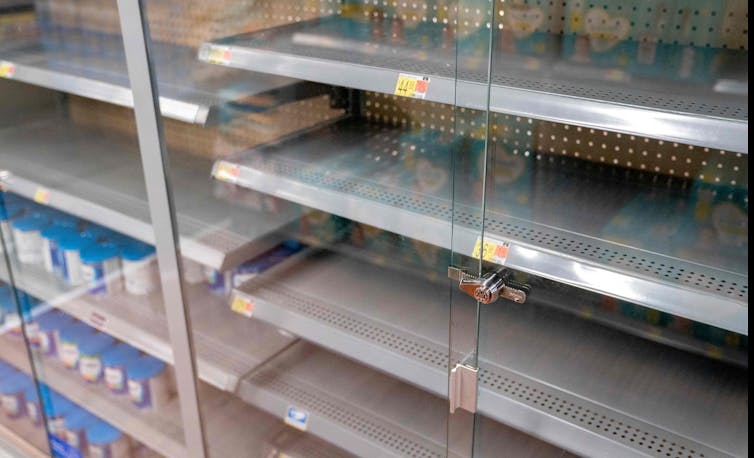
A baby formula shortage has added to the woes of American parents already confronted with the pressures of raising an infant during a pandemic in a country ranked low for family-friendly policies.
Media reports have highlighted the plight of mothers, fathers and caregivers across the U.S. who have scrambled to find scarce supplies, or driven long distances to buy formula.
But what is behind the shortage? And how can it be prevented from happening again? The Conversation asked Dr. Steven Abrams, a leading expert on pediatric health at the University of Texas who has advised both the formula industry and government on infant nutrition, these questions along with what advice he could give parents facing problems getting adequate supplies of infant formula.
1. Why there is a shortage of formula now?
There are really two factors that have driven the current shortage. First, we have the supply chain problem, which has affected all manner of goods since the onset of the pandemic. It eased off a little, but then at the beginning of 2022 it became worse.
Then in February a major baby formula manufacturing plant in U.S. went down. The FDA shut down Abbott Nutrition’s factory in Michigan. The closure came after Abbott’s nationwide recall of multiple brands of formula, including routine Similac cow milk-based formulas such as Similac Advance and several specialty formulas for allergic babies, including Similac Alimentum and and Similac EleCare.
Closing the factory had to be done amid an investigation into bacterial infections in connection to powdered formula produced at the plant, and the deaths of at least two babies. The problem is there just isn’t much redundancy in U.S. infant formula production. In other words, there aren’t enough other factories to pick up the slack when one goes down. The Michigan plant is the largest producer in the country, so when it goes down, it put added strain on the entire U.S. formula distribution system, especially for certain formulas for babies with high-risk allergic diseases and metabolic disorders.
Over the last couple of weeks the shortage has gotten worse. I can’t say for sure why this has happened. But I suspect there has been some hoarding going on as parents get anxious. Stores can limit the amount of formula that people can buy, but that doesn’t stop people going online to buy more.
On top of that, the shortage has gained wide publicity in newspapers, on TV and in political speeches. All that publicity feeds into public sense that the system is failing, prompting more panic buying and hoarding.
2. Who is the shortage affecting?
A majority of parents will feed babies with formula at some point to meet their nutritional needs, especially older infants. At birth and in days immediately after, around 80% of babies receive all their nutrition through breast milk. But by the age of 6 months, the majority of babies get at least some formula. The proportion of year-old babies receiving formula is even higher. This is largely the result of social dynamics and pressures - mothers going back to work after giving birth, but not receiving sufficient support to produce and store sufficient amounts of breast milk.
But the shortage will affect some parents more than others. Not surprisingly, the most affected parents are those on the lowest income. The federal food program for poorer women, infants and children, called WIC, provides formula for a majority of babies in low-income families. But costs have gone up and formula has become scarcer.
I’m hearing of some families driving two hours to find stores selling formula. Obviously that will be harder to do for poorer families as there are costs involved. Likewise, more affluent parents may be able to buy more expensive, so-called elite brand formulas.
The other thing to note is that the shortage is affecting both regular infant formula, and specialized versions. Regular or standard formula is the type most families are familiar with, and around 95% of formula-fed babies get the standard type. Specialized formula is for babies with unusual requirements, due to allergies, damaged intestines or special nutritional needs. Before the Michigan factory closed, it made most of the specialized infant formula used in the U.S. So it is an absolute crisis for families needing that type of formula.
3. What are the potential consequences of the shortage?
In the first six months, babies should only have breast milk or formula – anything else fed to them will be nutritionally incomplete. So there is a risk that a shortage will mean that babies will not be getting the nutrition they need to develop. That could lead to a range of health problems affecting their physical growth and brain development.
Then there are concerns that parents may be using unsafe alternatives, like watering down their baby’s formula. People have been known to try and make their own by mixing powdered milk or vegan milk with vitamins. Not only are these alternatives not nutritionally complete, they may not be entirely sterile.
After the age of six months, things get a little better once the infant is able to start eating solid food. But even then, formula or breast milk remains the primary source of nutrition. So there may still be a risk of nutritional deficiencies, such as iron deficiencies.
4. Are there any viable alternatives?
Over the age of six months of age, for only reasonably short periods of time, parents can feed infants whole cow milk and look into iron supplements.
It isn’t ideal, and only applies for older babies. For those under six months old, cow milk is a real problem. It doesn’t have the right protein blend for babies and has next to no iron – risking anemia in very young babies. Cow milk also has a misbalance of minerals, especially for younger babies.
5. So what guidance is there for low-income parents?
It is challenging and I can’t provide a magic answer. But food banks and the WIC program have been a crucial lifeline. The WIC program in particular has proved itself to be very flexible during this shortage. When Abbott had to recall products and then couldn’t provide enough non-recalled formulas in states in which they were the WIC provider, WIC was able to change providers and reprogram EBT cards to allow low-income parents to buy different brands.
6. What can be done to prevent this situation happening again in the U.S.?
First we need to help families regain confidence in the formula production and supply system. This will prevent problems such as hoarding or making home brew formulas.
Then we need to look at how to make sure one plant going down doesn’t affect the whole system. The federal government can’t stockpile formula in the same way it might stockpile oil, as formula has a shelf life. But diversifying infant formula production is a possibility. This would involve making sure multiple factories and companies are making the formulas that this country needs. This doesn’t necessarily mean increased costs – competition could potentially drive down prices.
I believe America also needs to look at the country’s breast feeding support system. Don’t get me wrong, some parents will always need formula. But those who want to breast feed need everything possible done to support them. That includes better family leave policies, and help for low-income mothers who want to pump and store milk while they work.
Steven A. Abrams, Professorof Pediatrics, University of Texas at Austin
This article is republished from The Conversation under a Creative Commons license. Read the original article.