 How to resolve AdBlock issue?
News
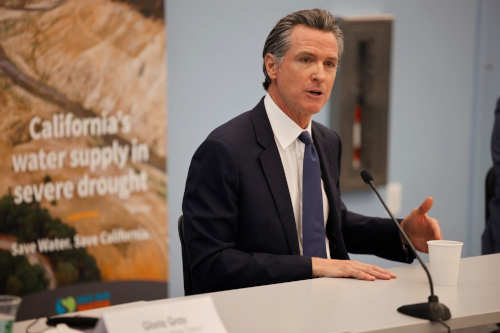
On Monday, Gov. Gavin Newsom convened leaders from the state’s largest urban water suppliers, which cover two-thirds of Californians, and water associations imploring them to take more aggressive actions to combat drought and better engage their customers to ensure all Californians are doing their part to save water.
After the last drought, local water agencies pushed for greater flexibility on water conservation and drought response based on regional needs and water supplies, arguing that tailored local approaches would be more effective than statewide mandates.
Gov. Newsom has embraced this localized approach, but voiced concerns on Monday given recent conservation levels around the state, and called on water agencies to step up efforts to reduce water use amid extreme drought conditions.
Newsom warned that if this localized approach to conservation does not result in a significant reduction in water use statewide this summer, the state could be forced to enact mandatory restrictions.
The governor will reconvene these same agencies in the next two months to provide an update on their progress.
“Every water agency across the state needs to take more aggressive actions to communicate about the drought emergency and implement conservation measures,” said Newsom. “Californians made significant changes since the last drought but we have seen an uptick in water use, especially as we enter the summer months. We all have to be more thoughtful about how to make every drop count.”
The governor also called upon local water agencies to submit water use data more frequently and increase transparency in order to more accurately measure whether California is meeting water conservation goals.
In addition, the governor called on local water agencies to increase education and outreach efforts to Californians on the urgency of the crisis.
In July 2021, Newsom asked Californians to voluntarily reduce their water use by 15%. At the end of March 2022 after the state failed to meet its 15% goal, the governor issued an executive order calling on local water agencies to escalate their response to the ongoing drought.
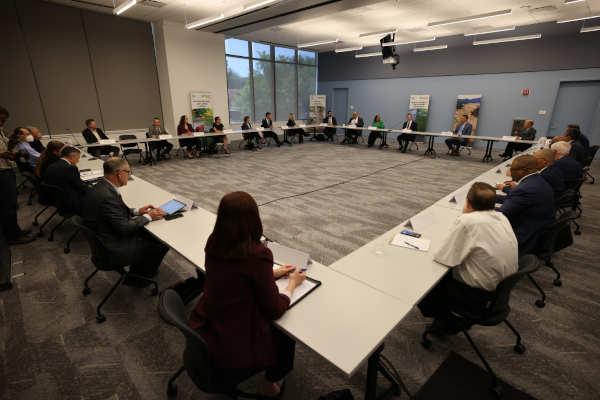
On Tuesday, at the governor’s direction, the State Water Resources Control Board will vote on a statewide ban on watering of nonfunctional turf in the commercial, industrial and institutional sectors as well as regulations requiring local agencies to implement water use restrictions amid the possibility that water supplies may be up to 20% lower due to extreme weather.
Currently, local water agencies have implemented restrictions on about half of California’s population. If the board’s regulations are approved, every urban area of California will be covered by a local plan to reduce water use.
Banning watering of decorative lawns would save between 156,000 acre-feet and 260,000 acre-feet per year, the equivalent of water used by 780,000 households in a year.
The climate crisis has resulted in the western United States experiencing one of the most extensive and intense droughts on record. January through March were the driest first three months in the state’s recorded history, the state’s largest reservoirs are currently at half of their historical averages, and the state’s snowpack is just 14 percent of average.
The Governor’s California Blueprint proposed this year would invest an additional $2 billion for drought response, which includes $100 million in addition to a previous investment of $16 million this fiscal year for a statewide education and communications effort on drought. These investments build on the previous $5.2 billion three-year investment in the state’s drought response and water resilience through the California Comeback Plan (2021).
California’s master water plan, the Water Resilience Portfolio, is a comprehensive vision to build water resilience containing more than 142 separate detailed actions to be taken by state agencies to ensure that California’s water systems can cope with rising temperatures, shrinking snowpacks, rising sea levels and more intense and frequent periods of drought.
In March 2021, the administration released the 2012-2016 Drought Report, which contains lessons learned by state agencies during the last drought.
The state is calling on Californians to take immediate action to avoid a crisis, including:
• Limiting outdoor watering — cutting back by even just one day a week can save you up to 20% more water.
• Taking shorter showers. Going to a 5 minute shower to save up to 12.5 gallons per shower when using a water-efficient shower head.
• Taking showers instead of baths — a bath uses up to 2.5 times the amount of water as a shower.
• Using a broom instead of a hose to clean outdoor areas to save 6 gallons of water every minute.
• Washing full loads of clothes to save 15 to 45 gallons of water per load.
More water saving tips can be found at www.saveourwater.com. For the latest on drought, please visit www.drought.ca.gov.

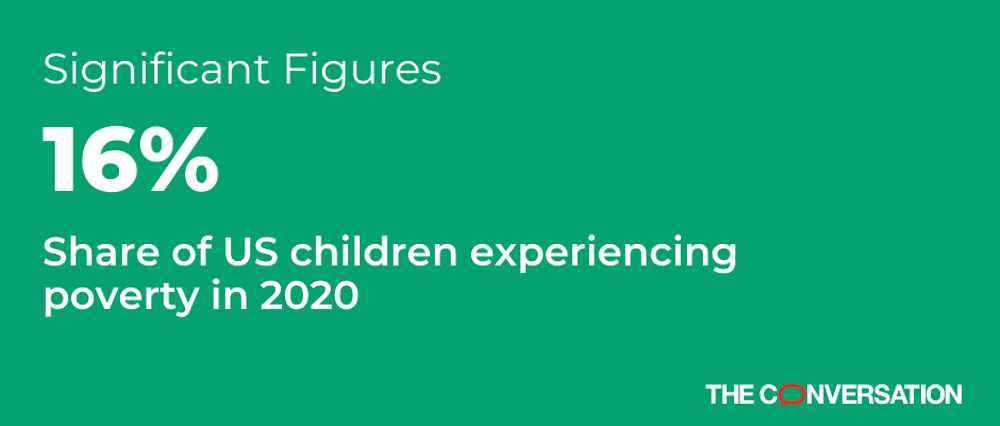
In the United States, children are more likely to experience poverty than people over 18.
In 2020, about 1 in 6 kids, 16% of all children, were living in families with incomes below the official poverty line – an income threshold the government set that year at about US$26,500 for a family of four. Only 10% of Americans ages 18 to 64 and 9% of those 65 and up were experiencing poverty, according to the most recent data available.
The official child poverty rate ticks down when the economy grows and up during downturns. It stood at 17% in 1967 – just about the same as in 2020. In many recent years the rate hovered even higher – around 20%.
Another way to measure poverty
Researchers calculate the official poverty rate by adding up a household’s income and comparing it with a threshold of what is needed to survive.
The government has calculated this rate the same way since the 1960s.
One of its shortcomings is that it excludes several sources of income, including tax credits and the Supplemental Nutrition Assistance Program, which are intended to reduce poverty.
In 2011, the government began to calculate an alternative metric: the supplemental poverty measure. It includes SNAP and tax credits. It also uses thresholds based on the cost of living in different areas of the country. For a family of four, this threshold currently ranges from $24,000 to $35,000, depending on where a family lives and whether they own or rent housing.
According to this alternative measure, 10% of children were living in poverty in 2020, the lowest rate ever recorded.
Depending on which measure you use, either 7 million or 11.7 million U.S. children lived in poverty in 2020.
By both metrics, poverty is higher for children of color. The official poverty rate for Black children stood at 26%, and 23% for Hispanic children, while for white, non-Hispanic children it was 10%.
Before and after 2020
Both child poverty rates had been declining before the COVID-19 pandemic.
The official rate dipped to 14% in 2019 from 21% five years earlier. It shot back up to 16% in 2020, when the pandemic compounded economic hardships for many families.
The supplemental measure of child poverty tells a more complete story.
Steps the government took during the pandemic, including its series of economic impact payments, the child tax credit expansion and a boost in SNAP benefits, led the supplemental child poverty rate to keep declining even during the economic crisis.
The government will release its child poverty data for 2022 in September 2023. But some researchers at Columbia University have monthly data suggesting that child poverty rose steeply after the expiration of the pandemic-era programs. They estimate that 3.7 million more children were living in poverty in January 2022 than in December 2021 because of the expiration of the child tax credit expansion.
Callie Freitag, Ph.D. Candidate in Public Policy and Governance, University of Washington and Heather D. Hill, Professor of Public Policy and Governance, University of Washington
This article is republished from The Conversation under a Creative Commons license. Read the original article.
At its May 18 meeting, LAFCo approved the resolution after a break in which commission staff made updates and additions to the language at the request of both commission members and the city of Lakeport.
The annexation area includes 50 parcels totaling 137 acres in the area adjacent to South Main Street and Soda Bay Road and east of Highway 29.
On May 6, LAFCo hosted a brief, 15-minute meeting on May 6 at Lakeport City Hall, the purpose of which was to collect protests from registered voters living in the annexation and property owners, said LAFCo Executive Director John Benoit.
Benoit said the protests were sent to the Assessor-Recorder's Office and the Registrar of Voters Office. The result was that the owners of 16 of the 50 parcels — accounting for 36% of the land valuation — protested the annexation, triggering an election. At least a 25% protest total is required.
As a result, Benoit said LAFCo needed to ask the city to conduct an election consisting of the registered owners. “I don’t know how the city’s going to handle the election. That’s their business.
The city will then need to report back to LAFCo, so the commission can go forward one way or the other, he said.
Benoit said Lakeport will probably have a special mail-in election and will need to work with the county’s elections department.
During public comment, Justin Ratcliffe, who owns Premier Flooring at 53 Soda Bay Road, questioned the validity of the voters’ roll from the area and how it would be brought up to date. Benoit said the elections office had used its current list to validate the outcome.
City Manager Kevin Ingram said the city also shared a concern about the list’s authenticity, as at least one deceased person was listed on it.
He said the city has 45 days to take formal action. Ingram said he needs to do more research, but as he understood it, the city had three options: hold a mail-in ballot, consolidate with the Nov. 8 election or hold a special election on a date the city chooses. That third and final option is the most expensive.
“We do have a little bit of homework that we need to do,” he said, explaining that the Lakeport City Council is expected to take formal action during one of its two June meetings.
Ingram said the city was concerned that the resolution LAFCo had before it didn’t reference the affected territory as is required in Government Code. It’s also supposed to provide the question to be put to voters.
LAFCo alternate Commissioner Victoria Brandon asked if the question could be structured in such a way to be a yes vote for annexation or yes for protest.
Counsel Scott Browne said it relies on the elections code, and there isn’t much discretion in the language. However, he said it won’t refer to a protest. “The protest has passed.”
LAFCo Chair Bruno Sabatier wanted to take a break so staff could make the changes to the resolution then in order to accomplish the matter.
Another property owner in the proposed annexation area, Lisa Weiler, raised concerns about an accurate count of voters and a true assessment on the property value in the annexation area. She said both are contingent on who can vote and how LAFCo came to the decision on the protest.
Benoit said he had questions regarding Proposition 13, and the values that are established when someone purchases a property. He wasn’t sure if the rules regarding annexations were written before 1978 and never changed. “I think we should look into it as a statewide organization to fix that.”
Weiler said she didn’t think the 18 voters counted in the protest was a very high number.
In response to her concerns, Sabatier said, “Voting integrity is part of any election process,” and the elections office will follow state laws.
Commissioner Moke Simon said he was confident in Registrar of Voters Maria Valadez’s integrity.
Sabatier asked for, and received, commission consensus to take a break and make the suggested changes to the resolution.
Following two separate breaks, one 30 minutes and one five minutes, staff presented the updated resolution which the commission approved unanimously.
Email Elizabeth Larson at
The commencement ceremony will start at 6 p.m.
Students who have earned certificates of achievement will be recognized for their accomplishments as well as students who have earned an associate in arts or associate in science degree this 2022.
Alumni graduates of 2020 and 2021 will be recognized for their accomplishments at the commencement ceremony hosted by the Dean, Dr. Cirilo Cortez.
Douglas Harris, trustee of the Yuba Community College District, will confer the degrees.
The keynote speaker will be Christine Davis and our two student speakers are Haley Campfield and Callie Lambert of Clearlake.
The students graduating with certificates and associate degrees are as follows.
Beale Air Force Base
Virginia Anne Ramsey, Associates of Science, Drinking Water and Wastewater Technology
Clearlake
Gil Aceves — Associates in Arts, Psychology
Laura Alanis — Associates in Science, Pre-Health Occupations
Yadira Bravo — Associate in Science for Transfer, Business Administration
Zoe Brown — Certificate of Achievement, CSU (California State University) General Education
Breadth
Haley Campfield — Associates in Arts, Social and Behavioral Sciences
Erika Dyson — Associates in Science, Business Management
Brandon Emery — Associates in Arts, Social and Behavioral Sciences
Tiara Fricano — Associates in Arts, Social and Behavioral Sciences
Yesenia Garcia Trinidad — Associates in Science, Pre-Health Occupations
Nicole Gentry — Associates in Science, Pre-Health Occupations
Michael Graves — Certificate of Achievement, Drinking Water and Wastewater Technology
Rick Hammond — Certificate of Achievement, Chemical Dependency Counselor
Mary Heptinstall — Associates in Science, Early Childhood Education
Steven Hughes — Certificate of Achievement, Drinking Water and Wastewater Technology
Hannah Jensen — Associates in Arts, Arts and Humanities
Kurt Jensen — Associates in Science, Drinking Water and Wastewater Technology
Cynthia Jimenez — Certificate of Achievement, Child Development Teacher
Cal Kranzler — Certificate of Achievement, Drinking Water and Wastewater Technology
Callie Lambert — Associates in Science, Early Childhood Education
Emily Larson — Certificate of Achievement, Child Development Associate Teacher
Sibilla McIntyre — Associates in Science, General Education: Natural Science and Math
Justine Merrill — Associates in Science, Accounting
Jacob Newcomb — Associates in Science for Transfer, Law Enforcement
Crystal Niderost — Associates in Arts, Social and Behavioral Sciences
Starleeta Pacheco — Associates in Science, Accounting
Richard Rodriguez — Associates in Arts, Culinary Arts
Dominic Sabala — Associates in Arts, Culinary Arts
Karen Santana — Associates in Arts for Transfer, Psychology
John Sheridan — Associate in Science, Human Services Chemical Dependency Counseling
Angela Tamagni — Associates in Science for Transfer, Business Administration
Abby Tuso — Associates in Arts, Social and Behavioral Sciences
Clearlake Oaks
Elias Bauer — Certificate of Achievement, Baking
Kaleena Budwell — Associates in Science, Pre-Health Occupations
Chris Kirkwood — Associates in Arts, Culinary Arts
Heather Sentz — Associates in Science, Accounting
Briana Waldenburg — Associates in Science, Human Services
Finley
Ignacio Gutierrez — Certificate of Achievement, Drinking Water and Wastewater Technology
Hidden Valley Lake
Lucas Auzenne — Associates in Science for Transfer, Law Enforcement
Yvonne Cronin — Associates in Science for Transfer, Business Administration
Katherine Maccario — Associates in Science for Transfer, Early Childhood Education
Jennifer Stephens — Associates in Arts for Transfer, Psychology
Maitea Williams — Associates in Arts, Social and Behavioral Sciences
Kelseyville
Christopher Beverly-Polk — Associates in Arts, Social and Behavioral Sciences
Makayla Davidson — Associates in Arts, Arts and Humanities
Michela Wilson — Certificate of Achievement, Baking
Lower Lake
Emily Austin — Certificate of Achievement, Child Development Associate Teacher
Laura-Jean Bevan — Associates in Science for Transfer, Business Administration
Jennifer Lark — Associates in Science, Human Services
Mira Porsley — Associates in Science for Transfer, Early Childhood Education
Fabiola Cordova — Associates in Arts for Transfer, Sociology
Lucerne
Salina Benitez — Associates in Arts, Culinary Arts
Middletown
Riley Barker — Associates in Arts, Social and Behavioral Sciences
Paramount
Jesus Ramirez-Zambrano — Certificate of Achievement, Drinking Water and Wastewater Technology
Family and friends are welcome to join the administration, faculty, and staff to celebrate the students’ accomplishments.
For more information, contact the campus at 707-995-7900 or visit LCC.yccd.edu.
The board will meet beginning at 9 a.m. Tuesday, May 24, in the board chambers on the first floor of the Lake County Courthouse, 255 N. Forbes St., Lakeport.
The meeting can be watched live on Channel 8, online at https://countyoflake.legistar.com/Calendar.aspx and on the county’s Facebook page. Accompanying board documents, the agenda and archived board meeting videos also are available at that link.
To participate in real-time, join the Zoom meeting by clicking this link.
The meeting ID is 966 9706 2933, pass code 584217. The meeting also can be accessed via one tap mobile at +16699006833,,96697062933#,,,,*584217#.
All interested members of the public that do not have internet access or a Mediacom cable subscription are encouraged to call 669-900-6833, and enter the Zoom meeting ID and pass code information above.
To submit a written comment on any agenda item visit https://countyoflake.legistar.com/Calendar.aspx and click on the eComment feature linked to the meeting date. If a comment is submitted after the meeting begins, it may not be read during the meeting but will become a part of the record.
At 11 a.m., the board will consider an ordinance adding Article 73 to Chapter 21 of the Lake Zoning Ordinance to address commercial cannabis permitting activities and enforcement.
Community Development Director Mary Darby’s memo to the board explains, “Cannabis projects are becoming more controversial in our communities. The growing number of acres already approved, illegal cannabis grows, drought concerns, and the proximity to communities has aided in increasing public participation in questioning these projects.”
She said the Community Development Department will present proposed changes to the revised commercial cannabis ordinance at the meeting and follow up with scheduled interactive cannabis workshops with the cannabis industry and the general public on May 25 and 26 from 4:30 to 6:30 p.m. in the supervisors’ chambers.
In an untimed item, the board will consider awarding a bid for $1,117,449.60 the Middletown Multiuse Path Project to Argonaut Constructors of Santa Rosa.
Public Works Director Scott De Leon’s report to the board said the project is to construct a Class 1 multiuse path along Highway 29 from the intersection of Rancheria Road to the intersection of Central Park Road.
Argonaut’s was the lowest of five bids submitted to the county, said De Leon.
He said the project is fully funded through the Active Transportation Program and Public Works road funds.
The full agenda follows.
CONSENT AGENDA
5.1: Approve Amendment No. 1 to the agreement between county of Lake and Mountain Valley Child and Family Services decreasing the total compensation payable under the agreement to $4,700.00 for fiscal year 2021-22 and authorize the board chair to sign.
5.2: Approve Board of Supervisors minutes for May 10 and May 17.
5.3: Approve request to waive 900-hour limit for extra-help office assistant, Marissa Davis.
5.4: Approve an agreement between the county of Lake and CTC Technology and Energy for the provision, installation and maintenance of advanced network (data) services for an amount not to exceed $50,000 annually; and authorize the chair to sign.
5.5: Adopt resolution to establish a list of projects proposed to be funded in FY 2021/2022 Pursuant to the Road Repair and Accountability Act of 2017 (SB1).
5.6: Approve to waive the 900 hour extra help limit for staff in the sheriff’s department.
5.7: Approve payment for mandated client services described as after care services delivered by Evolve Youth Services and authorize the director of Social Services or her designee to issue a purchase order in an amount not to exceed $ 40,086.
5.8: (a) Adopt resolution revising the fiscal year 2021-2022 adopted budget of the county of Lake by canceling reserves in Fund 281 CSA No. 21 North Lakeport Water O&M Reserve Designation, in the amount of $7,500 to make appropriations in the Budget Unit 8481, Object Code 784.62-74 Capital FA-Equipment/Other for the purchase of a Laser Turbidimeter. (b) Approve the purchase of a Laser Turbidimeter and authorize the Special Districts administrator/assistant purchasing agent to issue and sign a purchase order not to exceed $7,500 to HACH Co.
5.9: (a) Waive the formal bidding process, pursuant to Lake County Code Section 38.2, as it is not in the public interest due to the unique nature of the goods and services, and (b) authorize the county of Lake Water Resources director to sign an memorandum of understanding agreement between the Lake County Watershed Protection District and the Tribal EcoRestoration Alliance for the time period of May 1, 2022, to April 30, 2024.
TIMED ITEMS
9:05 a.m.: Pet of the Week.
6.3, 9:07 a.m.: Presentation of the current status and next steps of the Lake County Clean Water Program and storm water management in Lake County.
6.4, 10:30 a.m.: Presentation and consideration regarding Community Development Block Grant funding for the Community Development and Economic Development Allocations of the California Department of Housing and Community Development-Community Development Block Program.
6.5, 11 a.m.: Consideration of an ordinance adding Article 73 to Chapter 21 of the Lake Zoning Ordinance to address commercial cannabis permitting activities and enforcement.
UNTIMED ITEMS
7.2: Consideration of award of bid for the Middletown Multiuse Path Project; Bid No. 22-05, State Project No. ATPL-5914(102) to Argonaut Constructors of Santa Rosa in the Amount of $1,117,449.60.
ASSESSMENT APPEALS
8.1: Approve stipulation on the following assessment appeal applications: No. 59-2020 Maroun Allan.
8.2: Approve withdrawal on the following assessment appeal applications: No. 56-2020 Debra Watson; and b) No. 27-2020 through 48-2020, 49-2020 through 54-2020, 71-2020 through 74-2020 Geysers Power Co. LLC.
8.3: Continue the following assessment appeal applications: a) No. 03-2020 through 10-2020 Earthways; and b) No. 68-2020 Worldmark to the Oct. 18, 2022, Board of Supervisors meeting at 10 a.m.
CLOSED SESSION
9.1: Public employee evaluation: Community Development Director Mary Darby.
9.2: Conference with legal counsel: Existing litigation pursuant to Government Code section 54956.9 (d)(1): Nichols v. County of Lake, et al.
Email Elizabeth Larson at
Call Lake County Animal Care and Control at 707-263-0278 or visit the shelter online at http://www.co.lake.ca.us/Government/Directory/Animal_Care_And_Control.htm for information on visiting or adopting.
The following cats at the shelter have been cleared for adoption.

Male domestic shorthair
This 1-year-old male domestic shorthair cat has an all-black coat.
He is in cat room kennel No. 66, ID No. LCAC-A-3309.

‘Delilah’
“Delilah” is a 2-year-old female domestic longhair cat with a gray coat with white markings.
She is in cat room kennel No. 103, ID No. LCAC-A-3070.
Email Elizabeth Larson at