 How to resolve AdBlock issue?
News
Willie Brown Jr., 10, was found at Austin Park later on Sunday morning, said Police Chief Andrew White.
The child was reported missing after he had last been seen at 12:30 a.m. leaving the Lamplighter Motel.
Police put out an alert shortly before 1:45 a.m.
By around 9 a.m., the child had been located, White reported.
We have a retirement home right on the lake and now that the water is warmer, we are seeing lots of growth of water weeds, and my grandchildren don’t like to swim as the weeds tickle their ankles. What are these plants and what should we tell our grandkids?
Thanks,
- The Johnsons
Dear Johnsons,
Thank you for writing this very timely question! It’s now officially spring and lake users might start to see more abundant plant life within the lake from now on through summer. You may not know it, but writing about aquatic plants is one of my very favorite things. In fact, I love aquatic plants so much that for my graduate research in 2011, I moved all the way to Michigan from California just so I could study a project that was all about aquatic plants. I learned so much during that experience, and I brought back that knowledge and aquatic plant appreciation here with me to my work and play in Clear Lake.
If you want to know more, and see some of these plants up close, you have an opportunity to visit with me while I talk about aquatic plants this coming Wednesday, May 25, from 9 a.m. to 1 p.m at the Anderson Marsh Invasive Weed Tour hosted by the Lake County Department of Agriculture. You can find out more here in the notice published by the Lake County News. I will be discussing some of the most commonly found aquatic plants in Clear Lake, and talk about management of these species.
First, you may notice that I don’t call them “water weeds” but “aquatic plants”. A definition of a “weed” is simply a plant growing where it is not wanted. So someone’s plants are someone else’s weeds, and that is totally fine. I love and appreciate almost all aquatic plants, and so that is the umbrella term I use for all of them. My goal with the column today is to convince you, and maybe even your grandchildren, that you might even consider referring to them as aquatic plants and not “water weeds” too.
First, let’s go through some basic ecology and biology of aquatic plants, then we will become familiar with some of the most common species you might encounter in the lake. In part 2, I will discuss a few more of the present, but less common species found in the lake, and other water bodies in the County, and also in part 2 I will cover management of these species.
Aquatic plant ecology
Aquatic plants are widely distributed throughout the continental US. This means that the exact same species of native aquatic plant can be found here, can also be native and found in a pond in Delaware, or a reservoir in Texas, for example. Most species of aquatic plants are generalists, meaning they tolerate and grow, and look exactly the same, in many different types of conditions, like temperatures, flows, and water chemistry.
Aquatic plants are also called macrophytes, meaning they are plants that can be seen with the naked eye, no microscope needed. “Macro” means large, and “phyte” means plant in Greek (i.e. greek affix). Together, macrophyte, means large plants.
Within the macrophytes, there are sub categories like chlorophytes, which are green algaes large enough to be seen with the naked eye, in contrast to the floating, cellular algae, that requires a microscope to be seen. Another category, like bryophyte, includes mosses and liverworts and epiphytes means those plants that grow on other plants.
To keep things simple, I will maintain the term aquatic plants, since that term is inclusive of all these categories when we are talking about plants that grow in and around the lake.
The next way to distinguish aquatic plants is where they grow, which also conveniently describes how they grow. There are four major categories of aquatic plant growth types, emergent, submersed, floating-leaf, and free-floating.
Emergent plants are rooted in water with tissue that grows above the water line. Submersed plants are rooted in the sediment and grow entirely under the surface of the water, however submersed plants can grow along the surface and some have flowering potions that do sit above the waterline. Floating-leaf plants are rooted in the sediment and grow leaves that sit above the water line, think of the classic water lily example for this growth type. Free-floating plant species have roots, but are not rooted in the sediment and live entirely on the surface of the water or are free floating in the water column under the surface of the water, but are not rooted.
Aquatic plants have different growth types including emergent, floating-leaf, free-floating, and submersed. The variety of growth types creates a unique habitat that provides many benefits to the aquatic and shore zone ecosystem.
Now for some basics. Aquatic plants, like terrestrial, or plants that grow on land, consume carbon dioxide to grow, and exhale, or respire oxygen. The carbon the plants take in is converted into biomass, plant tissue, or cellulose, which creates the structure of the plant that we can see growing in the water. The oxygen the plant respires during photosynthesis is released into the water column, where it’s consumed by other living things like insects and fish.
Therefore, aquatic plants, no matter how annoying they are to us air-breathers, are vital to the biological demands of organisms that live and breathe under the water surface.
Some aquatic plants, like emergent and floating-leaved species, release oxygen both into the water and into the air, and are contributing directly to the oxygen terrestrial organisms need, including humans!
Aquatic plants, like most plants, need specific conditions to sprout, grow, reproduce, and die. Usually these are cues from the environment like the amount of daylight hours and water temperature minimums. The conditions needed vary between species too, some starting to grow earlier in the season when it's cooler and shorter days and some reaching maximum growth when it’s hottest during the summer and the daylight hours are the longest.
Generally, aquatic plants will start to grow from the sediments in spring, when the frost days are few and far between, and the lake temperatures are getting warmer. Then as the summer goes on, and the water temperature increases, the plants will grow rapidly, sometimes up to four inches a day for as long as the space allows them to grow.
In late spring or summer, aquatic plants will flower, and some will seed, or fruit. In fall, when the water temperature decreases and the sunlight hours decrease, aquatic plants, just like terrestrial garden plants and trees, will go through senescence, plant aging sometimes called die-back. During this process, the plant tissues change color from greens to browns and reds, from chlorophyll degradation, the same process that causes fall deciduous trees to change to their remarkable autumn-scape colors of brown, yellow, orange, and red.
Aquatic plant biology: Reproductive strategies
While many aquatic plants flower, wind and insect pollination is the least used method of reproduction for aquatic plants. Not to be deterred, aquatic plants still expend the energy and biomass to produce flowers in hopes that some genetic recombination and seed production will result in new genetic materials eventually sprouting into a new plant. Even aquatic plants are looking for love!
However, most aquatic plants reproduce asexually, or by reproduction that does not require the fusion of gametes or change in number of chromosomes. The only way plants can sexually reproduce is if pollen from one plant merges in the ovule of a different plant, genetically, and the genetic composition of the newly created offspring has different genetics (chromosomes) then either of the parents. But this process rarely occurs in aquatic plants.
In aquatic plants, it would not surprise you to know that many of the plant biomass in any given area is clonal, meaning the genetics are exactly the same among the entire area, meaning one plant gave rise to the entire “population” although it’s not technically a population since it’s all considered the same individual.
Think of this like grass that grows in a dirt field, if given food and water, that grass will continue to spread, along runners or roots, and could soon grow throughout the entire field, and even if patches split or die, the genetic material is all the same and the tissue is all derived from the same individual. This is exactly what happens with aquatic plants, although they can grow asexually from a variety of ways.
The main way aquatic plants spread, or grow, is from fragmentation, or propagation of propagules. Naturally, without motorboats or people stirring up the water, aquatic plants would grow tall in the water column and fragments could break off in a strong wind or if an animal is moving around in the water -think of a deer, moose, or large waterfowl moving around and chopping up the plant material.
Fragments of the aquatic plant, even as small as 1-2 inches long, will float away on the water, and using sunlight and nutrients within the water column as food, the fragment will begin to grow itself, eventually growing long enough that it can reach the bottom sediment and anchor in with roots.
This fragmentation growth strategy can make it very difficult to manage invasive populations of aquatic plants, as any activity or manual removal effort ends up fragmenting the plant and causing more plants to spread to new areas and re-grow. This is why managers of Clear Lake currently do not allow large scale mechanical harvesters on the lake, as they would just “chop up” and fragment all the plants growing and the fragmented growth would end up being exponential and unsustainable to manage.
Boat motors and props can, and do, cause fragmentation, but this is why the County of Lake conducts strategically placed herbicide treatments throughout target areas in Clear lake that are high-use areas for boats, to prevent their motors from causing exponential growth from fragments they disperse just boating around the lake. These target areas are perpendicular to the shore at boat ramp / launch areas, heavy-use marinas, and access points, and parallel to the shore in high-density use areas, along parks, beaches, and public access shorelines.
In addition to fragmentation, most aquatic plants utilize other asexual methods of reproduction. Aquatic plants can sprout from turions, or winter buds, that were grown in the summer and fall the year previous, and fell off the plant into the sediment to stay cozy until spring conditions triggered their regrowth.
Other plants produce tubers, like small potatoes, that also grow from the sediment when conditions are favorable. Some plants grow from rhizomes that are fibrous, very root-like, that remain in the lake sediment, again until environmental and weather conditions are most favorable to sprout.
Perhaps you can see how the variety of reproductive strategies utilized by aquatic plants can make management difficult. Management efforts or treatments might remove top green growth, but sometimes the sediments can harbor turions, tubers, or rhizomes for many years, waiting until optimal opportunities are in their favor to sprout, grow, and reproduce more for future years.
Common aquatic plants found in Clear Lake
In part 1 of Amazing Aquatic Plants, I will review five of the most common aquatic plants that you will find in Clear Lake, in the future part 2 I will discuss some of the less common aquatic plants, and some management strategies for them.
In this column I will not be discussing invasive Hydrilla, as there has not been a detection of Hydrilla in Clear Lake since 2019, and it is heavily monitored and managed by the State of California Department of Food and Agriculture. If you want more information about Hydrilla, I will refer you to this amazing factsheet on the county of Lake Water Resources Aquatic Plant webpage.
Potamogeton crispus (curly-leaf pondweed)
This is the most common aquatic plant growing in Clear Lake at this time of year. This plant sprouts from turions in the sediment, and it's usually the first one growing in the late winter, or early spring and usually the first species to senesce and die-back in July, or early-mid summer.
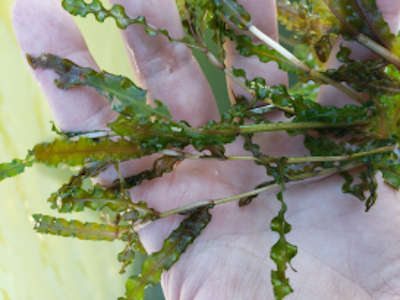
Curly-leaf pondweed is very unique looking, if you were to pull it out of the water and look closely at its leaves, they are curly, or rather, wavy like lasagna noodles. That’s because the edges of the leaves are toothed, and the serrated edges cause the leaves to undulate their shape, instead of being flat and even.
Curly-leaf is generally considered an invasive species throughout the entire United States, as it does not historically originate from North America and was suspected to be brought over for fish farm habitat in the midwest and southern US in the early 1900s. Curly-leaf is native to the entire Eurasian region down to Australia.
While curly-leaf is noxious, and many consider it an extremely nuisance invasive plant, in some ecosystems it has naturalized, and is just a member of the community and hasn’t caused a environmental, economical, or health hazard - which is the definition of an invasive species by the US EPA.
One of its most invasive plant traits is that it can grow very fast, very quickly in the early spring, sometimes up to five meters from the bottom of a water body to the surface. When it gets to the surface, it can easily shade out natives trying to sprout later in the season, and it can grow in such big clumps that it restricts boating, paddling, and disrupts fishing and other water-recreation activities. However, it does die back in the mid-summer, allowing other natives, and invasives, to take its place.
The unique growth characteristics of curly-leaf, including the early sprouting and dropping of plentiful turions by mid-summer, make it a difficult species to manage, and while we see it in abundance in Clear Lake, we also see it growing alongside other native and beneficial aquatic plants.
Stuckenia pectinata (Sago pondweed)
Although called a “pondweed”, Sago pondweed is not actually within the same genus as the true pondweeds (Potamogeton spp.). Sago is a very unique and beneficial aquatic plant, even though it’s the number one nuisance species in Clear Lake; it’s notorious for clogging boat props, growing to the surface in stringy, tangled mats, and accumulated on beaches in smelly piles.
The growth features that make Sago such a nuisance to us humans, make it one of the most amazing of all the amazing aquatic plants. Sago is a native aquatic plant, not just to Clear Lake, but to the entire north american continent. It can be found in waters up to 2 meters deep and will grow up to the surface and across. While other submersed aquatic plants seem to be hindered by Clear Lake’s green, cloudy and turbid waters in the hot of summer, Sago will be the last remaining stronghold even in these conditions.
Sago has many, long, slender leaves that grow in a fan shape at the surface of the water, so that it can attain sunlight to conduct photosynthesis, even if the water is cloudy or filled with algae. If Sago can’t recruit nutrients from the water column, it has nutrient reserves in its many, numerous tubers it grows consistently throughout the year - one study found that a single plant can grow up to 36,000 tubers in one season!
Sago is the plant I most commonly hear referred to as “seaweed” or “ seagrass” when people are describing the aquatic plants they encounter in the lake, and it’s the number one culprit when a motor or jet ski intake is clogged.
However, the benefits of Sago pondweed are enormous. For example, if you like bird watching on the lake, you should be extremely grateful for Sago pondweed. Sago pondweed is a top food source for waterfowl, in addition to its leaves, its fruits, called nutlets, and the tubers it produces, are prime snacks for many water birds. The branchy underwater growth of Sago creates prime habitat, refuge, and food source for juvenile and adult fish, in shallow and deepers waters, and in some artificial ponds and wetlands, Sago has purposely been planted to create duck habitat.
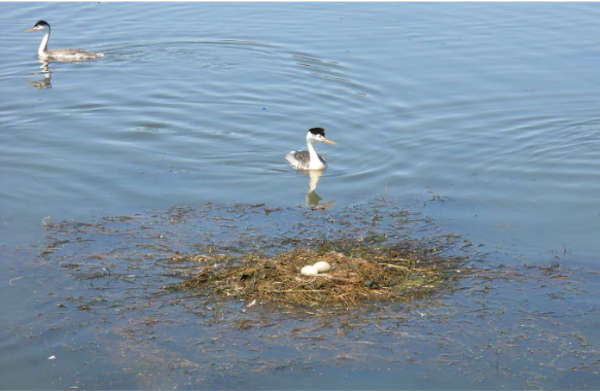
Lastly, you might have seen the grebes nests in the summer, sometimes they are in the tules along the shoreline, among the shallows of Rodman Slough, or rarely, floating in the middle of the lake after being dislodged by wind or boat wakes. Grebes use Sago to make their nests, as the long, slender stalks and leaves fit together and create cozy, floating mats.
Lemna minor (Duckweed)
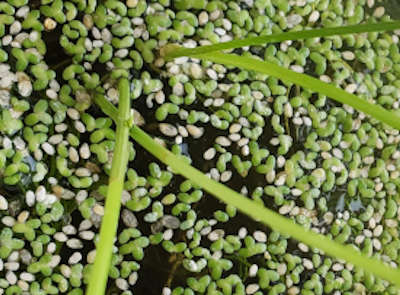
Duckweed is a free-floating aquatic plant that has hanging roots and floats along the surface of the water. The leaves are bright green and small, mostly less than half a cm in length. The surface of the leaves are smooth and so are the edges of the leaves. Usually individual duckweed leaves clump into groups of 2-3 leaves, but entire areas of calm, quiet waters can become overgrowth with duckweed.
This species is the one most commonly confused with algae or cyanobacteria, as the leaves are so small and it coats the surface of the water, however unlike algae or cyanobacteria, duckweed provides value to the aquatic community.
Duckweed is a nutritious food source for ducks and geese, sometimes providing up to 90% of the dietary needs of these waterfowl. You could say that to the ducks, duckweed is not aptly or appropriately named, as I doubt they would consider it a weed. Additionally, it’s a food staple for fish and muskrats. Probably most importantly, duckweed creates a safe, cool refuge for juvenile fish and invertebrates and mats of duckweed can also prevent mosquito habitat from forming.
Duckweed has also been shown to remediate heavy metals and other contaminants from water it’s growing in, and it’s even commonly used in wastewater treatment as it can remove large amounts of nutrients from the water column and can be systematically skimmed and safely disposed of in large scale treatment scenarios.
Lake and water-users however, can find duckweed annoying and inconvenient, as it can get on everything; your fishing gear, your gloves, your motor, your anchor, your float tube, and you will find it on your ankles and toes after wading. It’s basically harmless for people, but its small size and free-floating behavior make it easily transferable to our stuff and ourselves once we venture into the water.
Duckweed doesn’t have many treatment options, and I discourage from applying chemical treatment as it’s a beneficial, native plant. Some folks that want to maintain their pond or channel have had some luck with manually skimming or scooping it out with pool scoops, but as you can imagine it’s hard to keep up with it’s growth habit and it can be hard to dispose of, although it’s great in the composter.
Sometimes keeping the water moving with an aerator or water mover mounted to your dock can help keep it out of the vicinity, as duckweed prefers slow, stagnant, calm waters like those found in bays, coves, and channels.
Azolla filiculoides (Pacific Mosquito Fern)
So this is one species that isn’t really an aquatic plant, it’s technically a water fern, but it’s very common in Clear Lake, especially in calm areas like channels, coves and the Clear Lake keys. It can be found growing among duckweed, and it too can be a nuisance when wading or paddling through floating mats.
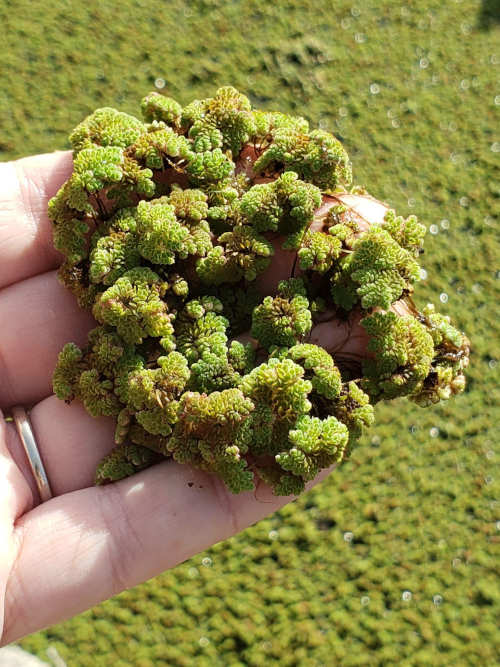
Azolla is free floating and up close, leaves are small, less than 5mm, scale like, and looking at it closely, Azolla has an almost velvet texture. In the summer when it's really sunny, the leaves can turn reddish or almost purple.
Unlike the other aquatic plants mentioned in this column, Azolla reproduces by spores instead of fragments, seeds, or tubers or rhizomes. While Azolla can clog motors, and intake pipes, it can be a food source for fish or waterfowl, and it does provide cool, safe habitat for juvenile fish and invertebrates.
Azolla can be skimmed or harvested for compost or fertilizer, but it's thick mats shade out other plants and it can promote conditions conducive to algae and cyanobacteria.
Invasive Creeping Water Primrose (Ludwigia peploides)
Creeping yellow water primrose is one of Clear Lake's most annoying and nuisance shoreline, emergent aquatic plants. This plant has a creeping character, like its namesake, sprouting on the shoreline and growing out over the water surface on long,strong spreading rhizomes. Creeping water primrose is bright green, with bright yellow flowers in July through September.
This plant is so unique and very complicated to manage, that I wrote an entire column dedicated to it last season. You can find that here in my August 22, 2021 column titled: “Peeved about Primrose.”
Just a little bit about management
Part II of this piece will go into more depth about management and mitigation of aquatic plants, but in general you should know that invasive plant management science is a broad and burgeoning field, as new species and newly observed characteristics are constantly adding to the knowledge and field of research. Every system and ecosystem responds differently to the introduced invasive species and potential treatments and implemented management. Sometimes, a treatment shown to be highly effective in the lab setting is less than successful in the field in real-life applications. That makes management difficult, especially when the options are all very expensive, such as herbicide chemicals or labor intensive manual removal.
However, the goal of any aquatic plant management program is to attain balance. How can we retain enough of the plants to provide the benefits we enjoy (i.e. plentiful fishing, clean water, prolific bird watching, sediment reduction, and nutrient cycling) while also being able to enjoy the water for recreation. Clear Lake is a very old, natural lake, and her natural state is to be full of a vibrant, healthy aquatic plant ecosystem of many different species that inhabit all the different growth zones and types.
For private properties and homeowners that live along Clear Lake shoreline and connected channels and canals, there are management options through the Clear Lake Integrated Aquatic Plant Management Program. With the right permits and instructions, you can manually remove aquatic plants from your individual beach or swim area, or you can hire a professional licensed herbicide applicator to safely and effectively treat the aquatic area within your parcel.
There is also a local diver company that can manually pull submerged species from the water by hand. This last option is the most effective for smaller shoreline properties and for certain species.
There are pros and cons to every treatment option, but for an effective removal that can last, and for persistent invasive species, sometimes utilizing both chemical or manual treatments for several years consecutively in a row is the best option, as this will help to remove the seedbank and any remaining fragments or roots.
However, as we have learned in this column, plants can float in on fragments from anywhere else in the lake, so a majority of them are here to stay, so maybe instead of fighting them, we should learn to love all there is about amazing aquatic plants!
- Sincerely, Lady of the Lake
References for this column included two books.
“Through the Looking Glass: A field Guide to Aquatic Plants” Published by the Wisconsin Lakes Partnership, University of Wisconsin Extension. 2001. DNR Publication #FH-207-97. https://www3.uwsp.edu/cnr-ap/UWEXLakes/Pages/resources/bookstore/TTLG.aspx
“Aquatic and Riparian Weeds of the West” By JM DiTomaso and EA Healy. Published by the University of California Agriculture and Natural REsources. Publication #3421. 2003. https://anrcatalog.ucanr.edu/Details.aspx?itemNo=3421
Angela De Palma-Dow is a limnologist (limnology = study of fresh inland waters) who lives and works in Lake County. Born in Northern California, she has a Master of Science from Michigan State University. She is a Certified Lake Manager from the North American Lake Management Society, or NALMS, and she is the current president/chair of the California chapter of the Society for Freshwater Science. She can be reached at

LAKE COUNTY, Calif. — The Clearlake Police Department said early Sunday that it is trying to locate a missing juvenile.
Willie Brown Jr., age 10, was last seen at the Lamplighter Motel in Clearlake at 12:30 a.m. Sunday, the agency reported.
The child left in an unknown direction, possibly on foot, police said.
Police said he may be wearing a black hoodie and shorts.
He has a history of medical issues and may not be wearing a medical bracelet.
If he’s found, please contact the Clearlake Police Department at 707-994-8251.
Dogs available for adoption this week include mixes of Australian cattle dog, Catahoula leopard dog, German shepherd, Labrador retriever, mountain cur, pit bull and wire-haired terrier.
Dogs that are adopted from Lake County Animal Care and Control are either neutered or spayed, microchipped and, if old enough, given a rabies shot and county license before being released to their new owner. License fees do not apply to residents of the cities of Lakeport or Clearlake.
The following dogs at the Lake County Animal Care and Control shelter have been cleared for adoption.
Call Lake County Animal Care and Control at 707-263-0278 or visit the shelter online for information on visiting or adopting.
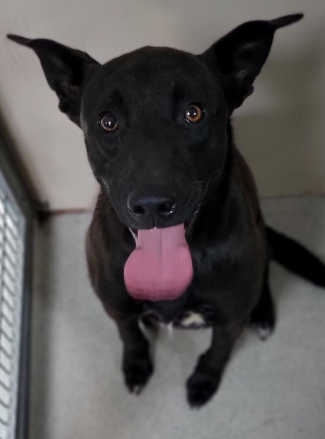
Male Labrador retriever
This 1-year-old male Labrador retriever has a short black coat.
He is in kennel No. 13, ID No. LCAC-A-3437.
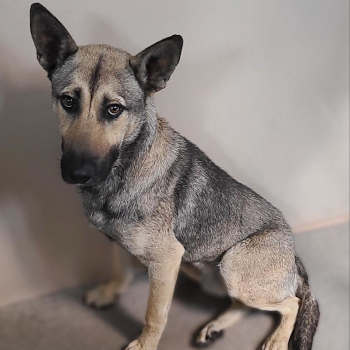
Male German shepherd mix
This 3-year-old male German shepherd mix has a short black and tan coat.
He is in kennel No. 14, ID No. LCAC-A-3436.

‘Mako’
“Mako” is an American pit bull terrier with a short gray and white coat.
He is in kennel No. 16, ID No. LCAC-A-3387.

Chocolate lab mix
This young male chocolate Labrador, who is under a year old, has a short coat.
He is in kennel No. 17, ID No. LCAC-A-3385.

‘Willie’
“Willie” is a 1-year-old male pit bull terrier with a short brown and white coat.
He is in kennel No. 20, ID No. LCAC-A-3301.

Female German shepherd puppy
This female German shepherd puppy has a short tan and black coat
She is in kennel No. 21a, ID No. LCAC-A-3211.

Male wire-haired terrier
This 2-year-old male wire-haired terrier has a cream-colored coat.
He is in kennel No. 22, ID No. LCAC-A-3399.

Male German shepherd mix puppy
This male German shepherd mix puppy has a short tan coat.
He is in kennel No. 25a, ID No. LCAC-A-3212.

Male German shepherd mix puppy
This male German shepherd mix puppy has a short tan coat.
He is in kennel No. 25b, ID No. LCAC-A-3214.

‘Dexter’
“Dexter’ is a 1-year-old male pit bull with a short black coat with white markings.
He is in kennel No. 27, ID No. LCAC-A-3290.
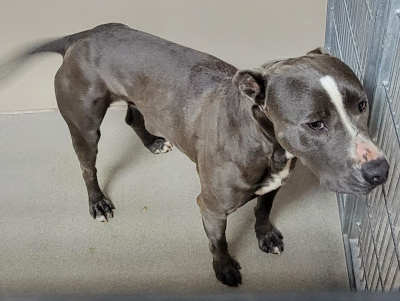
Male American Staffordshire terrier
This 3-year-old male American Staffordshire terrier has a short gray coat.
He is reported to be a very friendly dog with a great temperament, good with cats and already neutered.
He is in kennel No. 29, ID No. LCAC-A-3398.

Black lab mix
This 1-year-old male black Labrador Retriever has a short coat.
He is in kennel No. 31, ID No. LCAC-A-3418.

‘Rooster’
“Rooster” is a 5-year-old male mountain cur with a brown brindle coat.
He is in kennel No. 34, ID No. LCAC-A-3384.
Email Elizabeth Larson at

U.S. President Joe Biden on May 18, 2022, announced he is invoking the Defense Production Act to help end the shortage of baby formula stressing out parents nationwide.
He said he will direct suppliers of baby formula ingredients to prioritize delivery to formula manufacturers and control their distribution as necessary.
You might well wonder what babies going without formula has to do with defense production, which calls to mind big warships and weapons systems. While using the Defense Production Act to force companies to make baby formula would certainly be a novel use of the act, it would hardly be the first time the postwar law has been used beyond its originally intended purpose to support national defense.
And in fact, the law is used a lot more frequently than you might think. But as a business professor who studies strategies to maximize efficient allocation of resources, I believe when presidents invoke the act it’s often more about political theater – showing the public you’re doing something – than addressing the problem in the most effective way.
Sweeping authority
The Defense Production Act was passed in 1950 and modeled on the War Powers acts of 1941 and 1942.
The War Powers acts gave the president sweeping authority to control domestic manufacturing. For example, it helped the U.S. increase production of warplanes from 2,500 a year to over 300,000 by the end of the war.
In 1950, America faced war in Korea, and Congress feared that growing postwar demand for consumer goods would crowd out defense production needed to face China and the Soviet Union, which both backed North Korea in the conflict. There were also concerns about inflation during that postwar period.
The Defense Production Act gave the president – who later delegated this authority to Cabinet officials like the secretary of defense – broad powers to force manufacturers to make goods and supply services to support the national defense, as well as to set wages and prices and even ration consumer goods.
“We cannot get all the military supplies we need now from expanded production alone,” President Harry Truman told Americans in a radio address after signing the act into law. “This expansion cannot take place fast enough. Therefore, to the extent necessary, workers and plants will have to stop making some civilian goods and begin turning out military equipment.”
The original law focused on “shaping U.S. military preparedness and capabilities,” which limited the scope of the president’s authority.
Routinely invoked
Although the Defense Production Act makes news only when the president dramatically invokes it, the government uses the law – or just the threat of using it – routinely to force private companies to prioritize government orders. The Department of Defense, for example, uses it to make an estimated 300,000 contracts with private companies a year.
Congress has to reauthorize the act every several years and has amended it frequently to expand or limit its scope. Over time, this has significantly broadened the definition of national defense to include supporting “domestic preparedness, response, and recovery from hazards, terrorist attacks, and other national emergencies.”
The Department of Homeland Security invoked it about 400 times in 2019, mostly to help prepare for and respond to hurricanes and other natural disasters, such as by providing resources to house and feed survivors. And Presidents Bill Clinton and George W. Bush, for example, both used it to divert electricity and natural gas to California during the 2000-2001 energy crisis.
The act has also been used extensively during the COVID-19 pandemic. President Donald Trump used it to prioritize the allocation of medical resources, prevent hoarding of personal protective equipment and require General Motors to build ventilators. He also ordered beef, pork and poultry processing facilities to stay open during the lockdowns to ensure a supply of protein for the American population.
Biden, for his part, has also already used the act a number of times, mainly to fight the pandemic. For example, in March 2021, he invoked it to speed up vaccine production by ensuring extra facilities were up to snuff, as well as to expedite the production of critical materials, equipment, machinery and supplies. In March 2022, he issued a directive to increase the supply of materials for large-capacity batteries that are used mainly in civilian electric vehicles.
Biden’s use of the Defense Production Act to address the baby formula problem illustrates a limitation of it. It can be used to set priorities for ingredients and manufacturing capacity, but it’s not a magic wand. A president can’t by decree make capacity that doesn’t exist instantly appear. And it isn’t clear how much it will do to quickly end the formula shortage – given the main problem is manufacturing issues that closed production at a key plant, not just a shortage of ingredients.
The act is widely used and has been widely useful, but it is no substitute for advance planning and preparedness.
Erik Gordon, Professor of Business, University of Michigan
This article is republished from The Conversation under a Creative Commons license. Read the original article.

Continuing the collaboration that produced the COVID-19 Earth Observing Dashboard in 2020, NASA and its international partners in Europe and Japan have combined the collective scientific power of their Earth-observing satellite data in expanding the online resource to document a broad array of planet-wide changes in the environment and human society.
The expanded dashboard from NASA, the European Space Agency and the Japan Aerospace Exploration Agency, includes six new focus areas — atmosphere, agriculture, biomass, water and ocean, cryosphere, and the economy — that allow users to drill down into data-driven stories and interactively explore relevant data sets.
“At NASA, accessibility to data is a top priority,” said Karen St. Germain, NASA Earth Science Division director. “With our partners at ESA and JAXA, this is another important step to getting the latest information to the public about our changing planet, in an accessible and convenient way, which can inform decisions and planning for communities around the world.”
The dashboard provides an easy-to-use resource for the public scientists, decision-makers, and people who may not be familiar with satellite or Earth observation data. It offers a precise, objective, and comprehensive view of our planet.
Using accurate remote sensing observations, the dashboard shows the changes occurring in Earth’s air, land, and water and their effects on human activities. Users can explore countries and regions around the world to see how the indicators in specific locations change over time.
The agencies collaborated to identify the most relevant satellite data streams and adapted existing computing infrastructure to share data from across the agencies and produce relevant indicators and stories.
“International collaboration between our space agencies is key,” said Simonetta Cheli, director of Earth Observation Programs at ESA. “Our advanced Earth-observing satellite data provided by ESA, NASA and JAXA are used every day to benefit society at large and advance our knowledge of our home planet. After the success of the Earth Observing Dashboard, I am delighted to see how our resources and technical knowledge can be expanded and used to further our understanding of global environmental changes and other societal challenges impacting our planet.”
The atmosphere focus area demonstrates ways in which air pollution and climate change contribute to the biggest environmental challenges of our time.
In the agriculture focus area, users can explore satellite data that provides insights into agricultural production, crop conditions, and food supply.
The biomass focus area features a story describing how trees and plants remove substantial amounts of carbon dioxide out of the atmosphere each year.
In the cryosphere focus area, a story on the effects of global temperature rise on the extent of sea ice allows the reader to interact with a geographic visualization of a JAXA sea ice data set.
The water and ocean area focuses on Earth’s largest natural resource and enables users to discover a view of the ocean that is as rich and complex as that of land.
The economy focus area provides access to data sets that show how Earth's social and economic systems are connected to the environment.
In addition to the curated stories and data set offered in each of the focus areas, the Earth Observing Dashboard provides direct access to a data set exploration tool, which allows users to interactively explore the different indicators in detail.
"Following the collaboration with NASA and ESA on COVID-19, we expanded this dashboard to widely provide the stories on global issues about the environment and climate change to the world in the trilateral collaboration,” said Koji Terada, JAXA vice president and director general for the Space Technology Directorate I. “From the perspective of contributing to the understanding of the Earth's environment and systems and enhancing the values of Earth observation data, we at JAXA will continue to work on updating this dashboard.”
Last year, NASA Administrator Bill Nelson announced a concept for NASA’s Earth Information Center, which is an opportunity for the agency to leverage its data and modeling capabilities to work with trusted government and community partners with long-standing engagement in communities most affected by climate change. The expanded Earth Observing Dashboard complements planning that is underway for the Earth Information Center.
NASA, ESA and JAXA will continue to enhance the dashboard as new data become available.
Visit the Earth Observing Dashboard at https://www.eodashboard.org.