 How to resolve AdBlock issue?
News

Amid rising COVID-19 cases across the country, and following the U.S. Food and Drug Administration’s emergency authorization of a booster dose for healthy 5- to 11-year-olds, Gov. Gavin Newsom on Wednesday received his second Moderna booster at a clinic in Bakersfield, and encouraged all eligible Californians to get boosted to keep their immunity strong against COVID-19.
The second booster dose of the Pfizer-BioNTech or the Moderna vaccine is available to all Californians 50 and older, as well as those who are immunocompromised or received the Johnson & Johnson vaccine.
“Vaccines have saved tens of thousands of lives in California, and with COVID-19 still prevalent, we can’t afford to let our guard down,” said Gov. Newsom. “The best protection against serious illness and hospitalization is getting vaccinated and boosted. I encourage all eligible Californians to get your second booster – for you, for your family, for your friends, for your community.”
Under the Newsom Administration’s SMARTER Plan, the state maintains operational readiness to continue the fight against COVID-19 and respond quickly, including the ability to administer 200,000 vaccinations and 500,000 tests per day.
The California Blueprint includes another $2.4 billion for COVID response, which ensures California will be on the best possible footing against future waves.
According to a study analyzing California’s pandemic response, COVID-19 vaccines prevented an estimated 1.5 million coronavirus infections, nearly 73,000 hospitalizations, and almost 20,000 deaths in California.
“Vaccines remain the best protection against hospitalization and death from COVID-19. Our state, like much of the nation, is beginning to see an increase in COVID-19 transmission. Fortunately, thanks to California's robust vaccination efforts, we are seeing relatively low hospitalization rates,” said Dr. Mark Ghaly, California Health and Human Services secretary, who joined Newsom at the event. “This underscores the efficacy and importance of staying up to date on your COVID-19 vaccines. Californians age 50 and over are encouraged to get their additional booster dose to keep their immunity strong and strengthen their protection against COVID-19.”
According to the California Department of Public Health, the statewide test positivity rate is 5 percent as of Tuesday, about double the positivity rate a month prior, with some regions seeing positivity rates as high as 9 percent.
Unvaccinated people are 4.8 times more likely to get COVID-19 than fully vaccinated individuals who are boosted.
Unvaccinated people are also 6.5 times more likely to be hospitalized than boosted individuals, and 7.8 times more likely to die than boosted individuals.
California’s response to COVID-19 has led the nation with the lowest COVID death rate among the country’s most populous states.
More than 8 in 10 Californians have received at least one dose of the vaccine and more than 15.5 million Californians have received their first booster dose, representing 59.1 percent of those eligible for a booster. Additionally, 22% of eligible Californians have received their second booster dose.
LAKE COUNTY, Calif. — In a unanimous vote, the Board of Supervisors on Tuesday dealt another blow to a large cannabis project that would have been located next to south county subdivisions and which proposed to remove a large portion of a blue oak woodland.
Tuesday’s vote against WeGrow LLC was the second action the board has taken against Zarina Otchkova’s project.
The project Otchkova proposed included growing, processing and distribution operations on a nine-acre portion of a 309-acre property at 16750 Herrington Road, 17610 Sandy Road and 19678 Stinson Road in Middletown, located next door to several residential subdivisions, including Hidden Valley Lake.
Principal Planner Michael McGinnis said the original application for WeGrow was heard by the Lake County Planning Commission on April 22, 2021, when the use permit was approved 4-1.
However, an appeal filed by neighbors in nearby subdivisions went to the Board of Supervisors on June 8, 2021. At that time, the board upheld the appeal and denied the use permit without prejudice due to a discrepancy in the site plan submitted to the state clearinghouse, which differed from the site plan approved by the commission.
McGinnis said Otchkova reapplied for a use permit with the amended site plan with documentation including a cumulative water availability analysis, a tree removal and revegetation plan, updated well test and a traffic analysis.
The Planning Commission heard the new version of the project on Feb. 24, at which time it denied WeGrow’s use permit application in a 4-0 vote. Otchkova filed an appeal on March 2.
McGinnis said the property currently has a two-story barn and residence on the site, along with a well and an access road.
He said it would include a total of 34 greenhouses, each with more than 10,000 square feet of growing area, along with four 5,000 square foot drying buildings, two 200-square-foot sheds and 20 5,000 gallon water tanks. Total cultivation area was estimated at 387,600 square feet.
The hydrology study concluded the project would use 4,713,410 gallons or 14 acre feet of water annually, but that the water use would cause no adverse cumulative impacts to other nearby wells, McGinnis said.
However, one of the key factors that supervisors cited in making their denial, and which also was an issue for planning staff, was Otchkova’s proposal to remove 130 mature blue oak trees.
McGinnis said it’s very rare to find intact oak savanna in California. In areas of the region, many of the remaining blue oak woodlands were never systematically logged and contain trees that range in age from 150 to 500 years.
These woodlands are one of the most extensive old-growth forest types left in California, said McGinnis, who noted that those ancient woodlands contribute to watershed protection and preserve an important component of eroding biodiversity.
“Blue oak savanna is considered one of the oldest ecosystems in California,” he said, adding it’s fair to think of the oak as the “king of biodiversity.”
The removal of those 130 oaks trees is not something that can be mitigated to a less than significant level, McGinnis said.
He said contemporary science has found that efforts at replanting have mixed results and are also costly. That’s because blue oak plantations develop habitat conditions slowly — it may take in excess of 50 years to replace mature habitat that is lost in a particular project.
“It can take many generations for a new blue oak plantation to reflect the values that are often lost” due to oak tree removal, he said.
McGinnis pointed to a county ordinance that specifically states the importance of oak woodland ecosystems and the important role landowners play in the responsible stewardship of oak woodlands. County ordinance also says that removing oak trees for cannabis grows should be avoided.
Staff’s written report to the board also pointed out that the scale of oak tree removal WeGrow proposed is inconsistent with the Oak Woodlands Conservation Act in California Fish and Game Code.
McGinnis said the county received more than 100 emails and letters against the project, with opposition coming from the Redbud Audubon Society, California Wildlife Foundation and the Middletown Area Town Hall.
Project ‘mistreated’
Sufyan Hamouda, Otchkova’s representative, said the project was “mistreated.” For two years, the project was under scrutiny and review, and along the way they had been told they had done everything asked of them and the project was moving forward.
He said it was 17 days before the commission’s Feb. 24 hearing that county planning officials told them that the decision had been changed and that staff was recommending its denial because they had determined an environmental impact report was needed.
Hamouda asked board members how they would feel if their project was treated that way, adding the county needs to look at what it wants for its own future, with up to 100 cannabis permits pending.
“No one deserves to be told one thing and action taken in a different direction,” he said.
Eight community members made public comments in person at the meeting, all of them raising issues with the project and opposing it.
“This project is in the wrong place,” said Bart Levenson, who questioned the adequacy of roads and evacuation routes.
Dan Levine asked how it would look to people if Lake County allowed 130 oak trees to be cut down. He added that the county’s cannabis ordinance should be revisited and updated
Their attorney addressed omissions
Craig Bainbridge, who lives on one of the roads that access the property, said he was concerned about biodiversity, and he questioned Otchkova’s proposal to replant oak trees to replace the ones she wanted to remove.
“If somebody could explain to me how that will occur, if that hasn’t occurred naturally,” he said, noting the trees would be placed in an area where they previously hadn’t grown.
His wife, Debbie, followed up by saying she planned to leave if the project went through. “Nature is something we need to treasure. We can’t just go in and do anything we like,” she said, adding that cannabis farms need to be put far away from people.
In their comments, members of the board — in apparent response to Hamouda’s comments about how the project was treated — said the county was learning and now had better and more consistent leadership in place in the Community Development Department.
“It’s going to take us awhile to get things right,” said Supervisor Moke Simon, who added that the county approves or denies projects based on their individual merit.
Supervisor Bruno Sabatier said he didn’t think a new cultural analysis had been done, and referenced a letter from Sally Peterson of the Middletown Rancheria that noted the importance of blue oaks and how they are typically close to areas where archaeological sites are found.
“For myself, it’s the blue oaks,” said Supervisor Tina Scott of her problems with the project , also noting that the county ordinance is clear about not removing oaks to allow for cannabis grows. She said the project should not have gotten this far.
Supervisor Jessica Pyska said she hadn’t heard anything to change her mind about the project, also pointing to her concerns about the tree removal.
“I think we are making progress. We’re trying to do better,” she said.
Pyska also raised the philosophical question of who does the hydrology report, explaining that she finds it problematic that it’s the applicant’s responsibility. She said she wants to see neutral analysis of hydrology and cumulative impacts.
Hamouda, when given the opportunity, offered no additional rebuttals to the comments made by members of the public or the board.
Simon moved to deny the appeal and uphold the Lake County Planning Commission’s decision, with Pyska seconding and the board voting 5-0. The board also gave the County Counsel’s Office direction to draft the intended decision.
The vote received a round of applause from the audience.
Email Elizabeth Larson atThis email address is being protected from spambots. You need JavaScript enabled to view it. . Follow her on Twitter, @ERLarson, or Lake County News, @LakeCoNews.
Tuesday’s vote against WeGrow LLC was the second action the board has taken against Zarina Otchkova’s project.
The project Otchkova proposed included growing, processing and distribution operations on a nine-acre portion of a 309-acre property at 16750 Herrington Road, 17610 Sandy Road and 19678 Stinson Road in Middletown, located next door to several residential subdivisions, including Hidden Valley Lake.
Principal Planner Michael McGinnis said the original application for WeGrow was heard by the Lake County Planning Commission on April 22, 2021, when the use permit was approved 4-1.
However, an appeal filed by neighbors in nearby subdivisions went to the Board of Supervisors on June 8, 2021. At that time, the board upheld the appeal and denied the use permit without prejudice due to a discrepancy in the site plan submitted to the state clearinghouse, which differed from the site plan approved by the commission.
McGinnis said Otchkova reapplied for a use permit with the amended site plan with documentation including a cumulative water availability analysis, a tree removal and revegetation plan, updated well test and a traffic analysis.
The Planning Commission heard the new version of the project on Feb. 24, at which time it denied WeGrow’s use permit application in a 4-0 vote. Otchkova filed an appeal on March 2.
McGinnis said the property currently has a two-story barn and residence on the site, along with a well and an access road.
He said it would include a total of 34 greenhouses, each with more than 10,000 square feet of growing area, along with four 5,000 square foot drying buildings, two 200-square-foot sheds and 20 5,000 gallon water tanks. Total cultivation area was estimated at 387,600 square feet.
The hydrology study concluded the project would use 4,713,410 gallons or 14 acre feet of water annually, but that the water use would cause no adverse cumulative impacts to other nearby wells, McGinnis said.
However, one of the key factors that supervisors cited in making their denial, and which also was an issue for planning staff, was Otchkova’s proposal to remove 130 mature blue oak trees.
McGinnis said it’s very rare to find intact oak savanna in California. In areas of the region, many of the remaining blue oak woodlands were never systematically logged and contain trees that range in age from 150 to 500 years.
These woodlands are one of the most extensive old-growth forest types left in California, said McGinnis, who noted that those ancient woodlands contribute to watershed protection and preserve an important component of eroding biodiversity.
“Blue oak savanna is considered one of the oldest ecosystems in California,” he said, adding it’s fair to think of the oak as the “king of biodiversity.”
The removal of those 130 oaks trees is not something that can be mitigated to a less than significant level, McGinnis said.
He said contemporary science has found that efforts at replanting have mixed results and are also costly. That’s because blue oak plantations develop habitat conditions slowly — it may take in excess of 50 years to replace mature habitat that is lost in a particular project.
“It can take many generations for a new blue oak plantation to reflect the values that are often lost” due to oak tree removal, he said.
McGinnis pointed to a county ordinance that specifically states the importance of oak woodland ecosystems and the important role landowners play in the responsible stewardship of oak woodlands. County ordinance also says that removing oak trees for cannabis grows should be avoided.
Staff’s written report to the board also pointed out that the scale of oak tree removal WeGrow proposed is inconsistent with the Oak Woodlands Conservation Act in California Fish and Game Code.
McGinnis said the county received more than 100 emails and letters against the project, with opposition coming from the Redbud Audubon Society, California Wildlife Foundation and the Middletown Area Town Hall.
Project ‘mistreated’
Sufyan Hamouda, Otchkova’s representative, said the project was “mistreated.” For two years, the project was under scrutiny and review, and along the way they had been told they had done everything asked of them and the project was moving forward.
He said it was 17 days before the commission’s Feb. 24 hearing that county planning officials told them that the decision had been changed and that staff was recommending its denial because they had determined an environmental impact report was needed.
Hamouda asked board members how they would feel if their project was treated that way, adding the county needs to look at what it wants for its own future, with up to 100 cannabis permits pending.
“No one deserves to be told one thing and action taken in a different direction,” he said.
Eight community members made public comments in person at the meeting, all of them raising issues with the project and opposing it.
“This project is in the wrong place,” said Bart Levenson, who questioned the adequacy of roads and evacuation routes.
Dan Levine asked how it would look to people if Lake County allowed 130 oak trees to be cut down. He added that the county’s cannabis ordinance should be revisited and updated
Their attorney addressed omissions
Craig Bainbridge, who lives on one of the roads that access the property, said he was concerned about biodiversity, and he questioned Otchkova’s proposal to replant oak trees to replace the ones she wanted to remove.
“If somebody could explain to me how that will occur, if that hasn’t occurred naturally,” he said, noting the trees would be placed in an area where they previously hadn’t grown.
His wife, Debbie, followed up by saying she planned to leave if the project went through. “Nature is something we need to treasure. We can’t just go in and do anything we like,” she said, adding that cannabis farms need to be put far away from people.
In their comments, members of the board — in apparent response to Hamouda’s comments about how the project was treated — said the county was learning and now had better and more consistent leadership in place in the Community Development Department.
“It’s going to take us awhile to get things right,” said Supervisor Moke Simon, who added that the county approves or denies projects based on their individual merit.
Supervisor Bruno Sabatier said he didn’t think a new cultural analysis had been done, and referenced a letter from Sally Peterson of the Middletown Rancheria that noted the importance of blue oaks and how they are typically close to areas where archaeological sites are found.
“For myself, it’s the blue oaks,” said Supervisor Tina Scott of her problems with the project , also noting that the county ordinance is clear about not removing oaks to allow for cannabis grows. She said the project should not have gotten this far.
Supervisor Jessica Pyska said she hadn’t heard anything to change her mind about the project, also pointing to her concerns about the tree removal.
“I think we are making progress. We’re trying to do better,” she said.
Pyska also raised the philosophical question of who does the hydrology report, explaining that she finds it problematic that it’s the applicant’s responsibility. She said she wants to see neutral analysis of hydrology and cumulative impacts.
Hamouda, when given the opportunity, offered no additional rebuttals to the comments made by members of the public or the board.
Simon moved to deny the appeal and uphold the Lake County Planning Commission’s decision, with Pyska seconding and the board voting 5-0. The board also gave the County Counsel’s Office direction to draft the intended decision.
The vote received a round of applause from the audience.
Email Elizabeth Larson at
LAKE COUNTY, Calif. — The Lake Local Agency Formation Commission will meet Wednesday to discuss the process for handling protests against the city of Lakeport’s proposal to annex the South Main Street corridor.
The commission, or LAFCo, will meet at 9:30 a.m. Wednesday, May 18, in the council chambers at Clearlake City Hall.
The meeting also will be available via Zoom. The meeting ID is 826 1600 1952, pass code is 195287. Dial by location: +1 669 900 6833. One tap mobile: +16699006833,,82616001952#,,,,*195287#.
The city of Lakeport is seeking to annex 137 acres, made up of 50 parcels, in the area south of the existing Lakeport city limits, adjacent to South Main Street and Soda Bay Road and east of Highway 29.
LAFCo on Wednesday will consider a resolution containing the results of the South Lakeport
Annexation protest proceeding and requesting the city of Lakeport conduct an election.
The protest proceeding, held on May 6, yielded protests from the owners of 16 of the 50 parcels in the annexation area.
LAFCo Executive Officer John Benoit told Lake County News that it was determined that the protests totaled 36% of the annexation area’s assessed value, which is approximately $26,661,753.
Benoit said the protests only needed to total 25% of the value to go to an election.
At Tuesday night’s Lakeport City Council meeting, City Manager Kevin Ingram said that the protest process will result in staff coming back to the council meeting in June to look at options for moving forward.
Also on Wednesday, commissioners will hold a public hearing on the 2022-23 Lake LAFCo budget, and consider a resolution authorizing an increase in meeting stipends for LAFCO commissioners and contract amendments for staff and counsel.
Commissioners are Stan Archacki, Stacey Mattina, Ed Robey, Bruno Sabatier, Jim Scholz, Moke Simon and Dirk Slooten, and alternates Victoria Brandon, Suzanne Lyons, Tina Scott and Russ Perdock.
Email Elizabeth Larson atThis email address is being protected from spambots. You need JavaScript enabled to view it. . Follow her on Twitter, @ERLarson, or Lake County News, @LakeCoNews.
The commission, or LAFCo, will meet at 9:30 a.m. Wednesday, May 18, in the council chambers at Clearlake City Hall.
The meeting also will be available via Zoom. The meeting ID is 826 1600 1952, pass code is 195287. Dial by location: +1 669 900 6833. One tap mobile: +16699006833,,82616001952#,,,,*195287#.
The city of Lakeport is seeking to annex 137 acres, made up of 50 parcels, in the area south of the existing Lakeport city limits, adjacent to South Main Street and Soda Bay Road and east of Highway 29.
LAFCo on Wednesday will consider a resolution containing the results of the South Lakeport
Annexation protest proceeding and requesting the city of Lakeport conduct an election.
The protest proceeding, held on May 6, yielded protests from the owners of 16 of the 50 parcels in the annexation area.
LAFCo Executive Officer John Benoit told Lake County News that it was determined that the protests totaled 36% of the annexation area’s assessed value, which is approximately $26,661,753.
Benoit said the protests only needed to total 25% of the value to go to an election.
At Tuesday night’s Lakeport City Council meeting, City Manager Kevin Ingram said that the protest process will result in staff coming back to the council meeting in June to look at options for moving forward.
Also on Wednesday, commissioners will hold a public hearing on the 2022-23 Lake LAFCo budget, and consider a resolution authorizing an increase in meeting stipends for LAFCO commissioners and contract amendments for staff and counsel.
Commissioners are Stan Archacki, Stacey Mattina, Ed Robey, Bruno Sabatier, Jim Scholz, Moke Simon and Dirk Slooten, and alternates Victoria Brandon, Suzanne Lyons, Tina Scott and Russ Perdock.
Email Elizabeth Larson at
LAKE COUNTY, Calif. — The Clearlake City Council is set to discuss new rules for a food recovery program, the sale of a vacant city-owned parcel and a contract for police mobile audio visual equipment.
The council will meet at 6 p.m. Thursday, May 19, in the council chambers at Clearlake City Hall, 14050 Olympic Drive.
The meeting will be broadcast live on the city's YouTube channel or the Lake County PEGTV YouTube Channel. Community members also can participate via Zoom or can attend in person.
The agenda can be found here.
Comments and questions can be submitted in writing for City Council consideration by sending them to City Clerk Melissa Swanson atThis email address is being protected from spambots. You need JavaScript enabled to view it. .
To give the council adequate time to review your questions and comments, please submit your written comments before 4 p.m. Thursday, May 19.
Each public comment emailed to the city clerk will be read aloud by the mayor or a member of
staff for up to three minutes or will be displayed on a screen. Public comment emails and town hall public comment submissions that are received after the beginning of the meeting will not be included in the record.
At the start of the meeting, the council will meet one of the adoptable dogs from the city shelter, present proclamations declaring May 21 to 27 as Safe Boating Week and May 2022 as California Tourism Month, and hear a presentation of the Lake County Tourism Improvement District’s annual report.
Under council business, council members will hold the first reading of an ordinance establishing edible food recovery program regulations in accordance with SB 1383.
Staff also will present the annual financial report for fiscal year 2019-20.
In other business, the council will consider the sale of a vacant parcel at 4438 Fir Ave. for $20,000.
Also on Thursday, the council will consider authorizing Police Chief Andrew White to enter into a five-year contract with Axon Enterprises Inc. for the purchase of Axon Fleet 3 mobile audio and video systems for police vehicles and adopt Resolution No. 2022-27 waiving the competitive formal bidding process. The cost to the city is $208,637.60.
On the meeting's consent agenda — items that are considered routine in nature and usually adopted on a single vote — are warrants; adoption of Resolution 2021-30 to adopt a list of approved projects for submission to California Transportation Committee for funding pursuant to SB1; minutes of the April 13 meeting; and adoption of Resolution 2022-25 supporting the application of Chelsea Investments for the Local Government Matching Grant Program for development of affordable housing at 15837 18th Ave.
The council also will hold a closed session to discuss labor negotiations with the Clearlake Municipal Employee Association and Clearlake Police Officers Association, a liability claim from Smiley James Harris and ongoing litigation, including a suit against the county of Lake.
Email Elizabeth Larson atThis email address is being protected from spambots. You need JavaScript enabled to view it. . Follow her on Twitter, @ERLarson, or Lake County News, @LakeCoNews.
The council will meet at 6 p.m. Thursday, May 19, in the council chambers at Clearlake City Hall, 14050 Olympic Drive.
The meeting will be broadcast live on the city's YouTube channel or the Lake County PEGTV YouTube Channel. Community members also can participate via Zoom or can attend in person.
The agenda can be found here.
Comments and questions can be submitted in writing for City Council consideration by sending them to City Clerk Melissa Swanson at
To give the council adequate time to review your questions and comments, please submit your written comments before 4 p.m. Thursday, May 19.
Each public comment emailed to the city clerk will be read aloud by the mayor or a member of
staff for up to three minutes or will be displayed on a screen. Public comment emails and town hall public comment submissions that are received after the beginning of the meeting will not be included in the record.
At the start of the meeting, the council will meet one of the adoptable dogs from the city shelter, present proclamations declaring May 21 to 27 as Safe Boating Week and May 2022 as California Tourism Month, and hear a presentation of the Lake County Tourism Improvement District’s annual report.
Under council business, council members will hold the first reading of an ordinance establishing edible food recovery program regulations in accordance with SB 1383.
Staff also will present the annual financial report for fiscal year 2019-20.
In other business, the council will consider the sale of a vacant parcel at 4438 Fir Ave. for $20,000.
Also on Thursday, the council will consider authorizing Police Chief Andrew White to enter into a five-year contract with Axon Enterprises Inc. for the purchase of Axon Fleet 3 mobile audio and video systems for police vehicles and adopt Resolution No. 2022-27 waiving the competitive formal bidding process. The cost to the city is $208,637.60.
On the meeting's consent agenda — items that are considered routine in nature and usually adopted on a single vote — are warrants; adoption of Resolution 2021-30 to adopt a list of approved projects for submission to California Transportation Committee for funding pursuant to SB1; minutes of the April 13 meeting; and adoption of Resolution 2022-25 supporting the application of Chelsea Investments for the Local Government Matching Grant Program for development of affordable housing at 15837 18th Ave.
The council also will hold a closed session to discuss labor negotiations with the Clearlake Municipal Employee Association and Clearlake Police Officers Association, a liability claim from Smiley James Harris and ongoing litigation, including a suit against the county of Lake.
Email Elizabeth Larson at
LAKE COUNTY, Calif. — A proposed voter initiative that raised significant concerns for local governments across California has failed to qualify for this year’s ballot, but there are concerns it may resurface in a future effort.
Voter Initiative No. 21-0042A1, the Taxpayer Protection and Government Accountability Act, so alarmed local officials that the city councils of both Clearlake and Lakeport voted in February to formally oppose it at the request of the League of California Cities, which called the measure “deceptive” and “irresponsible.”
Cities up and down the state followed suit, passing similar resolutions earlier this year.
The main thrust of the measure, Cal Cities reported, was to give wealthy corporations a major loophole to pay less for the infrastructure, environmental, water and air quality, and natural resources impacts on communities while jeopardizing vital services and undermining voter rights and accountability.
However, on Tuesday evening, Lakeport City Attorney David Ruderman told the Lakeport City Council that the deadline for submitting signatures to qualify the initiative for the ballot had passed and it hadn’t been submitted.
He said proponents had spent $10 million on the effort so far.
The initiative measure was sponsored by the California Business Roundtable.
The initiative aimed to amend the State Constitution to change the rules for how the state and local governments can impose taxes, fees and other charges, according to the Legislative Analyst’s Office.
The concern for local governments was due to its potential negative impact for cities and counties.
The Legislative Analyst’s Office analysis said it “would lower annual state and local revenues, potentially substantially lower, depending on future actions of the Legislature, local governing bodies, voters, and the courts.”
The California Special Districts Association reported on its website that the initiative would have retroactively voided all state and local taxes or fees adopted after Jan. 1, 2022, if they didn’t follow the initiative’s provisions.
“This may also affect indexed fees that adjust over time for inflation or other factors. Effectively, it would allow voters throughout California to invalidate the prior actions of local voters, undermining local control and voter-approved decisions about investments needed in their communities,” the association reported.
In his report to the Clearlake City Council in February, City Manager Alan Flora called it “particularly concerning.”
A staff report to the council said it was backed by major corporations and would have “far-reaching and yet undefined impacts to how local government, including the City of Clearlake functions.”
Those impacts were expected to include measures meant to fund infrastructure and the ability of the city to charge development fees.
For his part, Lakeport City Manager Kevin Ingram in February called the initiative “potentially devastating,” explaining that it would make it more difficult to enact fees, allow for more repeal of fees and provide disruption to the city's fiscal ability.
The title, he said, was meant to elicit anti-tax and small government spirit.
Councilman Kenny Parlet said during the February meeting that those naming initiatives in misleading ways in California — including this new initiative, along with propositions 47 and 57 — were guilty of fraud.
“Whoever writes these titles should be incarcerated. It’s absolutely ridiculous,” he said.
Ruderman told the council at that point that it’s the initiative proponents who provide the initiative titles.
“That explains a lot,” said Mayor Pro Tem Mireya Turner.
Ruderman said Tuesday night that there was talk that the initiative may be brought back in an effort to get it on the ballot in 2024.
For the time being, however, Ruderman said he was glad to have the initiative behind them.
Email Elizabeth Larson atThis email address is being protected from spambots. You need JavaScript enabled to view it. . Follow her on Twitter, @ERLarson, or Lake County News, @LakeCoNews.
Voter Initiative No. 21-0042A1, the Taxpayer Protection and Government Accountability Act, so alarmed local officials that the city councils of both Clearlake and Lakeport voted in February to formally oppose it at the request of the League of California Cities, which called the measure “deceptive” and “irresponsible.”
Cities up and down the state followed suit, passing similar resolutions earlier this year.
The main thrust of the measure, Cal Cities reported, was to give wealthy corporations a major loophole to pay less for the infrastructure, environmental, water and air quality, and natural resources impacts on communities while jeopardizing vital services and undermining voter rights and accountability.
However, on Tuesday evening, Lakeport City Attorney David Ruderman told the Lakeport City Council that the deadline for submitting signatures to qualify the initiative for the ballot had passed and it hadn’t been submitted.
He said proponents had spent $10 million on the effort so far.
The initiative measure was sponsored by the California Business Roundtable.
The initiative aimed to amend the State Constitution to change the rules for how the state and local governments can impose taxes, fees and other charges, according to the Legislative Analyst’s Office.
The concern for local governments was due to its potential negative impact for cities and counties.
The Legislative Analyst’s Office analysis said it “would lower annual state and local revenues, potentially substantially lower, depending on future actions of the Legislature, local governing bodies, voters, and the courts.”
The California Special Districts Association reported on its website that the initiative would have retroactively voided all state and local taxes or fees adopted after Jan. 1, 2022, if they didn’t follow the initiative’s provisions.
“This may also affect indexed fees that adjust over time for inflation or other factors. Effectively, it would allow voters throughout California to invalidate the prior actions of local voters, undermining local control and voter-approved decisions about investments needed in their communities,” the association reported.
In his report to the Clearlake City Council in February, City Manager Alan Flora called it “particularly concerning.”
A staff report to the council said it was backed by major corporations and would have “far-reaching and yet undefined impacts to how local government, including the City of Clearlake functions.”
Those impacts were expected to include measures meant to fund infrastructure and the ability of the city to charge development fees.
For his part, Lakeport City Manager Kevin Ingram in February called the initiative “potentially devastating,” explaining that it would make it more difficult to enact fees, allow for more repeal of fees and provide disruption to the city's fiscal ability.
The title, he said, was meant to elicit anti-tax and small government spirit.
Councilman Kenny Parlet said during the February meeting that those naming initiatives in misleading ways in California — including this new initiative, along with propositions 47 and 57 — were guilty of fraud.
“Whoever writes these titles should be incarcerated. It’s absolutely ridiculous,” he said.
Ruderman told the council at that point that it’s the initiative proponents who provide the initiative titles.
“That explains a lot,” said Mayor Pro Tem Mireya Turner.
Ruderman said Tuesday night that there was talk that the initiative may be brought back in an effort to get it on the ballot in 2024.
For the time being, however, Ruderman said he was glad to have the initiative behind them.
Email Elizabeth Larson at
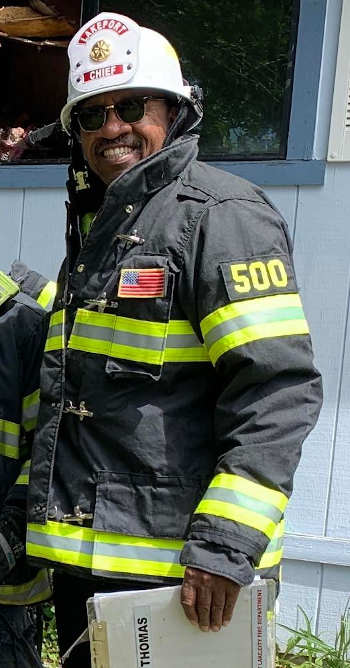
LAKE COUNTY, Calif. — After just over a year on the job, Lakeport Fire’s chief has decided to retire.
Chief Jeffrey Thomas tendered his resignation to the Lakeport Fire Protection District Board following its meeting on May 10, said Board President John Whitehead.
Whitehead said Thomas’ retirement was effective at the close of business on Monday.
Thomas told Lake County News that he retired for “personal reasons.”
As for what’s ahead, Thomas said he has no plans at the moment, just plans to relax “for a few beats.”
Thomas, the first Black chief of the fire district in its 128-year history, arrived in March 2021 from Salt Lake City, where he had worked in the fire service for 36 years.
Since then he’s worked on preparedness and in December led the department in celebrating its newest fire engine.
Last year, he worked with the Lakeport Police Department to create a specialized team of a police officer and a firefighter to patrol for illegal fireworks during the city’s July 4 celebration.
Whitehead said the board held a special meeting on Monday morning, at which time they named retired Ukiah Valley Fire Chief Dan Grebil as Lakeport’s interim chief.
In Ukiah Valley Grebil was the predecessor of Chief Doug Huchison, who previously had served at Lakeport Fire.
“He was doing the job,” Whitehead said of Thomas. “We’re just happy that he’s going to be happy and we wish him the best.”
As for how Lakeport Fire will conduct the recruitment for Thomas’ successor, Whitehead said, they don’t know yet.
“We really haven’t made any solid decision. We discussed that a little bit today,” he said.
He added, “We will be talking at our June meeting about that for sure.”
As a retired annuitant in the CalPERS retirement system, Grebil is limited to working a total of 960 hours in a year. Whitehead said that if Grebil works full-time, that means he has just under six months of time.
Whitehead reported that one of the district’s board members, Gary Deas, also has resigned. He’s received a job promotion and is moving out of the area.
Email Elizabeth Larson at