 How to resolve AdBlock issue?
News
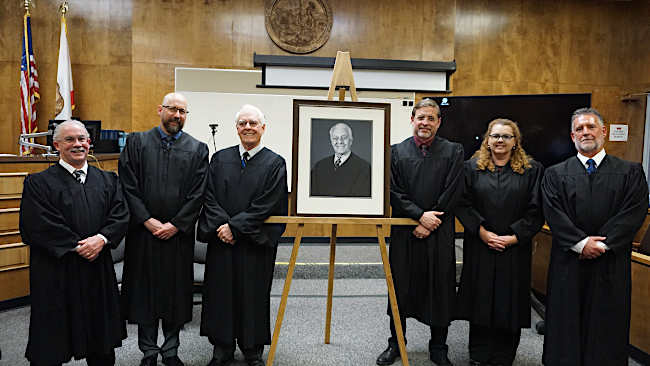
LAKEPORT, Calif. — A special ceremony held on Friday honored a retired Lake County Superior Court judge with the presentation of his portrait.
Judge Richard Martin retired in May of 2017, but the appreciation for the contributions he made during his tenure remains very much a thing of the present, according to the testimony of his peers, friends and family during the Friday afternoon ceremony.
The new black and white portrait of Martin will hang on the wall of the courtroom where he served as judge from 2005 to 2017. It will be hung next to the portrait of his predecessor Judge Robert Krone, who Martin called his mentor.
Since his retirement, Martin and wife, Charlotte, have done some traveling in their travel trailer and lately he’s learning to cook when he’s not working on his property near Lakeport.
Martin was lauded by members of the current bench, the district attorney and her staff, his son Sheriff Brian Martin and sheriff’s command staff, current and former bailiffs, court staff, friends and family.
The gathering was in the courtroom where Martin presided over Department Two. However, today the courtroom has been renumbered so that it’s Department One.
His successor, Judge J. David Markham, was on hand, along with fellow judges Andrew Blum, Michael Lunas and Shanda Harry, and Commissioner John Langan.
Attending via Zoom were retired judges Stephen Hedstrom, who stepped down at the end of his term the year after Martin, and Arthur Mann, who retired from full-time work in 2009 but served in a part-time capacity until the end of January after more than 41 years of service. Martin and Mann had run against each other for a judicial seat in the 1980s, a race which Mann ultimately won.
Before the ceremony, Hedstrom and Mann were chatting and catching up on Zoom and, at one point, Hedstrom asked if people in the courtroom could hear them. The audience responded with a loud chorus of “yes.”
Hedstrom responded by saying they should have put him on mute. Mann quipped that they had tried that in the past and it never worked.
During the ceremony, Markham said Martin was known for his “fair, well-reasoned” decisions and a judicial demeanor that was one of his greatest assets on the bench.
Harry said that a discussion she had with Martin about running for judge was one of the best things she did when considering launching a campaign.
Lunas recalled how he and Martin had gone up against each other when both were civil attorneys. He welcomed Martin back “to the room where it happened.”
Langan, who was coming up through the ranks of the District Attorney’s Office when Martin was a judge, thanked him for his patience with him and other young attorneys. “You impacted a lot of people here.”
The individual who had perhaps the most to say about Martin was Blum, a longtime friend. They worked together in the District Attorney’s Office before Martin came up with the “harebrained” idea of going off to Micronesia to become the attorney general of the island of Kosrae. Within six months, Martin had talked Blum into joining him there.
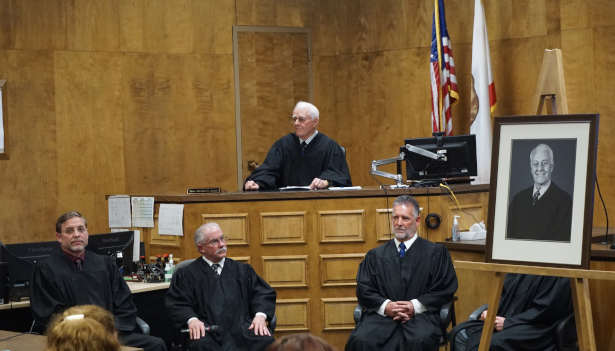
In that capacity, Martin did all manner of legislative and legal duties. One of the accomplishments Blum highlighted: Martin wrote the sea cucumber conservation legislation.
“It was a pleasure serving with him,” said Blum.
He added that while it’s been five years since Martin retired, “I can’t picture this building without Rick in it.”
Mann congratulated Martin for a spectacular and varied career, and Hedstrom recalled being the master of ceremonies at Martin’s swearing-in ceremony.
“This is a tremendous honor,” Brian Martin told the group.
He said the values that his father displayed on the bench were the same ones he followed at home. Richard Martin, his son said, believed in leaving things better than he found them.
Markham let Martin sit in his former seat on the bench, at which point he noted that, among the thousands of cases he handled, he was mindful that for many people, coming into his courtroom was the first and only time they would be in court. For others, they spent almost as much time as he did in the courtroom.
While the United States’ legal system isn’t perfect, Martin said he considered it the best in the world, which he credited to the people who make it work.
He also spoke about some of his proudest accomplishments, including work with the drug court and establishing a veterans court, which had special meaning for him since his father was a World War II veteran.
Martin took a redemptive view of cases involving veterans. While a veteran who came before him may have done something wrong, he held that such actions didn’t negate the good of their service to the country.
He thanked his fellow judges and attorneys, court staff, the community members who served as jurors, his family and particularly his wife for the years of support.
“It’s been an honor to serve,” he said.
Email Elizabeth Larson at
In partnership with Blue Zones Project Lake County, the Lake County Library hosted several discussions, cooking classes, and walking groups all designed to help patrons apply the principles of “The Blue Zones of Happiness: Lessons From the World's Happiest People” by Dan Buettner.
All events were free to the public, and free copies of the book were made available to the public.
The library clubs (Book Cubs, Cookbook Club and Garden Book Club) also participated. The monthly book club welcomed new members and had a lively discussion, in which patrons shared their thoughts on the contents of the book.
Several found that the principles resonated with their own experience, including the importance of community and staying connected throughout the pandemic.
Another patron praised the beauty of the Middletown hike on April 27. “I want to keep the weekly walking moai going,” said Amy, the event coordinator at the Lakeport library.
A moai is a small group of friends who encourage each other through life, and a walking moai walks together while they talk. “The Lakeport moai is going to be Thursdays at 8:30 a.m. and Middletown’s is Saturdays at 10 a.m.,” she said.
Lakeport and Middletown patrons also enjoyed a cooking class, in which they made a Tex-Mex bowl with avocado and chunky salsa, a strawberry mango salsa, and black bean seviche tostadas. Pictures from the class are available on the “Blue Zones Project — Lake County” Facebook page.
This project was made possible in part by the Institute of museum and library services.
The Lake County Department of Public Services Parks Division and Lake County Department of Public Health CalFresh Program will also be providing speakers, materials and more for the program.
Visit the Lake County Library website at http://library.lakecountyca.gov.


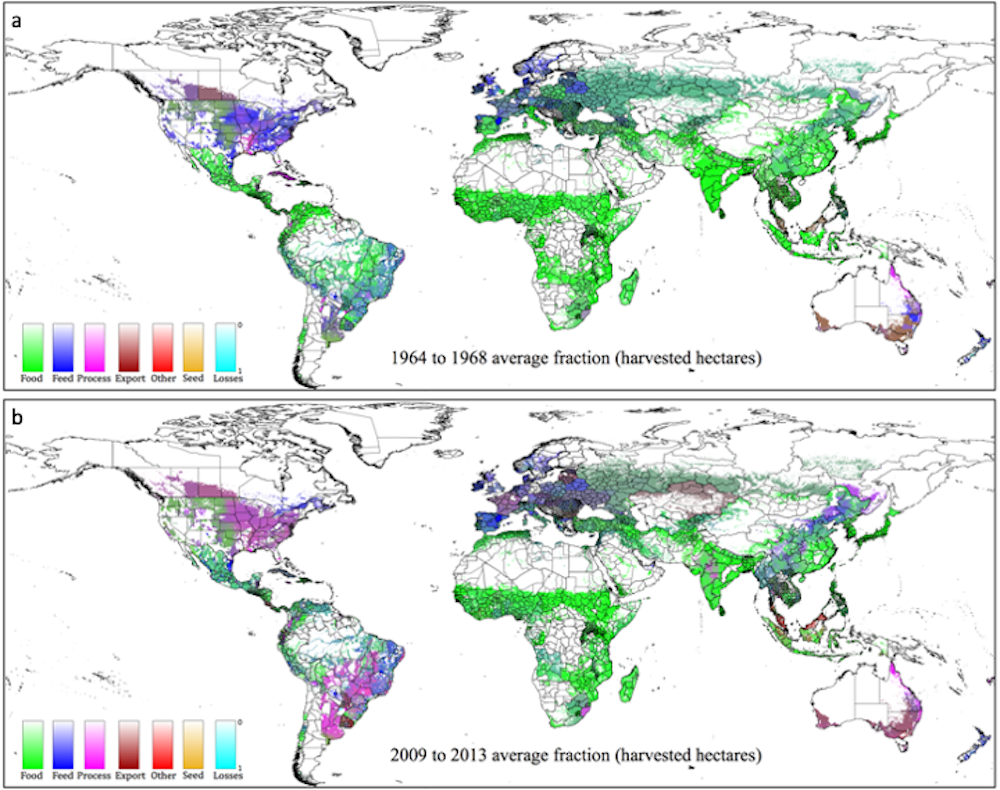
Rising competition for many of the world’s important crops is sending increasing amounts toward uses other than directly feeding people. These competing uses include making biofuels; converting crops into processing ingredients, such as livestock meal, hydrogenated oils and starches; and selling them on global markets to countries that can afford to pay for them.
In a newly published study, my co-authors and I estimate that in 2030, only 29% of the global harvests of 10 major crops may be directly consumed as food in the countries where they were produced, down from about 51% in the 1960s. We also project that, because of this trend, the world is unlikely to achieve a top sustainable development goal: ending hunger by 2030.
Another 16% of harvests of these crops in 2030 will be used as feed for livestock, along with significant portions of the crops that go to processing. This ultimately produces eggs, meat and milk – products that typically are eaten by middle- and upper-income people, rather than those who are undernourished. Diets in poor countries rely on staple foods like rice, corn, bread and vegetable oils.
The crops that we studied – barley, cassava, maize (corn), oil palm, rapeseed (canola), rice, sorghum, soybean, sugar cane and wheat – together account for more than 80% of all calories from harvested crops. Our study shows that calorie production in these crops increased by more than 200% between the 1960s and the 2010s.
Today, however, harvests of crops for processing, exports and industrial uses are booming. By 2030, we estimate that processing, export and industrial-use crops will likely account for 50% of harvested calories worldwide. When we add the calories locked in crops used as animal feed, we calculate that by 2030, roughly 70% of all harvested calories of these top 10 crops will go to uses other than directly feeding hungry people.
Serving the affluent, not the poor
These profound changes show how and where agriculture and agribusiness are responding to the growth of the global middle class. As incomes rise, people demand more animal products and convenient processed foods. They also use more industrial products that contain plant-based ingredients, such as biofuels, bioplastics and pharmaceuticals.
Many crops grown for export, processing and industrial uses are specially bred varieties of the 10 major crops that we analyzed. For example, only about 1% of corn grown is the U.S. is sweet corn, the type that people eat fresh, frozen or canned. The rest is mostly field corn, which is used to make biofuels, animal feed and food additives.
Crops grown for these uses produce more calories per unit of land than those harvested for direct food use, and that gap is widening. In our study we calculated that industrial-use crops already yield twice as many calories as those harvested for direct food consumption, and their yield is increasing 2.5 times faster.
The amount of protein per unit of land from processing crops is twice that of food crops, and is increasing at 1.8 times the rate of food crops. Crops harvested for direct food consumption have had the lowest yields across all metrics of measurement and lowest rates of improvement.
Grow more foods that feed the hungry
What does this mean for reducing hunger? We estimate that by 2030, the world will be harvesting enough calories to feed its projected population – but it won’t be using most of those crops for direct food consumption.
According to our analysis, 48 countries will not produce enough calories within their borders to feed their populations. Most of these countries are in sub-Saharan Africa, but they also include Asian nations such as Afghanistan and Pakistan and Caribbean countries such as Haiti.
Scientists and agricultural experts have worked to increase the productivity of food crops in countries where many people are undernourished, but the gains so far have not been enough. There may be ways to persuade wealthier nations to raise more food crops and divert that extra output to undernourished countries, but this would be a short-term solution.
My colleagues and I believe the broader goal should be raising more crops in food-insecure countries that are used directly as food, and increasing their yields. Ending poverty, the U.N.‘s top sustainable development goal, will also enable countries that can’t produce enough food to meet their domestic needs to import it from other suppliers. Without more focus on the needs of the world’s undernourished people, eliminating hunger will remain a distant goal.
Deepak Ray, Senior Scientist, University of Minnesota
This article is republished from The Conversation under a Creative Commons license. Read the original article.
Generally speaking, however, most married couples use a single joint trust. The joint trust consists either entirely of community property assets or a mixture of the couple’s community property and separate property assets.
Sometimes, when there are little community property assets, such as with later in life marriages, each spouse may want full independent control over their own assets and to keep their own assets separate.
A joint bank account can be used to receive any marital income and to pay any joint living expenses. Either spouse can still use their separate property assets for the couple’s joint benefit.
Using a separate property trust in addition to a joint community property trust occurs when a married person owns substantial separate assets, such as large inheritances and/or assets acquired from before marriage. It is often seen in second marriages where one spouse wants to protect their separate property assets for inheritance by their own children.
Often the two trusts have different distribution schemes at the death of the settlor (trust owner); typically the separate property trust is more beneficial to the deceased settlor’s children.
Having assets in a separate property trust allows the settlor (owner) to control their assets independently of their spouse.
A person who establishes a separate property trust has sole control, while they are alive and competent, over their assets inside the trust. That is, the sole settlor has complete control over the management, the use and the final distribution of their separate assets.
Such control may be important to a married person who wants to protect their separate property assets in a second marriage.
With a joint trust, both spouses as co-trustees and co-settlors have joint control (management) over the combined assets as provided under the terms of the trust. Typically, either spouse acting alone as trustee can manage the trust’s community property assets. Both spouses acting together would be required to amend the trust, unless otherwise provided in the trust.
In California, a spouse’s management and control of community property is subject to a fiduciary duty that each spouse owes the other to act in the “highest good faith and fair dealing.”
A spouse who takes any unfair advantage of the other spouse has breached the fiduciary duty and can be held accountable.
Both spouse’s acting together say who inherits the community property assets in the joint trust when the first spouse and then the second spouse dies. Each spouse controls who inherits their own separate property assets at their own death.
When a married person with a separate property trust dies, their surviving spouse may, or may not, have any beneficial rights in the deceased spouse’s separate property trust. The surviving spouse only receives whatever benefits the deceased spouse left for the surviving in that trust.
The surviving spouse, as an heir, however, is still entitled to request a copy of the deceased spouse’s separate property trust.
The deceased spouse’s separate property trust is liable to pay for the separate property debts of the deceased spouse, for debts associated with the last illness, and for any expenses of administration associated with the decedent’s estate. Otherwise such debts are payable from the decedent’s community property trust.
Any payments of the deceased spouse’s debts and expenses by the decedent’s separate property trust may provide relief to the surviving spouse.
The surviving spouse often benefits more from the joint community property trust than from the deceased spouse’s separate property trust.
Often, however, the largest unpaid debts of the deceased spouse are community property debts, i.e., debts acquired while married, and as such are chargeable against the community assets in the couple’s joint trust.
The foregoing brief discussion of a complex and broad subject is not legal advice. Consult a qualified attorney for legal guidance.
Dennis A. Fordham, attorney, is a State Bar-Certified Specialist in estate planning, probate and trust law. His office is at 870 S. Main St., Lakeport, Calif. He can be reached at
What is a lunar eclipse?
A lunar eclipse occurs when the Sun, Earth, and Moon align so that the Moon passes into Earth’s shadow. In a total lunar eclipse, the entire Moon falls within the darkest part of Earth’s shadow, called the umbra. When the Moon is within the umbra, it will turn a reddish hue. Lunar eclipses are sometimes called “Blood Moons” because of this phenomenon.
How can I observe the eclipse?
You don’t need any special equipment to observe a lunar eclipse, although binoculars or a telescope will enhance the view and the red color. A dark environment away from bright lights makes for the best viewing conditions.
The eastern half of the United States and all of South America will have the opportunity to see every stage of the lunar eclipse. Totality will be visible in much of Africa, western Europe, Central and South America, and most of North America.
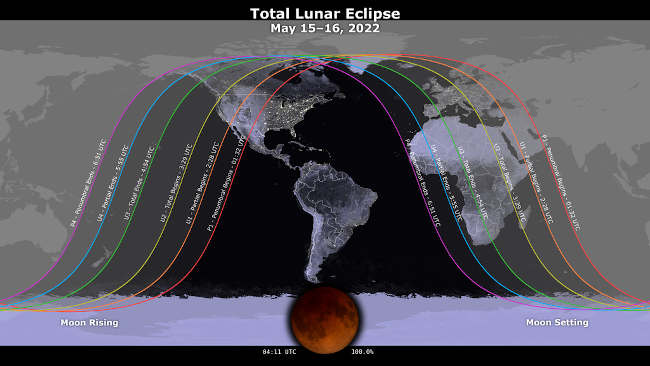
What if it’s cloudy or I’m not in the viewing region?
NASA will feature livestreams of the eclipse from locations across the globe! We’ll also host an episode of NASA Science Live, from 11 p.m. – 12 a.m. ET. Watch at one of the following locations and ask your lunar eclipse questions using #AskNASA on social media.
What can I expect to observe (Pacific Time)?
8:29 p.m.: Totality begins. The entire Moon is now in the Earth’s umbra. The Moon will turn a coppery-red. Try binoculars or a telescope for a better view. If you want to take a photo, use a camera on a tripod with exposures of at least several seconds.
9:53 p.m.: Totality ends. As the Moon exits Earth’s umbra, the red color fades. It will look as if a bite is being taken out of the opposite side of the lunar disk as before.
10:55 p.m.: Partial eclipse ends. The whole Moon is in Earth’s penumbra, but again, the dimming is subtle.
11:50 p.m.: Penumbral eclipse ends. The eclipse is over.

Why does the Moon turn red during a lunar eclipse?
The same phenomenon that makes our sky blue and our sunsets red causes the Moon to turn red during a lunar eclipse. It’s called Rayleigh scattering. Light travels in waves, and different colors of light have different physical properties. Blue light has a shorter wavelength and is scattered more easily by particles in Earth’s atmosphere than red light, which has a longer wavelength.
Red light, on the other hand, travels more directly through the atmosphere. When the Sun is overhead, we see blue light throughout the sky. But when the Sun is setting, sunlight must pass through more atmosphere and travel farther before reaching our eyes. The blue light from the Sun scatters away, and longer-wavelength red, orange, and yellow light pass through.
During a lunar eclipse, the Moon turns red because the only sunlight reaching the Moon passes through Earth’s atmosphere. The more dust or clouds in Earth’s atmosphere during the eclipse, the redder the Moon will appear. It’s as if all the world’s sunrises and sunsets are projected onto the Moon.
Will any NASA spacecraft observe the eclipse?
NASA’s mission team for the Lunar Reconnaissance Orbiter, or LRO, NASA’s spacecraft in orbit around the Moon, will turn the instruments off during the eclipse. The spacecraft is solar-powered, so LRO will power down to preserve its battery while the Moon is in shadow.
The Lucy spacecraft, currently on its journey to study Jupiter’s Trojan asteroids, will turn its gaze toward its home planet to observe a portion of the five-hour long eclipse – from just before the penumbral eclipse to just before the end of totality.
The mission team plans to capture a view of both the Earth and the Moon with the high-resolution imager, L’LORRI. Since the spacecraft will be 64 million miles away and uses the Deep Space Network, it will likely take a few weeks to download and process the images. Follow @NASASolarSystem for updates on the Lucy mission.
Molly Wasser and Ernie Wright work for NASA.

The Blue Zones Project Community Kickoff and inaugural Hope4Health Festival/Hope in the Park Concert will take place on Saturday, May 14, from 10 a.m. to 5 p.m. at Austin Park in Clearlake.
Jamey Gill, executive director of Blue Zones Project Lake County, said the project is partnering with its sponsor organization, Adventist Health Clear Lake, to present the event.
Gill said the Blue Zones Experience aspect of the event will take place from 10 a.m. to 3 p.m., and will feature food, information booths, health services including free vaccines, and children’s activities including a petting zoo and bicycle safety.
Other offerings will include dog adoptions, a kayak giveaway and a daylong pickleball demonstration by the Lake County Tennis Club.
At noon there will be a talk by Nick Buettner, vice president of community engagement and producer of Blue Zones Expeditions. He is the brother of Dan Buettner, author of “The Blue Zones” and “The Blue Zones Solution.”
That will be followed by the inaugural Hope in the Park Concert featuring the music of Unity Voices, which will take place from 3 to 5 p.m. at the park’s band stage.
Gill said the event is meant to introduce the Blue Zones to Lake County. The goal is that visitors to the festival leave with the feeling that “the healthy choice can be the easy choice.”
“We have been in our foundation and planning phase for Blue Zones since October when the team came on board,” said Gill.
She said the steering committee and leadership team have almost completed their blueprint, or strategic plan, which will direct the project’s first year of activity. “We’re very much still in an exploration stage.”
The group also is working to decide on its marquee project, which will be unveiled early in the four-year initial project.
“This is a huge undertaking,” said Gill.
Part of the work involves studying what work is already being done to improve Lake County’s health outcomes — some of the worst in the state — and offer support to elevate those efforts, Gill said.
Gill said the strategic plan has goals and objectives that will be signed off on the steering committee on things we will focus on for the next four years. “Obviously, we can’t focus on everything,” she said, noting the many great ideas coming their way.
“The goal is at the end of four years, we will become a certified Blue Zone Project Community,” Gill said.
They will have to meet certain goals to do that, one of which is encouraging organizations, worksites and schools to register with them if they want to become Blue Zones approved.
So far, they have more than 10 such organizations, including Foods, Etc. in Clearlake, which has signed up to be the first Blue Zones approved grocery store in Lake County.
Another early adopter is the Lake County Library, which set up a walking moai, a group of friends that walks and talks together, Gill said. Moais gather in Lakeport at 8:30 a.m. on Thursdays and 10 a.m. on Saturdays in Middletown.
Gill said another group that also is actively participating is the Kelseyville Sunrise Rotary, which is working stretching and other healthy practices into its meetings.
Blue Zones can be tailored to meet the needs of the community, Gill said.
She said the Blue Zones format offers a model, and there are 70 such projects now at work across the nation. There are six within Adventist Health’s footprint. Gill said a community comparable to Lake County is Corry, Pennsylvania, a rural area in the northwestern part of that state.
“We do have so many great things happening in our community,” she added.
For more information about the Lake County Blue Zones project, visit https://lc.bluezonesproject.com/home.
Email Elizabeth Larson at