 How to resolve AdBlock issue?
News
Call Lake County Animal Care and Control at 707-263-0278 or visit the shelter online at http://www.co.lake.ca.us/Government/Directory/Animal_Care_And_Control.htm for information on visiting or adopting.
The following cats at the shelter have been cleared for adoption.

‘Delilah’
“Delilah” is a 2-year-old female domestic longhair cat with a gray coat with white markings.
She is in cat room kennel No. 103, ID No. LCAC-A-3070.

Male domestic shorthair
This 1-year-old male domestic shorthair cat has an all-black coat.
He is in cat room kennel No. 66, ID No. LCAC-A-3309.
Email Elizabeth Larson at

LAKE COUNTY, Calif. — After missing two years due to the pandemic, the Lake County Home Wine and Beer Makers’ Festival is back.
This family-friendly event will take place from noon to 5 p.m. on Saturday, June 11, at Library Park in Lakeport.
Now in its 20th year, the winefest has become a fixture in Lake County. It was originally started by the late Connel Murray and other amateur winemakers who were members of the Lake County Symphony Association to help raise needed funds for the symphony.
This year, John Parkinson, the conductor of the symphony, will again be manning the symphony’s booth.
The WineFest was expanded over the years to include amateur and commercial beer makers — a welcome addition that has included participants such as the Konocti Mashers and the O’Meara Bros. Brewing Co.
For nearly two decades, home winemakers and brewers from all over Northern California have come to Lake County to pour samples for the public.
Home winemakers have the chance to enter their products before the event for judging by experts. All participants are eligible for the gold, silver and bronze ribbons which are awarded for a wide range of varietals and brews.
All have a chance to win the popular “Peoples’ Choice” awards voted on by attendees, with results announced during the festival. Several Lake County commercial wineries, including Rose d’Oro and Smiling Dogs, will be represented at the WineFest to show support for the LCSA, but they are not eligible for prizes; these only go to the amateurs.
There is more to the WineFest than just wine and beer, though. As in past years, there will be numerous vendors offering original arts and crafts, clothing, and agricultural products.
Attendees to this year’s event can also expect a variety of delicious food choices, including tri-tip sandwiches from our local Knights of Columbus and the always-popular Villa’s Snow Cones. Tres Bien Creamery, the Noodle Bowl and I Love BLT’s (AKA Badass BLT’s) are also planning to be there.
Music will come from a variety of sources, including the ever-popular David Neft Duo, featuring David Neft on keyboard and Steve Dubois on drums.
The silent auction is another key component of the WineFest, featuring a variety of gift items donated by local businesses and original artwork.
A US flag that was flown over our Capitol has been provided by Congressman Mike Thompson, along with a donation of wine and balsamic vinegar from his own small Lake County vineyard.
The popular “Barrel of Wine” raffle goes on all day long and gives the lucky winner approximately 36 bottles of assorted Lake County wines. The actual barrel used for the wines in the raffle will be available for bidders in the Silent Auction.
Advance tickets are $30, a discount of $5. They are available now at Watershed Books, Wine in the Willows, and the Chamber of Commerce.
For additional ticket information and other details, go to https://www.homewinemakersfestival.com.
Questions concerning the event can be sent to
Deb Fredrickson is a member of the Lake County Symphony Association.
Dogs available for adoption this week include mixes of American Staffordshire terrier, Anatolian shepherd, Australian cattle dog, Australian shepherd, Catahoula leopard dog, French bulldog, Labrador retriever and pit bull.
Dogs that are adopted from Lake County Animal Care and Control are either neutered or spayed, microchipped and, if old enough, given a rabies shot and county license before being released to their new owner. License fees do not apply to residents of the cities of Lakeport or Clearlake.
The following dogs at the Lake County Animal Care and Control shelter have been cleared for adoption.
Call Lake County Animal Care and Control at 707-263-0278 or visit the shelter online for information on visiting or adopting.

Male American Staffordshire terrier
This 3-year-old male American Staffordshire terrier has a short gray coat.
He is reported to be a very friendly dog with a great temperament, good with cats and already neutered.
He is in kennel No. 9, ID No. LCAC-A-3398.

Black lab mix
This 1-year-old male black Labrador Retriever has a short coat.
He is in kennel No. 2, ID No. LCAC-A-3418.
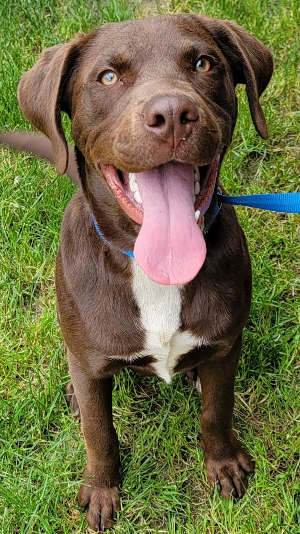
Chocolate lab mix
This young male chocolate Labrador, who is under a year old, has a short coat.
He is in kennel No. 3, ID No. LCAC-A-3385.

‘Bella’
“Bella” is a 2-year-old Catahoula leopard dog mix with a short black and white coat.
She is in kennel No. 4, ID No. LCAC-A-3245.

‘Dozer’
“Dozer” is a 2-year-old male pit bull with a short black coat.
He is in kennel No. 5, ID No. LCAC-A-3278.

‘Dexter’
“Dexter’ is a 1-year-old male pit bull with a short black coat with white markings.
He is in kennel No. 6, ID No. LCAC-A-3290.

Female pit bull mix
This young female pit bull mix has a short black and white coat.
She is in kennel No. 10, ID No. LCAC-A-3353.

‘Bruno’
“Bruno” is a young male pit bull with a short black and white coat.
He is in kennel No. 11, ID No. LCAC-A-3344.

Female pit bull
This 3-year-old female pit bull had a short gray coat with withe markings.
She is in kennel No. 12, ID No. LCAC-A-3323.

Male pit bull
This 1-year-old male pit bull has a short brown coat with white markings.
He is in kennel No. 15, ID No. LCAC-A-3321.

‘Macho’
“Macho” is a 3-year-old male pit bull mix with a short brown coat.
He is in kennel No. 17, ID No. LCAC-A-3343.

Female shepherd mix
This 1-year-old female shepherd mix has a short gray brindle coat.
She is in kennel No. 19, ID No. LCAC-A-3342.

‘Willie’
“Willie” is a 1-year-old male pit bull terrier with a short brown and white coat.
He is in kennel No. 20, ID No. LCAC-A-3301.

Male wirehaired terrier
This 2-year-old male wirehaired terrier has a cream-colored coat.
He is in kennel No. 22, ID No. LCAC-A-3399.

‘Cody’
“Cody” is a 7-year-old male French bulldog-pit bull terrier mix with a short brindle and white coat.
He is in kennel No. 23, ID No. LCAC-A-3284.

‘Pozey’
“Pozey” is a 6-year-old female Anatolian shepherd with a short cream-colored coat.
She is in kennel No. 26, ID No. LCAC-A-3362.
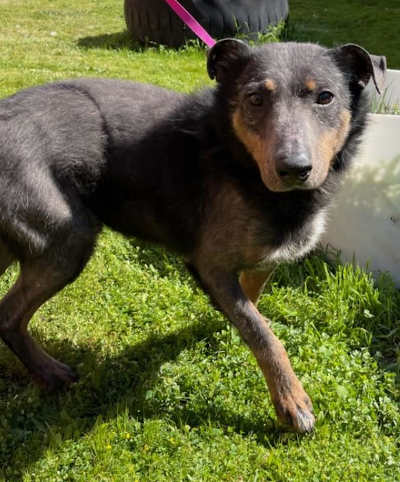
Male Australian cattle dog
This 3-year-old male Australian cattle dog has a short black, tan and white coat.
He is in kennel No. 27, ID No. LCAC-A-3130.
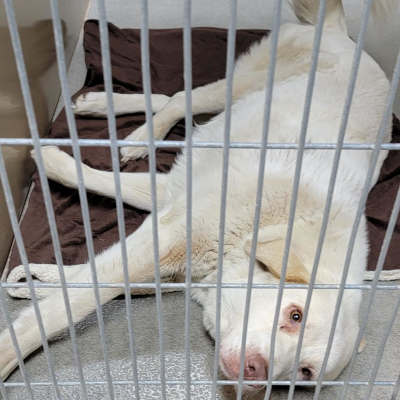
‘Mozey’
“Mozey” is a 6-year-old female Anatolian shepherd with a short cream-colored coat.
She is in kennel No. 33, ID No. LCAC-A-3363.

‘Rooster’
“Rooster” is a 5-year-old male mountain cur with a brown brindle coat.
He is in kennel No. 34, ID No. LCAC-A-3384.
Email Elizabeth Larson at
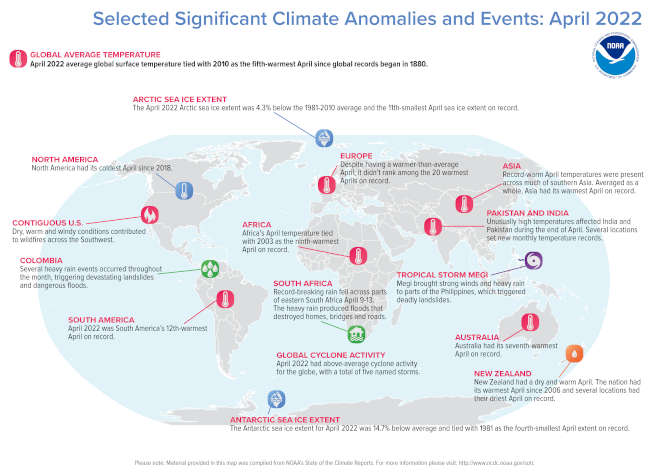
April was very warm throughout the globe, with the month tying 2010 as the fifth-warmest April in 143-year climate record, according to scientists from NOAA’s National Centers for Environmental Information.
Last month also contributed to a very warm start to 2022, as sea ice coverage at both poles ran well below average.
Climate by the numbers
April 2022
The average global temperature in April was 1.53 degrees F (0.85 of a degree C) above the 20th-century average of 56.7 degrees F (13.7 degrees C), tying with April 2010 as the fifth-warmest April on record.
Asia had its warmest April on record — dating back to 1910 — with the month running 4.72 degrees F (2.62 degrees C) above average. This surpassed the now second-warmest April in 2016 by 0.09 of a degree F (0.05 of a degree C). Unusually high temperatures across India and Pakistan contributed to the record heat in Asia, with several locations setting new April temperature records.
Oceania had its fifth-warmest April on record, while Africa and South America saw their ninth and 12th-warmest April on record, respectively. North America was the only continent with a cooler-than-average April, seeing its coolest April since 2018.
The world’s 10 warmest Aprils have all occurred since 2010, with 2014-2022 all ranking among the 10 warmest Aprils on record.
Year to date
The global temperature for the year to date (YTD, January through April 2022) was 1.57 degrees F (0.87 of a degree C) above average, making it the fifth-warmest such YTD on record.
Asia had its fourth-warmest YTD on record, Oceania had its seventh warmest and Europe saw its 11th warmest. South America had its ninth-warmest January-through-April YTD on record, while North America saw its coolest such YTD since 2014.
According to NCEI’s Global Annual Temperature Rankings Outlook, it is virtually certain (> 99.0%) that 2022 will rank among the 10 warmest years on record.
Polar sea ice coverage was low: Arctic sea ice extent (coverage) averaged 5.43 million square miles in April, 243,000 square miles below the 1981-2010 average and the 11th smallest for April since records began in 1979. Despite being below average, it was the largest April sea ice extent since 2014. Antarctic sea ice extent for April 2022 was 2.25 million square miles — 390,000 square miles below average — tying with 1981 as the fourth-smallest April sea ice extent on record. Only the Aprils of 1980, 2017 and 2019 had smaller sea ice extents.
An active April for the tropics: Five tropical cyclones formed around the globe in April, which is above average. Of the five storms, the strongest was Typhoon Malakas in the West Pacific Ocean, which intensified to an equivalent Category 4 hurricane on the Saffir-Simpson scale. The Northern Hemisphere had two named storms form over the West Pacific during the month. The South Indian Ocean had two tropical storms, while the Southwest Pacific basin had one storm for the month. Between January-April 2022, there were a total of 23 tropical cyclones, which is near average.

The California Highway Patrol on Friday announced the graduation and deployment of nine new canine teams.
After months of intensive training, the CHP certified its newest members during a ceremony at the CHP Academy’s Canine Training Facility.
“These nine teams are joining an already astonishing unit that serves as a vital part of the Department in protecting the public,” said CHP Commissioner Amanda Ray. “The canines have received hundreds of hours of intense training and are ready to serve and support the mission of the CHP.”
The graduates consist of eight patrol and narcotics detection canine teams and one patrol and explosives detection canine team, all of which meet the guidelines set by the Commission on Peace Officer Standards and Training.
The newest team members include two Belgian malinois, two Dutch shepherds and five German shepherds. The CHP now has a total of 53 canine teams deployed throughout the state.
Each canine’s partner, or handler, is an experienced CHP officer with anywhere from three to 15
years of experience.
The officers represent the CHP’s eight geographic regions of Northern, Valley, Golden Gate, Central, Southern, Border, Coastal and Inland Division.
Once deployed, the handlers will spend a minimum of eight hours every week training with their canines to ensure the highest level of peak performance by creating scenarios similar to what is experienced out in the field.
The CHP uses its canines to perform a variety of tasks, including detecting human scent, contraband, and explosives.
A canine team can improve the safety and effectiveness of officers as well as save time and money.
The CHP canines are also used to assist allied agencies in apprehending criminals, detecting explosives or drugs, and in locating at-risk missing persons.

On May 12, 2022, astronomers on the Event Horizon Telescope team released an image of a black hole called Sagittarius A* that lies at the center of the Milky Way galaxy. Chris Impey, an astronomer at the University of Arizona, explains how the team got this image and why it is such a big deal.
1. What is Sagittarius A*?
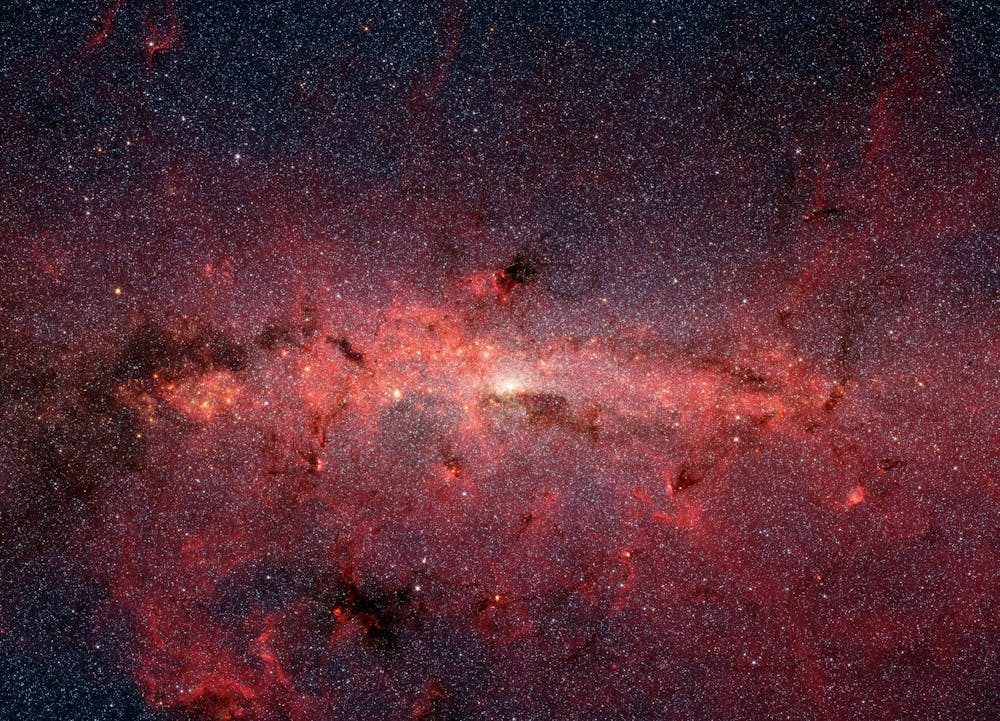
Sagittarius A* sits at the the center of our Milky Way galaxy, in the direction of the Sagittarius constellation. For decades, astronomers have been measuring blasts of radio waves from an extremely compact source there.
In the 1980s, two teams of astronomers started tracking the motions of stars near this mysterious source of radio waves. They saw stars whirling around a dark object at speeds up to a third of the speed of light. Their motions suggested that at the center of the Milky Way was a black hole 4 million times the mass of the Sun. Reinhard Genzel and Andrea Ghez later shared the Nobel Prize in Physics for this discovery.
The size of a black hole is defined by its event horizon – a distance from the center of the black hole within which nothing can escape. Scientists had previously been able to calculate that Sagittarius A* is 16 million miles (26 million kilometers) in diameter.
The Milky Way’s black hole is huge compared to the black holes left behind when massive stars die. But astronomers think there are supermassive black holes at the center of nearly all galaxies. Compared to most of these, Sagittarius A* is meager and unremarkable.
2. What does the new image show?

Black holes themselves are completely dark, since nothing, not even light, can escape their gravity. But black holes are surrounded by clouds of gas, and astronomers can measure this gas to infer images of the black holes within. The central dark region in the image is a shadow cast by the black hole onto the gas. The bright ring is the gas itself glowing. The bright spots in the ring show areas of hotter gas that may one day fall into the black hole.
Some of the gas visible in the image is actually behind Sagittarius A*. Light from that gas is being bent by the powerful gravity of the black hole toward Earth. This effect, called gravitational lensing, is a core prediction of general relativity.
3. What went into producing this image?
Supermassive black holes are extremely hard to measure. They are far away and shrouded by the gas and dust that clogs the center of galaxies. They are also relatively small compared to the vastness of space. From where Sagittarius A* sits, 26,000 light years away at the center of the Milky Way, only 1 in 10 billion photons of visible light can reach Earth – most are absorbed by gas in the way. Radio waves pass through gas much more easily than visible light, so astronomers measured the radio emissions from the gas surrounding the black hole. The orange colors in the image are representations of those radio waves.

The team used eight radio telescopes spread across the globe to collect data on the black hole over the course of five nights in 2017. Every night generated so much data that the team couldn’t send it through the internet – they had to ship physical hard drives to where they processed the data.
Because black holes are so hard to see, there is a lot of uncertainty in the data the telescopes collect. To turn it all into an accurate image, team used supercomputers to produce millions of different images, each one a mathematically viable version of the black hole based off the data collected and the laws of physics. They then blended all of these images together to produce the final, beautiful, accurate image. The processing time was equivalent to running 2,000 laptops at full speed for a year.
4. Why is the new image such a big deal?
In 2019, the Event Horizon Telescope team released the first image of a black hole – this one at the center of the galaxy M87. The black hole at the center of this galaxy, named M87*, is a behemoth 2,000 times larger than Sagittarius A* and 7 billion times the mass of the Sun. But because Sagittarius A* is 2,000 times closer to Earth than M87*, the Event Horizon Telescope was able to observe both black holes at a similar resolution – giving astronomers a chance to learn about the universe by comparing the two.
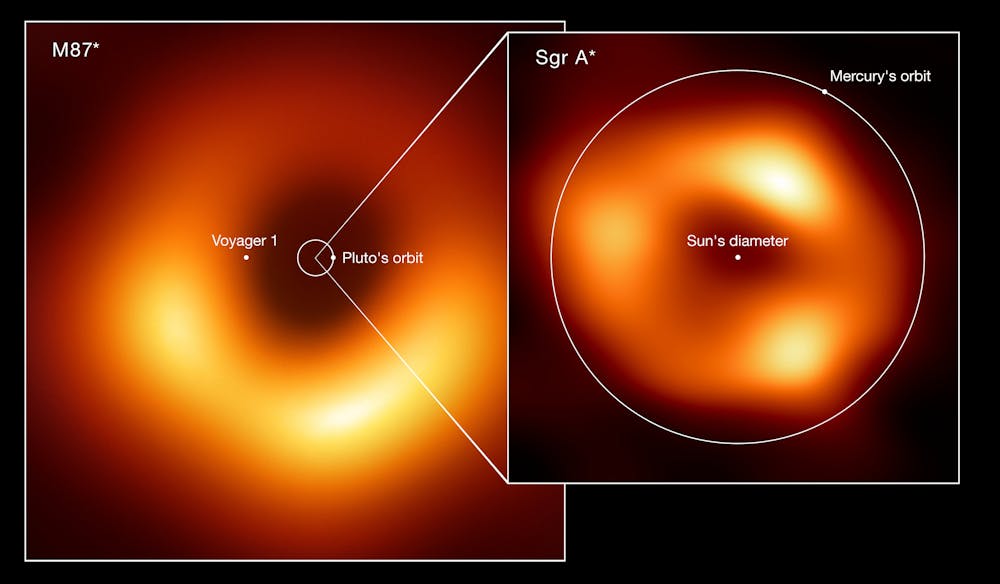
The similarity of the two images is striking because small stars and small galaxies look and behave very differently than large stars or galaxies. Black holes are the only objects in existence that only answer to one law of nature – gravity. And gravity does not care about scale.
For the last few decades, astronomers have thought that there are massive black holes at the center of almost every galaxy. While M87* is an unusually huge black hole, Sagittarius A* is likely pretty similar to many of the hundreds of billions of black holes at the center of other galaxies in the universe.
5. What scientific questions can this answer?
There is a lot more science to be done from the data the team collected.
One interesting avenue of inquiry stems from the fact that the gas surrounding Sagittarius A* is moving at close to the speed of light. Sagittarius A* is relatively small, and matter trickles into it very slowly – if it were the size of a human, it would consume the mass of a single grain of rice every million years. But by taking many images, it would be possible to watch the flow of matter around and into the black hole in real time. This would allow astrophysicists to study how black holes consume matter and grow.
A picture is worth a thousand words, and this new image has already generated 10 scientific papers. I expect there will be many more to come.
Chris Impey, University Distinguished Professor of Astronomy, University of Arizona
This article is republished from The Conversation under a Creative Commons license. Read the original article.