 How to resolve AdBlock issue?
News
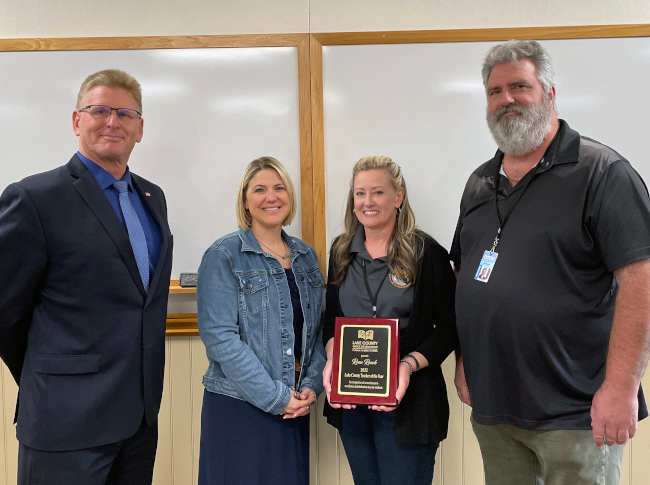
LAKE COUNTY, Calif. — Rena Roush, lead teacher at the Kelseyville Learning Academy in the Kelseyville Unified School District, has been named Lake County Teacher of the Year 2022.
“Rena Roush is the reason the Kelseyville Learning Academy is so successful,” said Dr. Nicki Thomas, Kelseyville Unified’s assistant superintendent. “She excels at developing positive relationships with students and families.”
Roush received notification of the honor on Friday during Teacher Appreciation Week.
Her students, colleagues and family members gathered at the Kelseyville Unified School District office as Lake County Superintendent of Schools Brock Falkenberg presented a surprised Roush with her Teacher of the Year plaque and flowers.
Roush was chosen as the Kelseyville Unified Teacher of the Year in March.
In late April, Roush participated in an interview at the Lake County Office of Education. She was chosen from a group of four other Lake County District Teachers of the Year to represent Lake County at the California Teacher of the Year competition this fall.
The other District Teachers of the Year 2022 include Kacy Mitchell, Konocti Unified School District; Farrah Alameda, Lakeport Unified; Scott Ferguson, Middletown Unified; and Paul Holt, Upper Lake Unified School District.
Roush became a teacher after her high school counselor called her into his office to suggest it as a career path, telling Roush she’d make a great teacher.
“Since then, I have valued and appreciated my career choice,” Roush said.
Roush has spent most of her teaching years working in alternative education settings. The Kelseyville Learning Academy is a home study and long-term independent study program.
Before this assignment, Roush spent many years teaching at the Lakeport Alternative School, a home study program offered through Lakeport Unified School District.
Roush feels fortunate to have the opportunity to partner with students and parents in achieving academic and personal goals through one-on-one instruction.
“I am privileged to have witnessed the success of many students, who struggled academically, socially, and emotionally in the ‘traditional’ classroom setting, grow in self-confidence, learn to apply useful study skills, and effectively implement self-management tools for life,” said Roush.
Roush is also proud of facilitating work experience and apprenticeship programs with local businesses and coordinating dual-enrollment courses for her students at the local community colleges.
“Her students maintain high levels of attendance, engagement, and academic achievement,” said Thomas. “Rena is a master teacher by all definitions.”
Members of the interview panel included Cynthia Lenners, deputy superintendent of schools; Michelle Mackey, Lake County Teacher of the Year 2021; Jennifer Kelley, former Lake County and California Teacher of the Year; Alan Siegel, former Lake County and California Teacher of the Year; and Judy Fletcher, representing the California Retired Teachers Association.
Lake County has had three California Teachers of the Year in the last 17 years. Erica Boomer from Upper Lake Unified School District was named a California Teacher of the Year 2019. Jennifer Kelly from the Middletown Unified School District received the honor in 2011 and Alan Siegel from Konocti Unified School District received the honor in 2005.
Falkenberg acknowledged Lake County teachers’ high success rate in the California Teacher of the Year program. “Our Lake County students are being served well by some of the best teachers in our state. That’s awe-inspiring.”
The Lake County Teacher of the Year program is administered through the Lake County Office of Education and the California Department of Education.
For more information about Rena Roush and the Lake County District Teachers of the Year, please visit https://www.lakecoe.org/TOY.
LAKE COUNTY, Calif. — A Clearlake Oaks man convicted by a jury in March in a burglary case has been sentenced to state prison.
Judge J. David Markham sentenced David Clair Archuleta to prison during an April 18 sentencing, said Chief Deputy District Attorney Richard Hinchcliff.
Archuleta, 39, received a sentence of 17 years and four months in state prison, Hinchcliff said.
Hinchcliff said evidence at Archuleta’s trial showed that Lake County Sheriff’s Deputy Matthew McCabe was on patrol in Clearlake Oaks on Dec. 30, 2020, at approximately 12:45 a.m. when he observed Archuleta unloading a Predator 3500 generator from a Toyota Rav4 which was parked in front of his residence on first street.
McCabe was aware that a similar generator had been reported stolen on Dec. 24 from a residence on Fourth Street, Hinchcliff said.
Deputy McCabe made contact with Archuleta, and subsequently obtained a search warrant for his residence and the RAV 4. Hinchcliff said the search of the residence discovered property which had been reported stolen from two separate residences, each on Keys Boulevard in Clearlake Oaks.
Hinchcliff said one burglary had been reported on Dec. 26, 2020, and one had been reported on Dec. 29, 2020.
In addition to the stolen property, Hinchcliff said deputies discovered a loaded Glock 9 millimeter pistol. Archuleta had previously been convicted of several felonies and was prohibited from possessing firearms or ammunition.
A search of the RAV 4 disclosed a backpack which contained several pry bars, Hinchcliff said. Deputy Andrew Moyeda and his Field Training Officer Deputy Walter White, who had investigated the Dec. 29 Keys Boulevard burglary, noted that one of the pry bars was consistent in appearance with marks left on the door of the burglarized house.
Additionally, HInchcliff said the pry bar had white paint on it consistent with the paint of the home in question. The deputies seized the pry bar and took it to the Keys Boulevard address to compare it with the marks on the damaged door.
Hinchcliff said a complaint charging Archuleta with burglary of the Fourth Street residence and possession of a firearm by a felon was filed on Dec. 31, 2020.
He said Archuleta was arrested and appeared in court. Archuleta was released on his own recognizance pursuant to recent changes in California law concerning bail and custody status.
Based on reports documenting the search of the First Street residence which were received by the district attorney after Archuleta’s first court appearance, another case was filed charging burglaries of the two Keys Boulevard homes, Hinchcliff said.
An arrest warrant was issued and Archuleta was arrested on Feb. 3, 2021. During that arrest, deputies discovered a second Glock 9 millimeter pistol and separate 9 millimeter ammunition. Hinchcliff said those charges were added to the complaint; the two cases were consolidated for trial.
The jury trial began on March 9. Archuleta was represented by Mitchell Hauptman. Deputy District Attorney Edward Borg prosecuted the case, Hinchcliff said.
The case was submitted to the jury on March 17. Hinchcliff said the jury returned verdicts on March 18.
He said Archuleta was convicted of three counts of first degree burglary, one count of possession of stolen property; two counts of being a felon in possession of a firearm, and two counts of being a felon in possession of ammunition.
The court also found that Archuleta had suffered a prior strike conviction for arson, Hinchcliff said.
Judge J. David Markham sentenced David Clair Archuleta to prison during an April 18 sentencing, said Chief Deputy District Attorney Richard Hinchcliff.
Archuleta, 39, received a sentence of 17 years and four months in state prison, Hinchcliff said.
Hinchcliff said evidence at Archuleta’s trial showed that Lake County Sheriff’s Deputy Matthew McCabe was on patrol in Clearlake Oaks on Dec. 30, 2020, at approximately 12:45 a.m. when he observed Archuleta unloading a Predator 3500 generator from a Toyota Rav4 which was parked in front of his residence on first street.
McCabe was aware that a similar generator had been reported stolen on Dec. 24 from a residence on Fourth Street, Hinchcliff said.
Deputy McCabe made contact with Archuleta, and subsequently obtained a search warrant for his residence and the RAV 4. Hinchcliff said the search of the residence discovered property which had been reported stolen from two separate residences, each on Keys Boulevard in Clearlake Oaks.
Hinchcliff said one burglary had been reported on Dec. 26, 2020, and one had been reported on Dec. 29, 2020.
In addition to the stolen property, Hinchcliff said deputies discovered a loaded Glock 9 millimeter pistol. Archuleta had previously been convicted of several felonies and was prohibited from possessing firearms or ammunition.
A search of the RAV 4 disclosed a backpack which contained several pry bars, Hinchcliff said. Deputy Andrew Moyeda and his Field Training Officer Deputy Walter White, who had investigated the Dec. 29 Keys Boulevard burglary, noted that one of the pry bars was consistent in appearance with marks left on the door of the burglarized house.
Additionally, HInchcliff said the pry bar had white paint on it consistent with the paint of the home in question. The deputies seized the pry bar and took it to the Keys Boulevard address to compare it with the marks on the damaged door.
Hinchcliff said a complaint charging Archuleta with burglary of the Fourth Street residence and possession of a firearm by a felon was filed on Dec. 31, 2020.
He said Archuleta was arrested and appeared in court. Archuleta was released on his own recognizance pursuant to recent changes in California law concerning bail and custody status.
Based on reports documenting the search of the First Street residence which were received by the district attorney after Archuleta’s first court appearance, another case was filed charging burglaries of the two Keys Boulevard homes, Hinchcliff said.
An arrest warrant was issued and Archuleta was arrested on Feb. 3, 2021. During that arrest, deputies discovered a second Glock 9 millimeter pistol and separate 9 millimeter ammunition. Hinchcliff said those charges were added to the complaint; the two cases were consolidated for trial.
The jury trial began on March 9. Archuleta was represented by Mitchell Hauptman. Deputy District Attorney Edward Borg prosecuted the case, Hinchcliff said.
The case was submitted to the jury on March 17. Hinchcliff said the jury returned verdicts on March 18.
He said Archuleta was convicted of three counts of first degree burglary, one count of possession of stolen property; two counts of being a felon in possession of a firearm, and two counts of being a felon in possession of ammunition.
The court also found that Archuleta had suffered a prior strike conviction for arson, Hinchcliff said.
On Friday, Gov. Gavin Newsom announced a new public-private partnership to create workforce development programs focused on good-paying careers in climate, public health and other jobs of the future, particularly in disadvantaged communities.
The High Road Training Fund is launched in partnership with the nonprofit Jobs for the Future, or JFF, and California Workforce Development Board.
The state has already invested approximately $62 million in public funding to expand High Road Training Partnerships, or HRTP, and High Road Construction Careers, or HRCC.
Over the next three years, the High Road Training Fund will invest more than $18 million to support the needs of HRTP and HRCC grantees. Gov. Newsom has proposed more than $500 million to further expand high road programs.
The HRTP and HRCC, administered by the California Workforce Development Board, provide training to help workers garner the skills and experience necessary to participate in growing and emerging industries such as construction, forestry and agriculture, hospitality, public transit and utilities, health care, trade, and logistics.
“We’re building a workforce of the future to create a cleaner, healthier, and more prosperous California,” said Gov. Newsom. “Public-private partnerships like these are critical to achieving our shared goals as a state — an all-hands-on-deck approach to provide workers with the training and education needed for these new jobs as we create a more sustainable and resilient future for all Californians.”
“At a time of broad-based income inequality and growing climate threats, climate resilience and economic inclusion are two sides of the same coin,” said Ana Bertha Gutierrez, Senior Director at JFF. “This work is about driving investment in inclusive models of workforce development that prioritize equity, economic growth and inclusive regional economies alongside climate resilience and environmental protection."
With seed funding and aligned support from the James B. Irvine Foundation and Lumina Foundation, CWDB is working with JFF to launch the new fund in late summer 2022, with a focus on supporting grantees to supplement areas historically not covered through public funding streams.
The fund will provide resources to cover the barriers often faced by workers living in poverty, ranging from support to cover basic needs like housing and food insecurity to capacity-building funding for local programs and community-based organization partners.
“When we talk about climate change, homelessness, health disparities, and the preservation of natural resources — at the heart of all of these priorities are workers and how they drive change in their communities,” said Natalie Palugyai, secretary of the California Labor & Workforce Development Agency. “This new fund further empowers communities to more equitably access State high-road investments that foster inclusion, good jobs, worker voice and economic prosperity.”
The High Road Training Fund is launched in partnership with the nonprofit Jobs for the Future, or JFF, and California Workforce Development Board.
The state has already invested approximately $62 million in public funding to expand High Road Training Partnerships, or HRTP, and High Road Construction Careers, or HRCC.
Over the next three years, the High Road Training Fund will invest more than $18 million to support the needs of HRTP and HRCC grantees. Gov. Newsom has proposed more than $500 million to further expand high road programs.
The HRTP and HRCC, administered by the California Workforce Development Board, provide training to help workers garner the skills and experience necessary to participate in growing and emerging industries such as construction, forestry and agriculture, hospitality, public transit and utilities, health care, trade, and logistics.
“We’re building a workforce of the future to create a cleaner, healthier, and more prosperous California,” said Gov. Newsom. “Public-private partnerships like these are critical to achieving our shared goals as a state — an all-hands-on-deck approach to provide workers with the training and education needed for these new jobs as we create a more sustainable and resilient future for all Californians.”
“At a time of broad-based income inequality and growing climate threats, climate resilience and economic inclusion are two sides of the same coin,” said Ana Bertha Gutierrez, Senior Director at JFF. “This work is about driving investment in inclusive models of workforce development that prioritize equity, economic growth and inclusive regional economies alongside climate resilience and environmental protection."
With seed funding and aligned support from the James B. Irvine Foundation and Lumina Foundation, CWDB is working with JFF to launch the new fund in late summer 2022, with a focus on supporting grantees to supplement areas historically not covered through public funding streams.
The fund will provide resources to cover the barriers often faced by workers living in poverty, ranging from support to cover basic needs like housing and food insecurity to capacity-building funding for local programs and community-based organization partners.
“When we talk about climate change, homelessness, health disparities, and the preservation of natural resources — at the heart of all of these priorities are workers and how they drive change in their communities,” said Natalie Palugyai, secretary of the California Labor & Workforce Development Agency. “This new fund further empowers communities to more equitably access State high-road investments that foster inclusion, good jobs, worker voice and economic prosperity.”
Why does Earth support life, while Venus and Mars — and for all we know, any other planet in the universe — do not?
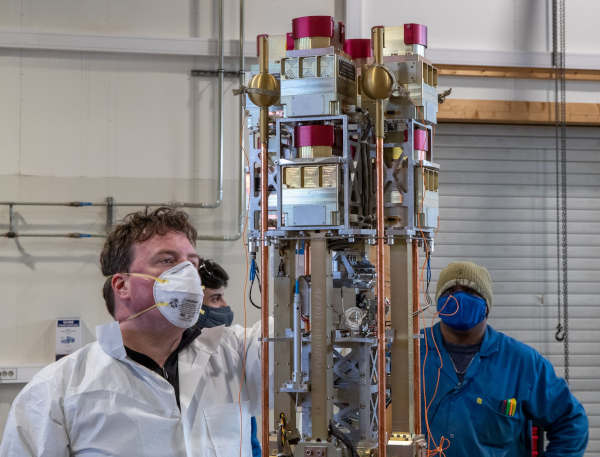
“It’s one of the most fundamental questions in all of science: Why are we here? And it’s what Endurance is after,” said Glyn Collinson, a space scientist at NASA’s Goddard Space Flight Center in Greenbelt, Maryland, and principal investigator for NASA’s Endurance mission.
The Endurance mission will attempt to measure Earth’s global electric potential, or how much Earth’s electric field “tugs” at electrically charged particles in our air.
This electric potential is expected to be very weak, making it difficult to measure – and one reason Earth can support life. Endurance’s launch window from the small town of Ny-Ålesund in Svalbard, Norway, opens on May 9.
Earth is a watery planet, one of the key reasons it can support life. Yet billions of years ago, you might have said something similar about Venus. Scientists believe Venus was once much wetter than it is today, but for reasons we still don’t fully understand, it has since dried out. Figuring out why could pinpoint a key difference from Earth – and reveal a hidden ingredient for a habitable planet.
In 2016, the European Space Agency's Venus Express mission discovered a clue. The spacecraft detected a 10-volt electric potential surrounding the planet, meaning that positively charged particles would be pulled away from its surface.
Like a planet-wide vacuum cleaner, this electric potential could siphon away ingredients of water, like the positively charged oxygen that gets split from its hydrogen atoms by intense sunlight. Over time, this electric potential may have played a role in draining Venus’ water away to space.
These findings from Venus, however, raised questions about Earth. Venus’ electric potential is created by its ionosphere – the electrically charged outer layer of its atmosphere. But Earth has an ionosphere as well. So does Earth have a similar electric potential, and if so, why is our water still around?
“We think one of the reasons Earth may be habitable is because we have this very weak electrical potential,” Collinson said. The Endurance team estimates a strength of about 0.3 volts, some 25 times weaker than on Venus and so weak it has foiled all previous attempts at measurement. “It’s not even as strong as a watch battery – but it should be there,” Collinson added.
With his team and rocket experiment, Collinson is traveling to the northernmost launch range in the world and located in Svalbard, a Norwegian archipelago in the Arctic Ocean. There his team will launch their experiment through Earth’s magnetic north pole.
“We had to invent a brand-new technology to do this on Earth, using the technique we pioneered at Venus,” Collinson said.
Once airborne, the Endurance mission will measure electrons escaping from Earth’s atmosphere – part of a gradual process of atmospheric escape that’s been happening for billions of years. These electrons escape Earth at a specific, predictable speed, but they should be slowed ever so slightly by Earth’s global electric potential. Collinson’s instruments will attempt to measure that subtle slowing effect to find out how strong it is.
If all goes as planned, it will be the first measurements of Earth’s global electric potential.
“The reward, if we're successful, is fantastic,” Collinson said. “Because we’ll measure this fundamental property of the Earth, which is directly related to understanding why we’re here.”
Endurance is a NASA-funded mission. The Svalbard Rocket Range is owned and operated by Andøya Space Center. The European Incoherent Scatter Scientific Association, or EISCAT, Svalbard radar, located in Longyearbyen, will make ground-based measurements of the ionosphere critical to interpreting the rocket data. The United Kingdom Natural Environment Research Council and the Research Council of Norway funded the EISCAT radar for the Endurance mission. EISCAT is owned and operated by research institutes and research councils of Norway, Sweden, Finland, Japan, China and the United Kingdom (the EISCAT Associates).
Miles Hatfield works for NASA’s Goddard Space Flight Center in Greenbelt, Maryland.
KELSEYVILLE, Calif. — Thanks to recent action by Congress, a project that will make it safer for children to get to school in Kelseyville will now move forward.
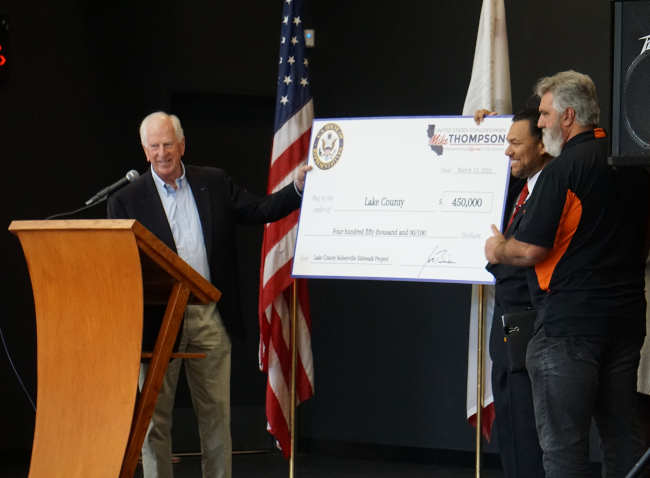
On Thursday afternoon, hundreds of Kelseyville Elementary school students gathered with their teachers and district and county leaders to welcome Congressman Mike Thompson for a ceremonial check presentation in the school’s multiuse building.
Congressman Mike Thompson (D-CA-05) secured $10.8 million in Community Project Funding for his district as part of H.R. 2471, the Funding For The People bill.
That funding for the Fifth District includes $450,000 for the Lake County Kelseyville Sidewalk Project, which is part of the Safe Routes to School Program.
The project will fill in a gap in the sidewalk where students walk along Konocti Road, a collector road that is the primary route for vehicles traveling from downtown to Kelseyville Elementary and Mt. Vista Middle School.
It will create one continuous sidewalk along the south side of Konocti Road, beginning at the Cole Creek bridge and stretching over about a third of a mile to Oak Hills Lane.
Thompson said Konocti Road currently has many sections without a sidewalk, which forces students to walk in the bike lane and closer to passing vehicles.
“Providing our students with a safe walking route to school will give parents the peace of mind they need to know their children are safely getting to school,” said Thompson.
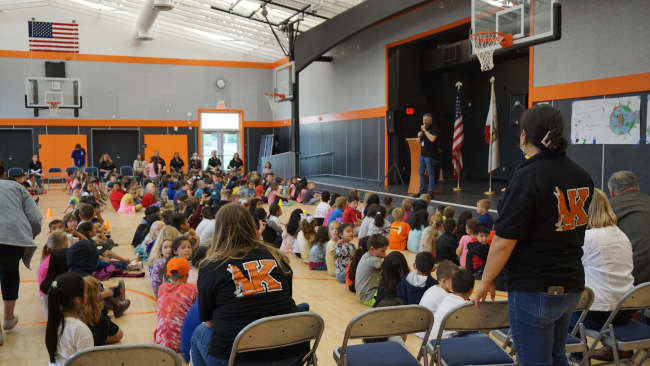
At the school assembly, as the students sat on the floor, Thompson and local leaders took to the stage to explain the project.
Thompson handed a large ceremonial check to district Superintendent Dr. Dave McQueen, Board of Supervisors Chair EJ Crandell and Susan Parker, the county’s interim administrative officer.
McQueen offered his thanks to Thompson, as did Crandell, who said the supervisors are committed to working to promote the best and brightest possible future for every Lake County resident.
Crandell said generations of Kelseyville parents will have greater confidence their kids will be safe walking and biking to and from school as a direct result of this project.
“That is the kind of community investment that makes a difference,” he said.
“Your future matters to all of us,” Parker told the students.
Thompson told the children to study hard, listen to their teachers and be careful.
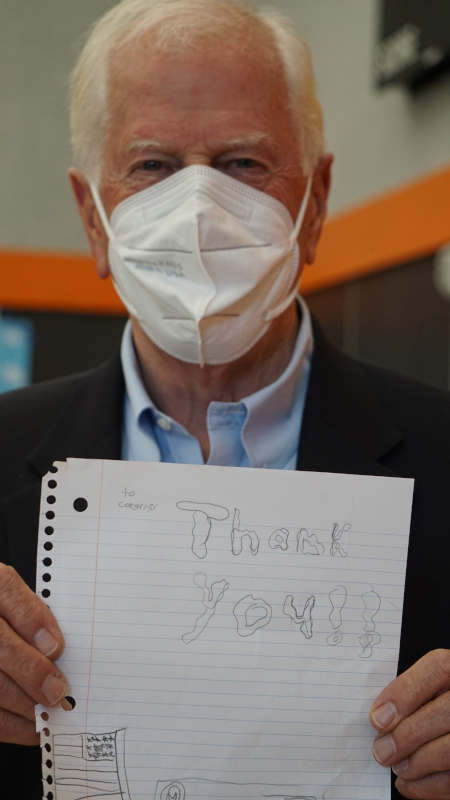
After the event, a young student walked up to Thompson, thanked him and then handed him a thank you note she had drawn herself on lined paper.
Email Elizabeth Larson at
LAKE COUNTY, Calif. — The Forest Fire Lookout Association is once again seeking volunteers to help spot fires this summer season.
Veteran lookouts and new volunteers are welcomed in the effort to keep Lake County safe.
The group has been credited for helping spot numerous fires over the last several years, in some cases spotting them early so they could be prevented from doing serious damage.
The association will hold its season opener at 1 p.m. Saturday, May 14, at Kelseyville County Park, 5270 State St.
There will be association members on hand to answer questions about the season and the lookout work they do.
Veteran lookouts and new volunteers are welcomed in the effort to keep Lake County safe.
The group has been credited for helping spot numerous fires over the last several years, in some cases spotting them early so they could be prevented from doing serious damage.
The association will hold its season opener at 1 p.m. Saturday, May 14, at Kelseyville County Park, 5270 State St.
There will be association members on hand to answer questions about the season and the lookout work they do.