 How to resolve AdBlock issue?
News
Call Lake County Animal Care and Control at 707-263-0278 or visit the shelter online at http://www.co.lake.ca.us/Government/Directory/Animal_Care_And_Control.htm for information on visiting or adopting.
The following cats at the shelter have been cleared for adoption.

Male domestic shorthair kitten
This male domestic shorthair kitten has an orange tabby coat with white markings.
He is in cat room kennel No. A1a, ID No. LCAC-A-3662.

Male domestic shorthair kitten
This male domestic shorthair kitten has a gray tabby coat with white markings.
He is in cat room kennel No. A1b, ID No. LCAC-A-3663.

‘Luna’
“Luna” is a female domestic shorthair kitten with a black and white tuxedo coat.
She is in cat room kennel No. 10, ID No. LCAC-A-3745.

‘Mom’
“Mom” is a female domestic shorthair cat with a white coat and blue eyes.
She is in cat room kennel No. 21, LCAC-A-3635.

Female gray tabby
This 2-year-old female gray tabby has a short coat with white markings.
She is in cat room kennel No. 28, ID No. LCAC-A-3661.

Domestic shorthair kitten
This female domestic shorthair kitten has an all-black coat.
She is in cat room kennel No. 84b, ID No. LCAC-A-3615.

Domestic shorthair kitten
This male domestic shorthair kitten has an all-black coat.
He is in cat room kennel No. 84c, ID No. LCAC-A-3616.

‘Fudge’
“Fudge” is a young female domestic shorthair cat with a gray tabby coat.
She is in cat room kennel No. A139, ID No. LCAC-A-3700.
Email Elizabeth Larson at

As of July 16, 2022, people have only to press three digits, 988, to reach the U.S. National Suicide Prevention Lifeline when they need help during a mental health crisis.
Mental health issues such as anxiety and depression were a leading cause of global health problems even before the spread of COVID-19; however, they’ve gotten worse. Since the first year of the COVID-19 pandemic, anxiety and depression rates worldwide have increased by an overwhelming 25%. In the U.S., 4 in 10 adults have reported symptoms of anxiety or depression during the pandemic, compared with 1 in 10 from January to June 2019.
Among the most affected are young adults and women. The surge in people struggling with mental illnesses has coincided with gaps in mental care services as well.
Research suggests that the pandemic has exacerbated the impacts of loneliness. Additionally, people’s fear of missing out, also known as FOMO, hasn’t decreased even since in-person social gatherings became less frequent. But small daily actions – such as a short walk, break from social media or even a catnap – can add up to have an impact on mental health. Separately, counseling, therapy and medication prescribed by health care providers are effective treatments for those experiencing mental illness.
The Conversation U.S. gathered four essential reads that explore some daily habits and practices that have been shown to improve mental health. These are food for thought, not guidelines or medical advice, but reading these articles could be the first steps toward a healthier lifestyle.
1. A short break goes a long way
Reducing screen time can alleviate feelings of isolation, loneliness and envy, which may arise from scrolling through social media, according to Jelena Kecmanovic, adjunct professor of psychology at Georgetown University.
“Several studies have shown that even a five-day or weeklong break from Facebook can lead to lower stress and higher life satisfaction,” she writes. “You can also cut back without going cold turkey: Using Facebook, Instagram and Snapchat just 10 minutes a day for three weeks resulted in lower loneliness and depression.”
2. Exercise is like medicine for the brain
Arash Javanbakht, associate professor of psychiatry at Wayne State University, shares the science behind the connection between exercise and mental well-being as well as his personal experience with the positive impacts of physical activity.
“Working out regularly really does change the brain biology, and it is not just ‘go walk and you will just feel better,’” he explains. “Regular exercise, especially cardio, does change the brain. Do not see it as all or none. It does not have to be a one-hour drive to and from the gym or biking trail for a one-hour workout vs. staying on the couch.
"I always say to my patients: ‘One more step is better than none, and three squats are better than no squats.’ When less motivated, or in the beginning, just be nice to yourself. Do as much as possible. Three minutes of dancing with your favorite music still counts.”
3. Think therapy is navel-gazing? Think again
People in need of therapy and counseling have long suffered from social stigma around mental illnesses, but these services are vital to protecting and improving our health.
“Decades of research show psychotherapy is effective for alleviating the most common forms of psychological suffering, such as anxiety and depression. But wellness is about more than reducing suffering,” writes Steven Sandage, professor of the psychology of religion and theology at the Boston University School of Theology. “Counseling informed by positive psychology can be effective in improving well-being and increasing such qualities as forgiveness, compassion and gratitude.”
4. Doing ‘nothing’
Though it may not always feel plausible or even comfortable, slowing down and allowing yourself a dedicated moment of rest can do wonders for mental well-being, especially when speed and efficiency seem to have become integral to our lives.
“In this 24/7, ‘always on’ age, the prospect of doing nothing might sound unrealistic and unreasonable. But it’s never been more important,” writes Simon Gottschalk, a professor of sociology at University of Nevada, Las Vegas.
“To equate ‘doing nothing’ with nonproductivity betrays a shortsighted understanding of productivity,” he explains. “In fact, psychological research suggests that doing nothing is essential for creativity and innovation, and a person’s seeming inactivity might actually cultivate new insights, inventions or melodies.”
Jacqueline Kim, Editorial intern, The Conversation and Michelle McAdams, University Relationship + Internship Manager, The Conversation
This article is republished from The Conversation under a Creative Commons license. Read the original article.
What's up for August? Grab your binoculars for planet viewing, the outlook for the Perseids, and flying with Cygnus the swan.
The morning planet parade we've been enjoying the past few months comes to an end in August, with Venus and Saturn making their exits on opposite sides of the sky. But that still leaves Mars and Jupiter high overhead to enjoy.
In fact, August begins with a close conjunction of the Red Planet and distant ice giant planet Uranus. Uranus can be difficult to find without a self-guided telescope, but it's an easy object for binoculars if you know where to look. And on the 1st, you'll find the tiny, bluish disc of Uranus just northwest of Mars in the morning sky. They'll easily fit within the same field of view through binoculars.
Moving on to the morning of the 15th, you'll find the Moon only a finger's width from Jupiter. Like Mars and Uranus, they'll make a great pairing through binoculars, and you'll also likely catch a glimpse of Jupiter's four largest moons.
The Moon then works its way eastward, to join Mars on Aug. 19. This is another nice pairing for binoculars, plus you'll find the pair super close to the Pleiades — you may even be able to fit them all into the same view.
Moving to the evening sky, Saturn is transitioning from a late night and early morning object to an all-night sight. It's rising as night falls in August. Look low in the east around 9 p.m. to find it as a steady, yellowish point of light. You'll find that the Ringed Planet rises a bit earlier each night over the course of the month.
Saturn's at opposition this month, meaning it's directly on the opposite side of Earth from the Sun. It's around this time when the Ringed Planet appears its biggest and brightest for the year.
By the end of the month, you'll start to notice Jupiter rising around 9 p.m. to join Saturn.
This means Jupiter will be pulling double duty as an early evening object, appearing in the eastern sky, and an early morning one, appearing in the west.
The Perseid meteors are an annual event many of us skywatchers look forward to, as they often produce lots of shooting stars to enjoy. Unfortunately, this year all but the brightest Perseids will be washed out by a full moon on the peak night of Aug. 12.
So, this is probably not the year to make a special trip in order to see the Perseids, but, if you find yourself outside between midnight and dawn on Aug. 13th, don't forget to look up anyway. Because you never know – you might just catch one of the bright Perseid meteors that defies the glare of the Moon. And don't forget the occasional early Perseid can streak across the sky as much as a week beforehand.
You'll find the constellation Cygnus, the swan, flying high in the eastern sky after dark in August. Cygnus has an overall shape like a T or cross, and contains a star pattern sometimes called "the Northern Cross."
Cygnus is anchored by its brightest star, Deneb, which represents the swan's tail. Deneb is the northernmost of the three stars in the Summer Triangle, and it's visible even in bright city skies. On the other end of Cygnus from Deneb is double star Albireo, which is a stargazing favorite, as it shows beautiful blue and gold colors through even the most modest telescope.
Now, Cygnus lies right along the plane of the Milky Way, so it's dense with glittering stars and dark dust clouds, with lots of interest for telescope observers and astrophotographers to enjoy, including the North America Nebula, the Veil Nebula, and the Blinking Planetary Nebula. It also includes the open star clusters M29 and M39, which are visible with binoculars.
However you're observing the sky where you live, August is a great time to discover the constellation Cygnus, the graceful swan soaring across the dusty lanes of the Milky Way.
Preston Dyches works for NASA's Jet Propulsion Laboratory in Pasadena, California.
In a statement published on its website, the Elijah House Foundation said it will no longer operate the shelter at 1111 Whalen Way in Lakeport as of Sept. 4.
The shelter has been operating in the county’s former juvenile hall facility which Elijah House has been in negotiations with the county to purchase.
“The reason why Elijah House is pulling out is due to funding,” Behavioral Health Services Director Todd Metcalf told Lake County News.
On Tuesday, the Board of Supervisors — as part of its consent agenda — approved a request from Metcalf to extend the use of the former juvenile hall facility for a temporary support shelter targeting Lake County's chronically homeless population through Sept. 30.
Metcalf’s report for the item explained that on July 20, 2020, the board approved a contract between Lake County Behavioral Health Services and Elijah House to fund continued COVID-19 homeless shelter operations at the old juvenile hall.
He said Elijah House is confident it can continue to run the shelter through Sept. 30, “however, due to funding constraints, operations may cease before then.”
He said Lake County’s Space Use Committee “has provided ongoing support for the use of the former juvenile hall facility on a temporary basis for the purpose of a homeless shelter.”
The Elijah House Foundation said in its online statement that it is talking with the Lake County Continuum of Care and other agencies that address homelessness in hopes of identifying a nonprofit willing to take over operations of the emergency shelter.
Metcalf said he’s met with a nonprofit which is potentially interested in taking over the shelter, with a follow-up meeting planned for Aug. 4.
Since the 32-bed shelter opened on July 27, 2020, Elijah House said it has served more than 400 individuals, offering meals, laundry service, showers and personal items, and providing case management to connect shelter residents with services.
Elijah House said it offered housing navigation to help clients gain permanent housing, and provided independent living training and job development with the Back2Work program.
The organization said its employees have helped more than 100 people find permanent housing, reconnected 41 people with families and helped 38 people gain employment.
All of the shelter’s 32 residents will be placed in alternate housing, which Elijah House said was managed through working with Lake County agencies and connecting clients with their families, and with the generosity of local philanthropists.
Elijah House said it will continue to offer housing navigation, case management, employment development through the Back2Work Program, general counseling and placement into sober living housing at its Lucerne location, 6110 East Highway 20, the site of the former Lake County visitor center.
Email Elizabeth Larson at

LAKE COUNTY, Calif. — Since 2015, nearly two-thirds of Lake County’s landmass has been burned by wildfire.
In response, groups throughout the county are taking urgent action to make our communities safer.
Collaboration and partnership among firefighters and other fire protection professionals, tribal, county and city governments, community-based organizations and agencies and others have prepared us to make meaningful progress.
One recent success story is Northshore Fire Protection District’s Fuels Management Crew.
Under the leadership of Chief Mike Ciancio, this group is already conducting fire suppression and fire prevention activities in areas of high priority throughout Lake County.
This work is possible, in part, thanks to a $662,000 donation from the Habematolel Tribe of Upper Lake.
The Lake County Board of Supervisors has committed to support remaining anticipated first-year costs, up to $538,000, of a total of $1.2 million.
Are you interested in joining this important team, and helping to reduce Lake County’s wildfire risk?
Applications are available at https://www.northshorefpd.com/employment and are being accepted on an ongoing basis.
Email your completed application, resume and/or certificate(s) to
You can also mail your application NFPD, PO Box 1199, Lucerne, CA 95458.
For more information, call Northshore Fire at 707-274-3100 or email


If you look at homes on real estate websites today, you’ll likely see risk ratings for flooding, hurricanes and even wildfires.
In theory, summarizing risk information like this should help homebuyers and renters make more informed housing choices. But surveys show it isn’t working that way, at least not yet. Housing developments and home sales are still expanding in flood- and wildfire-prone areas.
The problem isn’t necessarily that consumers are ignoring the numbers. In our view, as experts in hazards geography, it’s that the way risk information is being presented ignores long-established lessons from behavioral science.
These ratings tend to appear as a single number for each hazard and lack an intuitive interpretation. What does it mean to have a heat risk of 84 (“extreme”) with 52 hot days in 2050, or a flood risk of 10 (“extreme”)?
We believe that current and future hazard and climate risks can more effectively be translated as costs, savings and trade-offs.
Making risk personal
Studies show that people rely on personal experience as the dominant driver when considering risk. In the absence of having personally experienced a flood or wildfire damage, they need actionable and understandable information.
We belong to a group of more than 20 interdisciplinary researchers at universities in Arizona, Florida, Louisiana and South Carolina who are trying to improve risk rating information. We’re currently testing an online tool for the Gulf Coast that provides residents with actionable resilience information. It is an early model of what residential risk reporting could look like.
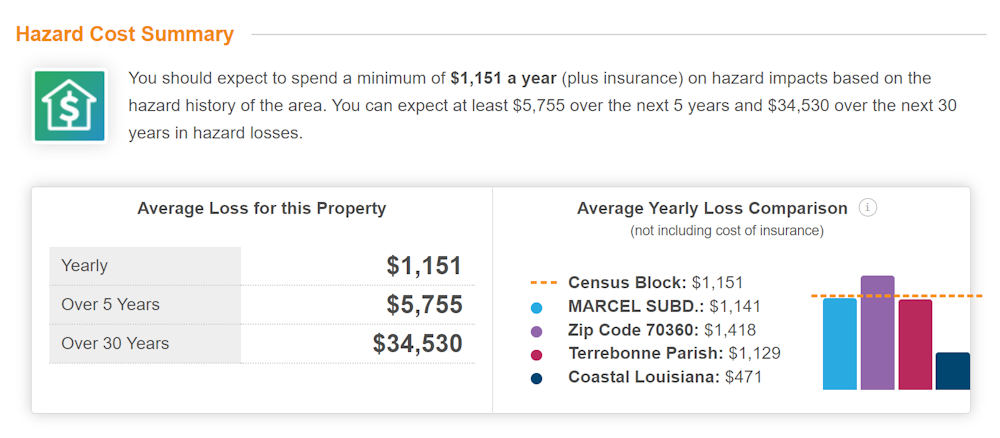
Rather than just presenting a score, the tool offers information on the costs annually and over time that one can expect from each hazard, such as flooding or wind damage, and how the home’s census block compares with the local area, county and state. To capture the effects of sea-level rise, for example, we model the number of years it will take for a home to go from outside a high flood risk area to being inside.
Homebuyers’ psychological hurdles
The development of real estate-focused climate and hazard risk metrics, such as those offered by First Street Foundation and ClimateCheck, is a step in the right direction, going beyond government risk maps that provide risk data by county. The next step is to ground those numbers in behavioral science research.
People do not ignore risk ratings per se, but the point at which information motivates people to take protective actions varies.
The motivation hurdle is lower for people with past experience, those who are aware of the risks and receptive to this kind of information, and those who have the financial resources to choose safer communities.
For others, the hurdle can be much higher. They might struggle with common decision biases, such as oversimplifying the severity of the risk, which leads to either an overestimation or underestimation of the threat depending on the type of hazard, focusing on today rather than the future, or simply assuming nothing bad is going to happen. They might just follow what others do – which research finds is what most of us do when deciding on a home.
Many people also have unrealistic beliefs that insurance and government payouts after disasters will fully compensate them for their losses, and a false sense of security that building codes and permitting mean homes are built to withstand any natural hazard.
The combination of these decision biases causes residents to underestimate the risk and impacts from disasters and climate change. Most people then underprepare and don’t consider these risks in their housing choices.
Risk ratings could help overcome those biases by expressing risk information in relatable terms such as the number of assistance requests made to the Federal Emergency Management Agency after disasters, the rejection rate and the average FEMA funds received per applicant in the area.
Next step: Pull it all together in one location
Ideally, homebuyers and renters would have a one-stop shop for all of this risk information about a property. To be prepared for climate change, risk must become a factor in housing choices similar to square footage and number of bedrooms.
Currently, risk data is scattered. For example, people can learn about insurance costs by checking flood insurance rate maps, which outline the areas with a 1% or greater annual chance of flooding. Or they can ask an insurance agent to generate a Comprehensive Loss Underwriting Exchange report, which lists all flood insurance claims made on a property in the past five to seven years. A handful of states such as California require sellers to disclose the risk of natural hazards to the property.
In our view, the continuing influx of residents into high-risk areas, along with skyrocketing disaster losses, presents an urgent need to give prospective renters and buyers better information about the risks properties face.
Melanie Gall, Clinical Professor and Co-Director, Center for Emergency Management and Homeland Security, Watts College, Arizona State University; Christopher Emrich, Associate Professor of Public Administration, University of Central Florida, and Marie Aquilino, Senior Research Analyst in Emergency Management, Arizona State University
This article is republished from The Conversation under a Creative Commons license. Read the original article.