 How to resolve AdBlock issue?
News

Wills, trusts, powers of attorney and advance health care directives all appoint persons to act in a fiduciary (legal representative) capacity.
What do such appointments mean to the person(s) named to act? What happens if such persons fail or decline to act? Can the planning appoint alternative representatives?
A will nominates someone to act as executor upon the death of the testator (will maker). Many people think that their being named as executor makes them executor. Not so. A will only nominates someone to act as executor. A person named as executor does not have to accept the nomination in the will.
A petition to a court for a court order appointing an executor and letters testamentary signed by the appointed executor are necessary for the named person to become executor.
An executor is an officer of the court with fiduciary duties, authority and powers to act as personal representative of the decedent’s estate.
With a small estate it is not necessary to appoint an executor because alternative simplified approaches mean that probate is usually not necessary.
If a person declines or fails to accept the position of executor in a probate matter then an alternative person can request appointment. Persons nominated in the will as alternatives have priority but others can also petition to be appointed as executor too, if necessary.
A trust appoints someone to act as successor trustee upon the death or incapacity of the settlor. The appointment, however, is not effective unless and until the appointee accepts their appointment.
This is usually done by the successor trustee signing an acceptance of the trustee, but can also occur by the successor trustee taking action on behalf of the trust exercising their representative authority as successor trustee.
Of course, a person named as successor trustee does not have to accept the nomination. Once a person accepts to become trustee the person as trustee has an affirmative fiduciary duty to manage the assets and affairs of the trust. That is, the person cannot simply ignore their responsibilities (not perform) after they accept appointment as trustee.
If a person declines or fails to accept the position of successor trustee then an alternative person can step in. Persons nominated in the trust have priority. A trust may also provide a mechanism for the selection and appointment of alternative successor trustees. Otherwise, a court petition to appoint a successor trustee becomes necessary.
A power of attorney nominates a person to act as an agent (“attorney in fact”) to manage the finances, property, and legal affairs of the principal (signor of the power of attorney). An agent, similarly, has no affirmative duty to act as agent. However, once the agent first starts to act they become legally responsible for their actions.
An advance health care directive appoints a person to act as agent for healthcare decisions of the principal (signor of the AHCD). An agent under an AHCD has no affirmative duty to act as agent simply because they are named in the ACHD. However, once the agent acts as agent they become legally responsible for their actions.
If none of the persons nominated to act as agent under a person’s power of attorney or advance health care directive, as relevant, accept appointment then it is often necessary for a conservator of the person’s estate and/or person to be appointed by the court.
This entails a petition for appointment of a conservator which involves an investigation of the situation and persons involved.
It may also be contested by the person who is to be conserved (due to the lack of an alternative approach) or by family members who dispute the need for a conservatorship or the appointment of the person requesting appointment as conservator.
Before accepting their appointment, anyone nominated to act in any legal representative capacity, in any of the ways discussed above, should first consider whether they are ready to assume such responsibilities.
The foregoing is not legal advice. Anyone confronting the issue of protecting and preserving the assets of a decedent’s estate should seek appropriate legal and investment counsel before proceeding.
Dennis A. Fordham, attorney, is a State Bar-Certified Specialist in estate planning, probate and trust law. His office is at 870 S. Main St., Lakeport, Calif. He can be reached at
When a daring team of engineers put a lander and the first rover on the Red Planet a quarter century ago, they changed how the world explores.
On a July evening in 1997, Jennifer Trosper drove home from work at NASA’s Jet Propulsion Laboratory holding a picture of the Martian surface to her steering wheel.
Earlier that day, the agency’s Pathfinder mission had landed on Mars encased in protective air bags and taken the image of the red, rubbly landscape that transfixed her.
“As I was on the freeway, I had that image on my steering wheel and kept looking at it,” Trosper said, reminiscing. “I probably should have been looking more closely at the road.”
Given that Trosper was the mission’s flight director, her excitement was understandable. Not only had Pathfinder landed on Mars, a feat all its own, but it had done so at a fraction of the cost and time required of previous Mars missions.
And, the next day, the team was set to change the course of Mars exploration forever: They had sent instructions to Pathfinder to extend a ramp so that history’s first Mars rover, Sojourner, could roll down onto the planet’s surface.

Named after the fiery American abolitionist and women’s rights activist Sojourner Truth, the rover weighed just 25 pounds (11 kilograms) and was no larger than a microwave oven.
But after touching down and spending 83 days traveling the surface, the tiny spacecraft proved that exploring Mars with a rover was possible.
It also led Trosper to work on a series of ever-larger, more complex rovers: Spirit and Opportunity, Curiosity, and NASA’s most advanced Mars rover to date, Perseverance, on which she served as project manager until recently.
In fact, just as Pathfinder took Sojourner along for the ride, Perseverance brought Ingenuity, the plucky little helicopter that proved powered, controlled flight in Mars’ thin atmosphere is possible. Slated for just five flights, Ingenuity has flown 29 times so far, and it has the potential to reshape Mars exploration every bit as much as Sojourner did a quarter century ago.
With every new mission and every new way of exploring Mars, humanity gains a better understanding of how the Red Planet once resembled Earth, covered by rivers and lakes and featuring the chemistry needed to support life.
NASA’s search for life on the Martian surface started in earnest in 1976, when the twin Viking landers arrived. The agency wouldn’t land another spacecraft on Mars until Pathfinder, which arose in an era when NASA had been directed to build its missions “faster, better, cheaper.”
Pathfinder’s team harnessed new approaches and technologies to deliver the mission ahead of schedule and at a lower cost than the Viking landers.

Jessica Samuels, an engineering intern in Arizona at the time of Pathfinder’s landing, remembers watching news coverage of the event with her roommate. The excitement helped lead her to pursue aerospace engineering.
“That moment — seeing this little mechanical rover exploring the surface of another planet — made me realize that’s something I would love to do,” said Samuels, now Perseverance’s mission manager. “I had always been interested in space, but that was the spark where I thought this could actually be my profession.”
To take the public along for the journey, the agency harnessed the power of another kind of relatively new technology: the Internet. A website devoted to the mission featured the latest images from Mars, and it became a sensation.
Doug Ellison, who today uploads commands to Curiosity from JPL, was about to enter college in rural England when Pathfinder touched down. After hearing about Pathfinder’s website, he bicycled into town to an IT business that let people pay by the hour for Internet access.
With the business’ employees huddled behind him, Ellison saved Pathfinder’s Martian landscapes onto a 3 1/2-inch floppy disk (this was an era long before cloud computing) and printed them out on a black-and-white dot matrix printer to create a vista of the Red Planet he could look at from home.
He taped the printouts up to form a circle. Then, he stuck his head in it.
“It was pretty much the worst VR experience ever,” Ellison said.
Even so, the Internet provided an inspiring new way to experience space exploration.
“Putting so much online so quickly was a paradigm shift. That’s the motivation today to share as much as we can as quickly as we can from our rover missions,” said Ellison. “I think the Mars program owes Pathfinder a debt of gratitude for being the entire steppingstone for everything since.”

Tech demos lead the way
Sojourner began as a technology demonstration, NASA’s way of testing and proving what is possible. Ingenuity began the same way — though now it’s an operations demonstration scouting locations on Mars not just for Perseverance, but for a possible landing spot for a future Mars Sample Return campaign.
The campaign would bring samples collected by Perseverance to Earth to be studied by powerful lab equipment searching for signs of ancient microscopic life. But the campaign would include other milestones, like the first instance of a rocket launching off the surface of another planet (a crucial part of getting samples from Mars to Earth). That feat would also support future efforts to land humans on Mars and bring them back home.
Back in 1997, Trosper and team had their hands full just learning to drive a rover on Mars for the first time. “We were a little bit cowboyish. We just didn’t know what we didn’t know,” she said.
What they did know was this: Their mission has lived up to its name, finding a path forward to what had seemed almost impossible before.

The helitankers arrived on July 1, 2022.
Cal Fire has positioned two contracted type-1 helitankers used as exclusive use for aerial firefighting operations in the LNU.
Helitanker 1CH from Columbia Helicopters will be based out of Napa County Airport, and Helitanker 37S from Siller Brothers will be based out of Sonoma Air Attack base at the Sonoma County Airport.
In addition to the unit's own Type-1 Cal Fire HAWK "Copter 104" based in Lake County, the region will now have three large helicopters not only arriving quicker to any new fire but can send local aircraft to multiple fires occurring at the same time.
These aircraft will be available for fire assignments in the greater Bay Area and all of California.
As rapid fires spread and concurrent wildfires will continue to be the norm, and areas throughout the state previously thought to be immune to large and damaging fires are proving to be as vulnerable as areas with active fire histories.
Cal Fire said the entire state is at greater risk of major fires than at any other time in recorded history.
That includes the redwood coastal belts and the more temperate areas of Northern California, as evidenced by the 2020 San Mateo and Santa Cruz Unit Lightning Complex, which burned over 86,000 acres and destroyed 1,490 structures along the coast range of Santa Cruz and San Mateo counties.
Additional surge equipment will be required to enhance Cal Fire’s ability to meet the increasing operational deficiencies created by a changing climate, meet demands caused by a year-round fire regime, and provide a deeper pool of available equipment.
In addition to Cal Fire staffed helicopters, the department relies on exclusive use contracted or “call when needed” helicopters to increase its aviation response. Contracts which are based on a call when needed premise do not guarantee the availability of a helicopter when the department calls, and these arrangements are usually implemented when a large fire is ongoing and not for initial attack response.
Cal Fire has experienced the reliability and dependability of exclusive use contracts in that they provide greater efficiencies in getting helicopters to the initial attack stage of fires.
Helitanker 1CH, a Boeing CH-47D Chinook, is owned and operated by Columbia Helicopters of
Aurora, Oregon.
Helitanker 1CH arrived at the Napa County Airport and has been on contract since June 16. This helitanker holds up to 2,800 gallons of water on a fixed tank, which is permanently attached to the aircraft. The fixed tank system also provides a safer operation since they do not have a bucket hanging underneath the helicopter while in flight.
Helitanker 37S, a Sikorsky S-64E Skycrane, is owned and operated by Siller Brothers out of Yuba City. Helitanker 37S arrived and has been on contract since July 1. This helitanker holds up to 2,000 gallons of water on a fixed tank.
“The S-64E helicopter features three experienced pilots — a command pilot, copilot and aft seat pilot, whose job is to guarantee precision on every job,” Siller Brothers reported.
These respective 2,800 and 2,000 gallon water droppers will enhance Cal Fire’s operations, ensuring that these mission critical resources are always available to respond to emergency fire events and operate safely in the field.
There will be additional firefighting resources that will help to address complex initial attack and large fire support operations. Cal Fire said this will not only increase its initial attack strength dramatically but will also reduce the time in getting these valuable resources to large fires as well.
The state also has on exclusive use contract this year three large air tankers with 3,000 and 4,000 gallon capacity as well as those normally available from Cal Fire’s partnership with the United States Forest Service.
These will be used in supporting roles behind the Cal Fire copters including the Cal Fire HAWK out of Boggs Mountain and the Cal Fire air tankers out of Sonoma, Ukiah, Sacramento and Chico, Cal Fire’s closest bases.
“Cal Fire LNU welcomes both Helitanker 1CH and 37S to the Unit and we look forward to working with both helitankers this year,” the agency said.
To learn more about Cal Fire’s Aviation Fleet visit https://www.fire.ca.gov/programs/fire-protection/aviation-program/.
The City of Clearlake Animal Association also is seeking fosters for the animals waiting to be adopted.
Call the Clearlake Animal Control shelter at 707-273-9440, or email
Visit Clearlake Animal Control on Facebook or on the city’s website.
The following dogs are available for adoption. The newest additions are at the top.

‘Luna’
“Luna” is an 8-month-old Labrador retriever-terrier mix with a black and white coat.
She is dog No. 50339254.

‘Mamba’
“Mamba” is a male Siberian husky mix with a gray and cream-colored coat.
He has been neutered.
He is dog No. 49520569.

‘Andy’
“Andy” is a male American pit bull mix with a short gray and white coat.
He is dog No. 48995415.

‘Bear’
“Bear” is a male Labrador retriever-American pit bull mix with a short charcoal and fawn coat.
He has been neutered.
He is dog No. 48443153.

‘Betsy’
“Betsy” is a female American pit bull mix with a short white coat.
She has been spayed.
She is dog No. 50236145.

‘Bluey’
“Bluey” is a male retriever mix with a short black coat.
He has been neutered.
He is dog No. 50552999.

‘Big Phil’
“Big Phil” is a 13-year-old male American pit bull terrier mix with a blue coat.
He has been neutered.
He is dog No. 49951647.

‘Bro’
“Bro” is a male terrier mix with a short tan coat.
He has been neutered.
Bro is dog No. 50262527.

‘Colt’
“Colt” is a male Rhodesian Ridgeback mix with a short rust and black coat.
He has been neutered.
He is dog No. 49812106.

‘Hakuna’
“Hakuna” is a male shepherd mix with a tan coat.
He has been neutered.
He is dog No. 50176912.

‘Hondo’
“Hondo” is a male Alaskan husky mix with a buff coat.
He has been neutered.
He’s dog No. 50227693.

‘Kubota’
“Kubota” is a male German shepherd mix with a short tan and black coat.
He has been neutered.
Kubota is dog No. 50184421.

‘Matata’
“Matata” is male shepherd mix with a tan coat.
He has been neutered.
He is dog No. 50176912.

‘Newman’
“Newman” is a 1-year-old male American pit bull terrier mix with a black and white coat.
He has been neutered.
Newman is dog No. 49057809.

‘Sadie’
“Sadie” is a female German shepherd mix with a black and tan coat.
She has been spayed.
She is dog No. 49802563.

‘Terry’
“Terry” is a handsome male shepherd mix with a short brindle coat.
He gets along with other dogs, including small ones, and enjoys toys. He also likes water, playing fetch and keep away.
Staff said he is now getting some training to help him build confidence.
He is dog No. 48443693.

‘Tiramisu’
“Tiramisu” is a female Alaskan husky mix with a short brown and cream coat.
She is dog No. 49652833.

‘Ziggy’
“Ziggy” is a male American pit bull terrier mix with a short gray and white coat.
He has been neutered.
Ziggy is dog No. 50146247
Email Elizabeth Larson at

On July 21, 2022, the International Union for the Conservation of Nature placed the migratory monarch butterfly on its Red List of threatened species and classified it as endangered. Monarchs migrate across North America each year and are one of the continent’s most widely recognized species. The Conversation asked Oklahoma State University biologist Kristen Baum, who has studied pollinators for more than 25 years, to explain the listing’s implications for the monarch butterfly in the U.S.
What is the IUCN, and what does its action mean?
The IUCN is a network of public, private and nonprofit organizations that work to conserve nature worldwide. The Red List, which was developed in 1964, provides a standardized approach for assessing the extinction risks of species. Listing the monarch butterfly draws attention to its status and to areas where more research is needed to understand factors contributing to its decline.
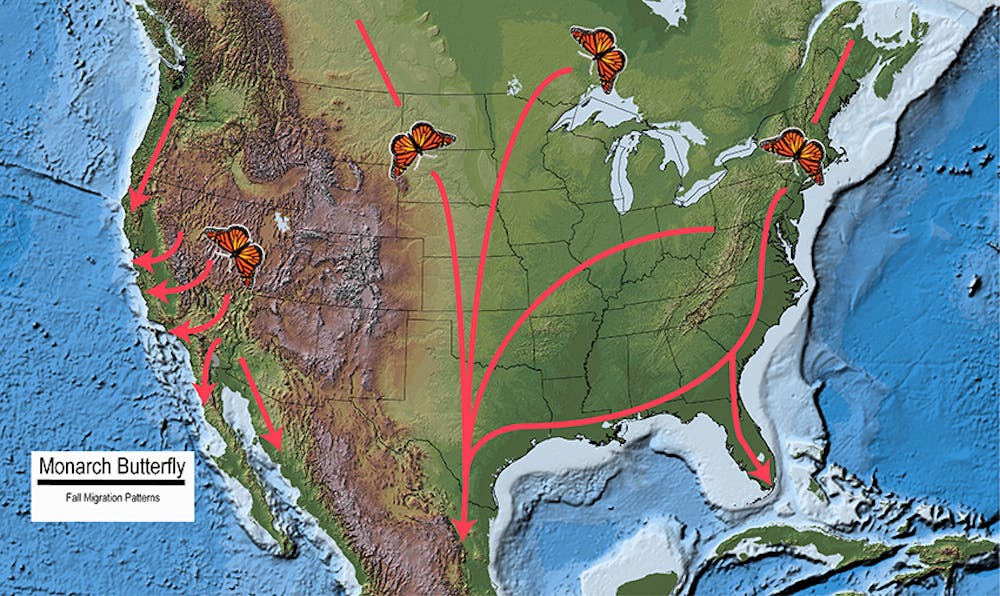
The IUCN listing applies to the migratory subspecies of the monarch butterfly, or Danaus plexippus plexippus. There are two migratory populations: one east and one west of the Rocky Mountains.
The eastern population migrates thousands of miles from overwintering sites in central Mexico to breeding grounds in the Upper Midwest and southern Canada. The western population migrates from overwintering sites along the Pacific Coast in California and Baja California in Mexico to breeding grounds west of the Rocky Mountains. Monarchs in other locations throughout the world, such as in Europe and many Pacific Islands, don’t migrate and are not part of the listing.
What are the main factors threatening monarchs?
There are many factors contributing to monarchs’ decline. One of the most serious threats is habitat fragmentation and loss. Habitat fragmentation occurs when urban development or agricultural expansion break up large areas of habitat into smaller, often isolated patches. This leaves fewer areas for monarchs to find the nectar-rich plants that adult butterflies feed on, or milkweed, the sole food source for monarch caterpillars.
Other threats include pesticides, disease, climate change and invasive species. Providing more suitable habitat for monarchs in more places could help them tolerate these stresses.
Monarchs are particularly susceptible to threats during the parts of their annual cycle when many millions of them cluster together. For example, a winter storm in March 2016 killed 31%-40% of the monarchs in some overwintering colonies in central Mexico. Winter storms also blow down trees, which can reduce habitat for overwintering colonies in subsequent years.
Temperature and precipitation can influence monarchs’ spring and fall migrations and breeding season success. For example, spring weather is an important factor influencing the size of the summer monarch population. Slightly warmer and drier springs produce more monarchs on the summer breeding grounds.
Are monarch butterflies protected in the US?
Not yet, although the U.S. Fish and Wildlife Service recognizes that they are at risk.
The agency received a petition in 2014 to list the monarch butterfly as threatened under the Endangered Species Act. It concluded in 2020 that listing the monarch was warranted but precluded. This means that while monarchs are at risk of extinction, they are less at risk than other species that are currently higher priorities, such as the rusty patched bumblebee.
That decision put monarchs on the candidate list, where the agency reviews their status every year. Only a subset of species on the IUCN Red List is also protected under the Endangered Species Act. For insects, that number is less than 20%.
The IUCN report estimates that the eastern monarch population has declined by 22%-72% over the past decade, and the western population has declined by 66%-91%. Evaluating trends for insect populations can be challenging because they tend to fluctuate from year to year.
Another challenge for measuring the populations of migratory species is that patterns can differ depending on when in the annual cycle they are evaluated, such as breeding versus overwintering. To estimate how many eastern monarchs overwinter in central Mexico, scientists measure how many hectares of trees are covered with monarchs and convert that number into an estimated number of butterflies.
Many factors influence how densely monarchs cluster together in trees on their overwintering grounds. Estimates based on data from the summer breeding grounds are also challenging because monarchs go through multiple generations per year and breed across a large area.
Would an ‘endangered’ listing in the US help monarchs?
Migratory monarchs have a huge range that extends from southern Canada to central Mexico and includes all of the contiguous U.S. They use many types of open habitats, from prairies to urban parks. This makes it challenging to implement and enforce regulatory actions.
The IUCN report points out that the decline of the eastern migratory population seems to have slowed, or even stabilized, over the past 10 years. The 2014 petition to list monarchs under the U.S. Endangered Species Act spurred many actions to support monarchs that likely contributed to slowing their decline, from planting milkweeds and nectar plants in home gardens to large-scale restoration projects.
Supporting these efforts could provide more benefits than a listing under the Endangered Species Act. When a species is listed, the federal government produces a recovery plan that often includes restrictions on actions that threaten the species, such as hunting or land development. Studies have found that private land owners often become less willing to participate in conservation activities, such as allowing researchers to monitor the species on their property, after a species is listed.
It’s hard to say whether listing monarchs would have this effect. People love monarch butterflies, and community science projects that involve activities like monitoring eggs and caterpillars and tagging monarchs are very popular. Data collected by citizen scientists has expanded what researchers know about monarchs. Many of these efforts have taken place over large areas and long time spans that would be hard for scientists to replicate.
I see community scientists as critical for informing monarch conservation efforts, and hope the IUCN’s action will inspire more people to get involved.
Kristen A. Baum, Professor of Integrative Biology and Associate Dean for Research, Oklahoma State University
This article is republished from The Conversation under a Creative Commons license. Read the original article.
Social media use was most likely to be linked to conduct disorder, while other forms of screen use — such as watching videos and television, playing video games, and texting — were more likely to be associated with oppositional defiant disorder (ODD).
Conduct disorder is characterized by violating others’ basic rights or societal rules with actions such as bullying, vandalism and stealing, while ODD is marked by a pattern of angry or irritable mood, argumentative or defiant behavior, and vindictiveness.
Researchers collected data on screen use, then evaluated for behavior disorders one year later. Each hour of social media was linked with a 62% higher prevalence of conduct disorder, while television, video games, video chat, and texting were linked with a 14% to 21% higher prevalence of ODD.
“Social media platforms can encourage bullying and aggression, which may contribute to the development of conduct disorder in children,” said Jason Nagata, MD, lead study author and assistant professor of pediatrics at UCSF.
“Children can be exposed to violent content on social media through ads even if they are not searching for it,” said Nagata. “If kids do search for violence, algorithms will feed back even more disturbing content and children can get stuck in cycles of toxicity.”
Watching movies and playing video games, on the other hand, may displace sleep and physical activity as well as reduce social support, he said, which could explain the tie to ODD.
In another recent study, Nagata and colleagues found that adolescents are so attached to their phones — the main vehicle for screen time — that they report losing track of time when using their phone (47.5%) and will interrupt whatever they are doing when contacted by phone (31%).
A threshold at four hours a day
Prior cross-sectional studies have suggested an association between screen time and behavior disorders but didn’t differentiate between types of screen use or only examined one type, such as video games.
The current prospective study examined links between several types of screen time and behavior in a demographically diverse national sample of 11,875 children ages 9 to 11 years old.
Children self-reported hours per day spent on six different screen modalities: viewing/streaming TV shows or movies; watching/streaming videos, such as on YouTube; playing video games; texting; video chatting; and using social media such as Instagram, separately for weekdays and weekend days.
Exceeding four hours of daily screen time may lead to disruptive behaviors through exposure to harmful content or the development of screen addictions.
The average amount of screen time was four hours per day, with the most time spent watching/streaming TV shows/movies (1.3 hours on average), playing video games (1.1 hours), and watching/streaming videos (1 hour).
In fact, four hours a day was a threshold, with time above four hours associated with a 69% higher prevalence of conduct disorder and a 46% higher prevalence of ODD.
“Some guidelines recommend limiting recreational screen time to two hours per day, but this may not be realistic for many teens,” said Nagata. “Exceeding four hours of daily screen time may lead to disruptive behaviors through exposure to harmful content or the development of screen addictions.”
To assess for behavior disorders, researchers asked parents and caregivers to complete the Kiddie Schedule for Affective Disorders and Schizophrenia, or KSADS-5, a computerized tool for categorizing child and adolescent mental health concerns, a year after their children had reported screen use.
They found 1.9% of the children met criteria for new-onset conduct disorder (1.1% of girls and 2.8% of boys) and 6.3% met criteria for new-onset oppositional defiant disorder (4.7% of girls and 7.9% of boys).
Future research could examine sleep and ADHD as potential mediators between screen use and disruptive behavior disorders, the authors wrote. “Given that the strongest association was between social media and conduct disorder, social media may be the platform to target for preventive interventions,” said Dr. Nagata.
Co-authors: Andrea Garber, Ph.D., RD in the UCSF Department of Pediatrics; Kirsten Bibbins-Domingo, MD, Ph.D. in the UCSF Department of Epidemiology and Biostatistics; and UCSF medical students Jonathan Chu and Puja Iyer contributed to this research. Please refer to the paper for additional co-authors.
Jess Berthold writes for UC San Francisco.