 How to resolve AdBlock issue?
News
The incident was first reported at about 11:40 p.m. on Highway 53 between Jessie Street and Dam Road, according to radio reports.
The first units on the scene reported a man down in the highway’s northbound section.
Initial reports said it appeared to be a pedestrian who had been hit by a vehicle.
Just after 11:50 p.m., it was confirmed over the air that the injured man had died.
At 11:55 p.m., at the request of one of the officers on the scene, the Clearlake Police Department issued a Nixle asking people to avoid that area of the highway due to a traffic collision, with the northbound lane temporarily blocked.
Firefighters released the scene to the California Highway Patrol just after 12:20 a.m. Saturday.
A short time later, there was a request for two personnel to assist with traffic control for less than an hour.
Additional information will be published when it becomes available.
Email Elizabeth Larson at

CLEARLAKE, Calif. — Clearlake Animal Control has a full house of great dogs waiting for their new homes.
There are 28 dogs available this week for adoption.
They include “Aoki,” a 2-year-old male Siberian husky mix with bright blue eyes, and “Data,” a 1-year-old male Labrador retriever mix.

The shelter is located at 6820 Old Highway 53. It’s open from 9 a.m. to 6 p.m. Tuesday through Saturday.
For more information, call the shelter at 707-762-6227, email
This week’s adoptable dogs are featured below.
Email Elizabeth Larson at

Mid-April has arrived. And along with the spring sunshine, that means the often dreaded civic duty of finishing off one’s taxes.
It’s an arduous time for many, characterized by navigating increasingly confusing rules to arrive at the best refund possible. For some, it means writing a check to the federal government. Not fun.
On a brighter note, the tax deadline has been pushed back to April 18 this year, giving those leaving it to the last minute a few extra days. Usually, the day falls on April 15.
But why is Tax Day in April anyway? Well, it hasn’t always been.
The federal individual income tax was permanently enacted by the 16th Amendment in 1913. Before that, the only federal individual income tax that existed was in place for about a decade beginning in 1861 to ease the financial burden of the Civil War on the government.
Extending the deadline
The tradition of filing tax returns in early spring has historically been a practical one. Since individual tax returns encompass a calendar year, Congress sought to allow time for individuals to fully account for all of their income, deductions and credits.
The original due date for individual income tax returns was March 1, just over a year following the adoption of the 16th Amendment on Feb. 3, 1913.
Back then, not many taxpayers needed to file a tax return, since the filing requirement applied only to single filers with income over US$3,000 and married filers with income over $4,000 – about $90,000 and $120,000 in today’s dollars, respectively.
In 1914, this threshold represented approximately the top 4% of earners, so filing a tax return was a burden reserved for the wealthy.
Quickly realizing that many taxpayers needed more time to complete their returns, Congress pushed the tax deadline back to March 15, effective in 1919.
And on that date Tax Day stood for over 30 years.
But with more taxpayers needing to file returns as the filing threshold declined and the tax laws grew in complexity, Americans needed even more time to correctly complete their returns.
So in 1954, Congress overhauled the tax system and adopted a major revision to the Internal Revenue Code.
This change also came with another extension of the tax deadline for individuals, pushing the due date back again to the familiar April 15.
The intent of giving taxpayers an extra month to prepare their returns was to allow more people the ability to file on time – and often get refunds more quickly. Not only did this change assist taxpayers, but it also allowed the Internal Revenue Service more time to spread out its workload.
The April 15 deadline proved to be a more reasonable deadline, and it has stuck with U.S. taxpayers for almost 70 years.
Since 1955, the IRS has established earlier due dates for many information returns that provide numbers feeding into Form 1040, such as Forms 1099 and W-2, both of which are due Jan. 31, to ensure that most taxpayers are able to file by Tax Day.
In 2016, the IRS pushed the due date of other returns forward a month to March 15, again in an effort to allow more individuals to timely file.
So why later this year?
The mid-April date seems to work for the majority of taxpayers – in most years, anyhow. According to the IRS, about 90% of taxpayers were able to file their returns by the deadline in 2021, with the other 10% requesting a six-month extension to file.
But for the tax year 2022, about 19 million taxpayers extended their returns, a significant increase from prior years due to the increased complexity of the tax code brought on by temporary provisions relating to the COVID-19 pandemic.
So why is Tax Day this year April 18 instead of April 15?
Any time a deadline falls on a Saturday or Sunday, the IRS pushes the due date to the following Monday, which would be April 17, 2023. However, any federal holiday also pushes the date back by a day. Since Emancipation Day, which usually falls on April 16, is observed in Washington, D.C., on April 17 this year, Tax Day was pushed back an additional day to Tuesday, April 18, 2023.
While having a tax deadline of April 18 happens only about every six years, the IRS occasionally pushes back the filing deadline for emergency situations like natural disasters, although these are often local. For example, the IRS extended the original due date of individual tax returns in disaster areas in Alabama, California and Georgia until Oct. 16, 2023. Similarly, the IRS pushed the national deadline back to July 15, 2020, in the early stages of the COVID-19 pandemic.
So use your extra days of tax preparation time wisely in 2023 and be sure to file your individual income tax return, or request an extension to file by April 18.
Although this time of year can often be stressful and confusing because of complicated tax laws, it will be over soon enough.
Thomas Godwin, Assistant Professor of Accounting, Purdue University
This article is republished from The Conversation under a Creative Commons license. Read the original article.

Special considerations arise when making gifts to charities. Let us discuss.
First, what is the proper legal name and address of the charity?
For example, naming the “Mendocino Humane Society” as a beneficiary would cause problems. There are at least three different “not for profit” organizations in Mendocino which each use the words “Mendocino” and “Humane Society” as part of their name.
If the bequest is large enough, this can result in litigation amongst the charities over who receives the bequest.
Fortunately, this problem is easily avoided by contacting the charity to obtain their legal name and legal street address.
Second, is the bequest intended to be used in a specific geographic location (e.g., Northern California)?
For example, a gift to Shriner’s Children (formerly known as, “Shriners Hospital for Children”) is a gift to an international organization and is not limited to use in any one specific area. A gift intended for use in the Northern California hospital would need to be made to, “Shriner’s Children Northern California.”
Ask the intended charity for the exact wording needed to designate a specific member of a national organization as the sole beneficiary.
Moreover, it may be prudent also to say that the funds may not be shared with the nationwide organization.
In BREATHE SO. CAL. V. AM. LUNG ASS’N (Case cite: A160785), California First District Court of Appeal, examined the plain language of three separate bequests and decided that the donors had intended to restrict the gift to use by a particular affiliate of the American Lung Association.
The appellate court honored the donors’ intentions even though specific language excluding sharing with the national organization was not used.
Third, is the bequest intended to be used for a specific purpose?
An outright gift to a charity is typically absorbed into the charity’s general fund where it may be used, amongst other things, to pay for the charity’s administrative expenses, i.e., overhead.
If the gift is intended, for example, to be used only for research into cures for cancer then a specifically worded endowment fund is needed. The wording will include both the name of the endowment and the limitation, “for research into cancer cures.”
Fourth, when an ongoing endowment is involved, i.e., it lasts beyond one year, consideration should be given to how much of the endowment’s income and principal may be spent each year.
If the endowment’s wording is silent on how much income and principal may be used each year, then expenditures are governed by California’s Uniform Prudent Management of Institutional Funds Act (UPMI) (codified as Section 18501 to 18510 of the Probate Code).
Under section 18504(a), “… an institution may appropriate for expenditure or accumulate so much of an endowment fund as the institution determines is prudent for the uses, benefits, purposes, and duration for which the endowment fund is established.”
Fifth, when a charitable gift is intended to qualify for an estate tax or an income tax deduction, consideration needs to be given to eligibility to receive the tax deduction based on both the purpose of the gift and the tax status of the organization.
That is, the tax deduction depends on both the use of the gift and the tax-exempt status of the beneficiary.
The gift should say it is qualified on the condition that the beneficiary is still a qualified tax exempt organization eligible to receive a tax-deductible gift, either for estate tax or income tax (as is relevant), at the time the gift is made.
The foregoing is a brief discussion of some issues that may need to be considered when making a significant charitable gift. For legal guidance consult a qualified attorney.
Dennis A. Fordham, attorney, is a State Bar-Certified Specialist in estate planning, probate and trust law. His office is at 870 S. Main St., Lakeport, Calif. He can be reached at
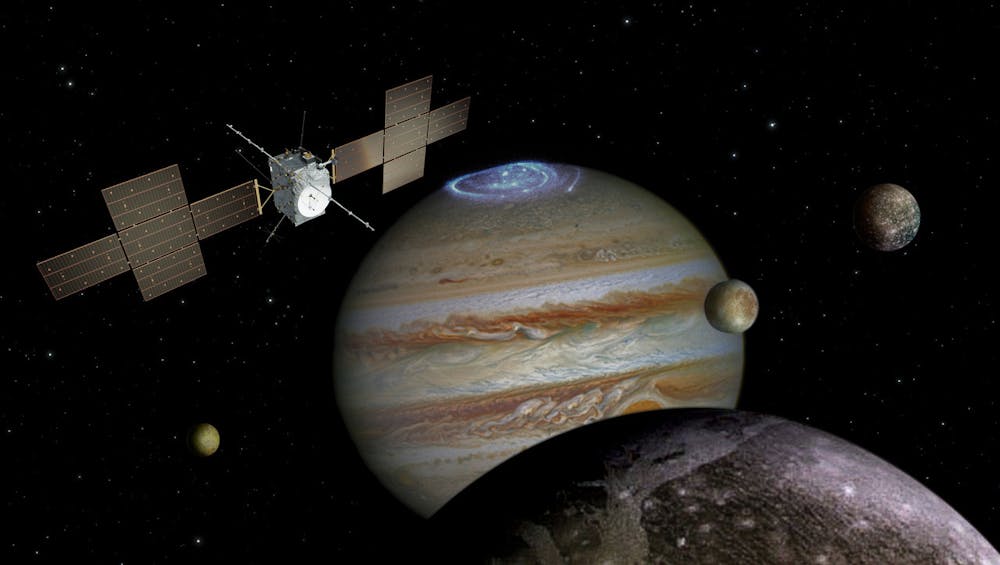
On April 13, 2023, the European Space Agency is scheduled to launch a rocket carrying a spacecraft destined for Jupiter. The Jupiter Icy Moons Explorer – or JUICE – will spend at least three years on Jupiter’s moons after it arrives in 2031. In October 2024, NASA is also planning to launch a robotic spacecraft named Europa Clipper to the Jovian moons, highlighting an increased interest in these distant, but fascinating, places in the solar system.
I’m a planetary scientist who studies the structure and evolution of solid planets and moons in the solar system.
There are many reasons my colleagues and I are looking forward to getting the data that JUICE and Europa Clipper will hopefully be sending back to Earth in the 2030s. But perhaps the most exciting information will have to do with water. Three of Jupiter’s moons – Europa, Ganymede and Callisto – are home to large, underground oceans of liquid water that could support life.

Meet Io, Europa, Ganymede and Callisto
Jupiter has dozens of moons. Four of them in particular are of interest to planetary scientists.
Io, Europa, Ganymede and Callisto are, like Earth’s Moon, relatively large, spherical complex worlds. Two previous NASA missions have sent spacecraft to orbit the Jupiter system and collected data on these moons. The Galileo mission orbited Jupiter from 1995 to 2003 and led to geological discoveries on all four large moons. The Juno mission is still orbiting Jupiter today and has provided scientists with an unprecedented view into Jupiter’s composition, structure and space environment.
These missions and other observations revealed that Io, the closest of the four to its host planet, is abuzz with geological activity, including lava lakes, volcanic eruptions and tectonically formed mountains. But it is not home to large amounts of water.
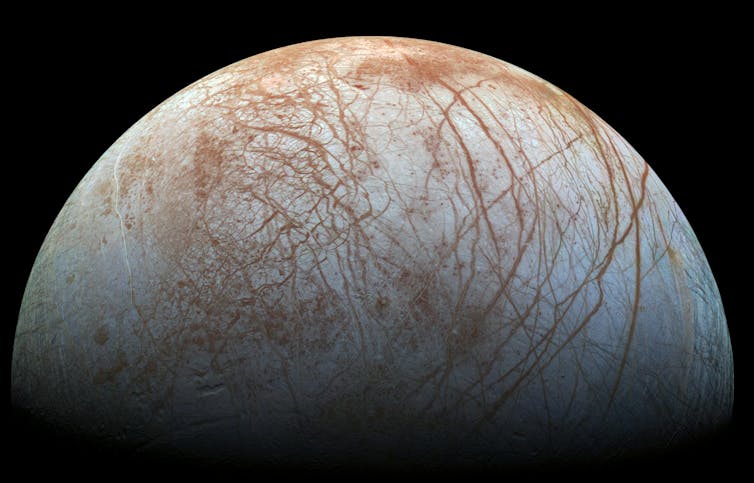
Europa, Ganymede and Callisto, in contrast, have icy landscapes. Europa’s surface is a frozen wonderland with a young but complex history, possibly including icy analogs of plate tectonics and volcanoes. Ganymede, the largest moon in the entire solar system, is bigger than Mercury and has its own magnetic field generated internally from a liquid metal core. Callisto appears somewhat inert compared to the others, but serves as a valuable time capsule of an ancient past that is no longer accessible on the youthful surfaces of Europa and Io.
Most exciting of all: Europa, Ganymede and Callisto all almost certainly possess underground oceans of liquid water.
Ocean worlds
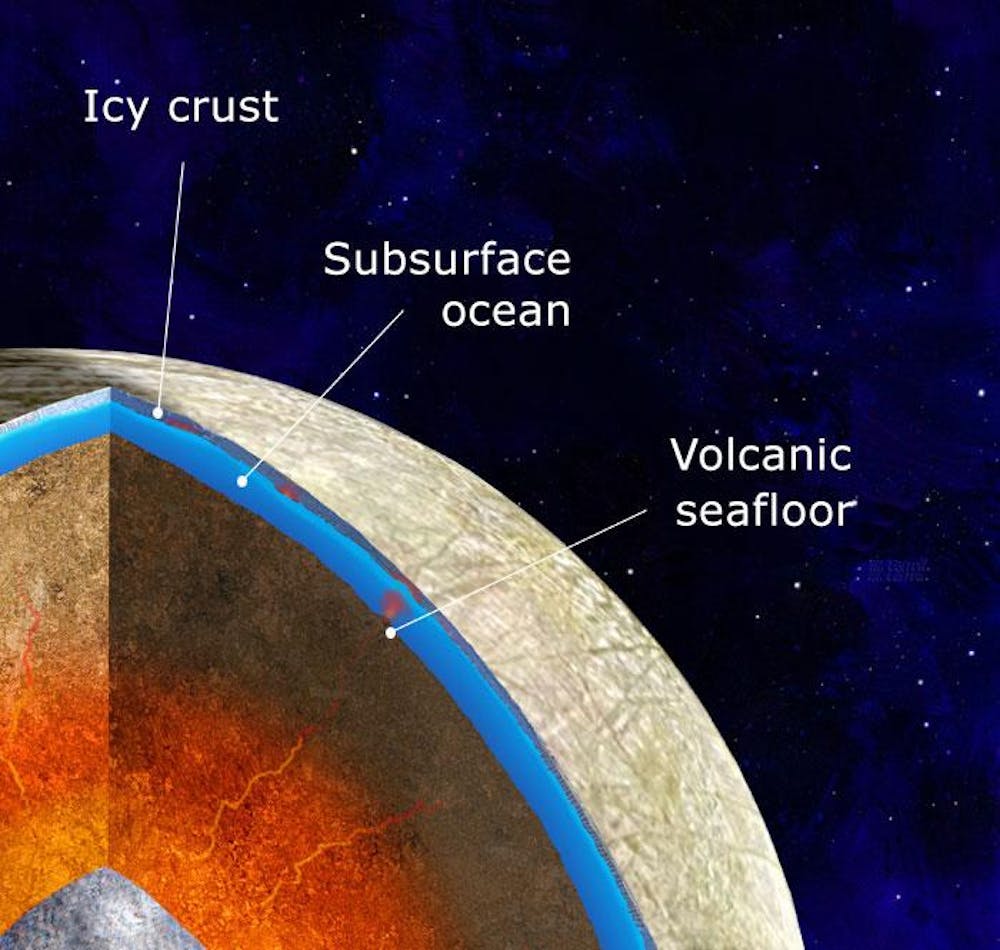
Europa, Ganymede and Callisto have chilly surfaces that are hundreds of degrees below zero. At these temperatures, ice behaves like solid rock.
But just like Earth, the deeper underground you go on these moons, the hotter it gets. Go down far enough and you eventually reach the temperature where ice melts into water. Exactly how far down this transition occurs on each of the moons is a subject of debate that scientists hope to resolve with JUICE and Europa Clipper. While the exact depths are still uncertain, scientists are confident that these oceans exist.
The best evidence of these oceans comes from Jupiter’s magnetic field. Saltwater is electrically conductive. So as these moons travel through Jupiter’s magnetic field, they generate a secondary, smaller magnetic field that signals to researchers the presence of an underground ocean. Using this technique, planetary scientists have been able to show that the three moons contain underground oceans. And these oceans are not small – Europa’s ocean alone might have more than double the water of all of Earth’s oceans combined.
An obvious and tantalizing next question is whether these oceans can support extraterrestrial life. Liquid water is an important piece of what makes for a habitable world, but far from the only requirement for life. Life also needs energy and certain chemical compounds in addition to water to flourish. Because these oceans are hidden beneath miles of solid ice, sunlight and photosynthesis are out. But it’s possible other sources could provide the needed ingredients.
On Europa, for example, the liquid water ocean overlays a rocky interior. That rocky seafloor could provide energy and chemicals through underwater volcanoes that could make Europa’s ocean habitable. But it is also possible that Europa’s ocean is a sterile, inhospitable place – scientists need more data to answer these questions.
Upcoming missions from ESA and NASA
JUICE and Europa Clipper are set up to give scientists game-changing information about the potential habitability of Jupiter’s moons. While both missions will gather data on multiple moons, JUICE will spend time orbiting and focusing on Ganymede, and Europa Clipper will make dozens of close flybys of Europa.
Both of the spacecraft will carry a suite of scientific instruments built specifically to investigate the oceans. Onboard radar will allow JUICE and Europa Clipper to probe into the moons’ outer layers of solid ice. Radar could reveal any small pockets of liquid water in the ice, or, in the case of Europa, which has a thinner outer ice layer than Ganymede and Callisto, hopefully detect the larger ocean.
Magnetometers will also be on both missions. These tools will give scientists the opportunity to study the secondary magnetic fields produced by the interaction of conductive oceans with Jupiter’s field in great detail and will hopefully give researchers clues to salinity and volumes of the oceans.
Scientists will also observe small variations in the moons’ gravitational pulls by tracking subtle movements in both spacecrafts’ orbits, which could help determine if Europa’s seafloor has volcanoes that provide the needed energy and chemistry for the ocean to support life.
Finally, both craft will carry a host of cameras and light sensors that will provide unprecedented images of the geology and composition of the moons’ icy surfaces.
Maybe one day, a spacecraft will be able to drill through the miles of solid ice on Europa, Ganymede or Callisto and explore oceans directly. Until then, observations from spacecraft like JUICE and Europa Clipper are scientists’ best bet for learning about these ocean worlds.
When Galileo discovered these moons in 1609, they were the first objects known to directly orbit another planet. Their discovery was the final nail in the coffin of the theory that Earth – and humanity – resides at the center of the universe. Maybe these worlds have another humbling surprise in store.
Mike Sori, Assistant Professor of Planetary Science, Purdue University
This article is republished from The Conversation under a Creative Commons license. Read the original article.

NORTHERN CALIFORNIA — The Yuba Community College District’s two-year process to find a new chancellor came to an end on Thursday evening with a unanimous vote of the board of trustees to select their top candidate.
During the board’s regular meeting, its members voted to appoint Dr. Shouan Pan as the district’s next chancellor, approving a three-year employment contract.
“I’m honored,” Pan, who attended the meeting via Zoom, told the board members, adding that he was humbled by their trust and confidence in him.
Pan said he’s looking forward to joining the district and creating a greater impact.
The employment contract the board approved with Pan is for a three-year period from June 2023 to June 2026, with an annual salary of $256,000.
Pan holds a bachelor’s degree in English from Hefei Polytechnic University in China, where he was born and raised.
He came to the United States in 1985, earning a Master of Education degree from Colorado State University and a Doctor of Philosophy in higher education from Iowa State University.
Pan has held leadership positions in colleges across the country, including Broward College-South Campus in Florida, Florida State College at Jacksonville, Community College of Philadelphia, Northern Arizona University, Mesa Community College in Arizona and, most recently, Seattle Colleges in Washington, where he left his post as chancellor in August.
He and three other chancellor candidate finalists — Dr. Beatriz Espinoza, Dr. Eugene Giovannini and Dr. Wei Zhou — were introduced to the college community during forums in Marysville and Woodland earlier this month.
Board members thanked staff, the screening committee and the search firm hired to lead the recruitment.
Trustee Richard Teagarden said it had taken almost two years to get to that point, with hundreds of hours of work.
The Yuba Community College District crosses eight counties and serves an estimated 13,000 students.
The district includes both Yuba College and Woodland Community College, with the Clearlake campus a part of the latter. In addition to Clearlake, there are campuses in Marysville and Woodland, and Colusa and Sutter counties.
Pan will take over from Dr. James L.J. Houpis, who has served as interim chancellor since July 1, 2021, following the departure of Chancellor Dr. Douglas B. Houston, who left the college last year.
Originally, Houpis — selected after a nationwide search — was supposed to serve until June 30, 2022.
However, in November 2021, the district board voted to pause the recruitment process, with proponents of that pause arguing for taking additional time in order to also work through human resources and financial issues.
On Thursday evening, Houpis congratulated Pan, and said he will be blessed to work with an outstanding staff.
Board President Juan Delgado thanked everyone for their work in the chancellor selection process.
Delgado said it took time, but patience is a virtue, and waiting two years to make the hire was the right thing to do.
Email Elizabeth Larson at