 How to resolve AdBlock issue?
News
This traveling exhibit from the Smithsonian Institution's National Museum of American History explores the little-known story of the Bracero Program, which brought millions of Mexican guest workers to the United States to help fill the labor shortage during World War II and beyond.
“Bittersweet Harvest” features photographs, artifacts and oral histories that provide insight into the experiences of the Bracero workers and their families.
The exhibit examines the program's impact on agriculture, labor and immigration policies, as well as on the lives of the workers themselves.
“The Bracero Program played a significant role in the history of agriculture and immigration in our country, and we are honored to be able to share this story with our community,” museum officials said in a written statement.
The Museums of Lake County California will host the exhibit from May through August 2023.
In conjunction with the exhibit, they are seeking local residents who have personal connections to the Bracero Program as part of the ongoing Oral History project.
“Bittersweet Harvest: The Bracero Program, 1942-1964” was organized by the Smithsonian Institution Traveling Exhibition Service and the National Museum of American History, in collaboration with the Bracero History Archive and the Institute of Oral History at the University of Texas at El Paso.
The exhibition was made possible through the support of the Smithsonian Latino Center.
Admission to the exhibit is free, but donations to support the Museums of Lake County California are welcome.
For more information about the exhibit and related programs, visit the museum's Facebook page at www.facebook.com/MuseumsOfLakeCountyCa.
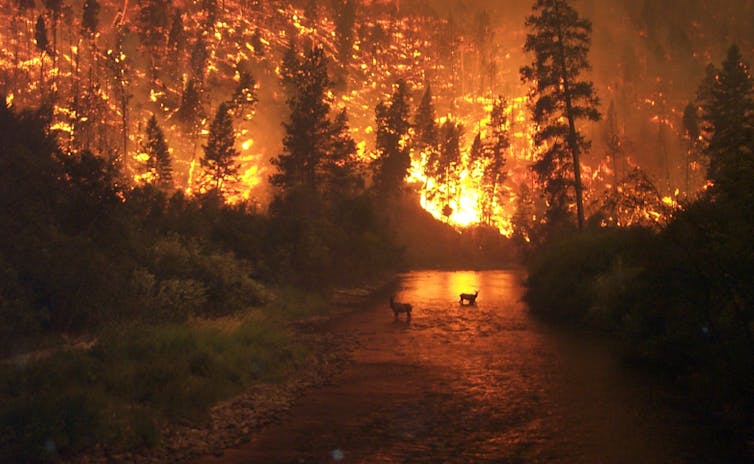

As wildfire risk rises in the West, wildland firefighters and officials are keeping a closer eye on the high mountains – regions once considered too wet to burn.
The growing fire risk in these areas became startling clear in 2020, when Colorado’s East Troublesome Fire burned up and over the Continental Divide to become the state’s second-largest fire on record. The following year, California’s Dixie Fire became the first on record to burn across the Sierra Nevada’s crest and start down the other side.
We study wildfire behavior as climate scientists and engineers. In a new study, we show that fire risk has intensified in every region across the West over the past four decades, but the sharpest upward trends are in the high elevations.
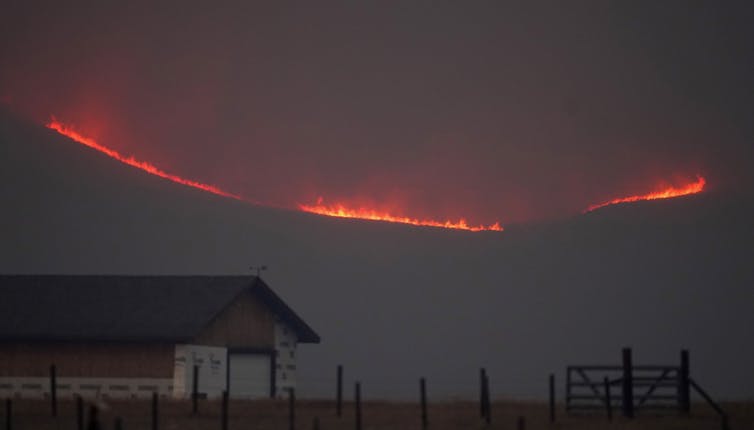
High mountain fires can create a cascade of risks for local ecosystems and for millions of people living farther down the mountains.
Since cooler, wetter high mountain landscapes rarely burn, vegetation and dead wood can build up, so highland fires tend to be intense and uncontrollable. They can affect everything from water quality and the timing of meltwater that communities and farmers rely on, to erosion that can bring debris and mud flows. Ultimately, they can change the hydrology, ecology and geomorphology of the highlands, with complex feedback loops that can transform mountain landscapes and endanger human safety.
Four decades of rising fire risk
Historically, higher moisture levels and cooler temperatures created a flammability barrier in the highlands. This enabled fire managers to leave fires that move away from human settlements and up mountains to run their course without interference. Fire would hit the flammability barrier and burn out.
However, our findings show that’s no longer reliable as the climate warms.
We analyzed fire danger trends in different elevation bands of the Western U.S. mountains from 1979 to 2020. Fire danger describes conditions that reflect the potential for a fire to ignite and spread.
Over that 42-year period, rising temperatures and drying trends increased the number of critical fire danger days in every region in the U.S. West. But in the highlands, certain environmental processes, such as earlier snowmelt that allowed the earth to heat up and become drier, intensified the fire danger faster than anywhere else. It was particularly stark in high-elevation forests from about 8,200 to 9,800 feet (2,500-3,000 meters) in elevation, just above the elevation of Aspen, Colorado.
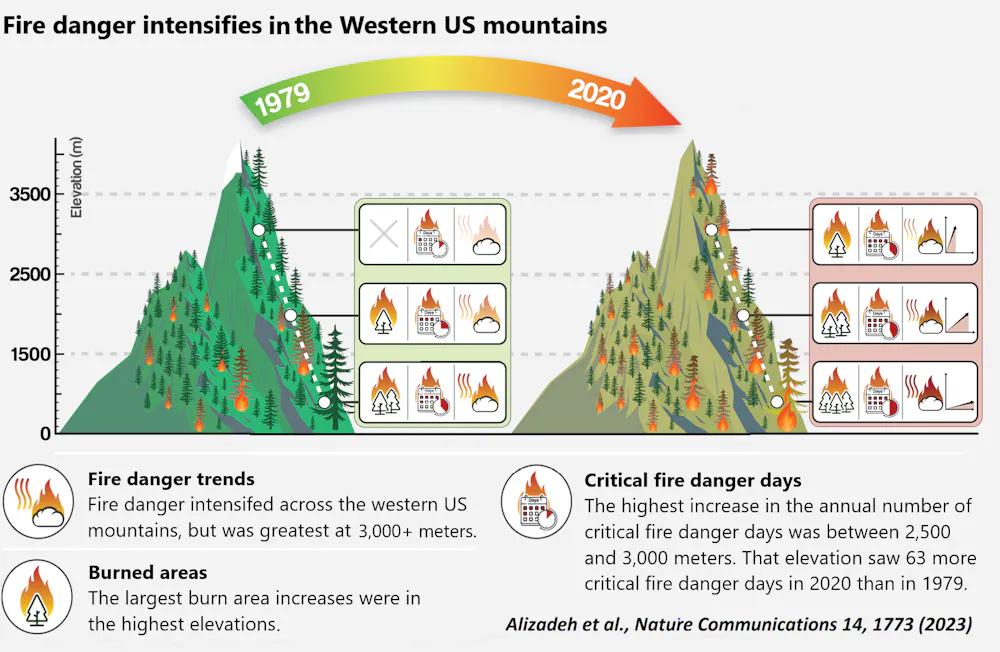
We found that the high-elevation band had gained on average 63 critical fire danger days a year by 2020 compared with 1979. That included 22 days outside the traditional warm season of May to September. In previous research, we found that high-elevation fires had been advancing upslope in the West at about 25 feet (7.6 meters) per year.
Cascading risks for humans downstream
Mountains are water towers of the world, providing 70% of the runoff that cities across the West rely on. They support millions of people who live downstream.
High-elevation fires can have a significant impact on snow accumulation and meltwater, even long after they have burned out.
For example, fires remove vegetation cover and tree canopies, which can shorten the amount of time the snowpack stays frozen before melting. Soot from fires also darkens the snow surface, increasing its ability to absorb the Sun’s energy, which facilitates melting. Similarly, darkened land surface increases the absorption of solar radiation and heightens soil temperature after fires.
The result of these changes can be spring flooding, and less water later in the summer when communities downstream are counting on it.
Fire-driven tree loss also removes anchor points for the snowpack, increasing the frequency and severity of avalanches.
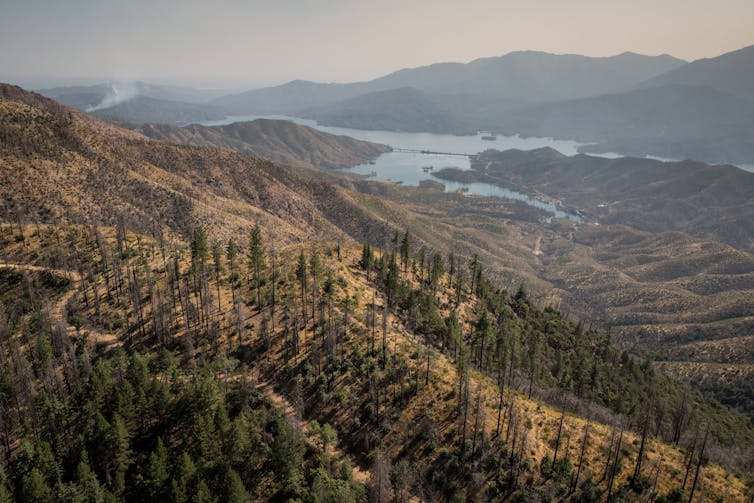
Frequent fires in high-elevation areas can also have a significant impact on the sediment dynamics of mountain streams. The loss of tree canopy means rainfall hits the ground at a higher velocity, increasing the potential for erosion. This can trigger mudslides and increase the amount of sediment sent downstream, which in turn can affect water quality and aquatic habitats.
Erosion linked to runoff after fire damage can also deepen streams to the point that excess water from storms can’t spread in high-elevation meadows and recharge the groundwater; instead, they route the water quickly downstream and cause flooding.
Hazards for climate-stressed species and ecosystems
The highlands generally have long fire return intervals, burning once every several decades if not centuries. Since they don’t burn often, their ecosystems aren’t as fire-adapted as lower-elevation forests, so they may not recover as efficiently or survive repeated fires.
Studies show that more frequent fires could change the type of trees that grow in the highlands or even convert them to shrubs or grasses.
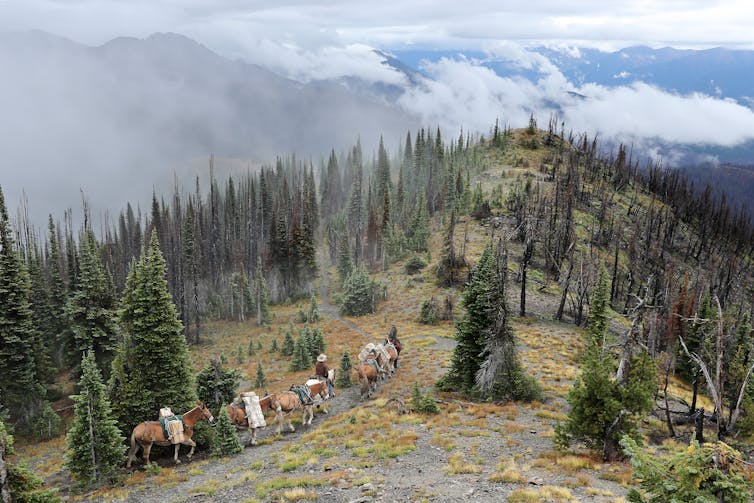
Wet mountain areas, with their cooler temperatures and higher precipitation, are often peppered with hot spots of biodiversity and provide refuges to various species from the warming climate. If these areas lose their tree canopies, species with small ranges that depend on cold-water mountain streams can face existential risks as more energy from the Sun heats up stream water in the absence of tree shading.
While the risk is rising fastest in the high mountains, most of the West is now at increasing risk of fires. With continuing greenhouse gas emissions fueling global warming, this trend of worsening fire danger is expected to intensify further, straining firefighting resources as crews battle more blazes.
Mohammad Reza Alizadeh, Postdoctoral Researcher in Environmental Engineering, Massachusetts Institute of Technology (MIT) and Mojtaba Sadegh, Assistant Professor of Civil Engineering, Boise State University
This article is republished from The Conversation under a Creative Commons license. Read the original article.

Astronomers are celebrating NASA's Hubble Space Telescope's 33rd launch anniversary with an ethereal photo of a nearby star-forming region, NGC 1333.
The nebula is in the Perseus molecular cloud, and located approximately 960 light-years away.
Hubble's colorful view, showcased through its unique capability to obtain images from ultraviolet to near-infrared light, unveils an effervescent cauldron of glowing gasses and pitch-black dust stirred up and blown around by several hundred newly forming stars embedded within the dark cloud.
Hubble just scratches the surface because most of the star birthing firestorm is hidden behind clouds of fine dust – essentially soot – that are thicker toward the bottom of the image. The blackness in the image is not empty space, but filled with obscuring dust.
To capture this image, Hubble peered through a veil of dust on the edge of a giant cloud of cold molecular hydrogen – the raw material for fabricating new stars and planets under the relentless pull of gravity. The image underscores the fact that star formation is a messy process in our rambunctious universe.
Ferocious stellar winds, likely from the bright blue star at the top of the image, are blowing through a curtain of dust. The fine dust scatters the starlight at blue wavelengths.
Farther down, another bright, super-hot star shines through filaments of obscuring dust, looking like the Sun shining through scattered clouds. A diagonal string of fainter accompanying stars looks reddish because dust is filtering starlight, allowing more of the red light to get through.
The bottom of the picture presents a keyhole peek deep into the dark nebula. Hubble captures the reddish glow of ionized hydrogen. It looks like a fireworks finale, with several overlapping events. This is caused by pencil-thin jets shooting out from newly forming stars outside the frame of view.
These stars are surrounded by circumstellar disks, which may eventually produce planetary systems, and powerful magnetic fields that direct two parallel beams of hot gas deep into space, like a double light saber from science fiction films. They sculpt patterns on the hydrogen cocoon, like laser-light-show tracings. The jets are a star's birth announcement.
This view offers an example of the time when our Sun and planets formed inside such a dusty molecular cloud, 4.6 billion years ago. Our Sun didn't form in isolation but was instead embedded inside a mosh pit of frantic stellar birth, perhaps even more energetic and massive than NGC 1333.
Hubble was deployed into orbit around Earth on April 25, 1990, by NASA astronauts aboard the Space Shuttle Discovery. To date, the legendary telescope has taken approximately 1.6 million observations of nearly 52,000 celestial targets. This treasure trove of knowledge about the universe is stored for public access in the Mikulski Archive for Space Telescopes, at the Space Telescope Science Institute in Baltimore, Maryland.
The Hubble Space Telescope is a project of international cooperation between NASA and ESA. NASA's Goddard Space Flight Center in Greenbelt, Maryland, manages the telescope. The Space Telescope Science Institute (STScI) in Baltimore, Maryland, conducts Hubble and Webb science operations. STScI is operated for NASA by the Association of Universities for Research in Astronomy, in Washington, D.C.
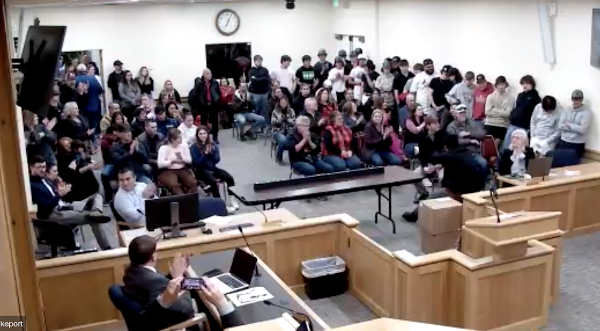
LAKE COUNTY, Calif. — The Lakeport City Council on Tuesday joined with community members in honoring Clear Lake High School’s varsity football team for an incredible season that led them all the way to the state finals.
The Cardinals squad members were the 2022-23 Coastal Mountain League champions — the last time they won a league title was in 2008 — as well as the 2022-23 North Coast Section champions. This was the second section title for the team, the first being in 1998.
The team’s overall record was 12-2, with a 7-1 league record.
They also made school history by playing a record 14 games and winning 12 of them.
The team made it all the way to the state championship against the Orland Trojans, played on the Trojans’ home turf in December. Ultimately, the Trojans defeated the Cardinals, giving them one of only two losses for the year.
In honor of the Cardinal varsity football team’s brilliant season, the school, parents and other community members pitched in to raise the nearly $9,000 to give each of the team members a section championship ring, said Head Coach Mark Cory.
The city also presented the team with a certificate of achievement.
The council chambers and the lobby were filled with people who came to support the team.
Mayor Stacey Mattina read the names of the players as Cory presented them with their big square section rings.
Team members are:
• Jake Soderquist, quarterback.
• AJ Bruch, quarterback.
• Graden Greer, defensive back/wide receiver/quarterback.
• Hank “Kenny” Ollenberger, running back/linebacker.
• Ayden Williamson, wide receiver/strong safety.
• Jadin Vestal, wide receiver/defensive back.
• Peyton Portlock, linebacker.
• Jesse Hayes, wide receiver/strong safety.
• Issac Hassberg, wide receiver/defensive back.
• Saul Reyes, wide receiver/free safety.
• Kaden Graham, tight end.
• Cody Hayes, tight end/linebacker.
• Liam Orr, wide receiver/defensive back.
• Colton Mendonca, offensive line/defensive line.
• Fabian Moreno, offensive line/linebacker.
• Axel Alvarez, offensive line/defensive line.
• Tony Gersalia, offensive line/defensive end.
• Wade Wittman Jr., linebacker.
• Pedro Sloan, offensive line/defensive end.
• Ethan Masterson, offensive line/defensive line.
• Carson Wikstrom, offensive line/linebacker.
• Diego Brewster-Ramirez, offensive line/defensive end.
• Bobby Bruhn, offensive line/defensive line.
• Michael Frease, offensive line/defensive line.
• Jace Beard, wide receiver/defensive back.
Cory’s coaching staff includes defensive coordinator Shady Cerezo and assistant coaches Billy Roberson, Augie Perez, Adrian Perez and Garrett Harwood, and filmer Hannah Garrity. They honor the late Rob “Rummy” Rumfelt as their “forever” coach.
Cory thanked the city for putting together the presentation to the players. “I appreciate it,” he said, adding that the players will remember it.
He also thanked the parents and community members who helped pay for the rings. “Luckily, we have a very supportive community.”
Cory presented a ring to Brian Sumpter, the Record-Bee’s longtime sports editor, for his coverage of this season.
The team is hoping to have another great season later this year, and Cory said they have a pretty good chance. “Let’s go back to back.”
Team member Michael Frease thanked all the coaches, who helped them when they were struggling.
“We had a lot of ups and downs, but Cardinals — we never break, we just keep pushing,” Frease said.
He also thanked the offensive line for their work in the trenches, and offered a big thanks to the parents for showing up and supporting the team.
“Congratulations. We’re really proud of you,” said Mattina.
The council then rose to join the audience in giving the team a standing ovation.
It also was reported this week that three of the seniors on the team, including Frease, will be playing football at the college level.
Frease has signed to play at College of the Redwoods, where he will major in business.
His teammates Anthony Gersalia and Pedro Sloan have signed to play with the Yuba College 49ers next season.
Email Elizabeth Larson at
Rickelman will manage the creation of a countywide Economic Development Strategic Plan, support Lake County businesses, and work with partners throughout Lake County and the region to grow, diversify and bring greater resiliency to the local economy.
He has a decade of economic development experience, including work with the city of San Antonio, Montgomery County, Maryland, and the NoMa Business Improvement District in Washington DC.
In San Antonio, Rickelman focused on several targeted industries, which encompassed recruitment, retention/expansion and workforce development.
He managed prospects and incentives for the city of San Antonio with successful projects including the Navistar manufacturing plant and technology center, Scorpion Biological Services’ manufacturing and research facility, and the DeLorean headquarters.
He collaborated frequently with local universities, research institutes, the military and local public-private partnerships on capital attraction, business development, entrepreneurial support systems, federal funding opportunities, strategic planning initiatives and place-based economic development.
In Montgomery County, Maryland, Rickelman supported the assistant chief administrative officer, who was head of economic development for the county. He managed county relationships with industry and workforce development public-private partnerships, Opportunity Zones advocacy, and approval of an enterprise zone designed to drive private sector investment and entrepreneurship at a college campus.
At the NoMa Business Improvement District, he supported neighborhood based strategic planning, marketing, infrastructure projects and placemaking initiatives in an area transitioning rapidly from post-industrial to a mixed-use, 18 hour neighborhood.
Rickelman holds a Master of Public Administration degree from the George Washington University and is a Certified Economic Developer.

CLEARLAKE, Calif. — More dogs are being adopted at Clearlake Animal Control, according to a report at the Clearlake City Council meeting on Thursday evening.
Clearlake Police Lt. Ryan Peterson, who oversees the shelter, reported that from Jan. 1 to April 20, 107 dogs have come in.
Of those, 30 were transferred to rescues, 33 returned to owners, 15 were adopted and none were euthanized, for a 100% live release rate, Peterson said.
Peterson said that, currently, there are 62 dogs at the shelter, down from 80 when he had last reported to the council in March. “So they are making progress on lowering the numbers.”
In response to issues with conditions at the shelter, run by North Bay Animal Services in contract with the city, City Manager Alan Flora made several directives about actions that needed to be taken.

In addition, Peterson was assigned the task of conducting an investigation into the matter.
This week, there are 26 dogs listed as available for adoption on the shelter website.
They include “Mikey,” a pit bull terrier mix, and “Josie,” a 3-year-old Labrador retriever mix.
The shelter is located at 6820 Old Highway 53. It’s open from 9 a.m. to 6 p.m. Tuesday through Saturday.
For more information, call the shelter at 707-762-6227, email
This week’s adoptable dogs are featured below.
Email Elizabeth Larson at