 How to resolve AdBlock issue?
News
At the start of the meeting, City Manager Alan Flora asked to add an emergency item to the agenda — reconsideration of a contract the council unanimously approved at its April 6 meeting.
That contract was with Argonaut Constructors, which was the low bidder at $4,632,295 for the 18th Avenue Improvement Project.
The council voted unanimously to add the item, which it discussed later in the meeting.
In explaining the item, Flora said part of the funding for the project is through the California Transportation Commission. Thanks to the city’s Measure V road sales tax, Clearlake is eligible for $500,000.
The commission is due to consider that funding at its meeting on May 17 and 18, Flora said.
However, he said that the commission won’t approve an allocation after a contract is executed.
At the same time, the city can lose the funding if it’s not allocated by July 4, he said.
Flora said he’d found out about those procedural issues that week. “Our contractor is aware of this,” he said, noting they’d been in communication and that he didn’t feel that it would impact the project schedule.
The only public comment on the matter was from Holly Roberson, an attorney for the Koi Nation tribe.
Roberson asked for clarification on what the project entailed.
Flora said it’s a project connecting 18th Avenue to Highway 53, crossing the city’s former Pearce Field airport property.
Roberson asked Flora if the city was moving forward on a project in active litigation.
Flora said yes.
Roberson, in turn, thanked him for being clear on the subject.
The litigation matter refers to the Koi Nation’s filing of a writ of mandate against the city on March 3 over its approval of plans for a new hotel project at the airport property.
In January, the council denied the Koi Nation’s appeal of the project to build a 75-room Fairfield Inn by Marriott hotel on 2.8 acres at 6356 Armijo Ave. The hotel is proposed by MLI Associates LLC, owned by Matt Patel.
The tribe has objected to the project on the grounds that it believes the city’s tribal consultation process violates the California Environmental Quality Act.
It’s one of a series of objections over projects in Clearlake that the tribe has raised over the past few years.
Nonetheless, on Thursday the council voted unanimously to rescind the previous contract approval so the project can be considered by the California Transportation Commission next month.
Flora told Lake County News after the meeting that the tribe’s writ of mandate included both the hotel and the 18th Avenue project.
He said the city has no obligation to stop a project just because a writ was filed, “so we will continue.”
There was a mandatory settlement conference the following day, “but based on the last year of negotiations with the Koi on various projects reaching a settlement is unlikely,” Flora said.
A settlement has not been reported since that conference.
Council hears update on animal shelter
In other business on Thursday, Lt. Ryan Peterson of the Clearlake Police Department updated on the council on the situation at the shelter.
The city contracts with North Bay Animal Services to run the shelter, but issues raised about animal care and shelter conditions led to Flora late last month issuing directives including that Peterson investigate the allegations. That investigation must be completed within 30 days, and so is expected by the end of this month.
Peterson did not discuss that investigation, but did update the council on animal statistics.
He said that 107 dogs have come into the shelter from Jan. 1 to April 20. Of those, 78 have left the shelter — including 30 being transferred to rescues or other facilities, 33 returned to owners and 15 have been adopted. None have been euthanized, giving the shelter a 100% live release rate.
At that point, there were 62 dogs at the shelter, down from 80 when he had reported to the council the previous month. “So they are making progress on lowering the numbers.”
Councilwoman Joyce Overton asked how many animals the facility is supposed to hold.
The newer portion of the shelter is meant to hold 30 dogs, with more dogs being held in a Public Works building at the site. Peterson said that the Public Works building is only supposed to be used for emergencies.
Flora said they haven’t completely removed all of the dogs from that shop area, but that there are no more dogs in temporary crates and the shelter is reducing the number of dogs per the direction given.
He said there will be an agenda item on the shelter after Peterson concludes the investigation, and that will be the appropriate time to discuss it further.
During public comment later in the meeting, Kay Lopez told the council she felt the shelter has failed the animals in more ways than one. In her visits to the shelter, beginning in 2017, Lopez said she’s either found the animals in overheated or freezing cold conditions.
Based on a visit on March 21, she said dogs appeared to have two-day-old food and a dog she saw was suffering from giardia. The shelter had a giardia outbreak earlier this year.
Lopez gave pictures she had taken of conditions at the shelter to Peterson.
The April 20 meeting also included Police Chief Tim Hobbs leading a swearing-in of Chelsea Banks as Clearlake Police’s new records and communications supervisor and an update from the city’s Recreation and Events Division.
Email Elizabeth Larson at
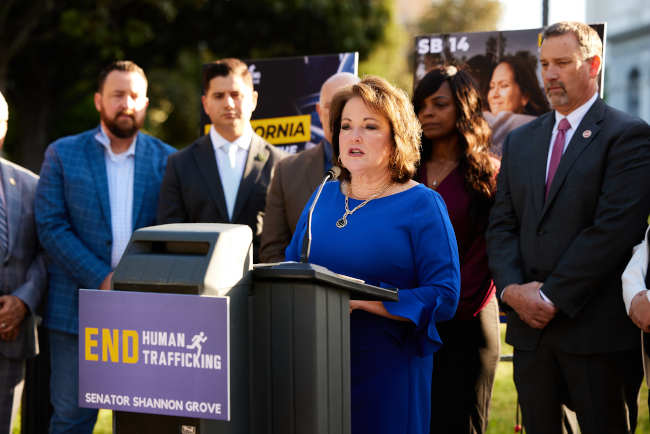
A bill to enforce greater penalties for those who victimize children through human trafficking has advanced in the State Legislature.
State Sen. Shannon Grove’s (R-Bakersfield) legislation, Senate Bill (SB) 14, is one of the first enhancement bills to pass out of the Senate Public Safety Committee this year.
As amended, SB 14 is a bipartisan measure that would add human trafficking of a minor to the list of felony crimes that are defined as serious, making it a strike offense, under California’s Three Strikes law.
The fastest growing criminal industry in the world is the buying and selling of human beings, and California is one of the largest hubs for human trafficking.
“SB 14 will help strengthen protections for the thousands of minor victims who are sex trafficked and will serve as a deterrent for those who engage in this horrendous crime. While I am thankful that my legislation passed out of Senate Public Safety and will protect countless children who are trafficked, I remain committed to continuing to fight for survivors and victims of all ages,” said Grove.
This bipartisan measure was co-authored by 31 members of the Legislature. SB 14 is supported by a large coalition of human trafficking survivors, advocates, local, national and international organizations.
3Strands Global Foundation, whose mission is to mobilize communities in order to combat human trafficking through prevention, education and reintegration programs, sponsored the measure.
“3Strands Global Foundation is honored to sponsor Senate Bill 14. As an organization that has worked for over a decade to end human trafficking, we applaud Sen. Grove’s determination to ensure our communities are safe from this serious crime. SB 14 will bring justice for survivors and hold traffickers responsible who perpetrate this crime. We are committed to doing our part to hold those responsible for trafficking in our communities accountable, and it is our hope that the legislators will now do theirs,” said Ashley Bryant, CEO and co-founder of 3Strands Global Foundation.
An estimated 40 million people globally in the last decade have been forced into this modern form of slavery called human trafficking, a number that continues to grow. This horrendous practice could very easily be defined as “The Crime of our Time.”
Human trafficking is one of the world’s fastest growing and most lucrative crimes, generating around $150 billion around the world each year.
SB 14 made it out of the Senate Public Safety Committee with a 5-0 vote and will next be heard in the Senate Appropriations Committee.
The free event will take place from 10 a.m. to 3 p.m. Saturday, April 29, at Station 60, located at 21095 Highway 175 in Middletown.
Scheduled demonstrations during the open house include a hands-only cardiopulmonary resuscitation raining at 11 a.m., an auto extrication demonstration at 11:30 a.m., and a live smoke crawl at 12:30 p.m. and 2 p.m.
There will be burger and hot dog meals for $2 each; fire engine rides, bounce house and face painting, each for $1; a meet and greet with Sparky; fire safety education; REACH helicopter demonstration and tour; free raffles; children’s activities and games including the flame knockdown, cupcake walk and smoke crawl; and fire department t-shirts will be for sale.
For more information, call the district at 707-987-3089.
Most of the clothing and gadgets you buy in stores today were once in shipping containers, sailing across the ocean. Ships carry over 80% of the world’s traded goods. But they have a problem – the majority of them burn heavy sulfur fuel oil, which is a driver of climate change.
While cargo ships’ engines have become more efficient over time, the industry is under growing pressure to eliminate its carbon footprint.
The European Union Parliament this year voted to require an 80% drop in shipping fuels’ greenhouse gas intensity by 2050 and to require shipping lines to pay for the greenhouse gases their ships release. The International Maritime Organization, the United Nations agency that regulates international shipping, also plans to strengthen its climate strategy this summer. The IMO’s current goal is to cut shipping emissions 50% by 2050. President Joe Biden said on April 20, 2023, that the U.S. would push for a new international goal of zero emissions by 2050 instead.
We asked maritime industry researcher Don Maier if the industry can meet those tougher targets.
Why is it so hard for shipping to transition away from fossil fuels?
Economics and the lifespan of ships are two primary reasons.
Most of the big shippers’ fleets are less than 20 years old, but even the newer builds don’t necessarily have the most advanced technology. It takes roughly a year and a half to come out with a new build of a ship, and it will still be based on technology from a few years ago. So, most of the engines still run on fossil fuel oil.
If companies do buy ships that run on alternative fuels, such as hydrogen, methanol and ammonia, they run into another challenge: There are only a few ports so far with the infrastructure to provide those fuels. Without a way to refuel at all the ports that a ship might use, companies will lose their return on investment, so they will keep using the same technology instead.
It isn’t necessarily that the maritime industry doesn’t want to go the direction of cleaner fuels. But their assets – their fleets – were purchased with a long lifespan in mind, and alternative fuels aren’t yet widely available.
Ships are being built that can run on liquefied natural gas (LNG) and methanol, and even hydrogen is coming online. Often these are dual-fuel – ships that can run on either alternative fuels or fossil fuels. But so far, not enough of this type of ship is being ordered for the costs to make financial sense for most builders or buyers.
The costs of alternative fuels, like methanol and hydrogen fuels made with renewable energy (as opposed to being made with natural gas), are also still significantly higher than fuel oil or LNG. But the good news is those costs are starting to decline. As production ramps up, emissions will drop further.
Can tougher regulations and carbon pricing effectively push the industry to change?
A little bit of pressure on the industry can be helpful, but too much, too fast can really make things more disruptive.
Like most industries, shipping lines want standardized rules they can count on not to change next year. Some of these companies have invested millions of dollars in new ships in recent years, and they’re now being told that those ships might not meet the new standards – even though the ships may be almost brand new.
Another concern with the EU’s moves is whether it has a grasp on all the “what if” scenarios. For example, if the EU has stricter rules than other countries, that affects which ships companies can use on European routes. Any vessels that they put on routes to Europe will have to meet those emissions standards. If there’s a greater demand for products in Europe, they may have fewer vessels they could use.
I do think the change will be coming soon in the industry, but changes have to make financial sense to the shipping lines and their customers, too.
Economists have estimated that the cost of cutting emissions 50% by 2050 are anywhere from US$1 trillion to, more realistically, over $3 trillion, and full decarbonization would be even higher. Many of those costs will be passed down to charterers, shippers and eventually consumers – meaning you and me.
Are there ways companies can cut emissions now while preparing to upgrade their fleets?
There are a number of options ship companies are using now to lower emissions.
One that has been used for at least 10 years is putting higher quality paint on the hulls, which reduces the friction between the hull and the water. With less friction, the engine isn’t working as hard, which reduces emissions.
Another is slow speed. If ships run at a higher speed, their engines work harder, which means they use more fuel and release more emissions. So shippers will use slow steaming. Most of the time, ships will go slow when they’re close to shore to reduce emissions that cause smog in port cities like Los Angeles. On the open ocean, they will go back to normal speed.

Another option common in the U.S. and Europe is shutting down the ship’s engines while in port and plugging into the port’s electricity. It’s called “cold ironing.” It avoids burning more of the ship’s fuel, which affects air quality. The Ports of Los Angeles and Long Beach, where smog from idling ships has been a health concern, have been a big driver of electrification. It’s also less expensive for shipping companies than burning their fuel while in port.
As simple as those may sound, they have made huge improvements in terms of emissions, but they aren’t enough on their own.
Will a higher goal set by the IMO be enough to pressure the industry to change?
I used to work in shipping, and I know the maritime industry is a very old-school industry from centuries ago. But the industry has invested millions in new ships with the most effective technology available in recent years.
When the IMO began requiring all ships using heavy fuel in global trade to shift to low-sulfur fuel, the industry pivoted to meet the rule, even though retrofits were costly and time consuming. Many shipping lines complied by installing “scrubbers” that essentially filter the ship’s engine, and new ships were built to run on the low-sulfur fuel oil.
Now, the industry is being told the standards are changing again.
All industries want consistency so they can be confident investing in a new technology. The shipping lines will follow what the IMO says. They will push back, but they will still do it. That’s in part because the IMO supports the maritime industry, too.
Don Maier, Associate Professor of Business, University of Tennessee
This article is republished from The Conversation under a Creative Commons license. Read the original article.

LAKE COUNTY, Calif. — Mark your calendar — the Lake County Weed Management Area has announced its annual invasive weeds tours.
For 2023, they will offer two tours on consecutive days: the first, showcasing weeds that affect Clear Lake and efforts to restore tules along the shoreline; the second, featuring weeds of grasslands and oak woodlands and restoration of native wildflowers at the McLaughlin Reserve.
Both great tours are free.
The public is welcome and encouraged to join one or both.
The first tour will take place from 9 a.m. to noon on Thursday, May 11, at Clark’s Island in Clearlake Oaks.
Join staff from the Lake County Water Resources Department and Resource Conservation District as they dive into the world of aquatic plants and wetland weeds of Clear Lake and Lake County.
Aquatic and wetland plant specimens and examples will be presented to facilitate hands-on learning and education.
They also will learn about recent invasive plant management efforts at Clark’s Island and the successful tule replanting effort that has been ongoing for the past two years.
This effort has been led by Lake County Watershed Protection District, Tribal EcoRestoration Alliance and tribal partners at Big Valley Band of Pomo Indians and Robinson Rancheria. Outreach materials and display tables will be available.
Attendees are asked to park on the west side of Clark’s Island, by the Adobe sign; extra parking is available along the north side of the channel, adjacent to PowerMart.
Then, on Friday, May 12, from 9 a.m. to noon, learn about weeds and wildflowers at the McLaughlin Reserve.
Join staff from the University of California McLaughlin Reserve to learn how invasive plants, especially annual grasses, have reduced native wildflower displays in Lake County.
Participants will view areas of the reserve where wildflowers have been restored by removing invasive species.
They will discuss the use of prescribed fire, cattle grazing, herbicides, mowing and hand pulling as tools to control weeds and restore wildflowers.
Robust wildflower displays are expected in May this year, so bring your cameras.
The group will meet at the McLaughlin Reserve Headquarters at 26775 Morgan Valley Road, then carpool for the field tour, which will involve walking about a quarter mile on gentle terrain.
For both tours, please bring hats, sunscreen, lunch or a snack, drinking water, and your questions about plants and the lake.
Please wear sturdy shoes free of seeds and mud, and bring gloves if you want some hands-on weed removal experience.
This event is sponsored by the Lake County Department of Agriculture and the Lake County Resource Conservation District. No reservations are required.
Please contact the Agriculture Department at 707-263-0217 if you have any questions.

The virtual town hall will take place beginning at 6:30 p.m. Tuesday, May 2.
Sen. Mike McGuire will host the town hall, with guests Cal Fire Northern California Region Chief Jake Hess and Marin County Fire Chief Jason Weber.
This important conversation will cover how the state is responding in this era of megafires, what type of expanded resources are available this summer and fall to protect our communities and what people can do to better prepare themselves for wildfire season.
Watch the Town Hall live here, on Facebook, or dial in to listen by phone at 1-669-900-6833 and enter the Webinar ID, 854 0548 1929.
To ask a question during the town hall, RSVP here.