 How to resolve AdBlock issue?
News
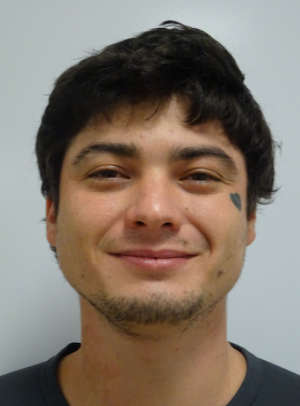
LAKE COUNTY, Calif. — The sentencing of an Occidental man for a 2021 murder took an unusual turn on Tuesday after the defendant objected to a portion of his plea agreement that related to a lesser charge.
Nova Maye Deperno, 27, appeared before Judge J. David Markham on Tuesday afternoon for his scheduled sentencing.
He’s charged with the killing of 63-year-old Ronald Meluso of Lucerne, a man with whom he had been staying while working for him.
Meluso was reported missing in August 2021. His remains were found near Bartlett Springs in northern Lake County on Jan. 14, 2022, a day after authorities arrested Deperno in Occidental on several felony charges.
Deperno’s attorney, Kevin Davenport, had reached a plea agreement with the District Attorney’s Office which gives Deperno 25 years to life for Meluso’s death, with another 10 years for an enhancement for use of a gun.
Chief Deputy District Attorney Richard Hinchcliff said during the hearing that the plea agreement was reached three months ago.
In addition to the murder case, the plea agreement covered an assault with a deadly weapon case in which authorities said Deperno pointed a gun at a young woman’s head. That aspect of the plea was for three years in prison to be served concurrently with the murder case, meaning he won’t have any additional time.
Not included in the plea are other felony cases filed against Deperno involving several victims from July 2020 to February 2021. They include vandalism, assault with a firearm, threats, felony evading and negligent discharge of a firearm. In that latter case, Hinchcliff said it involved Deperno — who had told some of the victims he was with the Mexican mafia — shooting into a home.
As the sentencing hearing began, Deperno raised objections to the plea agreement — not to the portion relating to the murder but to the case involving the threat against the young woman.
“I feel I took this deal under false pretenses, actually,” said Deperno, who maintained that it’s a “completely fabricated incident.”
When Markham said to Davenport that it sounded like his client wanted to withdraw his plea, a surprised Davenport said it was for “reasons I don’t understand.”
Deperno insisted he didn’t do the crime. Davenport said he had advised Deperno thoroughly about the plea agreement, spending several hours with him in going over it during the course of one day.
When Deperno continued to try to interrupt Davenport, Davenport turned to him and said, “I have to make a record here.” Markham also told Deperno to stop interrupting.
“This is about justice. This is supposed to be about upholding the law,” said Deperno, who claimed the woman accusing him of the crime is known for lying.
He said he’s not willing to accept that plea and have it on his conscience.
Regarding the homicide, Deperno said mistakes were made leading to loss of life. “I feel very deeply for that and I’m sorry.”
He added regarding the murder case, “I’m trying to move forward and make peace in my soul and my person with this,” but he wasn’t willing to accept the charges for the other case.
Hinchcliff said that was the first time he had heard of there being an issue. He said Meluso’s family had come, some from a distance, for the sentencing.
He said he and Davenport had worked for four to five hours on the agreement and that it was clear that Deperno had pleaded voluntarily to it.
Markham called in Tom Feimer, one of the administrators of Lake Indigent Defense, the county’s indigent defense contractor, to ask for another attorney to appoint to discuss with Deperno his concerns about the assault with a deadly weapon plea.
Attorney Ed Savin declined, telling the court that he’s “drowning in cases” and that, politically, there are so many problems with the system that he’s been told by legal counsel that he can decline assignments under the contract if he doesn’t have the time and energy. His reference to the political situation appeared to be a reference to the county’s current issues with the indigent defense contract and plans to end it in favor of a public defender’s office.
Markham then appointed attorney Angelina Potter, another defense attorney, and set a new hearing for 3 p.m. May 2.
At that time, there will either be a hearing to withdraw Deperno’s plea or to reschedule the sentencing.
“I’ve never seen anything like that before,” Hinchcliff, who has spent decades as a prosecutor, said after the derailed sentencing hearing.
Depending on the outcome of the May 2 hearing, Hinchcliff said Deperno’s sentencing could be pushed out for months.
“We’ll see what happens,” and try to do what’s in the best interests of everyone, he said.
Email Elizabeth Larson at
The council will meet at 6 p.m. Thursday, April 20, in the council chambers at Clearlake City Hall, 14050 Olympic Drive.
The meeting will be broadcast live on the city's YouTube channel or the Lake County PEGTV YouTube Channel. Community members also can participate via Zoom or can attend in person.
The agenda can be found here.
Comments and questions can be submitted in writing for City Council consideration by sending them to City Clerk Melissa Swanson at
To give the council adequate time to review your questions and comments, please submit your written comments before 4 p.m. Thursday, April 20.
Each public comment emailed to the city clerk will be read aloud by the mayor or a member of staff for up to three minutes or will be displayed on a screen. Public comment emails and town hall public comment submissions that are received after the beginning of the meeting will not be included in the record.
At the start of the meeting, the council will host a swearing-in of Chelsea Banks as Clearlake Police’s new records and communications supervisor.
Police Chief Tim Hobbs will give a presentation on the Clearlake Police Department Safety Education Loan Forgiveness Program.
There also will be a presentation of April's adoptable dogs and the quarterly update on the Recreation and Events Division.
On the meeting's consent agenda — items that are considered routine in nature and usually adopted on a single vote — are warrants; approval of Resolution Number 2023-18, approving a temporary road closure for the Soap Box Derby race; minutes of the March 15 Lake County Vector Control District Board meeting; adoption of the second amendment to the Adams Ashby consultant contract; adoption of Resolution 2023-20 committing to maintain new gateway monuments at each entryway into the city of Clearlake; and consideration of Resolution 2023-19 adopting the fourth amendment to fiscal year 2022-23 Budget (Resolution 2022-44) adjusting appropriations and revenues.
Following the open portion of the meeting, the council will hold a closed session to discuss negotiations with the Clearlake Middle Management Association and a case of anticipated litigation.
Email Elizabeth Larson at
The group will meet at 6 p.m. Thursday, April 20, in the multipurpose room at Lucerne Elementary School, 3351 Country Club Drive.
To attend virtually, use this video call link: https://meet.google.com/oui-okbf-bbg.
The moderator will be Kurt McKelvey, who was chair of the Lucerne Area Town Hall before the Board of Supervisors took action to dismantle it on April 11.
The group of community members that intends to keep meeting and holding activities going forward — despite the supervisors’ actions — will be called the Lucerne Town Hall.
Interested community members are invited to come and discuss issues of importance to them.
They will consider a nominating sub-council, discuss bylaws changes, as well as the county’s lack of response to previous town hall actions.
There also will be discussion and action for a proposed Community Cleanup Day and accompanying survey, a discussion of the much-prolonged dredging of the Lucerne Harbor.
Other topics include consideration of county efforts to derail public participation and the future of the Lucerne community, and announcement about the April 24 equity and inclusion workshop to discuss fairness at the county courthouse.
“We're still continuing to meet up as a community and I look forward to seeing you at the meeting,” McKelvey said.
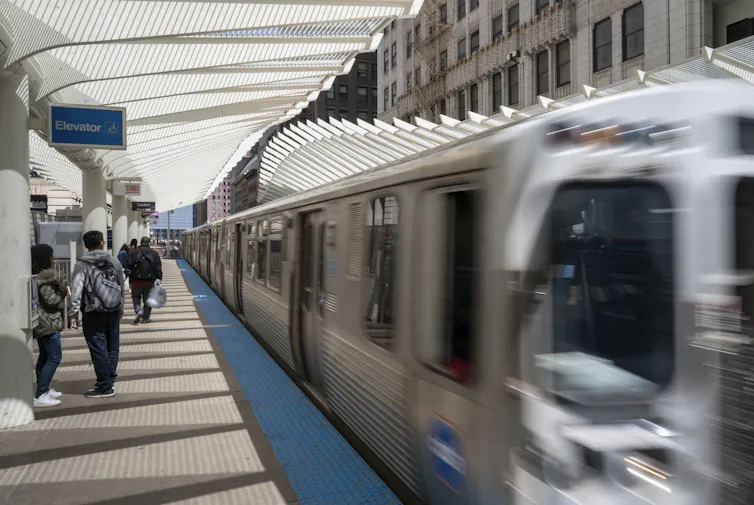
Public transit systems face daunting challenges across the U.S., from pandemic ridership losses to traffic congestion, fare evasion and pressure to keep rides affordable. In some cities, including Boston, Kansas City and Washington, many elected officials and advocates see fare-free public transit as the solution.
Federal COVID-19 relief funds, which have subsidized transit operations across the nation at an unprecedented level since 2020, offered a natural experiment in free-fare transit. Advocates applauded these changes and are now pushing to make fare-free bus lines permanent.
But although these experiments aided low-income families and modestly boosted ridership, they also created new political and economic challenges for beleaguered transit agencies. With ridership still dramatically below pre-pandemic levels and temporary federal support expiring, transportation agencies face an economic and managerial “doom spiral.”
Free public transit that doesn’t bankrupt agencies would require a revolution in transit funding. In most regions, U.S. voters – 85% of whom commute by automobile – have resisted deep subsidies and expect fare collection to cover a portion of operating budgets. Studies also show that transit riders are likely to prefer better, low-cost service to free rides on the substandard options that exist in much of the U.S.
Why isn’t transit free?
As I recount in my new book, “The Great American Transit Disaster,” mass transit in the U.S. was an unsubsidized, privately operated service for decades prior to the 1960s and 1970s. In the 19th and early 20th centuries, prosperous city dwellers used public transit to escape from overcrowded urban neighborhoods to more spacious “streetcar suburbs.” Commuting symbolized success for families with the income to pay the daily fare.
These systems were self-financing: Transit company investors made their money in suburban real estate when rail lines opened up. They charged low fares to entice riders looking to buy land and homes. The most famous example was the Pacific Electric “red car” transit system in Los Angeles that Henry Huntingdon built to transform his vast landholdings into profitable subdivisions.
However, once streetcar suburbs were built out, these companies had no further incentive to provide excellent transit. Unhappy voters felt suckered into crummy commutes. In response, city officials retaliated against the powerful transit interests by taxing them heavily and charging them for street repairs.
Meanwhile, the introduction of mass-produced personal cars created new competition for public transit. As autos gained popularity in the 1920s and 1930s, frustrated commuters swapped out riding for driving, and private transit companies like Pacific Electric began failing.
Grudging public takeovers
In most cities, politicians refused to prop up the often-hated private transit companies that now were begging for tax concessions, fare increases or public buyouts. In 1959, for instance, politicians still forced Baltimore’s fading private transit company, the BTC, to divert US$2.6 million in revenues annually to taxes. The companies retaliated by slashing maintenance, routes and service.
Local and state governments finally stepped in to save the ruins of the hardest-strapped companies in the 1960s and 1970s. Public buyouts took place only after decades of devastating losses, including most streetcar networks, in cities such as Baltimore (1970), Atlanta (1971) and Houston (1974).
These poorly subsidized public systems continued to lose riders. Transit’s share of daily commuters fell from 8.5% in 1970 to 4.9% in 2018. And while low-income people disprortionately ride transit, a 2008 study showed that roughly 80% of the working poor commuted by vehicle instead, despite the high cost of car ownership.
There were exceptions. Notably, San Francisco and Boston began subsidizing transit in 1904 and 1918, respectively, by sharing tax revenues with newly created public operators. Even in the face of significant ridership losses from 1945 to 1970, these cities’ transit systems kept fares low, maintained legacy rail and bus lines and modestly renovated their systems.
Converging pressures
Today, public transit is under enormous pressure nationwide. Inflation and driver shortages are driving up operating costs. Managers are spending more money on public safety in response to rising transit crime rates and unhoused people using buses and trains for shelter.
Many systems are also contending with decrepit infrastructure. The American Society of Civil Engineers gives U.S. public transit systems a grade of D-minus and estimates their national backlog of unmet capital needs at $176 billion. Deferred repairs and upgrades reduce service quality, leading to events like a 30-day emergency shutdown of an entire subway line in Boston in 2022.
Despite flashing warning signs, political support for public transit remains weak, especially among conservatives. So it’s not clear that relying on government to make up for free fares is sustainable or a priority.
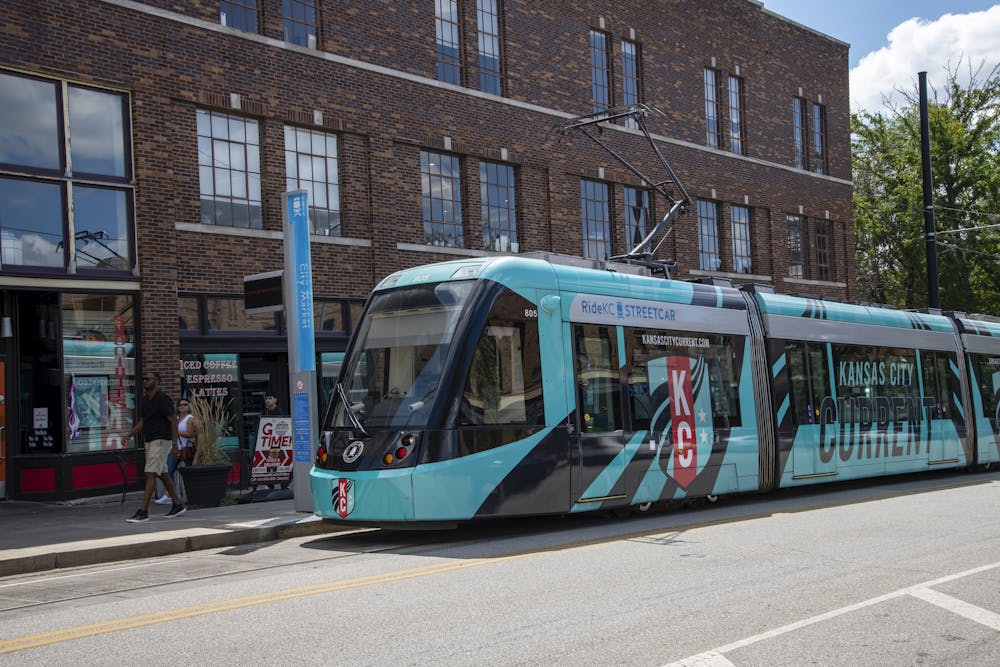
For example, in Washington, conflict is brewing within the city government over how to fund a free bus initiative. Kansas City, the largest U.S. system to adopt fare-free transit, faces a new challenge: finding funding to expand its small network, which just 3% of its residents use
A better model
Other cities are using more targeted strategies to make public transit accessible to everyone. For example, “Fair fare” programs in San Francisco, New York and Boston offer discounts based on income, while still collecting full fares from those who can afford to pay. Income-based discounts like these reduce the political liability of giving free rides to everyone, including affluent transit users.
Some providers have initiated or are considering fare integration policies. In this approach, transfers between different types of transit and systems are free; riders pay one time. For example, in Chicago, rapid transit or bus riders can transfer at no charge to a suburban bus to finish their trips, and vice versa.
Fare integration is less costly than fare-free systems, and lower-income riders stand to benefit. Enabling riders to pay for all types of trips with a single smart card further streamlines their journeys.
As ridership grows under Fair Fares and fare integration, I expect that additional revenue will help build better service, attracting more riders. Increasing ridership while supporting agency budgets will help make the political case for deeper public investments in service and equipment. A virtuous circle could develop.
History shows what works best to rebuild public transit networks, and free transit isn’t high on the list. Cities like Boston, San Francisco and New York have more transit because voters and politicians have supplemented fare collection with a combination of property taxes, bridge tolls, sales taxes and more. Taking fares out of the formula spreads the red ink even faster.
Nicholas Dagen Bloom, Professor of Urban Policy and Planning, Hunter College
This article is republished from The Conversation under a Creative Commons license. Read the original article.
The Board of Supervisors took the unanimous vote during the morning session at the April 11 meeting.
The action included approving a resolution rescinding the 2017 formation of the Middle Region Town Hall and the 2018 amendment to change it to the Lucerne Area Town Hall, or LATH, in order to allow Supervisor EJ Crandell to establish a new organization, the Central Region Town Hall, or CERTH.
The board discussed the matter late last month. Crandell has not taken it to the community of Lucerne for a discussion.
The proposed resolution includes all of the 95458 zip code — not just the Lucerne community growth boundaries — and allows nonresident property owners to be seated on the new board, a proposal which the Lucerne Area Town Hall’s members rejected in its latest version of the bylaws, accepted last year both by that group and by the Board of Supervisors.
The matter had appeared a foregone conclusion after the board’s March 28 meeting, and Crandell quickly brought the matter back.
Crandell, who hadn’t taken the matter for a discussion in Lucerne with community members there, claimed it’s “a restructure” based on public comment at the March 28 meeting.
“It is evident that establishing CERTH is the most plausible for the central region of District 3,” he said.
Disagreeing with that conclusion was Kurt McKelvey, a 30-year resident of Lucerne who was the Lucerne Area Town Hall’s last chair.
“I encourage the board not to approve the proposed resolution before you today,” McKelvey said.
McKelvey suggested the motivation for Crandell’s actions wasn’t because of a claim of being more inclusive but rather that it stemmed from the town hall’s action at a special meeting on Dec. 21.
At that meeting, the town hall unanimously approved a resolution condemning a proposal by the Scotts Valley Band of Pomo Indians to turn the historic Lucerne Hotel — which the county sold without community support — into a homeless youth shelter.
“Community members expressed a range of opinions at that meeting, but the overwhelming majority of those present had serious concerns about the proposed project, and were in support of a LATH resolution condemning the project. The resolution to condemn the project was passed unanimously by the council, and was then sent to the county of Lake,” McKelvey said.
Crandell did not attend that meeting, although his wife Lorree was at a special meeting of the Lake County Board of Education that same night speaking in support of the Lucerne Hotel project.
Lorree Crandell also chairs the Lake County Continuum of Care, an organization on whose behalf then-Lake County Behavioral Health Services Director Todd Metcalf wrote a letter to the state advocating for a grant for the project at the historic building.
McKelvey said it was shortly after that special town hall meeting that all five of LATH’s council members were told their terms would end at the end of the year, in spite of the fact that Crandall assured him in November that the terms would be corrected before the end of the year so that they conformed to the LATH bylaws that specify two-year staggered terms.
“Due to this sudden and unexpected end of terms, we attempted to resolve this through email communications and public input in these chambers, and were ultimately told that we ‘just needed to reapply,” said McKelvey.
He added that, “So far I've only been given a series of conflicting and nonsensical reasons as to why this has all happened.”
Despite Crandell’s direction that they reapply, McKelvey said Crandell refused to appoint anyone and hadn’t given any substantive reason or justification for not doing so.
He said he believed it’s really an attempt to erase the work of the LATH in December.
McKelvey attempted to give the board the minutes of those meetings, LATH’s bylaws, a copy of the resolution against the Lucerne Hotel project, as well as petitions with signatures of community members opposing the project and California Government Code Section 1302, under the auspices of which the LATH continued to meet in recent months.
He said there have been attempts to portray those in support of drastically altering the LATH as being a “majority” when in fact it is more probable that they are a very small minority, and that many of those pushing for those drastic changes don't even live in Lucerne or the proposed territory.
McKelvey said he suspects once Lucerne residents find out about the changes, they’ll be upset about them. “These changes are unprecedented, nothing like this has been done with any other council in the county. I suggest, at the very least, you should hold an informational meeting about it in lucerne to gauge the community's actual views about this before any action to go forward with it.”
He’d made that suggestion for a community meeting in Lucerne ahead of the changes at a previous board meeting as well.
McKelvey said LATH has strived to give Lucerne its own voice and that the action was a gross disservice to Crandell’s constituents.
As he was attempting to ask four followup questions, the three-minute timer for public comment went off, and Board Chair Jessica Pyska repeatedly told him that his time was up.
John Jensen, a former LATH member who also is the co-founder of Lake County News and the Lucerne Area Revitalization Association, said LATH continues to meet with the support of the community and the association.
Jensen said Crandell’s changes are radical and go beyond just changing the borders, by allowing nonresident property owners to sit on them, which is not common for municipal advisory councils in Lake County.
He said when that proposed change to the bylaws about nonresident property owners came up, “it was not supported by the town hall and that raises questions about the genesis of this scheme.”
Jensen asked why residents of Lucerne have been excluded from this important discussion. He also asked how many municipal advisory councils in Lake County allow nonresidents to sit on them, why Crandell hadn’t discussed the matter directly with the town hall, who lobbied for the change, how many people lobbied for it, where those proponents live and what reasons they gave for wanting the change.
After that, Pyska allowed McKelvey to come forward to make additional comments.
“Lucerne really needs its own voice,” said McKelvey, adding that’s why the name of the town hall had been changed five years ago from the Middle Region Town Hall to the Lucerne Area Town Hall.
“The community of Lucerne has been largely underrepresented through the county. A lot of our needs have been unmet through decades,” said McKelvey.
He said LATH was just trying to help the community. “We’re all in this together, EJ.”
McKelvey then attempted to submit the minutes, resolution and petition papers to the board. This time, Assistant Clerk Johanna DeLong got up and pulled them from his hands and put them on the table next to her computer.
He said the town hall has continued to meet under the auspices of California Government Code Section 1302, which says, “Every officer whose term has expired shall continue to discharge the duties of his office until his successor has qualified.”
“Lastly, I respectfully request that the Board of Supervisors considers putting as much effort as you do into giving yourselves raises, patting yourselves on the back and suppressing the current representation of Lucerne and instead put that same effort and zeal into more productive things like prioritizing fixing the levees in Upper Lake, dredging our harbor in Lucerne, and keeping up on basic county maintenance needs. Those, I feel, are the real priorities. This whole thing that’s going on right now is just a disservice to the community,” McKelvey said.
He then asked his four questions:
How long has this change been in the works?
What is the compelling reason for the change?
How many people asked for this change?
Why are you supporting a radical departure like this, but only for one area?
Pyska then brought the matter back for action.
Crandell said he would cover some of the questions, but in actuality, he didn’t.
When he asked newly appointed County Counsel Lloyd Guintivano to respond to the use of Government Code 1302, Guintivano didn’t answer the question, instead saying that the board may form municipal advisory councils under Government Code 31010.
Crandell said he had only canceled one LATH meeting in December, a reference to the meeting that had been scheduled to take place at the Lucerne Hotel, but that the building’s owner, Andrew Beath, had told the group they couldn’t meet there due to the resolution condemning the sale that they planned to discuss and which they later approved.
The Dec. 21 meeting occurred the next week — it was held at the Lucerne Elementary School — and Crandell said he didn’t interfere but had sent an update that he claimed wasn’t shared with the public.
He then said there are 3,004 people in Lucerne, with 1,657 who are voting members and 1,076 people in the area of the Lucerne Hotel.
Crandell said there’s a suggestion that people advocating for the action are from the outside, conceding “there may be,” but adding, “That’s the discretion of us as the board.”
He added, “There is no situation where we want to lower the voice of Lucerne. That’s the exact opposite of this.”
Pyska then said there had been “a lot of support” for taking the action at the board’s March 28 meeting.
Supervisor Michael Green said that based on his reading of the one-line Government Code 1302, he didn’t think it applied to an appointed council member.
“I’m very supportive of any reasonable change needed,” Green said.
Green — who said at a board meeting last month that he “reenergized” the Scotts Valley Advisory Committee, an apparent reference to him updating that group’s bylaws to establish staggered terms at the start of this year — said that group also allows for nonresident property owners to have a leadership role.
Green said it can be helpful to have a fresh start from time to time.
Crandell said people who are not happy with the change can continue to have their own topics in their own private meetings.
Supervisor Moke Simon said that’s the case in his district. While the Middletown Area Town Hall’s membership is approved by the supervisors, the Lower Lake Action Committee Group has its own active group which is not Brown Act compliant.
Simon said the board has supported the Lucerne Harbor dredging, a project that has drug on for several years. “It will get done.”
Crandell added that he’s working “hand in hand” with Public Services Director Lars Ewing to move the harbor dredging along. “There’s a path forward.”
Crandell offered the resolution, which the board approved 5-0.
Public Records Act request
On March 28, after the Board of Supervisors gave Crandell support for his plan to override the existing town hall, Lake County News submitted a Public Records Act request to the county seeking information about the contacts he has had community members as well as what happened to a Facebook page for the Lucerne Area Town Hall that he had managed.
The county had 10 calendar days to initially respond to that request under state statute.
The county failed to meet that requirement.
On April 11, 14 days after the request was submitted, Lake County News resubmitted it.
Guintivano responded via email to say that his office is working on the request but that it needed more time.
He said it’s estimated the “records will be produced on or before May 8, 2023.”
That’s anticipated to be after members of the new town hall are appointed.
Email Elizabeth Larson at
The event will take place at 3 p.m. Friday, April 21.
The panelists are Lori Thomas, a professor of Native American Studies at Santa Rosa Junior College and a member of the Hopland Band of Pomo Indians; Eliste Reeves, an elder from Round Valley Indian Tribes; and Beniakem Cromwell, the chairman of Robinson Rancheria.
They will focus on education, with panelists discussing both the history and current experiences of native students in the educational system.
Organizers ask people to register ahead of time through EventBrite.
A Zoom link also will be made available ahead of the event.
Future panels will discuss topics including icons and activists, wellness, science, native plants and foods, contemporary art and language.
The Mendocino College Lake Center is located at 2565 Parallel Drive.