 How to resolve AdBlock issue?
News
LAKE COUNTY, Calif. — Woodland Community College and Yuba College are reporting an increase in enrollments and educational opportunities in high-demand occupations.
Woodland Community College and Yuba College play a critical role in the regional economy, providing pathways for transfer to four-year higher educational institutions and ensuring there continue to be highly trained students available to enter our regional workforce.
Both colleges offer robust transfer and Career and Technical, or CTE, programs including degrees and certificates in administration of justice, agriculture, business, culinary arts, early childhood education, nursing, psychology and veterinary technology.
To support students in achieving their educational goals and to encourage enrollment, Yuba Community College District awarded over $17 million dollars of financial aid during the last academic year.
This financial support is critical for students. A recent College Scorecard analysis notes, “YCCD institution’s strong combination of graduation rate performance in the face of elevated student poverty rates, as well as their ability to prepare graduates who can earn disproportionately high wages for their home counties, illustrates these intuition’s contributions to economic mobility in northern California.”
Statewide California Community Colleges experienced a steep decline in enrollment during the height of the COVID-19 pandemic, losing approximately 300,000 students or an 18% drop in enrollment.
YCCD colleges also experienced a similar decline, dropping 19% from 2019-2020 pre-pandemic enrollments.
To address the decline, Woodland Community College and Yuba College, implemented a number of strategies to increase enrollments including, increased marketing, outreach, and engagement, expanded dual enrollment offerings, focused outreach to older students who have some college or an interest in upskilling, targeted reengagement to students who departed during the COVID-19 pandemic, and updated scheduling processes to better align program needs and student demand.
The Yuba Community College District said the work began to positively impact enrollments during the fall 2022 semester, which was the first semester the district began to see an increase in enrollments.
Preliminary fall 2023 enrollment data indicates that the positive enrollment trend is continuing with an 8% increase in year-over-year enrollments.
Both Yuba College and Woodland Community College offer a variety of late-start classes in face-to-face and online modalities for anyone interested in taking classes this fall.
Classes are available at the Lake County Campus of Woodland Community College in Clearlake.
Woodland Community College and Yuba College play a critical role in the regional economy, providing pathways for transfer to four-year higher educational institutions and ensuring there continue to be highly trained students available to enter our regional workforce.
Both colleges offer robust transfer and Career and Technical, or CTE, programs including degrees and certificates in administration of justice, agriculture, business, culinary arts, early childhood education, nursing, psychology and veterinary technology.
To support students in achieving their educational goals and to encourage enrollment, Yuba Community College District awarded over $17 million dollars of financial aid during the last academic year.
This financial support is critical for students. A recent College Scorecard analysis notes, “YCCD institution’s strong combination of graduation rate performance in the face of elevated student poverty rates, as well as their ability to prepare graduates who can earn disproportionately high wages for their home counties, illustrates these intuition’s contributions to economic mobility in northern California.”
Statewide California Community Colleges experienced a steep decline in enrollment during the height of the COVID-19 pandemic, losing approximately 300,000 students or an 18% drop in enrollment.
YCCD colleges also experienced a similar decline, dropping 19% from 2019-2020 pre-pandemic enrollments.
To address the decline, Woodland Community College and Yuba College, implemented a number of strategies to increase enrollments including, increased marketing, outreach, and engagement, expanded dual enrollment offerings, focused outreach to older students who have some college or an interest in upskilling, targeted reengagement to students who departed during the COVID-19 pandemic, and updated scheduling processes to better align program needs and student demand.
The Yuba Community College District said the work began to positively impact enrollments during the fall 2022 semester, which was the first semester the district began to see an increase in enrollments.
Preliminary fall 2023 enrollment data indicates that the positive enrollment trend is continuing with an 8% increase in year-over-year enrollments.
Both Yuba College and Woodland Community College offer a variety of late-start classes in face-to-face and online modalities for anyone interested in taking classes this fall.
Classes are available at the Lake County Campus of Woodland Community College in Clearlake.
LAKE COUNTY, Calif. — The key to making sure that you and your family safely and successfully respond to a natural disaster or emergency is to prepare before it happens.
That’s the reason September’s National Preparedness Month exists.
That’s why Pacific Gas and Electric Co. teamed up with the Placer Hills Fire Department to put one local family to the test.
In this video, released in 2021 and just as relevant today, a Sierra foothills family is put through a simulated wildfire evacuation to demonstrate how being prepared can help bring calm to the chaos.
“You think you’re ready, but are you? It’s scary,” said Michelle Childers, who participated in the disaster readiness drill with her husband Justin and their two children.
PG&E urges all our customers to assess how prepared your family, home and community are for a natural disaster or other emergency, and to take the necessary actions to be ready.
In addition to the video, PG&E’s Safety Action Center website provides the following valuable resources:
• Take a quiz to find out if you know what to pack in an emergency kit;
• Learn how to prepare a kit with six easy steps;
• Create an emergency plan;
• Learn how to create defensible space around your home;
• Watch a special video series: 7 Saturdays to a more fire resistant home.
An ‘eye-opening’ experience
For the Childers family, firefighters gave them just 10 minutes to get what they would need, as is often the case in a real evacuation, and leave their home.
“My first instinct was birth certificates, passports, IDs, keys, wallets, because those are the things we’re going to need immediately (if evacuated) to get a hotel, to rebuild. My second initial response was mementos, pictures,” said Justin.
“I’ve never experienced this, I know what I was thinking, but I paused,” said Michelle, describing the first seconds after the knock at the door. “I got a couple of changes of clothes for each of us, got some snacks that I know the kids would eat, and some mementos.”
Although the family did not have go-bags ready during the drill, they grabbed essentials: important documents, changes of clothes and some food.
“I thought they did a really good job,” said Battalion Chief Matt Slusher with the Placer Hills Fire Department. “They worked well together. But what if one of you was not home at the time of an evacuation? What would you prioritize? For example, the kids—if you had to be away for 72 hours, their homework, the things that are important to them because their lives are going to be turned upside down, how do you maintain a level of normalcy?”
“I was motionless,” said Michelle, who is an elementary school teacher. “You need to have a go-bag, container with food and water for 72 hours. This was eye-opening.”
“This life-like emergency drill was a great reminder for all of us to plan what we would do before any kind of natural disaster or other emergency, and to practice how we would respond. It’s muscle memory. You have to practice it to perfect it,” said Joe Wilson, PG&E’s Vice President, North Valley & Sierra Region.
How customers can prepare
Here are some simple guidelines to prepare for an emergency.
• Build or restock your emergency kit with flashlights, fresh batteries, first-aid supplies and cash. • Keep face masks and hand sanitizer in your emergency kit.
• Identify backup charging methods for phones and keep printed copies of emergency numbers.
• Plan for medical needs like medications that require refrigeration or devices that need power.
• Keep in mind family members who are elderly, younger children and pets.
• Update your contact information online or by calling PG&E at 1-866-743-6589 during normal business hours so you can receive Public Safety Power Shutoff alerts.
LAKE COUNTY, Calif. — A Willits man died on Tuesday evening after his motorcycle collided head-on with a pickup near Lucerne.
The Lake County Sheriff’s Office identified the fatal crash victim as James Andrew Eble II, 43.
The California Highway Patrol’s Clear Lake Area office said the crash occurred at approximately 7:06 p.m. Tuesday.
CHP Officer Ryan Erickson received a call two minutes later about the collision, involving a 2005 Harley-Davidson motorcycle and a 2020 Dodge 5500 truck on State Route 20 east of Rosemont Drive.
When the CHP’s officers arrived at the scene, they located both vehicles partially in the eastbound lane, and partially on the south shoulder, the CHP reported.
The CHP said initial indications are that Eble was traveling westbound on Highway at an unknown speed when he crossed over the solid double yellow lines into the eastbound lane.
Eble’s motorcycle collided head-on with a 2020 Dodge 5500 truck traveling eastbound on SR-20., the CHP said.
The pickup was driven by 33-year-old Spencer Langenback of Redding, who had 26-year-old John Tirri of Cottonwood riding as his passenger, according to the report.
The CHP said emergency personnel pronounced Eble dead at the scene.
Langenback and Tirri were uninjured, the CHP said.
The collision report stated that all three men were using their safety equipment at the time of the wreck.
The CHP said Clear Lake Area Sgt. Joel Skeen responded to the scene and assumed incident command.
Officer Erickson will be handling the investigation, the CHP reported.
Email Elizabeth Larson atThis email address is being protected from spambots. You need JavaScript enabled to view it. . Follow her on Twitter, @ERLarson, or Lake County News, @LakeCoNews.
The Lake County Sheriff’s Office identified the fatal crash victim as James Andrew Eble II, 43.
The California Highway Patrol’s Clear Lake Area office said the crash occurred at approximately 7:06 p.m. Tuesday.
CHP Officer Ryan Erickson received a call two minutes later about the collision, involving a 2005 Harley-Davidson motorcycle and a 2020 Dodge 5500 truck on State Route 20 east of Rosemont Drive.
When the CHP’s officers arrived at the scene, they located both vehicles partially in the eastbound lane, and partially on the south shoulder, the CHP reported.
The CHP said initial indications are that Eble was traveling westbound on Highway at an unknown speed when he crossed over the solid double yellow lines into the eastbound lane.
Eble’s motorcycle collided head-on with a 2020 Dodge 5500 truck traveling eastbound on SR-20., the CHP said.
The pickup was driven by 33-year-old Spencer Langenback of Redding, who had 26-year-old John Tirri of Cottonwood riding as his passenger, according to the report.
The CHP said emergency personnel pronounced Eble dead at the scene.
Langenback and Tirri were uninjured, the CHP said.
The collision report stated that all three men were using their safety equipment at the time of the wreck.
The CHP said Clear Lake Area Sgt. Joel Skeen responded to the scene and assumed incident command.
Officer Erickson will be handling the investigation, the CHP reported.
Email Elizabeth Larson at

CLEARLAKE, Calif. — This week, Rep. Mike Thompson (CA-04) held a press conference at the Clearlake Tractor Supply Co. store to highlight the importance of safe storage for firearms and to celebrate the decision by the Commerce Department to lift the tariffs on various gun safes.
“There are tragic stories about children finding unsecured firearms and shooting themselves or others accidentally, and we know that the safe storage of firearms would help stop these instances and save lives,” said Thompson. “At this press conference in Clearlake, we were able to highlight the importance of gun safes and how responsible gun owners can ensure that their firearms are properly secured. The recent decision by Commerce to lift tariffs on these gun safes will help save lives and keep firearms in secure locations.”
“As an old cop that has been doing this for a long time, I've always been a proponent of proper storage for firearms. I've been involved with cases where guns were stolen through theft or burglary and those guns end up in the hands of criminals. I’ve been involved in cases where those criminals then use those firearms to commit other crimes. I’ve even been involved in some cases where unfortunately, children gain access to unsecured firearms, sometimes leading to terrible results. The thing about all those scenarios is they're largely preventable with the use of a good gun safe. The bottom line is anything we can do to make gun safes available and affordable are things we should be doing,” said Lake County Sheriff Rob Howe.
“Millions of Tractor Supply customers and neighbors as well as our 52,000 Team Members are grateful for Rep Thompson’s leadership keeping high quality gun safes affordable and accessible for American families. His efforts clearly defined gun safes and prevented a huge price increase keeping safe gun storage within reach,” said Kent Knutson, Tractor Supply Co. vice president for government relations.
According to Everytown, last year there were 355 unintentional shootings by children in the United States, resulting in 158 fatalities and 212 injuries.
When the administration placed tariffs on metal lockers from China, they excluded gun safes from retaliatory tariffs because of the public health benefits of this product.
When the Commerce Department implemented the tariffs, they placed tariffs on several common gun safes which should have been excluded from tariffs.
These tariffs threatened to increase prices on common models of gun safes and discourage gun owners from responsibly storing their firearms.
Rep. Thompson led 50 members of the Gun Violence Prevention Task Force in calling on Commerce Secretary Gina Raimondo to address the problem of tariffs that are raising the prices of secure gun storage options.
The Commerce Department recently announced that these tariffs are being lifted. The administration’s action makes gun safes more affordable, allowing more people to buy them which keeps guns safely secure, away from children, and more difficult to steal.
Thompson represents California’s Fourth Congressional District, which includes all or part of Lake, Napa, Solano, Sonoma and Yolo counties.
Following federal approval of the updated COVID-19 vaccine and recommendations for the upcoming winter respiratory virus season, the California Department of Public Health, or CDPH, is recommending all Californians stay up to date on the vaccine and get the updated shot when available.
For renewed protection against severe illness, hospitalization and death, state health officials said all Californians 5 years and older should receive one dose of the updated COVID-19 vaccine, as long as it's been 2 months or more since their most recent dose.
Getting vaccinated may also minimize your symptoms if you do become infected so you can return to your daily activities more quickly.
Recommendations for younger children depend on the number of doses received previously.
CDPH strongly urges vaccination for individuals who are at high risk of serious illness from COVID-19 due to advanced age or underlying illness as this is the group of individuals most vulnerable to severe disease and the worst outcomes.
“Staying up to date on the COVID-19 vaccine is the best way to keep your immunity strong and protect yourself and others from severe illness, hospitalization, and death,” said CDPH Director and State Public Health Officer Dr. Tomás Aragón. “As we enter the winter season, it is crucial that all individuals remain up to date with vaccinations when they’re eligible, including flu, COVID-19 and RSV.”
Who should get vaccinated
Everyone age 5 and up: Everyone 5 years of age and older, regardless of previous vaccination, is eligible to receive a single dose of the updated COVID-19 vaccine as long as it’s been at least 2 months since the last dose.
Younger children and infants: Infants and younger children, 6 months through 4 years of age, who have previously been vaccinated against COVID-19 are eligible to receive one or two doses of the updated vaccine. The timing and number of doses depends on the previous COVID-19 vaccine received.
Unvaccinated younger children and infants: Unvaccinated infants and younger children, 6 months through 4 years of age, are eligible to receive three doses of the updated Pfizer-BioNTech COVID-19 vaccine or two doses of the updated Moderna COVID-19 vaccine.
When and how to schedule your updated covid-19 vaccine: Initial supplies of updated COVID-19 vaccine are expected in California in the coming weeks. For added convenience, COVID-19, flu, and RSV vaccines can all be administered in the same visit. Schedule a vaccine appointment by visiting MyTurn.ca.gov or contacting your local pharmacy or health care provider.
How to pay for a COVID-19 vaccine: COVID-19 vaccines will continue to be free for most Americans through their health insurance plans, including Medi-Cal and regular health care providers.
The CDC’s Bridge Access Program will provide limited quantities of COVID-19 vaccines to uninsured and underinsured adults through December 2024. The Vaccines For Children (VFC) program is a federally funded program that provides vaccines at no cost to children (18 and younger) who might not otherwise be vaccinated because of inability to pay.
CDPH’S virus prevention tips
For renewed protection against severe illness, hospitalization and death, state health officials said all Californians 5 years and older should receive one dose of the updated COVID-19 vaccine, as long as it's been 2 months or more since their most recent dose.
Getting vaccinated may also minimize your symptoms if you do become infected so you can return to your daily activities more quickly.
Recommendations for younger children depend on the number of doses received previously.
CDPH strongly urges vaccination for individuals who are at high risk of serious illness from COVID-19 due to advanced age or underlying illness as this is the group of individuals most vulnerable to severe disease and the worst outcomes.
“Staying up to date on the COVID-19 vaccine is the best way to keep your immunity strong and protect yourself and others from severe illness, hospitalization, and death,” said CDPH Director and State Public Health Officer Dr. Tomás Aragón. “As we enter the winter season, it is crucial that all individuals remain up to date with vaccinations when they’re eligible, including flu, COVID-19 and RSV.”
Who should get vaccinated
Everyone age 5 and up: Everyone 5 years of age and older, regardless of previous vaccination, is eligible to receive a single dose of the updated COVID-19 vaccine as long as it’s been at least 2 months since the last dose.
Younger children and infants: Infants and younger children, 6 months through 4 years of age, who have previously been vaccinated against COVID-19 are eligible to receive one or two doses of the updated vaccine. The timing and number of doses depends on the previous COVID-19 vaccine received.
Unvaccinated younger children and infants: Unvaccinated infants and younger children, 6 months through 4 years of age, are eligible to receive three doses of the updated Pfizer-BioNTech COVID-19 vaccine or two doses of the updated Moderna COVID-19 vaccine.
When and how to schedule your updated covid-19 vaccine: Initial supplies of updated COVID-19 vaccine are expected in California in the coming weeks. For added convenience, COVID-19, flu, and RSV vaccines can all be administered in the same visit. Schedule a vaccine appointment by visiting MyTurn.ca.gov or contacting your local pharmacy or health care provider.
How to pay for a COVID-19 vaccine: COVID-19 vaccines will continue to be free for most Americans through their health insurance plans, including Medi-Cal and regular health care providers.
The CDC’s Bridge Access Program will provide limited quantities of COVID-19 vaccines to uninsured and underinsured adults through December 2024. The Vaccines For Children (VFC) program is a federally funded program that provides vaccines at no cost to children (18 and younger) who might not otherwise be vaccinated because of inability to pay.
CDPH’S virus prevention tips
The best defense against COVID-19 and other winter viruses starts with good prevention. Follow these five tips to protect yourself and others:
- Stay up to date on vaccines: Vaccines reduce the chances of infection and are the best defense to limit severe illness and death. COVID-19, flu, and RSV vaccines will all be available for this winter season.
- Stay home if you're sick, test for COVID and treat if needed: Staying home when you’re sick slows the spread of COVID-19, flu, RSV, and even the common cold. If you have symptoms, test for COVID-19 and contact your doctor immediately to seek treatment. Treatments work best when started right after symptoms begin.
- Consider wearing a mask in indoor public places: Wearing a mask significantly reduces the spread of respiratory viruses, especially in crowded or poorly ventilated spaces.
- Wash your hands: Frequent handwashing with soap and warm water, for at least 20 seconds, is an easy and very effective way to prevent getting sick and spreading germs.
- Cover your cough or sneeze: Remember to cough or sneeze into your elbow, your arm, or a disposable tissue to help prevent the spread of winter viruses. Wash or sanitize your hands and dispose of your tissue after.
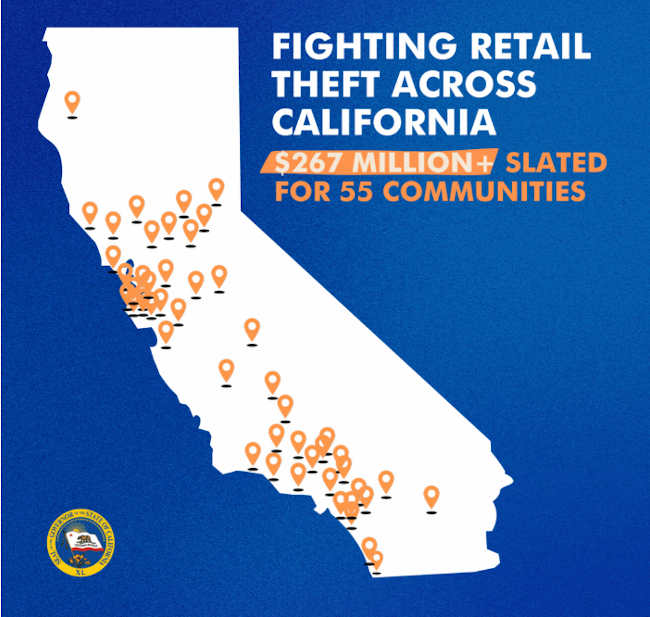
On Tuesday, Gov. Gavin Newsom announced the state is poised to make the largest-ever single investment to combat organized retail crime — $267,118,293.
As part of a competitive grant process, staff are recommending the Board of State and Community Corrections, or BSCC, award funding to 55 local law enforcement agencies across California.
If approved by the BSCC, the funding, part of the Governor’s Real Public Safety Plan, is slated to be dispersed on Oct. 1 to police departments, sheriffs’ departments, and district attorney offices in every region of the state to prevent and investigate cases of organized retail theft and arrest and prosecute more suspects.
Agencies in Humboldt, Sonoma and Yolo counties are among those set to receive funds.
“Enough with these brazen smash-and-grabs. With an unprecedented $267 million investment, Californians will soon see more takedowns, more police, more arrests, and more felony prosecutions. When shameless criminals walk out of stores with stolen goods, they’ll walk straight into jail cells,” Newsom said.
Across the state, 41 sheriffs’ and police departments, as well as one probation department, stand to be awarded up to $23,663,194 each.
The funding would be used to create fully staffed retail theft investigative units, increase arrests, install advanced surveillance technology, train loss prevention officers, create new task forces, increase cooperation with businesses and the community, target criminals in blitz operations, as well as crack down on vehicle and catalytic converter theft.
After a competitive grant application process for the state’s Organized Retail Theft Grant Program, local law enforcement agencies in seven counties and 34 cities are being recommended for funding by BSCC: Orange County, Los Angeles County, Riverside County, Sacramento County, San Mateo County, Santa Clara County, Ventura County and the cities of Anaheim, Bakersfield, Beverly Hills, Brea, Campbell, Chula Vista, Citrus Heights, Clovis, Coalinga, Costa Mesa, Daly City, Delano, Fremont, Fresno, Garden Grove, Hemet, Irvine, Los Angeles, Modesto, National City, Newark, Palm Springs, Palo Alto, Roseville, Salinas, San Bruno, San Fernando, San Francisco, San Jose, San Ramon, Santa Monica, Santa Rosa, and Vacaville. Recommended funding levels and project scopes for each agency are available on BSCC’s website.
Thirteen district attorneys’ offices across California stand to receive up to $2,050,000 each. The funding would be used to establish new vertical prosecution units — new teams dedicated to prosecuting organized retail theft — and to establish county-wide de facto “intelligence centers,” prosecution hubs for all related investigations within a county.
After a competitive grant application process for the Organized Retail Theft Vertical Prosecution Grant Program, the following district attorneys’ offices are being recommended for funding by BSCC: Alameda, Humboldt, Orange, Placer, Riverside, Sacramento, Santa Barbara, Santa Clara, San Francisco, Stanislaus, Sonoma, Ventura, and Yolo.
Recommended funding levels and project scopes for each agency are available on BSCC’s website.
BSCC members are scheduled to vote on the recommendations on Thursday, Sept. 14. The board meeting can be viewed here. All funds for both grants will be allocated in annual installments over the next three years.
This week’s funding is poised to significantly aid local law enforcement in cracking down on organized retail theft and other types of property crime — including vehicle and catalytic converter theft. Local efforts are supported by the California Highway Patrol’s Organized Retail Theft Task Force, or ORCTF, which successfully dismantles large-scale statewide organized crime operations.
Established by Governor Newsom in 2019, the ORCTF has recovered $30.7 million in stolen merchandise, conducted more than 1,850 investigations, and arrested over 1,250 individuals statewide.
Newsom’s office said public safety funding in California is at an all-time high. Building on investments to improve officer retention and well-being and the Governor’s Real Public Safety Plan — which focuses on strengthening local law enforcement response, ensuring perpetrators are held accountable, and getting guns and drugs off our streets — California’s 2023-24 budget includes more than $800 million in funding to support multiple programs to improve public safety and crack down on retail crime, including today’s grants.