 How to resolve AdBlock issue?
News
Dogs available for adoption this week include mixes of border collie, boxer, German shepherd, Great Pyrenees, hound, pit bull, shepherd and terrier.
Dogs that are adopted from Lake County Animal Care and Control are either neutered or spayed, microchipped and, if old enough, given a rabies shot and county license before being released to their new owner. License fees do not apply to residents of the cities of Lakeport or Clearlake.
The following dogs at the Lake County Animal Care and Control shelter have been cleared for adoption.
Call Lake County Animal Care and Control at 707-263-0278 or visit the shelter online for information on visiting or adopting.

Male Great Pyrenees
This 1 and a half year old male Great Pyrenees has a white coat.
He is in kennel No. 3, ID No. LCAC-A-5469.

This 2-month-old male boxer-pit bull puppy has a short tan coat with black and white markings.
He is in kennel No. 5a, ID No. LCAC-A-5806.

Boxer-pit bull puppy
This 2-month-old male boxer-pit bull puppy has a short tan coat with black and white markings.
He is in kennel No. 5b, ID No. LCAC-A-5807.

Male terrier puppy
This 3-month-old male terrier has a short tan coat.
He is in kennel No. 8a, ID No. LCAC-A-5803.

Male terrier puppy
This 3-month-old male terrier has a short tan coat.
He is in kennel No. 8b, ID No. LCAC-A-5804.

Male border collie
This 1-year-old male border collie has a black and white coat.
He is in kennel No. 9, ID No. LCAC-A-5643.

Hound-pit bull terrier
This 6-month-old male hound-pit bull terrier puppy has a black coat with white markings.
He is in kennel No. 12, ID No. LCAC-A-5834.

Hound-pit bull terrier
This 6-month-old male hound-pit bull terrier puppy has a black coat with white and tan markings.
He is in kennel No. 15a, ID No. LCAC-A-5831.

Hound-pit bull terrier
This 6-month-old male hound-pit bull terrier puppy has a white coat with gray markings.
He is in kennel No. 15b, ID No. LCAC-A-5832.

Male pit bull terrier
This 3-year-old male pit bull terrier has a short brown coat.
He is in kennel No. 18, ID No. LCAC-A-5835.

Male pit bull
This 1-year-old male pit bull has a short brindle coat.
He is in kennel No. 21, ID No. LCAC-A-5616.

Male shepherd
This 2-year-old male shepherd has a black and tan coat.
He is in kennel No. 22, ID No. LCAC-A-5423.

Male pit bull terrier
This 1-year-old male pit bull terrier has a short tan coat.
He is in kennel No. 25, ID No. LCAC-A-5628.

Male shepherd
This 1 and a half year old male shepherd has a short tricolor coat.
He is in kennel No. 26, ID No. LCAC-A-5424.

Female German shepherd
This 7-year-old female German shepherd has a black and tan coat.
She is in kennel No. 30, ID No. LCAC-A-5629.

Male German shepherd puppy
This 2-month-old male German shepherd puppy has a black and tan coat.
He is in kennel No. 31a, ID No. LCAC-A-5784.

‘Chikis’
“Chikis” is a 5-year-old female boxer with a short brown coat.
She is in kennel No. 32, ID No. LCAC-A-3672.

‘Nana’
“Nana” is a 2-year-old female shepherd mix with a short yellow coat.
She is in kennel No. 33, ID No. LCAC-A-5277.
Email Elizabeth Larson at
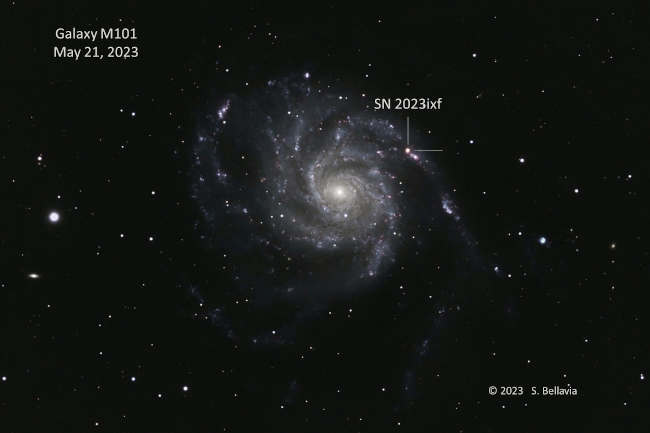
BERKELEY, Calif. — Alex Filippenko is the kind of guy who brings a telescope to a party. True to form, at a soiree on May 18 this year, he wowed his hosts with images of star clusters and colorful galaxies — including the dramatic spiral Pinwheel Galaxy — and snapped telescopic photos of each.
Only late the next afternoon did he learn that a bright supernova had just been discovered in the Pinwheel Galaxy. Lo and behold, he'd also captured it, at 11 p.m. the night before — 11 and a half hours before the explosion's discovery on May 19 by amateur astronomer Koichi Itagaki in Japan.
Filippenko, a professor of astronomy at the University of California, Berkeley, graduate student Sergiy Vasylyev and postdoctoral fellow Yi Yang threw out their planned observations at the UC’s Lick Observatory on Mount Hamilton a few hours later to focus on the exploding star, which had been dubbed SN 2023ixf. They and hundreds of other astronomers were eager to observe the nearest supernova since 2014, a mere 21 million light years from Earth.
These observations were the earliest-ever measurements of polarized light from a supernova, showing more clearly the evolving shape of a stellar explosion. The polarization of light from distant sources like supernovae provides the best information on the geometry of the object emitting the light, even for events that cannot be spatially resolved.
"Some stars prior to exploding go through undulations — fitful behavior that gently ejects some of the material — so that when the supernova explodes, either the shock wave or the ultraviolet radiation causes the stuff to glow," Filippenko said. "The cool thing about the spectropolarimetry is that we get some indication of the shape and extent of the circumstellar material."
The spectropolarimetry data told a story in line with current scenarios for the final years of a red supergiant star about 10 to 20 times more massive than our sun: Energy from the explosion lit up clouds of gas that the star shed over the previous few years; the ejecta then punched through this gas, initially perpendicular to the bulk of the circumstellar material; and finally, the ejecta engulfed the surrounding gas and evolved into a rapidly expanding, but symmetric, cloud of debris.
The explosion, a Type II supernova resulting from the collapse of the iron core of a massive star, presumably left behind a dense neutron star or a black hole. Such supernovae are used as calibratable candles to measure the distances to distant galaxies and map the cosmos.
Another group of astronomers led by Ryan Chornock, a UC Berkeley adjunct associate professor of astronomy, gathered spectroscopic data using the same telescope at Lick Observatory. Graduate student Wynn Jacobson-Galán and professor Raffaella Margutti analyzed the data to reconstruct the pre- and post-explosion history of the star, and found evidence that it had shed gas for the previous three to six years before collapsing and exploding. The amount of gas shed or ejected before the explosion could have been 5% of its total mass — enough to create a dense cloud of material through which the supernova ejecta had to plow.
"I think this supernova is going to make a lot of us think in much more detail about the subtleties of the whole population of red supergiants that lose a lot of material before explosion and challenge our assumptions about mass loss," Jacobson-Galán said. "This was a perfect laboratory to understand in more detail the geometry of these explosions and the geometry of mass loss, something we already felt ignorant about."
The improved understanding of how Type II supernovae evolve could help refine their use as distance measures in the expanding universe, Vasylyev said.
The two papers describing these observations have been accepted for publication in The Astrophysical Journal Letters. Margutti and Chornock are co-authors of both papers.
One of the most studied supernovae to date
In the more than three months since the supernova's light reached Earth, perhaps three dozen papers have been submitted or published about it, with more to come as the light from the explosion continues to arrive and the observations of a variety of telescopes are analyzed.
"In the world of Type II supernovae, it's very rare to have basically every wavelength detected, from hard X-rays to soft X-rays to ultraviolet. to optical, near-infrared, radio, millimeter. So it's really a rare and unique opportunity," said Margutti, a Berkeley professor of physics and of astronomy. "These papers are the beginning of a story, the first chapter. Now we are writing the other chapters of the story of that star."
"The big-picture question here is we want to connect how a star lives with how a star dies," Chornock said. "Given the proximity of this event, it will allow us to challenge the simplifying assumptions that we have to make in most of the other supernovae we study. We have such a wealth of detail that we're going to have to figure out how to fit it all together to understand this particular object, and then that will inform our understanding of the broader universe."
Lick Observatory's telescopes on top of Mount Hamilton near San Jose were critical to the astronomers' efforts to assemble a complete picture of the supernova. The Kast spectrograph on the Shane 120-inch telescope is able to switch quickly from a normal spectrometer to a spectropolarimeter, which allowed Vasylyev and Filippenko to obtain measurements of both the spectrum and its polarization. The group led by Jacobson-Galán, Chornock and Margutti employed both the Kast spectrograph and the photometer on the Nickel 40-inch telescope, with photometry (brightness measurements) also from the Pan-STARRS telescope in Hawaii through the Young Supernova Experiment collaboration.
The polarization of light emitted by an object — that is, the orientation of the electric field of the electromagnetic wave — carries information about the shape of the object. Light from a spherically symmetric cloud, for example, would be unpolarized because the electric fields symmetrically cancel. Light from an elongated object, however, would produce a nonzero polarization.
While polarimetry measurements of supernovae have been going on for more than three decades, few are close enough — and thus bright enough — for such measurements. And no other supernova has been observed as early as 1.4 days after the explosion, as with SN 2023ixf.
The observations yielded some surprises.
"The most exciting thing is that this supernova shows a very high continuum polarization, nearly 1%, at early times," Vasylyev said. "That sounds like a small number, but it's actually a huge deviation from spherical symmetry."
Based on the changing intensity and direction of polarization, the researchers were able to identify three distinct phases in the evolution of the exploding star. Between one and three days after the explosion, the light was dominated by emission from the circumstellar medium, perhaps a disk of material or lopsided blob of gas shed earlier by the star. This was due to ionization of the surrounding gas by ultraviolet and X-ray light from the explosion and by stellar material plowing through the gas, so-called shock ionization.
"Early on, we're saying that most of the light that we're seeing is from some kind of nonspherical circumstellar medium that is confined to somewhere around 30 A.U.," Yang said. An astronomical unit (AU), the average distance between Earth and our sun, is 93 million miles.
At 3.5 days, the polarization quickly dropped by half, and then a day later shifted by nearly 70 degrees, implying an abrupt change in the geometry of the explosion. They interpret this moment, 4.6 days after explosion, as the time when the ejecta from the exploding star broke out from the dense circumstellar material.
"Essentially, it engulfs the circumstellar material, and you get this peanut-shaped geometry," Vasylyev said. "The intuition there is that the material in the equatorial plane is denser, and the ejecta get slowed down, and the path of least resistance will be toward the axis where there's less circumstellar material. That's why you get this peanut shape aligned with the preferential axis through which it explodes."
The polarization remained unchanged between days 5 and 14 after the explosion, implying that the expanding ejecta had overwhelmed the densest region of surrounding gas, allowing emission from the ejecta to dominate over light from shock ionization.
Shock ionization
The spectroscopic evolution roughly agreed with this scenario, Jacobson-Galán said. He and his team saw emissions from the gas surrounding the star about a day after the explosion, likely produced as the ejecta slammed into the circumstellar medium and produced ionizing radiation that caused the surrounding gas to emit light. Spectroscopic measurements of the light from this shock ionization showed emission lines from hydrogen, helium, carbon and nitrogen, which is typical of core-collapse supernovae.
The emissions produced by shock ionization continued for about eight days, after which it decreased, indicating that the shock wave had moved into a less dense area of space with little gas to ionize and re-emit, similar to what Vasylyev and Filippenko observed.
Margutti noted that other astronomers have looked at archival images of the Pinwheel Galaxy and found several occasions when the progenitor star brightened in the years before the explosion, suggesting that the red supergiant repeatedly sloughed off gas. This is consistent with her group's observations of ejecta from the explosion plowing through this gas, though they estimate a density about 1,000 times less than implied by the pre-explosion undulations.
Analysis of other observations, including X-ray measurements, could resolve this issue.
"This is a very special situation where we know what the progenitor was doing before because we saw it slowly oscillating, and we have all the probes in place to try to reconstruct the geometry of the circumstellar medium," she said. "And we know for a fact that it cannot be spherical. By putting together the radiant X-rays with what Wynn found and what Sergiy and Alex are finding, then we will be able to have a complete picture of the explosion."
The astronomers acknowledged the help of numerous researchers and students who gave up their observing time at Lick to allow the teams to focus on SN 2023ixf, and the observational assistance of Thomas Brink, an associate specialist in astronomy at UC Berkeley.
Filippenko captured his early photo of SN 2023ixf with a Unistellar eVscope, which has become popular among amateurs because the telescope subtracts background light and thus allows nighttime viewing in areas like cities, with lots of light pollution. He and 123 other astronomers — mostly amateurs — using Unistellar telescopes recently published their early observations of the supernova.
“This fortuitous observation, obtained while conducting public outreach in astronomy, shows that the star exploded considerably earlier than when Itagaki discovered it,” he said, jokingly adding, “I should have immediately examined my data!”
Filippenko's research was supported by Steven Nelson, the Christopher R. Redlich Fund, Landon Noll, Sunil Nagaraj, Sandy Otellini, Gary and Cynthia Bengier, Clark and Sharon Winslow, Sanford Robertson, Alan Eustace, Frank and Kathleen Wood, and numerous other donors. The work led by Chornock and Margutti was supported by the National Science Foundation, the Heising-Simons Foundation and Marc and Cristina Bensadoun.
Robert Sanders writes for the UC Berkeley News Center.
On Friday, Middletown Unified announced that it will move sixth grade from elementary schools to the middle school beginning with the 2024-25 school year, which the district said is a matter of coming into line with many California school districts.
The agenda for a special meeting of the Middletown Unified Board of Trustees on Aug. 24 included an action item to consider a plan for facilities and exploring all options to accommodate the increase in student numbers.
As part of that item, the board discussed administrative recommendations in the district’s facilities master plan and implementation plan.
That board recommendation document, dated Aug. 18, states: “Middletown Unified School District administration is recommending the move of sixth grade to Middletown Middle School starting the 2024-2025 school year. Our recommendation for moving sixth grade, our Facilities Master Plan (2018), and Implementation Plan (2018) are the foundation for our Measure H Bond funding recommendations. Middletown Middle School facilities are a priority including the new gym to facilitate the welcoming of the sixth-grade students. On page 8 of our implementation plan, it states that mandatory projects are also referred to as ‘safe, warm, and dry.’ These projects relate to building code updates, repair, and maintenance of existing facilities and the physical safety of students. This plan will prepare for the influx of students over the next five years.”
As part of that meeting, the board discussed budgeting for school improvement projects across the district.
The board concluded the discussion with its unanimous vote to approve moving sixth graders to the middle school.
The district said Friday that, a year from now, Middletown elementary schools will consist of grades transitional kindergarten through fifth grade, and Middletown Middle School will comprise grades six through eight.
Part of the reason for the move is the new state requirement for public schools to offer transitional kindergarten to increasingly younger students, the district said.
In a statement released by the district, Middletown Middle School Principal Erin Dorman said, “I'm really excited for sixth graders to join us at the middle school next year. It is going to benefit them in many ways — academically, socially and athletically. I was speaking with some current seventh graders about their own switch to middle school this year and they really like the plan for sixth grade to have a slow transition to switching classes.”
At the end of this school year, the district said elementary schools will have a step-up rally for both fifth and sixth graders to celebrate their transition to middle school.
Starting in fall of 2024, sixth graders will attend school on the middle school campus, but their schedules will be tailored to make the transition to middle school easier, officials reported.
Students will have two primary teachers, as well as a teacher for their elective class, and their lunch period will only be with students in their grade.
Middletown Unified Superintendent Thad Owens said in the Friday announcement that the middle school will allow sixth graders to benefit academically and socially.
The district recently purchased a science and math curriculum designed to support California state standards, which is structured based on middle schools comprising sixth, seventh and eighth grades.
Sixth graders will have 50-minute classes for each subject, including physical education, which will better prepare them for both standardized testing and the academic rigors of high school.
The district said sixth graders also will benefit from access to elective courses. Middletown Middle School offers students four electives per year (one per quarter).
For student athletes, middle school will offer the opportunity to join school sports teams and compete with other Lake County schools.
“We’ve already gotten tons of positive feedback on this move,” Dorman said in the district announcement.
Owens explained that having enough lead time will allow the district to do things right.
“This fall, we’re planning classroom renovations,” Owens said. “This spring, we’ll get those renovations done. This summer, we’ll work with sixth grade teachers to prepare for the transition. We’re looking forward to this — it’s going to be really good for our students. If anyone has any questions, please don’t hesitate to reach out to me.”
Owens can be contacted via email at
Email Elizabeth Larson at
Invasive species – including plants, animals and fish – cause heavy damage to crops, wildlife and human health worldwide. Some prey on native species; other out-compete them for space and food or spread disease. A new United Nations report estimates the losses generated by invasives at more than US$423 billion yearly and shows that these damages have at least quadrupled in every decade since 1970.
Humans regularly move animals, plants and other living species from their home areas to new locations, either accidentally or on purpose. For example, they may import plants from faraway locations to raise as crops or bring in a nonnative animal to prey on a local pest. Other invasives hitch rides in cargo or ships’ ballast water.
When a species that is not native to a particular area becomes established there, reproducing quickly and causing harm, it has become invasive. These recent articles from The Conversation describe how several invasive species are causing economic and ecological harm across the U.S. They also explain steps that people can take to avoid contributing to this urgent global problem.
1. The best intentions: Callery pear trees
Many invasive species were introduced to new locations because people thought they would be useful. One example that’s widely visible across the U.S. Northeast, Midwest and South is the Callery pear (Pyrus calleryana), a flowering tree that botanists brought to the U.S. from Asia more than 100 years ago.
Horticulturists loved the Callery pear for landscaping and wanted to produce trees that all grew and bloomed in the same way. As University of Dayton plant ecologist Ryan W. McEwan explained, they created identical clones from cuttings of trees with the desired characteristics – a process called grafting. Unlike some trees, a Callery pear can’t fertilize its flowers with its own pollen, so plant experts thought it wouldn’t spread.
However, “as horticulturalists tinkered with Callery pears to produce new versions, they made the individuals different enough to escape the fertilization barrier,” McEwan wrote. As wind and birds spread the trees’ seeds, wild populations of the trees became established and started crowding out native species.
Today, Callery pear trees are such scourges that several states have banned them. Others are paying residents to cut them down and replace them with native plants.
2. Tiny organisms, big impacts: Zebra and quagga mussels
Invasive species don’t have to be large to cause outsized damage. Zebra and quagga mussels – shellfish the size of a fingernail – invaded the Great Lakes in the 1980s, clogging water intake pipes and out-competing native mollusks for food. Now they’re spreading west via rivers, lakes and bays, threatening waters all the way to the Pacific coast and Alaska.
As Rochester Institute of Technology environmental historian Christine Keiner wrote, it took several decades for the U.S. and Canada to regulate ships’ management of their ballast water tanks, which was the route by which the mussels were introduced to North America.
“Now, however, other human activities are increasingly contributing to harmful freshwater introductions – and with shipping regulated, the main culprits are thousands of private boaters and anglers,” Keller wrote. Limiting the destructive impacts of invasive species “requires scientific, technological and historical knowledge, political will and skill to persuade the public that everyone is part of the solution.”

3. Threatening entire ecosystems: Lionfish
When an invasive species is especially successful at spreading and reproducing, it can threaten the health of entire ecosystems. Consider the Pacific red lionfish (Pterois volitans), which has spread throughout the Caribbean and now is moving south along Brazil’s coast.
Lionfish thrive in many ocean habitats, from coastal mangrove forests to deepwater reefs, and they prey on numerous smaller fish species. In the Caribbean, they have reduced the number of small juvenile fish on reefs by up to 80% within as little as five weeks.
“Scientists and environmental managers widely agree that the lionfish invasion in Brazil is a potential ecological disaster,” warned Brazilian marine ecologist Osmar J. Luiz of Charles Darwin University. “Brazil’s northeast coast, with its rich artisanal fishing activity, stands on the front line of this invasive threat.”
Although the Brazilian government was slow to address the lionfish threat, Luiz asserted that “with strategic, swift action and international collaboration, it can mitigate the impacts of this invasive species and safeguard its marine ecosystems.” That will require many techniques, from recruiting coastal residents to monitor for the invaders to tracking lionfish subpopulations using DNA analysis.
4. The value of acting locally
Public awareness is critical for stemming the spread of many invasive plants and animals. That can involve actions as simple as cleaning your shoes and socks after a hike.
“Certain species of nonnative invasive plants produce seeds designed to attach to unsuspecting animals or people. Once affixed, these sticky seeds can be carried long distances before they fall off in new environments,” explains Boise State University ecology Ph.D. candidate Megan Dolman.
Research shows that recreational trails promote the introduction of invasive plant species into natural and protected areas, including national parks and scenic trails.
In her research, Dolman found that few Appalachian Trail hikers were aware of the risk of carrying invasive plant seeds on their shoes or socks, so they typically did not take steps such as cleaning their gear before and after hiking. By knowing about invasive species in their areas and ways to manage them, people can help protect special places and keep invasive species from spreading.
Editor’s note: This story is a roundup of articles from The Conversation’s archives.
Jennifer Weeks, Senior Environment + Cities Editor, The Conversation
This article is republished from The Conversation under a Creative Commons license. Read the original article.

A trust cannot own a retirement account — such as an IRA or 401(k) — but it can be named as a death beneficiary.
Until 2020, individuals receiving distributions from a retirement plan as a death beneficiary, either directly or as a beneficiary of a trust could expect to take annual taxable income distributions stretched out over their own lifetime; the stretch-out provided both tax deferred growth and income tax savings.
In 2020 the so-called, ”Setting Every Community Up for Retirement Enhancement,” or “SECURE,” Act of 2019 greatly reduced who was eligible for such benefits.
A limited pool of death beneficiaries, i.e., so-called, “eligible designated death beneficiaries,” or EDBs, now continue to receive the so-called “stretch out” lifetime death “required minimum distribution,” or RMD, payments (i.e., over the beneficiary’s lifetime).
EDBs include a surviving spouse, a disabled or chronically ill person, a minor child of the retirement plan participant, and a person who is not more than ten years younger than the plan participant or owner.
All other individual death beneficiaries who are not EDBs are called designated beneficiaries. A designated beneficiary must receive his RMD distributions over a 10-year period by which time everything must be fully distributed.
In 2022, the Internal Revenue Service issued new proposed regulations that now also require annual RMD distributions for designated beneficiaries within the 10-year period.
Designating a trust as beneficiary should only occur after careful estate planning regarding current “RMD” rules: Will the trust qualify as a designated beneficiary for maximum tax deferred RMD distributions under the IRS rules, and, if so, what annual RMDs and what final distribution year rules might apply.
If the trust itself does qualify as a designated beneficiary then the RMD rules depend on whether the individual trust beneficiaries are designated beneficiaries and/or EDBs.
Otherwise, if the trust is not a designated beneficiary, such as because it has a beneficiary who is not an individual (e.g., a charity), then either more or usually less favorable RMD rules apply.
Thus, what is at stake is preserving either the EDBs lifetime stretch out or the designated beneficiaries 10-year distribution period, as relevant.
Generally, it is best to name individuals as death beneficiaries to retirement plans. This avoids unintended income tax consequences associated with having a trust as beneficiary.
A trust should only be named as a death beneficiary to a retirement account when there is a good reason, such as, (1) the beneficiary is a disabled or incapacitated person receiving needs based government benefits; (2) the beneficiary is a minor; (3) the beneficiary has creditor problems; and (4) the trust has a complex distribution scheme.
Whether a trust qualifies as a designated beneficiary is determined at the retirement plan participant or owner’s date of death. First, does the trust satisfy the four so-called “see through” rules to allow the trust to qualify as a designated death beneficiary? This is rarely an issue (except infrequently when all trust beneficiaries are not identifiable).
Second, the trust itself must, for RMD purposes, be categorized as either a, “conduit trust” or as an, “accumulation trust.”
A “conduit trust’ is one that requires that, “all receipts of income from a retirement plan received by the trustee must be distributed in the same tax year either to or for benefit of the beneficiary.”
Any other trust is an “accumulation trust” which may accumulate retirement account distributions.
Third, all individual trust beneficiaries must be identified and listed, each beneficiary then be categorized as either a countable or a disregarded beneficiary when applying RMD rules.
All persons who either must or may receive benefits following the death of a participant are countable. Any alternative (back-up) beneficiaries who only stand to inherit if some other beneficiary dies, are secondary and may sometimes be disregarded for applying RMD rules.
Every listed beneficiary who either must or who may receive a benefit from the trust counts when applying RMD rules.
Secondary (alternative) death trust beneficiaries, i.e., who might receive benefits if a primary intended beneficiary were to die, are sometimes disregarded. With a conduit trust any secondary (alternative) death beneficiary is disregarded.
Fourth, if a trust is named a beneficiary and the trust is not an ongoing conduit trust or an ongoing accumulation trust but distributes assets outright to trust death beneficiaries at the settlor’s death, then unless one or more disabled or chronically ill trust beneficiaries are involved, each countable individual trust beneficiary is considered when determining a single annual RMD rule for all trust beneficiaries.
However, if a disabled or incapacitated trust beneficiary is involved, the new 2022 regulations provide that each trust beneficiary is considered separately as if each beneficiary had been named individually instead of naming the trust.
The annual RMD rules are then applied separately to each beneficiary’s share so long as one or more disabled or chronically ill trust beneficiaries are involved.
Thus, for example, if one trust beneficiary is a disabled or chronically ill EDB they can inherit their share of the decedent’s IRA subject to their EDB lifetime stretch-out annual and final year distribution RMD rules and any other beneficiary who is an ordinary DB will inherit subject both to the designated beneficiary’s 10-year final distribution and annual RMD rules.
Dennis A. Fordham, Attorney, is a State Bar-Certified Specialist in estate planning, probate and trust law. His office is at 870 S. Main St., Lakeport, Calif. He can be reached at
Using NASA’s Neil Gehrels Swift Observatory, which launched in 2004, scientists have discovered a black hole in a distant galaxy repeatedly nibbling on a Sun-like star.
The object heralds a new era of Swift science made possible by a novel method for analyzing data from the satellite’s X-ray Telescope, or XRT.
“Swift’s hardware, software, and the skills of its international team have enabled it to adapt to new areas of astrophysics over its lifetime,” said Phil Evans, an astrophysicist at the University of Leicester in the United Kingdom and longtime Swift team member. “Neil Gehrels, the mission’s namesake, oversaw and encouraged many of those transitions. Now, with this new ability, it’s doing even more cool science.”
Evans led a study about the unlucky star and its hungry black hole, collectively called Swift J023017.0+283603 (or Swift J0230 for short), which was published on Sept. 7 in Nature Astronomy.
When a star strays too close to a monster black hole, gravitational forces create intense tides that break the star apart into a stream of gas. The leading edge swings around the black hole, and the trailing edge escapes the system.
These destructive episodes are called tidal disruption events. Astronomers see them as flares of multiwavelength light created when the debris collides with a disk of material already orbiting the black hole.
Recently, astronomers have been investigating variations on this phenomena, which they call partial or repeating tidal disruptions.
During these events, every time an orbiting star passes close to a black hole, the star bulges outward and sheds material, but survives. The process repeats until the star loses too much gas and finally breaks apart.
The characteristics of the individual star and black hole system determine what kind of emission scientists observe, creating a wide array of behaviors to categorize.
Previous examples include an outburst that occurred every 114 days, potentially caused by a giant star orbiting a black hole with 78 million times the Sun’s mass. Another recurred every nine hours around a black hole with 400,000 times the Sun’s mass, likely caused by an orbiting stellar cinder called a white dwarf.
On June 22, 2022, the XRT captured Swift J0230 for the first time. It lit up in a galaxy around 500 million light-years away in the northern constellation Triangulum. Swift’s XRT observed nine additional outbursts from the same location roughly every few weeks.
Evans and his team propose that Swift J0230 is a repeating tidal disruption of a Sun-like star orbiting a black hole with over 200,000 times the Sun’s mass. They estimate the star loses around three Earth masses of material on each pass. This system provides a bridge between other types of suspected repeating disruptions and allowed scientists to model how interactions between different star types and black hole sizes affect what we observe.
“We searched and searched for the event brightening in the data collected by Swift’s Ultraviolet/Optical Telescope,” said Alice Breeveld, a research fellow at the University College London’s Mullard Space Science Laboratory (MSSL) who has worked on the instrument since before the satellite launched. “But there wasn’t any sign of it. The galaxy’s variability was entirely in X-rays. That helped rule out some other potential causes.”
Swift J0230’s discovery was possible thanks to a new, automated search of XRT observations, developed by Evans, called the Swift X-ray Transient Detector.
After the instrument observes a portion of the sky, the data is transmitted to the ground, and the program compares it to previous XRT snapshots of the same spot. If that portion of the X-ray sky has changed, scientists get an alert. In the case of Swift J0230, Evans and his colleagues were able to rapidly coordinate additional observations of the region.
Swift was originally designed to study gamma-ray bursts, the most powerful explosions in the cosmos. Since the satellite launched, however, scientists have recognized its ability to study a whole host of celestial objects, like tidal disruptions and comets.
“Swift J0230 was discovered only about two months after Phil launched his program,” said S. Bradley Cenko, the mission’s principal investigator at NASA’s Goddard Space Flight Center in Greenbelt, Maryland. “It bodes well for the detector’s ability to identify other transient events and for Swift’s future exploring new spaces of science.”
Goddard manages the Swift mission in collaboration with Penn State, the Los Alamos National Laboratory in New Mexico, and Northrop Grumman Space Systems in Dulles, Virginia. Other partners include Leicester, MSSL, Brera Observatory in Italy, and the Italian Space Agency.
Jeanette Kazmierczak works for NASA’s Goddard Space Flight Center in Greenbelt, Maryland.