How to resolve AdBlock issue?
News
As people, we are all shaped by the neighborhoods we grew up in, whether it was a bustling urban center or the quiet countryside. Objects in distant outer space are no different.
As an astronomer at the University of Arizona, I like to think of myself as a cosmic historian, tracking how supermassive black holes grew up.
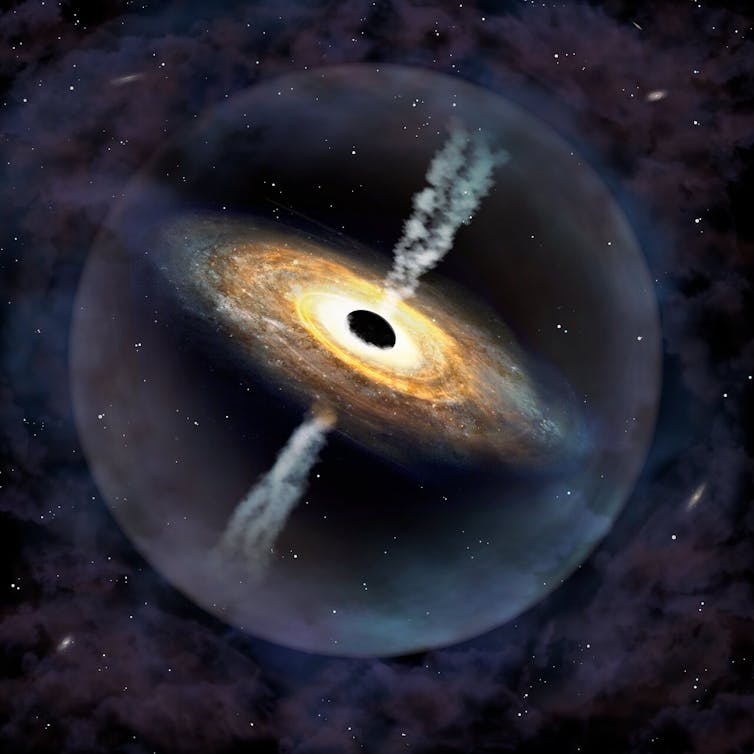
Like you, every supermassive black hole lives in a home – its host galaxy – and a neighborhood – its local group of other galaxies. A supermassive black hole grows by consuming gas already inside its host galaxy, sometimes reaching a billion times heavier than our Sun.
Theoretical physics predicts that black holes should take billions of years to grow into quasars, which are extra bright and powerful objects powered by black holes. Yet astronomers know that many quasars have formed in only a few hundred million years.
I’m fascinated by this peculiar problem of faster-than-expected black hole growth and am working to solve it by zooming out and examining the space around these black holes. Maybe the most massive quasars are city slickers, forming in hubs of tens or hundreds of other galaxies. Or maybe quasars can grow to huge proportions even in the most desolate regions of the universe.
Galaxy protoclusters
The largest object that can form in the universe is a galaxy cluster, containing hundreds of galaxies pulled by gravity to a common center. Before these grouped galaxies collapse into a single object, astronomers call them protoclusters. In these dense galaxy neighborhoods, astronomers see colliding galaxies, growing black holes and great swarms of gas that will eventually become the next generation of stars.
These protocluster structures grow much faster than we thought, too, so we have a second cosmic problem to solve – how do quasars and protoclusters evolve so quickly? Are they connected?

To look at protoclusters, astronomers ideally obtain images, which show the galaxy’s shape, size and color, and a spectrum, which shows the galaxy’s distance from Earth through specific wavelengths of light, for each galaxy in the protocluster.
With telescopes like the James Webb Space Telescope, astronomers can see galaxies and black holes as they were billions of years ago, since the light emitted from distant objects must travel billions of light-years to reach its detectors. We can then look at protoclusters’ and quasars’ baby pictures to see how they evolved at early times.
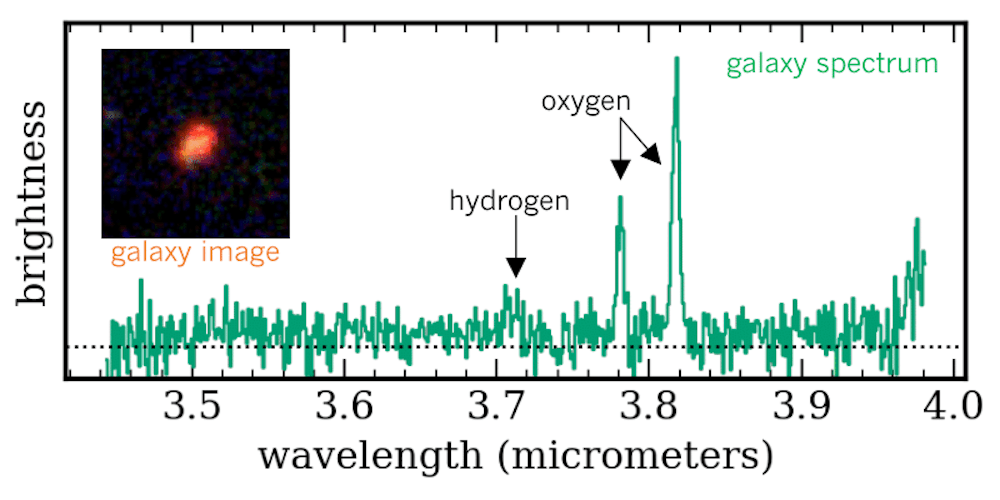
It is only after looking at spectra that astronomers determine whether the galaxies and quasars are actually close together in three-dimensional space. But getting spectra for every galaxy one at a time can take many more hours than any astronomer has, and images can show galaxies that look closer together than they actually are.
So, for a long time, it was only a prediction that massive quasars might be evolving at the centers of vast galactic cities.
An unprecedented view of quasar environments
Now, Webb has completely revolutionized the search for galaxy neighborhoods because of an instrument called a wide-field slitless spectrograph.
This instrument takes spectra of every galaxy in its field of view simultaneously so astronomers can map out an entire cosmic city at once. It encodes the critical information about galaxies’ 3D locations by capturing the light emitted from gas at specific wavelengths – and in only a few hours of observing time.
The first Webb projects are hoping to look at quasar environments focused on a period about 800 million years after the Big Bang. This time period is a sweet spot in which astronomers can view these monster quasars and their neighbors using the light emitted by hydrogen and oxygen. The wavelengths of these light features show where the objects emitting them are along our line of sight, allowing astronomers to complete the census of where galaxies live relative to bright quasars.
One such ongoing project is led by the ASPIRE team at the University of Arizona’s Steward Observatory. In an early paper, they found a protocluster around an extremely bright quasar and confirmed it with 12 galaxies’ spectra.
Another study detected over a hundred galaxies, looking toward the single most luminous quasar known in the early universe. Twenty-four of those galaxies were close to the quasar or in its neighborhood.
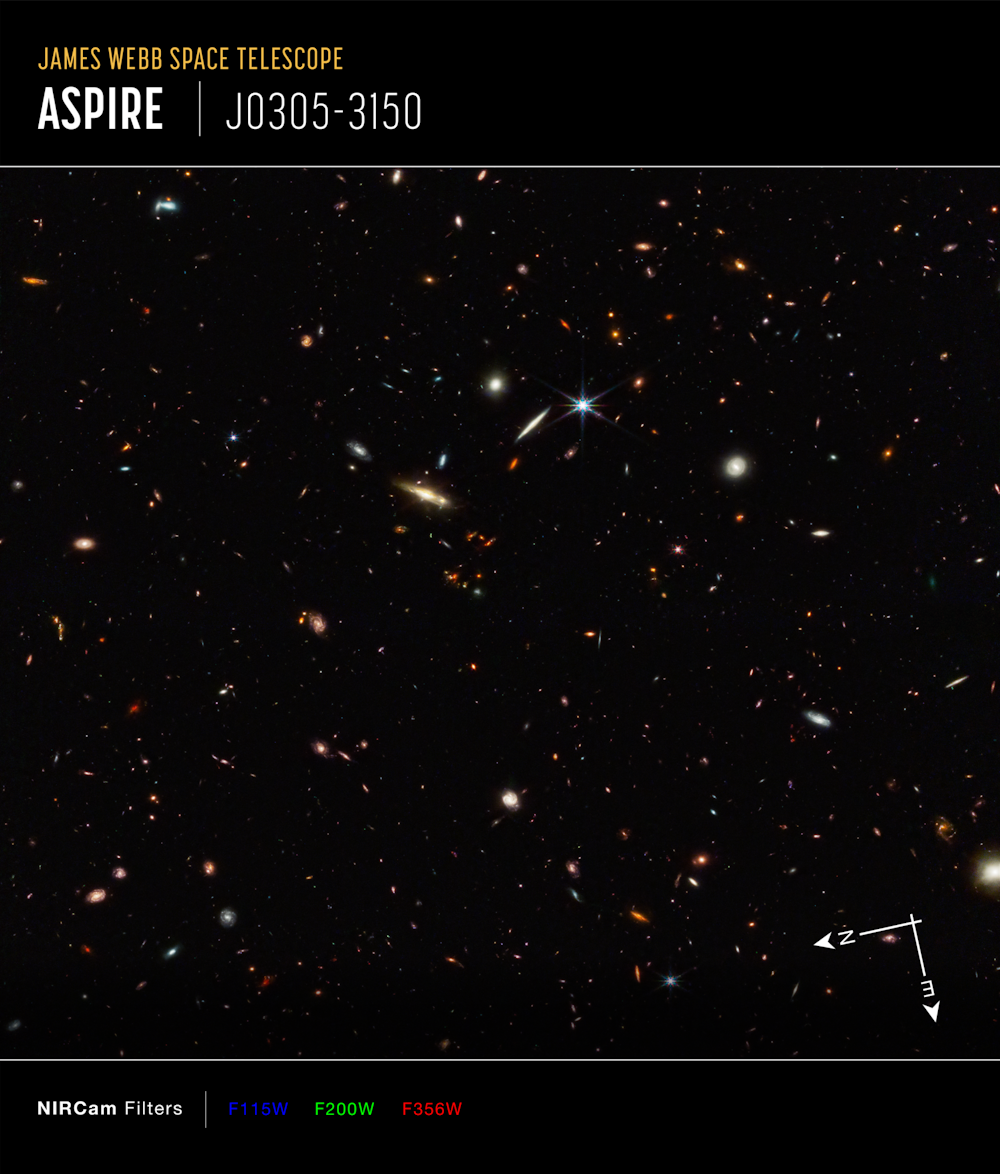
In ongoing work, my team is learning more details about mini galaxy cities like these. We want to figure out if individual galaxies show high rates of new star formation, if they contain large masses of old stars or if they are merging with one another. All these metrics would indicate that these galaxies are still actively evolving but had already formed millions of years before we observed them.
Once my team has a list of the properties of the galaxies in an area, we’ll compare these properties with a control sample of random galaxies in the universe, far away from any quasar. If these metrics are different enough from the control, we’ll have good evidence that quasars do grow up in special neighborhoods – ones developing much faster than the more sparse regions of the universe.
While astronomers still need more than a handful of quasars to prove this hypothesis on a larger scale, Webb has already opened a window into a bright future of discovery in glorious, high-resolution detail.
Jaclyn Champagne, JASPER Postdoctoral Researcher, University of Arizona
This article is republished from The Conversation under a Creative Commons license. Read the original article.
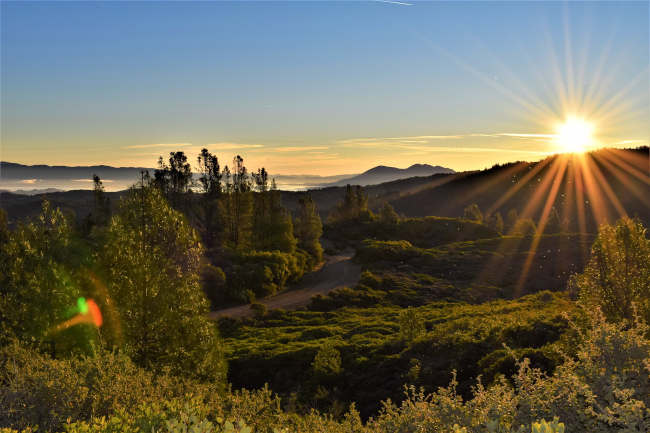
NORTH COAST, Calif. — The Bureau of Land Management is inviting the public to roll up their sleeves and come out on Saturday, Sept. 23, from 9 a.m. to noon, to help beautify the Westside Staging Area at South Cow Mountain for the 30th annual National Public Lands Day.
Participants are encouraged to bring water, hats, sunscreen, gloves and sturdy work boots.
Volunteers are needed to help repair the loading ramp, clean the parking area of sediment runoff, remove damaged signs and paint bathrooms.
“Public land visitors who give back by pitching in during National Public Lands Days are a huge help in keeping our recreation areas clean and safe year after year,” said Ukiah Field Manager Nicholas Lavrov. “Volunteers make a big difference in helping the BLM offer the best recreation opportunity possible.”
South Cow Mountain Off-highway Vehicle Management Area is a favorite recreation area consisting of approximately 23,000 acres of public lands for off-highway vehicle use.
Event volunteers will receive a free tee-shirt and lunch will be provided. After lunch, there will be opportunities to explore South Cow Mountain with fellow enthusiasts and BLM staff.
Feel free to bring out an off-highway vehicle and safety gear.
For more information about National Public Lands Day, visit the National Environmental Education Foundation website.
For more information about the event, please reach out to Ukiah Assistant Field Manager Shane Garside at 707-468-4081,
The purpose of High School Education Weeks is to bring awareness to our young and future voters, setting them on a pathway for continued civic engagement.
Eligible students ages 16 and 17 can be civically engaged by pre-registering to vote. If students pre-register to vote, they will automatically become voters when they turn 18.
Eligible students can register to vote online at https://registertovote.ca.gov/ or at the Lake County Registrar of Voters office at 325 N. Forbes St. in Lakeport.
Registrations are also available at all Lake County Libraries and post offices. Staff will set up a booth on scheduled Farmer’s Market days including Tuesday, Sept. 29, from 10 a.m. to 1 p.m.
By working together, we can educate and encourage our young citizens to register to vote and ensure their voices are heard when they are eligible to vote.
For additional information phone 707-263-2372 or toll-free at 888-235-6730.
On Sept. 12, 2023, the Centers for Disease Control and Prevention recommended the newly formulated COVID-19 vaccines for all Americans ages 6 months and up, hours after its expert advisory committee voted 13 to 1 in favor of recommending the vaccines.
The CDC’s broad recommendation comes one day after the Food and Drug Administration approved Moderna’s and Pfizer’s updated mRNA vaccines that target a previously dominant variant of the omicron family called XBB.1.5. The updated shots will be available to the public within days.
The Conversation asked Prakash Nagarkatti and Mitzi Nagarkatti, a husband and wife team of immunologists from the University of South Carolina, to weigh in on how the new vaccines might stand up against the latest COVID-19 variants that are swirling across the globe.
1. How are the new vaccines different from the previous?
When the first vaccine against COVID-19 was rolled out in December 2020, it was designed as a monovalent vaccine, meaning that it was formulated against only the original SARS-CoV-2 virus. That vaccine, as well as the updated ones, target the spike protein, which the virus uses to infect our cells and cause the disease.
That design made sense before the virus began mutating into a complex family tree of variants and sublineages. But as the virus structure shifted over time, the antibodies produced in response to the original vaccine became less effective against the new variants.
This necessitated the development in 2022 of new “bivalent” vaccines that targeted both the original strain of SARS‑CoV‑2 and new viral variants such as the omicron BA.4 and BA.5 lineages that were dominant in mid-2022.
But, not surprisingly, new variants of the virus continued to emerge.
In June 2023, the FDA asked vaccine developers to formulate new fall shots to target the then-dominant XBB.1.5 subvariant.
The FDA approved that monovalent mRNA-based vaccine based on the overall efficacy data presented by the vaccine manufacturers.
Unfortunately, XBB.1.5 is no longer the dominant strain in the U.S.; it has been displaced by other variants from the XBB lineage, thereby raising concerns about the potential efficacy of the new shot. As of mid-September, the dominant variants nationwide are EG.5, also known as Eris, followed by FL.1.5.1 – called Fornax – and XBB.1.16.6.
Meanwhile, a new highly mutated omicron offshoot, BA.2.86, nicknamed Pirola, is making its way across the globe – albeit so far in small numbers.
2. Who should get a new shot?
The CDC recommended that everyone ages 6 months old and up should get an updated COVID-19 vaccine so that they can be better protected against developing serious outcomes from COVID-19, including hospitalization. The agency noted that people who received the 2022-2023 bivalent COVID-19 shot “saw greater protection against illness and hospitalization than those who did not.”
Most Americans will be able to get the newly formulated vaccine at no cost, according to the CDC.
The FDA approved a single shot of the updated vaccine for anyone ages 5 and older – regardless of whether they were previously vaccinated or not. The agency also approved unvaccinated individuals 6 months to 4 years of age to receive three doses of the updated Pfizer vaccine or two doses of the updated Moderna vaccine.
3. How effective could the updated shot be against the latest variants?
Based on its current assessment, the CDC indicates that the BA.2.86 variant may be able to cause infection even in people who have been previously vaccinated or those who have had COVID-19 infection in the past. But the CDC says it still expects the updated fall 2023 booster shot to be effective at reducing severe disease and hospitalization.
Moderna reported in August 2023 that the new monovalent mRNA COVID-19 vaccine gave a “significant boost” in antibodies that are protective against two of the currently circulating variants: EG.5 – which is responsible for most cases in the U.S. as of mid-September – and FL.1.5.1. Then, in early September, Moderna announced that its most recent data from human trials showed an 8.7-fold increase in neutralizing antibodies against the newest variant, BA.2.86, following vaccination with the updated shot.
Similarly, new pre-clinical data from Pfizer shows that its version of the new mRNA vaccine produced antibodies that were effective at neutralizing the XBB.1.5, BA.2.86 and EG.5.1 variants.
This early research suggests that the new mRNA vaccines – although developed specifically against XBB.1.5 – are still effective against some of the most prevalent variants.
Novavax, which specializes in traditional protein-based vaccines, also announced in August that its updated COVID-19 vaccine directed against the XBB variant produced a broad neutralizing antibody response against key variants in animal studies. However, the company does not yet have data on its vaccine’s performance against two other key variants, FL.1.5.1 and BA.2.86. The Novavax vaccine has not yet gone up for FDA review, but its approval is also expected within months.
It is important to keep in mind that while all three vaccines have been shown to trigger antibodies that can neutralize most of the currently circulating variants, it is unclear whether the vaccines will be able to effectively prevent COVID-19 infection in humans. Such clinical studies are time-consuming, so given the urgency and speed needed to develop vaccines against the ever-changing COVID-19 variants, vaccine manufacturers rely on antibody levels as an indicator of protection.
4. Is there a ‘right’ time to get the new vaccine?
Antibodies produced after a COVID-19 infection or vaccination last for about six months, and then their levels start declining. This is called “waning immunity.”
About a year after getting a COVID-19 infection or vaccination, only a small fraction of antibodies can be detected. This is why health care providers recommend getting another shot if a year has passed since you were vaccinated or had an active infection.
It has become very clear that vaccines against COVID-19 do not provide 100% protection against catching a new COVID-19 infection, but they can make illness from the infection milder, shorter or both.
In addition, vaccines provide significant protection from hospitalization and death and may help protect against developing long COVID.
Viral infections normally peak in the winter, which is why experts advise getting both COVID-19 and flu vaccine shots in the months of September and October. For convenience, the two shots can be safely taken at the same time. This is because the immune cells that produce antibodies against one vaccine agent are distinct from those that produce antibodies against the other vaccine agent.
However, taking two different vaccines at the same time could cause more side effects, such as fever, aches and pain. This is especially the case for people who have experienced such side effects in the past after taking the COVID-19 and flu vaccines separately.
In addition, a newly approved vaccine against the respiratory syncytial virus, or RSV, is now recommended for people ages 60 and up.
5. Should some people wait for the updated Novavax vaccine?
The Moderna and Pfizer vaccines use the more recent vaccine technology based on mRNA, which instructs the body to produce a protein from a small portion of the SARS-CoV-2 virus. The immune system responds by producing antibodies.
In contrast, the Novavax vaccine relies on a more traditional approach to vaccine production, injecting the viral protein directly into the body to stimulate antibody production. So while the two vaccine types use different pathways to trigger antibodies against the virus, the end result is the same.
The CDC has reported rare cases of myocarditis, which is inflammation of the heart muscle, following vaccination with the Moderna and Pfizer mRNA vaccines. However, the same is true of the Novavax vaccine. So all three vaccines carry this very rare risk.
It is noteworthy that myocarditis is most frequently seen in adolescent and young adult males.
Although some people may have a preference for the traditional protein-based vaccine by Novavax, those who are at higher risk of catching COVID-19 should not wait for the approval of the Novavax vaccine to get their shot.
Prakash Nagarkatti, Professor of Pathology, Microbiology and Immunology, University of South Carolina and Mitzi Nagarkatti, Professor of Pathology, Microbiology and Immunology, University of South Carolina
This article is republished from The Conversation under a Creative Commons license. Read the original article.

CLEARLAKE, Calif. — Clearlake Animal Control has two new dogs among the canines waiting for go to new homes this week.
The Clearlake Animal Control website continues to list 32 dogs for adoption.
This week’s dogs include a puppy named “Cedar.”
He is a standard smooth-haired dachshund mix with a brown and copper-colored coat.

There also is “Josie,” a 3 and a half year old Labrador retriever mix. She has a black coat with white markings, and she has been spayed.
The shelter is located at 6820 Old Highway 53. It’s open from 9 a.m. to 6 p.m. Tuesday through Saturday.
For more information, call the shelter at 707-762-6227, email
This week’s adoptable dogs are featured below.
Email Elizabeth Larson at
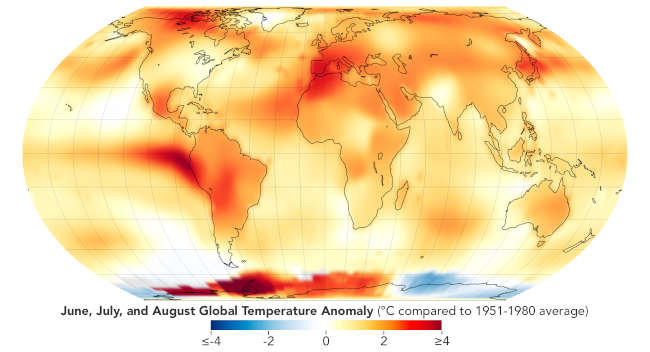
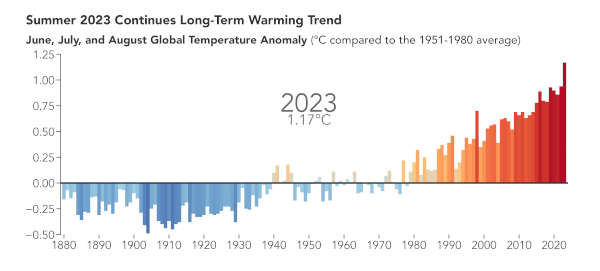
Summer of 2023 was Earth’s hottest since global records began in 1880, according to scientists at NASA’s Goddard Institute of Space Studies, or GISS, in New York.
The months of June, July, and August combined were 0.41 degrees Fahrenheit (0.23 degrees Celsius) warmer than any other summer in NASA’s record, and 2.1 degrees F (1.2 C) warmer than the average summer between 1951 and 1980. August alone was 2.2 F (1.2 C) warmer than the average. June through August is considered meteorological summer in the Northern Hemisphere.
This record comes as exceptional heat swept across much of the world, exacerbating deadly wildfires in Canada and Hawaii, and searing heat waves in South America, Japan, Europe, and the U.S., while likely contributing to severe rainfall in Italy, Greece, and Central Europe.
“Summer 2023’s record-setting temperatures aren’t just a set of numbers — they result in dire real-world consequences. From sweltering temperatures in Arizona and across the country, to wildfires across Canada, and extreme flooding in Europe and Asia, extreme weather is threatening lives and livelihoods around the world,” said NASA Administrator Bill Nelson. “The impacts of climate change are a threat to our planet and future generations, threats that NASA and the Biden-Harris Administration are tackling head on.”
NASA assembles its temperature record, known as GISTEMP, from surface air temperature data acquired by tens of thousands of meteorological stations, as well as sea surface temperature data from ship- and buoy-based instruments. This raw data is analyzed using methods that account for the varied spacing of temperature stations around the globe and for urban heating effects that could skew the calculations.
The analysis calculates temperature anomalies rather than absolute temperature. A temperature anomaly shows how far the temperature has departed from the 1951 to 1980 base average.
“Exceptionally high sea surface temperatures, fueled in part by the return of El Niño, were largely responsible for the summer’s record warmth,” said Josh Willis, climate scientist and oceanographer at NASA’s Jet Propulsion Laboratory in Southern California.
El Niño is a natural climate phenomenon characterized by warmer than normal sea surface temperatures (and higher sea levels) in the central and eastern tropical Pacific Ocean.
The record-setting summer of 2023 continues a long-term trend of warming. Scientific observations and analyses made over decades by NASA, National Oceanic and Atmospheric Administration (NOAA), and other international institutions have shown this warming has been driven primarily by human-caused greenhouse gas emissions. At the same time, natural El Niño events in the Pacific pump extra warmth into the global atmosphere and often correlate with the warmest years on record.
“With background warming and marine heat waves that have been creeping up on us for decades, this El Niño shot us over the hump for setting all kinds of records,” Willis said. “The heat waves that we experience now are longer, they’re hotter, and they’re more punishing. The atmosphere can also hold more water now, and when it’s hot and humid, it’s even harder for the human body to regulate its temperature.”
Willis and other scientists expect to see the biggest impacts of El Niño in February, March, and April 2024. El Niño is associated with the weakening of easterly trade winds and the movement of warm water from the western Pacific toward the western coast of the Americas. The phenomenon can have widespread effects, often bringing cooler, wetter conditions to the U.S. Southwest and drought to countries in the western Pacific, such as Indonesia and Australia.
“Unfortunately, climate change is happening. Things that we said would come to pass are coming to pass,” said Gavin Schmidt, climate scientist and director of GISS. “And it will get worse if we continue to emit carbon dioxide and other greenhouse gases into our atmosphere.”
NASA’s full temperature data set and the complete methodology used for the temperature calculation and its uncertainties are available online.
GISS is a NASA laboratory managed by the Earth Sciences Division of the agency’s Goddard Space Flight Center in Greenbelt, Maryland. The laboratory is affiliated with Columbia University’s Earth Institute and School of Engineering and Applied Science in New York.
For additional figures and maps related to this announcement, visit https://svs.gsfc.nasa.gov/14407.