 How to resolve AdBlock issue?
News
The Clearlake Animal Control website lists 37 adoptable dogs.
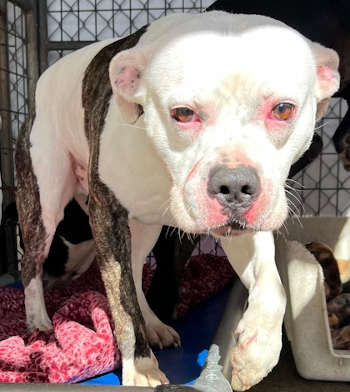
This week’s dogs include a new arrival, “Brutus,” an American pit bull terrier mix. He is neutered and has a short white coat with brindle markings.
Another new dog available for adoption is “Bung Bung,” a male Alaskan malamute mix. He has a black and white coat, and is neutered.
The shelter is located at 6820 Old Highway 53. It’s open from 9 a.m. to 6 p.m. Tuesday through Saturday.

For more information, call the shelter at 707-762-6227, email
This week’s adoptable dogs are featured below.
Email Elizabeth Larson at
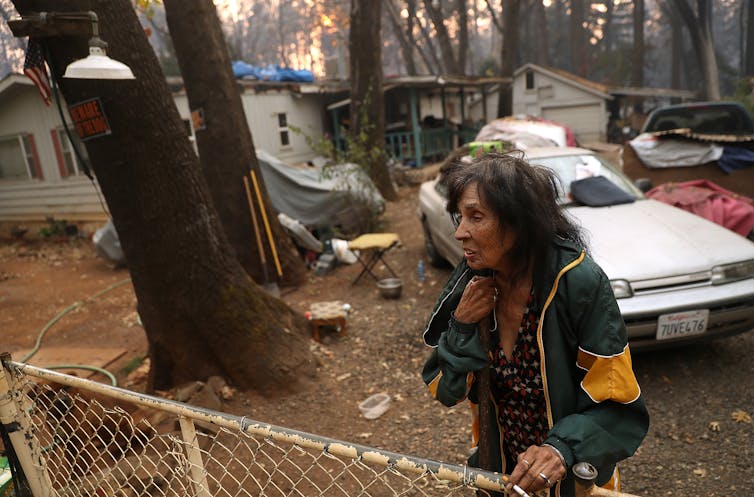
As wildfires burn across the Western U.S., the people in harm’s way are increasingly those least able to protect their homes from fire risks, evacuate safely or recover after a fire.
In a new study, we and a team of fellow wildfire scientists examined who lived within the perimeters of wildfires over the past two decades in Washington, Oregon and California – home to about 90% of Americans in the U.S. West exposed to wildfires over that period.
Overall, nearly half a million people in California, Oregon and Washington were exposed to wildfires at some point during the past 22 years. Alarmingly, about half the people exposed to wildfires in Washington and Oregon were considered socially vulnerable.
While the number of people exposed to fire rose overall, the number of socially vulnerable people exposed more than tripled between the first and second decades.
How social vulnerability affects fire risk
A variety of factors shape social vulnerability, including wealth, race, age, disability and fluency in the local language.
These factors can make it harder to take steps to protect homes from wildfire damage, evacuate safely and recover after a disaster. For example, low-income residents often can’t afford adequate insurance coverage that could help them rebuild their homes after a fire. And residents who don’t speak English may not hear about evacuation orders or know how to get assistance after a disaster.
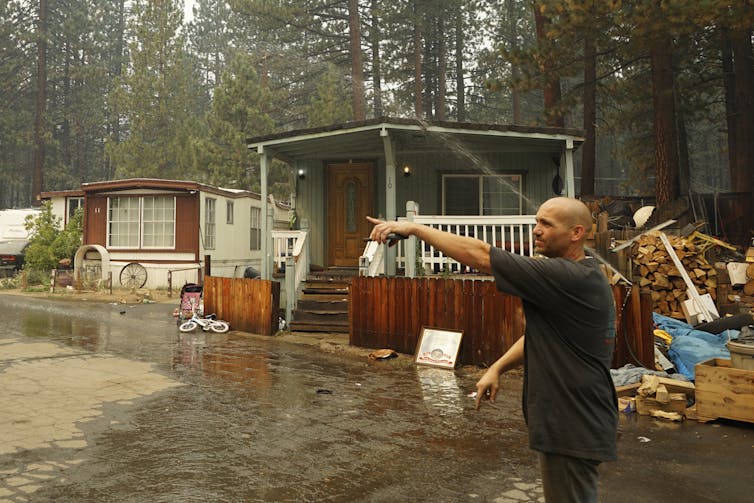
Older adults face rising fire exposure
We found that older adults in particular were disproportionately exposed to wildfires in all three states.
Physical difficulties and cognitive decline can hamper older adults’ ability to keep their properties clear of flammable materials, such as dry shrubs and grasses, and can slow their ability to evacuate in an emergency. The fire that destroyed the town of Paradise, California, in 2018 was a tragic example. Of the 85 victims, 68 were 65 years of age or older.
Poverty was another important factor in the exposure of people with high vulnerability to wildfires in Oregon and Washington.
The reasons that socially vulnerable people were increasingly exposed to wildfires varied by state.
In California, the rise was in large part due to socially vulnerable people moving into wildfire-affected areas, possibly in search of more affordable housing, among other factors.
In Oregon and Washington, however, wildfires have increasingly encroached on existing vulnerable communities over the past decade, mainly in rural areas. This is predominantly due to increasing trends of intense, destructive fires.
Nearly 17,000 people living within the perimeter of wildfires in Oregon and Washington over the past decade had high social vulnerability, based on data from the Centers for Disease Control and Prevention. A smaller percentage of California’s exposed population from 2011-2021 was considered to have high social vulnerability, 11%, but that was still 26,100 people.
Secondary impacts of wildfires
Our definition of exposure to wildfire considered only those people who directly lived within a wildfire perimeter.
If you take into account secondary exposures – those living close to wildfire perimeters and likely experiencing evacuation, trauma and poor air quality – the number of people affected is many times larger.
Importantly, other hazards related to wildfires reach still more high-vulnerability communities. Wildfire smoke, for example, has frequently filled large metropolitan areas with unhealthy air in recent years, disproportionately affecting people who work outdoors and other vulnerable populations.
Policy changes that can help
To prepare and respond as wildfire risk rises in a warming world, knowledge of the local population’s social vulnerabilities is necessary, along with targeted community-based strategies.
For example, the exposure of populations with limited English-language skills highlights the need for disaster warnings and response resources in multiple languages.
While the federal government increased its investment for reducing wildfire threats to at-risk communities, including tribes, funding availability does not currently meet the demand.
Increasing exposure of certain populations, such as those living in nursing homes, requires significant investment to plan for and ensure proper and timely responses. When a wildfire in August 2023 burned more than 200 homes near Medical Lake, Washington, southwest of Spokane, it came close to a state-operated psychiatric hospital and a residential home for people with intellectual disabilities.

Finally, including social vulnerability when studying future wildfire trends is important to shape community responses and policies.
Many national disaster prevention programs skew funding toward wealthier communities because they use cost-benefit analyses to direct resources to areas with the greatest potential losses. But while wealthy residents may lose more in dollar value, low-income residents typically lose a larger percentage of their assets and have a harder time recovering. With the rising percentage of people with high social vulnerability at risk of wildfires, governments may need to rethink those methods and lower the barriers for aid.
Mojtaba Sadegh, Associate Professor of Civil Engineering, Boise State University and John Abatzoglou, Professor of Engineering, University of California, Merced
This article is republished from The Conversation under a Creative Commons license. Read the original article.
Anglers, residents and visitors urged to help prevent further spread
The California Department of Fish and Wildlife reported that it has been informed by the Tahoe Regional Planning Agency, or TRPA, that divers monitoring for aquatic invasive species in Lake Tahoe detected invasive New Zealand mudsnails in areas off the South Shore of Lake Tahoe.
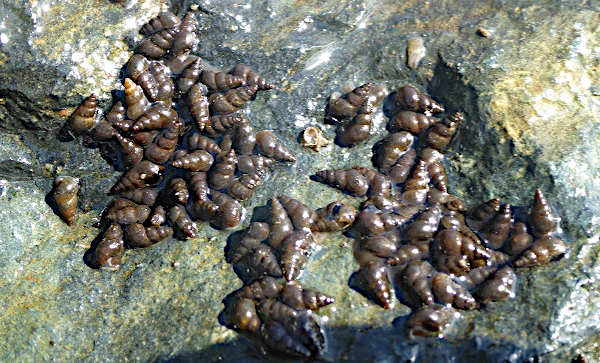
Samples of the New Zealand mudsnail (Potamopyrgus antipodarum) were subsequently positively identified by experts within CDFW and an outside genetics lab. This is the first time the species has been detected in Lake Tahoe.
New Zealand mudsnails, or NZMS, are tiny, aquatic snails that reach, on average, up to 4-6 millimeters long.
Despite their small size, NZMS are a highly problematic aquatic species. Dense populations can displace and outcompete native species, sometimes by consuming up to half the food resources in the waterway.
The snails have been linked to reduced populations of aquatic insects, including mayflies, caddisflies, stoneflies, and other insects upon which trout and salmon populations depend.
Angela DePalma-Dow, invasive species coordinator for Lake County Water Resources and author of the “Lady of the Lake” column for Lake County News, said that Cache Creek already has New zealand mudsnails.
“They are impossible to get rid of,” DePalma-Dow said.
“This is a significant detection and one we’re treating with the utmost seriousness and urgency to determine the extent of the infestation and prevent any further spread within the Lake Tahoe watershed,” said Colin Purdy, Environmental Program manager for CDFW’s North Central Region, which encompasses the California portion of Lake Tahoe and the surrounding areas of Placer and El Dorado counties. “We greatly appreciate the communication, collaboration and rapid response coordinated so far by TRPA and the Tahoe Resource Conservation District. It will take a coordinated commitment by all the entities that serve the Tahoe Basin as well as the public to prevent the further spread of these invasives in a lake and a watershed that’s cherished around the world.”
CDFW urges anglers, boaters, visitors and locals to “clean, drain and dry” all recreational items and fishing gear, which generally means anything that has gotten wet. It is important to leave any stream or lake water, debris and organic plant matter at a recreational site in order to prevent the further spread of the snails.
Once NZMS are established in a new habitat, they are impossible to eradicate without damaging other components of the ecosystem. Boaters, anglers and others who may visit any body of water, within or outside of infested areas, are asked to decontaminate their equipment and follow the “clean, drain and dry” best practices for all equipment and clothing used in a waterway.
Those best practices include:
• If you wade, freeze waders, wading boots and other gear overnight (at least six hours, though 24 hours is recommended).
• After leaving the water, inspect waders, boots, float tubes, paddleboards, kayaks or any gear used in the water. Leave all water and debris at the site that you exited.
• Additionally, remove any visible snails with a stiff brush, clean off soils and organic material, and follow this by rinsing at the site, preferably with high-pressure hot water.
• It is critical to completely dry out gear for a minimum of 24 hours.
• Never transport live fish or other aquatic plants or animals from one body of water to another.
CDFW scientists are also in the process of developing and implementing plans for sampling in waterbodies around the Tahoe Basin to better define the geographic range of this new population. Sampling areas will include high-traffic areas, boat launches, access points, coves, inlets and outlets, and side channels.
To date, the snails have not been identified at any of these surrounding waterbodies; however, they have been detected in several waterbodies (lakes and river systems) throughout California and in neighboring states. Decontamination procedures are being implemented by field crews working on Lake Tahoe and surrounding waterbodies.
How can you help?
Start with the following:
• Report an invasive species sighting online to CDFW.
• The best way to avoid spreading these non-native snails is to clean and decontaminate fishing gear, recreational equipment, and watercraft between waterbodies. Please refer to CDFW’s Aquatic Invasive Species Decontamination Protocol 2022.
The Lakeport Splash-In at Clear Lake will take place beginning at 9 a.m. and will continue throughout the day on Saturday, Sept. 23, in downtown Lakeport.
Also called the Clear Lake Splash-In, this will be the 41st annual event that celebrates seaplanes in Lakeport.
It will be paired with the annual Taste In Lakeport food and wine festival, which takes place at 5:30 p.m. Saturday on Main Street.
There also will be an artisan street fair in downtown Lakeport from 10 a.m. to 3 p.m. Saturday.
Seaplanes are set to begin arriving on Friday through Saturday morning, and departing following pilot-focused events on Sunday.
The Splash-In was last held in 2019, and didn’t return over the coming three years due to the COVID-19 pandemic.
While it had been scheduled to make its return in June 2022, weeks before it was set to take place the Lake County Chamber of Commerce announced on social media that it had canceled the event and that it was unlikely to lead the event in the future.
The event’s popularity, however, led to another group coming forward to take over the Splash-In.
The Lakeport Main Street Association and a team of pilots, the Clear Lake Flying Club, got to work putting the event together.
In years past, the event has been held at the former Natural High School property on North Main Street.
With that property now in the final stages of being developed into the city’s new Lakefront Park, organizers approached the city to use the Library Park Boat ramp and adjacent streets for the Splash-In’s return. Areas of the downtown will be closed to traffic in order to accommodate the planes.
At its Aug. 1 meeting, the Lakeport City Council approved the event applicants for both the Splash-In and the Taste In Lakeport.
Mayor Pro Tem Michael Froio, the council’s representative on the Lakeport Main Street Association Board and one of the organizing volunteers, said that the pilots group and the city have worked hard to bring the event back this year.
Froio said he wants to see the event continue, drawing with it seaplane owners who can have a place to fly in and stay and take a part in investing in the community. “I think this is a potential economic boost for the future.”
“I’m super excited that the Splash-In is back,” said Mayor Stacey Mattina.
She said she knew that it was going to be a challenge to organize with the Lakefront Park not yet ready, and she recognized the time and effort that went into organizing the Splash-In.
Since then, organizers have been busy finalizing a series of programs that will complement the presence of the planes in the downtown, including a series of free seminars that will take place throughout Saturday at Lakeport City Hall, 225 Park St.
Most of the seminars are free but registration is required due to limited space. Register here: https://www.eventbrite.com/e/clear-lake-splash-in-seminars-tickets-701690825147.
The seminar schedule for Saturday is as follows.
• 9 a.m.: Opening remarks, Herb Lingl
• 9:05 a.m.: “Wings Over Water: An Aviation History of Lake County,” Clark McAbee
• 9:30 a.m.: “Expanding Your Comfort Zones,” Dr. Stephen Bateman
• 10:15 a.m.: “Rising Sun Seaplane Base, Indiana, to Clear Lake, California, on Straight Floats,” Herb Lingl
• 10:45 a.m.: “How to Win Scholarships to Fund Flight Training,” Mary McEnroe
• 11:15 a.m.: The Clear Lake Flying Club Youth Program, Herb Lingl
• 11:30 a.m.: The AOPA High School Curriculum, Dr. Stephen Bateman (This seminar qualifies for FAA WINGS Pilot Proficiency program credit)
• Noon to 2 p.m.: Lunch break
• 2 p.m.: “The Future of the Clear Lake Splash-In”
• 2:30 p.m.: Preventing Common Seaplane Accidents (This seminar qualifies for FAA WINGS Pilot Proficiency program credit)
• 3 p.m.: “Which Seaplane is Right for You?”
• 3:45 p.m.: Seaplanes in Lakeport: Ramps and Docks
• 4:15 p.m.: The Clear Lake Flying Club Seaplane Flyout Program, Herb Lingl
• 4:45 p.m.: “Celebrating Seaplanes,” a curated exhibition featuring painting, drawing,
sculpture opening at the Lakeport Arts Council Main Street Gallery on April 5, 2024. Submission details at celebratingseaplanes.com.
Incoming pilots are reminded that ramp monitors will be prepared to inspect and screen arriving seaplanes to protect against invasive mussels.
Screenings will take place at Lampson Field from noon to 4 p.m. on Friday and from 6 a.m. to 3 p.m. Saturday at the Fifth Street boat ramp. Call Lake County Water Resources at 707-263-2344 for more information.
On Sunday, Sept. 24, the Historic Courthouse Museum will officially open its new exhibition,”Wings Over Water: An Aviation History of Lake County.”
The Museums of Lake County reported that the new exhibit will feature photographs and other artifacts that relate the history of seaplanes on Clear Lake.
That includes PanAm's use of Clear Lake as an alternative landing location for its Boeing Clipper aircraft, the Navy's use of Clear Lake as a training ground for PBY Catalina, and other seaplanes up to the current day and the Clear Lake Splash-In.
The exhibit, which will continue through March 30, will be open from 10 a.m. to 4 p.m. Thursday through Saturday, and noon to 4 p.m. Sundays.
Email Elizabeth Larson at
LAKE COUNTY, Calif. — California’s largest volunteer event, the Coastal Cleanup Day, takes place this weekend, offering everyone the chance to do their part to keep waterways clean and safe.
The Coastal Cleanup Day will be held on Saturday, Sept. 23.
In Lake County, cleanup events focusing on Clear Lake and other waterways will take place from 9 a.m. to noon.
The event makes a big impact every year.
In 2022, 70 Lake County volunteers covered 30 miles during the cleanup event, collecting 2,735 pounds of trash and 150 pounds of recyclables, according to the Lake County Department of Water Resources.
This year, there will be seven cleanup sites:
• Clear Lake Campground, 7805 Cache Creek Way, Clearlake.
• Habematolel Pomo EPA office, 9425 Main St., Upper Lake.
• Highland Springs Recreation Area, 3600 E. Highland Springs Road, Lakeport.
• Library Park, 200 Park St., Lakeport.
• Lucerne Harbor Park, 6235 E. State Highway 20.
• Redbud Park, 14655 Lakeshore Drive, Clearlake.
• Rodman Slough Park, 1005 Nice-Lucerne Cutoff, Nice.
Water Resources encourages volunteers to bring reusable water bottles, gloves and buckets to create a zero-waste cleanup.
In Lakeport, city and Lakeport Public Works Department staff will have a booth at Library Park with cleanup supplies, including trash grabbers, gloves, buckets and safety vests.
Visit the Coastal Cleanup Day website for more information.
Email Elizabeth Larson at
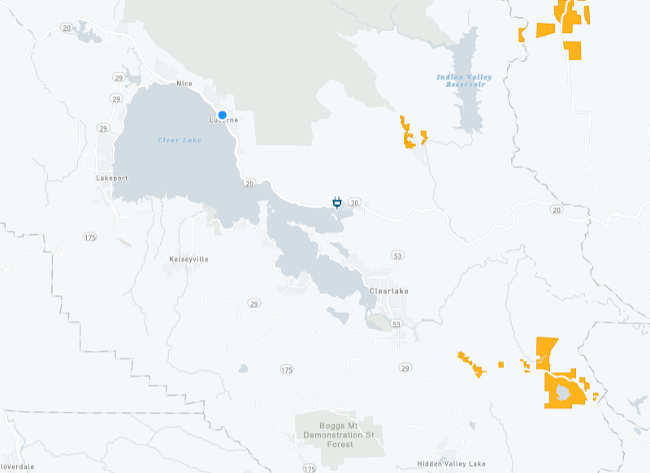
LAKE COUNTY, Calif. — Pacific Gas and Electric reported that it has moved forward with cutting power to several thousand people in eight counties, including Lake.
PG&E planned to include 4,200 customers from Butte, Colusa, Glenn, Lake, Napa, Shasta, Tehama and Yolo counties in the public safety power shut-off, or PSPS, due to a forecast of high winds.
The PSPS was set to begin Wednesday night for about 186 customers east of Clearlake Oaks near Indian Valley Reservoir and east of Lower Lake, along Morgan Valley Road.
PG&E said the shutoff was expected to start between 8:30 and 10 p.m. east of Clearlake Oaks and between 9:30 and 10 p.m. near Lower Lake on Wednesday night.
For both areas, power is anticipated to be restored by 2 p.m. Thursday.