 How to resolve AdBlock issue?
News
McGuire, who is now the Senate president designee, introduced Senate Bill 281 to institute greater consequences for aggravated arson cases.
McGuire’s office cited the fact that California is facing unprecedented, destructive wildfires, with 14 of the largest 20 wildfires in California history having occurred just in the last decade.
Some incredibly destructive wildfires have been set by arsonists including the 2016 Clayton fire in Lake County, which destroyed 188 homes, and the Esperanza fire, which claimed the lives of five firefighters in Southern California.
SB 281 will throw the book at individuals who are convicted of aggravated arson.
This is an issue that McGuire has championed for years.
The bill passed both the Senate and the Assembly and it’s now headed to the governor’s desk.
“An aggravated arson charge is reserved for the worst of the worst — the most heinous arsonists who exhibit specific intent to inflict damage and destruction in our communities or who are a continuing threat to society. We need to ensure this groundbreaking public safety measure is signed into law and we’ll be fighting alongside first responders and District Attorneys from across the Golden State to get this job done,” McGuire said.
Oct. 14 is the last day for Newsom to sign bills from this legislative session.
The council will meet at 9 a.m. Thursday, Sept. 21, in the council chambers at Clearlake City Hall, 14050 Olympic Drive.
The meeting will be broadcast live on the city's YouTube channel or the Lake County PEGTV YouTube Channel. Community members also can participate via Zoom or can attend in person.
The webinar ID is 869 9816 7652.
One tap mobile is available at +16694449171,,86998167652# or join by phone at 669 444 9171 or 720 707 2699.
The agenda can be found here.
Comments and questions can be submitted in writing for City Council consideration by sending them to City Clerk Melissa Swanson at
To give the council adequate time to review your questions and comments, please submit your written comments before 4 p.m. Thursday, Sept. 21.
On the agenda are two items of business.
The first is the award of the contract for the Burns Valley Light Pole Installation Project.
The council is being asked to approve the $43,594 contract and authorize City Manager Alan Flora to approve up to 10% for additional unforeseen contract amendments.
The second item of business is staff requested authorization of an amendment of contract with Northwest Construction for the Old Highway 53 Drainage Improvement Project. The amendment is in the amount of $25,500.
Email Elizabeth Larson at
On Monday, during Climate Week, Gov. Gavin Newsom announced California achieved its goal to install 10,000 fast chargers for electric vehicles more than a year ahead of schedule, just a week after the state announced new efforts to quickly deploy EV chargers in communities most harmed by pollution and the Legislature approved nearly $2 billion for EV charging infrastructure.
In 2018, then-Governor Jerry Brown established the fast charger goal as part of an executive order on zero-emission vehicles, or ZEV.
Since that time, the number of fast chargers installed nearly quadrupled from 2,657 to more than 10,000 today — for a total of more than 93,000 public and private shared chargers in California.
Fast chargers can recharge an all-battery electric vehicle to 80% capacity in about 30 minutes, depending on the size of the vehicle battery and the power level of the charger.
The network allows EV drivers to travel across the state with public fast chargers conveniently located along interstates and highways.
“California doesn’t just set big goals — we achieve them. Yet again, we’re showing the world what real climate action looks like,” said Gov. Newsolm. “We’re deploying EV chargers to communities most hurt by pollution and fast chargers along some of our most traveled highways. This is the future of transportation – and it’s happening right now all across California.”
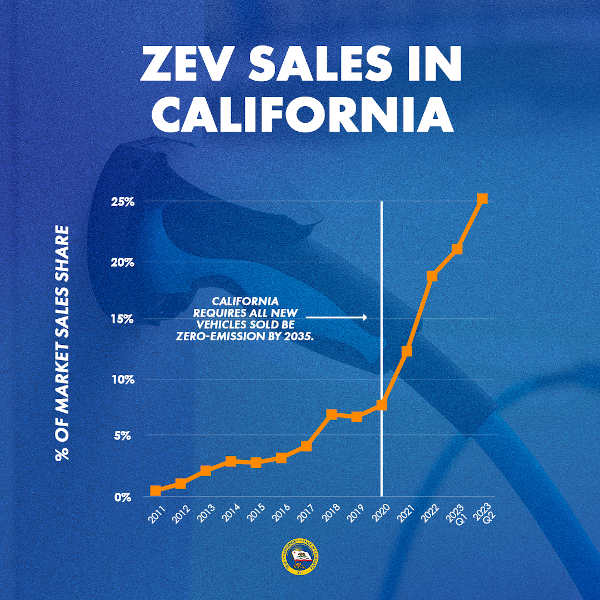
The milestone comes as one in every four new cars sold last quarter in California was zero-emission. Earlier this year, the state surpassed its goal of selling 1.5 million ZEVs — also ahead of schedule.
And last week, California opened applications for $38 million in equity-focused incentives to fund publicly accessible EV charging stations in low-income and disadvantaged communities in 28 counties across California.
Additionally, the Legislature passed a bill by Assemblymember Eloise Gómez Reyes and Senator Lena Gonzalez that would continue funding for another decade for three of the state's leading clean vehicle and infrastructure programs that date back to 2007. The bill – now awaiting the Governor’s signature – would provide close to $2 billion for all ZEV and supporting infrastructure through 2035. The infrastructure funded through these efforts will help ensure convenient charging and refueling across the state.
To accelerate the transition and help reach the goal to install 250,000 chargers, the state is investing over $10 billion for zero-emission cars, trucks, buses and infrastructure through the historic $52-plus billion California Climate Commitment.
California is already home to 56 ZEV and ZEV-related manufacturers and leads the nation in ZEV manufacturing jobs. Earlier this year, the California Energy Commission awarded nearly $200 million to support in-state manufacturing of ZEVs, ZEV components and batteries, and ZEV charging or refueling equipment. Additional funding will be available early next year.
California’s ZEV record
Since the governor’s executive order in 2020 calling for a rule to require all new car sales to be zero-emission by 2035, ZEV sales have risen dramatically:
• 25.4% of all new cars sold in California last quarter were ZEVs, according to the California Energy Commission: 125,939 ZEV sales in Q2 2023; 1,623,211 total ZEV sales to date.
• 34% of new ZEVs sold in the U.S. are sold in California, according to the Veloz EV Market Report.
• If California were a country, it would rank fourth in EV sales behind China, the U.S. and Germany.
• Thousands of dollars in grants and rebates are available for low-income Californians (learn more at ClimateAction.ca.gov).
• The historic $52-plus billion California Climate Commitment includes over $10 billion for zero-emission cars, trucks, buses and infrastructure.

The city of Phoenix set heat records in summer 2023, with high temperatures that topped 110 degrees Fahrenheit (43 degrees Celsius) for 31 consecutive days and at least 54 days in total. In such conditions, providing basic services – including cool spaces – for people experiencing homelessness is lifesaving.
In 2022, 420 people – many of them unsheltered – died in Phoenix from heat-related causes. Estimates are not yet available for summer 2023, but given this year’s extreme conditions, the toll is expected to be higher.
For the past two years, we have worked as researchers with the Human Services Campus, a 13-acre complex in Maricopa County, Arizona, where 16 nonprofit organizations work together to help people who are experiencing homelessness. The campus includes Central Arizona Shelter Services, or CASS, Phoenix’s largest homeless emergency shelter, which assists 800 people experiencing homelessness on any given night.
Our work includes talking with staff and clients to better understand their challenges and identify possible solutions that draw from our work in the fields of architecture, health and social innovation.
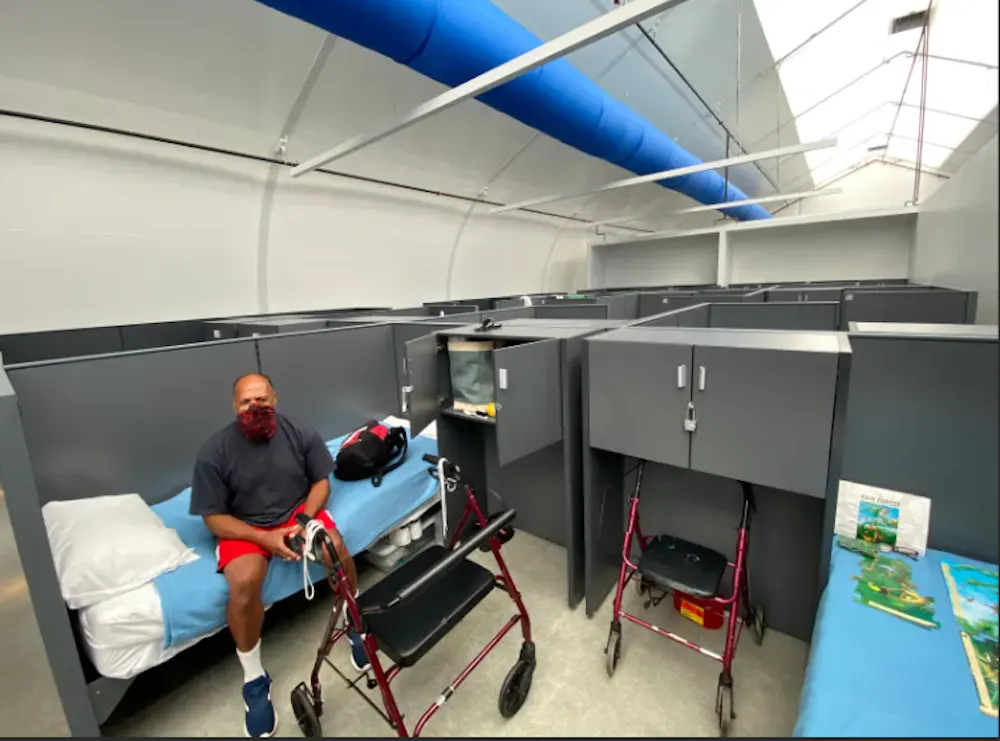
Dormitories at CASS protect residents from extreme heat with a bunk to sleep in, day rooms for socializing, case management services, and sanitary shower and restroom facilities. But CASS struggles to provide dignified spaces that offer privacy, storage space and quiet environments. People need this kind of environmental support in order to battle recurring physical and mental health issues that often accompany homelessness and can hinder or prevent healing.
Overflowing shelters
As of 2022, the U.S. Department of Housing and Urban Development estimated that the U.S. had nearly 600,000 homeless people nationwide, with about 60% living in emergency shelters, safe havens or transitional housing. The other 40% lived outdoors or in places such as abandoned buildings and public transit stations.
Homeless centers must conform to architectural standards for emergency shelter. These standards have historically been influenced by institutional building design, which prioritizes attaining minimum conditions needed to keep people alive. Today, many homeless shelters struggle to provide even that level of care.
The Human Services Campus was originally constructed in 2003 to provide consolidated services and a coordinated entry plan for people experiencing homelessness. However, it was intended to be part of a larger system of shelters, not the sole service provider for Phoenix’s estimated 9,000 homeless people.
The city’s homeless population has grown, in part because of unprecedented rent increases and a lack of affordable housing. During this summer’s heat wave, nearly 1,200 unsheltered homeless people lived on sidewalks surrounding the campus, many in tents, with limited access to bathrooms and sanitation facilities.
Homelessness and mental health
When asked about causes of homelessness, policymakers and members of the public often point to mental illness and addiction, as well as a lack of affordable housing. They tend to pay less attention to the underlying impacts of past trauma other than noting that many women become homeless to escape domestic violence.
In a 2005 study, an alarming 79% of homeless women seeking treatment for mental illness and substance abuse reported experiencing a past traumatic event such as physical or sexual abuse. More recently, a 2020 study showed that nearly two-thirds of homeless women and almost half of homeless men reported that they were homeless because of trauma. Shelter design can affect homeless people’s ability to recover from past trauma and to battle addiction and other mental health issues that perpetuate cycles of homelessness.
For example, one woman who currently lives in CASS told us about trying to get a full night’s sleep while living in a day room where the lights were kept on around the clock and there was constant activity. Because she had several bags of personal items that were too big to store in the dormitory, she could not get a bed there.
“When they don’t turn the lights down at night, I start to feel like my body is vibrating,” she said. “I start to see people walking around, and I’m not sure if they are even really there.”
Routinely sleeping less than seven hours per night can be harmful to health. It lowers immune function, increases chronic pain and raises the risk of heart disease, high blood pressure, diabetes, stroke and death. For homeless people battling mental health challenges, addiction and past trauma, rest and recovery are essential to getting back on their feet.
CASS staff have tried to create healthier sleep spaces, such as dorms that remain dark, quiet and cool at all times. Priority access goes to people with jobs. These sections can house only about a third of CASS’s residents, leaving others to sleep in dorms where there is more noise and light.
More supportive spaces
Simply feeding people and providing them with places to sleep is a major challenge for shelters in cities where homelessness is rising. But some have found ways to think more broadly.
In San Diego, Father Joe’s Villages, a nonprofit network with a central campus and scattered-site programs, houses more than 2,000 people nightly. San Diego’s more temperate climate makes it less urgent to maximize the number of people they shelter indoors, so staff at Father Joe’s can use its decentralized design to create shelters with private and quiet spaces.
The Father Joe’s network includes multiple smaller-scale facilities where clean bathrooms are easily accessible and homeless people can use basic amenities like laundry and storage. One example is Mary’s Place, a collection of diverse shelters that provides emergency and long-term support in smaller facilities modeled after the simplicity and comfort of a home.
People experience less stress and can more easily navigate the challenge of ending their own homelessness when they can get a restful night’s sleep in a quiet environment, with spaces that allow them some privacy. We are encouraged to see other U.S. shelters moving in this direction – but there’s a long way to go.
Steps toward better design
To address the lack of privacy at CASS, we have proposed subdividing the day room into more private spaces to accommodate activities like online telehealth appointments, counseling and job interviews. To tackle long-term impacts of overcrowding, we also have recommended introducing sanitation amenities, such as laundry facilities, “hot boxes” to sanitize clothing and bedding, more bathroom facilities and reliable trash removal to reduce the spread of infection and pests such as bedbugs and lice.
For new facilities, designers could consider small changes, such as increased storage and more diligent regulation of temperature, light and noise.
Hospitals, nursing homes and retirement communities have found many ways in recent decades to use design to support patients’ health. Many of the same concepts can be applied to emergency shelters and help turn these facilities from institutional warehouses into spaces of health and opportunity.
Natalie Florence, PhD Candidate in Humanitarian Design and Infrastructure Studies, Arizona State University and Heather Ross, Clinical Associate Professor in Nursing and Clinical Associate Professor, School for the Future of Innovation in Society, Arizona State University
This article is republished from The Conversation under a Creative Commons license. Read the original article.
The board will meet beginning at 9 a.m. Tuesday, Sept. 19, in the board chambers on the first floor of the Lake County Courthouse, 255 N. Forbes St., Lakeport.
The meeting can be watched live on Channel 8, online at https://countyoflake.legistar.com/Calendar.aspx and on the county’s Facebook page. Accompanying board documents, the agenda and archived board meeting videos also are available at that link.
To participate in real-time, join the Zoom meeting by clicking this link.
The meeting ID is 974 9994 3424, pass code 907084. The meeting also can be accessed via one tap mobile at +16694449171,,97499943424#,,,,*907084#.
All interested members of the public that do not have internet access or a Mediacom cable subscription are encouraged to call 669-900-6833, and enter the Zoom meeting ID and pass code information above.
The board will start off the meeting with proclamations designating Sept. 10 through Sept. 16 as National Suicide Prevention Week and Sept. 22 as Native American Day.
At 1:30 p.m., the board will hold a public hearing to consider the final recommended budget for fiscal year 2023-24 for the county of Lake and Special Districts governed by the Board of Supervisors.
Budget appropriations for the 2023-24 budget total $383,011,017, according to the staff reports.
The full agenda follows.
CONSENT AGENDA
5.1: Approve the second amendment to 2019 agreement between the city of Clearlake, city of Lakeport and the county of Lake relative to operation of a local public, educational, governmental, or PEG, cable television channel, extending the term through June 30, 2025, and authorize the chair to sign.
5.2: Approve letter of support for Clearlake grant application for Reconnecting Communities Program.
5.3: Adopt proclamation declaring Sept. 22, 2023 as Native American Day in Lake County.
5.4: (a) Waive the formal bidding process, pursuant to Lake County Code Section 38.1, as an extension of an annual agreement; and (b) approve Amendment No. 5 to the contract between county of Lake and Granicus Inc. for agenda management and government transparency services in the amount of $26,723.43, and authorize the chair to sign.
5.5: Adopt resolution approving memorandum of understanding between county of Lake and Lake County Resource Conservation District for management of goatsrue in Lake County for July 1, 2023, through June 30, 2025, in the amount of $32,716.
5.6: Adopt proclamation designating the week of Sept. 10, 2023, through Sept. 16, 2023, as National Suicide Prevention Week.
5.7: Approve lease between county of Lake and Berg Investments LP for 13300 East Highway 20, Unit N, Clearlake Oaks for a term commencing on July 1, 2023, and ending on Feb. 29, 2028, and authorize the Behavioral Health director to sign.
5.8 Action Item Approve Agreement Between County of Lake and Resource Development Associates for Consultation and Support in the Community Program Planning (CPP) Process for Fiscal Years 2023-24, 2024-25, 2025-26 in the amount of $310,920 and Authorize the Board Chair to Sign Not available Not available
5.9: Approve Amendment No. 2 to the agreement between Willow Glen Care Center for adult residential support services and specialty mental health services with no change to the contract maximum for fiscal years 2022-25 and authorize the board chair to sign.
5.10: Approve the continuation of the proclamation declaring a shelter crisis urgency due to the current need for sheltering for those experiencing homelessness during the weather and temperature patterns that the county of Lake has been experiencing.
5.11: Approve continuation of proclamation declaring a Clear Lake hitch emergency.
5.12: Approve continuation of proclamation of the existence of a local emergency due to pervasive tree mortality.
5.13: Approve continuation of an emergency declaration for drought conditions not available.
5.14: Approve continuation of a local emergency by the Lake County sheriff/OES director for the January 2023 Atmospheric River Event.
5.15:Approve continuation of proclamation of the existence of a local emergency due to low elevation snow and extreme cold.
5.16: Adopt proposed resolution authorizing submittal of application for the Illegal Dumping and Site Abatement Grant through CalRecycle, and authorize the Community Development director to sign all grant documents.
5.17: (a) Waive the competitive bidding procedures pursuant to Lake County Code Section 2-39.2 and Section 1.C.2 of the County’s Consultant Selection Policy; and (b) approve amendment one to agreement for investigative services between the Oppenheimer Investigations Group and the county of Lake increasing the contract amount by $522, not to exceed $30,522, and authorize the chair to sign.
5.18: Approve supplemental services agreement number 2 between the county of Lake and NCE for consulting services related to the design of road rehabilitation plans and authorize the chair to sign the agreement.
5.19: Adopt resolution approving the applications for grant funds through the FAA Airport Improvement Program and designating the Public Works director as the county’s authorized representative.
5.20: Approve purchase orders for the purchase of one vehicle for the Central Garage Fleet and three capital assets for the Road Department, and authorize the Public Works director/assistant purchasing agent to sign the purchase orders.
5.21: Approve equitable sharing agreement and certification between the Lake County Sheriff's Office and the US Department of Justice; and authorize the sheriff and chair to sign.
5.22: Sitting as the Board of Directors of the Lake County Watershed Protection District, approve the Well House easement deed with Linda Ruth Chandler for property within the middle creek flood damage reduction and ecosystem restoration project and authorize the chair of the board of directors to sign the Well House easement deed.
5.23: Sitting as the Board of Directors of the Lake County Watershed Protection District, adopt resolution authorizing the county of Lake Water Resources Ddirector to apply for California Department of Water Resources Flood System Repair Project for much-needed repairs to levee maintenance areas within the Upper Lake levee system.
5.24: Sitting as the Board of Directors for the Lake County Watershed Protection District, approve “approval of just compensation” for five properties within the Middle Creek Flood Damage Reduction and Ecosystem Restoration Project and authorize the chair of the board of directors to sign the approval.
TIMED ITEMS
6.2, 9:07 a.m.d: Pet of the Week.
6.3, 9:08 a.m.: New and Noteworthy at the Library.
6.4, 9:09 a.m.: Presentation of proclamation designating the week of Sept. 10, 2023, through Sept. 16, 2023, as National Suicide Prevention Week.
6.5, 9:10 a.m.: Presentation of proclamation declaring September 22, 2023, as Native American Day in Lake County.
6.6, 9:30 a.m.: Hearing, consideration of requested hearing (appeal) by Richard Saunders for a notice of nuisance and order to abate issued against 15892 Kugelman St., Lower Lake / APN# 012-025-860.
6.7, 10 a.m.: Public hearing, consideration of appeal (AB 23-01) of Planning Commission’s approval of parcel map (PM 22-02); Appellant: Scotts Valley Energy Corp.; Location: 7130 Red Hills Road, Kelseyville (APN: 009-021-07).
6.8, 10:30 a.m.: Public hearing, consideration of draft ordinance Amending Chapter 5 of the Lake County Code relating to permitting agriculture-exempt and temporary cannabis processing structures, and amending Chapter 27 of the Lake County Code regarding mitigation fees, and Amending Article 68 of the Zoning Ordinance regarding definitions of temporary building types.
6.9, 1:30 p.m.: Public hearing, continued from Sept. 12, consideration of the final recommended budget for fiscal year 2023-24 for the county of Lake and Special Districts governed by the Board of Supervisors.
UNTIMED ITEMS
7.2: Consideration of (a) purchase of an animal control box in the amount of $30,776.15 and (b) authorize the Animal Care and Control director or his designee to issue a purchase order.
7.3: Consideration of proposed agreement between the county of Lake and PlaceWorks, for planning services for the general plan and local area plan updates.
7.4: Consideration of amendment one to the agreement with COAR Design Group for facility design services for the Behavioral Health Clearlake Facility Expansion Project.
7.5: Sitting as Kelseyville County Waterworks District No. 3, Board of Directors, consideration of (a) waiving the competitive bid process per Section 2-38.4, Cooperative Purchases, of the County Code and (b) approving the purchase of a Ford F-550 Service Truck for KCWWD#3 and authorize the Special Districts administrator/assistant purchasing agent to sign the purchase request.
7.6: Sitting as the Lake County Sanitation District Board of Directors, consideration of a) waiving the competitive bidding process, pursuant to Lake County Code Section 2-38.4 Cooperative Purchases; b) authorizing Special Districts administrator/assistant purchasing agent to issue a purchase order not to exceed $79,000 to Garton Tractors for the purchase of a four-wheel drive ROPS tractor.
7.7: Sitting as the Lake County Sanitation District Board of Directors, consideration of a) waiving the competitive bidding process, pursuant to Lake County Code Section 2-38.4 Cooperative Purchases; b) authorizing Special Districts administrator/assistant purchasing agent to issue a purchase order not to exceed $550,000 to Owen Equipment for the purchase of a Vactor 2100i Truck.
CLOSED SESSION
8.1: Public employee appointment pursuant to Gov. Code Section 54957(b) (1): Interviews for chief public defender appointment of chief public defender.
8.2: Public employee appointment pursuant to Gov. Code Section 54957(b) (1): Interviews for Interim Health Services director; appointment of interim Health Services director.
8.3: Conference with legal counsel: Significant exposure to litigation pursuant to Gov. Code section 54956.9(d)(2), (e)(1) – One potential case.
Email Elizabeth Larson at
The council will meet at 6 p.m. Tuesday, Sept. 19, in the council chambers at Lakeport City Hall, 225 Park St.
The agenda can be found here.
The council chambers will be open to the public for the meeting. Masks are highly encouraged where 6-foot distancing cannot be maintained.
If you cannot attend in person, and would like to speak on an agenda item, you can access the Zoom meeting remotely at this link or join by phone by calling toll-free 669-900-9128 or 346-248-7799.
The webinar ID is 973 6820 1787, access code is 477973; the audio pin will be shown after joining the webinar. Those phoning in without using the web link will be in “listen mode” only and will not be able to participate or comment.
Comments can be submitted by email to
On Tuesday, Assistant City Manager Nick Walker will ask the council to execute the professional services agreement with Adams Ashby Group LLC for grant administration.
Walker’s report explained that Adams Ashby will help the city with state and federal grant administration, including the Community Development Block Grant.
Adams Ashby, the only firm that responded to the city’s request for proposals for the services, has had a contract with the city to provide grant writing and implementation services which expired.
The company’s “experience with federal applications and administration are needed to make sure the City is complying with all the federal regulations, documentation, federal and state labor compliance, and ongoing administration of federal awards. Adams also facilitates communication between the City, granting agencies, loan underwriters, contract engineers and any contractors involved in the grant projects, to make sure all parties are complying with federal standards and regulations,” Walker wrote.
In other business, Public Works Director Ron Ladd will ask the council to adopt a resolution revising the prohibited parking zones within the city.
“Due to pedestrian improvements and lane realignments completed with the Hartley Street Project it has been determined by staff that there is not adequate roadway width for safe traffic flow on Hartley Street to allow for parking along the west side of the street,” Ladd wrote in his report to the council. “Therefore, staff is recommending that the west side of Hartley Street from Boggs Lane north to the city limit be posted for ‘No Parking.’”
On the consent agenda — items considered noncontroversial and usually accepted as a slate on one vote — are the Sept. 8 warrant register; ordinances; minutes of the regular council meeting on Sept. 5; approval of application 2024-001, with staff recommendations, for the 2024 Western Outdoor News, or WON, Clear Lake Open bass tournament; and approval of application 2023-023, with staff recommendations, 2023 CLHS Homecoming Parade.
Email Elizabeth Larson at