 How to resolve AdBlock issue?
News

CLEARLAKE, Calif. — More new adoptable dogs have made their way to Clearlake Animal Control this week.
The Clearlake Animal Control website lists 38 adoptable dogs.
This week’s new dogs include “Goose,” a male Chihuahua mix with a short brown and brindle coat.
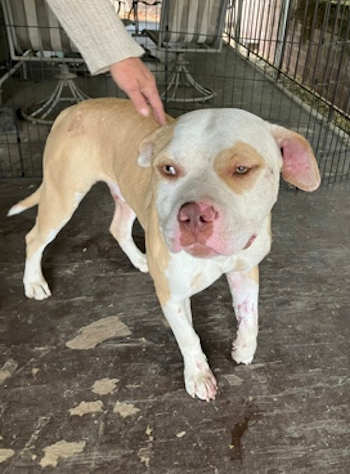
There also is “Winston,” a 1-year-old male American pit bull terrier mix with a short white and tan coat.
The shelter is located at 6820 Old Highway 53. It’s open from 9 a.m. to 6 p.m. Tuesday through Saturday.
For more information, call the shelter at 707-762-6227, email
This week’s adoptable dogs are featured below.
Email Elizabeth Larson at

CLEARLAKE, Calif. — A Clearlake resident whose quick and heroic actions are credited with saving a mother and child from an early morning house fire in August has become the first recipient of a new honor from Lake County’s fire chiefs.
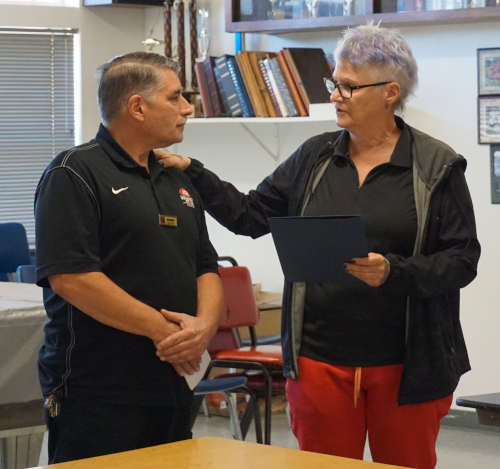
On Wednesday afternoon, during the Lake County Fire Protection District’s regular board meeting, Chief Willie Sapeta presented the new Fire Chiefs Challenge Medal to Robert Lombardi.
Sapeta said he was excited to be able to present the medal to Lombardi, a 33-year resident of the city who works as an assistant manager at Foods, Etc.
Lombardi was on his porch in the 3200 block of 13th Street at around 1 a.m. Aug. 29 when he said he heard an explosion at a nearby home.
He ran to that neighboring home, which was burning, and heard screaming from inside of it.
Lombardi went into the home’s backyard, where active fire was venting through the back door.
It was then that he saw a woman and her young daughter, still in the house.
Lombardi helped bring them out of the house, and then took them to his own home, where he cared for the injured pair until firefighters and emergency personnel arrived.
Sapeta told Lake County News that the fire involved two homes, with downed power lines and strong winds hitting the area.
“It was kind of the perfect storm,” he said.
Lake County Fire was joined in fighting the fire by a full wildland dispatch of Cal Fire engines.
Both the mother and her 9-year-old daughter were flown out of the county for treatment of their injuries. Another individual also was injured and transported to the hospital.
Sapeta said that it was a year ago that the fire chiefs began developing the challenge medal.
The colorful medal is larger than most, which Sapeta said was necessary in order for it to clearly show the details of the patches of all five Lake County fire districts: Kelseyville Fire, Lake County Fire, Lakeport Fire, Northshore Fire and South Lake County Fire.
He said each fire district has 20 of the medals to give to individuals in special recognition.
The rule is that potential recipients have to be vetted, with the chiefs needing to agree on them, Sapeta said.
Sapeta said he sent out an email to his fellow chiefs recommending Lombardi for the award.
Within 10 minutes, Sapeta said all of the chiefs had responded with unanimous support.
Before Sapeta presented the medal to Lombardi at Wednesday’s meeting, Fire District Board Vice Chair Diane Watson read a proclamation detailing Lombardi’s courageous actions as board members Mary Benson, Michael Dean, Richard Moore, Craig Scovel and Jacqueline Snyder looked on. Chair Denise Loustalot was absent.
Watson, who served as a volunteer EMT with the district for more than 13 years, put a hand on Lombardi’s shoulder as she read the proclamation’s account of the early morning fire.
The proclamation ended by honoring Lombardi’s bravery and heroism “with sincere appreciation.”
After receiving the proclamation and the medal, Lombardi offered his thanks to the district, and recognized the heroism of the firefighters in their work to keep the community safe.
Email Elizabeth Larson at

The Lake County forecast said there are chances of rain during the day on Friday and on Friday night.
Friday also is expected to be windy, with wind speeds of close to 15 miles per hour and wind gusts of more than 20 miles per hour.
Chances of rain and thunderstorms increase on Saturday morning.
Throughout the day on Saturday, the Pear Festival will be taking place in downtown Kelseyville.
Chances of rain are highest after 11 a.m. Saturday. Conditions are forecast to be partly sunny, with a high near 62 degrees, and a north wind of between 7 and 10 miles per hour.
Temperatures this week will top out in the high 70s, with nighttime lows in the low 50s, the National Weather Service said.
The forecast calls for dry weather to return early next week, with near-normal — and possibly warmer — temperatures expected.
Email Elizabeth Larson at
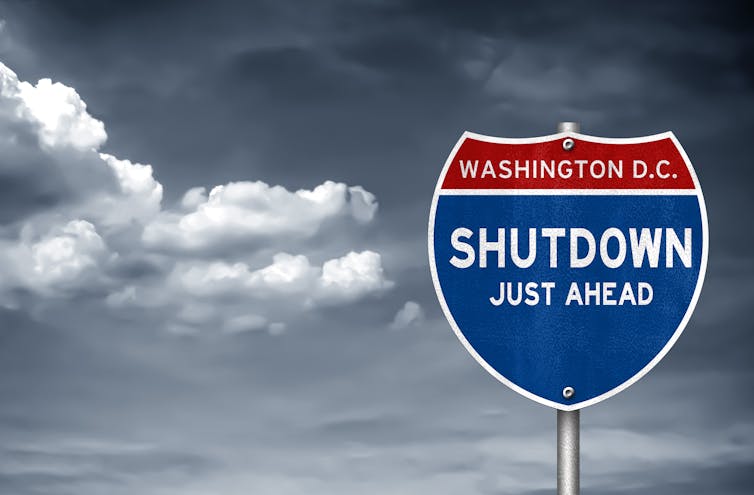
The U.S. is moving toward a government shutdown. House and Senate appropriators are divided on spending levels, policy riders and additional items, such as support for Ukraine.
As a political scientist who studies the evolving budget process, as well as brinksmanship in Congress, it is clear to me that this episode prompts many important questions for how the U.S. is governed.
There’s the larger, long-term question: What are the costs of congressional dysfunction?
But the more immediate concern for people of the country is how a shutdown will affect them. Whether delayed business loans, slower mortgage applications, curtailed food assistance or postponed food inspections, the effects could be substantial.

Affected: Farm loans to Head Start grants
The total federal budget is almost US$6 trillion. A little over one-fourth is discretionary spending that is funded by the annual appropriations process and thus debated in Congress. This portion of spending provides money for virtually every federal agency, roughly half of which goes to defense. The rest of yearly federal spending is on mandatory entitlement programs, mainly Social Security and Medicare, as well as interest on the national debt.
The Office of Management and Budget, which oversees both development of federal budget plans by federal agencies and their performance, regularly requires agencies to develop shutdown plans. Because agencies continually update these plans, no two shutdowns are exactly alike. Details depend on the agency, program and duration of the shutdown, as well as laws passed with funding since the previous shutdown, and the administration’s priorities. These plans identify a variety of ways the shutdown will affect Americans.
If a shutdown happens this year, new loan approvals from the Small Business Administration will stop. The Federal Housing Administration will experience delays in processing home mortgage loans and approvals. The Department of Agriculture will not offer new farm loans. Head Start grants will not be awarded, initially affecting 10,000 young children from low-income families who are in the program.
Some food inspections by the Food and Drug Administration, workplace safety inspections by the Occupational Safety and Health Administration, and environmental safety inspections by the Environmental Protection Agency could be delayed, as they have been when the government stopped functioning in the past.
During the last shutdown, about 60,000 immigration hearings, organized by the Department of Justice and not the courts, were canceled and had to be rescheduled. This year would also see cases involving noncitizens who are not being held by the government reset for a later date, even as other immigration services proceed.
Infrastructure projects awaiting approval from the Environmental Protection Agency could be stalled. The National Institute of Health’s clinical trials for diseases could also be slowed.
This is not a comprehensive list. Agency plans show what happens when federal workers are furloughed – that is, those who cannot report to work in a shutdown. Furloughs will apply to over 700,000 out of roughly 3.5 million federal employees, but even more workers will be “excepted” and required to work without pay until the shutdown ends.
That of course means employee hardship. But like past shutdowns, unpaid workers can fail to report to work in larger numbers. Americans relying on those services will face delays. There may be air travel delays as well, as air traffic controllers and Transportation Security Administration agents go without pay.
Not affected: The IRS, postal service and entitlement programs
Social Security, Medicare and Medicaid benefits are entitlement programs that are not included in the annual appropriations process. Americans relying on these programs will not see those benefits affected. But these programs require administration. Federal employees would not be available to verify benefits or send out new cards.
There are additional funding sources for government activities, beyond entitlement programs, that aren’t included in the annual appropriations bills and thus are unlikely to be affected by a shutdown.
The U.S. Postal Service, independently funded through its own services, will be unaffected by a shutdown. The federal judiciary could operate for a limited time, funded by court filings, fees and appropriations allocated off the yearly cycle. But this funding won’t last long – 10 days was an estimate for the 2013 shutdown. The Supreme Court, which has functioned in previous shutdowns, is expected to continue its typical schedule.

Sometimes, agencies have funding that exceeds the typical annual appropriations cycle. Or, earlier laws may have been passed that fund activities of an agency in whole or in part. The Inflation Reduction Act provided funds to run the IRS through 2031. Previous shutdowns saw significant IRS furloughs and employees walking off the job. This year, the IRS promises to be fully operational despite a shutdown.
A variety of advance appropriations also exist that provide funding for various programs one year or more beyond the year the appropriations bill was passed, including Veterans Affairs medical care; most VA benefits are unaffected.
The primary law governing funding gaps also makes exceptions for “emergencies involving the safety of human life or the protection of property,” which includes a variety of military activities.
The big question mark
The major unknown is, of course, how long a shutdown might last. Food assistance programs – including the federal food program for poorer women, infants and children, called WIC, and the Supplemental Nutrition Assistance Program, or SNAP – which have some contingency funds that carry over into the next fiscal year but are running low, run the risk of those accounts running out.
The federal judiciary has limited funds. There are also a variety of federal grants to states and localities that could be short on funds, such as disaster relief and economic development programs, in addition to nutrition assistance. Government officials at the federal, state and local levels will have to make choices about whether a federal shortfall should be covered by state funds, or if workers should be furloughed. Some of these funds have been protected by increased funding in recent laws: The Highway Trust Fund is solvent through 2027, due to the Bipartisan Infrastructure Law of 2021.
The economy as a whole will suffer more the longer a shutdown continues. The Congressional Budget Office estimated that the last shutdown, in 2018-2019, reduced gross domestic product growth by 0.2% in the first quarter of 2019. While that 35-day partial shutdown was the longest in U.S. history, it did not affect all agencies.
Federal employees and contractors are disproportionately hurt. Federal employees who are furloughed or excepted and do not receive pay during the shutdown will receive it retroactively, according to a 2019 law passed as a response to the last shutdown.
No such policy exists for contractors working for the federal government, including services ranging from janitorial to manufacturing. Beyond affecting individual workers, the private sector loses business and adjusts its hiring decisions and other practices.
Laura Blessing, Senior Fellow, Government Affairs Institute at Georgetown University, Georgetown University
This article is republished from The Conversation under a Creative Commons license. Read the original article.
Although seniors and persons with disabilities are more likely to be victims of serious crimes, these crimes have been historically underreported.
To better address this challenge, in 2019, California enacted Senate Bill 338, The Senior and Disability Justice Act (SB 338) to encourage local law enforcement agencies to adopt comprehensive policies to improve reporting and investigations of disability and elder abuse.
Attorney General Bonta’s advisory reminds these agencies of the requirements under SB 338 and urges each of them to reach compliance as soon as possible to protect the safety of seniors and persons with disabilities statewide.
“Law enforcement has a legal and moral obligation to do all they can to ensure that the rights of seniors and people with disabilities are protected,” said Attorney General Bonta. “When crimes go unreported or are improperly documented, these crimes and their victims remain in the dark. We must provide these victims with the accountability and the justice that they are entitled to. I urge all agencies to review their policies to ensure they are consistent with SB 338 and recognize seniors’ and people with disabilities’ equal protections under the law.”
People with disabilities, including disabilities caused by advanced age, are more likely to be victims of serious crimes, such as abuse, sexual assault, hate crimes, domestic violence, and human trafficking. Nationally, people with disabilities are at least 3.4 times more likely to be victimized by violent crimes than people without disabilities.
People with cognitive disabilities — including intellectual disabilities and dementia— are even more likely to be victims of violent crime, at 5.5 times the rate of people without disabilities.
This is especially concerning in California, where the number of seniors and people with disabilities are rapidly increasing.
In 2019, California enacted SB 338 to draw attention to the wide extent of crimes against seniors and people with disabilities; reinforce that these acts are crimes, not merely civil matters; and strongly encourage every local law enforcement agency to adopt a comprehensive policy concerning these crimes, including effective, accountable, and locally developed protocols for carrying out the agency’s existing responsibilities.
Despite their prevalence, crimes against seniors and persons with disabilities continue to be underreported.
For example, while 40,000 anti-disability hate crimes were estimated to have occurred nationally in 2017, California law enforcement agencies reported just four such incidents in 2017 and seven incidents in 2018.
Moreover, even when senior and disability victimization is reported, the response by law enforcement may be inadequate.
For example, one survey of crime victims with disabilities found that perpetrators were arrested just less than 10% of the time.
The majority of victims— nearly 53%—reported that nothing happened after they reported abuse to the authorities.
The bulletin, issued by the California Department of Justice’s Division of Law Enforcement outlines that municipal police or county sheriffs’ departments that adopt or revise a policy regarding elder and dependent adult abuse or senior and disability victimization on or after April 13, 2021, must include the 28 items stated in Penal Code section 368.6, subdivision (c).
The items provide clear definitions and information on the wide prevalence of crimes against seniors and people with disabilities.
The legislation also requires including provisions related to extensive training on senior and disability victimization, a requirement that officers investigate every report of senior and disability victimization, detailed protocols for handling these crimes, and provisions regarding outreach to the senior and disability communities to encourage reporting and prevention of these crimes.
The bulletin may be viewed here.

KELSEYVILLE, Calif. — The Kelseyville Pear Festival, Lake County’s biggest free event, is coming up this week.
On Saturday, Sept. 30, the 29th annual celebration of everything pear will take over Main Street of the “Pear Capital of the World.”
The event normally draws 10,000 to 12,000 attendees, according to organizers.
“I always get excited about the pear festival,” said Pear Festival team member Kim Riley, who organizes the 150 vendors.
“And I love the Grand Parade,” Riley added. “We’re going to have lots of tractors and My Divas will be singing the National Anthem.”
“Our Grand Marshall this year is Rick White,” Pear Festival Team Director Cindy Bain said. “He is a local Realtor and de facto Mayor of Kelseyville. The whole community is extremely grateful for his numerous contributions to town. He does everything … you name it, Rick is involved.”
The parade starts at 9:30 a.m. at State Street and Main at the east end of town and winds up at the Saw Shop at about First Street.
Tractors will be parked after the parade for viewing at the west end of Main Street.
Bain said a few things are changing this year. Kids’ Town, featuring activities for children including pear decoration and two jump houses, will be at a new location. This year it will be located at the old Pioneer Park behind Studebaker’s on Third Street.
Riley noted that among the 150 artisan vendors will be 50 food vendors that offer edible treats from seasonings to beer and everything in between.
“We have people coming back every year to sell their peararphernalia,” she said.
They're going to be many things about pears this year.
Pear ceramics, Bing’s Kitchen is making pear lumpia and there will be pear margaritas, pear shakes at the Presbyterian Church, pear pies, pear tarts and of course five different kinds of pears will be available at the free tasting next to Pogo’s Pizza in the Westamerica parking lot.
Local farmers will be selling organically-grown Bartletts, Abaté Fetel, Bosc, Comice and Rosie Red pears next to the tasting booth.
Among the too-many-to-be-listed features of the Pear Festival are the Lake County Horse Council’s Horse Faire that will include six breeds of horse, a tack swap and varied horse demonstrations throughout the day. The Horse Faire opens at 11 a.m.
The Konocti Art Society fine art show opens at 10:30 a.m. at Westamerica Bank Lobby and the pie-eating contest will be at noon at Pear Square just west of the bank.
The festival hosts several dancing groups including one on horses you’ll see in the parade.
Businesses will remain open during the event.
Bain is focusing her efforts on the opening prequel, the Farm to Fork Dinner that launches the Pear Festival Friday night.
“We’re seating 500 people down main street with a family style dinner prepared by Jeremy Zabel, the chef and owner at Red’s @ the Skyroom,” she said.
The lucky ticket-holders who managed to grab tickets — that sold out in a record 20 minutes almost four months ago — will get to enjoy a beefy menu including a Lake County pear Caesar salad and Lake County pear cake for dessert as well as local wines by Brassfield and Shannon Ridge.
The theme of the dinner this year is “Loving Our Lake.” The Kelseyville High School Interact Club-associated with the Kelseyville Sunrise Rotary Club-will be working the tables at the kickoff dinner.
Dinner is followed by an auction to benefit downtown beautification, followed by a street dance featuring live music by the Funky Dozen.
“If you weren’t able to get tickets this year,” Bain said, “mark June 1, 2024, at 7 a.m. when they go on sale at Eventbrite.
This year’s pear festival included an essay contest with higher dollar prizes for age 18 and under with the first place winner featured in the parade.
The first place winner will receive a check for $250 with second and third places getting $150 and $100 respectively. Winners have been selected and their works will be posted on the Kelseyville Pear Festival Facebook page Tuesday.
There also will be an art contest for fourth and fifth graders, whose selected winners will be prince and princess in the parade.
“We are extremely grateful to our sponsors,” said Bain. “Our grand sponsor this year is Sutter Lakeside Hospital. They provide an extremely important healthcare service to this community.”
Golden Bartlett Sponsors include Adventist Health, Calpine at the Geysers, Konocti Harbor, Reynold’s Systems, Roto Rooter of Lake County, Running Creek Casino, Scully Packing, Strong Financial, TNT storage and Lake County Tribal Health.
Also instrumental to the success of the event are local groups who help manage traffic including Kelseyville High School’s K-Corps as well as the county’s Sea Scouts. Kelseyville High School cheerleaders cleaning tables at the Pear Square, which will again be located at the Westamerica Parking lot.
Bain said that not only does the Pear Festival bring visitors who spend money into Lake County, but it gives youth groups and service clubs a venue.
“I would like to thank the Kelseyville Business Association for their contributions for helping us clean all our sidewalks. They set up our stages and all-around help us to get things going,” Bain said.
“The community has benefited by the additional visitors that come into the county,” Bain added, noting, “a lot of people who have second homes come into the festival and bring all their friends.”
Organizers urge everyone to leave their dogs at home.